Sculpting Your Character

Obviously you’ve been through a lot of character sculpting already. You started as a baby, and you’ve grown into the person you are today. But much of that sculpting process was done to you, such as by your family upbringing, the culture you were raised in, and the education you received. Up to a certain point, you were sculpted by the world.

How well did the world do its job?

How do you feel about your character’s values, behaviors, habits, identity, lifestyle, and overall place in the world? How pleased are you with your internal state of being? How delighted are you with the results that are currently flowing into your life?

Do you feel like the world did a good job? Did it complete the task of fully sculpting your character, such that now you have a wonderful role to play for the rest of your life?

Some people might indeed feel the world did a great job on them. Others, myself included, would find these statements laughable, depending on when in our lives we ask them.

In my early years the world tried to sculpt me into a reverent, obedient Catholic. Nice try, world. Nice try.

Rebellion Phase

Of course I didn’t like where that was headed, so I rebelled against that fate and opted to take charge of my own path without the nuns and priests.

Actually I wish I had thought of it as sculpting my character, but I wasn’t that self-aware at the time. So it was mostly a phase of chaotic rebellion. That led to my getting arrested 4 times in 18 months… and almost going to prison for a year or two.

Eventually that situation scared me straight, and I abandoned the temporary dream of becoming a criminal mastermind. But I was still left hanging by the world. What now?

Personal Growth Phase

Eventually I stumbled upon personal growth, starting with a late night informercial to buy a memory improvement course. That seemed better than doing things that would get me arrested, albeit a bit tame relative to my previous lifestyle. The memory course was just okay, but it got me started on the long road of personal growth that I’ve been traveling ever since.

In the beginning I gobbled up random books and audio programs – whatever looked interesting to me. This material gradually taught me to think more consciously and deliberately about my life. In the beginning I consumed lots of material on goal setting, time management, and values. This led me to eventually set a really big goal for myself: graduate from college with two degrees in only three semesters. I succeeded and even won an award for being the top computer science student in my graduating class. That was a potent taste of what personal development could do for me. It was also my second attempt at university, my first run resulting in expulsion. Such a stark contrast in my results was enough to convince me that I should stick with personal growth work for many more years.

I was still being sculpted by the world in a way, but at least I had some say in how I was being sculpted. I could choose which books to read and which courses to buy. But I was still subjected to the values the authors injected into their work. Some of that was really good, and I liked being influenced and stretched, but I cringed whenever I heard someone utter the word God in their programs. I was an atheist at the time and wanted nothing more to do with religion.

This phase lasted for many years. I went through 1000+ books on various aspects of personal growth – relationships, health, business, spirituality, productivity, success, meditation, lifestyle, and more. I started going to workshops too. I hired a few different coaches.

The positive influence of this material definitely had an effect. I took a lot more growth-oriented action. I trained in martial arts for a few years. I got into distance running and ran the L.A. Marathon. I went vegan. I wrote an award-winning computer game. I bought and moved into a home that cost more than $1 million. I overcame my fear of public speaking. I started traveling. I got married (twice) and had kids (twice, but just with wife #1).

Conscious Character Sculpting

Being influenced by positive sources was really empowering, but I also felt that I could do better by engineering my own growth experiences. I sensed that there was yet another level I could progress to.

One method I used again and again was to do 30-day challenges. I did my first one in 1992, which was to go vegetarian for 30 days. It stuck and I never went back, even though I wasn’t intending to do it permanently. I used the same approach to go vegan 3.5 years later.

I’ve done so many of these challenges now that I lose track of them. I’ve probably done 6 or 7 of them in the past year alone. Even the more mundane ones, like learning chess for 30 days, added some delightful nuances to my character. Sometimes I do bigger challenges too, like my current challenge to blog every single day of 2020. Since I started on December 24 (why wait?), this is day 14. I still have 360 days to go after I publish this. It’s a leap year. 🙂

Long ago this type of challenge would have seemed unachievable. Now two weeks into it, I’m still enthusiastic about it. I know how good this will be for sculpting my character in the direction I want to go this year.

I saw the connection between the knowledge and experience I gained each year and the long-term effect on my character. Knowledge changed me. Experience changed me too.

Year after year of investing in personal growth had sculpted me into a different person. My past self who wasn’t yet into personal growth wouldn’t recognize me as I am today. He might even find me intimidating. I’d just hug him though, even though he’d probably cringe. Even though our scars are basically identical, he hadn’t yet repaired the damage related to being touched by humans.

I can still remember how I used to be in other decades of my life, so in that sense I’m the same person I was before. But I’ve added and shifted so much through gains in knowledge and experience that my dominant thoughts and feelings can be strikingly different each decade. I seem to become increasingly relaxed and confident in who I am as I get older. I find it easier and more effortless to express myself without worrying about being judged or criticized. Making money is easy and fun. And I get to enjoy a cool lifestyle. Later this month I’m going to visit the Panama Canal for the first time, and I’m heading back to Europe again this summer. I used to have a character that thought it must be a huge deal to leave the country, so he never did so. He’s really going to love his first trip to Paris.

Appreciating the World’s Role

I used to resent what my Catholic upbringing did to my character. Much of my early personal growth work involved repairing the damage. It’s so nice to live by my own well-formed sense of ethics instead of having some vapid nonsense like the Ten Commandments stuck in my head.

Today I feel differently about the world’s role in early character training – grateful actually. The religious “truths” I was taught early in life just seemed so ludicrous and nonsensical once I grew half a brain that it was a no-brainer (or half-brainer?) to reject that sooner or later.

The world handed me such a terribly misaligned character that clearly wasn’t going to work for me long-term. Self-pity wasn’t going to help. And doing heart-racing stuff that got me arrested, while often fun, clearly wasn’t sustainable unless I wanted to sculpt myself into a character who only wears orange pajamas.

The world gave me little choice but to try to fix the crappy ass NPC preset that it served up. But if not for that, I don’t think I’d have learned some of the most powerful self-development methods that are such an integral part of my life today. Life put me in a position where I had to put tons of work into my character if I wanted to have any chance at long-term happiness.

This kind of work is very difficult at times. It’s especially difficult to admit the truth that we aren’t as happy with our current characters as we’d like to be. So many of us pretend to be okay to fit in socially when we clearly aren’t inside. I have thousands of emails from people as evidence of that.

It’s hard to say yes to character sculpting work. It usually involves a lot of crying. But it does work, and it is worth it. And in the long run, it’s way, way better than denial.

I feel lucky that my starting point didn’t give me much room for denial. I felt like I slammed hard into the truth about myself shortly before I was even an adult. I think this road is more difficult for people who have the option of pretending that all is well with them. It’s harder for many other people to get started on this path because they aren’t ready to admit just how misaligned their characters have become. So they continue living those lives of quiet desperation, if only to remind the rest of us not to end up like that.

Fortunately a lot of us are ready and willing to admit that our characters need work. The challenge for us is figuring out how to do it effectively, so that we create clear signs of progress inside and out.

While my character sculpting journey began with damage repair mode, that’s no longer true today (and hasn’t been true for many years). Now I just want to take a character I really like and continue sculpting it into one that I really, really like. And when I get there, I’ll work on creating a character that I really, really, really like. It’s definitely possible to like who you’ve become yet still want to keep growing. When I go through some intense growth for a while, I often like to settle in for a bit, but eventually the promise of more growth always seduces me back into the game.

Conscious Character Sculpting

These days I really love the character I get to play each day. I like myself because I worked hard to turn my character into someone I’d like.

This requires figuring out what kind of character you’d like (not always easy) and then doing the work to actually become that character (pretty much never easy).

I’m happy that I developed my character into a creative entrepreneur who hasn’t been anyone’s employee since 1992. Would you enjoy playing a character who never needs to deal with job interviews, commuting, corporate politics, and bad coffee? I’m literally writing this article dressed like Arthur Dent.

I’m happy that I see money as something fun and flowing and playful, not as something to fret over.

I’m happy that I’m married to a woman who’s smart, funny, and yummy. She’s my best friend too. I love snuggle-sleeping with her every night. And I like working with her each day as well.

I’m happy I have a lifestyle that I like. I get to create and publish a lot, which I enjoy. I get to work with very growth-oriented people every day in Conscious Growth Club. I get to travel a nice amount. And I get to keep doing lots of stretchy personal growth experiments.

And I’m not stopping – ever! I know that my character will always be a work in progress, and it’s fun and rewarding to progress (once you learn how to get yourself to actually change). It’s also fun to keep dreaming up new ways I can train him and teach my character new tricks, like when I got him to go 40 days without food in 2017… or when I had him go to Disneyland for 30 days in a row in 2016. This year I’ve put him on a major training program for amping up his creative output, so he’ll create and publish more this year than any year before.

If you have to live with your character for the rest of your life, wouldn’t it be nice if the experience keeps getting better and better?

Let Me Help You Sculpt Your Character

If you wake up each day with a character you love to play, kudos to you, especially if you didn’t start out that way. We should compare notes.

If, however, your character needs work, then you have two options. Figure it out on your own like I did, which will take decades.

or…

Leverage my decades of acquiring knowledge and experience, including years of coaching people, and join us for the new character sculpting deep dive that we just launched at the beginning of this year. It’s called Stature, and its ultimate purpose is to help you sculpt your character into one that you love playing each day – taking it one day at a time with bite-sized lessons and exercises.

Character sculpting is truly a lifelong process, but if you learn these tools early enough in life, they’re going to save you so many years of false starts and dead ends. I know I can shave years off your learning curve here if you’ll let me.

More than 100 people have already joined in the first few days (135 last time I checked). You can see the current count at the top of the Stature page. How many do we have now? You can be our +1.

During the launch week, we’re offering Stature at a 70% discount from the long-term price, so this discount is only good for about 2 more days: Tuesday and Wednesday this week. It expires at midnight Pacific time at the end of Wednesday, January 8.

So far I’ve published the first 7 audio lessons, and we have full transcripts published for the first 4 of those. We’re co-creating this course together throughout January and February, during which time we’ll build the course to at least 42 lessons (probably more).

Here’s a screenshot of the lessons in our member portal, so you can see what we have so far. You can stream or download any lesson from your favorite device (the portal is mobile friendly). There’s also a workbook to accompany the lessons and bunch of other bonuses and supplementary material being created for this.
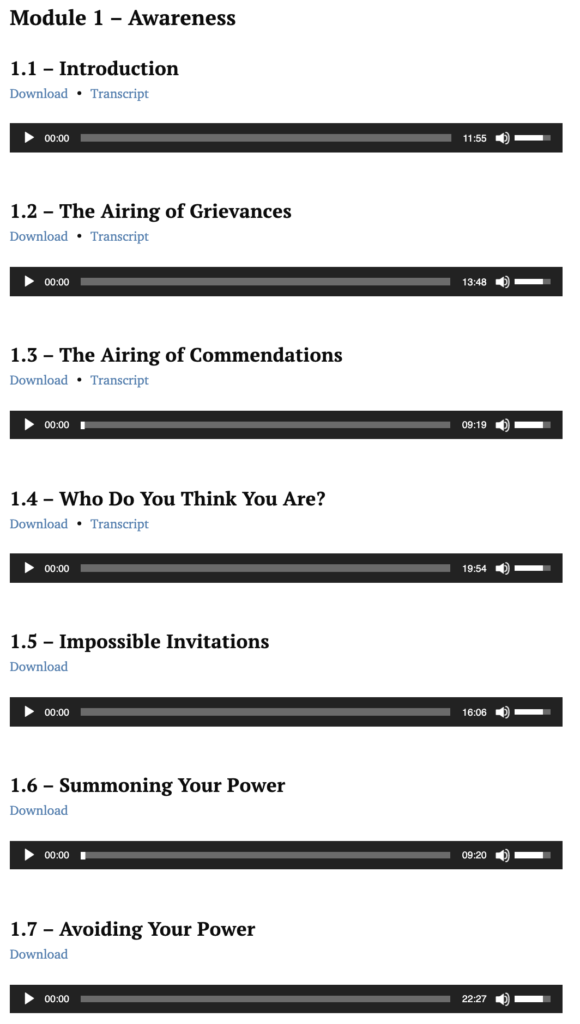
Stature Lessons

If you’re ready to dive in with 135+ other people and do some major character sculpting work to create not just an amazing 2020 but a happy and empowering life, you’d be wise to join us for the Stature course. You get to keep it for life and do the course as many times as you desire. My website is a long-term fixture in the personal growth community (operating continuously since 2004), so we have that stable longevity factor going for us.

Hopefully you have a character who’s empowered enough to say yes to this, but if you’re still on the fence, my tip is to go with your first gut instinct.

A recent study reported in the Washington Post today claimed that people make better decisions when they go with their first gut instinct instead of second-guessing themselves. I also asked growth-oriented friends on social media if they make better decisions from gut instinct or second-guessing analysis, and it was abundantly clear that gut instinct was the winner by far – many had regrets about second-guessing themselves and missing opportunities. So if your gut instinct is to join us, then join us.

I also trust my gut instinct, which told me that creating this course was one of the best projects I could do in my lifetime. I’m building a timeless course that will serve people for decades to come. This is just the beginning. I hope your character will join us in this special experience. The energy from the first group of people going through a course is just such a delight to behold.

We’re only 7 lessons in, and many people have told me they’ve cried a good bit already. Come share some tears with us if you’re brave enough. It’s part of the rebirthing process as we say goodbye to our old selves.

Seriously, please do join. Stature will do you a world of good.

Share Button

Swinging the Pendulum

What if you think you need to maintain an old situation that you’re only tolerating for the secondary gains, and you don’t feel you can afford to quit immediately and lose those gains while you seek a better situation?

For instance, what if you don’t think you can afford to quit your job and have no income coming in while you search for something better?

Or what if you don’t feel you could leave a so-so relationship while you look for a more aligned partner?

It will probably slow you down if you remain stuck in those situations, but it doesn’t have to derail your progress completely.

When you’re not aligned with a situation, life may eventually eject you from it, or you’ll sabotage the experience enough that other people eventually kick you out, such as by laying you off or by breaking up with you. Tolerating negative circumstances is an unstable situation. One way or another, it will eventually come to an end. The real question is when.

If you prefer to creep up on clarity at a snail’s pace, then tolerating a negative situation is certainly one way to do it. It will slow you down, usually by a lot. But you can still do it if you feel it’s what you need to experience.

Now if you’re not ready to move on from a tolerable situation with secondary gains, but you still want to progress towards greater clarity then here’s a key question to ask yourself (and to keep asking again and again): Which is more important to me right now – the secondary gains I’m getting (like the income, the companionship, etc) or increasing my alignment with something else?

Now if your honest answer is that the secondary gains are indeed the most important to you right now, and if you’re unwilling to risk them, then in a sense we could say you already have pretty good clarity, right? You’re clear that those gains are what’s most important to you. And so you can feel congruent continuing to do what it takes to maintain them.

In fact, if you suspect that’s the right approach for you right now, I encourage you to make that choice. Try it on for size. See how it feels. Go a few weeks living with that mindset. Know that you’ve chosen those secondary gains for now. Tell yourself that this is what you want or need to experience at this point in time. See if you can continue to feel good about that decision.

If you can feel good about that decision, then your negative internal reaction to your circumstances will begin to lift. You’ll progress from tolerance to acceptance and surrender, and you’ll stop resisting what you don’t want. You’ll actually begin to appreciate your situation for the worthwhile value it provides. You’ll appreciate your paycheck more. You’ll appreciate your relationship partner more. And through this surrender, your sense of clarity will improve.

If, on the other hand, your best efforts to accept your secondary gains don’t stand the test of time, and you still find yourself feeling ambivalent about the decision – meaning that you keep waffling back and forth on it – then this suggests that deep down, something else is actually more important to you than the secondary gains you’re trying so hard to defend. It suggests that you’re headed for a transition.

This is another invitation to acceptance and surrender. In this case, can you surrender to the transition that’s coming up for you? Can you accept that you’re currently in an unstable situation and that one way or another, you’ll soon be moving on?

If you can surrender to the inevitability of your transition, you’ll also experience an increase in clarity. It will help you get past the doubt of staying where you are, and this will swing the pendulum the other way. You’ll feel increasingly dissatisfied with your current situation, and you’ll be less willing to keep tolerating it.

Either way, swing the pendulum. That’s the key to overcoming ambivalence. If you swing it one way, and it doesn’t lead to greater clarity, then swing it even harder the other way. Lean one way, and if that doesn’t work out, then lean even more the other way. And keep increasing the amplitude of your swings till you break free on one side or the other.

Either you’ll come to love your current situation, and you’ll fully surrender to it and release any significant resistance to staying. Or you’ll find your current situation so intolerable that you’re finally ready to move on and transition.

You can swing the pendulum even while you continue to experience the secondary gains.

If you don’t swing the pendulum, or if you’re not willing to do so because you perceive it could risk your secondary gains by increasing the chances of a transition, then there’s another layer of acceptance and surrender that you can work on. And that is to accept that you’re effectively sentencing yourself to an ongoing lack of clarity. You’re degrading your hope of experiencing more clarity than you have right now.

You have the option to do that. You can keep yourself stuck in ambivalence and confusion if you so choose.

But if you do want greater clarity, then it’s wise to accept that you cannot continue to tolerate what you don’t actually like. And moreover, you cannot continue to tolerate ambivalence either. And the reason is simple. Tolerance and ambivalence don’t create clarity; they just perpetuate confusion.

Share Button

Creating a More Action-Oriented Character

Do you ever feel that your character is too hesitant and self-censoring? Maybe you get an idea to take action or to share something, and then another voice pops in your head and talks you out of it.

Perhaps you straddle the fence for a while, pondering whether it’s wiser to take action or hold back, and much of the time you hold back. Perhaps you start to take action and then undo or delete what you’ve done because of that voice chiming with objections like these:

  • I don’t really need to share this.
  • This isn’t important.
  • Someone might not like what I have to say.
  • What if I’m wrong?
  • What if this doesn’t turn out well?

These are the voices of suppression, and we all have them to one degree or another. Unfortunately if we don’t train these neural subnets well enough, then we’ll end up suppressing too much and leaving a lot of potential value untapped. It’s hard to improve our results if we aren’t taking enough inspired action.

The Problem of Self-Censoring

Here’s the problem with self-censoring. While sometimes it may indeed be wise to hold our tongues, if we do it too often, then we strengthen the mental patterns related to suppression, and this training will spill over into other areas too.

When you suppress your ideas for self-expression, such suppression won’t be compartmentalized to just those few thoughts. You’ll be training your mind to get better at suppression all around. This can keep you trapped – in a job you dislike, a misaligned relationship, and habits that don’t serve you.

If your life isn’t awesome yet, one major cause is that you’re self-suppressing and self-censoring way too much. How are you supposed to improve your results when you hold back so much?

You may think about moving on and taking a risk. You may get an idea to stretch yourself and step into what feels more aligned. And then the voice of suppression kicks in and talks you out of it. And so you remain in your current situation, and another year of your life slips away. The passage of time isn’t kind when you overdo suppression.

Hesitation

The best intention of hesitation to prevent you from making a mistake. Hesitation aims to keep you safe. It tries to reduce the damage your character takes, especially physical, social, and financial damage.

But not all mistakes are equal. Some mistakes are fantastic learning experiences. Mistakes are very often stepping stones to successes. You’re really not going to succeed much unless you make a lot of mistakes.

Hesitation keeps us trapped in our comfort zones because sticking with the familiar seems like the safer bet. Exploring outside our comfort zones seems riskier.

Unfortunately hesitation lies to you. It tempts you with promises of a safe and comfortable life, but what it really delivers is stagnation and decline. And that’s because while you stand still, the world will keep changing faster and faster while you continue aging, eventually leaving you with the impression that you’ve fallen behind. You have indeed fallen behind because this is a world of action.

So many people enter their senior years with piles of regrets about the opportunities they missed. They allowed their inspired ideas to be overruled again and again by the voice of suppression. Don’t less than happen to you if you can prevent it.

Hesitation also lies when it promises that you can revisit an idea later, once you’ve had more time to think it over, research it, or discuss it. But in reality such delays will usually kill good ideas from being implemented at all. You’ll either end up trapped in circular thought about the idea, or you’ll eventually forget about the idea altogether. Either way you never make it through the committed action phase. Sound familiar?

Immediate Action

The best intention of immediate action is for you to capture a reward quickly. This impulse aims to increase your gains.

But something else happens when you lean towards action more and more. You get into the flow of acting on your ideas sooner and faster. You train your action pathways to become more dominant. You ride waves of massive creativity and self-expression as the voice of self-suppression fades into the background.

Living in action mode for extended periods is marvelous. It’s a feeling of being awake and alive. It’s stimulating and fun – if you get the balance right.

You can still take breaks and enjoy plenty of time off, and during your time off, you can make quick decisions regarding what to do for fun, relaxation, and renewal. You can enjoy the flow of action during work, rest, and play.

My favorite way to travel is to just pick a place and go. It’s super fun to have a destination pop into my mind one day and then to be in that new place within a day or two, sometimes within a matter of hours if I can get there fast enough.

One friend got off a plane at an airport, then used some method to pick a random destination to travel to next. It turned out to be the same city and country he just left, so he hopped on a flight back there and had more amazing adventures. That might sound a bit crazy, but ask yourself this: Which style of action will create the best memories?

Do you think that my friend is going to regret his airport bouncing when he’s older? I seriously doubt it. Today he has a cool story to tell. Years from now he’ll have a delightful collection of memories.

When was the last time you had an idea to go travel to a certain place? And what happened next? You probably told yourself that it would be cool someday. Why not go right now, as quickly as you can arrange transportation and a place to stay? You do realize that you could be there with a day or two most likely, right? Why not now? Ah yes… those pesky suppression subnets will offer up plenty of objections. And yet you could still make the trip happen right now, if only your action subnets were strong enough.

When you think about taking action, especially in big and meaningful ways, just ask yourself:

Do I want the memories of doing this? Or do I want the memory of skipping this?

These questions give me great clarity on some tricky decisions. To be honest sometimes the answer that pops out really pushes me outside of my comfort zone. Sometimes it becomes obvious that I’d treasure the memories that would flow from taking action, even when the journey looks a bit scary or uncomfortable. And then I have the thought: Damn… I think I need to do this.

Balanced Thinking

When you’re thinking about taking action, especially to express yourself in some way, initially you may get an emotional response – perhaps fear, worry, or anxiety – and those feelings can throw you off balance.

One thing I like to do when I feel unbalanced by emotion is to grab three sheets of blank paper and a pen, and then I write out my thoughts and feelings as they arise until all three pages are full. This takes about 45 minutes and is well worth the time investment. It helps to move the energy through the emotional brain into the logical brain. It processes the feelings well enough that I can think clearly about the problem, situation, or opportunity. Using pen and paper (instead of typing) slows me down and provides more thinking time as I write, so the processing feels more thorough. I recommend this method if you struggle with distracting thoughts or feelings and want to feel mentally clear and sharp again. It’s a nice way to restore balance.

I know that if I lean too far in the direction of self-suppression, it will lead to boredom and stagnation. I’ll end up feeling trapped or stuck because I’m not taking enough action. It’s a feeling of being stifled. Sometimes it feels like I’m falling behind, and the world is passing me by.

If I lean too far towards impulsivity though, which I’ve done before, it creates excessive stress because my actions are too random and chaotic. This was the kind of imbalance that got me arrested four times when I was 18-19 years old. I’d do or say whatever crazy idea popped into my mind, illegal or otherwise.

Eventually I learned to balance these modes of thinking more deliberately. I love the stimulation of being in the flow of action, but I don’t need random stimulation from chaotic action. What helps to create the right balance is setting ambitious goals, consciously choosing my own personal growth challenges, and aligning my life with core values and a sense of purpose. This provides a big picture compass for the action and suppression circuits.

To create the right long-term balance, you must deliberately invite discomfort by stretching beyond your comfort zone again and again. You have to keep encouraging the action circuits, so you don’t over-suppress yourself.

Suppressing Suppression

Here’s a recent example of how I mentally handled a situation by leaning into action when the self-suppression circuitry was also active.

Yesterday an idea popped into my mind, which was to create a Facebook group for the upcoming Stature course launch. I thought this might make the launch more fun and social for those who want to feel more connected to like-minded people who are deciding if they want to do this particular deep dive. Since hundreds of people signed up for each of our previous courses during their launches, I could expect that hundreds will also be interested in our newest deep dive course. And I have seen evidence that some of these people would love to connect with that launch energy more directly.

This wasn’t a new idea. It had also popped into my mind now and then over the previous weeks. But each time it came up, another part of my mind suppressed the idea. Not right now… I’m too busy… Maybe for the next launch… I’ll need to research this first… Many of my readers don’t like Facebook… We don’t really need this… I can add this to a list of ideas to think about later…

Suppression will usually come up with some logical sounding objections to an idea, and those objections will tend to halt further thinking. Objections let you off the hook and give you the impression that delaying is best. An objection is really a block to deeper rational thought though.

So I tabled that idea for a while. But this recurring suppression combined with some other recent suppressions may me feel like I was slipping too far into suppression mode, and I recognize the risk of being in that mode for too long. So I decided it was time to swing the pendulum the opposite way and to encourage my mind to take more action.

I want to play a more action-oriented character for 2020, so I need to calibrate my thinking to stimulate more action and to suppress suppression. This led me to commit to what I shared in the 365-Day Challenges article. I intend to blog every day of 2020.

Swinging the pendulum like this rewards and activates the action subnets and while suppressing the suppression subnets. Consequently, it makes me feel more action-oriented each day.

Since committing to this challenge, my days are even richer in inspired action. I’m doing a better job of acting on ideas immediately as they arise. I feel inspired and energized to keep taking more action, which is a great feeling to have as we head into a new launch.

Yesterday the same idea to create a Facebook group for the launch popped into my mind, but this time my thought patterns were different. Because I’d been stimulating my action circuits with the blogging commitment, I’d shifted my inner mental balance. I still heard those hesitant thoughts come up, but they weren’t nearly as present and powerful as the stimulating voice of action.

Think about how this works. Since I actually started my blogging challenge on December 24th, I’ve already gone a week down this path. Each day I still perceive the suppression circuits activating, but they can’t come up with a viable reason why I shouldn’t blog each day, certainly nothing strong enough to counteract the public commitment I’ve made. So now that voice of suppression sounds really weak feeble when it tries to object, and it surrenders quickly: Oh never mind… go ahead and write. This voice gets quieter and quieter each day while the voice is action is growing louder and crisper.

Consequently, within a very short time after having that idea popped into my head yesterday, I asked Rachelle if she could look into setting up such a group and make it happen that same day. She agreed. But then a short time later, I felt that this was still a trick of suppression. Was delegating this actually faster or just another delay tactic? I thought: How long could it take to create a Facebook group? I Googled how to do it and saw that it was pretty simple. Then I just did it immediately. The group was created and open within a few minutes. It was simpler than I expected.

Next I had the thought that I should began inviting people to join. And of course I still heard the suppressing thoughts arise in response: Should I carefully check over the group settings first? Shouldn’t Rachelle and I go over the admin stuff first to make sure we know what we’re doing?

But again, the voice of action was louder because I’d been training it to become so. It squashed suppression’s feeble delay tactics, and I immediately began inviting people to join the group, such as by announcing it in a News post.

It hasn’t even been 24 hours yet, and we already have 177 people in the group – with more joining every hour. So that’s great to see. If I had suppressed the idea, it would be zero since the group wouldn’t exist. Now we already have more than enough people to make it interesting and worthwhile.

Note that by taking immediate action instead of suppressing an idea, I’ve also gained a new skill. I now know how to create an administrate a Facebook group, which I didn’t know how to do 24 hours ago. If it goes well for this launch, we could create such groups for other launches as a way of making them more social.

I also intend to do some Facebook Lives (live interactive video chats) in the new group. I’ve never done this before either, despite having known about them for years. Why continue to suppress this idea when taking action would be more fun and growth-oriented?

You’re of course welcome to join our new Facebook group if you’re interested in the new character sculpting deep dive, which will launch on January 1st. You’ll find the group at facebook.com/groups/stature. How many members does it have now?

Balancing Action and Suppression

Balancing your action and suppression circuits is a lifelong challenge. It’s good to accept this, so you can consciously think about which way you need to train your character next. It’s pointless to beat yourself up for becoming imbalanced one way or the other. Imbalances will happen. See this as an invitation to retrain your character to create the balance you desire.

Look back on your past year. Did you take enough inspired action? Or did you feel that suppression was the main voice of that year? Were your decisions too impulsive and chaotic? Did you create enough cherished memories?

What do you want for 2020? Do you want a calmer, more controlled, and more suppressed year? Or do you want more bold action and self-expression? Do you want more introspection and reflection? Or do you want this to be a year of action and results?

From interacting with my readers recently, I learned that most of them felt that 2019 was too stunted relative to their desires. They want to shift the balance towards more action and bolder self-expression for 2020 and beyond. They want to step up and stretch beyond their comfort zones and censor themselves less. They want to sculpt themselves into more action-oriented characters.

Yet they also want to be gentler towards themselves and others. They like kindness and compassion and don’t want their self-expression to come across as overly harsh and judgmental. The idea of gentle fierceness resonates with many of them.

This is doable, but it isn’t easy. Hence the reason we’re taking this on in the form of a new deep dive together.

Realize that if your 2019 was disappointing, your 2020 will likely be disappointing too unless you deliberately step outside of your comfort zone. I’m doing this too because I want my 2020 to be a more action-oriented year. By the time Valentine’s Day comes up, I’ll already have written more articles for 2020 than I did for all of 2019. This year I expect to write, record, and publish more than I have in any year of my life. So I need to train myself to favor action over suppression. This is partly due to curiosity. I really want to know what it’s like to live for a full year as this kind of character. What will it be like to make creative expression a bigger part of my reality than ever before?

I think it sounds fun and stimulating, even though it isn’t comfortable. I’m deliberately setting myself up for a less comfortable year because I think the character sculpting effect will be worth it, not to mention all the ripples this creates for other people as well. Notice how this plugs back into values and purpose – that’s our compass here.

If you want to train yourself into a more action-oriented character as well, I invite you to do whatever it takes to commit yourself to that this year. Make a commitment that deliberately exits your comfort zone and enters the growth zone. Don’t let another year of self-suppression and self-censoring slip through your fingers. Find your voice this year.

Share Button

Tidying Up Your Trust Clutter

I listened to Marie Kondo’s The Life-Changing Magic of Tidying Up audiobook this week. I know it’s a super popular book, but this is the first time I’ve checked it out. I liked it!

It also strikes me that the way she relates to possessions would be an interesting way to handle trust wounds as well, as both can be resolved through a decluttering process. The problem with both areas that creates stuckness is that such a process isn’t usually done thoroughly enough to fully fix the recurring problem (recurring clutter or recurring trust wounds).

Not doing a truly thorough, one-time tidying process is the main reason for recurring clutter, according to the book. We could say that a similar oversight also leads to recurring trust clutter.

What is trust clutter? It’s the presence of triggers (usually people) in your life that trigger trust issues for you. These could be people who’ve violated your trust in the past, and every time you think about them, those old wounds pop up again. Perhaps you keep such people around out of loyalty. Note that this is how people often accumulate lots of physical clutter as well – out of loyalty.

Marie Kondo’s standard for tidying is that you should only keep possessions that spark joy. That’s a high standard, and many people won’t be willing to meet it, but imagine what your life would be like if all of your possessions did meet that standard. You’d be surrounded by possessions that trigger only happiness. As as she notes in her book, this really does raise the long-term happiness level of people’s lives. If you eliminate the unhappiness triggers, you naturally get to experience more happiness.

I live in a home with lots of possessions that I like, but I’m nowhere near the spark joy standard across the board. This has been making me question some possessions: If an item doesn’t spark joy, what does it spark instead?

I’m discovering that possessions that don’t spark joy have other associations, many of them mixed. Some possessions trigger memories. Some trigger associations to people, especially gifts or hand-me-downs. Most of these triggers are on the positive side, but some aren’t. If I went through the process of evaluating and releasing the misaligned items, I do think it would improve my overall happiness. If you take away the negative triggers and the mixed ones, then there are only happy triggers left.

What I find interesting is that I actually apply this standard much better in my social life. When people violate my trust, I have a habit of releasing them and moving on. I remove them from my social circle, and I tend not to look back. In the past I’d give people second and third chances, and they pretty much always made me regret it sooner or later. While I wouldn’t say that all of the people in my social circle spark joy, I do believe that most of them do, and the ones that don’t are sparking mostly neutrality or weaker forms of positivity, but not negativity, problems, or trust violations. Consequently, my social circle is full of people I trust.

How many people are in my social circle today that I don’t trust? It feels like I have to wrack my brain to think of even one. I think it’s zero by definition. For me to consider someone part of my social circle, I have to trust them, so if I don’t trust them, they aren’t part of my social circle.

As Marie Kondo notes, once you do a really thorough tidying of your physical space, which mostly involves discarding items, and you push through until the job is truly done, it permanently raises your standards, and you’re unlikely to relapse. Can you imagine tidying up so well that you never relapse back to cluttered conditions? Life becomes so nice on the other side that any clutter that pops up really grabs your attention and makes you want to fix it immediately.

That’s how I tend to feel about my social life. Since my norm is to have trusting relationships and since my life has been like this for years, when something nasty does happen, it stands out like a truly glaring issue that must immediately be addressed. I just don’t tolerate social nastiness in my sphere. That’s probably why my Facebook block list has 100+ people on it. Cross the line once, and I’m very likely to conclude that we’re incompatible, so I’ll release you permanently. I respond to trust clutter like Marie Kondo deals with physical clutter.

This might sound a bit harsh, just as Marie Kondo’s tidying style may seem extreme. But I can see the logic in what she proposes because of my own experiences in my social life. There really is some life-changing magic to tidying up, not incrementally but in the form of a deep, one-time purging of the misaligned. As she notes in her book, this typically takes about 6 months for possessions if you’re going to do it right. Doing it once in your life is enough because that will raise your standards permanently.

If you have trouble maintaining an aligned social circle, consider doing a deep and thorough social tidying – so thorough that you only have to do it once in your life, and then you’ll never want to relapse. Ask if each person in your life sparks joy for you. If not, why are you wasting your life maintaining a relationship with them? If they spark joy + some crap, they go in the discard pile.

You might think you’ll have no friends left if you maintain this standard, just as people might feel like they won’t have any possessions left. But if you really have to downsize that much, it means that most or all of your friends or possessions are misaligned, and so starting fresh will be a good thing.

You don’t have to declutter harshly. You needn’t discard items by throwing them into the fire while bellowing, “Die, foul chatzki!” Marie Kondo recommends thanking and appreciating items as you release them. Consider using a similar approach when releasing relationships. You’re not tossing people into the Fire Swamp. You’re thanking and releasing them while appreciating the role they’ve played. You’re graduating to more aligned experiences.

If you cling to misaligned relationships, you hold yourself back (tremendously!) from graduating to more aligned relationships and social connections. That’s your choice, but I wouldn’t recommend staying stuck due to misplaced loyalty for too long. Be loyal to your path of growth, and you’re likely to see your relationships get better and better. Similarly, be loyal to your overall relationship with your home and to awakening and stimulating your best energy patterns. Loyalty to misaligned possessions and loyalty to misaligned people isn’t real loyalty – it’s really just resistance to growth and change. This life doesn’t reward settling into your comfort zone; it will make your comfort zone increasingly uncomfortable till you get back on a path of growth. If you’re stubborn about it, then your intention isn’t to remain in your comfort zone to the death – it’s to remain there to the pain! And good luck with that.

What do you think of someone when you walk into their cluttered home, full of stuff they clearly don’t appreciate? What would you think of them if their home had few possessions, but you could tell they liked and appreciated what they owned? Now apply this on a social level. What do people think when they see you tolerating people who trigger you? What would they think if you had a much sparser social life, but you fully appreciated everyone in it?

Even if you have to take your social circle to zero to reach this standard, then do as Marie Kondo does and start by appreciating your possessions. Develop the relationship with your stuff that you’d like to have with people. Misalignments are infectious, and so are alignments.

You could also extend this to customers and clients if you have a business… or to co-workers if you have a job. If the people in your life don’t spark joy for you, why not release them? Donate them to another business. If you do this enough, it will raise your standards for business and life. I do this pretty well, and so I get to connect with customers that I really like each day… even to the extent that I married one last year. And it’s a very happy, fun, and mutually enjoyable marriage because we both spark joy for each other.

Tidying up your social circle like this might sound crazy, especially if your life is full of misaligned people that you feel you must tolerate. But if that’s your justification, realize that you sound just like those people in cluttered homes justifying why they must keep every possession that makes them feel less than happy. Doing a thorough social cleanup would be incredibly freeing, even if it means you have to switch jobs or companies and even if it means you have to redefine “family” as something different from your relatives.

Just as no one is forcing you to live in a cluttered home, no one is forcing you to tolerate a misaligned social circle. You’re free to choose to clean house whenever you’re ready.

If you have trust clutter repeatedly popping up in your life, what’s the real cause of these recurring trust problems? Perhaps the true cause is that you’ve never done a throughout social tidying, so you don’t get the life-changing magic till you do.

Thanks a bunch, Marie Kondo. I thoroughly enjoyed and appreciated your book. 🙂

Share Button