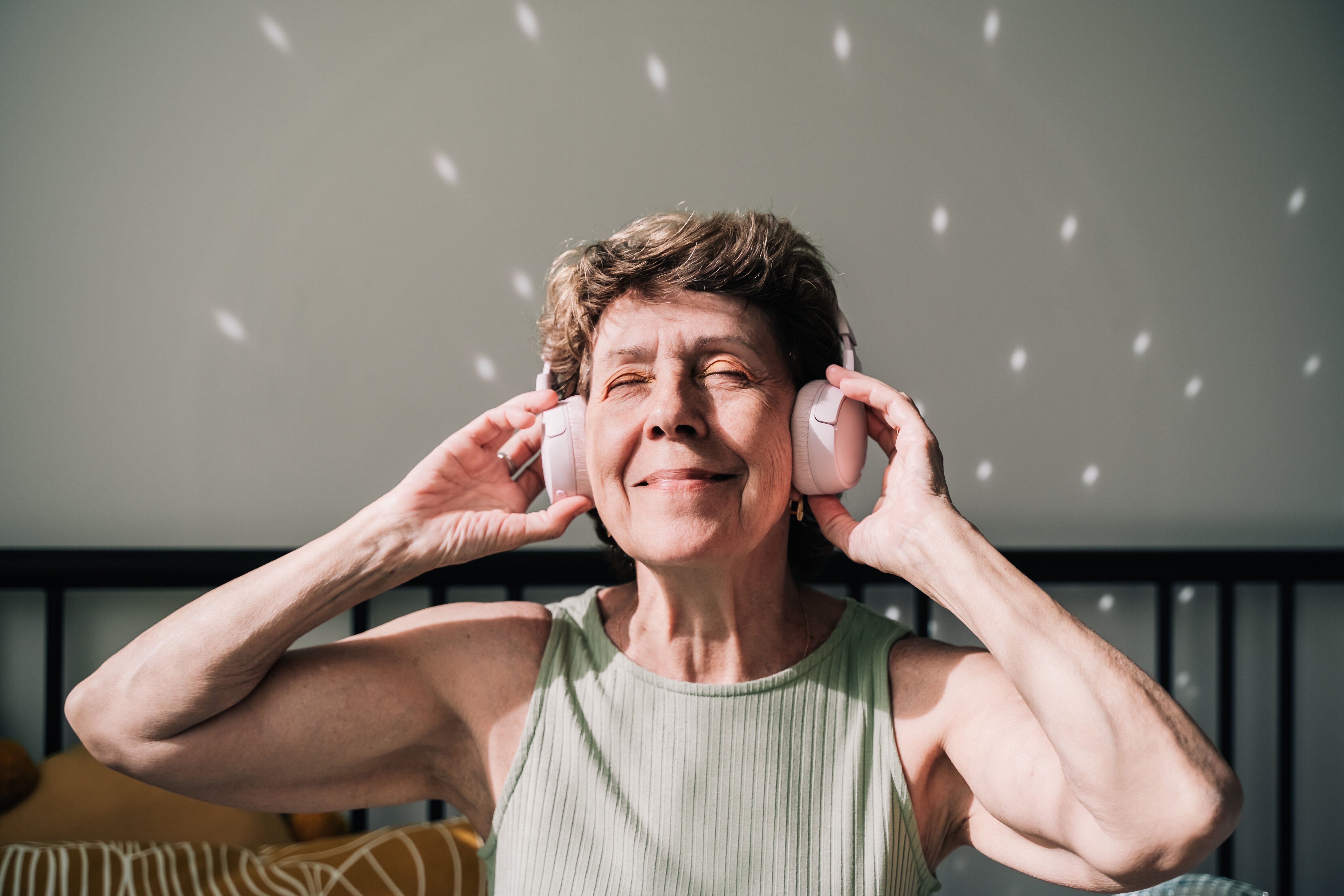
If you peek outside, it’s pretty likely you’ll see several people running errands with a pair of headphones on. In our digital-first world, many of us use headphones all day long at work, on our commute and even at home when we’re cleaning or exercising.
Headphones are a convenient (and polite) way to listen to music, videos or calls in public. But does the direct sound exposure impact your ears and hearing any differently than other sound sources? Are headphones more damaging to your ear health?
Advertisement
Below, experts share what you should know about safe headphone use.
Listening to music or calls through headphones is no different than listening via a speaker.
Our ears don’t know where sound is coming from, said Catherine V. Palmer, an audiologist at the University of Pittsburgh Medical Center. Sound can be damaging whether it’s coming from car speakers, living room speakers or headphones, she added.
“One is not more dangerous than another,” Palmer said.
There’s noise around you all the time, said Dr. Kenny Lin, an otolaryngologist at Houston Methodist, and headphones don’t pose a specific danger.
“It’s just the volume at which and the duration over which you are listening to music or phone calls or whatever the case might be,” Lin said. “As long as you’re using your headphones at a reasonable volume, it is no different than listening to music from the speaker or listening to the TV.”
Advertisement
Headphones can be more dangerous to your ears in specific situations, though.
“The one area where a headphone can be potentially riskier is that you place the sound source right up to the ear,” Lin noted.
If you mistakenly left the volume up very high on Spotify, for example, and then plug in your headphones, “the impact of that on your ear could be potentially higher just because of where it’s placed, closer to the ear in its first place,” Lin said.
According to Anna Bixler, an audiologist and the amplification and tinnitus program manager at Jefferson Balance and Hearing Center in Philadelphia, people can also run into problems if there is a lot of sound going on around them.
Advertisement
“That’s really where I see people get themselves into hot water with their streaming level, because when we’re in quiet, we tend to keep it to a pretty minimal volume … when we get on a train or when we’re running outside, and there’s a lot of noise around … that’s when we have a tendency to kick up the volume to compete with external signal,” Bixler said.
There is one simple way to combat this, though: Bixler recommends that folks turn on noise cancellation if it’s available on their headphones.
“That really, really helps a lot of people to keep their streaming volume to a much more minimal level,” Bixler added.
Advertisement
If you aren’t competing with external noise, you won’t be tempted to increase your volume, she said.
Tatiana Maksimova via Getty Images
That said, sound-induced hearing loss is the most common type of hearing loss.
“The most common cause of hearing loss in adults is [sound-induced] hearing loss,” Palmer said.
But not all sounds are created equal. “‘Dose’ predicts whether sound will damage an individual’s hearing,” Palmer said. “Dose is the combination of how loud a sound is and how long you are exposed to it.”
“The louder the sound is and the longer the exposure, the more likely that there will be damage,” Palmer continued, noting that this hearing loss is permanent.
Advertisement
Prolonged loud sound exposure can also cause tinnitus or ringing in the ears, in addition to hearing loss, according to Lin.
So, what noise level is best?
According to the National Institutes of Health, you’re likely safe from hearing damage if you’re around sounds that are 70 decibels or less; 70 decibels is roughly equivalent to a conversation or the sound of a washing machine.
In workplaces, people exposed to noise at 85 decibels or above are advised to wear hearing protection.
Advertisement
How can you tell what decibel level your music and calls come in at? Many phones and smartwatches tell you when your volume is at an unsafe level. There are also apps and websites that help measure noise levels.
But the most reliable way to understand the volume of your music is by visiting an audiologist, Bixler noted.
“We can’t always just trust our ear to know what’s a safe level [of sound],” Bixler said.
An audiologist can help measure the level of sound that’s being played out of your headphones.
“We can measure the level of the sound in the ear canal,” Bixler said. “I’ve had a number of patients in more recent years actually come in to see me and have this procedure done so we know where to set safe [limits].”
Advertisement
Most devices you’re streaming sound from have parental locks you can set for yourself so your sound doesn’t go above a certain level, Bixler added. “I think the best thing that most people can do is take a look at any streaming device they’re using and set a nice limit for themselves.”
You won’t notice hearing loss right away, but ringing in the ears and a feeling of fullness in the ears are signs that you should see a doctor.
It’s not like listening to too-loud music will cause you immediate and noticeable hearing loss. Instead, “sound-induced hearing loss is gradual,” Palmer said.
Advertisement
There are signs of hearing loss you should know about, including a feeling of fullness in the ears, ringing in the ears, and, of course, diminished hearing. “These are all signs of noise-induced hearing loss, and you should manage your exposure as well as seek a baseline hearing test from an audiologist,” Palmer said.
An audiologist can help you reduce your noise exposure and also take steps to protect your hearing throughout your life.
“You want to be preemptive in thinking about your dose of sound over time,” Palmer said.
While listening to music or taking calls on headphones isn’t any more damaging than doing so through a computer or kitchen speaker, any sound exposure that’s too loud or too long can be harmful.
Advertisement