I Was A Disillusioned Waiter In New York. A Chance Encounter With Catherine O’Hara Changed My Life.

“What’s your name?” Catherine O’Hara asked me, leaning forward in the booth. “What’s your story?”

I was standing in a swanky restaurant in New York City wearing a black dress short enough to satisfy management, my hands clasped behind my back in case a manager appeared. I had just broken the most important rule of the job: Never acknowledge a celebrity.

Three months earlier, I had dropped off my resume anywhere I could in hopes of securing a job that would supplement what my $35-a-week publishing intern stipend wouldn’t get me, which was, of course, everything but my subway fare.

I was hungry in every sense of the word. By the end of the day, I was offered three serving jobs and took them all. One was at this legendary restaurant continuously full of rock stars, Oscar-winning actors and models.

During my interview, the manager had ignored my flimsy (both in substance and content) resume and assessed my body instead. My waist. My chest. My legs. He said they had a place for me as a cocktail server in the private lounge where the windows were tinted, the tables were low and loungy, and the only clientele allowed in were ultra-wealthy patrons and celebrities.

The manager told me to show up later that night for my first training shift and emphasised that the dress code was all black, dresses only, hemlines not to exceed the end of my fingertips when my arms were hanging by my sides.

“We prefer the skirt to graze your first knuckles,” he said, making a fist and pointing to the ridged top of his hand to make his point.

I was 22, fresh out of college, and ready to do whatever it took to become a writer. If I can make it here… I thought.

When I walked in for my first shift, I was surprised to see a friend from college working at the host stand. Back in Colorado, he’d been a boisterous theater kid — lanky with bright blue eyes and flamboyant energy. Now he looked hollowed out — dark under the eyes, less “youthfully thin” and more underfed. He seemed tired and nervous, and his eyes flicked around as if we might get in trouble for hugging.

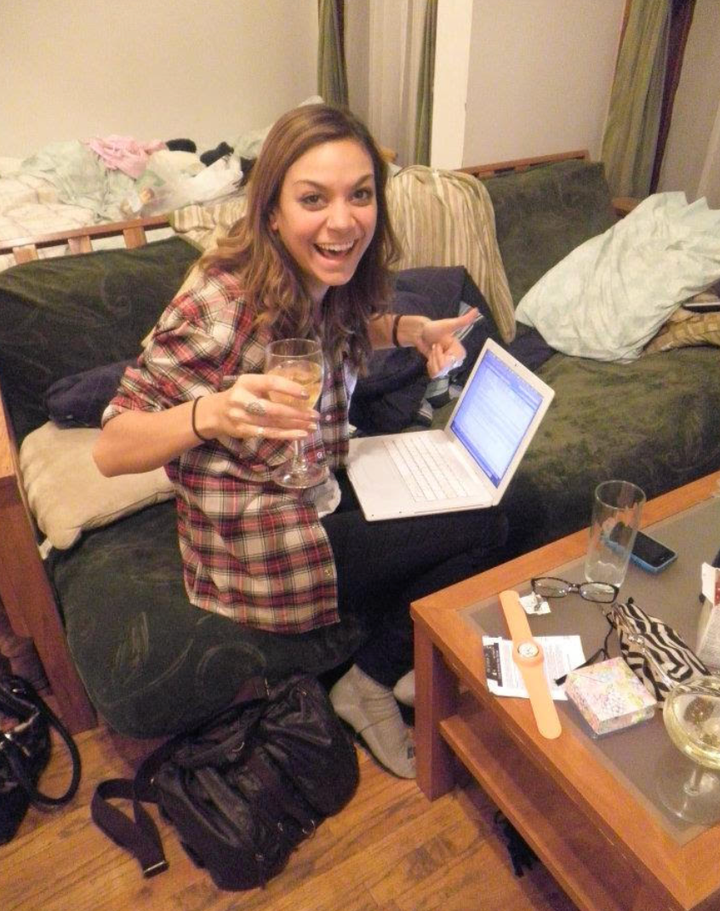
The author celebrating her first story being accepted for publication in 2011 — a year before she decided to move to New York City.

Courtesy of Sammi LaBue

The author celebrating her first story being accepted for publication in 2011 — a year before she decided to move to New York City.

The server I was assigned to shadow approached the host stand to retrieve me. She was gorgeous, waifish, and in place of the air of sadness my college acquaintance had, she’d built a bitter bubble of sarcasm around herself.

She walked me quickly through the labyrinthine back-of-house, dodging catcalls from her co-workers and managers deftly. She listed off rules as I struggled to keep up. Three of them stuck out.

1. We were required to try everything on the menu, which perked me up as a hungry, broke person used to only eating family meal slop before a shift.

2. We were a “pooled house,” which meant the managers gathered and then divvied up our tips (after shaving a cut).

3. We were not allowed — under any circumstances — to reveal that we recognised a celebrity. We were to treat everyone as an anonymous guest. Asking for an autograph, a photo, or even announcing that you were a fan of anyone famous would result in immediate termination.

Perhaps this last rule sounds easy enough to follow, but during my first training shift, Jay-Z, Adam Sandler and Mariah Carey were among our guests.

I lasted one month at this restaurant. Long enough to eat my way through the menu and gather enough celebrity run-in anecdotes to last a lifetime. My cocktail party stories suddenly involved run-ins with Bill Belichick, Jon Bon Jovi, Jonah Hill and Josh Hartnett, among many, many others. But not even these exciting encounters could make up for the depleting atmosphere of working in a place where every staff member was a hopeful singer, model, actor or artist.

After my first shift, I witnessed the server who was training me earn over $1,000 in tips — then walk out the door with only $220 after management’s cut. When I asked about the tip breakdown, my manager was finishing a line of cocaine in his windowless basement office. His explanation made little sense, but he laughed at my confusion, and I left his office feeling dejected and violated.

However, what really convinced me that I couldn’t survive there long was when I realised that my co-workers all seemed to be struggling with disordered eating. Years earlier, after my dad had died suddenly of a heart attack, I’d developed my own eating disorder — a coping mechanism that came with consequences. I’d slowly healed in college, partly thanks to a tight circle of wonderful friends. Now, without them and being surrounded by behaviours that I instantly recognised as potentially damaging, I felt my anxiety rising in a new — though disturbingly familiar — way.

During my work shifts, my trainer-server and I worked through the restaurant’s menu, each night picking something new for me to try, and we’d sit on the back staircase (there was no break room) while she explained the dish to me. No matter what it was — tuna on crispy rice, a black truffle pizza, half a roast chicken on a mountain of garlic mashed potatoes — she refused to have a bite.

“No way. I’m trying to be an actress,” she told me. “I wouldn’t even eat a cucumber here. They put sesame oil on everything.”

She joked about it — “I don’t eat, really. None of us do.”

Though I wasn’t attempting to make it as an actress, I still began to leave food on the plate, uneasy about doing so, but also worried she might have a point. She was putting her goals first. Hunger as discipline. Emptiness as a badge of ambition. Maybe fed girls didn’t make it in NYC.

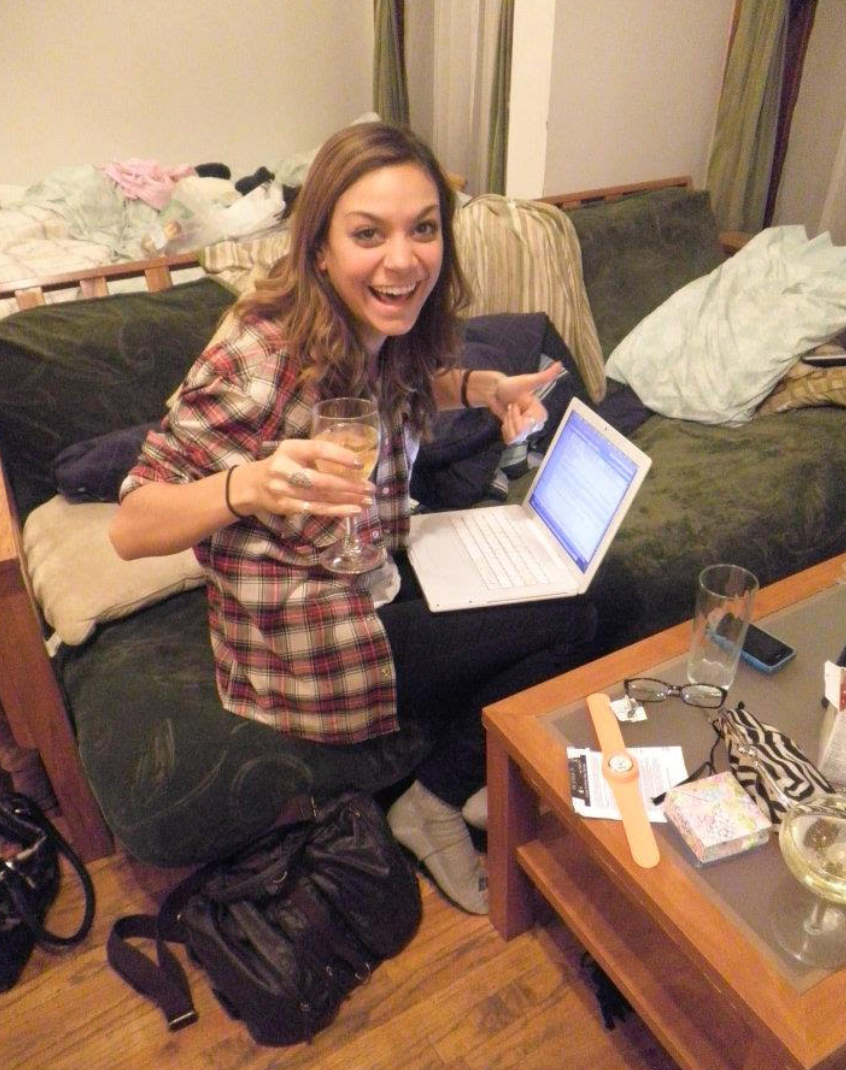
The author right after she moved to New York City in 2012.

Courtesy of Sammi LaBue

The author right after she moved to New York City in 2012.

By the time I walked in for my last training shift on a Sunday night, I was thinner, my spirit was beaten down, and I was worried about the road I seemed to be headed back down.

I was also still broke. I’d trained for seven shifts at $10 an hour, and I was relieved when my trainer asked me to take this shift alone. The managers were nowhere to be found, as usual, and she wanted to meet up with her boyfriend — a musician who was always cheating on her. The restaurant was slow, she told me I now knew what I was doing, and, best of all, she would let me take all of the tips I made home.

At nearly 9 o’clock, three women walked in: two women I’d never seen before and the one and only Catherine O’Hara. I froze. My mind flashed to O’Hara’s squiggly sideburns in “Beetlejuice.” Her iconic “Kevin!” in “Home Alone.” The dozens and dozens of times my sister and I had watched “Best in Show.” All of the characters she’d played that shaped my sense of humour. My sense of joy. How could I possibly serve her without telling her I loved her?

They sat in a window booth with Catherine in the centre. When I went to greet her party, her friends enthusiastically interrupted to tell me they were taking her out for her birthday. She shook her head sheepishly, embarrassed and amused.

“We’ve been friends forever,” she told me. “They don’t let me get away with anything.”

As a writer, I try to avoid cliches, but reader, her eyes truly sparkled with life and kindness.

Soon, they were my only table. I folded napkins a short distance away from them and watched the three friends enjoy each other’s company — and one of everything from the starter section, plus a burger, the tuna and the chicken. They shared a bottle of wine and giggled like girls.

Over the course of their meal, I realised that in just a few weeks, the restaurant I stood in had distorted what success should look like, but no one could extinguish the aura of true success that radiated off Catherine. She had “it” — that thing I’d come to NYC to prove I had, too, and “it” wasn’t thinness or ambition at all costs, or even talent, though of course she had that, too. It was her sense of self — how she held herself and confidently, yet humbly, moved through the world — that no one could rival… or take away from her.

By the time I dropped the chocolate soufflé off, their table held the last lit candle in the restaurant.

I placed the dessert in front of Catherine, and then I took a breath.

“I’m not supposed to bother our famous diners,” I said, “but I just have to tell you how much your acting means to me and my sister. ‘Best in Show’ is our favourite movie, and your character is my favourite.”

“Me?” she said, genuinely incredulous. “Your favourite!”

“I’m sorry to bother you. I just had to say something. Happy birthday.” I quickly turned away, mortified.

“It was her sense of self — how she held herself and confidently, yet humbly, moved through the world — that no one could rival… or take away from her.”

“Wait,” she called after me, “What’s your name? What’s your story?”

She insisted that I join them in their booth and asked what kind of artist I was.

“Every server in this city has an interesting story,” she said, gesturing her spoon toward me, her mouth full of birthday soufflé, and the trio’s attention now fully, yet comfortably, on me.

I told her all about my dream to be an author and about the short story I was working on.

“What if one of the characters dies?” she riffed, delighted.

Were we collaborating? I could hardly breathe.

I was glad to have refused their offer of a bite of soufflé because the manager suddenly appeared from his basement lair, and I immediately popped out of the booth.

“I’ll just grab you the check,” I said, with my arms behind my back again, in an attempt to look professional. She winked at me as I walked away.

She paid the bill herself, though her friends tried, and though my tip out didn’t reflect it, she left me 100% on their $400 bill and a note that read, “I know your day will come. Keep writing.”

The manager wouldn’t let me keep the receipt, but I didn’t need it.

Catherine had given me something invaluable that night. Her kindness has always stayed with me. She showed me a different way to be an artist — to be a person. She chose passion, curiosity, individuality and humility in an industry that often made that feel impossible.

I never went back to the restaurant again after that night. I left before the thinness of the place convinced me I had to disappear to deserve a future. There were plenty of other workplace cultures ahead of me that would also try to normalise self-erasure as ambition, but years later, when I sat down to write this essay just days after Catherine O’Hara’s death, I could still clearly conjure that moment with her. Thanks to her, I still try to follow my appetite, to seek fullness and to believe, even on my hungriest days, that my day will come.

Sammi LaBue is the founder of Fledgling Writing Workshops (“Best Writing Workshops,” Timeout NY) and basically obsessed with the feeling of having an idea and writing it down. Her latest project is a recently finished memoir written in collaboration with her mom titled “Bad Apples.” Some of her other essays can be found in BuzzFeed, Slate, Literary Hub, The Sun, Glamour and more. To follow her writing journey and find opportunities to write with her flow, visit fledgling.substack.com.

Do you have a compelling personal story you’d like to see published on HuffPost? Find out what we’re looking for here and send us a pitch at pitch@huffpost.com.

Help and support:

Share Button

What Can Zohran Mamdani Do?

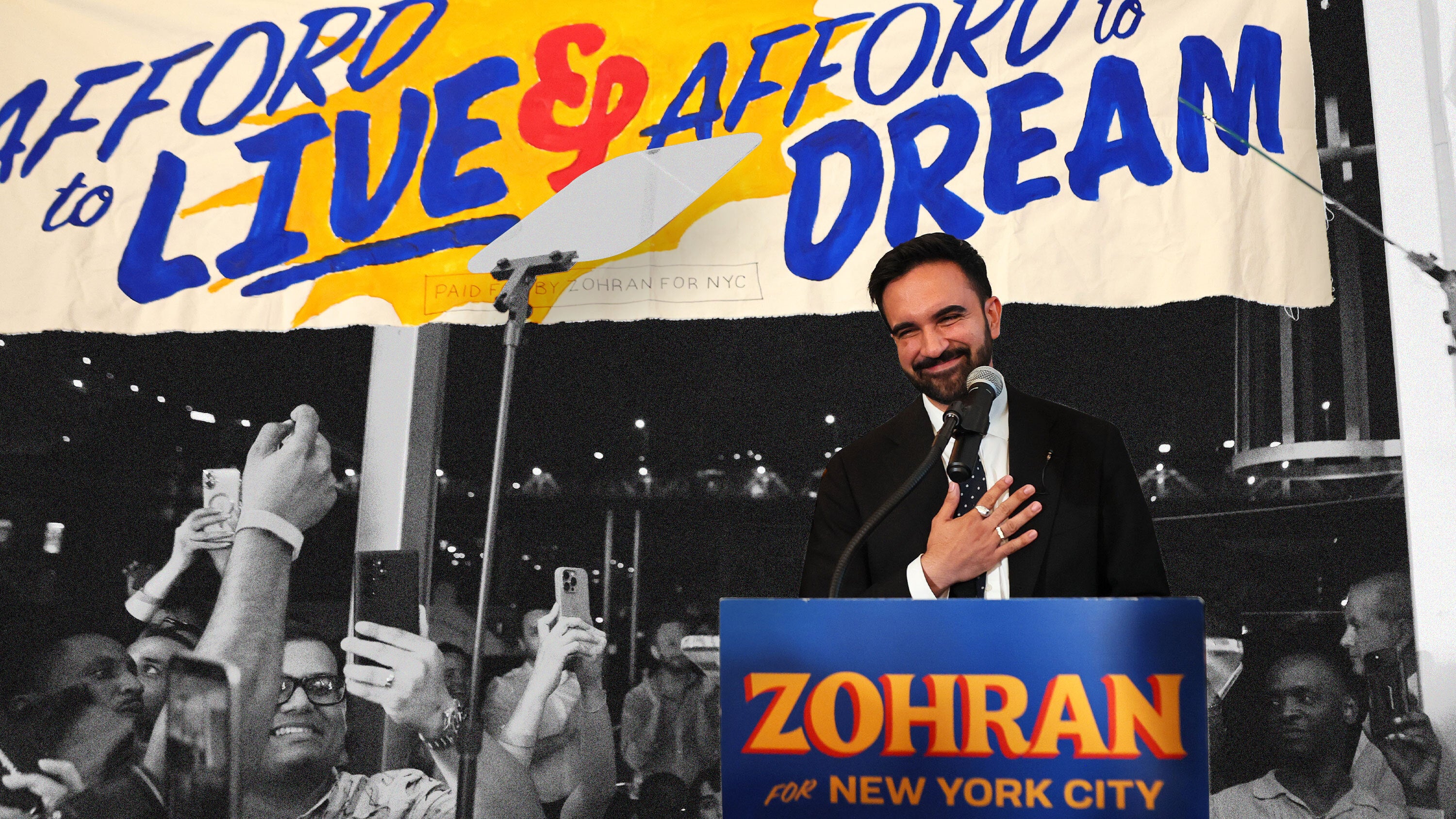
With a couple of days of early voting to go before Election Day in New York City, Democratic mayoral nominee Zohran Mamdani has maintained a significant lead in the polls over his main competitor, former Governor Andrew Cuomo, months after Mamdani’s generational upset over Cuomo in the Democratic primary.

To hear the candidate tell it, that advantage is thanks to one thing: Mamdani’s policy platform, which is laser-focused on making the city affordable for working people.

The three-term state assemblyman and democratic socialist has a stacked to-do list that includes freezing the rent on one million apartments, making buses fast and free, establishing universal child care, creating a network of five city-owned grocery stores, and spending billions of dollars to build rent-stabilized housing.

“He’s focused on affordability, and he probably has one of the most expansive services agendas that we’ve seen in decades,” said Andrew Rein, president of the Citizens Budget Commission, a nonprofit think tank.

Mamdani knows it’s an ambitious list.

“The job of city government isn’t to tinker around the edges,” he said in a campaign video about the city-owned grocery store proposal. (Mamdani’s campaign did not respond to HuffPost’s request for comment for this story.)

Big Apple political observers agree with Mamdani that his massive policy platform distinguishes him as a candidate. But big ideas require significant amounts of money, political capital or both.

“There are very real structural, budgetary and legal limits on what the city’s chief executive can accomplish without the cooperation and support of other branches of city or state government,” wrote Carl Weisbrod, who co-chaired former Mayor Bill de Blasio’s transition team and then led the city’s planning commission.

Should Mamdani win on Tuesday, he’ll face a balancing act.

“It would be unreasonable for any mayor to think they’re going to deliver right away on every promise,” Rein said. “He’s got to make those smart choices, and in his case, they should be bold choices, because he wants to deliver progress on his agenda. But he has to be able to do that while balancing the budget, preparing for federal cuts, and protecting critical services for needy New Yorkers and quality of life for all New Yorkers.”

Despite some scepticism, Mamdani’s ideas don’t break any laws – or, arguably, any laws of political gravity. Getting them done is a matter of political will and deft maneuvering.

He would most likely be able to ‘freeze the rent’ for millions of New Yorkers

Mamdani’s big-ticket campaign item — the one that leads his website and is featured in TV ads — is “freezing the rent” for millions of city residents.

He’s talking about what are known as “rent-stabilised” apartments, for which a government board determines landlords’ maximum possible annual rent increases. There are around 1 million such units in the city, constituting almost half of all rental units and housing over 2 million people. (This reporter lives in a rent-stabilized apartment.)

Yearly rent increase maximums in rent-stabilized units are determined by the Rent Guidelines Board. The board makes rent increase (or lack thereof) decisions in June, affecting rents starting in October. The mayor appoints members of that board, who serve anywhere from two- to four-year terms, depending on their role. Mamdani has said that he would only appoint board members “who understand that landlords are doing just fine.” The rent has been frozen three times in the past six decades, all during de Blasio’s tenure.

Asked in one recent interview for a priority for his first 100 days in office, Mamdani didn’t hesitate.

“The first thing is putting together my Rent Guidelines Board,” he told FOX 5 New York last week. “This is a key part, because for New Yorkers, the number one crisis of affordability is that of housing. They feel it every single day.” (A second priority, he said, “is actually to make government work again.”)

There are some caveats, though.

Six out of nine members of the current board are serving on terms that have already technically expired. Incumbent Mayor Eric Adams, who’s endorsed Cuomo, has the power to replace them in the final days of his term and has hinted he might do just that. However, board rules concerning outgoing mayors would mean that only four new board members “would actually continue on through the first year of a Mamdani administration,” as HellGate reports.

It’s also possible that certain Adams appointees could ultimately be convinced to support a rent freeze — and one of them, Alexander Armlovitch, told HellGate he would consider it in certain circumstances. Mamdani could also ask certain members to resign or move to dismiss them. But at that point, we’d be in uncharted waters, and the move might lead to a court battle.

“My understanding as a policy person is that he has very broad authority over who he names to the Rent Guidelines Board. That’s always been true of every mayor,” said Jessica Katz, who has served in three mayoral administrations, including as Adams’ housing chief in 2022 and 2023.

So, long story short, for nearly one-third of the city populace, Mamdani would likely be able to freeze the rent, though he may encounter some delay.

He would accomplish his major priorities with help from allies – including the governor

For several key priorities, Mamdani would need the help of the city council, the governor, the state Legislature or some combination of that group.

Universal no-cost child care for children between 6 weeks to 5 years old would cost somewhere around $6 billion, the campaign estimates, though other estimates are higher. Making buses free would essentially entail the city paying riders’ fares, which Mamdani has said would amount to somewhere around $700 million. Establishing a city-owned grocery store in each borough — which Mamdani has described as “like a public option for produce” — would add some $60 million to the bill, The New York Times estimated this summer.

Some ideas — like city-owned grocery stores and, potentially, fare-free buses — could be included in the city’s budget, which since 2022 has run over $100 billion annually and most recently topped $115 billion. Universal child care would likely require more than the city currently has to spare.

Mamdani says he can raise $10 billion through a mix of a 2% income tax on residents making more than $1 million per year, which the campaign says would raise $4 billion; raising the top state corporate tax rate to 11.5%, up from 7.25%, said to raise $5 billion; and a mix of procurement reform and collecting unpaid fines and taxes, which the campaign says would net nearly $1 billion.

He wouldn’t get everything done quickly, and certainly not in his first budget, which he’d have to propose within weeks of taking office.

And the big moneymakers — the income and corporate taxes — would need state approval. Mamdani has endorsements from all of the state’s major Democrats, signaling the tax hikes could ultimately make it through the Legislature. But Gov. Kathy Hochul has said she is “not raising taxes at a time when affordability is the big issue,” and her spokesperson recently reiterated that she is “not open to raising income taxes.”

But Hochul is up for reelection in 2026. And committing to new taxes or some other form of funding for New York City — particularly to pay for a popular policy like universal child care — could be the price she pays for Mamdani and his supporters’ backing for another term. During a recent rally in Queens for Mamdani’s campaign, where Sen. Bernie Sanders (I-Vt.) and Rep. Alexandria Ocasio-Cortez (D-N.Y.) also spoke, the governor’s brief remarks were interrupted with roaring chants of “Tax the rich!” as the Democratic leaders of the state Assembly and Senate stood behind her, grinning awkwardly.

“I can hear you,” the governor eventually relented. (“I couldn’t hear what they were chanting,” Hochul deadpanned to reporters later. “I thought they were saying, ‘Let’s go Bills.’”)

Mamdani wouldn’t only need Hochul’s help for tax revenue, though. In order to construct 200,000 “permanently affordable, union-built, rent-stabilized homes” over the next 10 years, the candidate proposes spending $100 billion, adding $70 billion in municipal debt over the next decade to the $30 billion the city was already planning on incurring. In order to do that, he’d need to raise the city’s debt limit, which would require approval from the Legislature and governor.

Other agenda items wouldn’t require state approval. Mamdani has pitched making city buses both free and fast, for example, and the latter item is securely in the mayor’s wheelhouse. Namely, he has campaigned on carrying out street redesign projects across the city, an area where Adams has long fallen short. “It doesn’t cost much, you don’t need Albany, all the tools are in the power of City Hall,” Mamdani pitched voters in one ad.

There are more Mamdani proposals than we’ve explored here. For example, he wants to establish a Department of Community Safety to augment the police department and “prioritize prevention-first, community-based solutions, which have been consistently shown to better improve safety.” He wants to raise the city’s minimum wage to $30 by 2030 — another area requiring state approval — and he would seek to incentivize residential housing development by reforming “our disjointed planning and zoning processes” through things like eliminating parking minimums. The list is lengthy and includes ideas big and small.

But the would-be mayor has a significant asset: political will. He’s well-liked among New Yorkers, unlike his competitors. And with enough popular support and dealmaking skill, there’s a real path toward achieving his agenda, should he be elected.

“One of the stranger opinions I have, given the context of this mayoral race and the increasingly unhinged attacks launched from the Andrew Cuomo camp, is that Mamdani’s actual campaign platform is relatively modest,” the writer and journalist (and, briefly, Mamdani’s former boss) Ross Barkan observed recently.

“The core planks do not stretch the political imagination all that much if you know anything about the recent history of the city.”

He would have to take on Trump while leading a massive bureaucracy

Donald Trump has hovered over the race. Should Mamdani win the mayor’s office, the president has threatened to “take over” the city — presumably with some combination of federal agents and military force — and cut its federal funding.

Trump has already approved cuts that will affect New Yorkers — namely, Republicans’ “big, beautiful bill” machete job, which slashed SNAP benefits and Medicaid to pay for massive tax cuts, largely for the rich, and lots of new spending on federal law enforcement and detention.

The law “will cost the state of New York over $15 billion per year, kick 1.5 million New Yorkers off their health insurance, eliminate benefits for up to 1 million food stamp recipients, cause the loss of over 200,000 jobs, and threaten nearly half of all hospitals throughout the state with financial collapse,” the Fiscal Policy Institute said upon the bill’s passage this summer.

On top of that, Trump could attack funding for the New York City Housing Authority, which would set back Mamdani’s plans to “double the city’s capital investment in major renovations of NYCHA housing.”

“I think the major threat is Donald Trump,” Mamdani said during an appearance on the HellGate podcast last week, when asked what he’d be up against as mayor. He noted Trump’s recent efforts to withhold $18 billion in federal funding for New York City-area infrastructure projects and the president’s attempt to create a mass deportation force.

“We have to approach this job with the expectation that crisis will be a regular part of life in dealing with Donald Trump, and that we simultaneously have to move the ball forward on medium- and long-term initiatives,” he said. “It cannot be that every hour of every day is just spent in a defensive posture to Donald Trump, because part of the reason we got Donald Trump is that we didn’t have an affirmative vision of what life would look like beyond Donald Trump.”

Katz, the veteran of city government, said Mamdani’s team could make or break his potential tenure. The mayor leads an enormous bureaucracy, and the city’s workforce hovers around 300,000, comparable to the overall population of Saint Paul, Minnesota, or Pittsburgh, Pennsylvania.

For every major policy, there are dozens of commitments and decisions the mayor and the mayor’s appointees must make.

“Government insiders are looking to see the names of who he appoints,” Katz said. “There’s 300,000 city employees and 8 million New Yorkers. He’s going to be running an operation at a scale which requires an amount of oversight and delegation that is a very gentle balance. So picking the right people, and letting them do their job, is going to be the number one thing that everyone’s looking for who’s been in these kind of positions before.”

And even with a great team in place, the city will have plenty of curveballs in store for the next mayor.

In a recent profile of Mamdani, an unnamed city hall veteran told The New Yorker that a mayor’s waking hours are filled with bad choices.

“You’re constantly making bad decisions that you know are bad decisions,” the person said. “You’re presented with two bad options, and you’ve got to pick one, and that’s your day.”

Share Button

Jodie Comer Halts Broadway Performance Amid New York Air Crisis

Jodie Comer had to abruptly stop a Wednesday performance of Suzie Miller’s play Prima Facie after New York City skies were filled with smoke spreading south from Canadian wildfires.

According to eyewitnesses who spoke to Variety, the Killing Eve actor, who stars in the one-woman Broadway show, told audiences she was unable to breathe. A stage manager then helped Comer into the wings, just 10 minutes into the matinee performance.

Comer’s understudy Dani Arlington stepped in to start the play over from the top, according to a spokesperson for the production.

The Big Apple has been dealing with unhealthy air quality for the past two days, as Canadian wildfires have sent smoke and haze drifting over the northeastern US. Many New Yorkers are finding it difficult to breathe under the orange, campfire-scented sky.

Jodie Comer poses at the 2023 Outer Critics Circle Awards on May 25 in New York City.

Bruce Glikas via Getty Images

Comer has been receiving rave reviews for Prima Facie, which follows a young lawyer who is raped by a colleague.

She was nominated for a Tony Award in May, after already earning an Olivier Award and an Evening Standard Theatre Award for the role.

The English performer was beside herself while talking to The New York Times about her nomination last month.

“We’ve been on such a journey with this play,” Comer told the paper. “I never dreamed that this would be a point that we would be at. So it just feels incredible.”

“The response has been beautiful, and I just feel very, very grateful that so many on the team have been recognized as well,” she went on. “I can’t stress enough how much of a team effort this piece truly is.”

Share Button

15 Amazing Photos You Missed This Week

HuffPost is part of Verizon Media. We and our partners will store and/or access information on your device through the use of cookies and similar technologies, to display personalised ads and content, for ad and content measurement, audience insights and product development.

Your personal data that may be used

  • Information about your device and internet connection, including your IP address
  • Browsing and search activity while using Verizon Media websites and apps
  • Precise location

Find out more about how we use your information in our Privacy Policy and Cookie Policy.

To enable Verizon Media and our partners to process your personal data select ‘I agree‘, or select ‘Manage settings‘ for more information and to manage your choices. You can change your choices at any time by visiting Your Privacy Controls.

Share Button

‘Donald Trump Has Blood On His Hands’: NYC Official Lashes Out After Mother’s Death

HuffPost is part of Verizon Media. Click ‘I agree‘ to allow Verizon Media and our partners to use cookies and similar technologies to access your device and use your data (including location) to understand your interests, and provide and measure personalised ads. We will also provide you with personalised ads on partner products. Learn more about how we use your data in our Privacy Centre. Once you confirm your privacy choices here, you can make changes at any time by visiting your Privacy dashboard.

Click ‘Learn more‘ to learn and customise how Verizon Media and our partners collect and use data.

Share Button

Clueless New Yorkers Gather To Watch USNS Comfort Arrive, Completely Missing The Point

HuffPost is part of Verizon Media. Click ‘I agree‘ to allow Verizon Media and our partners to use cookies and similar technologies to access your device and use your data (including location) to understand your interests, and provide and measure personalised ads. We will also provide you with personalised ads on partner products. Learn more about how we use your data in our Privacy Centre. Once you confirm your privacy choices here, you can make changes at any time by visiting your Privacy dashboard.

Click ‘Learn more‘ to learn and customise how Verizon Media and our partners collect and use data.

Share Button