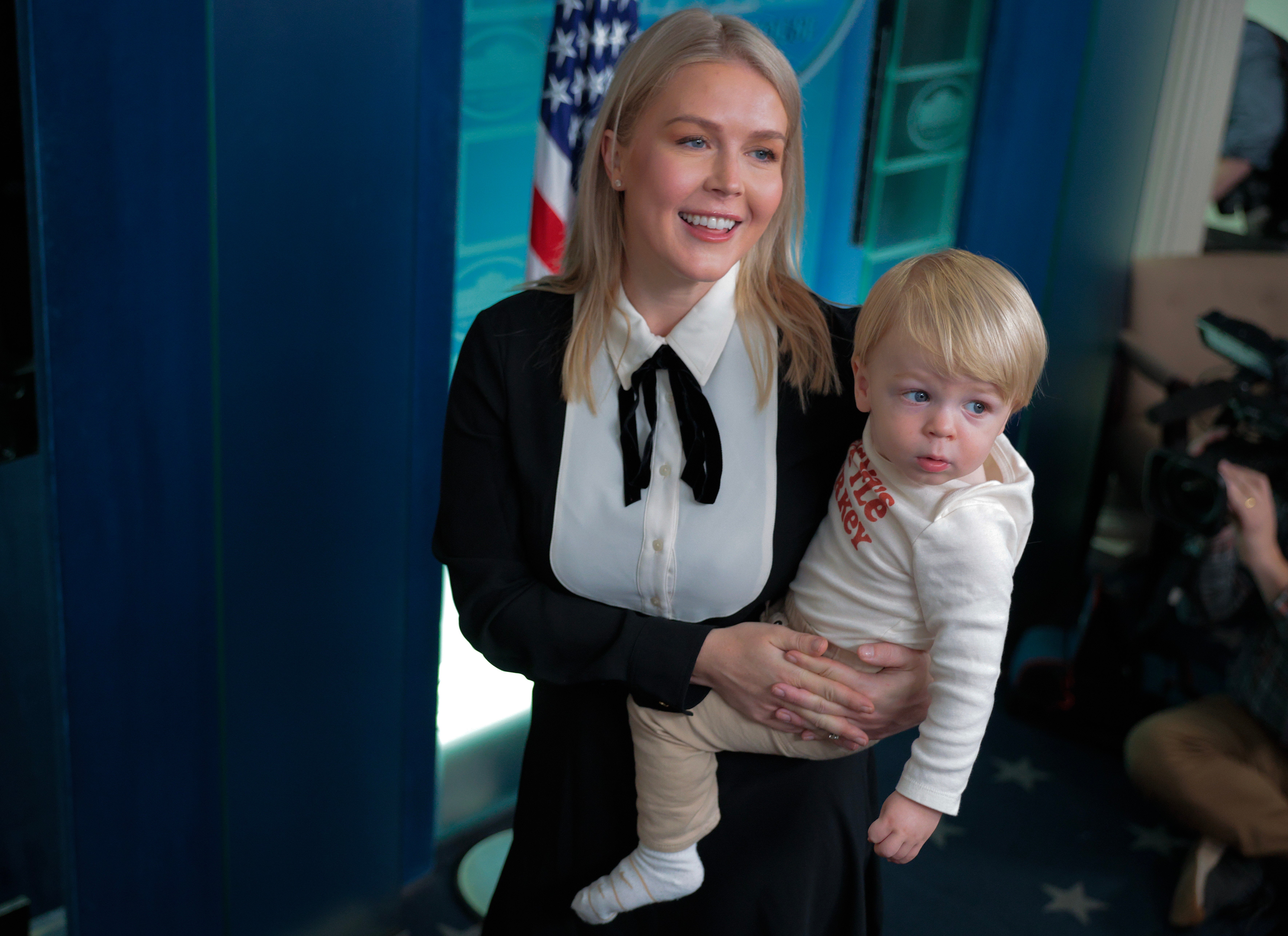
White House press secretary Karoline Leavitt announced she is pregnant with her second child in a festive Instagram post on Friday.
Along with a photo of her touching her bump in front of a Christmas tree, she announced, “The greatest Christmas gift we could ever ask for – a baby girl coming in May 2026.”
Advertisement
“My husband and I are thrilled to grow our family and can’t wait to watch our son become a big brother,” Leavitt said of husband Nicholas Riccio, 60, and son Niko, 1.
“My heart is overflowing with gratitude to God for the blessing of motherhood, which I truly believe is the closest thing to Heaven on Earth,” her caption continued.
Thanking her bosses, Leavitt added, “I am also extremely grateful to President Trump and our Chief of Staff Susie Wiles for their support, and for fostering a pro-family environment in the White House. 2026 is going to be a great year and I am so excited to be a girl mom.”
Advertisement
Leavitt, who at 28 years old is the youngest White House press secretary in history, regularly brings her son to work in Washington, D.C., with her, often sharing their office moments together on social media.
Leavitt, here at the White House with her son Nicholas “Niko” Robert Riccio on Nov. 25, thanked President Donald Trump and chief of staff Susie Wiles for “fostering a pro-family environment.”
Chip Somodevilla via Getty Images
She spoke more about juggling her high-pressure career and motherhood in an interview about her pregnancy with Fox News Digital, telling the site, “Nearly all of my West Wing colleagues have babies and young children, so we all really support one another as we tackle raising our families while working for the greatest president ever.”
Advertisement
The president is rather fond of his main spokesperson, whom he regularly praises for her appearance in public.
The White Stripes guitarist made a post featuring various photos and videos of sketchy things Trump has done while president, including selling Bibles and gold shoes. It also included a scorched-earth critique of Trump as a leader.
Advertisement
“I was raised to believe that we defeated fascism in World War II and that we would never allow it again in the world,” White began the post, while admitting that he doesn’t always state his political opinions publicly or “know all of the facts.”
However, he said when it comes to “this man and this administration I’m not going to be like one of the silent minority of 1930′s Germany.”
White then declared Trump to be “a danger to not just America but the entire world and that’s not an exaggeration.”
Advertisement
White also pointed out that Trump is “dismantling democracy and endangering the planet on a daily basis, and we. all. know. it,” before ending the post with this quote from President Theodore Roosevelt:
“To announce that there must be no criticism of the President, or that we are to stand by the President, right or wrong, is not only unpatriotic and servile, but is morally treasonable to the American public.”
You can see the post as it appeared on social media below:
Cheung was so angered about White’s post that he referred to the 12-time Grammy winner and soon-to-be member of the Rock And Roll Hall Of Fame as “a washed-up, has-been loser posting drivel on social media because he clearly has ample time on his hands due to his stalled career.”
White didn’t refer to Cheung in the post, but considering how testily the White House aide reacted to a basic style critique, it’s likely he will be even more miffed to see the post’s accusation that Trump is “dismantling democracy and endangering the planet on a daily basis.”
As war in the Middle East rages, President Donald Trump found time to supervise the installation of a giant flagpole on the White House grounds.
The president watched construction workers raise the new structure on the South Lawn and turned the event into an impromptu press conference.
Advertisement
Trump had announced on Truth Social on Tuesday that he would be “putting up two beautiful Flag Poles on both sides of the White House,” and described it as “a GIFT from me.”
The erection of new flagpoles comes as the president weighs up whether to send US warplanes to bomb Iran in a move that would significantly escalate the conflict with Israel.
In rambling comments to reporters that essayed the tensions in the Middle East, interest rates and immigration, the president appeared pleased with the new addition to the White House.
Advertisement
“It’s such a beautiful pole,” he said of the first pole to be put up, noting he has one at his Doral golf resort in Miami, Florida.
“These are the best poles anywhere in the country, or in the world, actually,” added Trump, before saying to no one in particular he wanted to “wish you a lot of luck with the new flagpole.”
The president also suggested he was barred from using the word “erect” as he described the installation as a “lifting.”
Advertisement
“They also use another word, but I’m not gonna use that word,” he said. “Do you know what that word is? It starts with an E. Do you know what the word is? If I ever used it, I would be run out of town by you people.”
When asked about whether he would sanction air strikes on Iranian nuclear facilities, Trump replied: “I may do it. I may not do it. I mean, nobody knows what I’m going to do.”
WASHINGTON — If you’re interested in finding Donald Trump’s precise words as he lied about his failed coup attempt in his Jan 20 remarks at the US Capitol soon after his inaugural speech, good luck with that.
Same with his Feb 12 thoughts in the Oval Office on how magnetism, in his view “a new theory,” doesn’t work on the aircraft carrier Gerald Ford.
Advertisement
Or his statements in the Feb 28 meeting with Volodymyr Zelenskyy, berating the Ukrainian president and empathising with Russian dictator Vladimir Putin instead.
Ditto with his April 14 explanation of how well he is doing with “the cognitive” compared to previous occupants of the White House.
The self-proclaimed “most transparent” White House in history, as it turns out, has little interest in making the vast majority of Trump’s speeches and interactions with journalists readily accessible to the public whose taxes pay for their transcription, publishing just 29 transcripts of the 146 public remarks Trump made in his first 100 days in office.
Advertisement
Trump’s White House posted transcripts for only 11 of the 40 speeches in which Trump did not take questions from the media, and for only one of his six formal news conferences, according to a HuffPost review. And of the 98 media “availabilities” in which Trump took questions from reporters informally — a practice that his aides point to as proof of his great accessibility — only 15 of the transcripts have been made public.
Previous White Houses, going back decades, made all of the transcripts compiled by the non-political stenography office, staffed by career civil servants, available in printed form, via email and on the White House website, as a matter of course. Trump’s first-term staff also published all his remarks, with the exception of his speeches at rallies and fundraisers. Trump’s second-term White House stopped emailing transcripts to its press list just five days after taking office, and of late has largely stopped posting them on the website, too. As of Thursday morning, the last transcript from Trump on the site is from March 13.
Trump aides would not explain their decision to withhold 80% of the transcripts that have been prepared. White House communications director Steven Cheung, however, did insult HuffPost for asking the question:
Advertisement
“You must be truly fucking stupid if you think we’re not transparent. The president regularly does multiple press engagements per day and they are streamed live on multiple platforms. We’ve even granted low-level outlets like HuffPo [sic] additional access to events, because we’re so transparent. For anyone to think otherwise proves they are suffering from Trump Derangement Syndrome. Stop beclowning yourself,” he wrote, demanding that his statement be published “in full.”
Kathleen Hall Jamieson, director of the Annenberg Public Policy Center at the University of Pennsylvania, said transcriptions of a president’s remarks have always been seen as historical records, not things to be politicised. “Making the words of the president readily available is part of the accountability obligation of the White House,” she said.
“The public has the right to know what the leader says … It’s a mark of a democratic system,” she added, saying that she could not speculate as to why Trump is withholding most of his transcripts’ release. “Trying to figure out why this White House does what it does requires a skill far beyond mine.”
Advertisement
Volodymyr Zelenskyy, Ukraine’s president, meets with US President Donald Trump and Vice President JD Vance in the Oval Office of the White House on Feb. 28.
Jim Lo Scalzo/EPA/Bloomberg via Getty Images
‘Utterly Fucking Off The Rails’
While it is true that videos of nearly all of Trump’s public remarks are available on C-SPAN, YouTube or other websites, they are not easily searchable by topic or keyword. There are private firms that transcribe his words, but they are not comprehensive and not well-known to the public.
Indeed, Trump critics say that increasing the difficulty of finding his exact words on any given topic is precisely the point of keeping most of the official transcripts a secret. After 10 years of hearing him, Trump’s outlandish claims and constant lies have become mere background noise to many Americans, they argue, while actually reading his statements hits in a different way.
Advertisement
“They know the transcripts will reveal, on paper, the word salad and incoherence that characterises Trump,” said Norman Ornstein, a political scientist with the conservative-leaning American Enterprise Institute. “It is much easier to pore through written transcripts and compare them, which will show inconsistencies and reversals.”
Andrew Bates, a top press aide in the Joe Biden White House, said his counterparts in the Trump White House clearly understand that reading what Trump has said does not reflect well on him. “He keeps saying things that are a liability, like talking about dolls and pencils. Or just getting confused,” Bates said.
The Biden press office famously altered punctuation in a transcript to make it seem that Biden was criticising a smaller subset of Trump supporters than the transcript originally suggested. The Biden team, nonetheless, released that transcript and appears to have released all those prepared by the stenography office, totaling well over 2,000 over four years.
Advertisement
The Trump press shop, in contrast, appears to have decided that the best way to avoid negative media coverage of his transcribed remarks is to not release them in the first place. A comparison of the posted transcripts versus the remarks for which the transcripts have been withheld suggests an effort to conceal Trump’s most outrageous, factually inaccurate or lie-filled statements.
On Inauguration Day, for example, while the transcript for the official speech given immediately after Trump took the oath of office is available on the White House website, a second one he gave to congressional Republicans soon afterward is not.
In that one, he again pushed his oft-repeated lies about January 6, 2021, the day he encouraged a mob of his followers to march on the Capitol and then tried to use their assault on police officers and other violence to remain in power despite having lost the 2020 election. Trump bemoaned that his staff talked him out of including that material in his actual inaugural address.
Advertisement
“You can’t put things in there that you were going to put in, and I was going to talk about the J6 hostages, but you’ll be happy because you know it’s action, not words that count, and you’re going to see a lot of action on the J6 hostages, see a lot of action,” he said in a 1,232-word section that repeatedly blamed former House Speaker Nancy Pelosi for all that happened on Jan. 6. “And I was going to talk about the things that Joe [Biden] did today with the pardons of people that were very, very guilty of very bad crimes like the unselect committee of political thugs where they literally, I mean, what they did is they destroyed and deleted all of the information, all of the hearings. Practically not a thing left.”
Three weeks later, following a swearing-in ceremony for his director of national intelligence, Tulsi Gabbard, Trump offered nonsensical answers to a variety of questions, including one about waste and fraud in the federal government. Trump launched into a 1,710-word rant on military contractors, including the builders of the newest aircraft carrier, the USS Gerald Ford, which uses a high-tech electromagnetic catapult system to launch airplanes to reduce stress on their airframes and landing gear.
“Take a look at the Gerald Ford, the aircraft carrier, the Ford. It came ― it was supposed to cost $3 billion; it ended up costing like $18 billion, and they make, of course, all electric catapults, which don’t work. And they have all magnetic elevators to lift up 25 planes at a time, 20 planes at a time,” he said, not appearing to understand the rationale for the new designs. “And instead of using hydraulic, like on tractors, that can handle anything from hurricanes to lightning to anything, they used magnets. It’s a new theory, magnets are going to lift the planes up, and it doesn’t work.”
Advertisement
At the end of that month, Trump and Vice President JD Vance attacked Ukraine’s Zelenskyy for not being sufficiently grateful to the United States before Trump turned to his familiar defense of Putin, who continues to slaughter Ukrainian civilians to this day through aerial attacks on residential areas.
“Let me tell you, Putin went through a hell of a lot with me. He went through a phony witch hunt, where they used him and Russia, Russia, Russia, Russia. You ever hear of that deal?” Trump said during a 206-word tangent again recounting his grievances.
“That was a phony ― that was a phony Hunter Biden, Joe Biden scam, Hillary Clinton, Shifty Adam Schiff. It was a Democrat scam, and he had to go through that, and he did go through it, and we didn’t end up in a war, and he went through it. He was accused of all that stuff. He had nothing to do with it. It came out of Hunter Biden’s bathroom. It came out of Hunter Biden’s bedroom, it was disgusting. And then they said, ‘Oh, oh, the laptop from hell was made by Russia,’ the 51 agents, the whole thing was a scam, and he had to put up with that. He was being accused of all that stuff.”
Advertisement
Six weeks later, during a visit by Salvadoran President Nayib Bukele, who is housing deportees whom Trump claims are criminal illegal immigrants, Trump was asked how many more people he intended to ship there. Trump responded with a 417-word answer that quickly veered into boasts about his mental acuity.
“By the way, I took my cognitive exam as part of my physical exam, and I got the highest mark. And one of the doctors said, ‘Sir, I’ve never seen anybody get that kind of ― that was the highest mark.’ I hope you’re happy with that, although they haven’t been bugging me too much to take a cognitive. But I did do my physical, and it was released. I hope you’re all happy with it. I noticed there’s no questions, so probably you are. But the cognitive, they said to me, ‘Sir, would you like to take a cognitive test?’ I said, ‘Did Biden take one?’ ‘No.’ ‘Did anybody take one?’ ‘No, not too many people took them.’ I said, ‘What about Obama, did he take one?’” Trump said.
“The totality of his statements clearly show that he is utterly fucking off the rails,” said Rick Wilson, a longtime Republican consultant who became an early Trump critic. “Most of the Washington media is still playing the polite game of pretending this is a normal White House, and so they just move on and move on and move on eternally into the future.”
Advertisement
‘What About The 38 Virgins?’
Trump’s usually rambling, often incoherent, at times downright deranged statements, of course, did not stop at the 100-day mark.
On Day 102, in a Rose Garden celebration of the National Day of Prayer, Trump suggested that Muslims are primarily terrorists willing to die to earn a reward of virgins in paradise: “Imams who I got to know in Michigan. I loved them. They were great, by the way. They said, ‘We don’t want to die.’ I said, ’Do you want to die? They said, ‘We don’t want to die.’ I said, ‘What about the 38 virgins?’”
On Day 106, in an Oval Office photo opportunity, Trump went on at length about his idea of reopening Alcatraz prison in San Francisco Bay. “I guess I was supposed to be a moviemaker. We started with the moviemaking, and we’ll end, I mean, it represents something very strong, very powerful in terms of law and order. Our country needs law and order. Alcatraz is, I would say the ultimate, right, Alcatraz, Sing-Sing and Alcatraz the movies,” he said in an answer that continued for 268 words. “But it’s right now a museum, believe it or not. A lot of people go there. It housed the most violent criminals in the world, and nobody ever escaped. One person almost got there, but they, as you know the story, they found his clothing rather badly ripped up, and it was a lot of shark bites, a lot of problems.”
Advertisement
It’s unclear what motion pictures featuring the prison as a setting have to do with reopening Alcatraz or why Trump believed his Muslim supporters in Michigan would be entitled to only 38 virgins, just over half of the 72 customarily cited.
Among the posted transcripts are two media interviews he did. While Trump does numerous interviews — most of which include statements that make him seem ignorant or foolish or both — his press staff has posted only two softball interviews: One by informal Trump adviser and Fox News host Sean Hannity dated Feb. 18 as well as a two-minute one by Jamie Little, a Fox Sports NASCAR announcer at the Daytona 500 race that Trump had attended two days earlier.
Advertisement
And while the stenography office transcribes every White House briefing and question-and-answer session aboard Air Force One by press secretary Karoline Leavitt, she and her staff have released only two. One was her first briefing on Jan. 29, in which she promised to always tell the truth, which she then immediately followed with an absurd falsehood about $50 million worth of condoms being sent to the Gaza Strip. The second was the Feb. 20 briefing in which she and other aides celebrated Trump’s first month in office.
Leavitt did not respond to HuffPost queries for this story.
Trump’s refusal to release transcripts created at taxpayer expense is just one piece of his effort to diminish independent news media. He has seized control of the White House press pool, which covers his events that take place in confined spaces like the Oval Office and Air Force One, from the White House Correspondents Association, which had administered it since its inception decades ago.
Trump and his staff have replaced journalists from legitimate news organizations with pro-Trump cheerleaders in many of the pool seats.
Advertisement
Trump also excluded the Associated Press from the pool because it refused to bend to his will and call the Gulf of Mexico by the name Trump decreed by fiat, the Gulf of America. When a federal judge ruled that Trump could not treat the AP any differently than it treats other wire services, he responded by ending assigned pool slots for all three wires: the AP, Reuters and Bloomberg.
On Trump’s current excursion to the Arabian Peninsula, his first extended foreign trip since he retook office in January, not one US wire service print reporter has been part of the pool aboard Air Force One or in meetings with various officials — thereby degrading news coverage for thousands of news outlets with billions of readers in the United States and globally.
The White House ripped Donald Trump for echoing “fascists” after the former president compared President Joe Biden’s administration to the Gestapo, the secret police force of Nazi Germany.
“Instead of echoing the appalling rhetoric of fascists, lunching with Neo Nazis, and fanning debunked conspiracy theories that have cost brave police officer their lives, President Biden is bringing the American people together around our shared democratic values and the rule of law — an approach that has delivered the biggest violent crime reduction in 50 years,” said deputy press secretary Andrew Bates in a statement.
Advertisement
The presumptive Republican presidential nominee, in remarks to a private Republican National Committee donor event at his Mar-a-Lago estate, hurled attacks at prosecutors in his legal cases before likening the Biden White House to a “Gestapo administration” on Saturday.
His recent event reportedly led to donations of $40,000 or greater from attendees. A Trump campaign official recently said that the former president and the Republican National Committee raised over $76 million last month.
Advertisement
CNN’s Jake Tapper questioned North Dakota Governor Doug Burgum, who is among Republicans eyed as a potential 2024 running mate for Trump, over whether he’s “comfortable” with Trump’s comparison on Sunday.
“Relative to the reference you’re discussing, I mean this was a short comment deep into the thing that wasn’t really central to what he was talking about,” said Burgum, who attended the Trump event, before claiming the hush money trial is “politically motivated.”
He continued, “So I understand that he feels like he’s being unfairly treated and I think that’s reasonable that someone who’s being kept off the campaign trail as the presumptive nominee has got some frustration about that.”
As open fighting between two of the Middle East’s best-armed players worsens, more than a million Palestinian lives hang in the balance.
Israel on Thursday attacked Iran, in retaliation for an April 13 attack from Iranian drones and missiles, which was itself a retaliation for the Israeli bombing of an Iranian consulate on April 1.
Advertisement
Iran downplayed the significance of the strike, with state media saying it caused no major damage. The US, Israel’s military lifeline, did so too. Secretary of State Antony Blinken told reporters the Biden administration “has not been involved in any offensive operations” and seeks “de-escalation and [to] avoi[d] a larger conflict.”
The state-on-state strikes between Israel and Iran, a prospect that risks sparking an all-out war, are “over,” a regional government source argued to CNN after the latest Israeli strike, saying Iran was unlikely to respond. Multiple national security analysts agreed Israel’s move seemed carefully calibrated, ostensibly in line with the priorities of the US and of anxious neighbouring countries.
Still, the two countries indisputably moved closer to head-on conflict through their unprecedented tit-for-tat in recent weeks. “The US will celebrate a small success. But the spiral is still spinning downward: rules are being rewritten on the battlefield,” wrote Emile Hokayem, an analyst at the International institute for Strategic Studies, a think tank, on X.
As the potential for extremely costly miscalculation persists, questions remain open: Is this the full extent of Israel’s response to Iran? Will the two now continue their longstanding bids to weaken each other through clashes elsewhere, perhaps in already bruised Lebanon?
Advertisement
It’s hard to see how the spiral stops until another question is answered: What about Palestine?
Rafah, the town in southern Gaza where nearly 1.5 million Palestinians are sheltering, is the only section of the strip Israel has yet to invade its sweeping, hugely controversial campaign.
Israeli Prime Minister Benjamin Netanyahu says an attack on Rafah is vital to shield Israel from the Gaza-based militant group Hamas.
Washington says it cannot support that plan without a serious strategy for evacuating and helping civilians — a strategy Israel has yet to provide, the White House confirmed in a Thursday statement, after a high-level meeting between US and Israeli officials.
The Biden administration is casting its attempt to temper the Rafah operation as distinct from its bid to prevent an Israel-Iran war. But to other observers, it’s impossible to separate the two. President Joe Biden is simultaneously the only outside world leader with the power to force a change in course for Israel, and a longtime ally of Israeli leadership who may be loath to seek their restraint, particularly as the country is in active conflict with Iran.
Calling the resurgent Israeli-Palestinian conflict “the beating heart of this increasingly regional problem,” Monica Marks, a professor at New York University’s Abu Dhabi campus, told HuffPost on Friday: “The thing to watch for … is whether Netanyahu bought more wiggle room on the Biden administration’s expectation for Israel to make humanitarian plans regarding Rafah’s civilians.”
Advertisement
Israel’s actions suggest it continues to see moving on Rafah as inevitable. Sources told multiple media outlets preparations had already begun, with leaflets directing civilians to flee already printed and scheduled to be dropped on Monday, though Israeli sourced told CNN the Iran attack had caused a delay. On Monday night, Israeli defence minister Yoav Gallant held a military briefing on Rafah, and at Thursday’s US-Israeli summit, both sides agreed discussions about the offensive would continue.
The prolonged uncertainty is chilling for civilians in Rafah, which constitutes the last remotely functional section of Gaza. The vast majority of Palestinians are barred from leaving the territory for neighbouring Egypt.
Describing widespread anticipation of an Israeli ground invasion and “constant anxiety due to the ongoing airstrikes,” Ghada Alhaddad told HuffPost she has witnessed panicked civilians Rafah to try to return to other parts of Gaza, only to find little but wreckage there.
“The lingering sense of fear has left many unsure of where to go next,” said Alhaddad, who works for the charity Oxfam.
Displaced Palestinian children line up to receive food in Rafah on April 19, 2024.
MOHAMMED ABED via Getty Images
Advertisement
As decision-makers in governments remain vague about their plans, the outside players helping Palestinians survive amid food shortages, bombardment and displacement fear the worst. Representatives of five major aid groups told HuffPost this week that even the meager support they are able to currently provide to Palestinians would plummet if Rafah is attacked, and they have yet to see either realistic plans for addressing the civilian toll of an assault or effective Israeli steps to bolster humanitarian relief for Gaza. Biden has pushed harder for increased aid since an Israeli attack killed seven relief workers on April 1.
“The conditions for us to provide an adequate humanitarian response are not there right now – let alone if the conditions become more challenging because we don’t have access to Rafah and people are put into a catastrophic situation,” said Tess Ingram, a UNICEF spokesperson who returned from a visit to Gaza on Monday.
Scott Paul of Oxfam America told HuffPost he and his colleagues fear geopolitical discussions will distract from measures to protect Palestinians, at least 34,000 of whom have been killed since Israel’s offensive began.
“There’s a widespread concern that it will be difficult to deescalate regional tensions and keep the focus on a population on the brink of famine,” Paul said. “We’re very worried that Palestinians will get the short end of the stick.”
Seeking anonymity to discuss sensitive internal deliberations, a source at a humanitarian organisation said they had little faith in the US to moderate Israel’s approach to Rafah.
Advertisement
“You just can’t look to the Biden administration for signals, because the Israelis have proven time and again that just because assurances are given to the US side doesn’t mean they’re going to be held to them,” said the source. They described aid groups as in “purgatory” as conditions for Palestinians decline and as the trajectory of the conflict remains unclear, and said Israel is deploying “a purposeful level of ambiguity.”
Spokespeople at Israel’s embassy in Washington and for the White House National Security Council did not respond to requests for comment for this story.
Known Knowns
Experts surveyed by HuffPost this week described three certainties for Israel, the Biden administration and the prospects of limiting Palestinian suffering.
Israel remains determined to pursue Hamas in Rafah beyond the attacks it has already launched on the town — most recently, an airstrike on April 18 that killed 10 members of a family, including five children.
Within Israel, there is popular dissatisfaction with Netanyahu over issues like his failing to bring home Israeli hostages captured in the Hamas-led attack on October 7, that initiated the current fighting. But worsening tensions with Iran could bolster Israelis’ feeling that security should be the country’s top priority.
Advertisement
Tackling the group’s remaining forces in Rafah is “necessary,” argued Neomi Neumann, the former head of research at the Israeli Security Agency, or Shin Bet.
“If we don’t deal with this, Hamas will manage every time to revitalise and become strong — this is the oxygen for Hamas,” said Neumann, now a visiting fellow at the Washington Institute for Near East Policy think tank, referring to Israel’s fears that Hamas will resupply itself through Gaza’s southern border region with Egypt.
Iran is a “danger,” she said, but “at the same time, we need to finish the Gaza issue.”
To “demilitarise the Gaza Strip,” Israel could use non-military means, Neumann noted, like using political agreements and technological safeguards along with Egypt and the US, and bringing in the Palestinian Authority (PA), which governs parts of the occupied West Bank.
Netanyahu and Israeli hardliners see PA rule in Gaza as unacceptable, casting the body as corrupt and Palestinian autonomy in the region as a “reward for terror,” but Neumann called it “the least bad option,” compared to Hamas or direct Israeli control of the strip.
The Biden administration has pinned its hopes on the PA and argues it can be reformed.
There’s a reason to be skeptical of how firm the US will be on the PA and related American plans for the region: its track record.
Advertisement
Throughout his career, and particularly since October 7, Biden has prioritised backing Israel. Critics say this has made him unwilling to deploy US leverage to prevent Israeli violations of human rights and other destabilising actions. But as Israel enters a new level of conflict with Iran — widely seen in American politics as an enemy country — Biden may prove especially deferential to Netanyahu.
“I think the US will have to sit harder on Israel to totally prevent any Rafah invasion,” said Marks of NYU.
The revival of hawkish talk about Tehran since its strike on Israel has already made it “that much harder to push the Israelis toward compliance” with international law “and to create pressure” on aid-related issues, argued the humanitarian organisation source.
“Can the Biden administration and Congress find a way to stop Israel’s war in Gaza and scale a humanitarian response in Gaza while enabling [Israelis] to defend themselves against Iran? Sure, if they properly staffed up and stopped half-measures, they could walk and chew gum,” the source said. “For now, it looks like the latter may take priority over the former.”
But Biden’s oft-stated resistance to a regional conflict could yet convince his team they must halt an Israeli offensive.
Advertisement
“The administration has been pretty consistently holding the line on Rafah because they know it’s a game-changer,” said Matt Duss, the executive vice president of the Center for International Policy think tank. “Biden’s policy has been to try and keep the catastrophe contained within Gaza. It’s an indefensibly callous and dangerous policy, but they’ve been consistent about it.”
Egypt, which worked with Israel to impose a years-long blockade on Gaza, has repeatedly warned Israel and the US about a Rafah assault, fearing it would push Palestinians to cross the Egyptian border en masse. Other US-aligned governments in the region, like Jordan, are facing domestic pro-Palestinian activism that has made some officials worried about the stability of their regimes.
The third reality: Too little humanitarian aid is getting to people who need it in Gaza, and the flow is increasing too slowly, despite some claims of progress.
Israeli authorities have touted an increase in how many trucks of supplies they permitted into Gaza this month through the two currently open crossings into the region, at which Israeli personnel inspect all incoming material.
On Friday, top White House Middle East official Brett McGurk told a public briefing with Jewish Americans there have been “pretty significant changes” in Israel’s treatment of aid — an assessment that was not shared by any of the aid workers HuffPost for this story.
Advertisement
“We’re interested in outputs, not inputs, which to say is the lowering of malnutrition. … We’re interested in no civilian casualties, we’re interested in no indiscriminate bombing. Those are the outputs we’re interested in, and the administration signalled they’re also interested in those things,” said Bill O’Keefe of the charity Catholic Relief Services. “We want to make sure they don’t just get caught up in inputs: there have been some increased trucks, that’s great, but there have been increased trucks before, and then that comes down.”
And on April 9, United Nations spokesperson Jens Laerke told reporters that Israel was counting half-full trucks that enter its screening sites — not the number of repacked, fully-loaded trucks that actually enter Gaza, which aid workers believe to be lower.
Meanwhile, multiple humanitarian officials told HuffPost they have no more details about plans for two additional points for supplying aid to Palestinians — the Erez land crossing and the Ashdod port — two weeks after Netanyahu’s cabinet approved their use.
The road leading from Erez to populated parts of northern Gaza requires extensive repairs before it can be used, and Israel has not greenlighted the opening of another land route, at Karni, Marks said. Meanwhile, Israel’s one currently open crossing into Gaza, Kerem Shalom, is closed on weekends. Calls for increased staffing and screening capacity there have yet to be answered, several aid workers said; neither have appeals for Israel to ease its policy of refusing to let in many aid supplies on the grounds that they’re “dual-use” and could also be used by militants.
Global attention “needs to be not on volume but types of aid and services: Can you get in tubing to do nasal feeding, the right types of food, staff to access clinics?” Marks added. “We still haven’t had that kind of results-based response, as opposed to volume-based.”
Advertisement
Israel could, for instance, make an immediate difference by restarting electricity supplies to Gaza, Paul noted.
Several humanitarian officials also described continued challenges in transporting equipment and personnel to northern Gaza, where famine is already underway.
UNICEF struggled to send fuel and food north from Rafah last week in convoys Ingram participated in, she said, as authorities delayed trucks in holding areas and directed them to a heavily congested route. Israeli officials also maintain extremely limited hours at the checkpoint separating southern Gaza from the north.
“These curfews, we run up against them all the time,” Ingram continued. Once she did reach the north on Sunday, she was appalled: “People were approaching our vehicles, fingers to the mouth. We went to Kamal Adwan hospital, which is treating malnourished children. … It is cruel that this is being inflicted on children when there is food and nutrition treatments and other aid.”
‘Undo Everything’
An Israeli attack on Rafah would force many traumatised Palestinians to abandon what little refuge they have found.
Advertisement
Abood Okal, a Palestinian American who spent weeks in Rafah with his wife and child before being permitted to leave on November 2, told HuffPost his sister Eman, her husband and their three children are now living in the space where the Okals had been staying.
They share a bathroom with 40 other people in a distant family friend’s house and can only communicate with their relatives every 3-4 days, when Eman is able to get a network signal.
Conditions in the other places Palestinians could flee to resemble those where Okal’s other sister, Asma, is staying: in a small tent in Al Mawasi, an overwhelmed coastal community where thousands of families from Rafah may move amid an Israeli offensive. Her children have contracted hepatitis A, one of many diseases that are spreading rapidly in Gaza, and she can only communicate with the outside world around once every two weeks, Okal said.
Soraya Ali of Save the Children, who visited Gaza earlier this month, told HuffPost she saw how people are living beyond Rafah in Deir Al Balah, in central Gaza. She witnessed a makeshift toilet facility shared by 200 people, dozens of people living in “unbearably hot” improvised “tents” crafted from plastic, sticks and tarpaulin and children spending their days roaming the streets seeking food and water.
In Khan Yunis, another town north of Rafah, the streets are full of unexploded bombs and Israeli attacks have destroyed infrastructure that was functioning a few months ago, said Ingram, who visited last week. “It is unrealistic to imagine that somebody could move back there and be safe,” she told HuffPost.
Advertisement
Additionally, people who have been living in Rafah and would now consider moving have already endured overcrowding and shortages of essentials for months. Oxfam’s Alhaddad mentioned one example: She has run out of heart medication for her mother.
“You’re starting already weakened,” O’Keefe said. Relocating civilians, he said, is a matter of providing not just food or shelter (which the Israeli military appears to be working on, by ordering tens of thousands of tents) but also water, sanitation and health equipment.
“We do not see how to safely provide for those people in order to allow for some sort of invasion of Rafah,” he added.
For humanitarian groups, major fighting in Rafah would make providing assistance to Palestinians nearly impossible.
It’s the “only place there is a semblance of an aid response,” Ali said. “If a ground incursion happens in Rafah, it would undo everything.”
Advertisement
Since the start of the war, aid organisations have developed storage and distribution facilities there, as well as accommodations for visiting staff serving Gaza’s population.
Between the added disruption to civilians’ lives and the worsening lack of aid supplies, full-on fighting in Rafah “would be the deadliest chapter of this conflict yet,” Ali said.
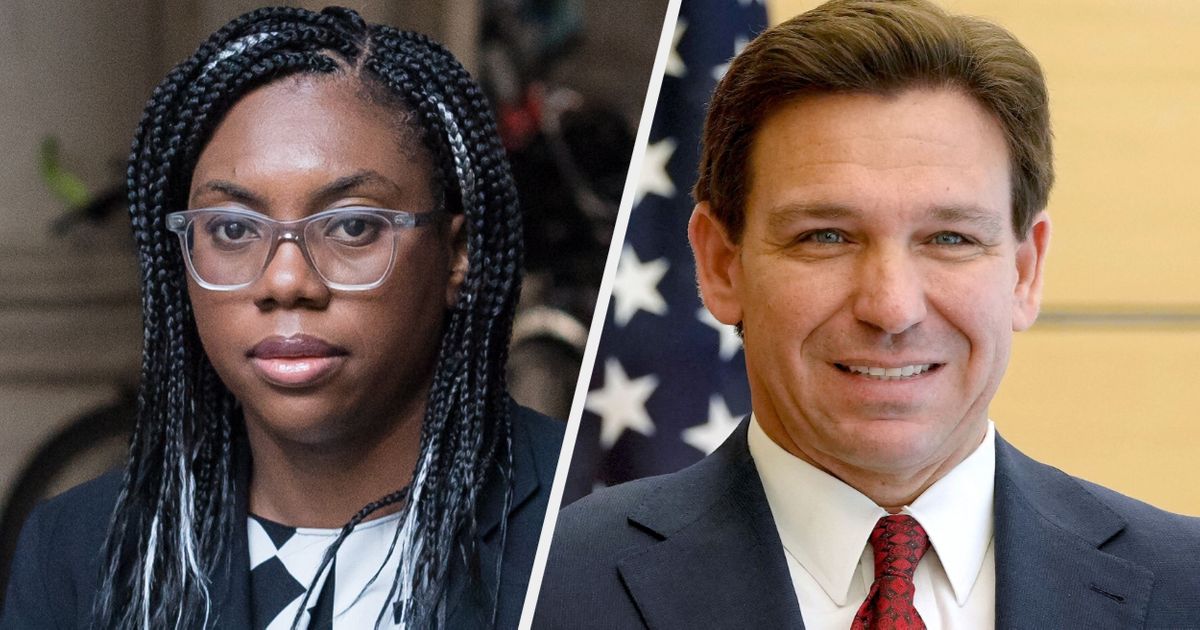
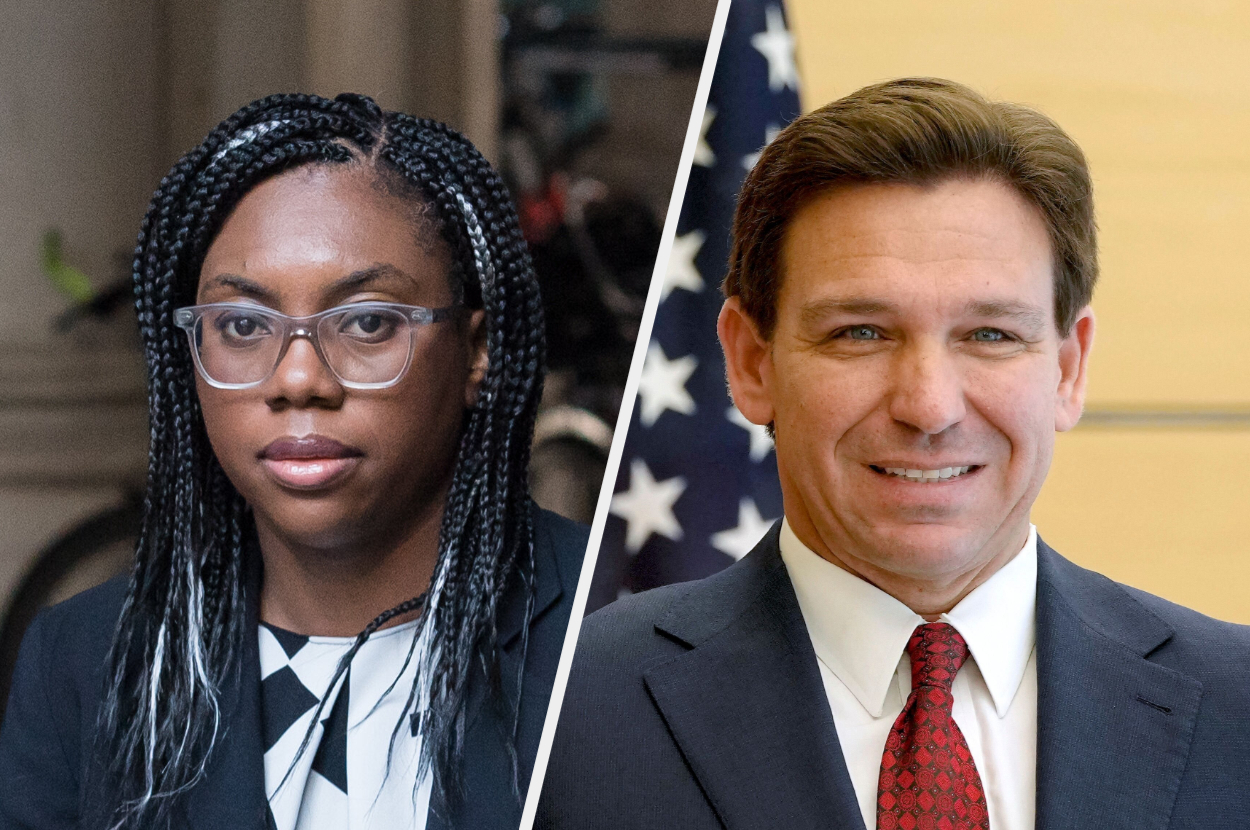
Hardline US presidential hopeful Ron DeSantis has praised Kemi Badenoch for her fight against so-called “woke ideology”.
The Florida governor met the business secretary on a trip to Britain ahead of a potential run against Donald Trump to be the next Republican candidate.
Advertisement
He singled out Badenoch for her views on Britain’s cultural debates, during an interview with The Sunday Telegraph.
The paper claimed his allies hope that Badenoch could be the next Margaret Thatcher to their new Ronald Reagan.
DeSantis praised the senior Tory, who is also minister for women and equalities, for her outspoken views.
He described “woke ideology” as “a war on the truth”, telling the paper: “When institutions get infected by woke ideology, it really corrupts the institutions.
Advertisement
“We look at woke infiltrating schools as a problem, woke infiltrating bureaucracies as a problem and woke infiltrating corporate America as a problem. We say that Florida is where woke goes to die.”
DeSantis said Badenoch “complimented what we are doing in Florida” and added: “I commend her and her efforts to make sure that this is not corrupting British society.”
In a post on Twitter following the meeting, DeSantis said she is such a “strong, outspoken leader in the United Kingdom”.
“We share the same goal of spurring economic growth for our people and I look forward to continuing our relationship,” he added.
Advertisement
.@CaseyDeSantis and I enjoyed meeting MP Kemi Badenoch, who is such a strong, outspoken leader in the United Kingdom.
We share the same goal of spurring economic growth for our people and I look forward to continuing our relationship. pic.twitter.com/hAwEw3BEyL
DeSantis has not announced his intention to run for the Republican nomination but is widely expected to do so.
In his interview, he also addressed speculation over his potential run at the White House, telling the paper: “I’m going to go through our legislative session, get the people’s business done. I’m still in the midst of that.
“I’ve got about another week or so of that, and then I have the Budget and everything. I’m not going to make any decision before then.
“But the end of that time is coming, it’s closer now than it was six months ago. So just stay tuned.”
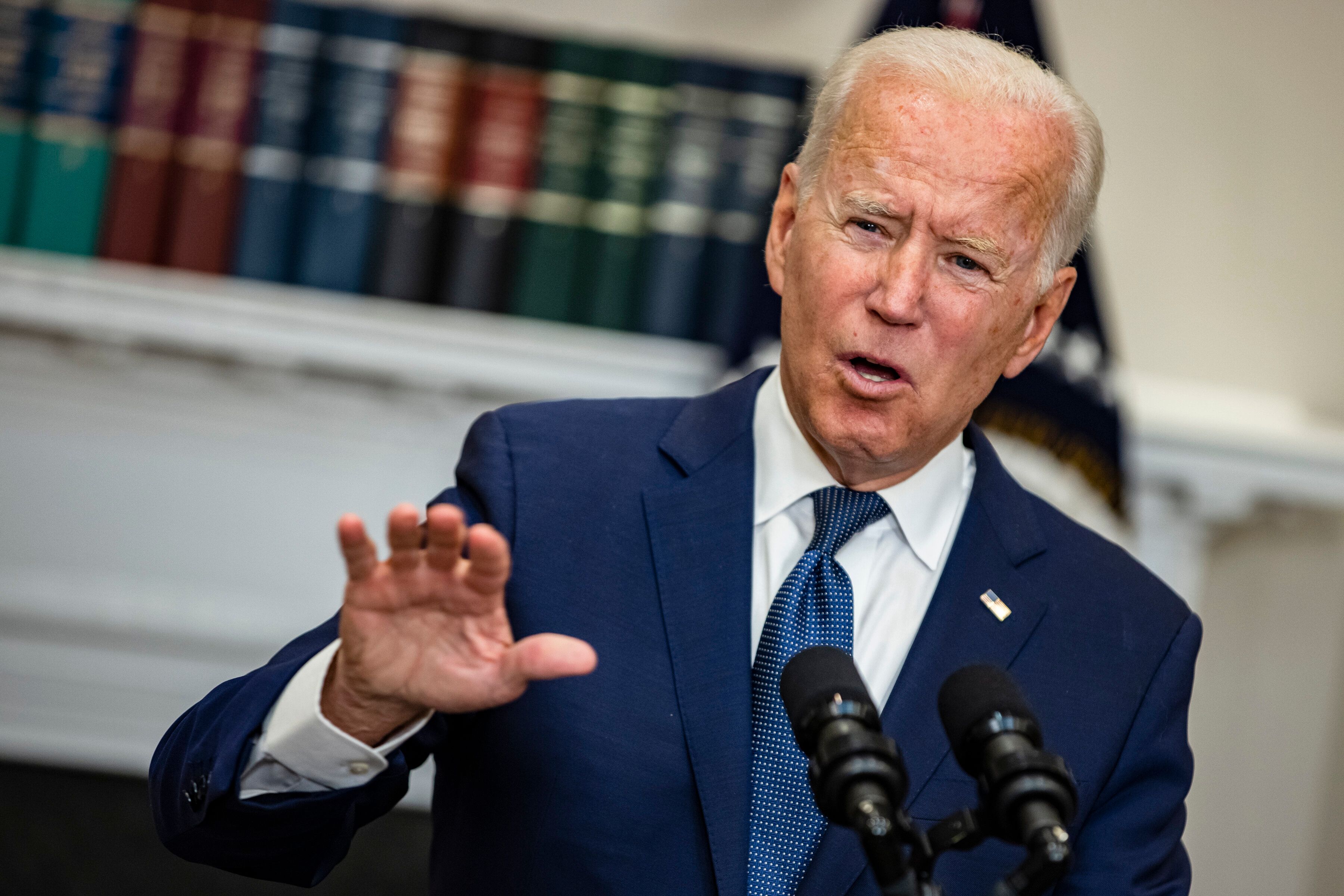
US President Joe Biden touted on Sunday the surging number of Afghanistan evacuations carried out so far by the United States, but acknowledged that such a massive operation does not come “without pain and loss.”
The White House said that the US has evacuated 30,300 people out of Afghanistan since August 14, including more than 13,000 people over the weekend. That brings the total evacuated by the US to about 35,500 since July, though the president stressed in a televised address that “we have a long way to go, and a lot could still go wrong.”
“Let me be clear, the evacuation of thousands of people from Kabul is going to be hard and painful no matter when it started, when we began,” Biden said. “It would have been true if we had started a month ago, or a month from now. There is no way to evacuate this many people without pain and loss, [like] those heartbreaking images you see on television. It’s just a fact.”
Biden: “Let me be clear — the evacuation of thousands of people from Kabul is going to be hard & painful no matter when it started, when we began. It would have been true if we had started a month ago, or a month from now. There is no way to evacuate this many people w/o pain.” pic.twitter.com/3t8wTZvwRv
“My heart aches for those people you see,” Biden said on Sunday. “We are proving, though, that we can move thousands of people a day out of Kabul. We’re bringing out citizens, NATO allies, Afghanis who in fact have helped us in the war effort ― but we have a long way to go, and a lot could still go wrong. But to move out 30,000 people in just over a week, that’s a great testament to the men and women on the ground in Kabul.”
Earlier on Sunday, national security adviser Jake Sullivan told CNN that 23 US military flights had evacuated about 3,900 people from Afghanistan, with an additional 3,900 airlifted by 35 non-US military flights, in the past 24 hours. Defence Secretary Lloyd Austin activated the Civil Reserve Air Fleet program, requesting 18 aircraft from US carriers to assist in transporting Afghan refugees after they’ve been evacuated to other countries.
To help continue the evacuations safely, the US has extended the “safe zone” perimeter around the Kabul airport to expand access to people trying to flee the country. This change includes changing the gate operations, which Biden explained is why the military has been able to increase the number of evacuees.
The president said that the Taliban “have been cooperative with regard to changing the perimeter” during discussions, but when asked by a reporter if he trusts Taliban promises, Biden said: “I don’t trust anybody, including you.”
Biden did say that the Taliban have not taken action against US forces so far during the evacuation, and “by and large” have followed through on allowing Americans to pass through. But the president also emphasised that US troops and Afghans still face danger at the airport, such as terrorists like ISIS and its Afghan affiliate ISIS-K who may “seek to exploit the situation ― including trying to strike from a distance.”
The president said he still hopes to meet the August 31 evacuation deadline out of Kabul, but is currently having discussions for the potential of extending the timeline to make sure the US can evacuate as many people as possible.
The chaotic rollout of Biden’s evacuation plan has unleashed bipartisan anger, though many officials and experts stress that this is not on one administration, but on decades of government and military officials. Still, with the evacuation occurring under the current White House that has a lackluster record on refugee issues, advocates are blasting Biden for not moving fast enough and claiming the president is more focused on avoiding political attacks than on helping vulnerable people abroad.
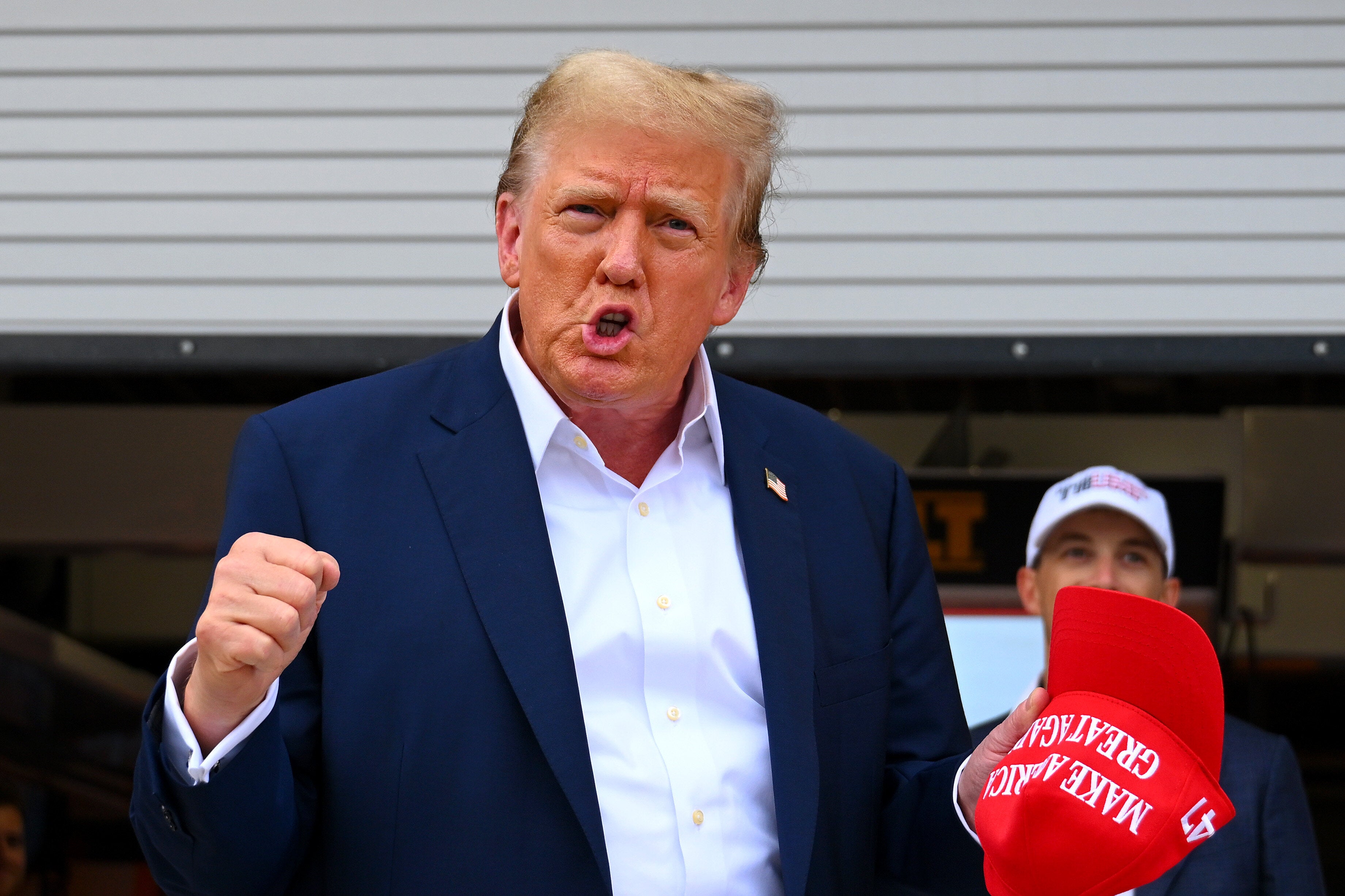
Former White House press secretary Kayleigh McEnany claims ex-president Donald Trump is now actually “doing just fine” without social media.
Trump railed against and desperately tried to circumvent his bans from multiple social media platforms — which for years he used to spread conspiracy theories, amplify lies, sow division and attack enemies ― after he was booted for inciting the deadly US Capitol riot on January 6.
But McEnany, a newly-minted contributor for Fox News, on Friday told Fox Business’ Stuart Varney that Trump now finds it “kind of freeing.”
“He said it was kind of freeing not to have Twitter. He had a lot of time on his hands. So I think he’s doing just fine without social media,” she said.
Social media users were skeptical about McEnany’s claim, given her history of lying on behalf of Trump and the ex-president’s well-documented love for Twitter in particular.
Twitter permanently banned Trump from his favourite platform in the wake of the insurrection. Facebook’s oversight board is due soon to rule on the possible reinstatement of Trump’s account. YouTube said Thursday it will lift Trump’s suspension once the risk of offline violence has diminished.
McEnany, in an apparent contradiction to her earlier comments, then pivoted to the right-wing talking point of so-called “cancel culture.”
“What a travesty, this cancel culture, this root someone out of the public square,” she told Varney, saying the bans weren’t about stopping violence but “about stopping Trump.”
HuffPost is part of Verizon Media. We and our partners will store and/or access information on your device through the use of cookies and similar technologies, to display personalised ads and content, for ad and content measurement, audience insights and product development.
Your personal data that may be used
Information about your device and internet connection, including your IP address
Browsing and search activity while using Verizon Media websites and apps
To enable Verizon Media and our partners to process your personal data select ‘I agree‘, or select ‘Manage settings‘ for more information and to manage your choices. You can change your choices at any time by visiting Your Privacy Controls.