HuffPost is part of Verizon Media. Verizon Media and our partners need your consent to access your device and use your data (including location) to understand your interests, and provide and measure personalised ads. Verizon Media will also provide you with personalised ads on partner products. Learn more.
How Verizon Media and our partners bring you better ad experiences
To give you a better overall experience, we want to provide relevant ads that are more useful to you. For example, when you search for a film, we use your search information and location to show the most relevant cinemas near you. We also use this information to show you ads for similar films you may like in the future. Like Verizon Media, our partners may also show you ads that they think match your interests.
HuffPost is part of Verizon Media. Verizon Media and our partners need your consent to access your device and use your data (including location) to understand your interests, and provide and measure personalised ads. Verizon Media will also provide you with personalised ads on partner products. Learn more.
How Verizon Media and our partners bring you better ad experiences
To give you a better overall experience, we want to provide relevant ads that are more useful to you. For example, when you search for a film, we use your search information and location to show the most relevant cinemas near you. We also use this information to show you ads for similar films you may like in the future. Like Verizon Media, our partners may also show you ads that they think match your interests.
HuffPost is part of Verizon Media. Verizon Media and our partners need your consent to access your device and use your data (including location) to understand your interests, and provide and measure personalised ads. Verizon Media will also provide you with personalised ads on partner products. Learn more.
How Verizon Media and our partners bring you better ad experiences
To give you a better overall experience, we want to provide relevant ads that are more useful to you. For example, when you search for a film, we use your search information and location to show the most relevant cinemas near you. We also use this information to show you ads for similar films you may like in the future. Like Verizon Media, our partners may also show you ads that they think match your interests.
HuffPost is part of Verizon Media. Verizon Media and our partners need your consent to access your device and use your data (including location) to understand your interests, and provide and measure personalised ads. Verizon Media will also provide you with personalised ads on partner products. Learn more.
How Verizon Media and our partners bring you better ad experiences
To give you a better overall experience, we want to provide relevant ads that are more useful to you. For example, when you search for a film, we use your search information and location to show the most relevant cinemas near you. We also use this information to show you ads for similar films you may like in the future. Like Verizon Media, our partners may also show you ads that they think match your interests.
HuffPost is part of Verizon Media. Verizon Media and our partners need your consent to access your device and use your data (including location) to understand your interests, and provide and measure personalised ads. Verizon Media will also provide you with personalised ads on partner products. Learn more.
How Verizon Media and our partners bring you better ad experiences
To give you a better overall experience, we want to provide relevant ads that are more useful to you. For example, when you search for a film, we use your search information and location to show the most relevant cinemas near you. We also use this information to show you ads for similar films you may like in the future. Like Verizon Media, our partners may also show you ads that they think match your interests.
HuffPost is part of Verizon Media. Verizon Media and our partners need your consent to access your device and use your data (including location) to understand your interests, and provide and measure personalised ads. Verizon Media will also provide you with personalised ads on partner products. Learn more.
How Verizon Media and our partners bring you better ad experiences
To give you a better overall experience, we want to provide relevant ads that are more useful to you. For example, when you search for a film, we use your search information and location to show the most relevant cinemas near you. We also use this information to show you ads for similar films you may like in the future. Like Verizon Media, our partners may also show you ads that they think match your interests.
HuffPost is part of Verizon Media. Verizon Media and our partners need your consent to access your device and use your data (including location) to understand your interests, and provide and measure personalised ads. Verizon Media will also provide you with personalised ads on partner products. Learn more.
How Verizon Media and our partners bring you better ad experiences
To give you a better overall experience, we want to provide relevant ads that are more useful to you. For example, when you search for a film, we use your search information and location to show the most relevant cinemas near you. We also use this information to show you ads for similar films you may like in the future. Like Verizon Media, our partners may also show you ads that they think match your interests.
HuffPost is part of Verizon Media. Verizon Media and our partners need your consent to access your device and use your data (including location) to understand your interests, and provide and measure personalised ads. Verizon Media will also provide you with personalised ads on partner products. Learn more.
How Verizon Media and our partners bring you better ad experiences
To give you a better overall experience, we want to provide relevant ads that are more useful to you. For example, when you search for a film, we use your search information and location to show the most relevant cinemas near you. We also use this information to show you ads for similar films you may like in the future. Like Verizon Media, our partners may also show you ads that they think match your interests.
A pinched nerve is a nerve that has become irritated or compressed. The nerve is not necessarily pinched, but people use this term to refer to a range of symptoms. A pinched nerve can occur at various sites in the body, including the neck. When it affects the neck, doctors call it cervical radiculopathy.
A person with a pinched nerve in the neck may experience tingling, numbness, or weakness in their neck, shoulders, hands, or arms. Pinched nerves often appear with age or due to arthritis or wear and tear on the spine.
Many people with pinched nerves are reluctant to exercise because of pain and tingling. However, staying still can actually make the pain worse because it can cause tension and wasting in nearby muscles.
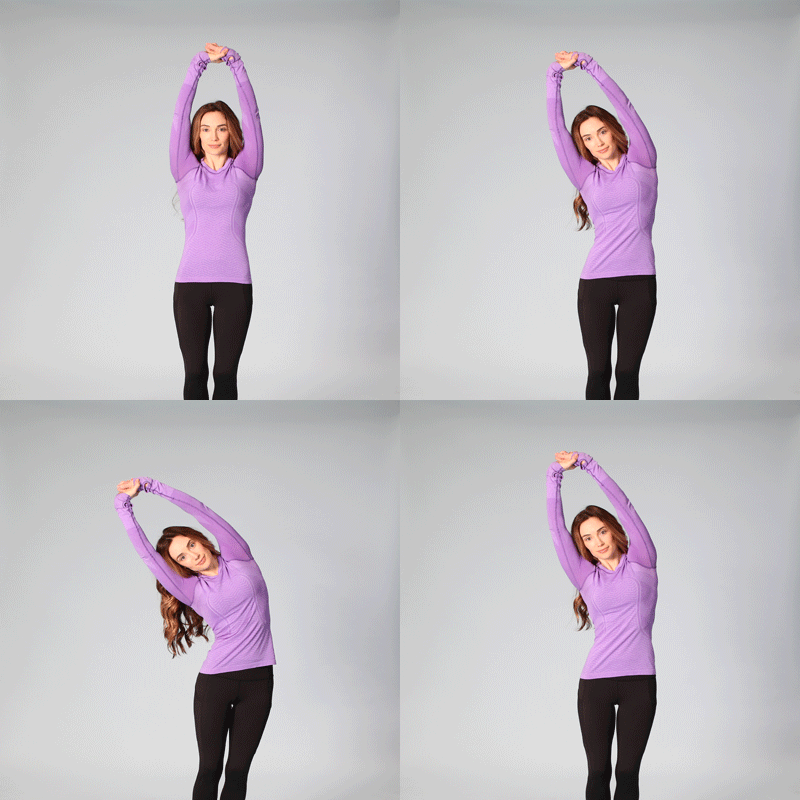
The following exercises may help relieve the pain and discomfort of a pinched nerve in the neck:
Sitting in the same position for long periods, especially with crossed legs, can damage the nerves and muscles. Instead, take frequent walking breaks.
Try to walk around the house or office for 10 minutes for every hour of sitting.
To get the most out of walking and help ease a pinched nerve, keep the head in a neutral position. The ears should be level with the shoulders, and the jaw should be loose, not clenched.
Moving the shoulders can help reduce tension in the neck. It can also alleviate the headaches that some people get with pinched nerves and muscle tightness.
To exercise the shoulders:
Shrug the shoulders slowly up and down for 30 seconds.
Rest for a few seconds.
Next, roll the shoulders forward and up toward the ears, then back down and back, pushing the shoulder blades together.
Repeat this move for 30 seconds, then reverse the direction.
Yoga involves the slow movement of the body through a wide range of positions while focusing on engaging each muscle group. This practice is an ideal low impact option for people dealing with pain.
Child’s Pose, in particular, can be helpful for people with a pinched nerve in the neck. To do Child’s Pose:
Start by sitting on the heels on a mat, with the tops of the feet flat on the floor.
Learn the body forward until it meets the thighs.
Extend the arms straight out above the head, with the hands flat on the floor.
Head turns can restore range of motion, but they may feel difficult at first. To do a head turn:
Sit or stand in a neutral position, then turn the face to one side to look over the shoulder.
Hold for 5 seconds.
Return the head to its neutral position.
Turn it again, this time to the other side.
Repeat 10 times.
The median nerve runs from the shoulder down to the end of the forearm. To relieve pain and numbness, a person can try doing a median nerve slider:
Begin in a neutral sitting position.
Position the palm in front of the face and look at the hand.
Next, extend the arm out to the side so that the fingertips point toward the ceiling, and the wrist is below the shoulders.
Follow the hand with the eyes.
Return to the starting position.
Repeat on the opposite side.
This exercise can also relieve the symptoms of a pinched nerve. To do it:
Stand in a neutral position.
Put the palm together in a “praying” position, pointing the fingers up.
Lift the elbows and lower the wrists so that the lower arms are almost parallel to the floor.
Push the elbows as far to the right as possible, then as far to the left as possible.
Repeat 10 times.
The ulnar nerve goes from the neck to the hand. It is the nerve responsible for a person feeling pain in the “funny bone.” To use ulnar nerve towel sliders to relieve pinched nerve symptoms, a person can:
Hold one end of a towel in the hand on the side of the pinched nerve, placing it near the head.
Let the rest of the towel drop behind the back and grab it with the other hand near the lower back.
Pull the towel upward with the top hand as far as it will go.
Pull it back down with the bottom hand.
Do not hold the stretch at the top or bottom but keep the arms moving for 30 seconds.
A pinched nerve may heal on its own. However, if it does not improve with rest and gentle stretching at home, a person can see a doctor for treatment.
Treatment usually focuses on reducing pain and preventing secondary injuries. In addition to exercises and physical therapy, a doctor may recommend:
a collar to immobilize the neck
nonsteroidal anti-inflammatory drugs (NSAIDs), such as ibuprofen
cold therapy with ice packs
massage therapy
surgery, in rare cases
Many injuries and illnesses can cause pain, numbness, and weakness. Anyone experiencing chronic numbness or pain in the neck should speak to a doctor before trying exercises for a pinched nerve.
For many people, an individualized physical therapy plan offers quick results and significant improvements in strength and mobility.
HuffPost is part of Verizon Media. Verizon Media and our partners need your consent to access your device and use your data (including location) to understand your interests, and provide and measure personalised ads. Verizon Media will also provide you with personalised ads on partner products. Learn more.
How Verizon Media and our partners bring you better ad experiences
To give you a better overall experience, we want to provide relevant ads that are more useful to you. For example, when you search for a film, we use your search information and location to show the most relevant cinemas near you. We also use this information to show you ads for similar films you may like in the future. Like Verizon Media, our partners may also show you ads that they think match your interests.