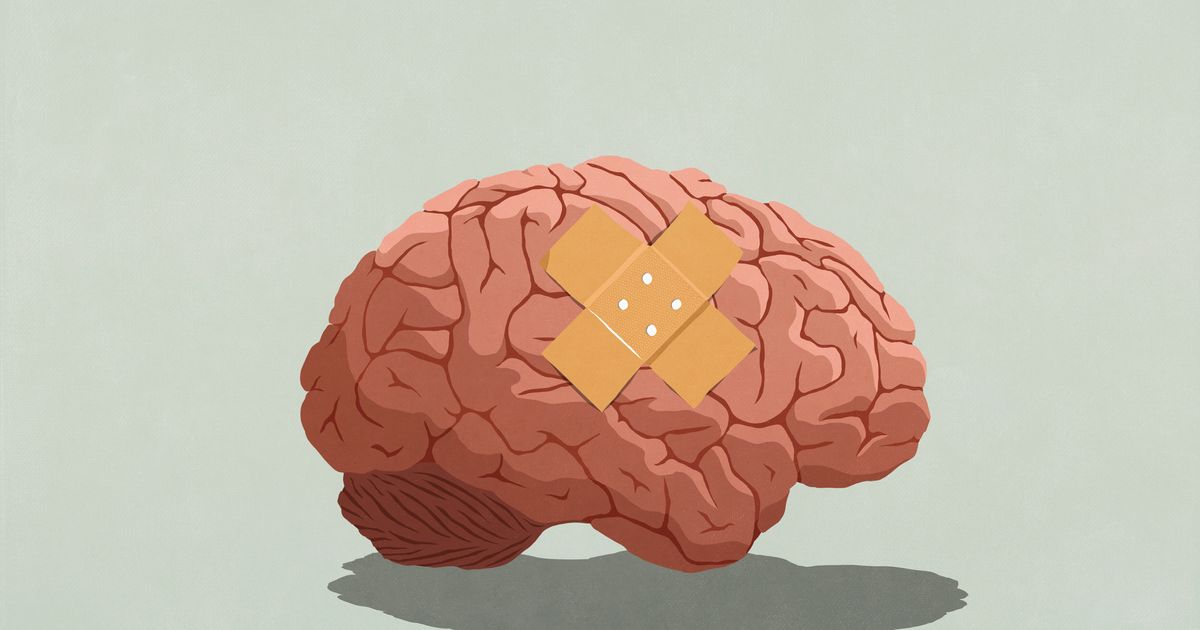
Yes Really – These 11 Things Can Damage Your Brain

Doctor, psychiatrist and author of Change Your Brain Every Day, Dr Daniel Amen, has shared 11 ways that we’re damaging our brain and minds daily — without even realising it.

Amen, who’s the go-to doctor for stars like Bella Hadid, Miley Cyrus and Justin Bieber, opened up with his advice on how to protect our brains on Steven Bartlett’s Diary Of A CEO podcast, where he said that our brains are so important because it’s “the organ of intelligence, character and every single decision that you make.”

In the episode, he shares how, in one of his books, he prescribes the pneumonic ‘BRIGHT MINDS’ as a guide for keeping a healthy brain, with every letter representing a different step.

Here’s what he has to say about all things grey matter…

The first letter in ‘BRIGHT MINDS’ represents blood, he says: “The B is for blood flow. Low blood flow is the number one brain imaging predictor of Alzheimer’s disease. How do you get low blood flow? Caffeine, nicotine, marijuana, alcohol, having a sedentary lifestyle, and being overweight.”

He says that caffeine “constricts blood flow by 30%” and also increases the stress hormone cortisol, which isn’t great for long-term health either.

We can assume, then, to get the blood flowing would be to do the opposite of the things he listed — cutting out our thrice daily coffee habits (gah!!), not smoking, limiting alcohol and getting moving in whatever way makes you feel good.

“R is retirement and ageing. You want to prematurely age your brain? Drop out of school. Do not engage in new learning. When you learn something new, your brain makes a new connection. When you stop learning, or you start doing the same thing over and over again, your brain starts to disconnect itself. Being in a job that does not require new learning is a risk factor for dementia,” Dr Amen explains.

Research shows that older adults can still learn new languages, form new memories and pick up new skills, and it’s beneficial to never stop learning as we age.

The I stands for — you guessed it — inflammation. The wellness world has been coming down like a ton of bricks on all things inflammation in the past few years, and Dr Amen says reducing it can really help protect the ol’ noggin.

“If you want to prematurely age your brain, eat a lot of red meat as if your iron and ferritin levels are high. Because ferritin, which is stored iron tends to age the brain,” he says.

“If you want to increase inflammation, which is a root cause of so many medical and mental health issues, never floss, don’t care about your teeth.”

He says there’s a fascinating link between your dental hygiene and your brain: “It’s absolutely critical for you not to have gum disease, but if you have gingivitis, odds are you’re at increased risk for heart disease and depression and dementia. It’s fascinating.”

Next up: genetics. Something that Dr Amen says a lot of health issues are blamed on when lifestyle changes can switch things upon. He says: “I have obesity and heart disease in my family, but I’m not overweight and I don’t have heart disease. Why? I’m on an obesity and heart disease prevention programme every day of my life. Because genes load the gun, it’s what happens to us and what we choose to do that pulls the trigger.”

H stands for head trauma. While it’s important to look after our brain through what we eat and how we exercise, physically looking after it is vital, too. He sarcastically says, “You want to damage your brain? Play football, play soccer, play rugby, and box.” We can guess then that he would rather we didn’t do all of those things…

He goes on to say that toxins in our personal care products and should be avoided.

According to a piece published in the National Institutes of Health, phthalates, parabens, PFAS, and triclosan, found in popular personal care products, are endocrine disruptors, which mimic or interfere with the body’s hormones and have been linked to problems with the brain, as well as development, and reproduction.

Embrace positivity for a healthy brain, he says: “M is mental health. Negativity increases stress, plus negativity drops activity in your cerebellum.”

“The second I is immunity and infections,” he explained. “Low vitamin D, which occurs in about 60% of the population, is associated virtually with every bad thing, including a smaller brain.

The UK government actually recommends that everyone in the UK should take a 10 microgram vitamin D supplement a day due to how we get absolutely no good weather, ever.

According to Dr Amen neurohormones are incredibly “important”. Some hormonal balances, such as too much cortisol, can actually alter brain function, impairing memory and causing brain fog.

D is for what Dr Amen refers to as ‘diabesity’ — a combination of diabetes and obesity — as research has shown being overweight or obese, especially in midlife, is associated with dementia later in life.

Finally, S is for sleep. Without sleep, we can’t form or maintain the pathways in our brain that let us learn and create new memories, and it’s harder to concentrate and respond quickly during the day, too.

So…. cut out coffee and smoking, get an early night, keep learning, embrace positivity, brush and floss and move your body?

Sounds like a tall order, but if we want to keep our marbles as we get older, maybe not so bad after all!
Share Button

Here’s What Venus In Retrograde Means For Your Love Life

What happens when the planet that rules all things love and beauty goes retrograde? And while we’re at it, what actually even is a retrograde?

You’ve most likely heard about Mercury retrograde — it’s when Mercury appears from Earth to rotate backwards and seems to send all things communication and technology into a tailspin.

Car broken down? Mercury retrograde. Sent a sext to your grandad by mistake? Mercury retrograde.

But did you know all the other planets of the solar system can go retrograde, too? And Venus’s turn is set to take place from July 22 to September 3rd.

What does Venus retrograde mean?

In astrology, the planet of Venus represents all things beautiful — art, good food, beauty, attraction and love. The Roman goddess of Venus was the human embodiment of all these things, encompassing love, beauty, desire, sex, fertility, prosperity, and victory.

We can assume, then, that this Venus retrograde will have something to do with some of those areas, and we wouldn’t be wrong, as TikTok astrologer Liv confirms in a video all about the upcoming astrological event.

“We may be able to observe relationships falling apart, more people breaking up during this time period,” she shares. “And you may notice that former lovers, even old friends or distant relatives start to bubble to the surface, too, and try to reconnect.”

This could be a time of letting go of past flames and situationships that aren’t serving you and allowing you to thrive. And a new love story could be on the horizon for some of us.

Those whose sun or rising signs are ruled by Venus — looking at you, Libra and Taurus! — should especially watch out this retrograde, as the effects will be amplified.

The dos and do nots of Venus retrograde

TikToker Divine Raven Tarot shared more about the effects on our relationships, plus her ‘dos’ and ‘don’ts’ in a video: “You don’t want to make any impulsive decisions when it comes to your finances, as well as career.

“Venus does rule over relationships and love, platonic love, but it also rules over finances. So be very careful when it comes to spending,” she shared.

She also says that, as tempting as it might be with the chaotic energy going on, don’t hand in your notice at work. “Once Venus goes direct again, you might end up regretting that,” she explains.

And for those of you who love cutting and dying your own hair during times of crisis, put down the box dye and scissors. She says that it’s important not to be impulsive around your appearance, too, as you’ll likely end up regretting it after September 3rd.

So what to do? Look after yourself: “You should focus on healing during this time. Any retrograde has a lot of lessons to learn when it comes to healing and finding closure from the past,” says the creator behind the Divine Raven Tarot account.

“Do focus on self-love and boundaries during this time. People are gonna be acting crazy. It’s not selfish to set boundaries and prioritise your own peace during this time.

“And lastly, do pay attention to the themes that are presented to you in your life because it can tell you a lot about what’s keeping you stagnant and how to overcome it as well.”

Share Button

Long-term changes in waves and storm surges have not impacted global coastlines

Changes in ocean wave and storm conditions have not caused long-term impacts on sandy coastlines in the past 30 years, a new study has found.

Published today in Scientific Reports, the study draws on data from 30 years of global satellite and model studies to investigate whether changes in ocean wave conditions will have an impact on the stability of coastal environments.

The compounding effect of climate change driven variations in waves, storm surge and sea level rise is projected to lead to shoreline position change along most of the world’s sandy coasts.

A team of researchers, led by University of Melbourne PhD candidate Mandana Ganavati and Professor Ian Young, together with colleagues from IHE Delft Institute for Water Education and Deltares of the Netherlands, looked at the changes in shoreline position over the past 30 years globally. These changes in shoreline position were compared to changes in wave and storm surge properties along the same coastlines.

“Although many shorelines around the world are dynamic, responding to wave and storm surge events, these changes tend to be short to medium term. However, we saw no evidence in the last 30 years or so of data that the long-term changes in waves and storm surge are directly causing long-term recession of coastlines.” said Professor Young.

Ms Ganavati said it is commonly inferred that climate change-induced increases in wind speeds and the ocean waves are impacting global shorelines.

“Changes in mean sea level due to global warming are expected to result in recession of our coastlines, in many places threatening homes, infrastructure and ecosystems. However, in a global sense, the magnitude of the observed changes in waves and storm surge over the last 30 years appears too small to have a measurable impact.

“Variations in the supply of sediment from rivers, longshore gradients in sediment transport and human management of coastlines are likely to have had a bigger impact on changing shoreline position than changes in wave and storm surge climate over the last 30 years.” Ms Ganavati said.

Climate change and mean sea level rise is projected to result in widespread coastal recession along sandy coasts through the twenty-first century, potentially disrupting lives and leading to massive socioeconomic losses. This study found the available datasets do not show clear linkages between long-term shoreline change and changes in waves and storm surge over the past three decades.

Share Button

Labour Blame Sadiq Khan’s ULEZ Scheme For Failing To Win Boris Johnson’s Old Seat

The Labour mayor of London’s decision to expand the Ultra Low Emission Zone (ULEZ) to cover the whole of the capital dominated the Uxbridge and South Ruislip by-election.

Speaking shortly after the result was announced, shadow justice secretary Steve Reed suggested Khan should consider ditching the ULEZ expansion – which is due to kick in next month – in light of the result.

He told the PA news agency: “I think the winning Conservative candidate just said it, didn’t he? He said that if it wasn’t for ULEZ, he believes Labour would have won this by-election.

“Clearly, it did resonate with a lot of people. They didn’t like the fact that ULEZ was going to cost people more to drive around at a time when there’s a cost-of-living crisis going on. That’s exactly what [Labour candidate] Danny Beales was saying all the way through the campaign.

“But I think when the voters speak, any party that seeks to govern has to listen. So that’s what Labour will be doing after this.”

A Labour source told HuffPost UK: “If Uxbridge helps us junk more crap then good.”

Share Button

Johnny Mercer Slammed Over ‘Inbetweeners’ Jibe At New Labour MP

Johnny Mercer has been criticised after launching an extraordinary attack on Labour’s newest MP.

The Tory minister compared Keir Mather to a character from hit comedy The Inbetweeners after his stunning victory in Selby and Ainsty.

He also suggested MPs should have raised a family before standing for parliament.

Mather, who is 25, overturned a 20,000 Tory majority in the seat to pull off the historic win.

But on Sky News afterwards, Mercer suggested the new MP was too inexperienced to be in parliament.

He also accused Mather of robotically “parroting” Labour lines because he does not have enough life experience.

He said: “I think it’s always good to get new people in politics. I think we mustn’t become a repeat of the Inbetweeners. You’ve got to have people who have actually done stuff.

“This guy has been at Oxford University more than he’s been in a job. You put a chip in him there and he just repeats Labour lines.

“The problem is people have had enough of that, right? They want people who are authentic, people who have worked in that constituency, who understand what life is like – to live, work and raise a family in communities like there’s.

“I’m afraid I don’t agree with this style of politics. It’s exactly why people like me couldn’t vote in the 2015 election, because you’ve got people with nothing to do with the constituency just dropped in, put a chip in them and they’ll start parroting Labour Party politics.”

Keir Mather celebrates winning with 16,456 votes the Selby and Ainsty by-election.

Ian Forsyth via Getty Images

A Labour source told HuffPost UK: “Johnny Mercer’s response to a young gay man being elected was to make fun of his appearance and criticise him for not having raised a family. The true face of the Tory Party.”

Asked about his relative inexperience on Sky News, Mather said: “I don’t think people mind a candidate with a bit of energy and determination.

I’m a taxpayer too, I feel the pressures as much as anybody else. I grew up in a rural village, very similar to the ones across Selby and Ainsty, so I do also know what it’s like to struggle to get that GP appointment.

“People are really struggling and I really get those experiences because I’ve lived them myself.”

Share Button

Major Boost For Rishi Sunak As Tories See Off Labour Challenge In Uxbridge

The Conservatives have narrowly beaten Labour to retain Boris Johnson’s former seat following a bitter by-election campaign.

In a major blow for Keir Starmer, Steve Tuckwell beat Tory candidate Danny Beales by just 495 votes to become the new MP for Uxbridge and South Ruislip.

The by-election was called following Johnson’s dramatic resignation last month after he was found guilty by the privileges committee of repeatedly lying to parliament over partygate.

The former prime minister retained the seat with a majority of 7,210 at the 2019 election.

Tuckwell received 13,965 votes to Beales’s 13,470 to claim the constituency for the Tories once again.

The Conservatives effectively turned the by-election into a referendum on Labour mayor Sadiq Khan’s decision to expand London’s Ultra Low Emission Zone (ULEZ) across the whole of the city from next month.

The result of a huge boost for Rishi Sunak, who had been braced for the Tories to lose the seat, given the unpopularity of the government and Labour’s commanding lead in the national polls.

A Labour spokesperson said: “This was always going to be a difficult battle in a seat that has never had a Labour MP and we didn’t even win in 1997. We know that the Conservatives crashing the economy has hit working people hard, so it’s unsurprising that the ULEZ expansion was a concern for voters here in a by-election.”

Elsewhere, Labour have won the Selby and Ainsty by-election after toppling one of the safest Tory seats in the country.

And in the third by-election of the night, the Lib Dems pulled off a stunning victory in a previously safe Tory seat of Somerton and Frome.

Despite the Conservatives avoiding a three-nil defeat, the swing in the vote went away from the Tories in every seat.

Share Button

Some NHS temporary staff miss out on full pay deal

A lump sum of at least £1,655 has failed to reach the pay packets of some “bank” nurses, who fill rota gaps.

Share Button

Researchers investigate new use for plastic bottles

For years, unrecycled plastic bottles have been dumped in landfills. Now, thanks to new research from UBC Okanagan, those bottles may have a second life in that landfill — stabilizing its earth walls.

Used plastic bottles and textiles pose an increasing problem for landfills worldwide. Researchers say nearly a hundred million metric tons of polyethylene terephthalate (PET), also known as microplastics, are produced globally each year — with a fraction of that number being recycled — making it one of the largest sources of plastic waste.

“One way we can manage plastic waste is through integrating it into geotechnical construction,” explains doctoral student Alok Chandra. “By finding new ways to use these discarded plastics, we can divert them from landfills and use them to stabilize cover materials within landfills.”

Chandra and his supervisor, UBCO Engineering Professor Dr. Sumi Siddiqua, have developed a new method of incorporating PET waste into clay soil stabilization.

“Due to its nontoxicity, low biodegradability and accessibility, it shows considerable potential for use in landfill designs. However, a considerable amount of research is still required,” says Dr. Siddiqua. “This not only solves the solid waste problem but also increases the economic value of waste and encourages its re-circulation back from already polluted lands and oceans.”

The study suggests the reused material strengthens the soil and serves as a water-resistant layer that will keep pollutants such as lead from escaping the landfill.

“Our results show great potential, but there is still some work to be done before we will integrate the PET waste into landfill soil stabilization management,” says Chandra.

The research is published in the journal Waste Management and funded by the Natural Sciences and Engineering Research Council of Canada Discovery Grants Program.

Share Button

New catalyst could dramatically cut methane pollution from millions of engines

Individual palladium atoms attached to the surface of a catalyst can remove 90% of unburned methane from natural-gas engine exhaust at low temperatures, scientists reported today in the journal Nature Catalysis.

While more research needs to be done, they said, the advance in single atom catalysis has the potential to lower exhaust emissions of methane, one of the worst greenhouse gases, which traps heat at about 25 times the rate of carbon dioxide.

Researchers from the Department of Energy’s SLAC National Accelerator Laboratory and Washington State University showed that the catalyst removed methane from engine exhaust at both the lower temperatures where engines start up and the higher temperatures where they operate most efficiently, but where catalysts often break down.

“It’s almost a self-modulating process which miraculously overcomes the challenges that people have been fighting — low temperature inactivity and high temperature instability,” said Yong Wang, Regents Professor in WSU’s Gene and Linda Voiland School of Chemical Engineering and Bioengineering and one of four lead authors on the paper.

A growing source of methane pollution

Engines that run on natural gas power 30 million to 40 million vehicles worldwide and are popular in Europe and Asia. The natural gas industry also uses them to run compressors that pump gas to people’s homes. They are generally considered cleaner than gasoline or diesel engines, creating less carbon and particulate pollution.

However, when natural-gas engines start up, they emit unburnt, heat-trapping methane because their catalytic converters don’t work well at low temperatures. Today’s catalysts for methane removal are either inefficient at lower exhaust temperatures or they severely degrade at higher temperatures.

advertisement


“There’s a big drive towards using natural gas, but when you use it for combustion engines, there will always be unburnt natural gas from the exhaust, and you have to find a way to remove that. If not, you cause more severe global warming,” said co-author Frank Abild-Pedersen, a SLAC staff scientist and co-director of the lab’s SUNCAT Center for Interface Science and Catalysis, which is run jointly with Stanford University. “If you can remove 90% of the methane from the exhaust and keep the reaction stable, that’s tremendous.”

A catalyst with single atoms of the chemically active metal dispersed on a support also uses every atom of the expensive and precious metal, Wang added.

“If you can make them more reactive,” he said, “that’s the icing on the cake.”

Unexpected help from a fellow pollutant

In their work, the researchers showed that their catalyst made from single palladium atoms on a cerium oxide support efficiently removed methane from engine exhaust, even when the engine was just starting.

They also found that trace amounts of carbon monoxide that are always present in engine exhaust played a key role in dynamically forming active sites for the reaction at room temperature. The carbon monoxide helped the single atoms of palladium migrate to form two- or three-atom clusters that efficiently break apart the methane molecules at low temperatures.

advertisement


Then, as the exhaust temperatures rose, the clusters broke up into single atoms and redispersed, so that the catalyst was thermally stable. This reversible process enabled the catalyst to work effectively and used every palladium atom the entire time the engine was running — including when it started cold.

“We were really able to find a way to keep the supported palladium catalyst stable and highly active and, because of the diverse expertise across the team, to understand why this was occurring,” said SLAC staff scientist Christopher Tassone.

The researchers are working to further advance the catalyst technology. They would like to better understand why palladium behaves in one way while other precious metals such as platinum act differently.

The research has a way to go before it will be put inside a car, but the researchers are collaborating with industry partners as well as with DOE’s Pacific Northwest National Laboratory to move the work closer to commercialization.

Along with Wang, Abild-Pedersen, and Tassone, Dong Jiang, senior research associate in WSU’s Voiland School, also led the work. The work was funded by the DOE Office of Science, and included research carried out at SLAC’s Stanford Synchrotron Radiation Lightsource (SSRL), Argonne National Laboratory’s Advanced Photon Source (APS) and the National Energy Research Scientific Computing Center (NERSC), which are all DOE Office of Science user facilities.

Share Button

(How) cells talk to each other

Like us, cells communicate. Well, in their own special way. Using waves as their common language, cells tell one another where and when to move. They talk, they share information, and they work together — much like the interdisciplinary team of researchers from the Institute of Science and Technology Austria (ISTA) and the National University of Singapore (NUS). They conducted research on how cells communicate — and how that matters to future projects, e.g. application to wound healing.

What comes to your mind when you think of biology? Animals, plants, theoretical computer models? The last one, you might not associate with it right away, although it is a major part of biological research. It is precisely these calculations that help to understand complex biological phenomena, down to the most concealed details. ISTA Professor Edouard Hannezo applies them to understand physical principles in biological systems. His group’s latest work gives novel insights into how cells are moving and communicating inside living tissue.

During his PhD, Daniel Boocock, along with Hannezo and long-term collaborator Tsuyoshi Hirashima from the National University of Singapore, developed a detailed new theoretical model, which is published today in the journal PRX Life. It allows a better understanding of long-range cell-cell communication and describes both the complex mechanical forces the cells apply to each other and their biochemical activity.

Cells communicate in waves

“Let’s say you have a Petri dish that is covered with cells — a monolayer. They appear to just sit there. But the truth is they move, they swirl, and they spontaneously make chaotic behaviors,” Hannezo explains.

Similar to a dense crowd at a concert, if one cell pulls on one side, another cell senses the action and can react by either going in the same direction or pulling the opposite way. Information can then propagate and travel in waves — waves that are visible under a microscope. “Cells not only sense mechanical forces but also their chemical environment — forces and biochemical signals cells are exerting on each other,” Hannezo continues. “Their communication is an interplay of biochemical activity, physical behavior, and motion; however, the extent of each mode of communication and how such mechanochemical interplays function in living tissues has been elusive until now.”

Predicting movement patterns

Driven by the wave visuals, the scientists’ goal was to establish a theoretical follow-up model that would validate their previous theory on how cells move from one region to the next. Daniel Boocock explains, “In our earlier work, we wanted to uncover the biophysical origin of the waves and whether they play a role in organizing collective cell migration. However, we hadn’t considered the liquid-solid transition of the tissue, the noise inherent in the system, or the detailed structure of the waves in 2D.”

advertisement


Their latest computer model pays attention to cell motility and material properties of the tissue. With it, Boocock and Hannezo found how cells communicate mechanically and chemically and how they move. They were able to replicate the phenomena observed in Petri dishes, verifying a theoretical explanation of cell communication based on physical laws.

Testing the theory

For experimental proof, Boocock and Hannezo collaborated with biophysicist Tsuyoshi Hirashima. To rigorously test whether the new model is applicable to real biological systems, scientists used 2D monolayers of MDCK cells — specific mammalian kidney cells — that are a classical in vitro-model for such research. “If we inhibited a chemical signaling pathway that allows cells to sense and generate forces, the cells stopped moving and no communication waves spread,” Hannezo explains. “With our theory, we can easily change different components of the complex system and determine how the dynamics of the tissue adapt.”

What’s next?

Cellular tissue resembles liquid crystals in some ways: it flows like a liquid but is arranged like a crystal. Boocock adds: “In particular, the liquid crystal-like behavior of biological tissue has only been studied independently of mechanochemical waves.” An extension to 3D tissues or monolayers with complex shapes, just as in living organisms, is one possible future avenue of investigation. The researchers have also begun to optimize the model with regard to wound healing. Where parameters improve the flow of information, healing has been accelerated — in computer simulations. Hannezo adds enthusiastically, “What’s really interesting is how well our model would work for wound healing in cells within living organisms.”

Share Button