New data reveals severe impact of European contact with Pacific islands

Pacific island nations suffered severe depopulation from introduced diseases as a consequence of contact with European vessels, a new study from The Australian National University (ANU) shows.

The research, published in the Journal of Archaeological Science, indicates population declines were a lot larger than previously thought.

According to the study, the main island of Tonga had a population decline of between 70-86 per cent once Europeans made contact.

Researchers from the ANU School of Culture, History & Language, PhD candidate Phillip Parton and ARC Future Fellow Professor Geoffrey Clark, found there were between 100,000-120,000 people in Tonga prior to European contact.

“I and my co-author used aerial laser scanning data to map residences on the main island of Tonga and then used archaeological data I collected as part of my PhD to estimate the population,” Mr Parton said.

“This improved understanding of the past has allowed us to show a significant population decline from 50,000-60,000 to 10,000 during a 50-year period on the main island of Tongatapu in the Kingdom of Tonga.

“Because this number is so much larger than anything anyone had previously considered, I used shipping and missionary data to check my estimates and found they were plausible.

“Obviously, this shows a big reassessment of the impact of globalisation in the 19th century.

“As in many parts of the world, the population of Pacific islands suffered severe declines after contact when Europeans introduced new pathogens.”


The research has been published in the Journal of Archaeological Science.

Pacific island nations suffered severe depopulation from introduced diseases as a consequence of contact with European vessels, a new study from The Australian National University (ANU) shows.

The research, published in the Journal of Archaeological Science, indicates population declines were a lot larger than previously thought.

According to the study, the main island of Tonga had a population decline of between 70-86 per cent once Europeans made contact.

Researchers from the ANU School of Culture, History & Language, PhD candidate Phillip Parton and ARC Future Fellow Professor Geoffrey Clark, found there were b

The research, published in the Journal of Archaeological Science, indicates population declines were a lot larger than previously thought.

According to the study, the main island of Tonga had a population decline of between 70-86 per cent once Europeans made contact.

Researchers from the ANU School of Culture, History & Language, PhD candidate Phillip Parton and ARC Future Fellow Professor Geoffrey Clark, found there were between 100,000-120,000 people in Tonga prior to European contact.

“I and my co-author used aerial laser scanning data to map residences on the main island of Tonga and then used archaeological data I collected as part of my PhD to estimate the population,” Mr Parton said.

“This improved understanding of the past has allowed us to show a significant population decline from 50,000-60,000 to 10,000 during a 50-year period on the main island of Tongatapu in the Kingdom of Tonga.

“Because this number is so much larger than anything anyone had previously considered, I used shipping and missionary data to check my estimates and found they were plausible.

“Obviously, this shows a big reassessment of the impact of globalisation in the 19th century.

“As in many parts of the world, the population of Pacific islands suffered severe declines after contact when Europeans introduced new pathogens.”

The research has been published in the Journal of Archaeological Science.

Pacific island nations suffered severe depopulation from introduced diseases as a consequence of contact with European vessels, a new study from The Australian National University (ANU) shows.

The research, published in the Journal of Archaeological Science, indicates population declines were a lot larger than previously thought.

According to the study, the main island of Tonga had a population decline of between 70-86 per cent once Europeans made contact.

Researchers from the ANU School of Culture, History & Language, PhD candidate Phillip Parton and ARC Future Fellow Professor Geoffrey Clark, found there were between 100,000-120,000 people in Tonga prior to European contact.

“I and my co-author used aerial laser scanning data to map residences on the main island of Tonga and then used archaeological data I collected as part of my PhD to estimate the population,” Mr Parton said.

“This improved understanding of the past has allowed us to show a significant population decline from 50,000-60,000 to 10,000 during a 50-year period on the main island of Tongatapu in the Kingdom of Tonga.

“Because this number is so much larger than anything anyone had previously considered, I used shipping and missionary data to check my estimates and found they were plausible.

“Obviously, this shows a big reassessment of the impact of globalisation in the 19th century.

“As in many parts of the world, the population of Pacific islands suffered severe declines after contact when Europeans introduced new pathogens.”

Share Button

How are birdsongs composed? Listening to the Australian pied butcherbird

An international collaboration between musicians and birdsong scientists has found that in the Australian pied butcherbird songs surveyed, the order of song elements is strongly related to rhythmical timing.

In a study published today on Australian pied butcherbirds in Royal Society Open Science, researchers found that the order of their song elements is strongly associated with the butcherbird’s rhythmical timing.

In the human brain, grammatical syntax and musical rhythm processing have been found to share cognitive resources in the human brain, and this research shows that songbirds could be processing syntactic-rhythmic relationships in a similar manner to humans.

Dr Hollis Taylor, ARC Fellow at the Sydney Conservatorium of Music, undertook this research along with colleagues from the University of California, San Diego.

They found that the order of song elements in Australian pied butcherbird songs share a predictive relationship with how the song elements are rhythmically timed, and that this relationship is retained when the length of song elements is controlled.

This suggests that the way syntax and rhythm interact with each other in pied butcherbird songs is not an artifact of simply producing song elements of different lengths in sequence.

“It is extremely exciting,” observes Dr Taylor. She has studied pied butcherbird vocalisations in Australia since 2005. From her base in Alice Springs, she records their long nocturnal songs each spring.

“This collaboration adds to my previous documentation of the myriad overlaps between pied butcherbird vocalisations and human music genres. The musician in me recognises the musician in them.”

“Each bird sings differently, and phrases change annually. The songs are combinatorial, like snap-together beads. These birds are minimalist composers who have been on the planet some thirteen million years.”

“Previously, songbird research has been dominated by studies of song syntax, or how song elements are ordered. Song rhythm, on the other hand, is relatively understudied. We know that if you provide a regular musical beat to children with communication disorders, their grammatical skills improve. To our knowledge, rarely anyone has thought about how syntax and rhythm might be related in birdsong.”

“Instead, birdsong scholars have primarily studied song syntax via information theory, a theory originating in mathematics that is more concerned with the encoding of discrete symbols than temporally-continuous bio-acoustic signals. This has led to a rich and useful research literature on birdsong syntax, but other aspects of songbird behavior have been neglected.”

“Information theory tends to treat birdsong as chunkable units; our paper shows we can more directly use music theory to patch some of the inherent problems of information theory.”

Although behavioural laboratory research is needed to further understand if songbirds truly process syntactic-rhythmic relationships similarly to humans, researchers are moving closer to an understanding that songbird and human cognition may have more similarities than previously known, even though birds lack a layered cerebral neocortex that is thought to support complex cognition in humans.

This research affirms that music theory can help inform birdsong science. Music theory (and musicality research in general) have influenced several recent birdsong papers on song rhythm. As fellow researcher from the University of California Mr Jeffrey Xing observes:

“Our paper adds to a gradually growing belief in the birdsong scientific community that we can start integrating what we know about how humans process music to understand how songbirds process their songs. In this pursuit, we can begin to understand the latent musicality of other animals, and in turn, re-examine our own musicality.”

By showing how rhythmic analyses rooted in music theory interact with traditional syntactic analyses in birdsong sciences, the researchers demonstrate the robust potential of collaborations between music scholars and birdsong scientists.

Share Button

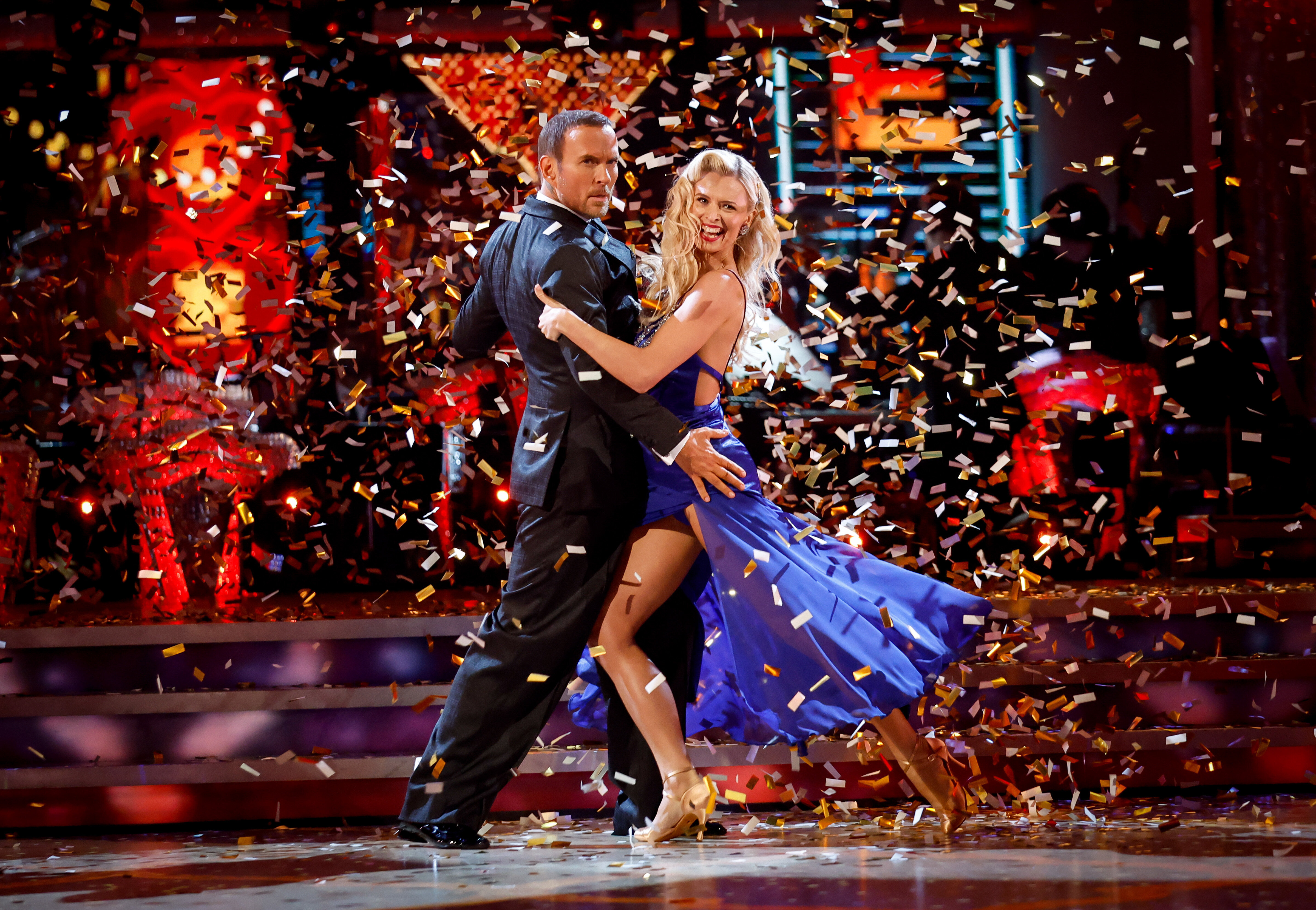
Matt Goss Responds To Rumours Of A ‘Feud’ With Strictly Dance Partner Nadiya Bychkova

Matt Goss has shut down rumours that he has been feuding with his Strictly Come Dancing partner Nadiya Bychkova.

After their first performance on last week’s show, some fans speculated that the pair weren’t getting along after Matt pulled Nadiya into a shot while chatting to host Claudia Winkleman.

However, in an interview with Metro.co.uk, the singer branded the rumours “bollocks”.

Matt Goss and Nadiya Bychkova

Ray Burmiston/BBC via PA Wire/PA Images

“First of all, I couldn’t enjoy my partner’s company more actually. She is just such a cool person. It’s all a load of bollocks,” he said.

“And to be quite honest with you, If she’s my partner, and I’m told to stand there, as a gentleman I will always make sure that she’s beside me – I’m not going to let stand behind some dark disco ball.

“I’m going to pull her in so she’s with me like every other couple but it is a load of bollocks and, as a gentleman. I’m going to make sure she’s next to me.”

Guy Levy/BBC via PA Media

Matt and Nadiya aren’t the only pairing from this year’s Strictly who have been at the centre of ’feud’ rumours.

Earlier this week, professional Giovanni Pernice shut down reports in the press claiming that he and his dance partner Richie Anderson aren’t getting along when the pair appeared on It Takes Two.

When host Janette Manrara asked Giovanni whether the pair were “having the best time in rehearsals”, the Italian dancer insisted: “We’re having a good time.

Richie Anderson and Giovanni Pernice

“Obviously it’s a dance competition at the end of the day, so we have to learn something,” he continued, before saying directly into the camera: “But there is no problem between us.

“We are having a good time! So forget about what you’re reading, it’s not true.”

Share Button

David Beckham’s Favourite Meal Includes Pineapple And Baked Beans On The Same Plate And People Have Thoughts

We’ve all got our favourite meals from childhood, but David Beckham’s go-to dinner has divided fans after he shared a snap of it online.

While his wife Victoria sticks to grilled fish and steamed vegetables, which David recently revealed she had eaten for the last 25 years, the same can’t be said for her husband.

The former footballer has revealed one of his favourite meals includes pineapple and baked beans on the same plate.

Sharing a pic of the meal on Instagram, Becks captioned it: “Last night’s feast one of my favourites growing up. Thanks mum. Gammon, chips, fried egg, tinned pineapple, peas & baked beans, coleslaw.”

David Beckham's favourite meal
David Beckham’s favourite meal

David Beckham/Instagram

People had thoughts…

“Pineapple does not belong on a main meal,” one fan commented.

A second wrote: “Coleslaw and mushy peas? Has everyone gone berserk?”

But others thought the opposite. “Perfectly acceptable dinner. Egg goes well with gammon, coleslaw with pineapple, chips with peas,” another fan wrote.

Speaking to the River Cafe Table 4 podcast earlier this year, David admitted that he gets “emotional” about food and wine, unlike his wife.

Victoria Bekham and David Beckham (Photo by Marc Piasecki/GC Images)

Marc Piasecki via Getty Images

“When I’m eating something great I want everyone to try it,” he said.

“Unfortunately I’m married to someone that has eaten the same thing for the last 25 years. Since I met Victoria, she only eats grilled fish, steamed vegetables, she will very rarely deviate away from there.”

David continued: “The only time she’s probably ever shared something that’s been on my plate was actually when she was pregnant with Harper and it was the most amazing thing. It was one of my favourite evenings. I can’t remember what it was but I know she’s not eaten it since.”

Appearing on the same podcast last year, Victoria revealed her go-to comfort food, and it sounded, well, anything but.

“This is where I sound even more boring in the food department,” she said.

“I like whole grain toast with salt on it. It’s that carbohydrate that makes you feel comforted and I love salt.”

Share Button

The Beckhams Put On A United Front To Support Victoria Beckham At Paris Fashion Week

The Beckham’s put on a united front on Friday to show their support for Victoria Beckham’s first ever Paris Fashion Week show.

The former Spice Girl-turned fashion designer debuted her latest collection in front of husband David Beckham, along with sons Romeo, 20, and Cruz, 17, and 11-year-old daughter Harper.

And despite unfounded rumours of a rift between Victoria and her eldest son Brooklyn’s wife Nicola Peltz, the newlyweds were also on the front row.

There was also a nod to Victoria and David’s former habit of wearing (often questionable) outfits with Brooklyn and Nicola rocking up in coordinated ensembles of denim jeans, black tops and boots.

Also sitting in the front row were Vogue editors Anna Wintour and Edward Enniful.

Victoria captioned her Instagram post: “It’s Paris baby!! I’m so grateful for my family, @BritishVogue and @VogueMagazine for always supporting me on this journey xx VB”.

Brooklyn also shared the post to his Story, writing: “Congratulations mum on a great show”.

Meanwhile, David shared a behind-the-scenes snap on his Instagram Story of Victoria backstage, and congratulated his wife on her latest collection and show.

Victoria Beckham
Victoria Beckham

David Beckham/Instagram

“16 years of hard work and we know how much today means to you. We are so proud,” he wrote.

US supermodels Gigi and Bella Hadid both walked in the show and other guests included Desperate Housewives star Eva Longoria and model Poppy Delevingne.

Describing her catwalk show, Victoria wrote: “Bold. Feminine. Delicate. Sexy. Those are the ideas I was thinking of for #VBSS23.

“It’s about embracing femininity and shifting between soft and hard, structured and fluid.

“Thank you so much to my incredible team and to these incredible VB women!!”

(L-R) David Beckham, Victoria Beckham and Harper Beckham are seen on September 30, 2022 in Paris, France. (Photo by Marc Piasecki/GC Images)

Marc Piasecki via Getty Images

Nicola recently spoke out about the false stories that there is any bad blood between her and her famous mum-in-law, after she chose to wear a Valentino dress to her wedding earlier this year.

She told Grazia: “When I read things that say [things like] I was never planning on wearing a [Victoria Beckham] dress or things like that, it does hurt my feelings. I try not to let it, but it’s just not the truth. It’s just a bit of a bummer when you’re like, ‘Oh, people think that,’ but it’s just not true.”

Share Button

Exploring Jupiter’s moon, Europa, possible with silicon-germanium transistor technology

Europa is more than just one of Jupiter’s many moons — it’s also one of most promising places in the solar system to look for extraterrestrial life. Under 10 kilometers of ice is a liquid water ocean that could sustain life. But with surface temperatures at -180 Celsius and with extreme levels of radiation, it’s also one of the most inhospitable places in the solar system. Exploring Europa could be possible in the coming years thanks to new applications for silicon-germanium transistor technology research at Georgia Tech.

Regents’ Professor John D. Cressler in the School of Electrical and Computer Engineering (ECE) and his students have been working with silicon-germanium heterojunction bipolar transistors (SiGe HBTs) for decades and have found them to have unique advantages in extreme environments like Europa.

“Due to the way that they’re made, these devices actually survive those extreme conditions without any changes made to the underlying technology itself,” said Cressler, who is the project investigator. “You can build it for what you want it to do on Earth, and you then can use it in space.”

The researchers are in year one of a three-year grant in the NASA Concepts for Ocean Worlds Life Detection Technology (COLDTech) program to design the electronics infrastructure for upcoming Europa surface missions. NASA plans to launch the Europa Clipper in 2024, an orbiting spacecraft that will map the oceans of Europa, and then eventually send a landing vehicle, Europa Lander, to drill through the ice and explore its ocean. But it all starts with electronics that can function in Europa’s extreme environment.

Cressler and his students, together with researchers from NASA Jet Propulsion Lab (JPL) and the University of Tennessee (UT), demonstrated the capabilities of SiGe HBTs for this hostile environment in a paper presented at the IEEE Nuclear and Space Radiation Effects Conferencein July.

Europa’s Challenge

Like Earth, Jupiter also has a liquid metal core that generates a magnetic field, producing radiation belts of high-energy protons and electrons from the impinging solar wind. Unfortunately, as a moon of Jupiter, Europa sits squarely in those radiation belts. In effect, any technology designed for Europa’s surface would not only need to be able to survive the cold temperatures but also the worst radiation encountered in the solar system.

Fortunately, SiGe HBTs are ideal for this hostile environment. The SiGe HBT introduces a nanoscale Si-Ge alloy inside a typical bipolar transistor to nano-engineer its properties, effectively producing a much faster transistor while maintaining the economy-of-scale and low cost of traditional silicon transistors. SiGe HBTs have the unique ability to maintain performance under extreme radiation exposure, and their properties naturally improve at colder temperatures. Such a unique combination makes them ideal candidates for Europa exploration.

“It’s not just doing the basic science and proving that SiGe works,” Cressler said. “It’s actually developing electronics for NASA to use on Europa. We know SiGe can survive high levels of radiation. And we know it’s remains functional at cold temperatures. What we did not know is if it could do both at the same time, which is needed for Europa surface missions.”

Testing the Transistors

To answer this question, the GT researchers used JPL’s Dynamitron, a machine that shoots high-flux electrons at very low temperatures to test SiGe in Europa-type environments. They exposed SiGe HBTs to one million Volt electrons to a radiation dose of five million rads of radiation (200-400 rads is lethal to humans), at 300, 200, and 115 Kelvins (-160 Celsius).

“What had never been done was to use electronics like we did in that experiment,” Cressler said. “So, we worked literally for the first year to get the results that are in that paper, which is in essence definitive proof that what we claimed is, in fact, true — that SiGe does survive Europa surface conditions.”

In the next two years, the GT and UT researchers will develop actual circuits from SiGe that could be used on Europa, such as radios and microcontrollers. Yet more importantly, these devices could then be seamlessly used in almost any space environment, including on the moon and Mars.

“If Europa is the worst-case environment in the solar system, and you can build these to work on Europa, then they will work anywhere,” Cressler said. “This research ties together past research that we have done in my team here at Georgia Tech for a long time and shows really interesting and novel applications of these technologies. We pride ourselves on using our research to break new innovative ground and thereby enable novel applications.”

Video: https://youtu.be/hKr6uh4k-7g

Story Source:

Materials provided by Georgia Institute of Technology. Original written by Tess Malone. Note: Content may be edited for style and length.

Share Button

A Guide To The Confusing Language Describing The UK’s Financial Markets Meltdown

The language of economics and the financial system can be confusing for those not steeped in the world of pensions, gilts and bear markets.

But there’s been a lot of around, as the Conservative Party’s mini-budget spooked the markets, causing a collapse in the pound and a surge in the UK’s borrowing costs. Here’s an explanation to some of the phrases and ideas being bandied around.

Why is ‘supply-side economics’ being mentioned?

The economic theory is highly fashionable having been fully embraced by the UK’s new prime minister, Liz Truss and her chancellor, Kwasi Kwarteng, in their controversial “fiscal event”.

The theory holds that the supply of goods and services within the economy is the main driver of growth. Put bluntly, the idea is to give wealthy individuals or large corporations tax cuts, which in turn creates jobs and later increases the number of people paying taxes and boosts the amount of money collected by the Treasury. The prime minister’s approach has been dubbed “Trussonomics”, and supporters talk a lot about baking a bigger economic “pie” that everyone can share.

The theory was particularly popular in right-wing circles in the 1980s. In common with US president Ronald Reagan, UK prime minister Margaret Thatcher experimented in this kind of low-tax economics, the results of which have been disputed ever since.

<img class="img-sized__img landscape" loading="lazy" alt="Chancellor Kwasi Kwarteng arrives at Darlington station for a visit to see local business.” width=”720″ height=”482″ src=”https://www.wellnessmaster.com/wp-content/uploads/2022/09/a-guide-to-the-confusing-language-describing-the-uks-financial-markets-meltdown-3.jpg”>
Chancellor Kwasi Kwarteng arrives at Darlington station for a visit to see local business.

Owen Humphreys via PA Wire/PA Images

The phrase “trickle-down” economics – the benefits generated at the top trickling down to everyone – has become synonymous with the idea.

When talking about supply-side economics, commentators will invariably refer to the Laffer Curve – a graph showing the relationship between tax rates and the amount of tax revenue collected by governments. It’s named after Arthur Laffer, a member of Reagan’s economic policy advisory board, who also advised Thatcher, earning him the nickname the “father” of supply-side economics.

When do we know we’re in a recession?

A technical recession is defined by two successive quarters of falling economic output – measured by gross domestic product (GDP), which attempts to summarise all the activity of companies, governments and individuals in an economy in a single figure.

Some people argue the term “recession” is an unreliable indicator because people could be suffering all the effects of an economic downturn, such as long-term unemployment, but the data might not officially say as much.

Kwarteng has admitted the UK is “technically” in a recession, even if the official figures are yet to confirm it.

In 2020, the Office for National Statistics (ONS) officially declared the UK in recession – the steepest on record – after the economy plunged by 19.6% between April and June due to the coronavirus lockdown.

It followed a 2.2% contraction in the previous three months – marking the first recession since the 2008 global financial crisis, when the UK fell into a year-long recession.

What is inflation?

At its heart, inflation is the measure of how quickly the cost of goods and services is growing. It is an average across many categories, so if food prices rise, that could still be offset by drops in, say, the price of petrol.

In the UK, the ONS is tasked with estimating the inflation rate.

It has a basket of goods and services that it tracks. It might be helpful to think of this as a massive shopping basket with what the ONS thinks that people in the UK buy. It includes around 730 items, anything from dating agency fees to condoms, wild bird seed to petrol, and crumpets to pet food.

What is in the basket changes every year – with some additions and some removals – because what people buy changes. For 2022 antibacterial surface wipes were added, along with meat-free sausages and other items.

What’s the Bank of England’s role?

Owned by but independent from the UK government, the Bank of England is tasked with keeping inflation under control, targeting 2% a year.

But in recent months inflation has started to run away. It hit 9.9% in August and, despite government action to freeze energy bills, is still expected to strike a new 40-year-high “just below 11%”, the central bank has said.

The Bank of England also has a wider remit to ensure the health of the economy. Many will remember the economy-boosting stimulus in the form of quantitative easing – often referred to as printing money – being deployed during the 2008 financial crisis.

How do interest rates fit in?

An interest rate is a measure that tells you how high the cost of borrowing money is, or how high the rewards are for saving.

The Bank of England’s “base rate” – the interest rate at which banks borrow from the central bank, which has billions of pounds in assets at its disposal – has a knock-on effect on the interest rates offered on the high-street for mortgages and savings.

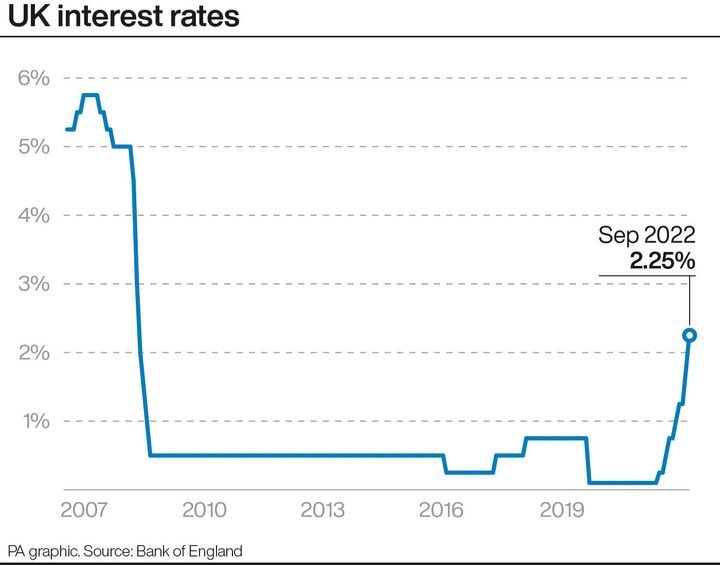
Raising and lowering interest rates is the blunt instrument at the Bank’s disposal to control the economy. Hiking the base rate increases the cost of borrowing, making both credit and investment more expensive. The idea is to put the brakes on the economy and curb soaring inflation. Bringing rates down is an attempt to have the opposite effect – stimulate growth by making borrowing cheaper, and in turn, encourage investment.

UK interest rates. See story ECONOMY Rates. Infographic PA Graphics. An editable version of this graphic is available if required. Please contact graphics@pamediagroup.com.

PA Graphics via PA Graphics/Press Association Images

Before the mini-budget, the Bank raised the base rate by 0.5 percentage points – the seventh hike since December – in a bid to keep inflation under control. Now some analysts are predicting the base rate, currently standing at 2.25%, will have to rise to as high as 6% next year.

What about bonds and yields?

The Bank of England has also intervened to try to bring surging yields in government bonds – known as gilts – under control as they spiralled higher, sending UK public borrowing costs soaring.

It said it would buy bonds “on whatever scale is necessary”. The Bank stepped in to calm markets after some types of pension funds were at risk of collapse.

Bonds are loans that investors make to a bond issuer and can be issued by companies or governments to raise money.

The yield on a bond is the amount of money an investor receives for owning the debt and is represented as a percentage of its price. When a bond price falls, its yield rises.

Yields fall when investors are less willing to own the debt, meaning they will pay a lower price for the bonds.

Alarm bells were ringing when yields on 10-year UK government bonds rose above 4%, the highest since the 2008 financial crisis, and more than triple the 1.3% rate at the start of the year.

The higher yield reflected fears investors had in the state of the UK economy, and again impacts how much interest banks charge for various types of loans, most notably mortgages.

Share Button

Evidence of social relationships between chimpanzees, gorillas

A long-term study led by primatologist Crickette Sanz at Washington University in St. Louis reveals the first evidence of lasting social relationships between chimpanzees and gorillas in the wild.

Drawn from more than 20 years of observations at Nouabalé-Ndoki National Park in the Republic of Congo, researchers documented social ties between individual chimpanzees and gorillas that persisted over years and across different contexts. The research was conducted by scientists from Washington University, the Wildlife Conservation Society, the University of Johannesburg (South Africa) and Lincoln Park Zoo (Chicago) and is reported in the journal iScience.

“There are few (if any) studies of interactions between primate species that have been able to take the identity of individuals into account,” said Sanz, a professor of biological anthropology in Arts & Sciences. “It has long been known that these apes can recognize individual members of their own species and form long-term relationships, but we had not known that this extended to other species.

“An example of what we found might be one individual traveling through a group of the other species to seek out another particular individual,” she said. “We were also able to document such interactions over time and in different contexts in this study.”

Most people do not realize that the majority of remaining gorillas and chimpanzees reside together.

The large tracts of forest in the Congo Basin are a conservation stronghold not only for these two kinds of endangered great apes but also forest elephants, leopards and many other species. The government of the Republic of Congo and the Wildlife Conservation Society have worked together for nearly three decades to save wild places that sustain the local people, protect natural resources and buffer global climate change.

In a review of published reports combined with a synthesis of previously unpublished data about daily follows of chimpanzees and gorillas from 1999 to 2020 in the Goualougo Triangle, scientists documented ape species engaging in a wide range of social interactions, ranging from play to aggression. Researchers investigated several possible benefits of these interspecies rendezvous, including protection from predation, improved foraging options and other social benefits from information sharing.

What they learned shows us that no ape is an island. “Rather than thinking about chimpanzees alone, we should be thinking about them within diverse and dynamic habitats where they are actively engaging with other species and play an integral role in the persistence of the unique ecosystems in which they exist,” said co-author David Morgan, research fellow at Lincoln Park Zoo.

Why interact at all

One of the key theories that has been suggested for why apes might choose to associate with members of different species is to avoid predators.

But information gathered in this study suggests these social interactions can’t be chalked up to threat reduction. The scientists found little support for the idea that chimpanzees or gorillas are associating to decrease leopard, snake or raptor predation attempts.

“Predation is certainly a threat in this region, as we have cases in which chimpanzees have been killed by leopards,” Sanz said. “However, the number of chimpanzees in daily subgroups remains relatively small, and gorillas within groups venture far from the silverback who is thought to be a protector from predation.”

Instead, enhanced foraging opportunities seem to be more important. The researchers found that co-feeding at the same tree represented 34% of the interspecific associations that they documented, with another 18% of observations involving apes foraging in close spatial proximity but on different foods.

At least 20 different plant species were targeted by apes during co-feeding events in this study, greatly expanding researchers’ knowledge of the diversity of resources that chimpanzees and gorillas are willing to gather together to share.

In addition to a greater diversity of interactions than previously documented among sympatric apes, this study revealed social relationships between members of different species that persisted over years.

For example, study authors noted that on several occasions at food sources, they observed young gorillas and chimpanzees seeking out particular partners to engage in bouts of play. These types of interactions may afford unique development opportunities that extend the individual’s social, physical and cognitive competencies.

“No longer can we assume that an individual ape’s social landscape is entirely occupied by members of their own species,” said co-author Jake Funkhouser, a doctoral candidate of biological anthropology at Washington University. “The strength and persistence of social relationships that we observed between apes indicates a depth of social awareness and myriad social transmission pathways that had not previously been imagined. Such insights are critical given these interspecies social relationships have the potential to serve as transmission pathways for both beneficial socially learned cultural behaviors and harmful infectious disease.”

Concerns about disease transmission

Certainly, social exchanges between apes have their risks. One is the potential for disease transmission. While poaching and habitat loss still represent the largest threats to apes, infectious disease has recently emerged as a threat of similar magnitude.

Because chimpanzees and gorillas are closely related, many pathogens can be transmitted between them. Ebola, for example, is a highly transmissible virus that has had a devastating impact on ape populations in central Africa. Just over 20 years ago, Ebola emerged in wild ape populations and then spread to humans. By some estimates, that wave of the Ebola virus wiped-out one-third of the world’s chimpanzees and gorillas.

“While we continue to be concerned about many disease risks, we now know much more about the origin of many of these pathogens and routes of their transmission within and between species, including humans,” Sanz said.

In this study, “the surprise to us was the extent of overlap and interaction that occurred between these apes that was previously not recognized or reported,” she said. “Based on the literature, we had anticipated that the apes would avoid one another … and in some cases, it seemed to be the opposite.”

Co-existing comfortably

Studying co-existing great apes may inform us about interactions between some early hominins, study authors said.

There has been a long history in paleoanthropology of assuming that early hominins would competitively exclude each other from using the same resources in the same areas. But if modern-day observations with non-human apes are informative about the behavior of early modern humans, then this study suggests these interactions would have most likely occurred in tolerant social contexts.

Sanz emphasizes the continuing importance of longitudinal studies to understand chimpanzee and gorilla behavior and ecology — but also to protect these apes and their habitats.

“Despite more than 60 years of chimpanzee and gorilla research, there is still much to be learned about these fascinating apes — the main challenge at this time is to ensure the conservation of these endangered species so that such opportunities exist for future generations,” she said.

Share Button

Molly Russell inquest: Father makes social media plea

Tech firms should “stop monetising misery”, the father of Molly Russell says as her inquest ends.

Share Button

Gene test spared baby unnecessary chemotherapy

It revealed a lump on the newborn’s leg was a rare and benign mass called a myofibroma.

Share Button