Boris Johnson Accused Of Breaking Ministerial Code With ‘Political’ Attack On Sadiq Khan

Stefan RousseauPA

Prime Minister Boris Johnson, during a media briefing in Downing Street, London, on coronavirus (Covid-19). Picture date: Monday April 5, 2021.

Boris Johnson broke ministerial rules and misled the public when he launched on “unprompted political attack” on Sadiq Khan using the government’s new £2.6m Downing Street press room, Labour has said. 

The prime minister was reaching the end of a televised briefing on the Covid pandemic when he made false claims about the London mayor and Transport for London (TfL) budget. 

Johnson, Khan’s predecessor at City Hall, claimed he left TfL’s finances in “robust, good order”, and the current mayor had blown a “black hole” in the budget with a fares freeze. 

The complete collapse in passenger numbers since Covid hit, however, has seen government agree a £1.6bn bailout in May, followed by a £1.8bn deal in November.

A TfL report published a month before Johnson left office in 2016 also showed TfL had a nominal debt of £9.1bn.

Labour deputy leader Angela Rayner has now written to cabinet secretary Simon Case calling for him to investigate and for the PM to apologise. 

She alleges Johnson broke the ministerial code by using government resources – the Downing Street press room – for political campaigning during an election period. 

It comes ahead of local elections in May, including at City Hall. 

The code, which governs ministers’ conduct, states: “Official facilities and resources may not be used for the dissemination of party political material”.

Rayner writes: “The attack was political in nature, unprompted, and entirely unrelated to either the topic of the press conference or the question the prime minister was asked.” 

The deputy leader also hit out at Johnson’s decision not to sack home secretary Priti Patel after a formal investigation found evidence that she bullied civil servants. 

Ethics adviser Alex Allan quit after Johnson ruled Patel should stay in post. 

Rayner said: “The ministerial code, by which government ministers are bound, clearly states that official facilities and resources may not be used for the dissemination of party political material.

“This includes the prime minister’s new media briefing room, which cost the British taxpayer £2.6 million.

“The prime minister has a lot of experience with the ministerial code – his home secretary was found to have breached it after bullying staff, prompting his independent advisor on ethics and ministerial standards to resign.

“The British people would rightly not expect a prime minister who has spent so much first-hand experience of dealing with matters relating to the Code to be so blatant in flouting it during a pre-election period.”  

Rayner states that in the four years Sadiq Khan was mayor before Covid hit, he reduced the operating deficit of TfL, left by the previous mayor, by 71%. 

But Johnson said during the press briefing on Monday: “As for the finances of TfL I must respectfully remind you that I left them in robust, good order. It is not through any fault of my own the current Labour mayor decided to blow them all on an irresponsible fares policy. 

“We are doing our best to help them out and we will continue to do so. But I’m afraid you have to look at some of the decisions that were taken by the current Labour mayor as well.

“I hesitate to make a point like that but since you rightly draw attention to the fact I’m a proud former mayor of London I do think we could look at the way TfL is being run.” 

The Cabinet Office confirmed the letter had been received.

Share Button

Grass rings: How the spinifex got its hole

Anyone who has visited the Australian outback would be familiar with spinifex grasses, which cover almost a fifth of our continent.

Like many scientists, they may have also wondered why this iconic arid grass grows in striking ring shapes.

Previous studies have tested whether spinifex rings could be caused by termites, water availability or nutrient depletion, but none has provided a convincing explanation.

Now scientists from UNSW Sydney have found that pathogenic soil microbes play a role in how the spinifex got its hole.

Their study, the first of its kind in an arid ecosystem, has been published in the Australian Journal of Botany.

Professor Angela Moles and Neil Ross from The Evolution & Ecology Research Centre tested the idea that an accumulation of pathogenic soil microbes might impede seedling emergence and subsequent growth in the centre of spinifex rings.

They collected soil from inside and outside naturally occurring spinifex rings and compared plants grown in soil with live microbes to plants grown in sterilised soil.

“Consistent with our hypothesis, we found that sterilising soil from the inside of spinifex rings significantly increased spinifex seedling emergence,” Prof. Moles said.

“We also found that seedings had significantly higher seedling emergence in unsterilised soil from outside the rings than in unsterilised soil from inside the rings.”

Their results suggest that die-back in the centre of spinifex plants might be explained by older parts of the plant succumbing to a build-up of pathogenic soil microbes through time, where as new seedlings tend to establish more at the outside edge of the rings where there are fewer pathogens in the soil.

“Most people tend to think of the beneficial effects of microbes on plant growth,” co-author and director of UNSW Science’s Evolution & Ecology Research Centre, Professor Angela Moles said.

“However, sterilising soil actually makes most plants grow better. That is, the negative effects of the pathogenic microbes tend to outweigh the positive effects of the beneficial microbes.”

“Overall, these results suggest that soil pathogens are quietly shaping the way the plants around us grow.”

Prof. Moles said this new information helps scientists further understand the unique ecology of Australia’s arid grasslands, and adds to the growing recognition of the crucial function that soil microbes play in terrestrial ecosystem processes worldwide.

The scientists have recommended further study to identify the types of soil microbes involved in the establishment of arid-zone plants, as well as the different types of microbes that are most important for seedlings at different times or under different germination conditions.

Story Source:

Materials provided by University of New South Wales. Note: Content may be edited for style and length.

Share Button

New proposal for the management of low back pain with a proprioceptive approach

Ever since the early humans learned to walk upright, they have suffered, as an unfortunate consequence of their erect posture, from low back pain. Modern understanding on this matter dictates that low back pain, in particular, is caused due to a postural instability resulting from poor “proprioception,” which is a term for the perception of part of our body’s own position in space. In fact, our trunk and lower legs are key to maintaining postural stability due to the presence of “proprioceptors” — sensory receptors responding to position and movement — in those areas.

Elderly people suffering from low back pain tend to have poorly performing proprioceptors, which is thought to affect their “proprioceptive control strategy” — a postural control strategy in response to vibratory stimulations as proprioceptive input. Interestingly, studies have suggested that a local vibratory stimulation can, in fact, improve proprioceptive function. In previous studies by other researchers, however, its effect on postural control is still unclear. Moreover, the studies make no distinction between poor and healthy proprioceptors and do not take into account the fact that each proprioceptor has a natural vibration response frequency.

To address these issues, a team of researchers from Japan recently conducted a study in which they explored the effect of local vibratory stimulations on the proprioceptive control strategy when applied to a poor proprioceptor. Prof. Yoshifumi Morita from Nagoya Institute of Technology, Japan, who was part of the study, published in Electronics, lays down the research question: “For elderly people with low back pain, can proprioceptive function be improved? Will it cure the low back pain?”

Researchers carried out their study over a period of 3 months in which they recruited six elderly individuals, all of whom were patients with low back pain. Researchers made each participant stand on a balance board to assess their standing balance and attached fasteners with vibrators to their legs as well as both sides of their trunk. They then generated vibration signals using a PC and amplified and output them from the vibrators as mechanical vibratory stimulations. Furthermore, they allowed the frequency of stimulation to vary with time, from an initial 20 Hz (cycles/second) up to 300 Hz, to gauge the postural response as a function of the applied frequency. Finally, they compared the proprioceptive control strategy in each patient before and after applying the stimulations to an impaired proprioceptor.

Three patients showed an improvement in their proprioceptive control strategy after their impaired muscle spindles (proprioceptor detecting stretch in muscles) responded to higher frequency, an observation that suggested that low back pain could be alleviated in patients by activating impaired proprioceptors with vibratory stimulations. Furthermore, the treatment device and protocol could be used for multiple frequency ranges, allowing for the diagnosis as well as activation of a poor proprioceptor.

Given the results, the researchers look forward to conducting a clinical trial for a larger group of patients. “The clinical trial is scheduled to start in April this year and will be conducted for the next three years. We plan to verify whether the improved proprioceptive sensation can be maintained for a long time, thus relieving elderly people of low back pain,” comments an excited Prof. Morita.

The team hopes that the trial’s findings will soon lead to the commercialization of their device, which will allow elderly patients with low back pain to finally breathe a huge sigh of relief!

Story Source:

Materials provided by Nagoya Institute of Technology. Note: Content may be edited for style and length.

Share Button

Scientists develop eco-friendly pollen sponge to tackle water contaminants

A team of scientists led by Nanyang Technological University, Singapore (NTU Singapore) has created a reusable, biodegradable sponge that can readily soak up oil and other organic solvents from contaminated water sources, making it a promising alternative for tackling marine oil spills.

Made of sunflower pollen, the sponge is hydrophobic — it repels water — thanks to a coat of natural fatty acid on the sponge. In lab experiments, the scientists showed the sponge’s ability to absorb oil contaminants of various densities, such as gasoline and motor oil, at a rate comparable to that of commercial oil absorbents.

Oil spills are difficult to clean up, and result in severe long-lasting damage to the marine ecosystem. Conventional clean-up methods, including using chemical dispersants to break oil down into very small droplets, or absorbing it with expensive, unrecyclable materials, may worsen the damage.

So far, the researchers have engineered sponges that measure 5 cm in diameter. The research team, made up of scientists from NTU Singapore and Sungkyunkwan University in South Korea, believes that these sponges, when scaled up, could be an eco-friendly alternative to tackle marine oil spills.

Professor Cho Nam-Joon from the NTU School of Materials Science and Engineering, who led the study, said: “By finetuning the material properties of pollen, our team successfully developed a sponge that can selectively target oil in contaminated water sources and absorb it. Using a material that is found abundantly in nature also makes the sponge affordable, biodegradable, and eco-friendly.”

This study builds on NTU’s body of work on finding new uses for pollen, known as the diamond of the plant kingdom for its hard exterior, by transforming its tough shell into microgel particles. This soft, gel-like material is then used as a building block for a new category of environmentally sustainable materials.

Last year, Prof Cho, together with NTU President Professor Subra Suresh, led a research team to create a paper-like material from pollen as a greener alternative to paper created from trees. This ‘pollen paper’ also bends and curls in response to changing levels of environmental humidity, a trait that could be useful for soft robots, sensors, and artificial muscles.

Prof Cho, who also holds the Materials Research Society of Singapore Chair in Materials Science and Engineering, added: “Pollen that is not used for plant pollination is often considered biological waste. Through our work, we try to find new uses for this ‘waste’ and turn it into a natural resource that is renewable, affordable, and biodegradable. Pollen is also biocompatible. It does not cause an immunological, allergic or toxic reaction when exposed to body tissues, making it potentially suitable for applications such as wound dressing, prosthetics, and implantable electronics.”

The findings were published in the scientific journal Advanced Functional Materials in March.

Building a sponge from pollen

To form the sponge, the NTU team first transformed the ultra-tough pollen grains from sunflowers into a pliable, gel-like material through a chemical process akin to conventional soap-making.

This process includes removing the sticky oil-based pollen cement that coats the grain’s surface, before incubating the pollen in alkaline conditions for three days. The resulting gel-like material was then freeze-dried.

These processes resulted in the formation of pollen sponges with 3D porous architectures. The sponges were briefly heated to 200°C — a step that makes their form and structure stable after repeatedly absorbing and releasing liquids. Heating also led to a two-fold improvement in the sponge’s resistance to deformation, the scientists found.

To make sure the sponge selectively targets oil and does not absorb water, the scientists coated it with a layer of stearic acid, a type of fatty acid found commonly in animal and vegetable fat. This renders the sponge hydrophobic while maintaining its structural integrity.

The scientists performed oil-absorption tests on the pollen sponge with oils and organic solvents of varying densities, such as gasoline, pump oil, and n-hexane (a chemical found in crude oil).

They found that the sponge had an absorption capacity in the range of 9.7 to over 29.3 g/g.* This is comparable to commercial polypropylene absorbents, which are petroleum derivatives and have an absorption capacity range of 8.1 to 24.6 g/g.

They also tested the sponge for its durability and reusability by repeatedly soaking it in silicone oil, then squeezing the oil out. They found that this process could go on for at least 10 cycles.

In a final proof-of-concept experiment, the team tested the ability of a sponge 1.5cm in diameter and 5mm in height to absorb motor oil from a contaminated water sample. The sponge readily absorbed the motor oil in less than 2 minutes.

“Collectively, these results demonstrate that the pollen sponge can selectively absorb and release oil contaminants and has similar performance levels to commercial oil absorbents while demonstrating compelling properties such as low cost, biocompatibility, and sustainable production,” said Prof Cho, the corresponding author of this study.

Going forward, the researchers plan to scale up the size of pollen sponges to meet industry needs. They are also looking to collaborate with non-governmental organisations and international partners to conduct pilot tests with pollen sponges in real-life environments.

“We hope our innovative pollen materials can one day replace widely-used plastics and help to curb the global issue of plastic pollution,” said Prof Cho.

*g/gis a unit of measurementfor absorption capacity. It refers to how many grams of the contaminant can adhere to per gram of the material that absorbs

Share Button

Covid: Moderna vaccine UK rollout begins in Wales

The vaccine is the third to be used in the UK, with England’s rollout due “in the next few days”.

Share Button

Covid-19 raises risk of depression and dementia, study suggests

Researchers looked at how likely 600,000 patients were to develop one of 14 common brain conditions.

Share Button

Covid: Child jabs halted in trial as adult clot link probed

The UK’s regulator is to investigate the Oxford-AstraZeneca jab over a possible link with blood clots.

Share Button

Labour MPs Told The Party Will Vote Against Domestic Vaccine Passports

Labour MPs have been told the party will vote against coronavirus vaccine passports as things stand, setting up a high stakes showdown between Boris Johnson and Tory rebels.

A briefing sent to Labour MPs from the parliamentary Labour party (PLP) office said that the current position is to oppose in a Commons vote any measures to require people to show proof of vaccination to access shops or pubs.

The government on Monday said vaccine passports could be used by pubs and restaurants to relax social distancing rules, from May 17 at the earliest.

More than 40 Tory MPs have already signed a cross-party letter opposing the idea.

If that many rebelled in a future vote, it could be enough to join forces with Labour an other opposition parties to defeat the prime minister, if he decides to roll out the measures.

Vaccines minister Nadhim Zahawi told Times Radio that “of course we will go to parliament for a vote” if Johnson decides to proceed with passports.

The briefing confirms Labour will vote against the measures, as things stand, as the party believes they will be discriminatory.

It asks the question “how will Labour vote on vaccine and test certification”, before answering: “On the basis of what we’ve seen we would oppose domestic vaccine passports.

“Labour’s focus would be on getting the vaccine out, fixing self-isolation and contact tracing”.

But the party left the door open to backing testing certification that could, for example, allow people to attend large events after a negative Covid test.

Earlier, shadow health secretary Jon Ashworth told the BBC: “I’m not going to support a policy that, here in my Leicester constituency, if someone wants to go into Next or H&M, they have to produce a vaccination certificate on their phone, on an app.

“I think that’s discriminatory.”

A senior Labour source said: “On the basis of what we’ve seen and discussed with ministers, we oppose the government’s plans for domestic vaccine passports.

“They appear poorly thought-through, will put added burdens on business and run the risk of becoming another expensive Whitehall project that gets outsourced to friends of Tory ministers.”

On Monday, a government review said ministers believe “that there are some settings (such as essential public services, public transport and essential shops) where Covid-status certification should never be required, in order to ensure access for all”.

But it added: “Equally, Covid-status certification could potentially play a role in settings such as theatres, nightclubs, and mass events such as festivals or sports events to help manage risks where large numbers of people are brought together in close proximity.

“It is possible that Covid-status certification could also play a role in reducing social distancing requirements in other settings which people tend to visit more frequently, for example in hospitality settings.”

Share Button

UK’s Vaccine Rollout ‘On Track’ Despite Sharp Slowdown In Jabs

Yui MokPA

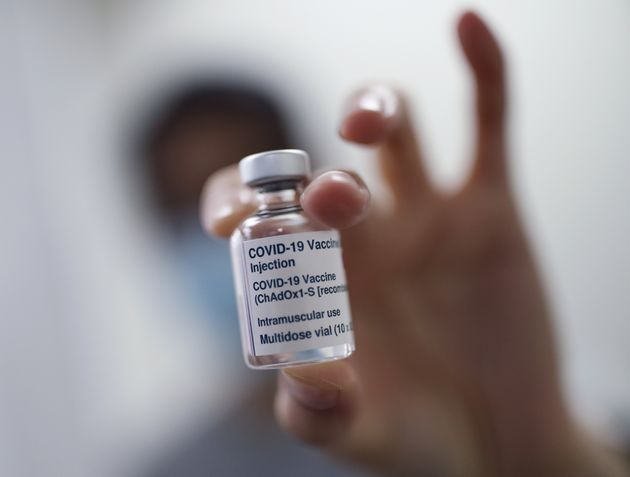
A vial of the Oxford/AstraZeneca coronavirus vaccine.

The number of people receiving a Covid-19 vaccine in the UK daily has fallen by around 75% in the last week as the supply of the jab has been squeezed.

Minsters revealed last month there would be a “significant reduction” in doses from the end of March, raising questions about whether the programme’s target dates will be met and when under-50s would be innoculated.

Supplies of vaccines in April have been constrained by the need to test a batch of 1.7 million doses and delays in a shipment of around five million from India.

Government data up to April 5 shows that first doses were given to 40,744 people on the previous day, and 64,590 got a second dose – or 105,334 in total. The number of people being injected with their first shot was the lowest since records began on January 10. A day earlier, just 95,763 people received one of their two doses. 

By contrast, just a week earlier – March 29 – 405,039 doses were distributed. And on March 5, the figure stood at 494,235. 

While the fall may seem steeper than billed, Downing Street on Tuesday moved to allay fears – insisting all adults will be offered a coronavirus vaccine by the end of July as planned.

Some 25m people have so far had a first dose of either the AstraZeneca or the Pfizer vaccine in the UK, while just under 1.8m have had both shots. The government is aiming to vaccinate all over-50s by mid-April and everyone else by the end of July.

The Cabinet Office has indicated that an average of 2.7 million doses a week will be given in England until the end of July, down from a previous estimate of 3.2 million.

The prime minister’s official spokesperson refused to be drawn on “details around supplies and deliveries” of vaccine doses but said “we remain on track” to meet the targets set for the programme.

But the Cabinet Office scenario, provided to experts on the Scientific Pandemic Influenza Group on Modelling (Spi-M) suggests the squeeze on supplies may continue for months.

Papers produced by Spi-M on February 17 were based on an average of 3.2 million doses a week until the end of July and 3.9 million thereafter.

Spi-M said the central scenario provided by the Cabinet Office for its March 31 paper was “considerably slower”, with 2.7 million weekly doses until the end of July and two million from then on.

A slower scenario suggested that just 2.5 million weekly doses might be available.

The Spi-M summary notes that the two scenarios produced by the Cabinet Office “may not reflect the situation most likely to occur”.

The PM’s spokesperson added: “The health secretary set out a couple of weeks ago now the fact that there will be a slight reduction in April but the key thing to remember is that doesn’t mean that we are not on track to hit our pledges.

“We remain on track to vaccinate all those in phase one by April 15, we remain on track to vaccinate or provide the first dose to all adults by the end of July.”

The rollout will be boosted by the introduction of Moderna jabs later in April alongside the Pfizer and AstraZeneca vaccines already being used.

“I’m not going to get into the specifics of how many we will get this month,” the spokesperson said, but “we will have three vaccines that we are able to distribute and that will ensure that we can continue to make sure we are giving people their first doses as well as giving more and more people their second doses”.

Some 26.7 million people in England have had a first dose, the equivalent of 60% of the adult population, leaving around 17.5 million adults needing their initial jab to meet the end-of-July target.

Share Button

To intervene or not to intervene? That is the future climate question

Nine of the hottest years in human history have occurred in the past decade. Without a major shift in this climate trajectory, the future of life on Earth is in question, which poses a new question: Should humans, whose fossil fueled society is driving climate change, use technology to put the brakes on global warming?

Michigan State University community ecologist Phoebe Zarnetske is co-lead of the Climate Intervention Biology Working Group, a team of internationally recognized experts in climate science and ecology that is bringing science to bear on the question and consequences of geoengineering a cooler Earth.

The group’s paper, “Potential ecological impacts of climate intervention by reflecting sunlight to cool Earth,” was published in the most recent issue of Proceedings of the National Academy of Sciences, or PNAS.

“There is a dearth of knowledge about the effects of climate intervention on ecology,” said Zarnetske, associate professor in the Department of Integrative Biology in the MSU College of Natural Science and the paper’s lead author. “As scientists, we need to understand and predict the positive and negative effects it could have on the natural world, identify key knowledge gaps and begin to predict what impacts it may have on terrestrial, marine and freshwater species and ecosystems if it were adopted in the future.”

Conversations in 2018 between Jessica Gurevitch, Distinguished Professor in the Department of Ecology and Evolution at Stony Brook University and working group co-lead, and Alan Robock, Distinguished Professor in the Department of Environmental Sciences at Rutgers University, gave rise to the pioneering group, which is more aware than most that geoengineering Earth’s atmosphere is more than just a science fiction scenario.

The costs and technology needed to reflect the sun’s heat back into space are currently more attainable than other climate intervention ideas like absorbing carbon dioxide from the air. The working group anticipates its discussions and open access paper will encourage an explosion of scientific investigation into how a climate intervention strategy known as solar radiation modification, or SRM, in tandem with greenhouse gas emissions reduction, would affect the natural world.

The feasibility of planetary wide SRM efforts hinge on accurate predictions of its myriad outcomes provided by the well-established computer simulations of the Geoengineering Model Intercomparison Project, or GeoMIP. The PNAS paper lays the foundation for expanding GeoMIP’s scope to include the incredible range and diversity of Earth’s ecosystems.

“While climate models have become quite advanced in predicting climate outcomes of various geoengineering scenarios, we have very little understanding of what the possible risks of these scenarios might be for species and natural systems,” Gurevitch said. “Are the risks for extinction, species community change and the need for organisms to migrate to survive under SRM greater than those of climate change, or does SRM reduce the risks caused by climate change?”

“Most of the GeoMIP models only simulate abiotic variables, but what about all of the living things that are affected by climate and rely on energy from the sun?” Zarnetske said, who is also a faculty member of MSU’s Ecology, Evolution and Behavior Program. “We need to better understand the possible impacts of SRM on everything from soil microorganisms to monarch butterfly migrations to marine systems.”

Zarnetske’s Spatial and Community Ecology Lab, or SpaCE Lab, specializes in predicting how ecological communities respond to climate change across scales from the microcosm to the global, making it uniquely poised to assist the working group in illuminating vital data for future SRM scenarios such as stratospheric aerosol intervention, or SAI, the focus of the paper.

SAI would reduce some of the sun’s incoming radiation by reflecting sunlight back into space, such as what happens after large volcanic eruptions. Theoretically, it would be possible to continuously replenish the cloud and control its thickness and location to achieve a desired target temperature.

But the paper reveals the under researched complexity of cascading relationships between ecosystem function and climate under different SAI scenarios. In fact, the scientists argue that climate change mitigation must continue regardless of whether SRM is adopted, and the question remains whether some or any SRM can be beneficial in addition to decarbonization efforts.

“Although SAI may cool Earth’s surface to a global temperature target, the cooling may be unevenly distributed, affecting many ecosystem functions and biodiversity,” Zarnetske said. “Rainfall and surface ultraviolet radiation would change, and SAI would increase acid rain and would not mitigate ocean acidification.”

In other words, SRM is not a magic bullet for solving climate change. Until the working group’s efforts inspire new research into the effects of different climate intervention scenarios, SRM is more akin to a shot in the dark.

“Participating in this working group has been quite eye-opening for me,” said Peter Groffman, ecosystem ecologist and professor at the Advanced Science Research Center at the CUNY Graduate Center and the Cary Institute of Ecosystem Studies. “I was unaware that modeling climate intervention was so advanced, and I think that climate modelers were unaware of the complexities of the ecological systems being affected. It is a strong reminder of the importance of the need for multidisciplinary analysis of complex problems in environmental science.”

“We hope that this paper will spark a lot more attention to this issue and greater cooperation between scientists in the fields of climate science and ecology,” Gurevitch said.

Share Button