Researchers who focus on fat know that some adipose tissue is more prone to inflammation-related comorbidities than others, but the reasons why are not well understood. Thanks to a new analytical technique, scientists are getting a clearer view of the microenvironments found within adipose tissue associated with obesity. This advance may illuminate why some adipose tissues are more prone to inflammation — leading to diseases like type 2 diabetes, cancer and cardiovascular disorders — and help direct future drug therapies to treat obesity.
In a new study, University of Illinois Urbana Champaign bioengineering professors Andrew Smith and Mark A. Anastasio, molecular and integrative physiology professor Erik Nelson and nutritional sciences professor Kelly Swanson detail the use of the new technique in mice. The results are published in the journal Science Advances.
Inflammation in adipose tissue presents itself as round complexes of inflammatory tissue called crownlike structures. Previous studies have shown that body fat that contains these structures is associated with worse outcomes of obesity and related metabolic disorders, the study reports.
Previously, researchers were confined to the use of 2D slices of tissue and traditional microscopy, limiting what researchers could learn about them.
To get a better view, the team combined a special type of microscopy that uses a 3D sheet of light rather than a beam, a fat-clearing technique that renders tissue optically transparent, and deep-learning algorithms that help process the large amount of imaging data produced.
The researchers found that the crownlike appearances that gives these structures their name are, in reality, more like 3D shells or concentric spheres surrounding an empty core, Smith said.
“Using our new technique, we can determine the crownlike structures’ volume, the specific number of cells associated with them, as well as their size, geometry and distribution,” Smith said.
This ability led the team to discover that obesity tends to be associated with a prevalence of rare, massive crownlike structures that are not present in the lean state.
“These very large crownlike structures are clustered together and located in the center of the tissue,” Smith said. “And there is no way we could have analyzed this before using our new technique.”
Smith said the research may lead to new drug therapies and new ways to evaluate patients’ metabolic health.
“Right now, we know that some patients are overweight but metabolically healthy, while others are underweight and metabolically unhealthy,” Smith said. “We believe that having the ability to look deep into the microenvironments with fat tissue may unlock some of the reasons why this is.”
Nearly a half-million people a year die from sudden cardiac death (SCD) in the U.S. — the result of malfunctions in the heart’s electrical system.
A leading cause of SCD in young athletes is arrhythmogenic cardiomyopathy (ACM), a genetic disease in which healthy heart muscle is replaced over time by scar tissue (fibrosis) and fat.
Stephen Chelko, an assistant professor of biomedical sciences at the Florida State University College of Medicine, has developed a better understanding of the pathological characteristics behind the disease, as well as promising avenues for prevention. His findings are published in the current issue of Science Translational Medicine.
Individuals with ACM possess a mutation causing arrhythmias, which ordinarily are non-fatal if managed and treated properly. However, Chelko shows that exercise not only amplifies those arrhythmias, but causes extensive cell death. Their only option is to avoid taking part in what should be a healthy and worthwhile endeavor: exercise.
“There is some awful irony in that exercise, a known health benefit for the heart, leads to cell death in ACM subjects,” Chelko said. “Now, we know that endurance exercise, in particular, leads to large-scale myocyte cell death due to mitochondrial dysfunction in those who suffer from this inherited heart disease.”
Several thousand mitochondria are in nearly every cell in the body, processing oxygen and converting food into energy. Considered the powerhouse of all cells (they produce 90 percent of the energy our bodies need to function properly), they also play another important role as a protective antioxidant.
As mitochondria fail to function properly, and myocyte cells in the heart die, healthy muscles are replaced by scar tissue and fatty cells. Eventually, the heart’s normal electrical signals are reduced to an erratic and disorganized firing of impulses from the lower chambers, leading to an inability to properly pump blood during heavy exercise. Without immediate medical treatment, death occurs within minutes.
Chelko’s research gets to the heart of the process involved in mitochondrial dysfunction.
“Ultimately, mitochondria become overwhelmed and expel ‘death signals’ that are sent to the nucleus, initiating large-scale DNA fragmentation and cell death,” Chelko said. “This novel study unravels a pathogenic role for exercise-induced, mitochondrial-mediated cell death in ACM hearts.”
In addition to providing a better understanding of the process involved, Chelko discovered that cell death can be prevented by inhibiting two different mitochondrial proteins. One such approach utilizes a novel targeting peptide developed for Chelko’s research by the National Research Council in Padova, Italy.
That discovery opens avenues for the development of new therapeutic options to prevent myocyte cell death, cardiac dysfunction and the pathological progression leading to deadly consequences for people living with ACM.
This research was funded by an American Heart Association Career Development Award.
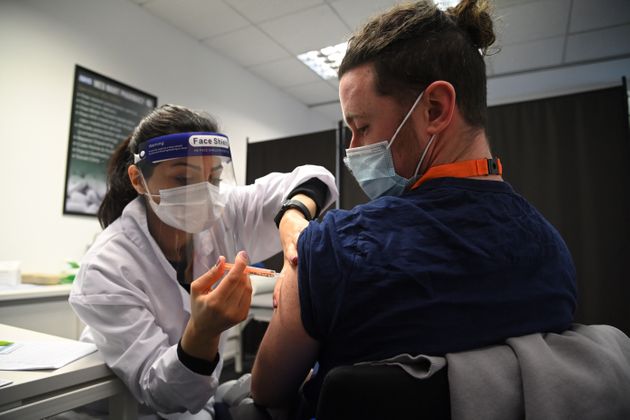
Photo by Karwai Tang/Getty ImagesA care worker receives the Oxford-AstraZeneca Covid-19 vaccine in Borehamwood.
A man was offered a Covid jab because the NHS had recorded his height as 6cm, meaning he was classified as morbidly obese.
A similar mix-up saw a woman wrongly offered a flu vaccine because she was thought to be 57cm tall instead of 5ft 7ins, while others have also had heights of less than a metre entered in their official records.
It came to light when journalist Liam Thorp tweeted last week that he had been offered his first coronavirus vaccine ahead of schedule, and couldn’t work out why.
“I am really confused why I would be offered at this stage when many more vulnerable or at risk groups haven’t been,” the political editor of the Liverpool Echo wrote.
The confusion cleared up when he rang his GP and discovered his height had been entered as 6.2cm rather than 6ft 2ins, “giving me a BMI of 28,000”.
So I’m not getting a vaccine next week – was feeling weird about why I’d been selected ahead of others so rang GP to check. Turns out they had my height as 6.2cm rather than 6 ft 2, giving me a BMI of 28,000 😂
Cue hilarity, with some people claiming it had them “crying” with laughter and that it was “the single best tweet of the entire pandemic”.
Others chimed in with similar experiences, including one person who said she had been invited for the seasonal flu jab a few weeks ago because her height had been recorded as 57cm rather than 5ft 7ins.
Writer and performer Natasha Hodgson only realised the mix-up when she turned up to receive the jab. “The nurse was brilliant and hilarious about it – she got up my records immediately when it was clear I was not, as was recorded on my records, currently morbidly obese,” she told HuffPost UK.
″[She] scanned my file and then burst out laughing: ‘According to this, you are 57cm tall. You’re a bowling ball!’”
OH SHIT, this happened to me last week! Was flagged as being offered a free flu jab, got there to discover according to NHS records I am 57cm tall and… dense. The nurse looked at me and said “YOU’RE A BOWLING BALL!” https://t.co/jE7TbPVoK0
The mistake was corrected immediately and Hodgson was not given the flu jab. “Obviously it’s good that they’re trying to push people in high-risk groups to get seasonal jabs, but yes, it looks like it’s not quite a perfect system,” she continued.
“To be honest, if I’m 57cm tall and 9 and a half stone, I’m amazed they only want to talk to me about my flu potential.”
Another person told HuffPost UK she had received an invitation to receive the Covid-19 vaccine on Monday because her BMI had been put down as 77 – three times what doctors consider a healthy weight.
“[My GP] was completely unsure how that happened, he says it was an error and that someone just entered it wrong. It makes sense now though as the NHS have been chasing me a lot to get my flu jab!” said town planner Lois-May Chapman.
“The doctor also despite everything being cleared up now with my BMI and myself falling in a healthy weight really encouraged me to get the jab and just count myself and very lucky.”
On Sunday the government confirmed more than 15m of the most vulnerable people in the UK have now had a first dose of a Covid-19 vaccine.
Those next in line to receive the jab include all those aged between 50 and 70, as well as those aged between 16 and 64 with underlying health conditions which puts them at higher risk of serious disease and death.
Boris Johnson has set a target of May to give the first jabs to these people, who are in the remaining priority groups five to nine, as set out by the Joint Committee on Vaccination and Immunisation (JCVI).
Dipsy was always the maverick of the Teletubbies, the one who refused to go along with the others. In many ways, he reflected John Simmit, the man inside the three-stone lime green suit, who proudly brought his heritage to the role.
“Being a Cuban-Jamaican-Brummie and coming from a comedy and music background, I used that to my advantage and there were a lot of cultural references,” Simmit tells HuffPost UK. “Dipsy would say ‘Papa Come Papa Come To Po’, which was actually my take on a classic reggae rhythm track called ‘The Whip’. And I’d slip in Jamaican dance moves, a Bogle there and a Tatty here. People spotted my little wink to my culture and I’m proud of that.”
The original Teletubbies, featuring the inimitable Tinky Winky, Dipsy, Laa-Laa and Po, launched in 1997 and aired in more than 120 countries and 45 languages. The show’s initial 365 episodes – which completed 20 years ago in February 2001 – inspired £1bn in merch sales. It was toddler TV gold.
The gang received the keys to New York City and even scored a hit single, ‘Teletubbies say Eh-oh!’, which was on track to be 1997 Christmas number one, only to be knocked off the top spot by Spice Girls. The rainbow fab four had reached the heights of Beatlemania – only it was less Yellow Submarine, more the lush rolling green hills of Teletubbyland.
TIMOTHY A. CLARY via Getty Images
“Running around in a three-stone and eight-foot tall bright green costume in the summer is not fun,” says stand-up comedian and DJ, Simmit, of clumping about the field in Stratford-upon-Avon where Teletubbies was originally filmed.
“At least I had a six-pack at the time. You had to roll up and down hills, squat, jump around and hug – you had to make it look like it was fun when in reality it was a massive workout.”
His efforts paid off – the BBC continues to airs old episodes of the much loved show, which also attracts up to 100 million YouTube views every month. In 2015 Teletubbies got a 21st century revival for tech-savvy toddlers. Still, there’s plenty to learn about one of the biggest kids’ TV shows ever. We asked Simmit some of the questions we’ve had since childhood, plus how it still impacts his life.
Like, those suits: how were they to wear? Very sweaty, says Simmit. Inside the originals was a mechanism to activate the eyes and mouth, he explains, and eventually, they also had small seats installed inside so the actors could sit down between takes. Given the physical nature of being a Telytubby, the four were constantly cooling off with regular water breaks.
“We had to wear really ugly underwear like those old Western long johns, which was essentially a onesie, but it was so it could absorb the sweat,” he adds. “When we were out of costume, you’d have to turn your face the other way and speak to us at a distance because we were reeking and so sweaty you could wring us out. Huge props to our dressers for putting up with us!”
Moviestore/Shutterstock
As for Tellytubbyland, a team of more than 50 people were on set at all times: designers, camera crew, lighting, writers, producers, and the show’s co-creators Andrew Davenport and Anne Wood. And while everything looks regular size on the screen, it wasn’t in real life.
“We used these Flemish giant rabbits, which were the world’s biggest rabbits,” Simmit explains. “I think that was Anne’s way of changing the perspective and making us look small.” Reportedly, the rabbits mated so regularly that takes regularly had to be interrupted and reshot to avoid any untoward humping.
Nothing was spared. From the dome-shaped house to the trumpets, bowls, and windmill, the set designers built everything from scratch and made it super-sized, even cooking up their own bespoke Tubby custard.
“I’m sorry to disappoint, but it was definitely not fit for human consumption,” Simmit reveals. “Later on, they did actually make an edible version, but originally, it was made from mashed potato and acrylic paint and there was a tube going into our costume mouths and siphoned off somewhere else.”
When the actors had the odd disagreement or were just trying to make each other laugh, they’d curse each other in Tubby speak. “It’s a bit surreal, but then again it was a very surreal show,” Simmit says. “In between takes, we’d be having regular conversations about what was in the news and the general election, in the right pitch and in that toddlers voice from time to time.”
No wonder that Teletubbies gained cult status among stoner students, too – just like Dougal and co in The Magic Roundabout a generation before it.
Heritage Images/Getty Images
An aerial view of Teletubbyland, Warwickshire, England. The set of The Teletubbies during its filming from 1997 until 2001
Producers kept close tabs on the precious four. “I remember, once a week, we’d all get a massage,” recalls Simmet. “At the time, I thought what a lovely caring company, but then you realise that they weren’t just looking after you. They were protecting their investment. There were no understudies. There’s only four of you and if one of you gets injured, which would happen from time to time, then filming would have to stop.”
Even though they’ve gone their separate ways in post-Tubby life, the main cast members still keep in touch – although Simon Shelton who played Tinky Winky sadly died in 2018. Dancer Nicola Jane Smedley, who played Laa-Laa, is writing a book about her time as a Teletubby, while Pui Fan Lee, aka Po, still works as a CBeebies presenter today.
As for Simmit, he is working on Rush, a new musical about Windrush. “It’s my parents’ story, which is very topical, personal and a godsend of an opportunity,” he says of the project, on pause but set to resume when theatres reopen. It follows Simmit’s years of work as a producer and performer with Upfront Comedy, which he founded to help build the Black comedy circuit in the UK.
And he hasn’t completely left his years as Dispy behind. His Instagram still features regular shots of his green alter ego. His daughters – adult and teenage – have at least outgrown the show. “Growing up, they both watched Teletubbies and it was so weird seeing yourself back on TV, but also an amazing moment to show what you do to your loved ones,” he says.
“They even said that I was a ‘cool dad.’”
John Simmit
John Simmit with an ice sculpture of Dipsy.
“Teletubbies has become a cultural phenomenon and continues to be, because there’s nothing quite like it,” Simmit says. “The demand has never really gone away because it made such an impact in people’s lives.
Ultimately, he says, it was a show about love. “At the end of the day, our jobs were to mess about, dance, hug and blink into the camera trying to make children laugh and smile, and I think we achieved that. When you think of the Teletubbies, you think of it in the same way as you would an old holiday with friends. You remember it with a smile. There’s certainly no frowning in Teletubbyland.”
Boris Johnson has hinted pubs, bars and other hospitality businesses will be the last to reopen when he lifts England’s lockdown in “stages”.
On Monday the prime minister is set to unveil his plan for the easing of restrictions over the coming months.
“It’ll be based firmly on a cautious and prudent approach to coming out of lockdown in such a way as to be irreversible,” he said on Wednesday. “We want to be going one way from now on based on the incredible vaccination rollout.”
Schools are expected to be the first part of society to reopen, with March 8 pencilled in as the earliest possible date.
Asked during a broadcast interview when the hospitality sector could be allowed to reopen in England, Johnson said: “I certainly think we need to go in stages. We need go cautiously.
“You perhaps remember last year we opened up hospitality fully as one of the last things we did. There is obviously an extra risk of transmission from hospitality.”
He added: “Just wait. We will try and say as much as we can on Monday.”
Dame Angela McLean, the chief scientific adviser at the Ministry of Defence, told MPs things were “all moving in the right direction” as infections are falling along with hospitalisation numbers and deaths.
But she also warned the lockdown should be lifted in a “cautious” way. “There’s still a lot of infected people out there,” she said.
The Daily Mail has reported ministers are weighing up allowing domestic holiday lets to open in time for the Easter weekend and that pubs could open in May, but with only two households permitted to mix indoors. According to the paper, the rule of six could then return for mixing inside by June.
Johnson’s comments came after NHS Providers chief executive Chris Hopson, who represents NHS trusts, said there was a “pretty clear view” the number of coronavirus infections needs to plummet to under 50,000 before lockdown should be eased.
The most recent estimate from the Office for National Statistics (ONS), released on Friday, suggested 695,400 people in England had Covid.
According to The Daily Telegraph cases would need to drop to 1,000 per day before lockdown could be softened, a figure suggested by former health secretary Jeremy Hunt earlier this month.
On Tuesday 10,625 lab-confirmed cases of coronavirus were confirmed in the UK, down from a peak of 68,053 on on January 8. The last time the infection rate was regularly below 1,000 a day was in August.
At a glacier near the South Pole, earth scientists have found evidence of a quiet, slow-motion fault slip that triggers strong, fast-slip earthquakes many miles away, according to Cornell University research published in Science Advances.
During an earthquake, a fast slip happens when energy builds up underground and is released quickly along a fault. Blocks of earth rapidly slide against one another.
However, at an Antarctic glacier called Whillans Ice Plain, the earth scientists show that “slow slips” precede dozens of large magnitude 7 earthquakes. “We found that there is almost always a precursory ‘slow slip’ before an earthquake,” said lead author Grace Barcheck, research associate in Earth and Atmospheric Sciences at Cornell University.
Barcheck said that these slow-slip precursors — occurring as far as 20 miles away from the epicenter — are directly involved in starting the earthquake. “These slow slips are remarkably common,” she said, “and they migrate toward where the fast earthquake slip starts.”
Observations before several large tsunami-generating magnitude 8 and 9 earthquakes on subduction zone faults suggest a similar process may have occurred, according to Patrick Fulton, assistant professor and Croll Sesquicentennial Fellow in the Department of Earth and Atmospheric Sciences.
As these faults are mostly offshore and deep underwater, and because it is difficult to know when or where a large earthquake will occur, the start of large earthquakes is generally hard to observe.
To overcome these challenges, the scientists placed GPS sensors above an icy glacial fault at Whillans Ice Plain, where large magnitude 7 earthquakes occur nearly twice a day over a 60-mile-wide area of the glacier.
Within a period of two months in 2014, the group captured 75 earthquakes at the bottom of the Antarctic glacier. Data from GPS stations indicated that 73 — or 96% — of the 75 earthquakes showed a period of precursory slow motion.
The data from the GPS tracking stations and surface seismometers allowed the team to identify how the slow precursory slip triggers the fast earthquake slip.
“Our group was a little surprised to see so many precursors,” Barcheck said.
“In some cases, we can actually see the migration of the earthquake precursor towards where the earthquake begins.”
“Before we pored over the data, I thought that if we saw any precursors before the earthquakes, they would be rare and in the same place as the earthquake epicenter,” she said. “Instead, we found many slow-slip precursors — starting miles from the epicenters and migrating across the fault.”
Story Source:
Materials provided by Cornell University. Original written by Blaine Friedlander. Note: Content may be edited for style and length.