Scientists say we’ve been looking in the wrong place for human origins

Researchers report that a newly uncovered fossil ape from northern Egypt is changing how scientists view early hominoid evolution. The discovery suggests that the closest ancestors of modern apes may have originated in northern Africa, rather than in East Africa, which has long been the main focus of fossil research. “[The] findings […] confirm that paleontologists might have been looking for crown-hominoid ancestors in the wrong place,” write David Alba and Júlia Arias-Martorell in a related Perspective.

The fossil dates to about 17-18 million years ago and belongs to a newly identified species called Masripithecus. It is considered the closest known hominoid relative to the lineage that eventually led to all living apes, including humans. Scientists generally agree that the earliest apes (stem hominoids) first appeared in Afro-Arabia during the Oligocene Epoch more than 25 million years ago. These early apes later spread into Eurasia between about 14 and 16 million years ago during the Miocene. Still, the exact origin of modern apes, which include all living species and their last common ancestor, remains uncertain because fossils from this time are rare, scattered, and often difficult to interpret. This challenge is made worse by gaps in Africa’s fossil record, where most discoveries come from a limited number of locations, leaving large areas from this period unexplored.

Masripithecus moghraensis and Early Ape Diversity

Shorouq Al-Ashqar and colleagues describe the fossil, which was found in the Wadi Moghra region of northern Egypt and dates to around 17-18 million years ago. The species, named Masripithecus moghraensis, provides new insight into ape diversity during a key period when Afro-Arabia was becoming connected to Eurasia, allowing species to spread beyond Africa.

To determine how this species fits into the evolutionary history of humans, the researchers used a Bayesian “tip-dating” method. This approach combines anatomical features with fossil ages to estimate evolutionary relationships and divergence times. Their results indicate that Masripithecus is a stem hominoid closely related to the lineage that eventually gave rise to all modern apes.

New Clues to the Origins of Modern Apes

Based on their findings, the researchers suggest that modern apes may have originated in northern Afro-Arabia, the Levant, or the eastern Mediterranean. This challenges long-standing assumptions and highlights how much remains unknown about the early evolution of apes and humans.

Share Button

Watch the Earth split in real time: Stunning footage captures a 2.5-meter fault slip in seconds

During midday Friday prayers on March 28, 2025, a powerful magnitude 7.7 earthquake hit central Myanmar along the Sagaing Fault. The epicenter was located near Mandalay, the country’s second-largest city. It was the strongest earthquake to strike Myanmar in more than a century and the second deadliest in its modern history.

This earthquake was triggered by a strike-slip fault, where two large sections of the Earth’s crust move horizontally past each other along a vertical fracture. To someone watching, it would appear as if the ground had split along a clear line, with each side being forced in opposite directions.

Previous studies based on seismic recordings suggested that earthquakes like this may involve a pulse-like rupture and slightly curved motion along the fault. However, those conclusions were based on instruments located far from the fault zone, meaning the observations were indirect.

Rare CCTV Footage Captures Fault Movement

In this case, a CCTV camera recorded the fault as it moved, creating a rare opportunity for researchers at Kyoto University to observe the rupture as it happened. (See video link at bottom of article.) This kind of direct visual evidence is extremely unusual in earthquake research.

Frame-by-Frame Analysis Reveals Extreme Speed

The research team used a method called pixel cross-correlation to examine the video frame by frame and measure how the ground shifted. Their findings show that the fault moved sideways by 2.5 meters in just 1.3 seconds, reaching a top speed of 3.2 meters per second.

While this amount of sideways movement is typical for strike-slip earthquakes, the very short duration of the motion stands out as a significant discovery.

“The brief duration of motion confirms a pulse-like rupture, characterized by a concentrated burst of slip propagating along the fault, much like a ripple traveling down a rug when flicked from one end,” says corresponding author Jesse Kearse.

Curved Fault Motion Challenges Assumptions

The analysis also revealed that the path of the slip was slightly curved. This matches earlier geological observations from faults around the world and suggests that fault movement is often not perfectly straight, as commonly assumed.

The study highlights the value of using video footage to monitor fault activity, offering a new way to study earthquakes in detail. Observations like these can improve understanding of how earthquakes unfold and help scientists better estimate the shaking that may occur during future large events.

“We did not anticipate that this video record would provide such a rich variety of detailed observations. Such kinematic data is critical for advancing our understanding of earthquake source physics,” says Kearse.

Next Steps in Earthquake Research

The researchers plan to build on these findings by using physics-based models to explore what controls fault behavior, using the new data revealed by this analysis.

Share Button

Are UK students at risk of more deadly meningitis outbreaks?

The worst seems to be over, but questions remain about why this happened and whether it could happen again.

Share Button

Is screen time always bad and how do I manage it?

How do you manage screen time, does it have a bad impact and what steps can you take to mitigate the problem?

Share Button

Putin Is Losing The Ukraine War – But Thanks To Trump, Not As Fast As He Was

Vladimir Putin broke his own record this week by launching his most aggressive strikes against Ukraine yet.

An astonishing 948 drones attacked Ukraine in a 24-hour period, killing at least six people across the country.

The barbaric attacks even reached the western city of Lviv, often viewed as one of the safest places in the beleaguered nation.

Moscow is evidently keen to remind Kyiv that, even four years after the invasion, nowhere is off limits.

But focusing solely on Russia’s spring offensive misses the bigger picture.

Despite baseless claims from Donald Trump about Ukraine’s decline, those close to the war believe Russia is actually losing.

Putin has not been able to keep up with his war of attrition, according to his rival Volodymyr Zelenskyy.

The Ukrainian president wrote on X on Thursday: “In historical terms, the Russians are losing, one hundred percent.

“Right now, they are suffering a terrifying number of casualties – 30,000 to 35,000 people a month.

“Russia cannot keep up with mobilisation, contract recruitment, and certainly cannot keep up with training its troops.”

Dossier Center, a non-profit founded by the Russian opposition leader Mikhail Khodorkovsky, reported this week that the odds of surviving the war as a Russian soldier on the frontline in Ukraine are close to zero.

Dr Simon Bennett, the director of the civil safety and security unit at University of Leicester, told HuffPost UK that eastern Ukraine’s Donbas region had become “a meat grinder for both sides” – but especially for Russia.

Putin’s military exceeded one million casualties last June, with Ukraine’s general staff now predicting Russia has lost 1,280,960 troops throughout the war.

However, Bennett noted that Russian casualties will not affect the ranks as much as Ukrainian losses.

He said: “The Ukrainians have fewer troops than the Russians and there is a strong incentive to carefully husband available resources.

“So, the Russians will always lose more troops than the Ukrainians.”

Keir Giles – associate fellow of Chatham House’s Russia and Eurasia Programme – also said the poor performance on the frontline was not why Putin was losing.

“The frontline is of no greater importance now than it has been at any point during this war,” he told HuffPost UK.

“It’s more about the politics, the geo-strategy, the economics – whether the US is willing to put sufficient pressure on Ukraine to surrender to Russia.”

Trump has been trying to force Ukraine to bend to Russia’s maximalist war goals and hand over more territory in the name of peace.

But territorial concessions and security guarantees have remained major sticking points.

Ukraine has so far resisted calls to give up more land, even though 2025 was the deadliest period for Ukrainian civilians since the initial months of the full-scale invasion.

According to some reports, Putin was thinking about finally compromising as his economy struggled to stay afloat while funding the war.

But last month’s Israel-US strikes on Iran ended up giving Russia a surprise boost.

When Tehran moved to block the Strait of Hormuz oil shipping lane, the US president decided to ease oil sanctions on Russia to help the global markets – meaning Moscow’s enthusiasm for negotiations waned.

Bennett told HuffPost UK that the money flooding into Russia as a result has allowed Putin “to turbocharge an already highly efficient war economy.”

The Economist’s defence editor Shashank Joshi pointed out this means Russians feel as though they have a “little bit of economic wind in their sails again”.

The Iran war means the US is re-routing munitions earmarked for Ukraine to the Middle East, too, reducing Kyiv’s ability to strike back.

Even so, this unexpected “lifeline” is not enough to push Russia to win the war.

As Giles noted, this boost only means Putin is not “losing as fast as he was before”.

In this image made from video provided by Russian Defense Ministry Press Service on Monday, March 23, 2026, a Russian Pion self-propelled 203 mm cannon fires towards a Ukrainian position.

Kyiv is also not completely oblivious to this change in Putin’s fortunes.

It continues to hold its own by targeting Russian oil refineries in the hope of putting a dent in Putin’s war machine.

Giles said: “I’m sure Ukraine is hoping that Trump does not notice this is happening or care because, if he does, he will certainly look for ways of limiting the damage to Russia.”

Even so, the impact of these attacks on Putin and the Kremlin will not be “immediate”, according to Giles.

He warned Ukraine needs to be a “much more comprehensive programme” to effectively cut off Russia’s income – meaning Putin will continue to line his pockets amid the chaos in the Middle East.

One senior Labour MP told HuffPost UK they privately suspected the conflict in Iran would last three months while the Ukraine war would rumble on for another three years.

But, according to some, optimism that Putin might realistically ever be able to give up may be misplaced.

As Zelenskyy told Reuters news agency, the “Russians have whipped up pro-war sentiment internally to such an extent that if we don’t stop Putin now, war will continue”.

He added: “He will pick some small country. He needs it.

“He’s boosted the war economy and radicalised the Russians.

“Today, 20–25% young people in Russia want to destroy Ukraine and Europe; they want to restore Soviet influence and revive the idea of destroying Nato. This will not just vanish.”

The Ukrainian president also theorised that Putin will have to either risk upset within Russian society, or he will “make a few steps into one of the Baltic states and set down his right or left foot there”.

Giles suggested Zelenskyy was bang on the money, telling HuffPost UK: “Russians have been told for more than a decade that the war is on.

“The assumption that many young Russians have grown up with is that they’re already in conflict.

“The entirety of the Russian economy has been turned into a war machine, and to turn it back would be massively disruptive.”

Asked to put a timeframe on when the war might end, Giles offered a rather bleak answer: “It will continue for as long as Russia exists.”

Share Button

I’m Officially Too Old For Hostels — But This £80-A-Night ‘Hub’ Is The Bougie-On-A-Budget Answer To Iceland

At a certain age, you just have to accept you are officially too old for some things. Now firmly in my 30s, my previously cemented love of budget hostels has expired. Once upon my twenties, a broken night’s sleep thanks to an anonymous bunkmate’s snoring was simply a minor inconvenience; now it will ruin my entire next day. The gymnastics of shuffling in and out of clothes under a bunkbed’s duvet used to be a breeze; now I’d probably end up slipping a disc.

However, my budget doesn’t exactly stretch to my developed taste for ‘comfort over everything’. I’m firmly in my accommodation ‘inbetweener’ era and there aren’t a whole whack of digs that bridge the gap between boutique and budget.

This struggle becomes even more of an issue when you factor in an expensive travel destination like Iceland. A trip to ‘The Land of Fire and Ice’ notoriously comes with a serious price tag, and according to The Times, Iceland is facing a reduction in tourism as a result, with international visitors dropping by 6% last year.

So, how can I make a trip to the top destination of many a travel wishlist achievable on a budget, without compromising on comfort? Well, CityHub might just have the answer.

CityHub Reykjavik

Now, when I say ‘pod hotel,’ you need to immediately banish the thought of those tiny, coffin-sized capsules in Japan. Yes, while CityHub Reykjavik is technically a pod hotel, I can guarantee that you’ve never seen something quite like this before.

CityHub hotels (they also have locations in Amsterdam, Rotterdam and Copenhagen) blend private sleeping spaces with vibrant hangout areas and premium amenities at an affordable cost. A concept that is, quite frankly, music to my ears, back and bank account.

Their private, pod-esque if you will, sleeping areas are called Hubs and despite being small, they pack a big punch – we’re talking king-size beds, smart storage that doesn’t compromise on space, Bluetooth speakers, air con and heating. The best bit? You can enjoy this all without the fear of someone cracking the big light on at 3am.

The secret? Opting for an L-shaped pod over the stereotypical coffin. Hubs are a bit like a clever game of accommodation Tetris – one ‘up’ Hub is connected to a ‘down’ Hub, offering vertical space at the start of each that acts like a foyer.

Some clever planning means plenty of space (without a price tag).

CityHub invited me to try out their accommodation for myself and honestly, the biggest shock was the silence – I was so surprised at my inability to hear anyone in the adjoining Hub. I’m a tall gal and unlike other pod hotels I’ve been to, I could comfortably sit upright in bed without fear of a concussion. Even with a second person in the Hub with me (ooo-er), there was plenty of space for our suitcases and room to get changed in – we just had to take it in turns.

‘Shared bathrooms’ don’t exactly scream luxury (pause for flashbacks to the horrors of a hostel shower), but CityHub does things differently. You’d be forgiven for thinking that you were actually in a spa while popping to the loo – their Pinterest-worthy bathrooms boast warm terracotta walls and high pressure showers as well as complimentary towels and Rituals amenities.

As for the communal spaces, again, it’s a far cry from the hostel lounges and kitchens of yore. The Hangout (CityHub’s reception, bar and lounge area-in-one) features a self-service system in which guests can tap their own beers and refreshments using the digital wristband they’re given on checking in (which also doubles as your Hub key). Forget someone badly playing Oasis on a guitar in the corner – The Hangout is perfect for relaxing or even working in.

Okay, so when can we move in?

The real showstopper, though? CityHub Reykjavik’s rooftop hot tub. There really isn’t anything like soaking yourself in geothermally heated water while sub-zero Icelandic air whips around you – all with an incredible view of the night sky. If you’re lucky, sometimes it’s even possible to see the Northern Lights from the comfort of the tub.

Thought it couldn’t get any better? Buckle up, because the best bit of all of this? The cost. While the average hotel price in Reykjavik for April is hovering around £156 per night, you can snag a Hub for as little as £60 to £80 – and you could get this price even lower depending on what promotions and discounts are available.

CityHosts

Now, the issue with Iceland trips is that you only have to step outside your hotel and it suddenly feels like you’ve spent £20. It’s notoriously expensive and with endless guides online as to where you should and shouldn’t go, which tours you should and shouldn’t book, it can all be really overwhelming.

Enter the CityHosts – CityHub’s onsite concierge service that does a whole lot more than just check you in. As Reykjavik locals themselves, the hosts on duty will happily help you set up cost efficient tours to experience as much Icelandic culture as possible without the hefty price tag. After all, who actually knows the best spots better than people who live in Iceland all year round?

We were pointed toward a walking foodie tour that let us sample the most iconic Icelandic dishes from local businesses (although I still can’t say fermented shark is for me). And on one (utterly freezing) evening I fulfilled my dream of seeing the Northern Lights in all their glory after being sent out exploring with a pocket-friendly guide who knew the best viewing points. Another Iceland expert took us on a day trip around the country’s most famous natural landmarks and we knew we were guaranteed a brilliant meal afterwards thanks to the restaurant recommendations from the CityHosts.

So what exactly is the key to CityHub’s ability to provide accommodation that bridges the gap between budget and bougie? Well, it’s all in their very clever climate-friendly planning.

CityHub transforms empty urban buildings into hotels, avoiding new construction which as a result cuts CO₂ emissions per guest by 89% compared to the European hotel average. Their modular, recyclable rooms, in-house smart tech and harnessing of Iceland’s famous geothermal energy all add up to a model that’s efficient, scalable, and certified B Corp, a title held by just 0.1% of hotels globally.

I’m already planning a trip to Copenhagen purely based on the fact that there’s a CityHub there – because as someone’s outgrown dorms but not budget-friendly travel, I know I’m guaranteed the perfect fit.

To book a stay at CityHub visit:https://cityhub.com/reykjavik/

Share Button

Farage Dismisses Reform Candidate’s ‘Nazi Salute’ Photo As ‘Fawlty Towers Impression’

Nigel Farage dismissed a photo of a Reform UK candidate appearing to perform a Nazi salute by describing it as a “Fawlty Towers impression”.

Corey Edwards is Reform’s lead candidate for the Pen-y Bont Bro Morgannwg constituency in May’s Senedd election.

A photo of Edwards appearing to replicate the offensive salute recently resurfaced, though the date and location of the image are unknown.

While launching his party’s local election campaign, Reform Party leader told ITV News that his candidate was doing a “Fawlty Towers impression”.

He said: “The context I have been told, it was taking a Basil Fawlty sketch, and that’s why he did it. He’s a human being.”

Asked if Edwards would remain a candidate, he said: “I get the point – it looks terrible. Things in isolation often do. I wouldn’t approve of it.”

He then compared the incident to what he described “far more serious” case of a Plaid Cymru candidate withdrawing from the race over an offensive social media post from more than a decade ago.

Edwards also issued a statement saying the photo had been “misinterpreted” and that he had made “mistakes”.

“There is a clear distinction between ordinary use of the appalling gesture, compared with me imitating a Welsh footballer’s use of it, or indeed Basil Fawlty’s walk,” the Reform candidate said.

“The Nazi regime was the most barbaric ever and I’d never make light of nor dilute its seriousness.”

A Reform UK spokesperson also told ITV Wales: “We’re not willing to write people off forever because of mistakes they made when they were young.”

The incident is the latest drama threatening to overshadow Reform’s campaign in the run-up to the local elections.

Farage already had to publicly defend Reform’s Scottish leader, Malcolm Offord, after an offensive homophobic joke he made a rugby club dinner in 2018 resurfaced.

Offord later apologised and denied he was homophobic.

At his party launch in Sunderland this week, Farage said: “If we’re going to drum people out of public life for telling a joke at a boozy rugby club dinner that’s amongst friends, we’ll finish up with the dullest group of individuals, looking a bit like, sounding a bit like Keir Starmer.”

He added: “When you take something as it is, yeah, of course it looks awful.”

However Farage said Offord “probably regretted doing it” even on the night, and accused critics of adopting a “po-faced purism attitude”.

Reform also had to drop its mayoral candidate for the Hampshire and Solent 2028 election, Chris Parry, this week, after he compared a Jewish community group to “Islamists on horseback”.

Share Button

Screen time for under-fives should be limited to one hour a day, parents told

New government guidance also suggests children under-two should not be watching screens alone.

Share Button

Our daughter battled Meningitis B despite being vaccinated in ‘very rare’ case

After Noa-Rose became critically ill, the four-year-old spent two weeks fighting for her life.

Share Button

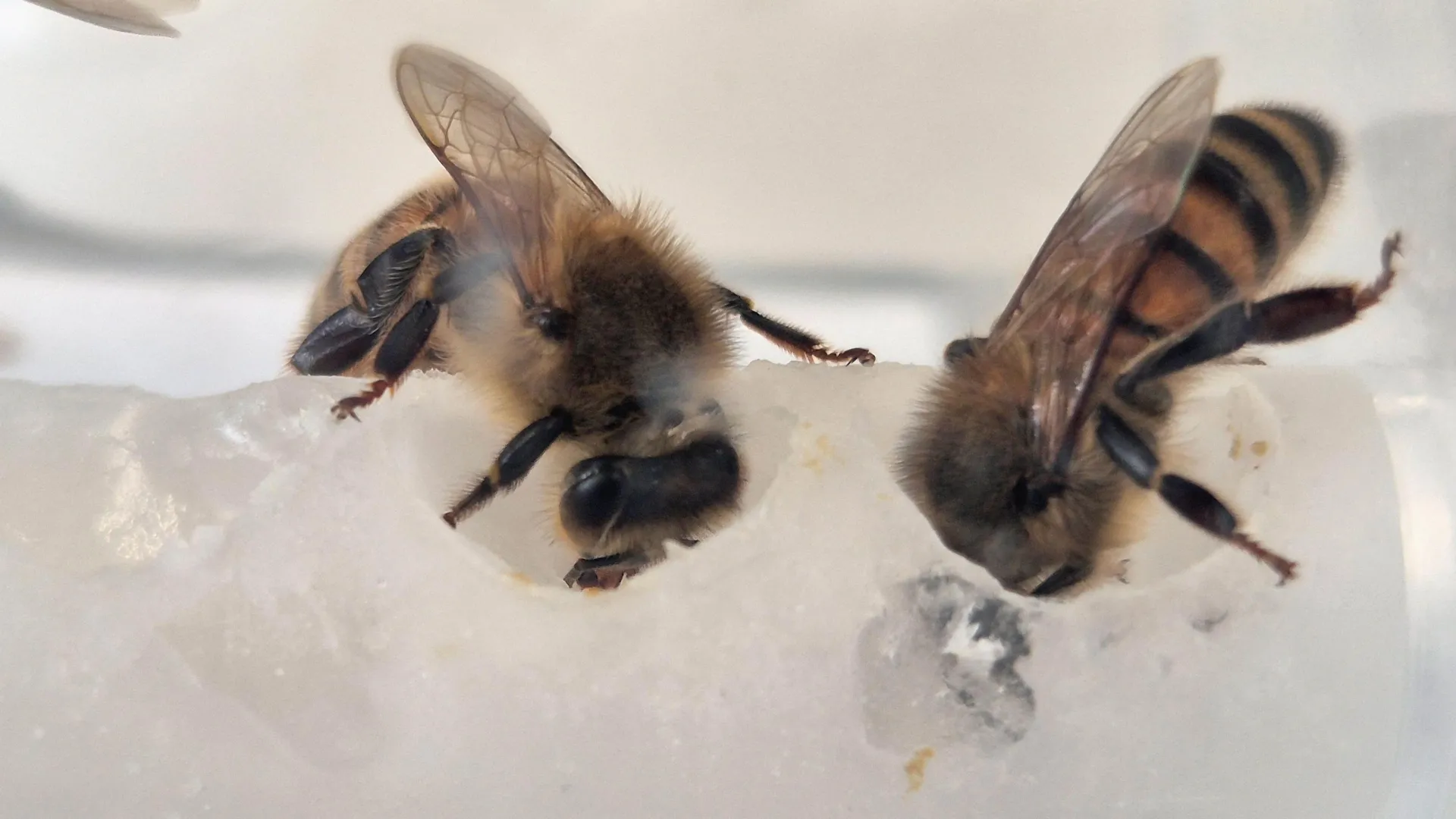
Scientists uncovered the nutrients bees were missing — Colonies surged 15-fold

A team of researchers led by the University of Oxford has developed a breakthrough food supplement that could help reverse the alarming decline of honeybees.

Working with Royal Botanic Gardens Kew, the University of Greenwich, and the Technical University of Denmark, the scientists engineered a diet that mimics the key nutrients bees normally get from pollen.

When tested, colonies fed this supplement produced up to 15 times more young. The findings were published in the journal Nature.

Bees Are Starving for the Right Nutrients

Honeybees rely on pollen as their main food source. It contains essential lipids called sterols that are critical for growth and development.

But climate change and intensive farming have reduced the variety of flowers bees depend on. As a result, bees are increasingly missing key nutrients.

Beekeepers often use artificial pollen substitutes made from protein flour, sugars, and oils. These provide calories but lack the sterols bees need, leaving colonies nutritionally deficient.

A Lab-Made Solution Using Engineered Yeast

To fill this gap, researchers engineered the yeast Yarrowia lipolytica to produce a precise mix of six essential sterols.

They added this yeast to bee diets and tested it over three months in controlled glasshouse experiments. The enclosed setup ensured bees ate only the experimental feed.

Colonies Grew Faster and Stayed Healthier

The results were dramatic. Colonies receiving the enriched diet produced up to 15 times more larvae that reached the pupal stage compared with those on standard diets.

They also continued raising brood throughout the entire study period. Colonies without sterols stopped producing brood after about 90 days.

Even more striking, the nutrient profile of larvae matched that of bees feeding naturally, suggesting the supplement closely replicates real pollen nutrition.

Scientists Say This Could Be a Game Changer

Senior author Professor Geraldine Wright (Department of Biology, University of Oxford), said: “Our study demonstrates how we can harness synthetic biology to solve real-world ecological challenges. Most of the pollen sterols used by bees are not available naturally in quantities that could be harvested on a commercial scale, making it otherwise impossible to create a nutritionally complete feed that is a substitute for pollen.”

Lead author Dr. Elynor Moore (Department of Biology, University of Oxford at the time of the study, now Delft University of Technology) added: “For bees, the difference between the sterol-enriched diet and conventional bee feeds would be comparable to the difference for humans between eating balanced, nutritionally complete meals and eating meals missing essential nutrients like essential fatty acids. Using precision fermentation, we are now able to provide bees with a tailor-made feed that is nutritionally complete at the molecular level.”

Cracking the Code of Bee Nutrition

To figure out what bees actually need, researchers analyzed tissues from pupae and adult bees. This required extremely delicate lab work, including dissecting individual nurse bees.

They identified six key sterols that dominate bee biology: 24-methylenecholesterol, campesterol, isofucosterol, β-sitosterol, cholesterol, and desmosterol.

CRISPR and Yeast Make It Scalable

Using CRISPR-Cas9 gene editing, the team programmed Yarrowia lipolytica to produce these sterols efficiently.

This yeast was chosen because it naturally produces lipids, is safe for food use, and can be scaled up for industrial production. The final supplement is made by growing the yeast in bioreactors and drying it into a powder.

Why This Matters for Food and Farming

Honeybees help produce more than 70% of major global crops. But their populations are under severe pressure from poor nutrition, climate change, parasites, disease, and pesticides.

In the U.S., annual colony losses have ranged from 40 to 50% in recent years and could reach as high as 60 to 70% in 2025.

This new supplement could strengthen bee health without increasing competition for limited wildflowers. It may even evolve into a complete nutritional feed.

Helping Wild Bees Too

Co-author Professor Phil Stevenson (RBG Kew and Natural Resources Institute, University of Greenwich) added: “Honey bees are critically important pollinators for the production of crops such as almonds, apples, and cherries and so are present in some crop locations in very large numbers, which can put pressure on limited wildflowers. Our engineered supplement could therefore benefit wild bee species by reducing competition for limited pollen supplies.”

A Potential Breakthrough for Beekeepers

Danielle Downey (Executive Director of honeybee research nonprofit Project Apis m., not affiliated with the study) said: “We rely on honey bees to pollinate one in three bites of our food, yet bees face many stressors. Good nutrition is one way to improve their resilience to these threats, and in landscapes with dwindling natural forage for bees, a more complete diet supplement could be a game changer. This breakthrough discovery of key phytonutrients that, when included in feed supplements, allow sustained honey bee brood rearing has immense potential to improve outcomes for colony survival, and in turn the beekeeping businesses we rely on for our food production.”

What Happens Next

Larger field trials are still needed to confirm long-term benefits. If successful, the supplement could reach farmers within two years.

The same technology could also be adapted to support other pollinators or farmed insects, opening new paths for sustainable agriculture.


Share Button