More Men Are Getting Botox Than Ever. Here’s How ‘Brotox’ Is Different.

First introduced to the general public in the late 1980s, Botox has now become a billion-dollar industry that has challenged our relationship with beauty, wellness, plastic surgery, ageism and even gender ― it’s not just women who are getting the procedure.

According to the 2020 plastic surgery statistics report by the American Society of Plastic Surgeons, in 2020, women received about 4 million Botox-type treatments while men underwent just over 250,000 procedures of the kind.

Although there’s still a large difference in number of treatments between the two genders, experts are quick to note that, in the past few years, there has been a sharp increase in desire for the muscle-freezing, wrinkle-reducing injection among a range of people.

“While Botox is and has traditionally been more popular among women, various sources have demonstrated that it has been growing in popularity among men, as well,” said Dr. Samuel Lin, a board-certified plastic surgeon and associate professor of surgery at Harvard Medical School.

Facial plastic surgeon Dr. Jacob D. Steiger has also noticed the trend. “We are seeing the proportion of men versus women increasing,” he noted, “meaning the male segment is increasing at a higher rate. This is jokingly referred to as ‘brotox.’”

According to the American Society of Plastic Surgeons, “brotox” is the No. 1 cosmetic procedure requested by men, with a 400% increase in treatments administered since 2000.

Overall, men and women seem to concentrate on the same area of the face when undergoing treatment: the forehead.

In the past, “people preferred a more total effect to the point that they looked expressionless,” explained Dr. Bruce Hermann, a board-certified plastic surgeon. “Today, I find that the majority of women prefer the maximal effect possible without having a frozen forehead. For men, I find that in general they prefer an effect similar to women but a bit more subtle on the forehead.”

Male vs. Female Botox

Although men and women tend to seek Botox treatments on similar areas of the face, experts note that the procedures differ based the gender one was assigned at birth. As a general statement, given their larger muscle mass in the facial musculature, men need more Botox than women do to obtain similar effects.

“For example, in the glabellar area [the skin between your eyebrows], for a similar effect, I start women with about 15 units of Botox and go up as needed to achieve the desired result,” Hermann shared. “For men, I would normally recommend starting with 20 units and adjusting from there.”

The expert is quick to note that the approach gets more complex when dealing with patients’ foreheads. “Men commonly prefer a more subtle effect in the area,” he said. “So I’ll use a higher dosage per area in men but inject a smaller surface area.”

As long as the dosage is adjusted, the frequency of injection is the same for men and women, Steiger said. For most patients, results last about four months.
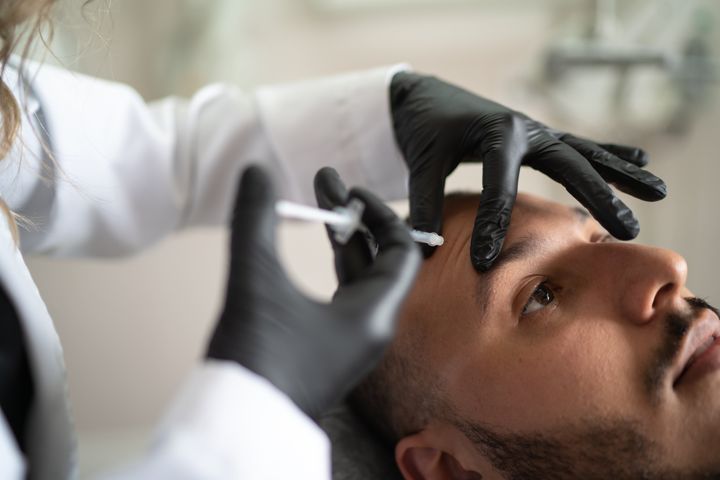
In general, given their larger muscle mass in the facial musculature, men need more Botox than women do to obtain similar effects.

FG Trade via Getty Images

In general, given their larger muscle mass in the facial musculature, men need more Botox than women do to obtain similar effects.

Anatomical variations in skin composition can also potentially lead to gender-specific differences in terms of reactions and complications. “Men typically have thicker skin with higher collagen composition compared to women,” Lin explained. “Male skin also tends to be more vascular, which carries a higher complication rate of bleeding and bruising when injecting Botox.”

Although based on anecdotal evidence, some physicians also believe that Botox wears off faster in men given their metabolism. However, Lin explained that this should be discussed directly between a patient and doctor, because it’s not easy to generalize “given broad differences in human metabolism.”

In short: Men and women look to address similar facial issues when getting Botox, but the dosages needed to reach similar results can vary.

The Future Of Botox

Experts, including Hermann, believe the overall trends will stay the same in the future: Men and women will continue seeking to tackle similar facial issues through the treatment. Although more women than men are likely to undergo the procedure, “the percentage of men getting Botox will increase slightly each year,” Hermann predicted.

The surgeon specifically calls out ageism in the workforce. Although ageism was once an issue commonly mentioned by women in the workforce, it affects men as well.

Case in point: In 2019, Google settled an age discrimination lawsuit concerning its hiring practices. As a result, over 200 job seekers over the age of 40 who had applied for positions at the company received a settlement of $11 million.

COVID-19 also changed things. “The ‘Zoom effect’ is a phenomenon brought on by the pandemic whereby people working from home saw themselves more frequently on camera and started to notice things that made them look more aged,” Hermann said. “A study by the American Society of Plastic Surgeons in 2020 showed an increase in interest in plastic surgery or non-surgical procedures like Botox to look younger in 11-35% of women surveyed that were using Zoom or similar platforms.”

If you’re ever considering a Botox treatment, here’s how to find a reputable provider.

Share Button

Over 100,000 monkeypox vaccines procured, government says

The majority of the nearly 2,500 confirmed monkeypox cases in England are in London.

Share Button

Analysis: Liz Truss’s Plan To Pay Public Sector Workers Less Outside London Wasn’t ‘Misrepresented’

When all else fails, shoot the messenger.

As Liz Truss’s plan to save £8.8bn by paying civil servants less outside London and the south east provoked a furious Tory backlash, her team pressed the panic button.

In the preamble to the inevitable screeching U-turn, a spokesperson for Truss told journalists: “Over the last few hours there has been a wilful misrepresentation of our campaign.”

This was, alas, copper-bottomed nonsense.

The press release issued yesterday by the Truss campaign announcing the policy makes it crystal clear that replacing national pay bargaining with “regional pay boards” would mean smaller salaries for those in less-affluent areas.

It said: “This will make it easier to adjust officials’ pay, ensuring it accurately reflects where they work and stops the crowding out of local businesses that can not compete with public sector pay.”

And in case anyone was in any doubt that this new policy would apply to the likes of nurses, teachers and the police as well, the release explained: “This could save up to £8.8 billion per year. This is the potential savings if the system were to be adopted for all public sector workers in the long term.”

Unsurprisingly, this went down badly with Red Wall Tories like Ben Houchen, the party’s mayor in Tees Valley, who said: “There is simply no way you can do this without a massive pay cut for 5.5m people including nurses, police officers and our armed forces outside London.”

Experiencing the first serious mis-step of her leadership campaign, Truss later recorded a TV clip insisting that while her policy had been “misrepresented”, she was going to abandon it completely.

She said: “I never had any intention of changing the terms and conditions of teachers and nurses.

“But what I want to be clear about is I will not be going ahead with the regional pay boards. That is no longer my policy.”

Rishi Sunak’s campaign, who have been on the back foot throughout the contest, wasted no time in taking advantage of their rival’s humiliation.

Pointing out that Truss had supported regional pay boards four years ago when she was chief secretary to the Treasury (CST), a source on Team Rishi said: “This wasn’t a mistake, Liz wanted this in 2018 as CST. The lady is for turning.”

That last sentence, echoing a famous line in one of Margaret Thatcher’s party conference speeches, was designed to twist the knife.

It’s far too early to say Truss’s mistake means the outcome of the leadership contest is back in the balance. She remains the clear favourite to succeed Boris Johnson.

But she’ll know better than anyone that any further slip-ups could be fatal to her hopes of entering Number 10.

Share Button

Don’t Pay: The Campaign Group Calling On Brits To Stop Paying Energy Bills

A campaign group is calling for people to stop paying their energy bills – and it comes as BP reported its biggest quarterly profit for 14 years.

The UK is in the midst of a cost of living crisis, with prices for petrol and gas soaring for British households. Typical household energy bills are expected to be more than £3,600 this winter, with bills set to rise again in October.

Suppliers have blamed the war in Ukraine and surging wholesale prices for the hikes, but on social media, some have dubbed the current situation “the cost of greed crisis”.

BP recorded a profit of $8.45bn (£6.9bn) between April and June, more than triple the amount it made in the same period last year. And it is not the only energy firm to report a staggering profit – both British Gas owner Centrica and rival Shell have recorded huge earnings recently, too.

Rising energy bills are one of the main reasons for the cost of living crisis. The government did introduce a one-off windfall tax on oil and gas companies in July, but it does not apply to profits announced by BP and other energy firms between April and June.

And as more households continue to struggle to pay bills, people aren’t happy – which is why the ‘Don’t Pay’ campaign is demanding action.

The campaign group is trying to get at least one million people to pledge not to pay their energy bills if the government continues with its goal to increase the price cap on October 1.

“We started this campaign because we were worried about how we will pay our energy bills. Everyone around us is struggling and we know it will only get worse with no end in sight,” the campaign group says.

“So far around 1,300 people have expressed an interest to become an organiser in their town, village and city. From there we will fan out the campaign with a local presence.”

Speaking on ITV’s programme Peston, money saving expert Martin Lewis previously warned a bill payment strike could be on the horizon.

“The big movement that I am seeing is an increase of growth in people calling for a non-payment of energy bills, mass non-payment. Effectively a consumer strike on energy bills and getting rid of the legitimacy of paying that,” he said. “It’s small at the moment, there’s a Twitter handle with about 5,000 followers.

“We are getting close to a Poll Tax moment on energy bills coming into October and we need the Government to get a handle on that, because once it starts becoming socially acceptable not to pay energy bills people will stop paying energy bills and you’re not going to cut everyone off.”

‘Don’t Pay UK’ began trending on Twitter following the BP profit release, but there are some things you need to consider before taking part in the protest.

What are the risks of taking part?

Of course, not paying your bills will have some consequences and you’ll need to look at the terms and conditions for your individual energy supplier to see what these may be.

SSE Energy, for example, says it will try to contact customers first regarding unpaid bills, but adds: “In some cases we might also try to visit you at home to work out the best way to pay, but we’ll add the cost of this visit to your account.

“We may take a case to court to obtain a warrant to enter your home. We don’t want to, but sometimes we’re left with no choice.”

Similarly, British Gas says it may do the following when met with unpaid bills:

  • Pass your details to a debt collection agency

  • Apply for a warrant to install a Pay As You Go meter to make it easier to pay back the money you owe

  • If possible, switch your smart meter to a smart Pay As You Go meter remotely.

Utility Bidder says if you haven’t paid a bill for 28 days, you cannot come to a repayment agreement and you refuse to have a prepayment meter installed without good reason, “your provider can disconnect your power supply”.

It’s worth noting that the Don’t Pay campaign is discouraging anyone on prepayment meters who face self-disconnection if their credit runs out to get involved. This also goes for those whose energy bills are included in rent and risk eviction if bills go unpaid. Instead, they want those people to support them online.

If you are struggling to afford your energy bills, you should follow the advice set up by Citizen’s Advice.

Share Button

Call for body-image warnings on retouched photos

The impact of body image on mental and physical health needs to be taken more seriously, MPs say.

Share Button

Bioscientists use mixed-reality headset, custom software to measure vegetation in the field

Ecologists won’t always need expensive and bulky equipment to measure vegetation in the wild. Rice University scientists have discovered a modern heads-up display works pretty well.

Rice researchers set up aMicrosoft HoloLens as a mixed-reality sensor to feed VegSense, their application to measure understory vegetation, plant life that grows between the forest canopy and floor.

A proof-of-concept study by graduate student Daniel Gorczynski and bioscientistLydia Beaudrot shows VegSense could be a suitable alternative to traditional classical field measurements at a low cost.

Their study in Methods in Ecology and Evolution shows the hardware-software combination excels at quantifying relatively mature trees in the wild, which is one measure of a forest’s overall health.

Gorczynski came up with the idea to try HoloLens, commonly marketed as a productivity tool for manufacturing, health care and education. He developed the open-source software for the device and noted that while the combination is less effective at picking up saplings and small branches, there’s ample room for improvement.

Gorczynski said he was introduced to mixed-reality sensing while an undergraduate at Vanderbilt University and recognized its potential for biological studies. “It seemed sort of like a natural fit,” he said. Gorczynski brought the idea to Beaudrot in 2019 shortly after his arrival at Rice.

The combination of stock hardware and custom software cost far less than systems based onlidar (for “light detection and ranging”) most often used in three-dimensional field studies, said Gorczynski, who developed VegSense on a platform geared more toward 3D games and interactive experiences than hard science.

Field tests at Houston’s Memorial Park showed that at least for mature trees, the smaller solution is just as good. In their case study, VegSense easily detected 48 of 50 such trees in the target area, a circle about 30 feet in diameter that Gorczynski walked, looking up, down and around to build the 3D database. (“Imagine an asterisk with a circle around it,” he said, describing the data-capture pattern.)

“For this study, we wanted to be really deliberate in trying to replicate more traditional understory vegetation structure measurements,” Gorczynski said. “We tried to get that level of detail.”

What he sees as he scans the environment is a holograph-like grid pattern that tracks the surfaces of vegetation. “What’s really cool about that is you can see what the scanner is picking up, but also the spots you missed,” Gorczynski said. “The idea is to get the mesh to cover as much of the vegetation as possible because that’s what gets you the best scan.”

“The results were so nice that Dan quickly wrote it up for publication,” Beaudrot said, noting that Gorczynski expanded his validation of the gear during a subsequent field trip to Tanzania, the focus of one of 15 tropical forests in a recent rainforest study by the Rice group.

“This device can facilitate a lot of great ecological research, particularly because it’s so cost-effective,” she said. “Collecting vegetation information on the forest floor right now is really hard to do without a lot of manual labor, or a really expensive lidar system.”

“So this is a groundbreaking, cost-effective device,” Beaudrot said. “It’s not going to give you the same resolution data that lidar will, but this is just the first application. We hope making VegSense open-source to the ecological research community will spur all the potential ways it can be developed.”

Northrop Grumman, Conservation International and Rice supported the research.

Video: https://youtu.be/dBHfxvhMChU

Story Source:

Materials provided by Rice University. Original written by Mike Williams. Note: Content may be edited for style and length.

Share Button

Signaling ‘stressed-out’ plants

A plant scientist from the University of Missouri has discovered a new way of measuring stress in plants, which comes at a time when plants are experiencing multiple stressors from heat, drought and flooding because of extreme weather events.

The discovery involves a once maligned collection of molecules called reactive oxygen species (ROS), which are produced by anything that uses oxygen, like animals, people and plants. But Ron Mittler at MU has uncovered a redeeming quality of ROS — their role as a communication signal that can indicate whether plants are stressed out.

“When stressors from heat and drought are added together, plants don’t have ground water to draw from, so they close the stomata [leaf pores], and this makes the leaves become really hot,” said Mittler, whose appointment is in the College of Agriculture, Food and Natural Resources. “This is why the combination of drought and heat is really dangerous, because the leaf temperature is much higher than with a plant subjected to just heat. The change can be anywhere between two and four degrees, and that can make the difference between life and death.”

Plant stress is also tied to crop loss, but existing analytical research on the subject has typically focused on how crops react to just one stressor. However, Mittler said a plant’s survival rate will dramatically decrease as the number of stressors continues to increase to three to six different stressors. The key, he said, is to keep ROS levels in check. Either too much or too little can be damaging, but an optimum level of ROS can be considered safe for life.

Hooked on science

Born and raised in Israel, Mittler wanted to be a veterinarian while growing up. But, after enrolling at the Hebrew University of Jerusalem, he recalls spending a summer in the late 1980s as an undergraduate student working in an agriculture lab, where he got “hooked” on science — particularly the role of ROS in plants. Mittler has been studying ROS ever since.

“At the time, we were trying to identify why certain cell lines were more resistant to salinity than others,” he said. “That was my first-ever scientific research problem. But then I started to work on desert plants, and from there on reactive oxygen species and blue green algae.”

“Reactive oxygen species signaling in plant stress responses,” was published in Nature Reviews Molecular Cell Biology, a journal of Nature. Other authors include Sara Zandalinas and Yosef Fichman at MU; and Frank Van Breusegem at Ghent University in Belgium.

This study was supported by funding from the National Science Foundation (IOS-2110017, IOS-1353886, MCB-1936590 and IOS-1932639), the National Institutes of Health, the University of Missouri Interdisciplinary Plant Group, University of Missouri, Research Foundation — Founders (project G0D7914N) and the Excellence of Science Research (project 30829584). The content is solely the responsibility of the authors and does not necessarily represent the official views of the funding agencies.

Story Source:

Materials provided by University of Missouri-Columbia. Note: Content may be edited for style and length.

Share Button

What’s new under the sun? Offering an alternate view on how ‘novel’ structures evolve

Many crustaceans, including lobster, crabs, and barnacles, have a cape-like shell protruding from the head that can serve various roles, such as a little cave for storing eggs, or a protective shield to keep gills moist.

This shell (carapace), it’s been proposed, didn’t evolve from any similar structure in the crustacean ancestor, but appeared de novo (or out of the blue) through somewhat random co-option of the genes that also specify insect wings.

However, in a new study from the Marine Biological Laboratory (MBL), Research Associate Heather Bruce and Director Nipam Patel provide evidence for an alternate view: The carapace, along with other plate-like structures in arthropods (crustaceans, insects, arachnids, and myriapods) all evolved from a lateral leg lobe in a common ancestor.

This evidence buttresses their proposal for a new concept of how novel structures evolve — one which suggests that they aren’t so novel, after all. The study, on the carapace of the crustacean Daphnia, appears online in Current Biology.

“How novel structures arise is a central question in evolution,” Bruce says. “The prevailing idea, called gene co-option, is that genes that are functioning in one context, say to make insect wings, end up in an unrelated context, where they make, say, a carapace,” says Bruce. “But here we show that the Daphnia carapace didn’t just pop out of nowhere.”

Rather, they propose the ancestral, plate-like leg lobe that evolved into both the wing and the carapace was likely present in the ancestor of all living arthropods. But because the wing and carapace look so different from this ancestral plate, and from other plates in neighboring arthropod lineages, no one realized that they were all the same thing.

“We are starting to realize that structures that don’t look anything alike — wings, carapaces, tergal plates — are actually homologous,” Bruce says. “That suggests they have a single origin that is way more ancient than anyone would have thought, way back in the Cambrian period, [500 million] years ago.”

It was there all along (cryptic persistence)

Bruce calls her model for how novel structures emerge “cryptic persistence of serial homologs.”

“Serial homologs are things like hands and feet, or the vertebrae of our spine, or the many legs repeating down a centipede’s body,” she says. “The [repeats] can look really different, but you can see similarities, and they are all built using the same initial genetic pathways. In some cases, the full structure doesn’t grow out — you may get a truncated centipede leg, or it’s really subtle and tiny. While the cells have been programmed to form the leg, they aren’t actually growing out the leg.”

In Bruce’s view, these dormant rudiments — legs, plates, etc — can persist over millions of years, as long as another repeat of the structure is still present somewhere else in the animal. And when the time is right, the structure may grow out again and take different forms in different species — a wing in an insect, say, or a carapace in a crustacean.

“If an ancestral structure is no longer needed, nature probably just truncates or reduces that tissue rather than deleting it completely. But the tissue is still there and can be elaborated again in later lineages, and appear to us to be novel,” Bruce says.

“This kind of truncation is probably common in evolution because genetic networks are so interdependent, “Bruce explains. “if a genetic pathway or tissue were to be deleted, some other pathway or tissue would be affected.”

“I think cryptic persistence can be an explanation for a lot of ‘novel’ structures,” Bruce says.

The authors drew their conclusions by analyzing gene expression patterns in several arthropod species, and by eliminating other hypotheses of how the carapace may have evolved.

“The ancient, common origin of all these plate-like structures [in arthropods] suggests the gene networks that pattern these structures are very evolvable and plastic. They are capable of generating an awesome amount of diversity,” Bruce says.

Share Button

Archie Battersbee: Judges reject allowing more time for UN to consider case

The Court of Appeal says treatment of the 12-year-old should not continue beyond Tuesday.

Share Button

Piers Morgan Banned From Russia In Latest Round Of Sanctions

TalkTV’s Piers Morgan and BBC presenter Huw Edwards are among the latest UK politicians and journalists to be banned from Russia.

The Russian foreign ministry issued a list of 39 newly sanctioned individuals it said are no longer allowed to enter the Russian Federation.

It said the action was in response to UK sanctions issued against Russian ministers, officials and members of influential families linked to the Kremlin following Vladimir Putin’s invasion of Ukraine.

The Russian foreign ministry claimed those individuals sanctioned have contributed to “London’s hostile course aimed at the demonisation of our country and its international isolation”.

Other than Morgan and Edwards, journalists including ITV’s Robert Peston and head of Sky News, John Ryley, are also listed alongside reporters at various outlets.

Morgan, writing on Twitter, said: “It wasn’t on my immediate vacation to-do list.”

The broadcaster last week interviewed Ukraine’s president Volodymyr Zelenskyy and first lady Olena Zelenska.

Edwards tweeted: “Huw’ve been banned! I made the Kremlin cut (39/39).”

Former prime minister David Cameron is the first name on the list, followed by Lord Robertson of Port Ellen, a former Nato secretary-general, while Labour leader Keir Starmer and shadow cabinet ministers Lisa Nandy, David Lammy and Nick Thomas-Symonds also feature.

SNP Westminster leader Ian Blackford, Scottish government economy secretary Kate Forbes and transport minister Wendy Morton, previously in the foreign office, are also among those included.

The Russian foreign ministry said in a statement: “As has been noted more than once, the pernicious actions of the UK in planting Russophobia, spreading false information about our country and supporting the Kyiv neo-Nazi regime will receive an adequate and decisive response from the Russian side.

“The choice in favour of confrontation is a conscious decision of the British political establishment, which bears all responsibility for the consequences.”

The statement also said it will continue work to expand the list.

Earlier this year, Russia said it was taking action against 287 MPs in retaliation for sanctions against Russian politicians.

But the list included several former MPs.

Prime minister Boris Johnson said in April that MPs should regard their inclusion on the list as a “badge of honour”.

Share Button