Deep dive into the dusty Milky Way

An animated dive into the dusty Milky Way reveals the outlines of our galaxy taking shape as we look out further and further from Earth.

Based on new data from an interactive tool that exploits data from the European Space Agency’s Gaia mission and other space science data sets, astronomers have created an animation to model dust in the Milky Way. The work was presented this week at the National Astronomy Meeting (NAM 2022) at the University of Warwick.

The animation shows the cumulative build-up of dust looking from Earth’s local neighbourhood to ~13000 lightyears towards the galactic centre — around 10% of the overall distance across the Milky Way. Close by, dust swirls all around but, further out, the concentration of dust along the galactic plane becomes clear. Two ‘windows’, one above and one below the galactic plane, are also revealed.

“Dust clouds are related to the formation and death of stars, so their distribution tells a story of how structures formed in the galaxy and how the galaxy evolves,” said Nick Cox, coordinator of the EXPLORE project which is developing the tools. “The maps are also important for cosmologists in revealing regions where there is no dust and we can have a clear, unobstructed view out of the Milky Way to study the Universe beyond, such as to make Deep Field observations with Hubble or the new James Webb Space Telescope.”

The tools used to create the animation combine data from the Gaia mission and the 2MASS All Sky Survey. The tools are part of a suite of applications designed to support studies of stars and galaxies, as well as lunar exploration, and have been developed through funding from the European Union’s Horizon 2020 Programme.

“State-of-the-art machine learning and visual analytics have the power to greatly enhance scientific return and discovery for space science missions, but their use is still relatively novel in the field of astronomy,” said Albert Zijlstra, of the University of Manchester and the EXPLORE project. “With a constant stream of new data, such as the recent third release of Gaia data in June 2022, we have an increasing wealth of information to mine — beyond the scope of what humans could process in a lifetime. We need tools like the ones we are developing for EXPLORE to support scientific discovery, such as by helping us to characterise properties within the data, or to pick out the most interesting or unusual features and structures.”

Video: https://youtu.be/K2hwjD5D7L0

Story Source:

Materials provided by Royal Astronomical Society. Note: Content may be edited for style and length.


Share Button

Predicting equatorial plasma bubbles with SWARM

Changes in atmospheric density after sunset can cause hot pockets of gas called ‘plasma bubbles’ to form over the Earth’s equator, resulting in communication disruptions between satellites and the Earth. New AI models are now helping scientists to predict plasma bubble events and create a forecast. The work was presented this week at the National Astronomy Meeting (NAM 2022) by Sachin Reddy, a PhD student at University College London.

Shortly after sunset, pockets of super-heated gas called ‘plasma bubbles’ form in the upper atmosphere and stretch into space (up to 900km above the Earth’s surface). These bubbles start small and grow rapidly — from the size of a football pitch to that of a small country in just a couple of hours. As the bubbles grow bigger, they can prevent satellites from communicating with the Earth by blocking and warping their radio signals.

To predict plasma bubbles, a team of researchers has collated 8 years of data from the SWARM satellite mission. The spacecraft has an automatic bubble detector on-board called the Ionospheric Bubble Index. This compares changes in the density of electrons and the magnetic field strength to check if bubbles are present: a strong correlation between the two indicates the presence of a plasma bubble.

The satellite flies at an altitude of 460km (about 30x higher than a commercial plane) through the middle of most plasma bubbles. The model combines the data collection from SWARM with a machine learning approach to make predictions on the likelihood of a plasma bubble event occurring at any time.

The results show that the number of plasma bubble events varies from season to season, just like the weather, and that the number of events increases with solar activity. Despite this, the model finds location to be a far more crucial element in predicting plasma bubbles than the time of year, with most events occurring over a region in the Atlantic called the South Atlantic Anomaly. The AI model predicts events with an accuracy of 91% across different tests.

Reddy says: “Just like the weather forecast on earth, we need to be able to forecast bubbles to prevent major disruptions to satellite services. Our aim is to be able to say something like: “At 8pm tomorrow there is a 30% chance of a bubble appearing over the Horn of Africa.” This kind of information is extremely useful for spacecraft operators and for people who depend on satellite data every day, just like you and me.”

Story Source:

Materials provided by Royal Astronomical Society. Note: Content may be edited for style and length.

Share Button

Channel 4 Says No Evidence Found To Support Nadine Dorries’ Claim It Used Actors On Reality Show

Channel 4 has said no evidence has been found to support Nadine Dorries’ claim the broadcaster used paid actors for a reality show she appeared in 12 years ago.

The now-culture secretary was one of four MPs to appear in Tower Block of Commons back in 2010, where they all spent a week living with a family on different housing estates.

During a Digital, Culture, Media and Sport Committee (DCMS) hearing in May, the Cabinet minister claimed she “discovered later [her hosts] were actually actors”.

Dorries said: “The parents of the boys in that programme actually came here to have lunch with me and contacted me to tell me, actually, they were in acting school and that they weren’t really living in a flat, and they weren’t real, they were actually actors.

“And there’s a pharmacist or somebody that I went to see who prepared food, she was also a paid actress as well.”

Following the accusations, Channel 4 said it asked the show’s production company Love Productions to carry out a thorough investigation.

The broadcaster said it then reviewed the findings and conducted its own internal searches and review.

In a statement documenting its process and findings, Channel 4 said: “At the DCMS Committee meeting on 19 May 2022, Secretary of State for Digital, Culture, Media and Sport Nadine Dorries MP alleged that contributors to the 2010 Channel 4 series Tower Block Of Commons, in which she appeared, were paid actors, in acting school and/or not living in the homes in which they were portrayed in the series as living.

“Channel 4 takes any allegations of misrepresentation extremely seriously and always rigorously investigates any such claims.

“In keeping with standard practice, Channel 4 asked Love Productions, who produced the programme, to conduct a thorough investigation into the concerns raised.

“The investigation, overseen by their external lawyers, encompassed contributors who were ordinary members of the public and with whom the Secretary of State had significant interaction.

“It involved speaking with many of those involved in the making of the series, including contributors and crew, and retrieving and reviewing relevant documentation and footage, including 85 hours of raw footage filmed for the series.

“Channel 4 then reviewed Love Productions’ findings and undertook its own internal document searches and review.

“Neither Love Productions’ investigation nor Channel 4’s internal inquiries revealed any evidence to support the allegations made about the programme.”

DCMS committee chairman Julian Knight said: “The committee has written to the Secretary of State on this matter and invited comments from her as a matter of urgency.

“Now that Channel 4 and Love Productions have concluded the investigation, we look forward to receiving the Secretary of State’s response, which we will then publish.”

It comes after Dorries announced the government’s plans to privatise Channel 4, which has been publicly owned since its creation in 1982, earlier this year.

A number of public figures – including the famous names from the network like Anna Richardson, Kirstie Allsopp and Russell T Davies – have spoken out against the potential sale.

Share Button

Rishi Sunak’s Smooth PM Campaign Praised For Being Slick Makes An Obvious Slip-Up

Rishi Sunak’s bid to the prime minister has been recognised for being particularly slick throughout his campaign – up until today.

The former chancellor has come out on top of both Conservative leadership ballots this week, and seems to be the frontrunner – at least among MPs – to take Boris Johnson’s place in No.10.

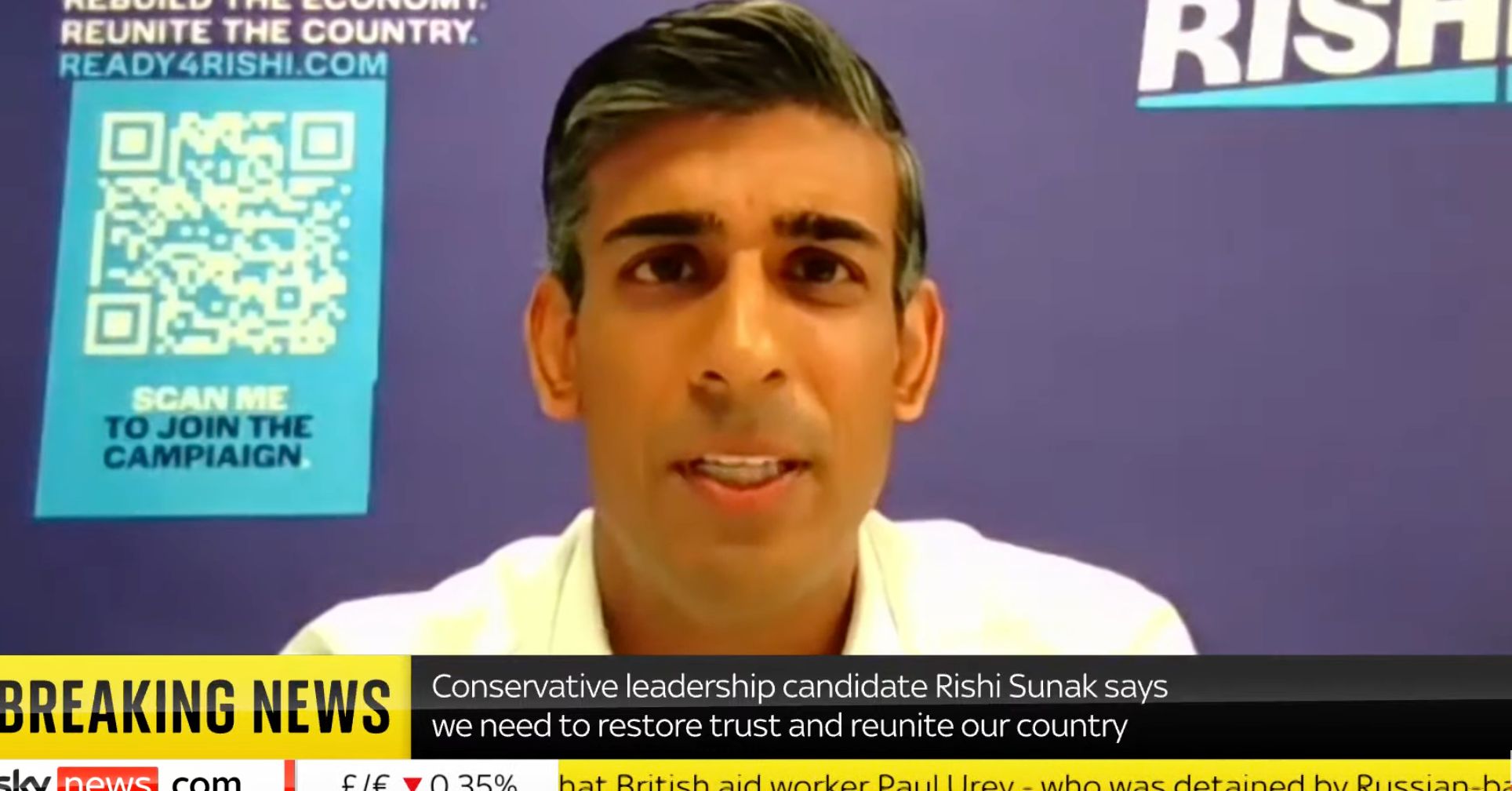
So it was particularly surprising that during a leadership hustings hosted by Conservative Home on Friday, a large spelling error on one of his campaign signs was visible.

Below a giant QR code was the caption: “Scan me to join the campiaign [sic].”

A close-up of the screen behind Sunak during his ConHome interview

It’s especially surprising as Sunak’s campaign has been so glossy since its launch, unlike his main competitor Penny Mordaunt, who had complaints about her launch video.

Sunak has even been accused of registering his official website Ready4Rishi.com back in December, although it was actually registered on July 6 according to public records. That’s the day after he quit as chancellor and the day before Johnson resigned.

Actually, a different web address was registered six months ago – Readyforrishi.com, which was snapped up on December 23, although Sunak’s team claim they were not responsible for that, according to The Guardian. This URL now redirects to Sunak’s official Ready4Rishi.com page.

Spelling mistakes aside, Sunak’s chances of winning the top job seemed to decrease after a YouGov poll found he was not the most popular candidate among the wider members of the Conservative Party.

Just 13% of the 879 members surveyed backed Sunak – meaning he was tied in third place with foreign secretary Liz Truss – compared to 27% who supported his opponent Mordaunt.

This comes despite Sunak being the second person to resign from Johnson’s cabinet last week, triggering a mass Tory exodus from his government which ultimately forced the prime minister to resign on Thursday.

Sunak has also faced criticism over his wife’s non-dom status (which did allow her to avoid paying taxes on overseas income) earlier this year, until she gave it up and started paying UK taxes.

When challenged over his multi-millionaire status on Thursday, Sunak also told BBC Radio 4′s Today programme on Thursday that he was not too rich to become prime minister.

“I don’t judge people by their bank accounts, I judge them by their character and I think people can judge me by my actions over the past couple of years,” he claimed.

Share Button

GB News Anchor Makes Don’t Look Up A Reality With Her Reaction To ‘Lethal Weather’

A GB News anchor appeared to channel the characters from the hit film Don’t Look Up in a bizarre exchange with an actual expert on Thursday.

Adam McKay’s stark sci-fi, starring Leonardo DiCaprio and Jennifer Lawrence, followed two scientists trying – and failing – to warn the world that a meteor was approach the Earth, soon to destroy it.

It was clearly a thinly-veiled reference to the warnings the world has had over the climate crisis.

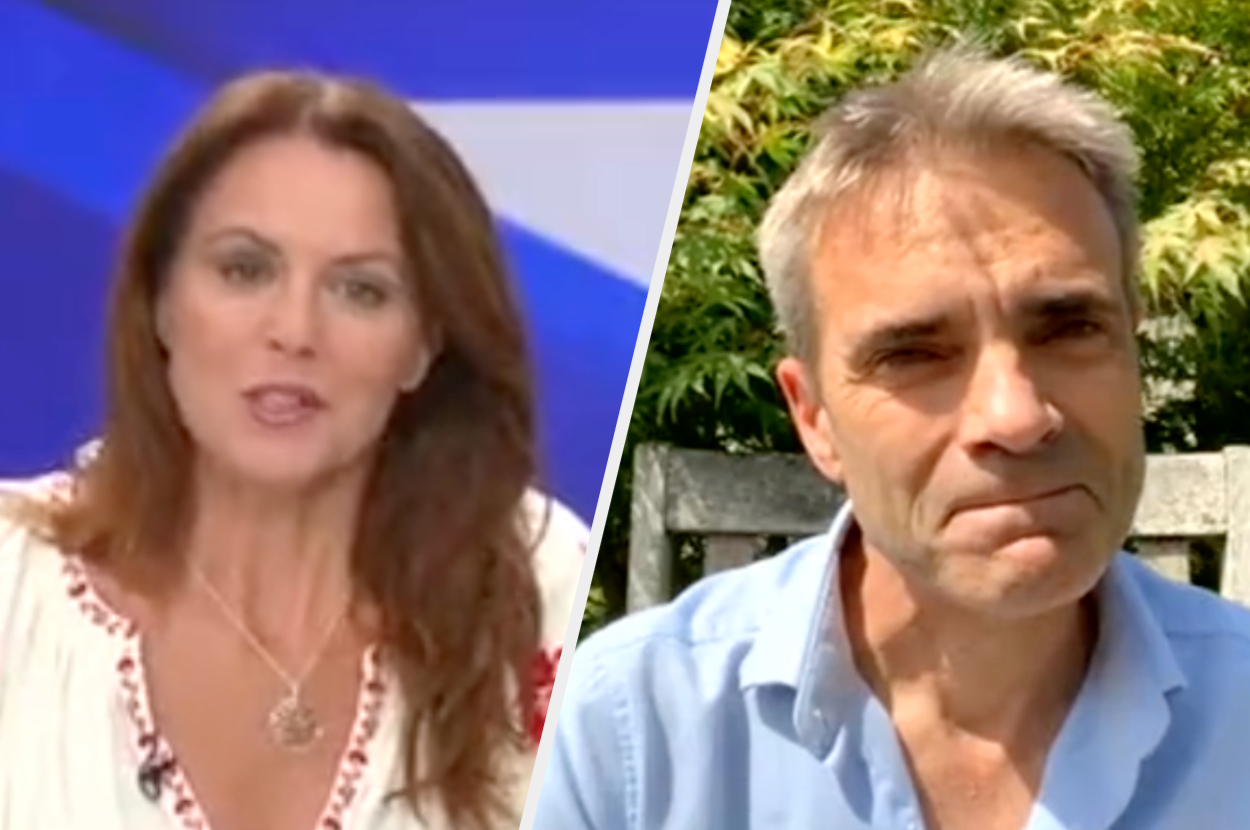
One of the scenes then seemed to play out in real life on GB News, when anchor Bev Turner appeared to dismiss the serious implications of the heatwave which has already descended on the UK, and may hit highs of 40C next week.

Addressing John Hammond, a meteorologist, on Wednesday, she said: “See John, you’re outside enjoying the sunshine. It’s not too hot, is it?”

He replied that the weather was much more mild – before issuing a stark reminder that “by earliest next week, you could scrap 20C, as it could well be 40C”.

″I think there will be hundreds if not thousands of excess deaths early next week.”

He said the charts he could see in front of him are “frightening”, adding that this will not be “nice weather”.

“This will be potentially lethal weather for a couple of days. It will be brief but it will be brutal.

“Oh John,” the anchor cut across. “I want us to be happy about the weather!

“I don’t know if something has happened to meteorologists to make you all a little bit fatalistic and harbingers of doom, but broadcasters – particularly on the BBC – every time I’ve turned on, anyone is talking about the weather and they’re saying there’s going to be tons of fatalities.

“But haven’t we always had hot weather, John?

“Wasn’t the summer of 76 – that was as hot as this, wasn’t it?”

“Er, no,” the expert replied. “And we are seeing more and more records, more and more frequently, and more more severely, so yes some people always hark back to the summer of 1976, which was a freak event, over 40 years ago.

″But heatwaves are becoming more extreme, this is yet another one that is coming down the tracks towards us and I don’t think we should be too lighthearted over the fact that many are going to die over the next week because of the heat. Forty degrees [Celsius] – the sort of temperature, I’m afraid, that this country is just not geared up to cope with.”

He urged employers to consider their workers’ safety on the way to work, and for employees to think about their own commutes.

This clip was also released online a day before the the UKHSA confirmed that the UK was in a national heat emergency.

The highest temperature ever recorded in the UK is 38.7C in 2019 – and temperatures are set to surpass that next week.

Share Button

One in 20 has Covid in the UK

Every nation of the UK has seen cases rise yet again, latest figures show.

Share Button

Heatwave: Met Office issues red extreme heat warning

It is the first time this highest warning has been issued and comes as temperatures could hit 40C (104F).

Share Button

UK skin cancer deaths higher in men than women

There are about 1,400 deaths a year from melanoma in men, compared to 980 in women, says Cancer Research UK.

Share Button

Ambulance services on fringe of collapse – paramedic

BBC Newsnight spends 12 hours at six hospitals with the longest delays handing over patients to A&E.

Share Button

California’s trees are dying, and might not be coming back

The State of California is banking on its forests to help reduce planet-warming carbon dioxide in the atmosphere. But that element of the state’s climate-change solution arsenal may be in jeopardy, as new research from the University of California, Irvine reports that trees in California’s mountain ranges and open spaces are dying from wildfires and other pressures — and fewer new trees are filling the void.

“The forests are not keeping up with these large fires,” said study co-author James Randerson, the Ralph J. and Carol M. Cicerone Professor of Earth system science at UCI. Across the entire state, tree cover area has declined 6.7 percent since 1985. “These are big changes in less than four decades,” he said.

It’s the first time that researchers have been able to measure tree population declines in California, and attribute the changes to such pressures as wildfires, drought stress and logging.

For the study, the UCI-led team used satellite data from the USGS and NASA’s Landsat mission to study vegetation changes between 1985 and 2021. They found that one of the starkest declines in tree cover was in Southern California, where 14 percent of the tree population in local mountain ranges vanished, potentially permanently.

“The ability of forests to recover from fire appears to be dwindling in the south,” said Jonathan Wang, a postdoctoral researcher in Randerson’s research group, who led the study published in AGU Advances. “At the same time, the state’s coverage of shrubs and grasses is rising, which could foreshadow more permanent ecosystem shifts.”

The rate and scale of decline varies across the state. Tree cover in the Sierra Nevada, for instance, stayed relatively stable until around 2010, then began dropping precipitously. The 8.8 percent die-off in the Sierra coincided with a severe drought from 2012 to 2015, followed by some of the worst wildfires in the state’s history, including the Creek Fire in 2020.

Fortunately “in the north, there’s plenty of recovery after fire,” said Wang, perhaps because of the region’s higher rainfall and cooler temperatures. But even there, high fire years in 2018, 2020 and 2021 have taken a visible toll.

The tree decline has also affected carbon storage abilities in the state, said Randerson, who added that the next step is to precisely quantify the impact on forests’ ability to absorb anthropogenic carbon dioxide. Co-author Michael Goulden, a UCI professor of Earth system science and director of the Center for Ecosystem Climate Solutions, is using the data to understand how changes in forest cover are affecting water resources, carbon storage and fire behavior across the state.

“This threat to California’s climate solutions isn’t going away anytime soon,” Wang said. “We might be entering a new age of intense fire and vulnerable forests.”

Collaborators include Clarke Knight and John Battles from UC Berkeley. The research was supported by California’s Strategic Growth Council and the UC National Laboratories grant program, along with long-term funding from NASA and the U.S. Department of Energy’s Office of Science.

Story Source:

Materials provided by University of California – Irvine. Note: Content may be edited for style and length.

Share Button