The latest research from the labs of Penn scientists Paulo Arratia and Douglas Jerolmack was an answer to “a call for help,” says Arratia.
It was 2020, and the Philadelphia Orchestra, like so many cultural institutions, had suspended performances due to the COVID-19 pandemic. Through P.J. Brennan, chief medical officer of the University of Pennsylvania Health System, the Orchestra sought expertise to help understand whether its musicians could return to playing in a safe physical arrangement that would minimize the chances of exposing one another, or their audiences, to SARS-CoV-2.
“The Orchestra director didn’t want the musicians to be far apart; they needed to be close together to produce the best sound,” says Arratia, of the School of Engineering and Applied Science. “And yet, if they needed to be separated with plexiglass, that also posed a problem.” The musicians reported problems hearing one another and poor sightlines with plexiglass dividers. “The challenge was, how can we get away from this to the point where they can play unobstructed but still safely,” Arratia says.
Now, in a publication in Nature Communications, Arratia, Jerolmack, and colleagues report on their findings, which suggest the aerosols musicians produce dissipate within about six feet. The results not only informed the arrangement of the Philadelphia Orchestra as they resumed performances in the summer of 2020 but also laid the groundwork for how other musical groups might think about safely gathering and playing.
“Having experts like Paulo and Doug, who could measure particle size and trajectory and distance and velocity, were really valuable in making decisions for the orchestra,” says Brennan, who now serves on the Orchestra’s Board of Directors. “Those decisions included the spacing between players, the distancing between sections, who needed to mask. As they gathered this information, along with the testing and case tracking that Penn Medicine was doing, it helped us make decisions with confidence.”
Experimental approach
The research hinged on the questions of how many aerosol particles the musicians generated, how densely the particles were emitted from the instruments, and how fast they traveled through the air.
advertisement
“You can have a big jet of air coming out, but if the aerosol concentration is very low it doesn’t much matter,” says Jerolmack, of the School of Arts & Sciences. “Or you can have a lot of aerosols that get concentrated in a narrow beam. Those things are important to understand.”
To gather data, the researchers invited Orchestra musicians to campus, bringing along their wind instruments, including flutes, tubas, clarinets, trumpets, oboes, and bassoons.
In order to visualize and track the aerosols flowing out of the instruments as the musicians played, the researchers operated a humidifier that emitted water vapor droplets at the bell end of the instruments. This arrangement was only shifted for the flute player, for whom the humidifier was placed near the musician’s mouth instead of the bell, since air travels over the mouthpiece while playing that instrument.
The researchers then shone a laser beam through the “fog” created by the humidifier, lighting up the aerosol particles and allowing them to be captured by a high-speed camera and particle counter.
“It’s just like on a rainy day; you will see the water drops if the sun shines through,” Arratia says.
advertisement
The musicians played scales continuously for two minutes. It proved somewhat surprising to the researchers to find that the wind instrument musicians produced aerosols that were similar in concentration to those emitted during normal breathing and speaking, from about 0.3 to 1 micrometer in diameter.
Particles of this size, the researchers say, are small enough to travel far through the air, provided the air flow is strong enough to take them there. Thus, measuring their concentration and the flow became important to understand the potential risk of a musician potentially passing SARS-CoV-2 to another person.
Evaluating the velocity of the flow, the researchers measured speeds of roughly 0.1 meters per second, orders of magnitude slower than that of a cough of sneeze, which can travel 5 to 10 meters per second. The flute was an outlier but still only reached flow speeds of around 0.7 meters per second.
“When you observe the flow, you see these puffs and eddies, and we know that they spread, but we didn’t know if there was going to be anything general at all between these instruments,” says Jerolmack. “Here, we found that by measuring only flow and aerosol concentration and counts, we can make predictions about how far aerosols will travel.”
Music’s flow
Based on their observations, the aerosols produced by these “mini-concerts” dissipated, settling into the flow of the background air draft, within about 2 meters, or 6 feet — reassuringly similar, the researchers say, to what has been measured for ordinary speaking or breathing. Only flute and trombone-generated aerosols traveled beyond that distance, for the flute perhaps because the air travels over the instrument instead of the instrument acting like a mask to prevent the spread of aerosols.
Overall, woodwind instruments emitted slightly lower concentrations of aerosols than brass instruments, perhaps because the wooden elements of the instrument absorbed some of the humidity and the numerous holes along the instrument may reduce the flow of some of the aerosols, the researchers speculate.
Because the measurements the researchers made were not connected to any specific quality of SARS-CoV-2, they can be used to extrapolate how transmission of other respiratory pathogens could be affected by making music.
“Now you have something to work with for potential future concerns, maybe an outbreak of influenza or something like that,” says Arratia. “You can use our findings about flow, plug in your numbers about infectiousness and viral loads, and adapt it to understand risk.
“This was not exactly a problem that we work on routinely, but we felt compelled to take it on,” he says. “It was a lot of fun, and we were lucky to have a problem to work on that made a meaningful difference during the difficult times of the pandemic.”
Organ transplant recipients take life-long immunosuppressive drugs to prevent their bodies from mounting an immune response against the donated organ, yet a substantial number of them still reject the organs. A new study by researchers from the University of Chicago shows that transplant recipients also mount an immune response against commensal bacteria in the organ graft, adding to the immune response against the genetic makeup of the tissue and reducing the effectiveness of immunosuppressive drugs.
The study, published today in the Journal of Clinical Investigation, also shows that this anti-microbial immune response can be triggered by immune cell memory of previous encounters with bacteria, further complicating the body’s ability to accept a lifesaving new organ.
“Before, we thought the reason why transplanted organs in humans are less easily accepted than in sheltered laboratory animals is that humans can have immune memory responses that cross-react on the cells of the organ, and memory responses are more difficult to suppress with drugs than naïve responses,” said Maria-Luisa Alegre, MD, PhD, Professor of Medicine at UChicago and senior author of the study. “Now, we see that it’s not only memory cells that recognize the organ itself that are the problem, but also memory responses that recognize bacteria in the organ.”
Two separate immune responses
The success of organ transplants depends on the type of organ. Lungs and small intestines are notoriously difficult to transplant and have shorter survival times. Statistics show that within five years of surgery, 41% of lung and 54% of intestinal transplant recipients rejected their grafts, compared to organs like kidneys (just 27% rejection) and hearts (23%). One hypothesis was that lungs and intestines, but not kidneys and hearts, are exposed to microbes from the air and digestive system and that the organ recipients were mounting immune responses not only to the organs but also to the microbes in those organs.
In a previous study, Alegre and her team had shown that when mice received a skin graft colonized with Staphylococcus epidermidis (S. epi), a common bacteria found on the human skin, S. epi caused low grade inflammation in the graft. The team then wondered if the host mounted a separate immune response against the bacteria in the graft in addition to the more well-understood “alloresponse,” or reaction to the foreign cells in the tissue, and if both could damage the graft.
“The commensal bacteria in the graft are different from the commensal bacteria of the recipient because each individual harbors a unique set of microbes, so the host may also see these bacteria as foreign too,” Alegre said. “We thought that maybe these two separate immune responses (host-versus-transplant and host-versus-bacteria) could work additively or synergistically to mount a more robust immune response against the graft and explain why the half-life of the organs that have microbes is shorter.”
Dealing with a lifetime of immune memory
In the new study, the researchers used mice from UChicago’s gnotobiotic facility which were carefully raised in a sterile environment and not colonized by any microbe. The team transplanted skin from donor mice that were genetically identical to the recipients to avoid an alloresponse. The receiving mice mounted an immune T cell response against the graft when it was first colonized with S. epi, but not when it was left sterile. This immune response damaged the skin graft, but not very much.
Alegre and her team then tested if prior immune exposure to commensal bacteria would cause greater damage to a graft colonized by similar bacteria, so they infected some recipient mice with S. epi before transplanting them, letting them develop memory responses to the bacteria. When these mice later received a skin graft colonized with similar bacteria, the immune response was much stronger and significantly damaged the new tissue. This is significant because transplant patients already have a lifetime of exposure to many bacteria and other microbes through everyday cuts, scrapes, infections, and diet.
Most importantly, when they transplanted mice with skin grafts that were genetically different and colonized with bacteria — simulating the scenario like most human organ transplants — they saw that immunosuppressive drugs that prolonged transplant survival in naïve mice did not work in mice with anti-bacterial memory.
“That explains why when you transplant a lung or intestine, patients do less well and have to receive higher levels of immunosuppression than when you transplant sterile organs,” Alegre said. “You have to deal not only with the response against the graft, but also the response against the bacteria that come with the graft.”
Story Source:
Materials provided by University of Chicago. Original written by Matt Wood. Note: Content may be edited for style and length.
","type":"video","meta":{"url":"https://www.youtube.com/watch?v=21veiLIGTZg","type":"video","version":"1.0","title":"Regé-Jean Page Taps into His Evil Side in The Gray Man","author":"Variety","author_url":"https://www.youtube.com/channel/UCgRQHK8Ttr1j9xCEpCAlgbQ","provider_name":"YouTube","description":"Regé-Jean Page discusses his role in The Gray Man and reminds people about Simon’s dark side in Bridgerton.\n\nhttp://bit.ly/VarietySubscribe\r\n\r\nhttp://www.facebook.com/variety\r\nhttp://www.instagram.com/variety\r\nhttp://www.twitter.com/variety","thumbnail_url":"https://i.ytimg.com/vi/21veiLIGTZg/maxresdefault.jpg","thumbnail_width":1280,"thumbnail_height":720,"cache_age":86400,"options":{"_start":{"label":"Start from","value":"","placeholder":"ex.: 11, 1m10s"},"_end":{"label":"End on","value":"","placeholder":"ex.: 11, 1m10s"},"_cc_load_policy":{"label":"Closed captions","value":false},"click_to_play":{"label":"Hold load & play until clicked","value":false}}},"fullBleed":false,"flags":[],"enhancements":{},"options":{"theme":"news","device":"desktop","editionInfo":{"id":"uk","name":"U.K.","link":"https://www.huffingtonpost.co.uk","locale":"en_GB"},"slideshowAd":{"scriptTags":[],"otherHtml":""},"slideshowEndCard":{"scriptTags":[{"attribs":{},"scriptBody":"\r\n (function(){\r\n var c = document.getElementById(‘taboola-endslate-thumbnails’);\r\n c.id += ‘-‘ + Math.round(Math.random()*1e16);\r\n \r\n var taboolaParams = {\r\n loader: \"//cdn.taboola.com/libtrc/aol-huffingtonpost/loader.js\",\r\n mode: \"thumbnails-b\",\r\n container: c.id,\r\n placement: \"Endslate Thumbnails\",\r\n target_type: \"mix\"\r\n };\r\n \r\n if (typeof window.modulousQueue === \"function\") {\r\n \twindow.modulousQueue.add(function(){ doTaboola(taboolaParams); });\r\n } else {\r\n \tdoTaboola(taboolaParams);\r\n }\r\n }());\r\n"}],"otherHtml":"
Any Bridgerton fans still holding out for a possible return of Regé-Jean Page to the Netflix series might want to look away now.
Just a month after the actor shut down rumours that he was set to return to the period drama for its upcoming third series, Regé-Jean has now doubled down on those comments, even declaring that he’d have no qualms if his character Simon Basset was recast.
Advertisement
*clutches pearls, starts furiously fanning self*
Regé-Jean played one of the romantic leads in the first season but did not return for the second, which was released earlier this year.
In an interview with Variety at the LA premiere of his new film, The Gray Man (above), Regé-Jean insisted his days of playing the “Regency fuckboy” (his words) are definitely over.
Rege-Jean Page
David Livingston via Getty Images
“They’re free to do as they like,” he said. “Shonda [Rhimes, executive producer on Bridgerton] and I had a wonderful conversation at the end of Season 1. We were quite happy with how we stuck the landing on that one.”
Advertisement
He continued: “We did so well on that redemptive arc that people forget that Simon was kind of horrific.
“He was the best example of a Regency fuckboy that any of us had come across. And so, because we came around full circle so well, because we stuck that landing, you’re left with this great feeling.
“You really do have to be brave about ending stories like that.”
Regé-Jean Page as Duke of Hastings, Simon Basset in Bridgerton
Regé-Jean also admitted that he still hasn’t tuned into the second series of Bridgerton, which debuted on Netflix in March.
After hanging out with former co-star Jonathan Bailey, who plays Anthony Bridgerton, at Milan Fashion Week last month, Regé-Jean posted some snaps on Instagram.
Advertisement
“The boys are back in town (No, I’m not going back to the show btw – the papers made that one up), he captioned the pics.
“But we had the best, and most stylish, catch up I’ve had in a while over some truly excellent Italian coffee and sunshine.”
Bridgerton series 1 and 2 are streaming in Netflix now.
Every morning I apply sunscreen, always to my face and usually to any other exposed skin too. Vanity drives my habit more than fear of skin cancer, but that vanity is going far to keeping my skin healthy — especially as a Florida resident.
But the same can’t be said for my husband.
Despite having a partner who writes about skincare and speaks enthusiastically about sunscreen, he doesn’t wear it daily.
Advertisement
But he, along with other men, have good reason to start: males are significantly more likely than females to die of melanoma, according to recent data from the US Centers for Disease Control and Prevention data. Among white people, who experience much higher rates of melanoma than people with other skin tones, males died of the cancer at more than twice the rate of females.
Lian Mack, a board-certified dermatologist and the medical director and owner of Gramercy Laser and Medical Dermatology, sees a disparity firsthand in her offices. “The number of women presenting to our offices for skin checks far exceeds the number of male patients,” she says, noting females in their mid-20s to late 50s make up the predominant demographic.
This same pattern is repeated elsewhere too. “Men seem to need a lot more coaxing to be seen in the office for skin checks,” says Luke Maxfield, a board-certified dermatologist. “Every year I have at least two or three men who are dragged into the office by their spouses only to have me confirm the diagnosis of melanoma. Literally, spouses often save men’s lives,” he says.
Advertisement
Delaying skin checks or forgoing them altogether means that problematic moles or spots may not be caught until later stages when melanoma’s survival rate begins to decrease, which can explain some of the increase in death rates. While skin cancer is more common in light skin, delaying skin checks is problematic for people of colour. Those with darker skin who are diagnosed with skin cancer often have a worse prognosis because it’s caught at a later stage.
Forgoing skin checks isn’t the only factor. Behaviour, lifestyle and even the locations of cancerous lesions make a difference.
“Women are more likely to wear sunscreen, more likely to stay out of the sun, and young women are more likely to have done a self-examination looking for skin cancers and also much more likely see a doctor for anything concerning,” Maxfield says. “These tendencies are extremely important given that more than half of melanomas may be first noticed by people examining their own skin at home.”
Without proper self-examination, those concerning spots can be hard to find and treat, especially in hard-to-see areas. “In males, most melanomas occur in areas that they are unable to monitor, like the shoulders or the back,” Mack explains, and without a partner to point it out, major delays in treatment can occur.
There may be biological factors, as well. Even when comparing melanomas of similar thickness and location between men and women, the men still fared worse. Levels of testosterone may play a role, but the science is still out on why exactly this is. “The story seems much more than just hormones, and there seems to be a biological role we have yet to discover,” he says.
Given the science, why aren’t more men wearing sun cream? When used properly, it has been proven to reduce the risk of both melanomas and other types of skin cancer. But while many people may apply sun cream when heading out to a day at the beach, making it a daily habit is essential since UV exposure is cumulative over time. “Most of my male patients need to be educated on the importance of sunscreen and the role that its use plays in the prevention of skin cancer and early aging. Most men simply do not believe that they need sunscreen if it is cold out or overcast,” Mack says.
Advertisement
It’s also not the easiest product to work with. Some sun creams can leave behind an uncomfortable stickiness or a white cast on the skin. “My skin-of-colour patients often struggle with the cosmetic elegance of sunscreen,” Mack says, explaining that some can leave behind a greyish-blue tone.
Since the effects of UV radiation damage don’t show up right away, it can be hard to connect time in the sun to any serious effects. And unlike women who use sunscreen to prevent premature ageing, men often don’t share the same motivation, Mack explains.
Making sunscreen a daily habit – even if it’s cloudy – comes down to just one thing: choosing a sun cream and applying it. “The best sunscreen is the one you use,” Mack says, repeating a quote oft-given by dermatologists.
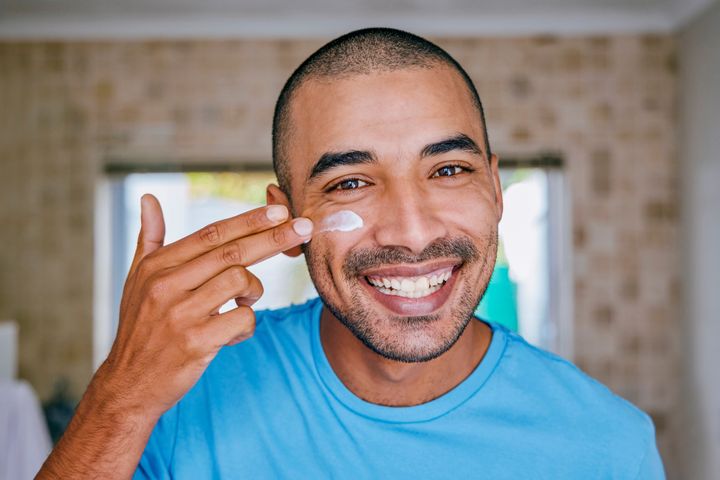
Moyo Studio via Getty Images
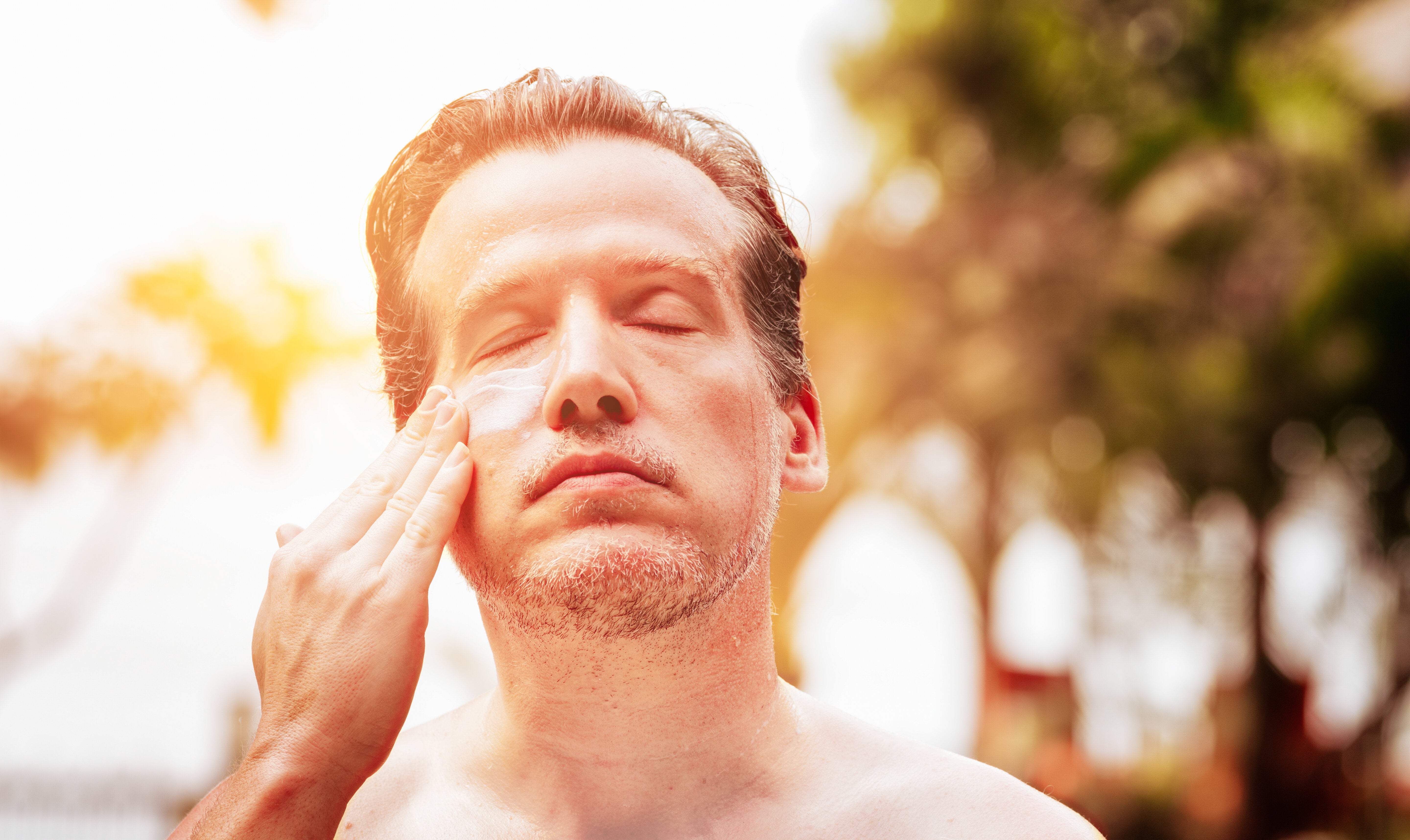
For face, a cream sun cream of SPF 30 or higher is ideal, applied daily after cleansing and moisturising (skipping moisturiser is OK if it’s not needed). Applying enough is important to get full coverage – Mack recommends the two-finger method. Apply a streak of cream to two fingers from base to tip, and apply generously. “I tell my patients to put some of that product on their ears and neck as well,” Mack says.
Advertisement
Don’t forget to apply sun cream to the body, especially if you’ll be in the sun during the day. “If you are going to be at the beach and applying cream to your body, you should apply at least 2 ounces (or the size of a shot glass) to the entire body 20 minutes before sun exposure and reapply every 80 minutes,” Mack says.
Think about your lifestyle when choosing a sun cream. “Moisturisers with SPF do double-duty to hydrate and protect the skin while also providing sun protection. Tinted sun creams can help them blend with darker skin tones as well as protect from visible light and protect skin from dark spots. And if you are an active person, make sure you are getting something water-resistant,” Maxfield says.
There is good news: despite bleaker statistics for men, knowledge and prevention can go a long way. “Take control of what you can,” Maxfield says. “Know your risk factors. These include sun exposure, having multiple moles on your body, or a family history of melanoma,” he says.
Aside from seeing a dermatologist, self skin checks can be lifesaving. “Check yourself for moles that have multiple colours or irregular borders, those larger than a pencil eraser, or any changing moles, and make sure you seek out a dermatologist if there is anything concerning,” Maxfield says.
Even though irritable bowel syndrome affects 5% to 10% of people worldwide, it’s still not taken totally seriously. To someone who doesn’t have it, IBS may seem like no big deal – like a run-of-the-mill stomachache.
But for people with IBS, a condition that may present with symptoms of chronic abdominal pain, bloating, diarrhoea, constipation or some combination of these, it can quickly become what your entire life revolves around.
Advertisement
“People with IBS are often physically and emotionally exhausted by their symptoms and by repeated efforts to get answers and treatments that could help,” Dr. Lauren Tormey, a gastroenterologist at Dartmouth Hitchcock Medical Center in Lebanon, New Hampshire, tells HuffPost. “Not only can it be challenging to make a diagnosis of IBS, but symptoms can change over time, causing confusion and frustration for both patients and doctors.”
This can lead to an all-consuming cycle of avoiding trigger foods, social gatherings that involve food and drinks (so, all of them) and any situations that entail not knowing where the nearest bathroom is – along with the following things only people with IBS would understand:
1. Being so worried you’ll experience gastro symptoms, you make them come true
“I wish I could say having IBS is always in the back of my mind, but truthfully, it’s front and centre – all day, every day,” Lauren Schneider, senior PR and communications manager at Compt, tells HuffPost. “The only time I’m not worried about it is if I know for a fact I won’t be leaving home that day.”
When we’re stressed about our gut health and anticipate a flare-up or a worsening of symptoms, it sends signals from our brain to our gut, which can actually affect our digestive system. The result? Tightened abdominal muscles, colon spasms and an uptick in discomfort.
Advertisement
“The stress associated with the fear of experiencing IBS symptoms can even result in an inability for the body to properly digest food,” Dr. Vanessa Méndez, a board-certified gastroenterologist and founder of Planted Forward, tells HuffPost. “This can lead to bloating and diarrhoea or even a slowing down of the digestive system that triggers constipation.”
2. Eating or drinking something spontaneously – and immediately paying for it
With IBS, because of the hyper-responsiveness of the enteric nervous system (the part of the nervous system located in our digestive tract), symptoms can often be unpredictable. This means turning down the chance to try a new menu item at a restaurant, or cocktails at happy hour, so as to not risk an attack of symptoms.
For people who have never dealt with IBS, these boundaries might seem like overkill. But they can mean the difference between enjoying time spent with others, or being so focused on masking your symptoms you miss out on the experience (or spend the bulk of the experience in the bathroom).
“That one scoop of ice cream is enough to make me feel like I’ve had food poisoning,” Abi Cowell, a vegan food blogger, tells HuffPost. “Will it kill me like a food allergy would? No. But it will cause an awful lot of pain and misery.”
3. Socialising is filled with mental – and intestinal – anguish
“Having IBS and socialising is filled with emotional landmines, especially when meals are involved,” Lindsay Barnes, media relations manager at Evoke Kyne, tells HuffPost.
Advertisement
There’s the frustration of people not understanding that needing to go to the bathroom means you need to go now. The fear of entering the dating world and having to explain why you go so much. The awkwardness when you’re having a good time and suddenly need to make a run to the loo.
“When you just want to sit down and have a normal meal, whether by yourself or with family and friends, these things can be emotionally exhausting,” Tormey says. “The pain experienced by individuals with IBS is in part due to visceral hypersensitivity.”
Visceral hypersensitivity is pain or discomfort coming from internal organs (like those in the abdomen), under circumstances that wouldn’t normally be painful (like eating or during a bowel movement).
The nervous system experiences these sensations and communicates them to the brain for processing via the gut-brain connection.
“Food – eating it, even thinking about it – regardless of the food type, stimulates normal digestive function and can therefore result in pain in IBS,” Tormey says. “Sometimes eating is accompanied by the immediate urge to have a bowel movement because of a heightened stomach-colon reflex.”
Advertisement
Putting food or fluid in the stomach sends a signal via the nervous system to the colon. The colon understands this as a stimulus to empty whatever waste is there – and doesn’t care if you’re mid-sentence on a first date.
10’000 Hours via Getty Images
Social outings, like dates or meals with friends, can cause emotional and physical discomfort.
4. Changing so many ingredients in a recipe or food order, it becomes a different meal
The average person can control the effects of what they put into their body, and can adapt to food-centric situations, because their sensitivities to certain foods remain relatively consistent and clear-cut.
“I don’t have that luxury,” Barnes says. “I have absolutely no control over my body anymore – I can be as mindful as possible and work really hard on my diet, but at the end of the day, my gut controls my body now, and not in a good way.”
Food intolerances are common in IBS, and dietary modifications can help manage symptoms for some people. But for others, “visceral hypersensitivity and abnormal gut-brain communication can cause flare-ups to happen anyway, despite watching what you eat,” Tormey says.
Advertisement
“And who knows how long the flareup will last?” Barnes said. “A half hour? Two hours? The rest of the day?”
5. Mapping out where every public bathroom is before you leave the house
When Schneider leaves her home, she’s always planning – always conscientious of where she can find a restroom if she needs to stop. “If I’m going to be driving somewhere without quick access to a bathroom, I won’t eat before my trip,” she says. “I’ll wait until I get there.”
These coping strategies are actually pretty common, and can be a normal response to a situation that’s outside of our comfort zone, even for people who don’t suffer from IBS.
“When anxiety levels are high in a situation such as traveling, your digestive processes can get dysregulated,” Méndez says. “During stress, the brain sends signals to the gut that influences motility and digestion, which can lead to diarrhoea or constipation.”
Because the gut is constantly at work, the brain typically filters out the nerve signals it sends (paying attention and responding to some in order to regulate gut activity, while not focusing on others). Normal gut-brain communication can go wrong when something disturbs the nervous system or the brain for a long period of time – like when traveling, working a stressful job or rushing to get errands done.
Advertisement
“In these circumstances, the brain perceives stronger signals from the gut, and even the mildest stomach cramp can immediately trigger the brain to start worrying about the potential for worsening pain or a bowel movement coming on,” Tormey says. “The brain subsequently sends inappropriate signals back that disrupt gut function and can worsen symptoms.”
As a result, you might find yourself doing the same as Schneider: scouting bathrooms on your route or delaying meals.
6. Maintaining excuses for why you’re taking so many bathroom breaks
“Something I want others to understand about how IBS impacts my life is the daily secrecy and diversions that surround my use of the bathroom,” Amanda Dexter, 36, tells HuffPost. “There’s a lot of sneaking (multiple) trips to the bathroom or making excuses as to why it took you so long.”
Eating food and having bowel movements are essential to our survival – and across cultures, food is social and often enjoyed and shared with others. But unless you’re potty training a toddler, bowel movements aren’t exactly a typical subject of dinner-table conversation.
“These aspects of daily life pose regular challenges for those with IBS,” Tormey says, and can lead to a loss of enjoyment around food, a fear of eating and even disordered eating habits, such as skipping meals to avoid needing to use the bathroom.
Advertisement
If more people were to open up about their own horror stories, Dexter believes it would help alleviate the unnecessary embarrassment that many people with IBS feel. “Commiseration can go a long way into helping IBS sufferers not feel so alone,” she says.
7. Having flare-ups so exhausting, you need to take the rest of the day off
IBS is a disorder of “dysmotility,” meaning that movement of food, fluid and waste through the gut is altered.
“This leads to irregular bowel habits (diarrhoea, constipation or both),” Tormey says. “You might spend a lot of time in the bathroom, either having bowel movements, trying to have a bowel movement or dealing with pain around the time of bowel movements.”
It’s not uncommon for people with IBS to miss days of work or school because of these exhausting, intrusive symptoms – only to be further stressed out over the resulting lost productivity and wages.
“There have been times where I feel so emotionally drained and frustrated that I’ll just cry in the bathroom,” Barnes says.
Advertisement
PixelsEffect via Getty Images
Flare-ups can be so painful and taxing, it’s hard to motivate yourself to leave the house.
8. The relief of knowing you don’t have anywhere to go that day
For Schneider, being able to work from home has alleviated much of the anxiety associated with her condition. She’s able to eat more intuitively and with a bathroom always nearby.
“Work trips are a little difficult, especially when the whole group goes out to dinner,” Schneider says. “That’s when I just resort to my old ways, and either barely eat or only eat my tried-and-true few things that won’t upset my stomach.”
Because IBS symptoms can be intermittent and unpredictable, varying in both nature and severity, the condition can leave you with a great deal of uncertainty and anxiety about what might happen outside the home.
“To compound matters, there’s a well-established recognition that the central nervous system, or brain, also has a significant role in regulating not only gastrointestinal motility, but sensation – from both an unconscious and a higher emotional level,” Dr. Brooks Cash, professor of gastroenterology at the University of Texas McGovern Medical School, tells HuffPost.
Advertisement
This typically leads to people with IBS becoming hyper-vigilant about their symptoms, and trying to be as ready for them as possible – including doing everything in their power to avoid potential triggers.
“Sometimes these triggers are absolutely accurate, and other times they’re merely innocent bystanders,” Cash says. “Either way, we often see patients changing their lifestyle, daily activities, diet, habits and social activities for the sake of avoiding them.”
9. Losing count of how often you’ve been told your IBS symptoms are all in your head
Schneider has done what’s recommended to treat IBS. She’s seen doctors, done the tests. The endoscopy and colonoscopy didn’t show anything helpful – just that she also has gastro-oesophageal reflux disease.
“I’m on an SSRI, so it isn’t anxiety-related, like one doctor so unhelpfully assumed,” she says. “She literally said to me, ‘Well, nothing’s shown up in your bloodwork or other tests – you have IBS-D but it’s probably all in your head.’ Thanks, super helpful.”
After being poked and prodded enough, Schneider gave up. “I’m tired of advocating [for] myself to doctors who won’t listen and paying co-pays that are essentially a waste of money to hear the same things over and over.”
Advertisement
While doctors don’t have an IBS biomarker to test for, there are formal diagnostic criteria for IBS called the Rome IV criteria.
“To make a diagnosis of IBS, patients should meet Rome IV criteria and not have any other ‘alarming’ signs such as blood in the stool, unintentional weight loss or new onset symptoms over the age of 50 without prior colon cancer screening,” Tormey says.
These criteria must be fulfilled for the past three months, with symptom onset at least six months prior to diagnosis. “IBS should then be sub-classified by the predominant bowel pattern – such as IBS-C, or IBS with constipation – which helps guide treatment,” Tormey says.
A diagnosis of IBS can be made confidently after a detailed history, a complete physical exam and a few thoughtfully selected diagnostic tests to evaluate for conditions that can present with similar symptoms.
So if your doctor implies – or straight-up tells you – your symptoms are all in your head, Méndez encourages you to get a second, third or even fourth opinion. “You know they’re not in your head and that IBS is a very real condition,” she says. “In fact, IBS is the most common functional digestive disorder. If you have symptoms, please keep seeking help until you find a healthcare provider you trust.”
People with systemic lupus erythematosus, or SLE, who received a “booster” dose of SARS-CoV-2 vaccine after full vaccination are roughly half as likely to have a subsequent “breakthrough” COVID-19 infection, a new study shows.
The finding, researchers say, should offer reassurance to the more than 200,000 Americans who have SLE, a condition in which the body’s immune system mistakenly attacks its own healthy tissues, especially joints and skin. Immune-suppressing drugs, such as steroids, needed to control symptoms of the disease, place them at increased risk of infections, including SARS-CoV-2.
Led by researchers at NYU Grossman School of Medicine, the new study tracked the health of 163 fully vaccinated men and women being treated for SLE at its affiliated hospitals in New York City. The researchers’ goal was to see who became infected with the virus over at least six months, given that more than half were taking at least one immune-suppressing medication for their SLE. All had received some combination of the vaccines manufactured by Pfizer, Moderna, or Johnson & Johnson prior to June 2021, but only 125 had received a third or booster dose of vaccine.
Publishing in the journal The Lancet Rheumatology online July 12, the study showed that at the end of the monitoring period (April 24, 2022), 44 vaccinated SLE patients had had breakthrough infections, with two needing hospitalization (but both surviving their infection).
Among those with breakthrough infections, 28 of 125, or 22%, had received a booster, while 16 of 38, or 42%, had not. Notably, according to investigators, the majority of breakthrough infections (42 of 44) occurred after Dec. 2, 2021, when the city detected its first case of the highly contagious omicron variant.
Another key study finding was among 57 of the study participants who agreed to have their blood antibody levels checked, once after full vaccination and again after receiving their booster.
advertisement
Researchers found that even those on immunosuppression who had not responded to the initial round of vaccination had an immediate rise in antibody levels after the administration of a booster shot. Previous research had shown that these antibody levels were lower among many initially vaccinated patients with rheumatic diseases, including SLE, who were taking immune-suppressing drugs, sparking fears of waning immunity to COVID-19 over time.
However, study results showed those with higher levels of antibodies, needed to block the SARS-Cov-2 “spike” protein and prevent the virus from infecting human cells, were no more protected from breakthrough infection than those with lower spike-protein antibody levels.
Still, researchers say their previous work showed elevated antibody levels in fully vaccinated lupus patients strengthened key measures of long-term immunity, which may help explain the lack of severe disease in those with breakthrough infections.
“Our study results offer people living with systemic lupus erythematosus clinical confirmation that vaccines are highly effective at guarding against severe COVID-19, despite their increased risk of catching the disease,” says study co-lead investigator and rheumatologist Amit Saxena, MD, MS.
“COVID-19 vaccine boosters, or third shots, offered an added, doubled layer of protection from breakthrough infection,” says Saxena, an assistant professor in the Department of Medicine at NYU Langone Health. “Even in cases of SARS-CoV-2 infection, cases were overwhelmingly mild among SLE patients who were fully vaccinated.”
“Our research also shows that most people with systemic lupus erythematosus who are fully vaccinated and boosted mounted good responses despite being on immune suppression,” says study co-senior investigator and rheumatologist Peter Izmirly, MD. Izmirly is an associate professor in the Department of Medicine at NYU Langone Health.
advertisement
However, researchers caution that further monitoring of patients is needed to determine if there is any antibody “cutoff” level below which SLE patients become more vulnerable to SARS-CoV-2 infection.
During the initial wave of the pandemic in spring 2020, NYU Langone hospitalization rates for its SLE patients were more than double those of its patients without the condition, the researchers note, although death rates were the same.
Funding support for the study was provided by grants from the National Institutes of Health (P50AR07059) and Bloomberg Philanthropies COVID-19 Response.
Besides Saxena and Izmirly, other NYU Langone researchers involved in this study are co-lead investigator Alexis Engel, BS; study co-investigators: Brittany Banbury, MD; Ghadeer Hasan, MD; Nicola Fraser, BS; Devyn Zaminski, BS; Mala Masson, BA; Rebecca Haberman, MD; Jose Scher, MD; Gary Ho, MD; Jammie Law, MD; Paula Rackoff, MD; Chung-E Tseng, MD; H. Michael Belmont, MD; Robert Clancy, PhD; and co-senior investigator Jill Buyon, MD.
Saxena has receive consulting fees from AstraZeneca, GlaxoSmithKline, Bristol-Myers Squibb, Eli Lilly, and Kezar Life Sciences, manufacturers of drugs used to treat SLE. Izmirly has served on an advisory board sponsored by GlaxoSmithKline and acted as a consultant to Momenta/Janssen. Haberman and Scher have acted as consultants to Janssen, while Scher has also consulted for and/or received research funding from Novartis, Pfizer, Sanofi, UCB, and Abbvie. Clancy and Buyon have acted as consultants to Momenta/Janssen, while Buyon has also consulted for and/or served on data safety monitoring boards for Ventus, Equillium, and GlaxoSmithKline. These arrangements are being managed in accordance with the policies and practices of NYU Langone.