Downing Street has rejected a call from the first ministers of Scotland and Wales to extend self-isolation for arrivals from two to eight days.
The prime minister’s official spokesman said he believed the government’s approach was “proportionate” and warned of the “detrimental” impact it would have on the travel industry.
Advertisement
It comes after Boris Johnson announced that all travellers, regardless of vaccination status, will be required to take a PCR test two days after arrival in the UK and to self-isolate until they receive a negative result.
However, the two leaders of Scotland and Wales want him to go further in response to concerns about the new omicron covid variant.
Advertisement
The PM’s spokesman told journalists: “We believe that the approach we’ve taken is the proportionate one to the evidence that we currently have available about this variant.
“Introducing further isolation requirements and testing requirements would have a detrimental affect on the travel industry and indeed those who are planning to go travelling.
Advertisement
“So our response needs to be balanced based on what we know currently about this variant. We’re taking a precautionary approach we believe it’s responsible and proportionate.
“Obviously, we will keep our measures under review as our evidence about this variant increases.”
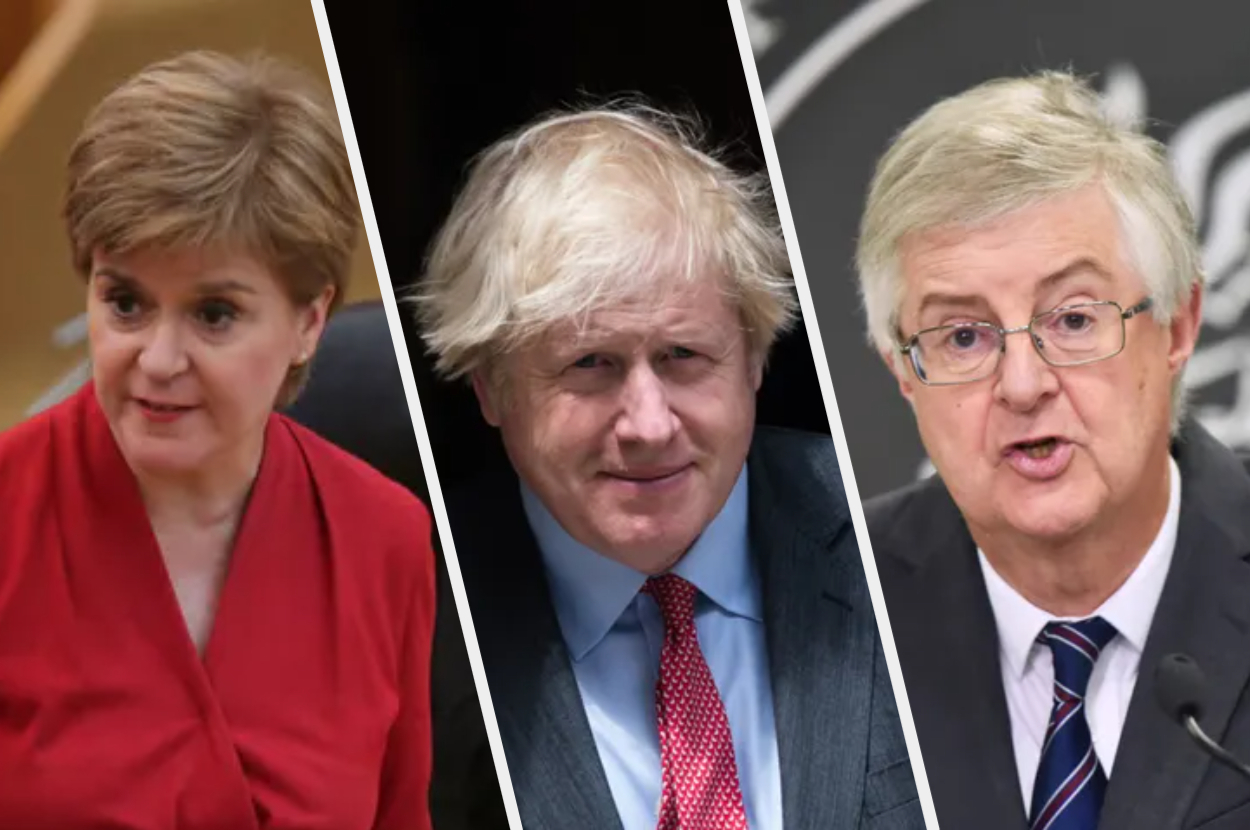
It comes after Nicola Sturgeon and Mark Drakeford wrote to Boris Johnson calling for people coming into the UK from overseas to be required to self isolate for eight days – and then do a second PCR test.
They said: “Public health advice is unequivocal that this is the best and safest way to protect against the importation of this variant to the fullest extent possible.”
Advertisement
They also demanded the PM convened an urgent Cobra meeting to discuss taking a four-nations approach to border restrictions.
But the PM’s official spokesman said: “We would confirm any plans for a cobra meeting in the normal way. Currently, there isn’t one scheduled.
“We obviously speak to our devolved administration counterparts very regularly and we will continue to coordinate our response with them.”
The leaders want the UK government to commit to providing the necessary funding to support businesses if “more interventionist measures are required”.
In her Covid briefing this morning, Sturgeon also said Scots should start working from home immediately to curb the spread of the virus.
Six cases of the Omicron variant of coronavirus were identified in Scotland, in addition to three previously identified in England.
The government is repeatedly dodging calls for tighter restrictions despite rising Covid cases in the UK – so does this mean Britain could be heading for another its fourth lockdown in less than two years?
Will there be another lockdown?
Advertisement
There are no current plans to introduce a lockdown any time soon. Boris Johnson has claimed there is “nothing in the data” to suggest the UK needs to tighten restrictions – but he also refused to “rule anything out”.
Hospitalisations would need to reach almost 1,500 a day for the NHS to be overwhelmed, triggering another lockdown. Government data shows there are currently around 880 people admitted each day.
Advertisement
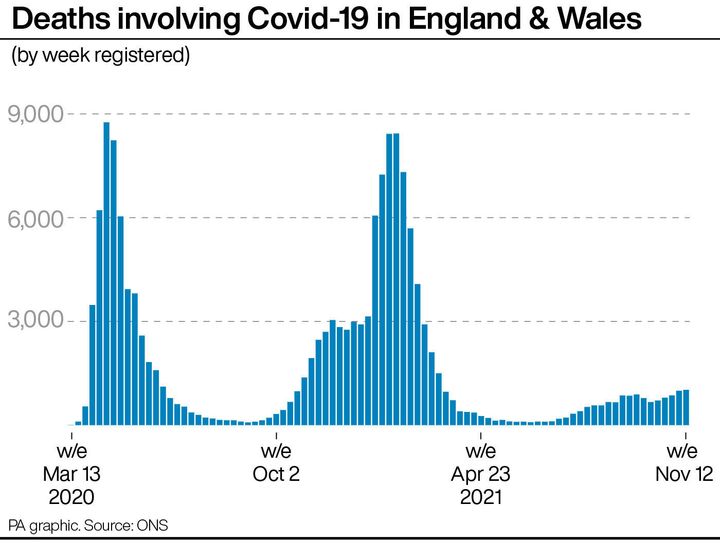
Deaths from Covid remain relatively low, too, compared to the previous rates seen shortly before lockdowns in March 2020, November 2020, and January 2021.
Deaths involving Covid-19 in England & Wales
Sky News’ science correspondent Thomas Moore has also said the government has shown “no inclination towards tightening up the rules” or even bringing in plan B.
Advertisement
Waning immunity and a relaxation in behaviour have triggered small spikes in infections since the UK unlocked in July, but booster jabs have seen these spikes level off quickly.
The prime minister has refused to implement plan B – mandatory face masks and working from home – relying on the vaccine take-up and boosters instead.
The government has promised to keep an eye on the data but also appears wary of bringing about the same anti-lockdown protests seen across Europe.
Only a “firebreak” lockdown will be used if necessary, although business secretary Kwasi Kwarteng told Sky News in October: “I would rule this out.”
Advertisement
Education secretary Nadhim Zahawi has also claimed the UK’s early and successful vaccine rollout means it’s unlikely that more restrictions will be brought in.
Austria became the first Western country to go into another full, national lockdown in November while Germany’s health minister Jens Spahn warned that by the end of winter, most of the country will be “vaccinated, cured or dead”.
The Netherlands, Belgium, Hungary, Croatia, Ireland, Slovakia and Czechia are all struggling with infections too.
However, Professor Neil Ferguson from Imperial College London, part of the government independent advisory panel SAGE, told Radio 4′s Today programme that the UK has already gone through the wave Europe is experiencing, and so the population has greater immunity compared to Germany and Austria.
Will Christmas be cancelled?
As Christmas 2020 was effectively cancelled just six days before December 25, this is a major concern for many families this year.
“Although vaccinations are our primary form of defence, there are many more things we can all do to help contain the spread of this virus, like meeting outdoors where it is possible.”
Advertisement
He added Christmas is possible “if we all play our part”.
Dr Mike Tildesley, part of the Scientific Pandemic Influenza Modelling group (Spi-M) told Sky News, “the idea of a winter lockdown is a long way away” unless the NHS comes under severe pressure again.
What you can do to stay safe in winter
As the UK’s future with Covid remains difficult to predict, you can reduce your own Covid risk in the upcoming months through several simple measures.
Make sure you ventilate your home for at least 10 minutes every hour. This prevents Covid from building up indoors.
Get vaccinated if you haven’t already and make sure you accept your booster jab when you are called up by the NHS.
Get your flu jab as the annual virus is likely to affect people more this year following last year’s lockdown – catching the flu could then make you more susceptible to Covid.
Wear a mask in crowded places, both indoors and outdoors, and wash your hands with soap and water for at least 20 seconds when you can.
Work from home where possible and reduce the number of people you see, or try to see more people outdoors.
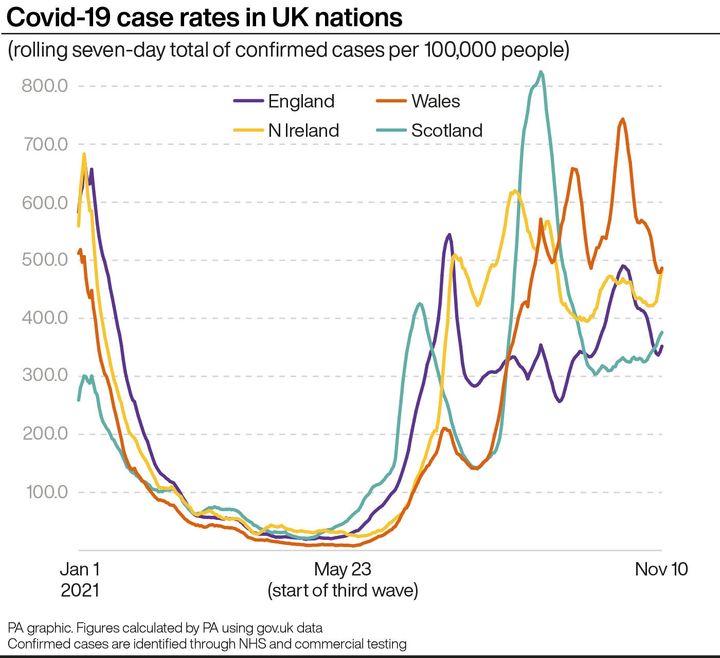
Covid positive cases have increased in England, Wales, Scotland and Northern Ireland in recent days.
The government continues to push the public to get booster vaccines and has just announced that it will roll out the second vaccine doses to those aged 16 and 17.
There were a total of 244,134 new Covid cases reported between November 3 and November 10 in the UK – data from November 11 to November 14 is incomplete and so has not been included.
This equates to 363.9 cases per 100,000 overall, which is higher than the last few days, but slightly below the previous week of 392.2 cases.
Advertisement
PA GraphicsPress Association Images
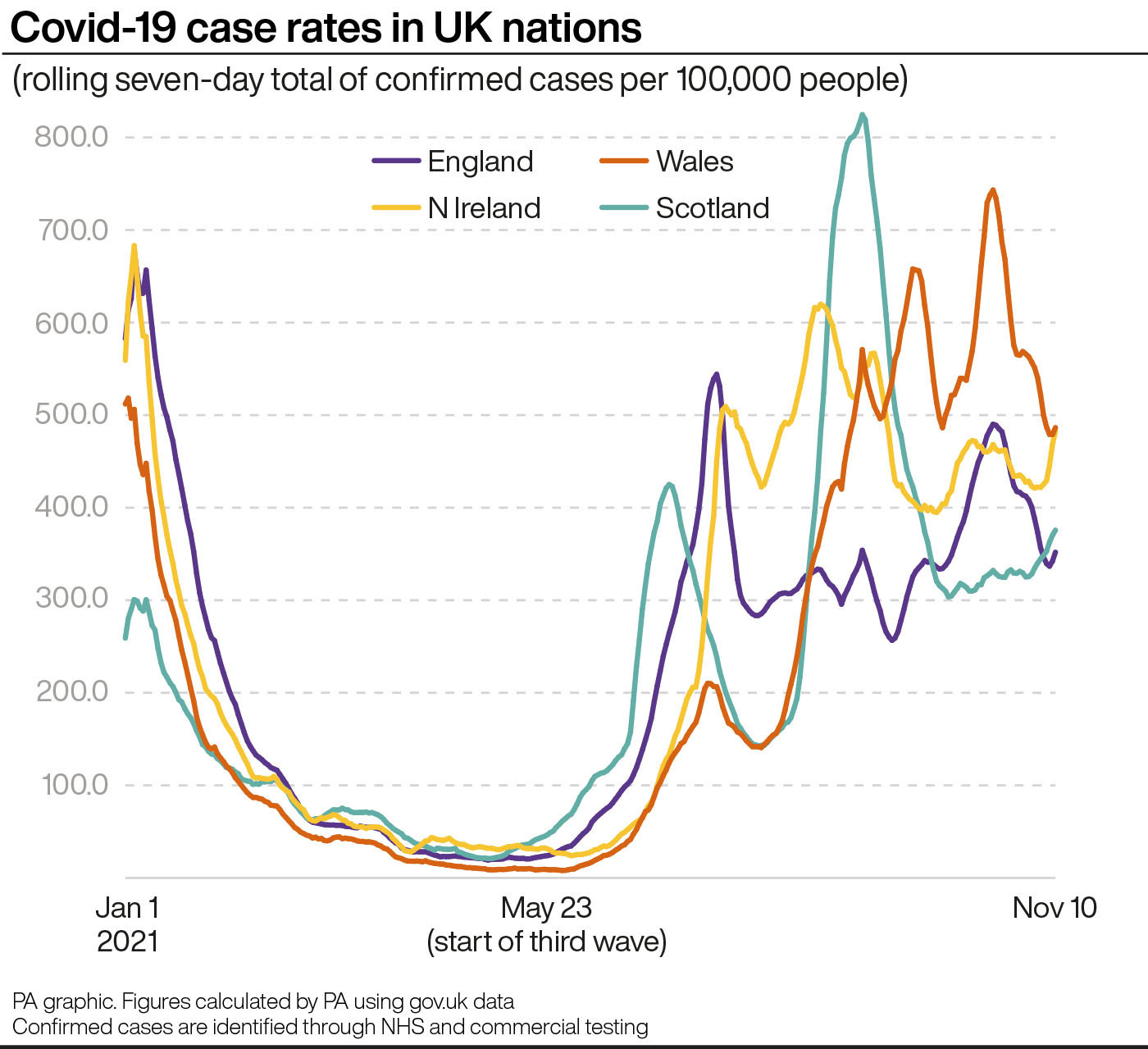
Covid-19 case rates in UK nations
As a third of UK local authorities are recording an increase in rates, here’s a breakdown of just which areas are experiencing the largest jump in the Covid infection.
England
The current rate in England is 351.9 infections per 100,000 people.
The three local authorities in England which have seen the largest jump in new Covid cases are:
Torridge in Devon, case rate increased from 376.9 to 638.8.
Charnwood in Leicestershire’s rate has jumped from 350.8 to 530.7.
North Devon now has the highest rate in England, as its rates increased from 495.1 to 645.8.
Scotland
Scotland has seen its case numbers rise up to 375.7 per 100,000 – this is an increase up week-on-week from 334.7.
This means the nation has the most Covid cases it has experienced since September 26.
Only six out of 32 areas in Scotland have experienced a decrease in case numbers.
The areas with the worst Covid rates are:
Moray, where cases shot up from 318.7 to 501.5.
Perth & Kinross – cases rose from 306-8 to 479.2.
Dumfries & Galloway, where the rate increased from 394.5 to 529.4.
Scotland has the highest local rate in the whole of the UK, in the Orkney Islands – the current infection rate is at 696.4 per 100,000.
Northern Ireland
The current rate of new cases in Northern Ireland is 482.7 per 100,000 – this has increased from 421.2 the previous week.
Advertisement
This is also the highest rate the nation has experienced since September 14, as Covid cases have soared in nine of the 11 local authority areas.
The case rate has jumped the most in:
Causeway Coast & Glens, has seen a large increase from 442.9 to 628.5 – the highest rate in Northern Ireland.
Mid-Ulster has seen an increase from 394.1 to 515.6.
Fermanagh & Omagh’s rate has increased from 484.9 to 591.5.
Wales
Wales has the highest case rate per 100,000 across the four nations, with 486.5 cases. Most of these cases are among just five of 22 areas in the nation.
The rate had recently risen to 551.1, so Wales has actually seen a drop in its overall week-on-week data.
The largest increases between November 3 and November 10 were seen in:
Gwynedd, where it increased from 475.3 to 551.2.
Carmarthenshire, from 480.3 to 529.3.
Vale of Glamorgan has the highest rate out of Wales, with 626.0 – down from 759.8.
PA Graphics
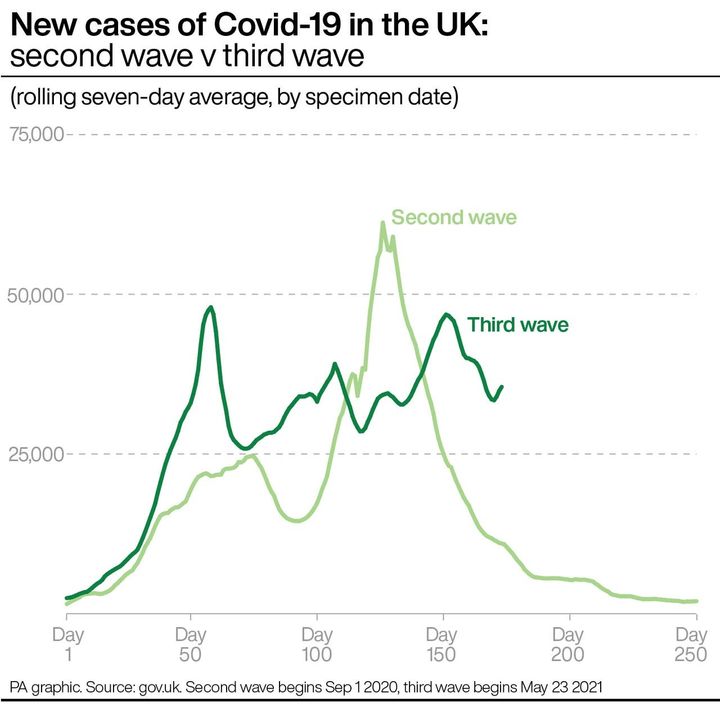
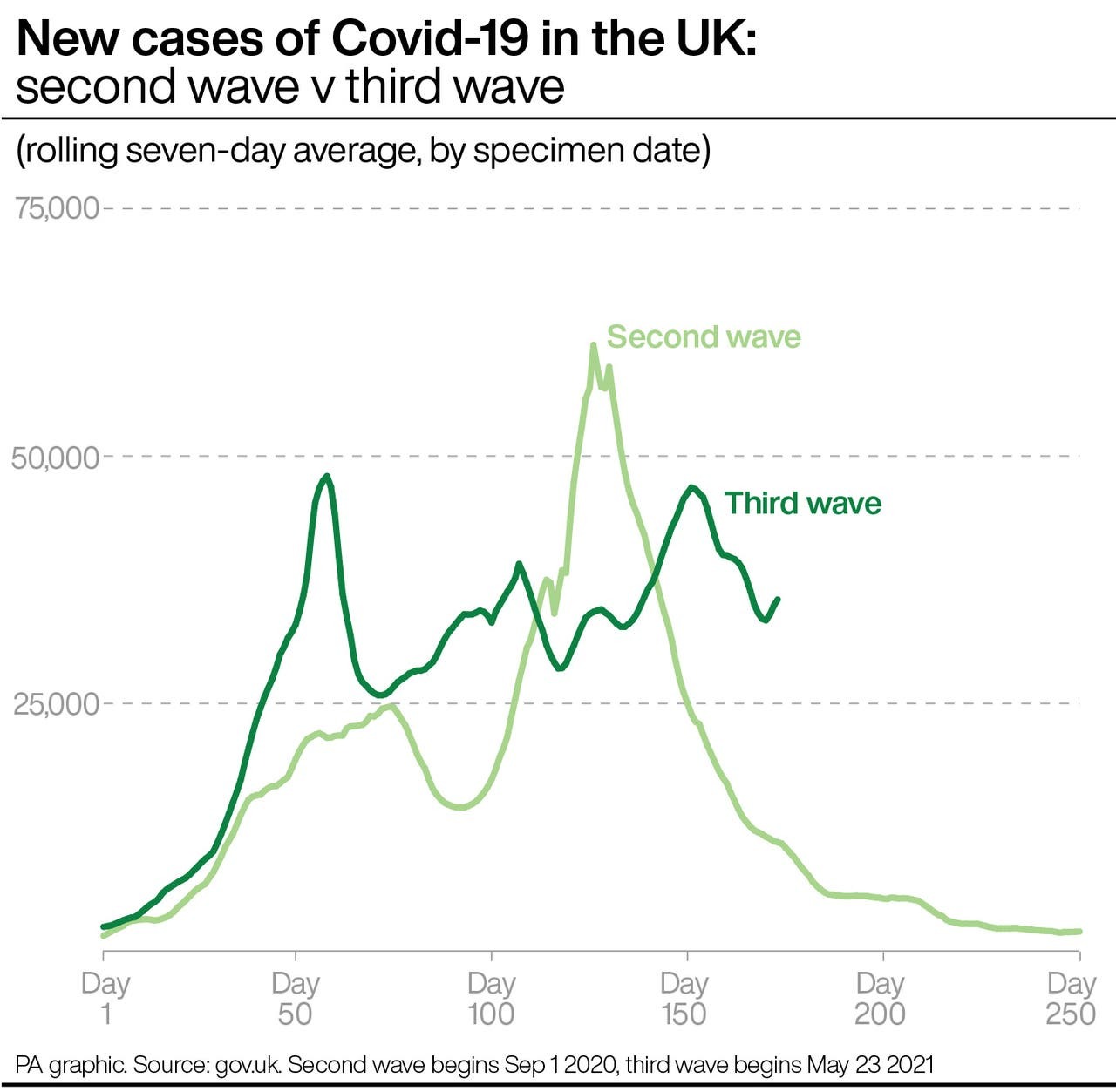
Second wave, starting from September 1 2020, third wave starting from May 23 2021
How does the UK compare to the rest of western Europe?
Concerns over a winter wave has seen the Netherlands implement a partial lockdown for at least three weeks and Austria impose a complete lockdown for unvaccinated people for 10 days, to start with.
Advertisement
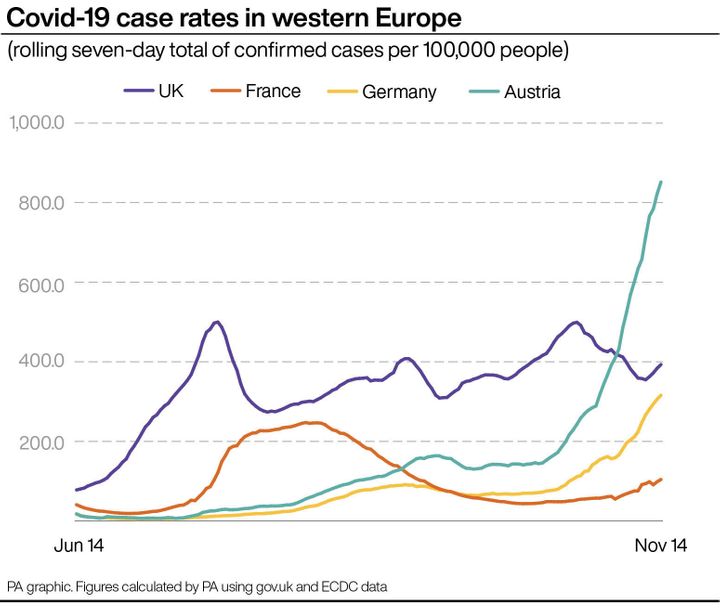
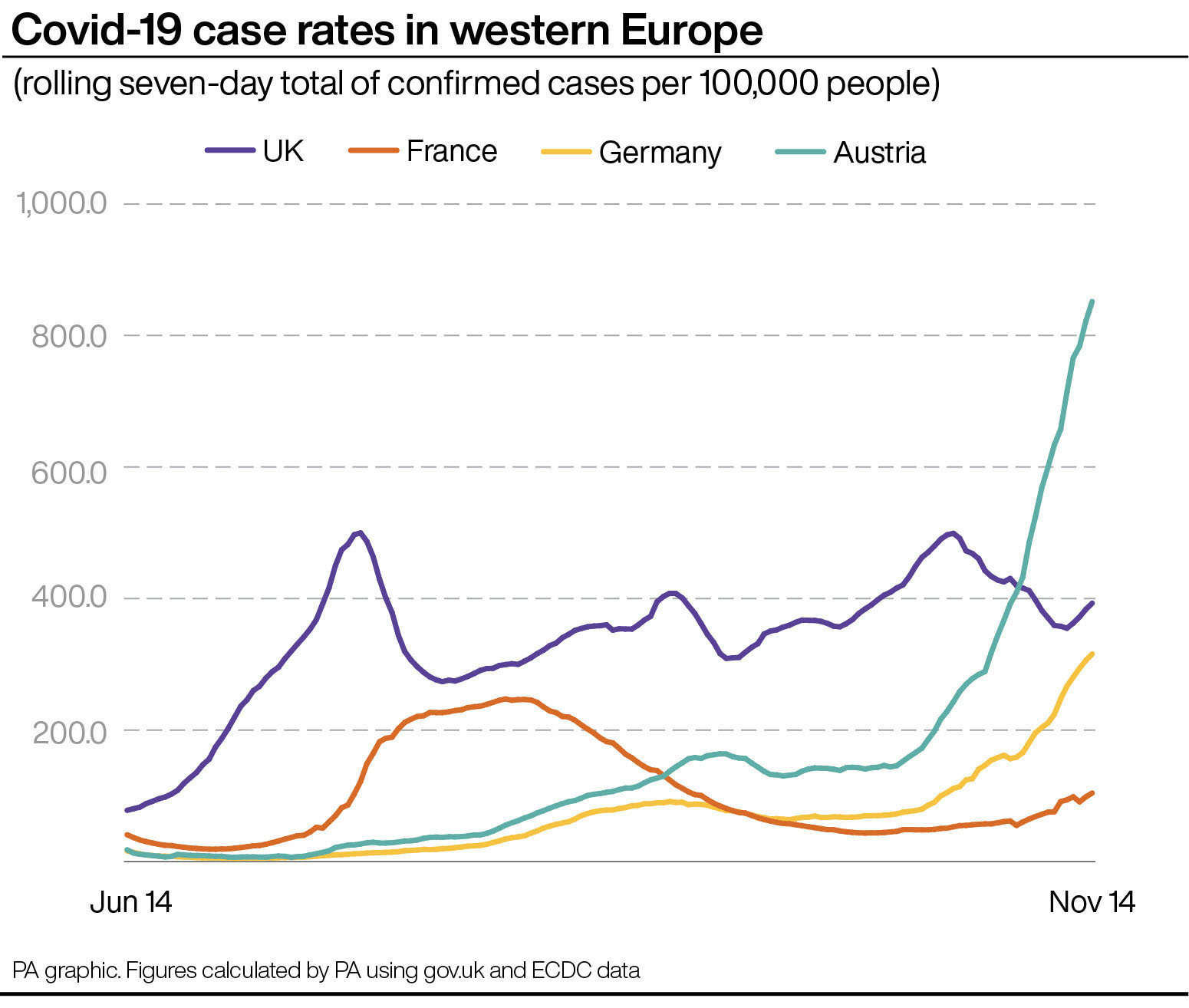
Both countries have see a rapid increase in Covid cases recently, with Austria’s cases soaring to more than 800 per 100,000 people.
The UK has a higher case rate than both France and Germany, but with a rate just under 400 cases per 100,000 people, it’s still a long way off Austria’s infections.
Downing Street is currently relying on plan A, which involves championing the booster vaccine programme, suggesting people choose to wear face masks in crowded areas, regular testing, more funds for the NHS and the “largest ever flu jab” campaign.
NHS representatives have pushed for stricter measures, also known as plan B, to be introduced – and now there’s even talk of plan C.
Advertisement
Where did all this talk of plan C come from?
Chief scientific adviser to the department of health and social care, Professor Lucy Chappell said measures beyond plan B have been “proposed”.
Advertisement
Speaking to a parliamentary committee on Tuesday, she said: “It has been proposed. The name has been mentioned. It is not being extensively worked up…people have used the phrase.”
She did not say any more on the issue, adding: “At the moment the focus is on plan B.”
The Telegraph reported last week that further measures were being considered, including potentially the banning of household mixing at Christmas.
But not everyone agrees that there is even a plan C
The prime minister’s spokesperson said: “As we have repeatedly made clear, there is no plan C.
“We knew the coming months would be challenging which is why we set out our plan A and plan B for autumn and winter last month.
“We are monitoring all the data closely and the government remains committed to taking further action if necessary to protect the NHS from being overwhelmed.”
Deputy chief medical officer for the government department Dr Thomas Waite told MPs: “I haven’t been consulted on anything about a plan C.”
What about plan B?
Plan B would see mandatory face masks implemented in certain crowded or indoor places, recommendations to work from home if possible and the potential introduction of vaccine certification.
According to leaked documents, this would last five months and finish around the end of March 2022.
However Downing Street has insisted that is “no planned five-month timeline” for plan B.
Advertisement
Why hasn’t plan B been introduced?
Professor Chappell told the science and technology there was “no single metric” which would enact plan B.
The government has been accused of deliberately leaking reports that plan B would cost the economy between £11 billion and £18 billion, as people would stop commuting.
The prime minister’s official spokesperson also said plan B would be introduced only if the “pressure on the NHS is unsustainable”, claiming that current measures allow “venues to remain open and remain trading”.
The government’s chief scientific adviser, Sir Patrick Vallance, told BBC Breakfast on Thursday: “As soon as you start thinking, ‘Am I or am I not going to do this? It looks close’, that is the time you need to push beyond your natural reluctance to do it and do it.
“This is obviously something the government will have to consider carefully but we need to be ready to move fast if that occurs.”
Workers at the New York Post have been ordered to mask up even while the newspaper slams masks and mask mandates to its readers and the public, CNN Business reported Monday.
The same Fox memo also encouraged even fully vaccinated people to mask up in public spaces, and it’s mandated for all in “small, confined spaces.”
New York Post workers were told in an August 12 memo from Sean Giancola, publisher and chief executive of the tabloid, that “masks are required while walking the floor/not at your desk,” CNN reported.
Employees must “mask up” and “cover” their face when “away from their desk or chatting with colleagues,” according to CNN, which obtained a copy of the memo. Workers may remove masks when sitting alone at their desks.
Workers are also required to submit to a daily health screening “every day before entering the office,” so they don’t come to work sick.
Yet despite that standard for its own workers, the Post has railed against calls to mask up, incredibly blasting it as “madness” when the Centers for Disease Control and Prevention recommended in July that even the vaccinated wear masks in communities with high transmission rates of COVID-19. The Post’s editorial also called the CDC recommendation “nonsense” and “pernicious.”
There was reportedly no mention of a vaccine requirement in the Post memo, unlike the demand from Fox News.
A disgusted Malcolm Turnbull, former prime minister of Australia, last month accused Murdoch of using his media properties to peddle lies about Covid-19 that he himself doesn’t believe just to make money by pandering to his gullible consumers.
Murdoch is “making billions of dollars out of a news channel, a news platform, Fox News, which is promoting and enabling all of this vaccine hesitancy,” Turnbull warned.
“Anybody who is “promoting these conspiracy theories about vaccines, and anyone who is discouraging people from getting vaccinated is contributing to death and disease. There’s no question about that,” Turnbull said.
A US conservative radio host and vaccine skeptic, who said he wouldn’t get vaccinated because he had a “low risk” of getting Covid-19 and dying from it, has died after being hospitalised with the virus, his employer said.
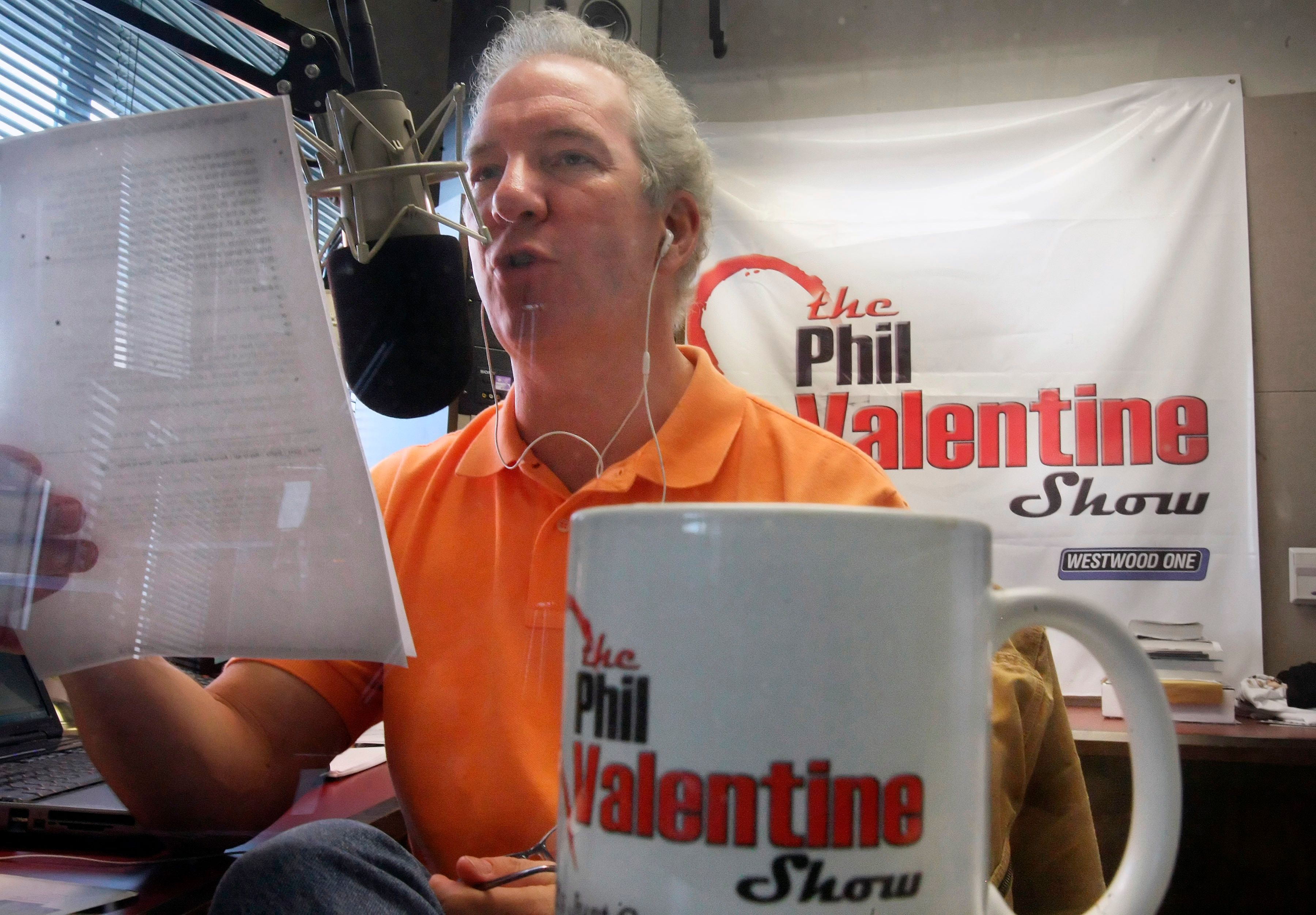
Phil Valentine’s death at age 61 was announced Saturday by Nashville radio station SuperTalk 99.7 WTN. The Tennessee-based talk radio host was first hospitalised in late July with the virus.
A statement from his family at the time of his hospitalisation said his illness led him to have second thoughts and regrets about the vaccines’ significance and encouraged people to “go get vaccinated.”
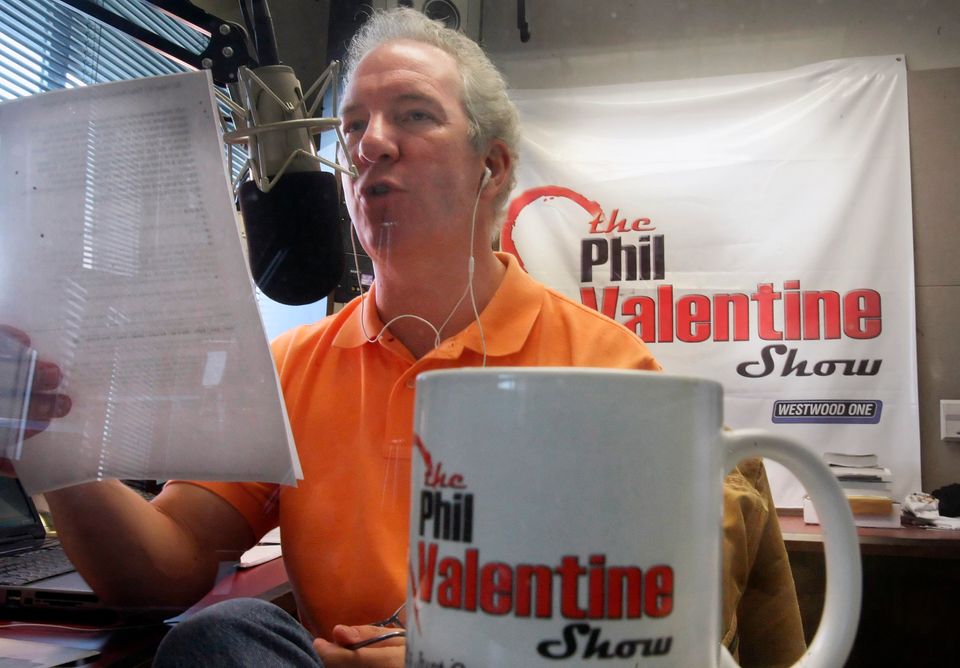
John Partipilo via APConservative talk show host Phil Valentine, seen in 2009, has died after being hospitalised with Covid-19, his employer announced.
“Phil would like for his listeners to know that while he has never been an ‘anti-vaxer’ he regrets not being more vehemently ‘Pro-Vaccine’, and looks forward to being able to more vigorously advocate that position as soon as he is back on the air, which we all hope will be soon,” his family said in a statement posted to Facebook by the radio station.
Valentine had expressed his skepticism of the coronavirus vaccines and masks on his radio program and social media, with one of his last tweets on July 15 questioning the safety of the Johnson & Johnson vaccine.
Back in December, he tweeted that people should do a “risk assessment” on whether they should get vaccinated.
“I have a very low risk of A) Getting COVID and B) dying of it if I do. Why would I risk getting a heart attack or paralysis by getting the vaccine?” he posted.
He also recorded a Beatles parody song, “Vaxman,” that mocked the vaccine.
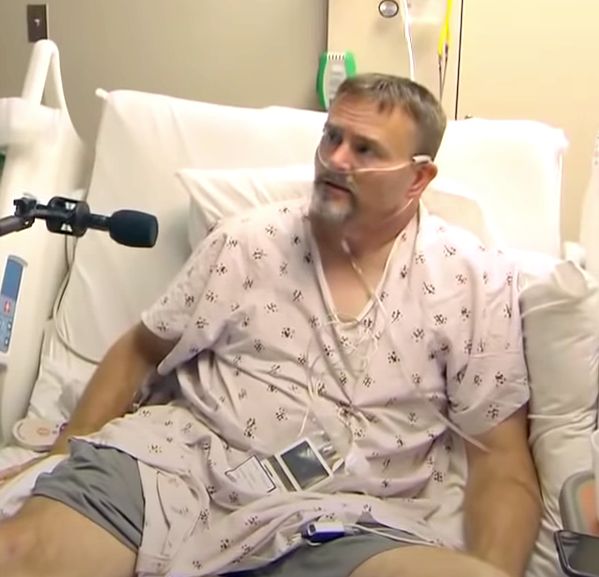
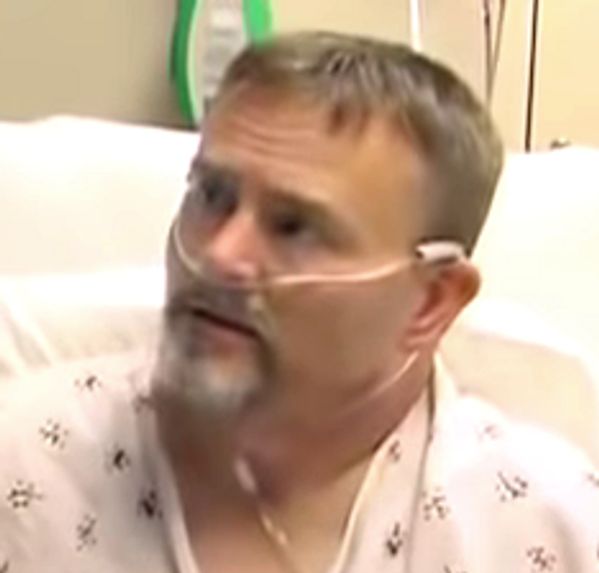
An unvaccinated man who was hospitalised in Baton Rouge, Louisiana, after he contracted Covid-19 and developed severe pneumonia said he still won’t get the vaccine.
“Before you got sick, if you would have had a chance to get the vaccine and prevent this, would you have taken the vaccine?” CBS News’ David Begnaud asked Scott Roe on his hospital bed at Our Lady of the Lake Medical Center in an interview this week.
“No,” Roe, a Republican, responded.
“So, you’d have gone through this?” asked Begnaud.
“I’d have gone through this. Yes, sir. Don’t shove it down my throat. That’s what local, state, federal administration is trying to do,” Roe replied.
“What are they shoving, the science?” asked Begnaud.
“No, they’re shoving the fact that it’s their agenda. Their agenda is to get you vaccinated,” Roe said, claiming there were “too many issues” with the shots. Millions of Americans have received the shots, which have proven remarkably effective at preventing infection and severe illness.
Watch the interview here:
In the same segment, pharmaceutical researcher Paula Johnson expressed regret at putting off getting the vaccine.
She ended up in hospital.
“I honest to God thought I walked my last day on this earth. I could not breathe. I just, all of a sudden, my lungs just didn’t work,” Johnson told Begnaud.
“I have no comorbidities, nothing, never had a lung problem. Don’t smoke, nothing,” Johnson explained. “And it took my lungs and just … I don’t even know how to explain it. It’s like trying to breathe in and hitting a wall in like a second.”
Her warning came as the highly transmissible delta variant continues to spread across the country. It echoes those delivered this week by other unvaccinated people (who now make up 99.5% of American deaths from COVID-19) who were hospitalized with the disease and are now urging others to take the shot.
William Hughes, from Arkansas, told CNN’s Erin Burnett on Thursday that he wished he’d had the jab.
“I mean, the vaccine may not have kept me from getting COVID, but it may have decreased greatly the pain and suffering I had to go through to get to the point where I am now,” he said.
Watch the video here:
William Hughes, who was hospitalized with Covid, shares his message for those opposing the vaccine. “Go get the vaccine. If you don’t do it for yourself, do it for your family. Because I almost left my wife and my daughter here to fend for themselves because I didn’t go get one.” pic.twitter.com/wtTHqTXVPi
Donald McAvoy, an unvaccinated 33-year-old gym manager from Jacksonville, Florida, said he was initially “skeptical” about the shot.
“I was like, ‘Eh don’t get it, I don’t need it. I’m healthy. I’m young. I’m good. I’m OK,’” McAvoy told Action News Jax. “If there’s one thing I could say to the public and everyone out there is get vaccinated now.”
The pandemic has been an undeniably tough time, leaving many people wondering when life will return to ‘normal’. But with more than 86% of adult Brits now having received their first vaccination, the light over the horizon isn’t just visible – it’s shining bright.
Vaccines are the most effective way to protect people from coronavirus and have already saved thousands of lives. We know that vaccinated people are far less likely to develop severe Covid-19, to be admitted to hospital or to die from the virus. What’s more, vaccinated people aren’t just protecting themselves by getting the jab, they are also less likely to pass the virus on to others.
Advertisement
Some people may feel hesitant about getting the jab, but the best way to overcome nerves is to arm yourself with as much information as possible before scheduling the appointment.
Luckily, we have done the work for you.
From how to book your spot to how you’ll feel afterwards, potential side effects and why it’s so important that you get both jabs, here’s everything you need to know about your Covid-19 vaccine appointment.
Halfpoint Images via Getty Images
Covid-19 and vaccination concept.
How To Book An Appointment – And What To Do If You Miss It
Advertisement
In the UK, all those aged 18 or above can book their vaccination through the NHS booking service. You can also call 119 free of charge, anytime between 7am and 11pm seven days a week.
Those who need to change the date of their appointment for any reason can easily cancel, rebook and manage bookings through the free NHS service. The same applies if you have missed your appointment and need to rebook it.
What’s more, walk-in sites will open across England this weekend too (July 16-18), where people can get their Covid-19 vaccine without an appointment. You don’t even need to provide ID or be registered with a GP.
There are also some perks (beyond the obvious protection against coronavirus). For instance, you can ‘grab-a-jab’ this weekend when you pop into Primark, while sunbathing in the park, or exploring Tate Modern, where DJ and influencer Zoe London will be performing Friday evening.
Advertisement
Here’s the most important part: one dose isn’t enough. You need to book and attend two appointments to get both doses for maximum protection.
We get it, life can get hectic – maybe you have kids or a stressful job – but the process is tailored to be easy and convenient. Put your health first.
What To Expect At And After Your Vaccine Appointment
The appointment could take place at a hospital, local GP surgery, a vaccine centre or pharmacy.
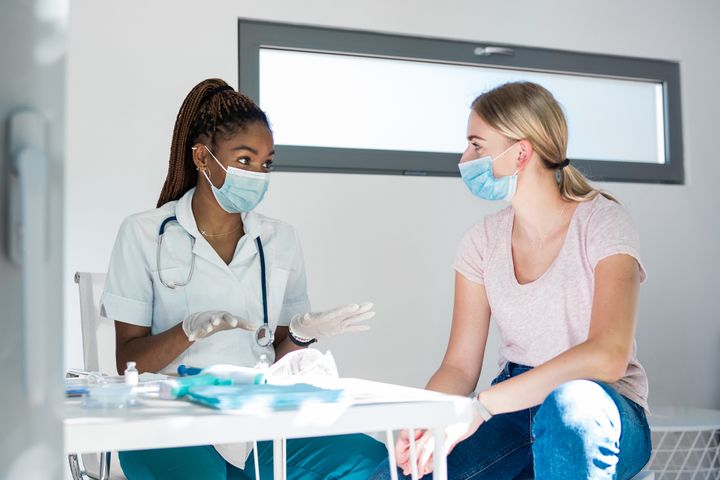
Every person is asked a series of questions before the jab is administered and handed an information pack. Equipment, including chairs, is sanitised after each person and the doctors, nurses and volunteers are required to wear masks.
In the UK, there are currently four vaccines approved for use: Moderna, AstraZeneca, Pfizer and Janssen. You don’t get to choose which one you get but there’s no need for concern, as each vaccine has gone through the same rigorous safety process and been approved by the MHRA, the regulatory body. All the vaccines are highly effective and will protect you from coronavirus.
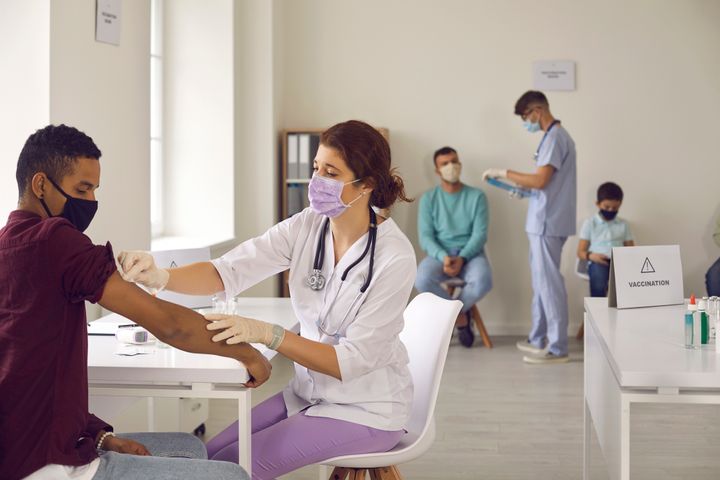
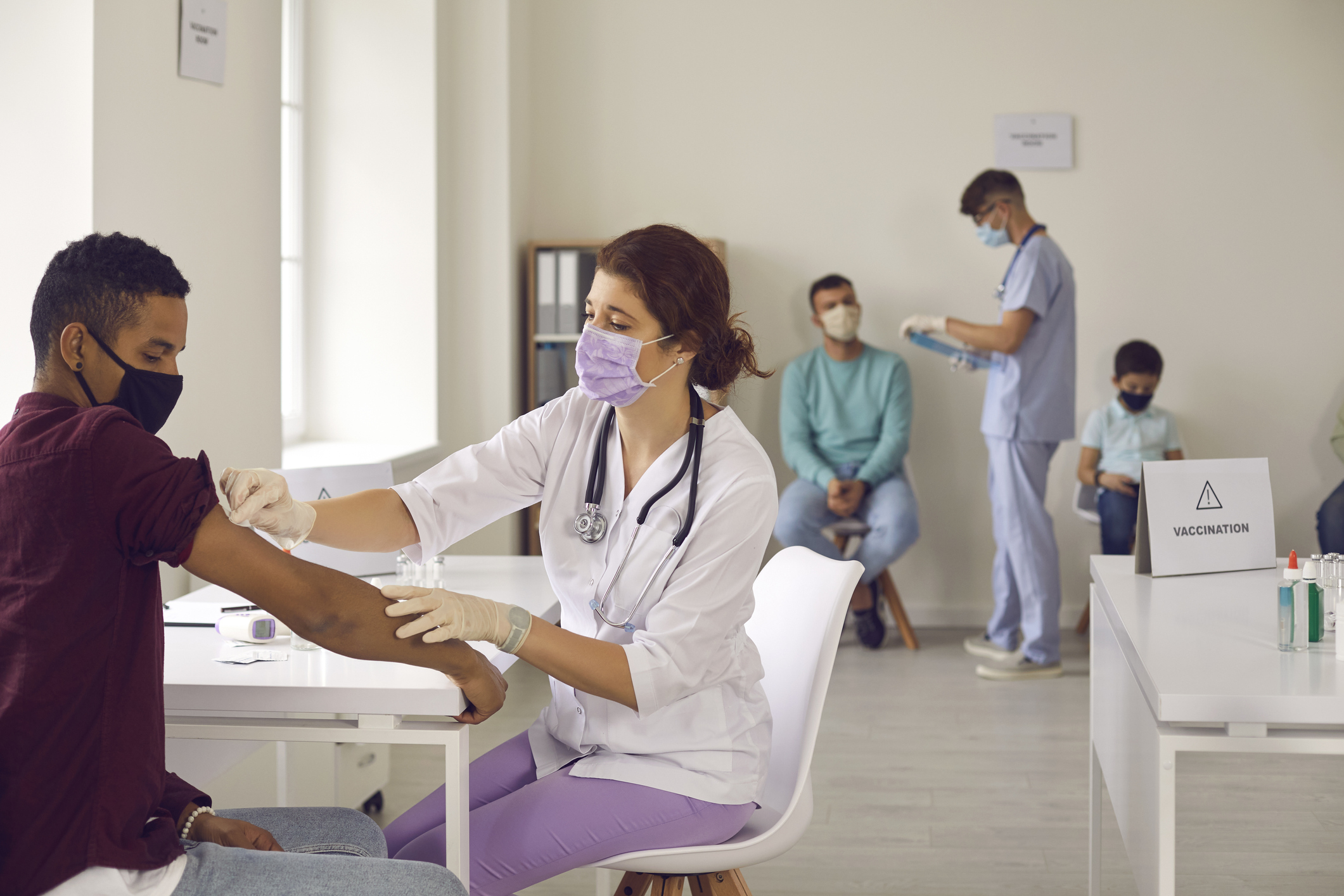
After the vaccine is administered into your arm muscle (top tip: wear a T-shirt or top that is easy to roll up or down) you will get a vaccine record card that includes the name of the vaccine, batch number and date it was administered.
Keep this document close and bring it to the second appointment (however, do not fret if you should lose it, as your vaccinations are also logged on the NHS app, which you can download on a smartphone).
Then it’s just a prick of the needle and you’re done. You also get a fancy “I got my Covid vaccine” sticker to show off to the world – and encourage others to get theirs too.
Lacheev via Getty Images/iStockphoto
The vaccine is administered into your arm muscle.
How You Will Feel After The Vaccine
Advertisement
Most reported side effects from the vaccine are mild and short-term, lasting no longer than a week. It’s also possible that you get no side effects at all or that your experience of the first and second dose is different.
Here is a list of some of the most common side effects:
A sore arm
Feeling or being sick
Feeling tired or achy
A headache
There have been reports of extremely rare cases of blood clots with the AstraZeneca vaccine however, the MHRA – the UK’s independent regulator – and the Joint Committee on Vaccination and Immunisation (JCVI) have both stated that the benefits of the vaccine far outweigh the risks for the vast majority of adults. As a precaution though, anyone under the age of 40 is offered a Pfizer or Moderna vaccine.
If you are concerned, don’t avoid the issue altogether. Instead, read the advice on the NHS website or speak to your GP so that they can help and answer any questions.
From Allergies To Pregnancy: Is The Covid-19 Vaccine Suitable For You?
At the appointment, you will be asked a series of questions to find out whether the vaccine is suitable for you. Answer these questions honestly and openly, so the experts can recommend the right vaccine option for you.
For instance, if you’ve ever had a serious allergic reaction to a previous dose of a Covid-19 vaccine or any of its ingredients, you should not get it. Also, if you’ve ever had a serious allergic reaction in general, tell the person administering the shot before your vaccination, so that they are aware.
All pregnant or breastfeeding women over 18 can now book a vaccine. If pregnant, this will be linked to your age and clinical risk group. If you are under 40 you will only be offered Pfizer and Moderna vaccine appointments. If you are over 40 you will be asked when booking if you are pregnant and will then only be offered Pfizer or Moderna appointments as the JCVI has advised these vaccines be offered to pregnant women based on the fact that 100,000 pregnant women have had these vaccines with no safety concerns.
There is no evidence that the vaccine will affect fertility or your chances of becoming pregnant in the future, and the vaccine can’t give you or your baby Covid-19.
Advertisement
Additionally, the vaccines are suitable for vegetarians and do not contain any animal-derived ingredients.
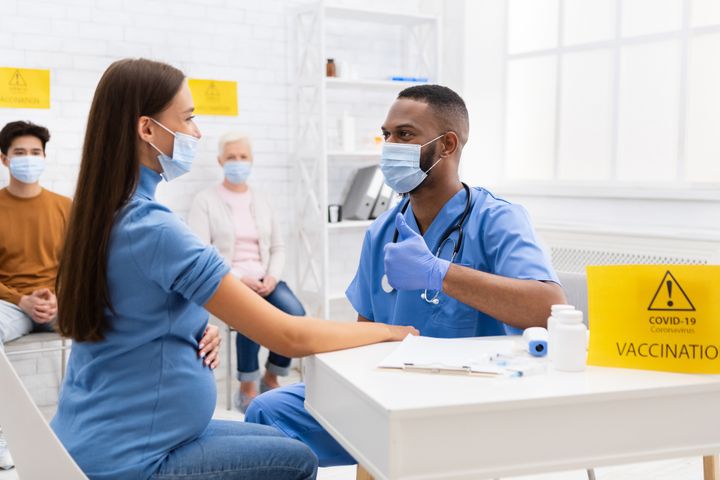
Prostock-Studio via Getty Images/iStockphoto
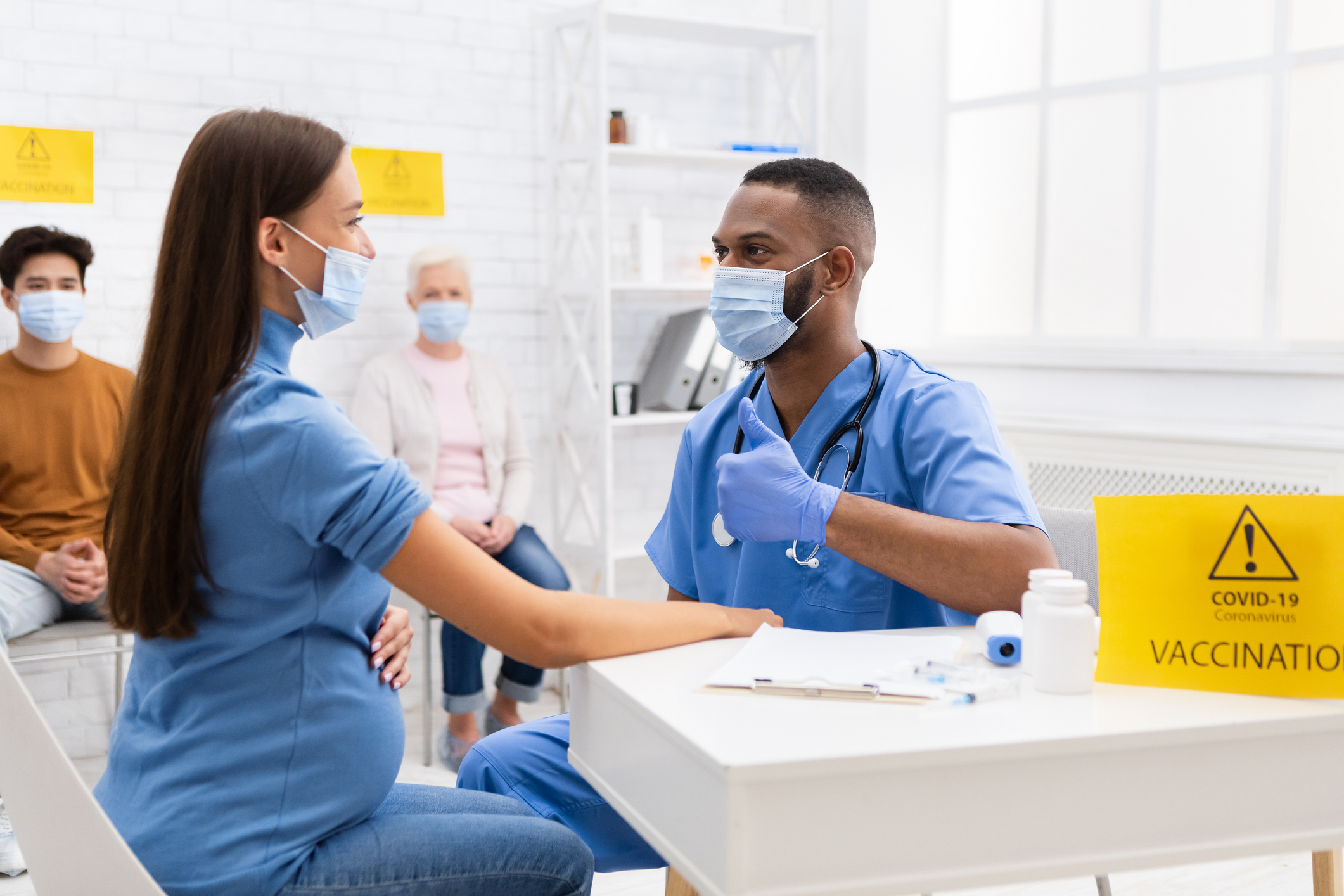
Successful Coronavirus Vaccination. Doctor In Face Mask Gesturing Thumbs-Up To Vaccinated Against Corona Virus Female Patient Sitting In Hospital. Covid Vaccine Injection And Immunization Campaign
Why You Should Get The Vaccine
Medical jargon aside, some of you might be struggling with other worries about the vaccine.
Here are some facts to put your mind at ease:
The four approved vaccines have been tested and are safe, so people should be assured that whatever vaccine they get will be highly effective and protect them from coronavirus.
Vaccinated people are far less likely to get Covid with symptoms. Vaccinated people are even more unlikely to get serious Covid-19, to be admitted to hospital, or to die from it and vaccinated people are less likely to pass the virus to others.
The first dose of the vaccine offers good levels of protection, but to get maximum protection everyone must get a second dose, so we are urging all people to book their second jab through the NHS booking system
Vaccines are helping to keep life moving. This could mean children safely hugging their grandparents, flirting in nightclubs, shaking hands with strangers, going on holidays abroad and the economy bouncing back.
But most importantly, vaccines save lives. And that’s really all you need to know.
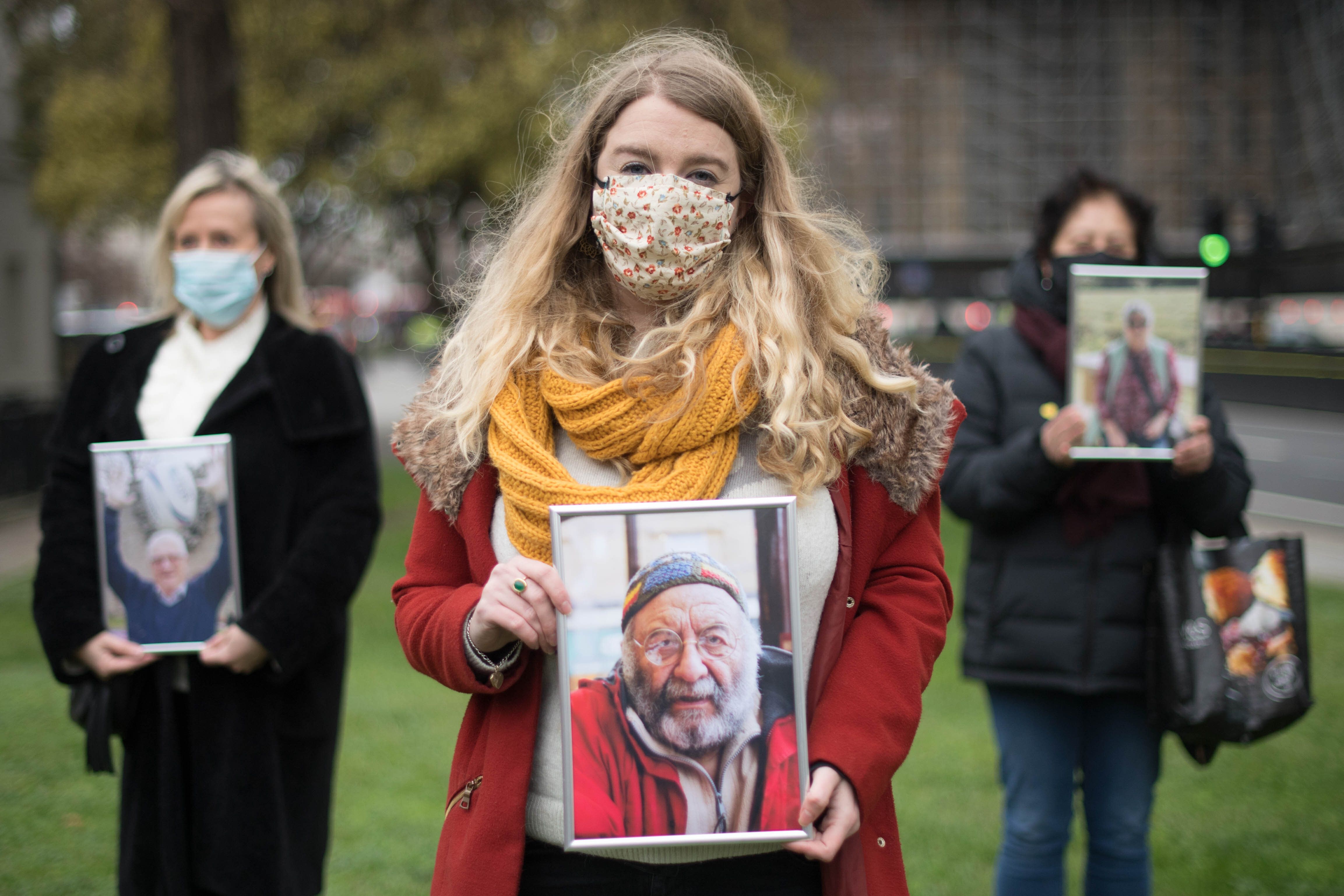
Stefan Rousseau – PA Images via Getty ImagesJo Goodman, who lost her father Stuart, 72, to COVID 19 stands with other families bereaved by the virus outside Parliament. (Photo by Stefan Rousseau/PA Images via Getty Images)
Boris Johnson faces growing calls to meet the families of Covid victims before the public inquiry into how his government handled the pandemic.
The prime minister has said an independent statutory inquiry that puts “state’s actions under the microscope” will begin in spring 2022.
But Covid-19 Families For Justice, which represents some 4,000 grieving families, has made an urgent call for ministers to consult with them about the aims, remit and chair of the inquiry.
The group’s key demand is the hearing allows for a rapid review phase.
Families fear lives may be lost in future if ministers fail to address gaps in the UK’s preparedness, such as on PPE, and government does not quickly learn from disastrous mistakes on lockdowns and sending infected back people to care homes.
However, ministers, including health secretary Matt Hancock, have refused to commit to meeting with families on the inquiry’s terms of reference.
Jo Goodman, co-founder of the families group lost her father Stuart, 72, to the virus during the first wave.
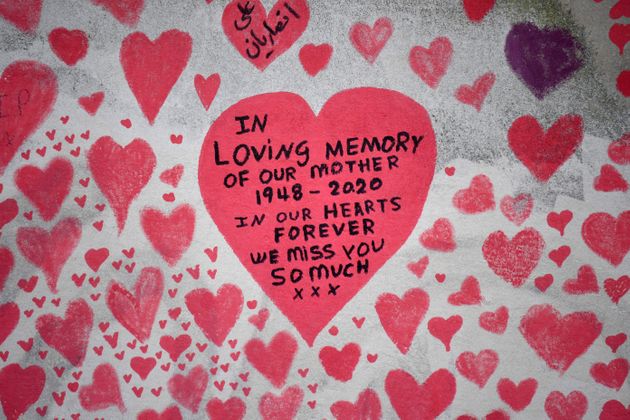
DANIEL LEAL-OLIVAS via Getty ImagesMessages are pictured on hearts painted on the National Covid Memorial Wall, at the embankment on the south side of the River Thames in London
She told HuffPost UK Johnson delayed a meeting because families threatened legal action over the inquiry’s delay.
“We stand ready and willing to meet government ministers but they’ve yet to set a date,” she said.
“Boris Johnson has previously promised to do so, but then went back on it because of the judicial review we had planned to seek.
“We have now dropped the judicial review, so there is no reason for the government not to meet with us. We are ready when you are prime minister.”
MPs have also been pressuring the government, confidence in the inquiry, which is likely to be traumatic for those hardest hit.
Jack Dromey, MP for Birmingham Erdington and shadow Cabinet Office minister, has written to chancellor of the duchy of Lancaster, Michael Gove, after questions in the House of Commons were ignored.
The letter, passed to HuffPost UK, underlines that “the country has experienced tragedy and human suffering on a scale not seen since the Second World War”.
Dromey stresses ministers were causing “deep hurt” to families who “simply want to know that the government is listening to them”.
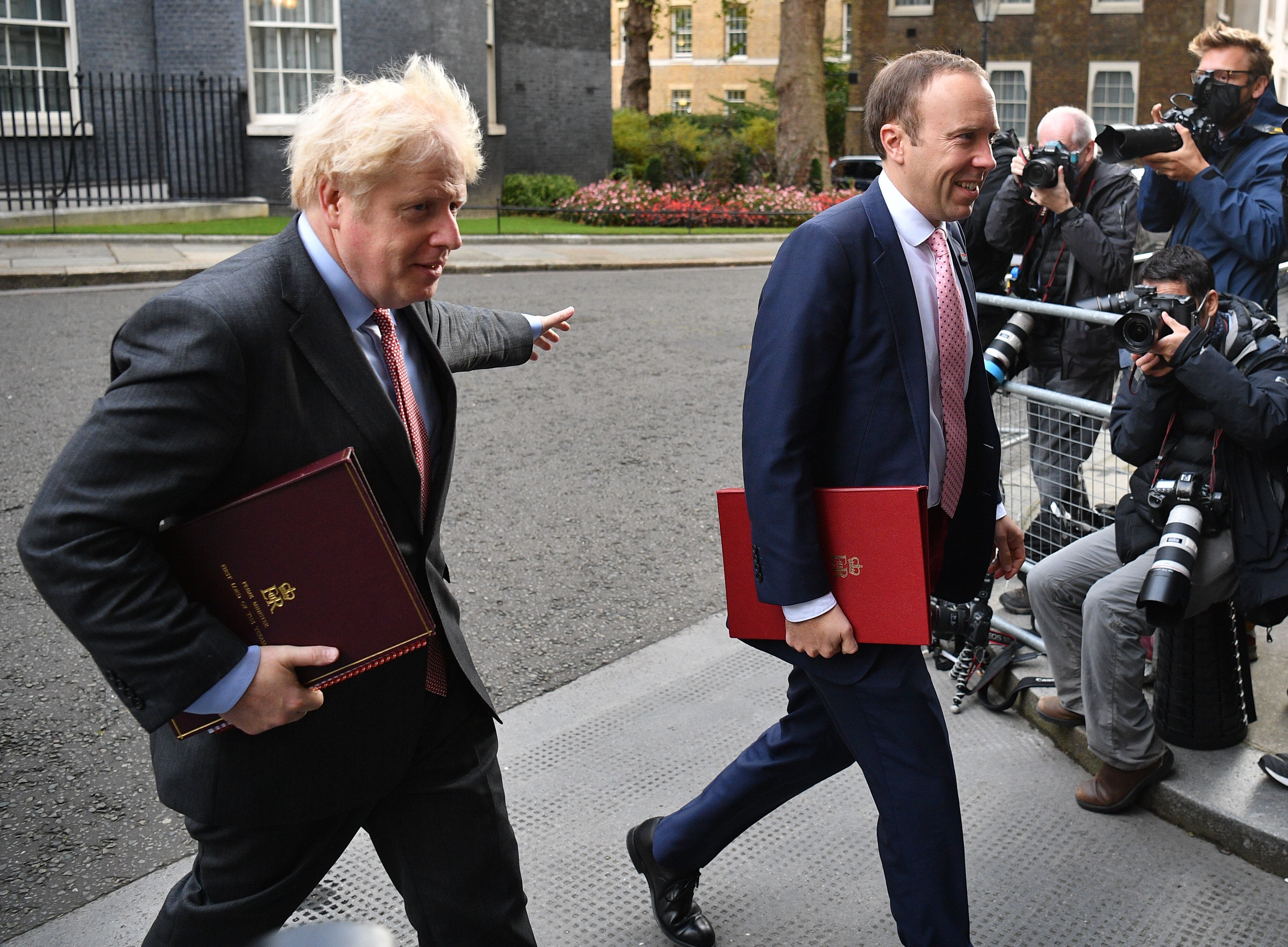
Leon Neal via Getty ImagesPrime Minister, Boris Johnson and Secretary of State for Health and Social Care, Matt Hancock walk from Downing Street
The letter says that Johnson and Hancock have seven times refused to meet families and adds: “MPs across the House will have met with constituents who have suffered great loss due to coronavirus. Meetings with bereaved families and listening to their stories are some of the most difficult and emotional meetings I have been involved in since being elected a member of parliament.
“Such meetings cannot fail but to bring home the sincere desire by the bereaved families that there be a meaningful public inquiry into the government’s handling of the coronavirus pandemic with outcomes the bereaved families can trust to be fair and reasonable.”
It adds: “That is why it is so important to the bereaved families that the government consults with them to ensure this is the case, by agreeing an appropriate chair and the right terms of reference.”
The government has said the inquiry’s remit and chair will be chosen “in due course” and that spring 2022 was the appropriate time to begin the hearing.
Asked about the inquiry in parliament, Gove has suggested families will have a role.
He told MPs: “A statutory inquiry is obviously the right way to ensure that all the right questions are asked and that full answers are arrived at.
“To ensure that the inquiry works, the experience, voices and views of those who have suffered so much must be a critical part in ensuring that it is set up appropriately.”
A government spokesperson, when asked if the PM would meet with the group, added: “Every death from this virus is a tragedy and our sympathies are with everyone who has lost loved ones.
“Throughout the pandemic senior ministers, including the prime minister, have met and will continue to meet with bereaved families.
“As the prime minister said, we have committed to holding a full public inquiry as soon as is reasonably possible.”
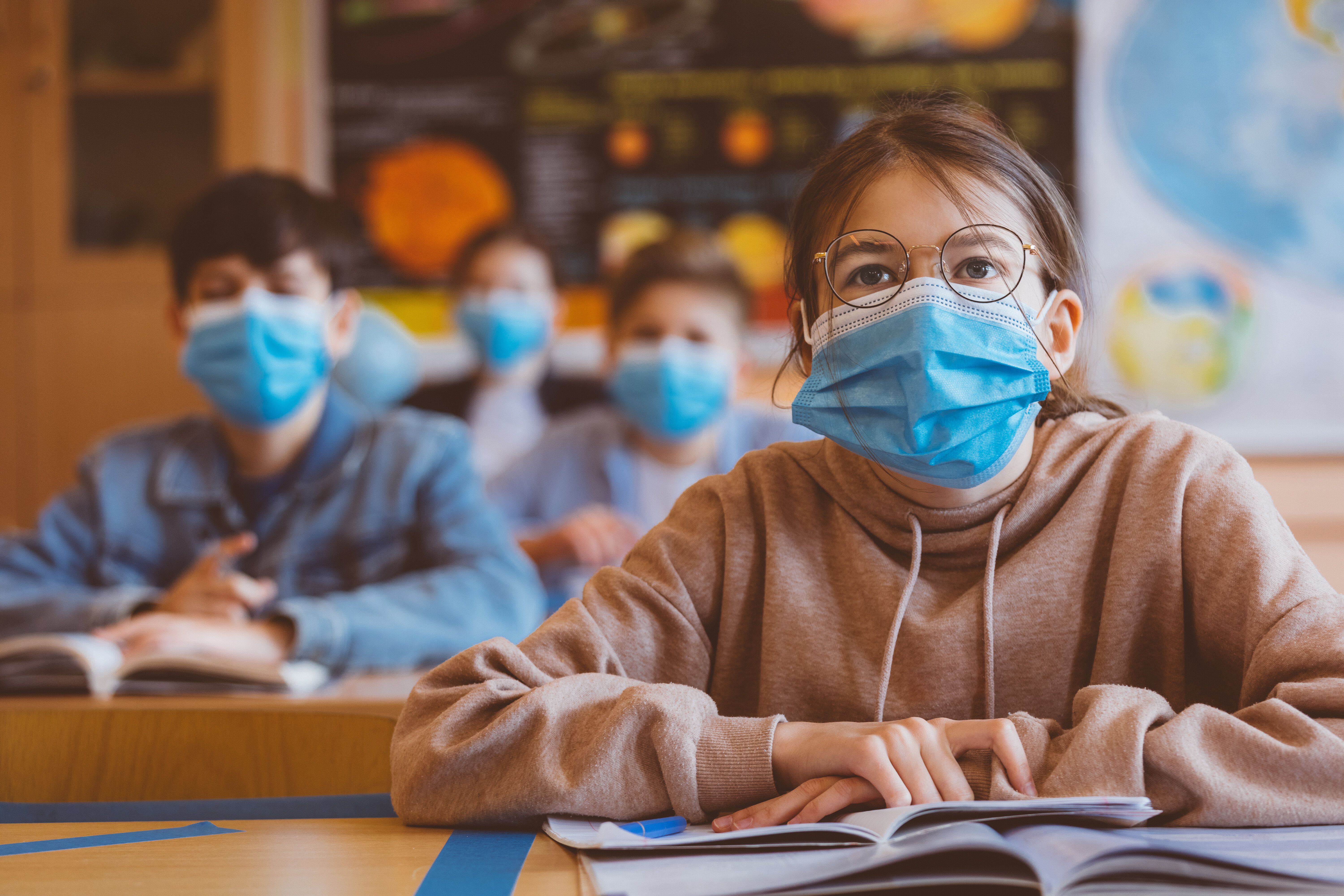
izusek via Getty ImagesHigh school students at school, wearing N95 Face masks. Teenage girl wearing eyeglasses sitting at the school desk and listening to the teacher.
A £1.4bn catch-up tuition plan to help children recover lost learning after Covid has been branded “hugely disappointing”.
The Department for Education (DfE) announced the cash for schools and colleges in England and have underlined it comes on top of £1.7bn already pledged for lost education.
The cash will see pupils offered up to 100 million hours of extra teaching, with Year 13 students given the option to repeat their final year if particularly hard-hit by lockdown.
But unions have said package “lets down the nation’s children”, and falls short of the £15bn school leaders hoped for, with some accusing Rishi Sunak’s Treasury of blocking further spending.
The DfE scheme includes £1bn to support up to six million, 15-hour tutoring courses for disadvantaged pupils, as well as an expansion of the 16-19 tuition fund which will target subjects such as maths and English.
A further £400 million will go towards providing high-quality training to early years practitioners and school teachers boost progress.
But the announcement – made during the half-term – does not include plans to lengthen the school day, or shorten the summer break.
The government’s education recovery commissioner, Kevan Collins, is still considering long-term proposals to address the impact of Covid on children.
Geoff Barton, general secretary of the Association of School and College Leaders (ASCL), suggested that there had been a battle behind the scenes over funding for education recovery between the Treasury and the DfE as the “settlement is less than a tenth of the £15bn that was being mooted”.
He said: “This is a hugely disappointing announcement which lets down the nation’s children and schools at a time when the government needed to step up and demonstrate its commitment to education.
“The amount of money that the government plans to put into education recovery is insufficient and shows a failure to recognise the scale of learning loss experienced by many pupils during the pandemic – particularly those from disadvantaged backgrounds.”
Paul Whiteman, general secretary of school leaders’ union the NAHT, said: “It’s a damp squib – some focus in a couple of the right areas is simply not enough.
“The funding announced to back these plans is paltry compared to the amounts other countries have invested, or even compared to government spending on business recovery measures during the pandemic.
“Education recovery cannot be done on the cheap.”
WPA Pool via Getty ImagesEducation Secretary Gavin Williamson
But Whiteman added that the union was relieved to see that extending the school day had been “shelved for now” as he warned the policy could reduce family time and leave less time for extracurricular activities.
Mary Bousted, joint general secretary of the National Education Union (NEU), said: “The government’s plans for education recovery for the nation’s pupils are inadequate and incomplete. Rarely has so much been promised and so little delivered.”
“The Treasury has shown, in this paltry offer, that it does not understand, nor does it appreciate, the essential foundation laid by education for the nation’s economic recovery.
“Its failure, on this scale, to fund what is needed for education recovery, is a scar which will take generations of children and young people to heal.”
Prime minister Boris Johnson has defended the fund, however, adding a review of longer school days would form part of the next stage of the review.
He said: “Young people have sacrificed so much over the last year and as we build back from the pandemic, we must make sure that no child is left behind.
“This next step in our long-term catch-up plan should give parents confidence that we will do everything we can to support children who have fallen behind and that every child will have the skills and knowledge they need to fulfil their potential.”
It was announced as Labour published its two-year £14.7 billion education recovery plan, which called for extracurricular activities to be expanded and mental health support in schools to be improved.