The gene-editing method used might ultimately offer a way to remove HIV, experts say.


The gene-editing method used might ultimately offer a way to remove HIV, experts say.
Former US President Donald Trump weighed into the recent scrutiny over Prince Harry’s visa, hinting that if he’s reelected, the Duke of Sussex could face deportation over drug use he admitted to in his 2023 memoir.
Trump, the presumed GOP nominee for president, made the warning in a preview of an interview with British broadcaster GB News that’s set to air on Tuesday evening.
Advertisement
“We’ll have to see if they know something about the drugs, and if he lied they’ll have to take appropriate action,” Trump said of the possibility that Harry falsified portions of his visa application that ask about drug use.

Since stepping down from official senior royal duties in 2020, the duke’s primary residence has been in California with his two children and his wife, Meghan Markle, Duchess of Sussex.
But last year, a conservative think tank called the Heritage Foundation sued the Department of Homeland Security for access to Harry’s immigration records, citing admissions in his memoir, Spare, that he’s used cocaine, marijuana and psilocybin. It’s unclear if Harry disclosed the drug use in his visa application. A federal judge is currently deciding whether the records should be made public.
Advertisement
When GB News host Nigel Farage asked Trump to clarify whether he was talking about Harry facing deportation, Trump played coy.
“Oh, I don’t know. You’ll have to tell me. You just have to tell me,” he said. “You would have thought they would have known this a long time ago.”
Other public figures have faced immigration issues over their drug use, including Argentine soccer star Diego Maradona and the late British singer Amy Winehouse.
A spokesperson for the Duke and Duchess of Sussex did not immediately return a request for comment on Trump’s remarks.
Harry said last month that he’s considered becoming an American citizen.
“It’s a thought that has crossed my mind, but it’s not a high priority for me right now,” he told ABC’s Good Morning America.
Advertisement

Ivy Rupasinghe’s grieving parents are considering their next move after a hospital’s admission.
The British Dental Association says increasing the treatment rate would provide a short-term fix in England.
Two Dundee mothers share their stories as scientists begin the search to find a vaccine for Strep A.
It seems Kate Middleton has been released from the princess protection programme.
TMZ obtained footage of the Princess of Wales and Prince William out and about a mile from their Adelaide Cottage home in Windsor, England, on Saturday.
The brief clip shows the royal couple decked out in casual gear — with William in a baseball cap and Kate in leggings and a light jacket — hauling bags as they leave a local business called the Windsor Farm Shop.
Advertisement
The video seems to corroborate eyewitnesses’ claims made to the UK tabloid newspaper The Sun in a report on Sunday that the princess was spotted out in the wild.

Chris Jackson via Getty Images
One bystander told The Sun that Kate appeared to be “happy, relaxed and healthy”.
Although the footage of the couple may seem somewhat banal, Kate hasn’t been photographed publicly since Christmas, leading many people to wonder where one of the highest-profile women in the world could possibly be.
In January, Kensington Palace attempted to quell speculation by announcing the princess had undergone planned abdominal surgery and would resume public duties sometime after Easter.
Advertisement

Samir Hussein via Getty Images
Then came the release of a photo of Kate with her three children last week, that brought the speculation to a bizarre peak. As it turned out, the photo appeared to be highly edited, and multiple news agencies, including The Associated Press, withdrew it from publication.
This led some to hypothesise about where Kate could possibly be, which spanned from genuine conspiracy theories to Freaky Friday jokes involving King Charles and Kate.




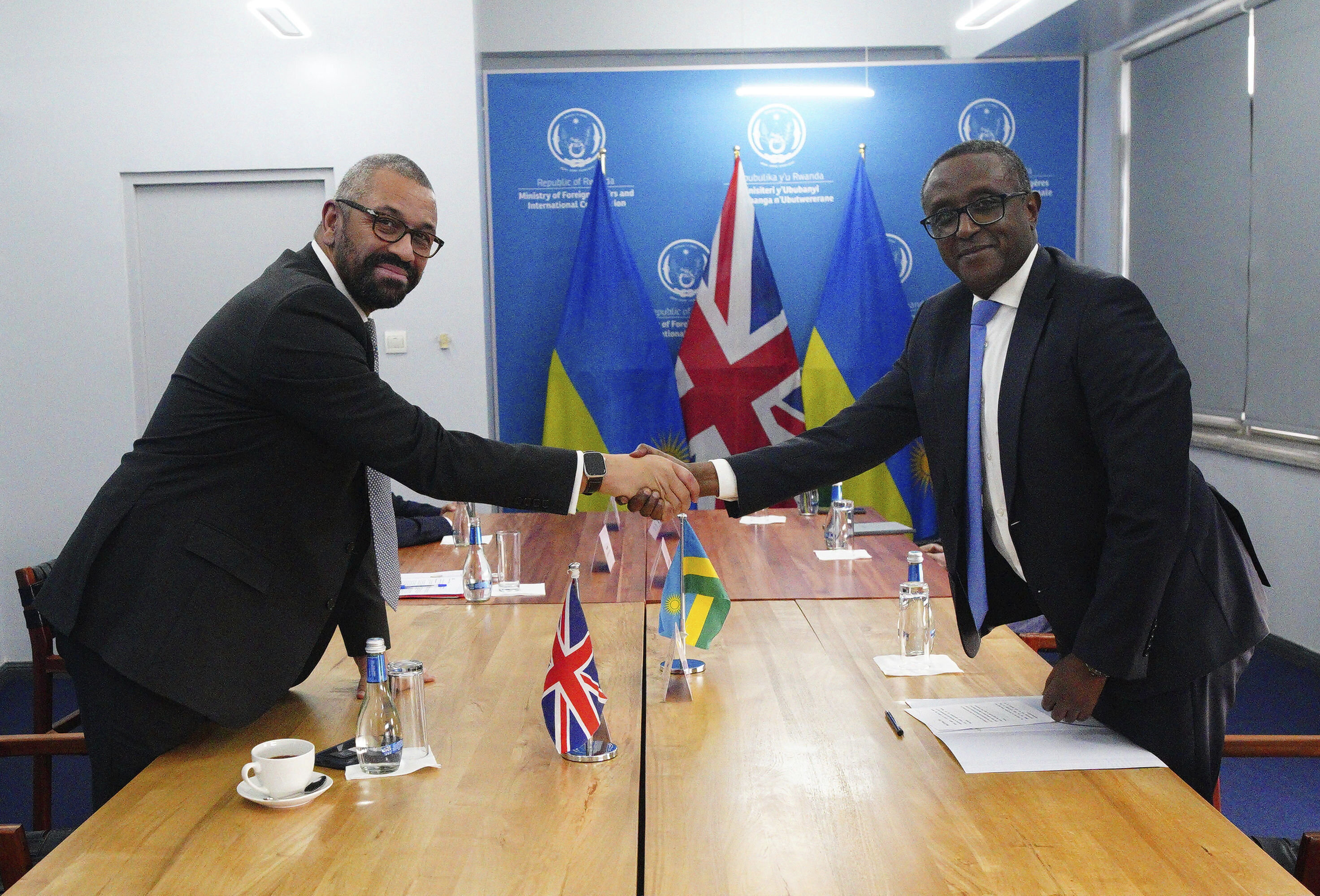
MPs have reversed all 10 amendments to Rishi Sunak’s flagship Rwanda legislation – setting up a showdown with the House of Lords over the controversial plan to send asylum seekers on a one-way trip to the east African country.
Using its comfortable Commons majority, the Tory government unpicked changes made to the Safety of Rwanda Bill by the Lords.
Advertisement
Peers inserted a series of amendments designed to water down the legislation, but all 10 were removed by MPs during votes in the Commons on Monday night.
The bill, which aims to overcome the Supreme Court’s block on deportation flights, will return to the Lords on Wednesday as part of the game of parliamentary “ping-pong”.
The government is almost certain to prevail because the unelected Lords can’t overrule elected MPs, and the bill could be passed into law within days.
The prime minister hopes that the first deportation flights will take off in the spring.
Advertisement
Britain and Rwanda signed a deal almost two years ago that would see migrants who cross the English Channel in small boats sent to the East African country, where they would remain permanently. So far, no migrant has been sent to Rwanda under the agreement.
The plan is key to Sunak’s pledge to “stop the boats” bringing unauthorised migrants to the UK. He argues that deporting asylum seekers will deter people from making risky journeys and break the business model of people-smuggling gangs.
Just under 30,000 people arrived in Britain in small boats in 2023.
“We need to make it clear that if you come here illegally, you won’t be able to stay and we will be able to remove you. That is the only way to properly solve the issue of illegal migration,” Sunak told reporters on Monday.
A harrowing food insecurity report has concluded that famine is “imminent” in northern Gaza, as millions of starving Palestinians face “catastrophic” food conditions in the territory amid Israel’s continued blockade of humanitarian aid.
The Integrated Food Security Phase Classification (IPC) report was released on Monday by the World Food Program. The IPC is an international process for estimating the scale of hunger crises, and serves as one of the international community’s primary sources for food insecurity data around the world.
Advertisement
According to the report, North Gaza and area governorates are projected to meet the definition of famine ― the IPC’s fifth and most severe phase of acute food insecurity ― anytime between now and May. In North Gaza, food security and malnutrition have become crises at the most dire level of the IPC’s scale.
Gaza’s southern governorates of Deir al-Balah, Khan Younis and Rafah are presently classified as IPC Phase 4 (Emergency) situations in the report. These governorates, however, face a risk of famine through July in a worst-case scenario, according to the data.
Per the ICP, Gaza’s entire population of 2.23 million people are enduring high levels of acute food insecurity. About half of those people are expected to suffer “catastrophic conditions” if Israeli forces launch their planned ground offensive into the packed southern city of Rafah.
Advertisement
“The upward trend in non-trauma mortality is also expected to accelerate, resulting in all famine thresholds likely to be passed imminently,” the group’s report said.
In December, the IPC warned that there needed to be an immediate reduction of hostilities and an increase in humanitarian access in order to prevent a “realistic chance” of starvation in Gaza. The agency’s analysis at the time said that Gaza’s crisis is “the highest share of people facing high levels of acute food insecurity that the IPC initiative has ever classified”.
“If no steps are taken to cease hostilities and to provide more humanitarian access, famine is imminent,” Beth Bechdol, deputy director-general of the United Nations’ Food and Agriculture Organization, said Monday. “It could already be occurring. Immediate access is needed to facilitate delivery of urgent and critical assistance at scale.”
Gaza’s current crisis stems from Israel’s ongoing military campaign launched after Hamas militants attacked that country on October 7, killing about 1,200 people and taking roughly another 250 hostage. More than five months later, the Gaza Health Ministry ― which has a record of providing casualty figures that closely reflect the UN’s own ― reports that Israeli forces have killed more than 31,000 Palestinians, wounded nearly 73,400, displaced almost the entire population and blocked civilians from accessing most aid deliveries of food, water, fuel and medicine.
The dire situation in Gaza is “simply unbearable” and “unjustifiable”, according to Hiba Tibi, country director for aid group CARE International in Gaza and the West Bank. “Our earlier fears that more would die in Gaza from hunger, dehydration and disease than from bombs, were well-founded, sadly. Starvation is cruel. It is a slow and painful death.”
Advertisement
“Our partners who run health centres in Northern Gaza have reported that the number of children categorized as having moderate or severe malnutrition nearly doubled in February, compared to January. Their staff report watching children get thinner and thinner as the days go by and of kids who can barely speak and walk due to starvation,” she continued. “We also hear of kids being born and dying in shelters without even being registered in the hospitals. It’s like they don’t exist.”

Said Khatib/AFP via Getty Images
The UN Children’s Fund recently warned that life-threatening malnutrition was “spreading fast”, supported by the IPC’s report detailing how adults in Gaza have reduced their meals so their children can eat. The FAO said that at least 10 times in the last month, almost two-thirds of northern Gaza households went “entire days and nights” without eating.
Northern Gaza was the first target of Israel’s invasion, and has become the centre of the territory’s humanitarian crisis, with much of the region completely destroyed. A third of children under two years of age in the north are acutely malnourished, according to the FAO, and the Gaza Health Ministry said last week that 27 Palestinians, mostly children, had died of malnutrition in the north.
Monday’s report confirms what aid groups have been trying to convey to the world about the starvation crisis facing Palestinians in the territory. The international community has continued to call for a permanent cease-fire, the release of all remaining hostages, accountability for civilian casualties and the safe passage and distribution of more aid to Palestinians.
Advertisement
“From the destruction of farms, flour mills and food processing sites, to ongoing fighting preventing the safe movement of humanitarian actors, to the blocking of aid, the people of Gaza are being starved to death. What’s worse, they have all too often been killed in attacks when seeking out food to keep their children alive,” Tjada D’Oyen McKenna, CEO of the aid group Mercy Corps, said in a statement, stressing that the denial of humanitarian access violates international law.
“We cannot wait for an official famine declaration in Gaza to act when it is abundantly clear that people are and will continue dying from hunger and malnutrition,” she continued. “Today’s report must be a wake-up call for all parties with leverage over Israel to dramatically change course. Gazans cannot wait any longer.”



Dinosaurs get all the glory. But aetosaurs, a heavily armored cousin of modern crocodiles, ruled the world before dinosaurs did. These tanks of the Triassic came in a variety of shapes and sizes before going extinct around 200 million years ago. Today, their fossils are found on every continent except Antarctica and Australia.
Scientists use the bony plates that make up aetosaur armor to identify different species and usually don’t have many fossil skeletons to work with. But a new study led by researchers at The University of Texas at Austin centers on an aetosaur suit of armor that has most of its major parts intact.
The suit — called a carapace — is about 70% complete and covers each major region of the body.
“We have elements from the back of the neck and shoulder region all the way to the tip of the tail,” said William Reyes, a doctoral student at the UT Jackson School of Geosciences who led the research. “Usually, you find very limited material.”
The research was published in The Anatomical Record.
Reyes and his collaborators used the armor to identify the specimen as a new aetosaur species — which they named Garzapelta muelleri. The name “Garza” recognizes Garza County in northwest Texas, where the aetosaur was found, and “Pelta” is Latin for shield, a nod to aetosaurs’ heavily fortified body. The species name “muelleri” honors the paleontologist who originally discovered it, Bill Mueller.
Garzapelta lived about 215 million years ago and resembled a modern American crocodile — but with much more armor.
“Take a crocodile from modern day, and turn it into an armadillo,” said Reyes.
The bony plates that covered Garzapelta and other aetosaurs are called osteoderms. They were embedded directly in the skin and formed a suit of armor by fitting together like a mosaic. In addition to having a body covered in bony plates, Garzapelta’s sides were flanked by curved spikes that would have offered another layer of protection from predators. Although crocodiles today are carnivores, scientists think that aetosaurs were primarily omnivorous.
The spikes on Garzapelta are very similar to those found in another aetosaur species, but surprisingly, researchers found that the two species are only distantly related. The similarities, they discovered, are an example of convergent evolution, the independent evolution of similar traits in different species. The development of flight in insects, birds, mammals and now-extinct pterosaurs is a classic example of this phenomenon.
According to Reyes, an array of unique features on Garzapelta’s plates clearly marked it as a new species. They range from how the plates fit together to unique bumps and ridges on the bones. However, figuring out where Garzapelta fit into the larger aetosaur family tree was more of challenge. Depending on which portion of the armor the researchers emphasized in their analysis, Garzapelta would end up in very different places. Armor that ran down its back resembled armor from one species, while its midsection spikes resembled armor from another.
Once the researchers determined that the spikes evolved independently, they were able to work out where Garzapelta fit best among other aetosaur species. Nevertheless, Reyes said the research shows how convergent evolution can complicate things.
“Convergence of the osteoderms across distantly related aetosaurs has been noted before, but the carapace of Garzapelta muelleri is the best example of it and shows to what extent it can happen and the problems it causes in our phylogenetic analyses,” Reyes said.
Garzapelta is part of the Texas Tech University fossil collections. It spent most of the past 30 years on a shelf before Reyes encountered it during a visit. Bill Parker, an aetosaur expert and park paleontologist at Petrified Forest National Park who was not part of the research, said that university and museum collections are a critical part of making this type of research possible.
“These specimens weren’t just dug in the field yesterday,” he said. “They’ve been sitting in the museum for decades and it just takes someone like Will to come along and finally decide to study them and make them come to life.”
In addition to different species having different armor, it’s possible that an animal’s age or sex could also affect armor appearance. Reyes is currently exploring these questions by studying aetosaur fossils in the Jackson School’s collection, most of which were found during the 1940s as part of excavations done by the Works Progress Administration.
The research was funded by the National Science Foundation and the Jackson School.
The study co-authors are Jeffrey Martz, an associate professor at the University of Houston-Downtown, and Bryan Small, a research associate at the Museum of Texas Tech University.

Leafhoppers, a common backyard insect, secrete and coat themselves in tiny mysterious particles that could provide both the inspiration and the instructions for next-generation technology, according to a new study led by Penn State researchers. In a first, the team precisely replicated the complex geometry of these particles, called brochosomes, and elucidated a better understanding of how they absorb both visible and ultraviolet light.
This could allow the development of bioinspired optical materials with possible applications ranging from invisible cloaking devices to coatings to more efficiently harvest solar energy, said Tak-Sing Wong, professor of mechanical engineering and biomedical engineering. Wong led the study, which was published today (March 18) in the Proceedings of the National Academy of Sciences of the United States of America (PNAS).
The unique, tiny particles have an unusual soccer ball-like geometry with cavities, and their exact purpose for the insects has been something of a mystery to scientists since the 1950s. In 2017, Wong led the Penn State research team that was the first to create a basic, synthetic version of brochosomes in an effort to better understand their function.
“This discovery could be very useful for technological innovation,” said Lin Wang, postdoctoral scholar in mechanical engineering and the lead author of the study. “With a new strategy to regulate light reflection on a surface, we might be able to hide the thermal signatures of humans or machines. Perhaps someday people could develop a thermal invisibility cloak based on the tricks used by leafhoppers. Our work shows how understanding nature can help us develop modern technologies.”
Wang went on to explain that even though scientists have known about brochosome particles for three-quarters of a century, making them in a lab has been a challenge due to the complexity of the particle’s geometry.
“It has been unclear why the leafhoppers produce particles with such complex structures,” Wang said, “We managed to make these brochosomes using a high-tech 3D-printing method in the lab. We found that these lab-made particles can reduce light reflection by up to 94%. This is a big discovery because it’s the first time we’ve seen nature do something like this, where it controls light in such a specific way using hollow particles.”
Theories on why leafhoppers coat themselves with a brochosome armor have ranged from keeping them free of contaminants and water to a superhero-like invisibility cloak. However, a new understanding of their geometry raises a strong possibility that its main purpose could be the cloak to avoid predators, according to Tak-Sing Wong, professor of mechanical engineering and biomedical engineering and corresponding author of the study.
The researchers have found that the size of the holes in the brochosome that give it a hollow, soccer ball-like appearance is extremely important. The size is consistent across leafhopper species, no matter the size of the insect’s body. The brochosomes are roughly 600 nanometers in diameter — about half the size of a single bacterium — and the brochosome pores are around 200 nanometers.
“That makes us ask a question,” Wong said. “Why this consistency? What is the secret of having brochosomes of about 600 nanometers with about 200-nanometer pores? Does that serve some purpose?”
The researchers found the unique design of brochosomes serves a dual purpose — absorbing ultraviolet (UV) light, which reduces visibility to predators with UV vision, such as birds and reptiles, and scattering visible light, creating an anti-reflective shield against potential threats. The size of the holes is perfect for absorbing light at the ultraviolet frequency.
This potentially could lead to a variety of applications for humans using synthetic brochosomes, such as more efficient solar energy harvesting systems, coatings that protect pharmaceuticals from light-induced damage, advanced sunscreens for better skin protection against sun damage and even cloaking devices, researchers said. To test this, the team first had to make synthetic brochosomes, a major challenge in and of itself.
In their 2017 study, the researchers mimicked some features of brochosomes, particularly the dimples and their distribution, using synthetic materials. This allowed them to begin understanding the optical properties. However, they were only able to make something that looked like brochosomes, not an exact replica.
“This is the first time we are able to make the exact geometry of the natural brochosome,” Wong said, explaining that the researchers were able to create scaled synthetic replicas of the brochosome structures by using advanced 3D-printing technology.
They printed a scaled-up version that was 20,000 nanometers in size, or roughly one-fifth the diameter of a human hair. The researchers precisely replicated the shape and morphology, as well as the number and placement of pores using 3D printing, to produce still-small faux brochosomes that were large enough to characterize optically.
They used a Micro-Fourier transform infrared (FTIR) spectrometer to examine how the brochosomes interacted with infrared light of different wavelengths, helping the researchers understand how the structures manipulate the light.
Next, the researchers said they plan to improve the synthetic brochosome fabrication to enable production at a scale closer to the size of natural brochosomes. They will also explore additional applications for synthetic brochosomes, such as information encryption, where brochosome-like structures could be used as part of an encryption system where data is only visible under certain light wavelengths.
Wang noted that their brochosome work demonstrates the value of a biomimetic research approach, where scientists looks to nature for inspiration.
“Nature has been a good teacher for scientists to develop novel advanced materials,” Wang said. “In this study, we have just focused on one insect species, but there are many more amazing insects out there that are waiting for material scientists to study, and they may be able to help us solve various engineering problems. They are not just bugs; they are inspirations.”
Along with Wong and Wang from Penn State, other researchers on the study include Sheng Shen, professor of mechanical engineering, and Zhuo Li, doctoral candidate in mechanical engineering, both at Carnegie Mellon University, who contributed to the simulations in this study. Wang and Li contributed equally to this work, for which the researchers have filed a U.S. provisional patent. The Office of Naval Research supported this research.
