US News Anchor Gives Trump’s ‘Most Vile Lie’ About 9/11 A Blunt Fact-Check

“Donald Trump has been lying about 9/11 since 9/11,” O’Donnell said on Monday night. “Here is Donald Trump’s most vile lie about 9/11.”

He played a clip of Trump claiming during a Republican debate that he “lost hundreds of friends” on 9/11.

O’Donnell said it was a lie ― and noted that he called Trump out over it at the time.

Trump during a subsequent appearance altered it to losing “many, many friends,” but O’Donnell said that was a lie too.

“Donald Trump lost zero friends on 9/11,” he said. “Donald Trump attended zero funerals of 9/11 victims. Zero. But Donald Trump tried to steal the grief of all of the families who lost someone on 9/11.”

O’Donnell noted that United Airlines Flight 93 was potentially headed for the U.S. Capitol on that morning, but instead crashed in a Pennsylvania field after the passengers revolted.

Then, he played footage of January 6 attackers breaking into the Capitol just steps away from a plaque honouring those aboard that flight for stopping the attack.

“In the 21st century, only two groups have tried to attack the United States Capitol: al-Qaida, led by Osama bin Laden, and Trump supporters, led by Donald Trump,” he said. “Only the Trump attackers actually did damage to the Capitol.”

See more from his Monday night broadcast:

Share Button

What Makes A ‘Sincere’ Apology? And Is It Better To Stay Quiet Sometimes?

Have you ever had someone do something terrible to you and, rather than being offered a sincere from-the-heart apology, you get something that sounds like they’re being forced to say it at gunpoint?

Similar, in a way, to Ashton Kutcher and Mila Kunis’s recent video ‘apologising’ for writing a letter to a judge overseeing the That 70s Show actor Danny Masterson’s recent court case that saw him sentenced to 30 years in jail for drugging and raping two women.

Rather than coming across as sincere, the two adopted a defensive and, for lack of a better word, bizarre approach, with fans online saying it was all part of a bad PR move and a fake apology.

Serious court cases aside, is it better to not apologise at all if it doesn’t sound sincere? Or should you give a half-baked apology in the interest of bettering your relationships?

“Sincerity is everything when it comes to apologies,” Jessica Alderson co-founder and relationship expert at So Syncd shares exclusively to HuffPost UK.

“Honesty is a fundamental aspect of trust in any relationship, and fake apologies can actually do more harm than good. They often lack any genuine emotion or remorse, and if this is evident, it can make recipients feel disrespected, manipulated, and dismissed. Authenticity is key when it comes to meaningful relationships and building trust,” she says.

What to do if you don’t genuinely feel sorry, but want to protect the relationship, though?

“One option is to acknowledge the other person’s feelings without apologising for something you don’t genuinely feel sorry for. For instance, you could say, ‘I’m sorry that my actions hurt you,’ without admitting wrongdoing if you believe you were in the right,” she recommends.

As with everything, communication is key, says Jessica: “If it’s a one-on-one situation, communication can help to repair the relationship. Listen intently, share your honest thoughts, and be open to being vulnerable.

“Personal relationships can be complex, and truly understanding the nuances of a situation can require communication and understanding. If you are both open to each other’s perspectives, you have a far higher chance of resolving the issue than if you go through the motions with a half-baked apology.”

Whatever you do, saying sorry when you don’t mean it just won’t make things work in the long run, she says: “A non-sincere apology is like putting a plaster on a deep wound. You may temporarily hide the situation, but it won’t heal until you address the underlying problem.

“Think about the long-term consequences. While a non-sincere apology might temporarily smooth things over, it can lead to resentment or further issues down the road.”

Share Button

Female surgeons sexually assaulted while operating

Trainees are being abused by senior male surgeons, a major analysis given to the BBC reveals.

Share Button

ER-positive breast cancer presents differing metabolic signatures in African American, white women

New research found the most common form of breast cancer presents differing metabolic signatures in the blood of African American women with estrogen receptor-positive breast cancer compared with non-Hispanic white women. The scientists also identified a protein — negative elongation factor complex E — that was linked with higher mortality rates among African American women with estrogen receptor-positive breast cancer.

The findings, published online by Nature Scientific Reports, may help explain some of the molecular processes driving higher rates of the disease — especially more aggressive forms of it — in African American women. ER-positive breast cancer accounts for about 70%-80% of all breast cancer cases, and African American women are 40% more likely to die from it than white women, said Zeynep Madak-Erdogan, a professor of nutritional sciences and of food science and human nutrition at the University of Illinois Urbana-Champaign and co-author of the paper.

Ashlie Santaliz-Casiano, a then-graduate student at the university, was the first author of the study. Madak-Erdogan, the corresponding author, oversaw the project along with Jonna Frasor, a professor of physiology and biophysics at the U. of I. Chicago; and Dr. Kent F. Hoskins, a professor of medicine in the UIC College of Medicine and director of the UIC Familial Breast Cancer Program. Researchers at Northwestern University, Northwestern Memorial Hospital and Northeastern University were partners on the project.

“Overall, we are pretty good at managing the disease, early diagnosing cases with mammography and treating them with drugs that were developed several decades ago,” Madak-Erdogan said.

“Although the tumors are often caught at earlier stages, patients from lower-income neighborhoods such as Chicago’s South Side are more likely to have poor outcomes. That suggests there are some biological factors driving these differing effects,” she said.

The study population included African American women and non-Hispanic white women ages 20-79 who were recruited at three hospitals in the Chicago area in 2018-19.

The team collected blood samples from 102 patients who were newly diagnosed with ER-positive breast cancer in stages 1-3, and 148 healthy women served as the control group. The samples were collected from control group participants at the time they enrolled in the study and from the patients with ER-positive breast cancer prior to breast surgery or other cancer treatment.

advertisement


“The participants were matched on characteristics such as similar tumor types, similar body mass indices or other factors so we could examine the effects of their neighborhoods and economic backgrounds,” Madak-Erdogan said.

The team analyzed 83 metabolites in the women’s blood and found that African American women with ER-positive breast cancer had decreased circulating levels of amino acids — including the antioxidant methionine — compared with women in the healthy control group. Conversely, non-Hispanic white patients with the disease had significantly higher levels of fatty acids compared with African American women and those in the healthy control group.

The team hypothesized that methionine might be needed in greater volume to support increased DNA methylation — a mechanism that controls which genes get expressed — in African American patients with the disease, Madak-Erdogan said.

Hypermethylation is a possible biological mechanism that might explain poorer disease outcomes in African American women, she said. Aberrant hypermethylation in DNA can occur in the promoter and enhancer regions of cancer-related genes, including tumor suppressors, silencing their expression.

“Using the Pan-Cancer Atlas, a database of 33,000 tumors classified by genetic similarity maintained by the Cancer Genome Atlas Program, we mapped the metabolites to epigenetic regulatory systems,” said Santaliz-Casiano, currently a postdoctoral researcher at the National Cancer Institute in the National Institutes of Health. “We identified 291 genes associated with methylation activities that were expressed at higher rates — 15 of them at statistically significant levels — in African American women with ER-positive breast cancer.”

Poorer survival rates among African American women with the disease — but not non-Hispanic white women — were associated with higher expression of the gene NELFE, a protein complex that regulates enzymes involved in transcriptional activities for downstream target genes, she said.

advertisement


Tumor cells utilize amino acids as alternative fuels and as precursors for processes such as DNA synthesis, constructing new blood vessels and promoting tumor cells’ rapid growth and proliferation.

In a previousstudy, published in the journal Cancer Research in 2019, a group led by Madak-Erdogan found that higher blood levels of free fatty acids “rewired” cancer cells’ metabolism, activating pathways that promoted tumor growth and proliferation in postmenopausal obesity-related cancer. The current study extends that work by identifying key differences by race: While higher fatty acid levels are good predictors of ER-positive breast cancer in non-Hispanic white women, higher amino acid levels are better predictors of the disease in African American women.

“These metabolic differences might suggest that there would be different screening strategies that could identify worse types of breast cancers,” Madak-Erdogan said. “These assays might enable earlier diagnosis based on patients’ blood. I imagine that it would not be difficult to design a cost-effective blood test for this purpose.

“The current standard screening is mammography, but it requires costly, dedicated equipment, as well as technicians and other trained professionals. If we could come up with a test to diagnose breast cancers earlier, especially those with potentially worse outcomes, that might be useful in clinics with limited resources.”

The paper was co-written by Dhruv Mehta, a then-graduate student at the U. of I. Co-authors at the U. of I. Chicago were: Oana C. Danciu, associate director of clinical research and professor, U. of I. Cancer Center; epidemiology professor Garth H. Rauscher; graduate students Hariyali Patel and Landan Banks; resident Ayesha Zaidi; and then-business administration associate Jermya Buckley.

Co-authors at Northwestern University were: clinical lead operations manager Lauren Schulte, and students Deanna Taiym and Lauren Ro Weller, all at the Robert H. Lurie Comprehensive Cancer Center; and, at the Feinberg School of Medicine, associate Natalie Pulliam, radiology professor Sarah M. Friedewald, breast surgery professor Seema Khan, obstetrics and gynecology professor J. Julie Kim and hematology/oncology professor William Gradishar.

Scott Hegerty, professor of economics and chair of anthropology, geography and environmental studies at Northeastern Illinois University, also co-wrote the study.

Share Button

Researcher helps boost immune system memory against influenza

When humans or animals get infected, the body’s immune system tries to not only clear the infection but also build up a memory of the pathogen that caused it. So, when the pathogen comes around again for possible reinfection, the body has an army of memory T cells that can recognize and destroy it. These T cells are a critical part of immunological memory, and an important component of efficient vaccines.

Now, researchers at the University of Missouri are one step closer to making the T cell army stronger. In a recent study, conducted in the Roy Blunt NextGen Precision Health building, the researchers found that by manipulating one molecular signaling pathway in the T cells that participate in clearing influenza virus in the lungs, the strength and longevity of immunological memory produced can be improved.

This finding can potentially support the future development of more effective vaccines and therapeutics to combat influenza and other respiratory infections with the ultimate goal of increasing the body’s immunological memory, which can both prevent and lessen the severity of infections and reinfections.

Emma Teixeiro and Mark A. Daniels, associate professors in the MU School of Medicine, led the NIH-funded study, which involved unique mouse models of influenza infection.

“Immunologists like myself have always wondered why T cells in the lungs after influenza infection disappear so quickly,” Teixeiro said. “This research can help us solve that problem by increasing the amount of T cells that can fight against infection. In this study, we have identified novel ways to improve the generation and long-term maintenance of protective immunity against influenza, and that is by manipulating a molecular target known as the IKK2/NFkB signaling pathway.”

Teixeiro added that T cells can recognize parts of viruses that do not mutate, so if researchers can better understand how to strengthen the T cells and extend the timeframe when they can do their job appropriately, the body’s immune system will ultimately be better suited to fight against infection and lessen the severity.

While the influenza virus was the focus of this particular study, gaining knowledge of the underlying molecular mechanisms and signaling pathways that regulate memory in tissues can be helpful to improve therapeutics for patients with cancer, autoimmunity or other respiratory infections.

“By unveiling the biochemical and molecular secrets of these T cells, we can provide valuable information to other scientists who work on optimizing vaccine strategies,” Teixeiro said. “The good news is there are already clinical treatments that do target this particular pathway we identified, so this study is a big step in the right direction, but we still have a long way to go.”

“IKK2/NFkB signaling controls lung resident CD8+ T cell memory during influenza infection” was recently published in Nature Communications. Coauthors on the study include Curtis J. Pritzl, Dezzarae Luera, Karin M. Knudson, Michael J. Quaney, Michael J. Calcutt and Mark A. Daniels.

Share Button

Healthy lifestyle can help prevent depression — and new research may explain why

A healthy lifestyle that involves moderate alcohol consumption, a healthy diet, regular physical activity, healthy sleep and frequent social connection, while avoiding smoking and too much sedentary behaviour, reduces the risk of depression, new research has found.

In research published today in Nature Mental Health, an international team of researchers, including from the University of Cambridge and Fudan University, looked at a combination of factors including lifestyle factors, genetics, brain structure and our immune and metabolic systems to identify the underlying mechanisms that might explain this link.

According to the World Health Organization, around one in 20 adults experiences depression, and the condition poses a significant burden on public health worldwide. The factors that influence the onset of depression are complicated and include a mixture of biological and lifestyle factors.

To better understand the relationship between these factors and depression, the researchers turned to the UK Biobank, a biomedical database and research resource containing anonymised genetic, lifestyle and health information about its participants.

By examining data from almost 290,000 people — of whom 13,000 had depression — followed over a nine-year period, the team was able to identify seven healthy lifestyle factors linked with a lower risk of depression. These were:

  • moderate alcohol consumption
  • healthy diet
  • regular physical activity
  • healthy sleep
  • never smoking
  • low-to-moderate sedentary behaviour
  • frequent social connection

Of all of these factors, having a good night’s sleep — between seven and nine hours a night — made the biggest difference, reducing the risk of depression, including single depressive episodes and treatment-resistant depression, by 22%.

Frequent social connection, which in general reduced the risk of depression by 18%, was the most protective against recurrent depressive disorder.

advertisement


Moderate alcohol consumption decreased the risk of depression by 11%, healthy diet by 6%, regular physical activity by 14%, never smoking by 20%, and low-to-moderate sedentary behaviour by 13%.

Based on the number of healthy lifestyle factors an individual adhered to, they were assigned to one of three groups: unfavourable, intermediate, and favourable lifestyle. Individuals in the intermediate group were around 41% less likely to develop depression compared to those in the unfavourable lifestyle, while those in the favourable lifestyle group were 57% less likely.

The team then examined the DNA of the participants, assigning each a genetic risk score. This score was based on the number of genetic variants an individual carried that have a known link to risk of depression. Those with the lowest genetic risk score were 25% less likely to develop depression when compared to those with the highest score — a much smaller impact than lifestyle.

In people at high, medium, and low genetic risk for depression, the team further found that a healthy lifestyle can cut the risk of depression. This research underlines the importance of living a healthy lifestyle for preventing depression, regardless of a person’s genetic risk.

Professor Barbara Sahakian, from the Department of Psychiatry at the University of Cambridge, said: “Although our DNA — the genetic hand we’ve been dealt — can increase our risk of depression, we’ve shown that a healthy lifestyle is potentially more important.

“Some of these lifestyle factors are things we have a degree control over, so trying to find ways to improve them — making sure we have a good night’s sleep and getting out to see friends, for example — could make a real difference to people’s lives.”

To understand why a healthy lifestyle might reduce the risk of depression, the team studied a number of other factors.

advertisement


First off, they examined MRI brain scans from just under 33,000 participants and found a number of regions of the brain where a larger volume — more neurons and connections — was linked to a healthy lifestyle. These included the pallidum, thalamus, amygdala and hippocampus.

Next, the team looked for markers in the blood that indicated problems with the immune system or metabolism (how we process food and produce energy). Among those markers found to be linked to lifestyle were the C-reactive protein, a molecule produced in the body in response to stress, and triglycerides, one of the primary forms of fat that the body uses to store energy for later.

These links are supported by a number of previous studies. For example, exposure to stress in life can affect how well we are able to regulate blood sugar, which may lead to a deterioration of immune function and accelerate age-related damage to cells and molecules in the body. Poor physical activity and lack of sleep can damage the body’s ability to respond to stress. Loneliness and lack of social support have been found to increase the risk of infection and increase markers of immune deficiency.

The team found that the pathway from lifestyle to immune and metabolic functions was the most significant. In other words, a poorer lifestyle impacts on our immune system and metabolism, which in turn increases our risk of depression.

Dr Christelle Langley, also from the Department of Psychiatry at the University of Cambridge, said: “We’re used to thinking of a healthy lifestyle as being important to our physical health, but it’s just as important for our mental health. It’s good for our brain health and cognition, but also indirectly by promoting a healthier immune system and better metabolism.”

Professor Jianfeng Feng, from Fudan University and Warwick University, added: “We know that depression can start as early as in adolescence or young adulthood, so educating young people on the importance of a healthy lifestyle and its impact on mental health should begin in schools.”

This study was supported by grants from organisations including the National Natural Science Foundation of China and the Ministry of Science, China*.


Share Button

Transport for London bans ‘unhealthy’ artisan cheese advert

The cheese featured in the advert doesn’t comply with advertising standards, TfL says.

Share Button

The War In Ukraine Is Causing Shortages In Russia’s Workforce, UK Says

Russia is experiencing shortages in its workforce as a result of the Ukraine war, according to the UK.

However, the MoD said Moscow’s conscription efforts “continue to have negative effects on its industry workforce”.

As an example, the country’s IT sector saw around 100,000 of its workers leave Russia in 2022 – 10% of the total.

That led to Putin increasing the age at which IT workers can be recruited to the army from 27 to 30.

“This shows that mobilisation and conscription within Russia has worsened non-defence workforce shortages,” the MoD said in its latest intelligence update on the war.

“In the run-up to the Russian presidential elections scheduled for March 2024, Russian authorities will likely seek to avoid further unpopular mobilisations.”

Share Button

Trump’s ‘Mental Acuity’ Challenge Gets Exactly The Response You’d Expect

Donald Trump threw another fit on his social media website on Sunday, this time challenging a host of rivals to a “mental acuity test.”

Trump, who is refusing to debate any of his Republican presidential rivals but instead offered to debate Meghan Markle, is demanding that US President Joe Biden, right-wing media mogul Rupert Murdoch and others take a test of his choosing, at a place of his choosing.

“It will be a tough one,” the former president wrote on Truth Social. “Nobody will come even close to me!”

Trump was triggered by a Wall Street Journal poll in which 49% said he was not mentally up for the job of president. (That number was 60% for Biden.)

“A few years ago I was the only one to agree to a mental acuity test, & ACED IT,” Trump wrote in response to the poll, which he claimed was “probably rigged.”

Trump hasn’t taken a “mental acuity test,” or at least hasn’t publicly revealed the results of such a test if he did. However, in 2020 he took the Montreal Cognitive Assessment, or MoCA, which is used to check for signs of cognitive impairments that could be an indication of dementia.

Trump has often bragged of passing the assessment, and insisted that it was hard.

But it’s not supposed to be.

“It is supposed to be easy for someone who has no cognitive impairment,” Dr Ziad Nasreddine, who invented the test, told MarketWatch in 2020.

It asks the subject to complete tasks like identifying an elephant, or remembering and then repeating five words ― which, in Trump’s case, were infamously “Person. Woman. Man. Camera. TV.”

Now, however, he seems to think passing the MoCA means he can challenge Biden, Murdoch, Murdoch’s sons, and the heads of the Wall Street Journal to the test of his choosing.

Neither Biden nor Murdoch have responded to Trump’s “challenge,” but the former president’s critics had plenty to say:

Share Button

Holly Willoughby Leads Tributes As This Morning Contributor Matty Lock Dies Aged 19

Holly Willoughby has led tributes to This Morning contributor Matty Lock following his death at the age of just 19.

Matty had a childhood love for vaccuum cleaners and managed to turn his passion into a side hustle, appearing on the hit ITV daytime show to review the latest cleaning gadgets on a number of occasions.

His death was announced on the This Morning Instagram account, with a statement that said everyone who works on the show was “shocked and saddened” by his sudden passing.

“He was a delightful young man, a joy to work with and his passion for vacuum cleaners and general mechanics was infectious,” the statement continued.

“His family came to the studio and they were so proud that he’d turned a childhood hobby into a career. We will miss him and send our condolences to his family.”

Numerous This Morning stars commented on the post, with Holly writing: “Just so unbelievably sad… such a lovely and talented young man… sending my love to his friends and family, this must be such a difficult time.”

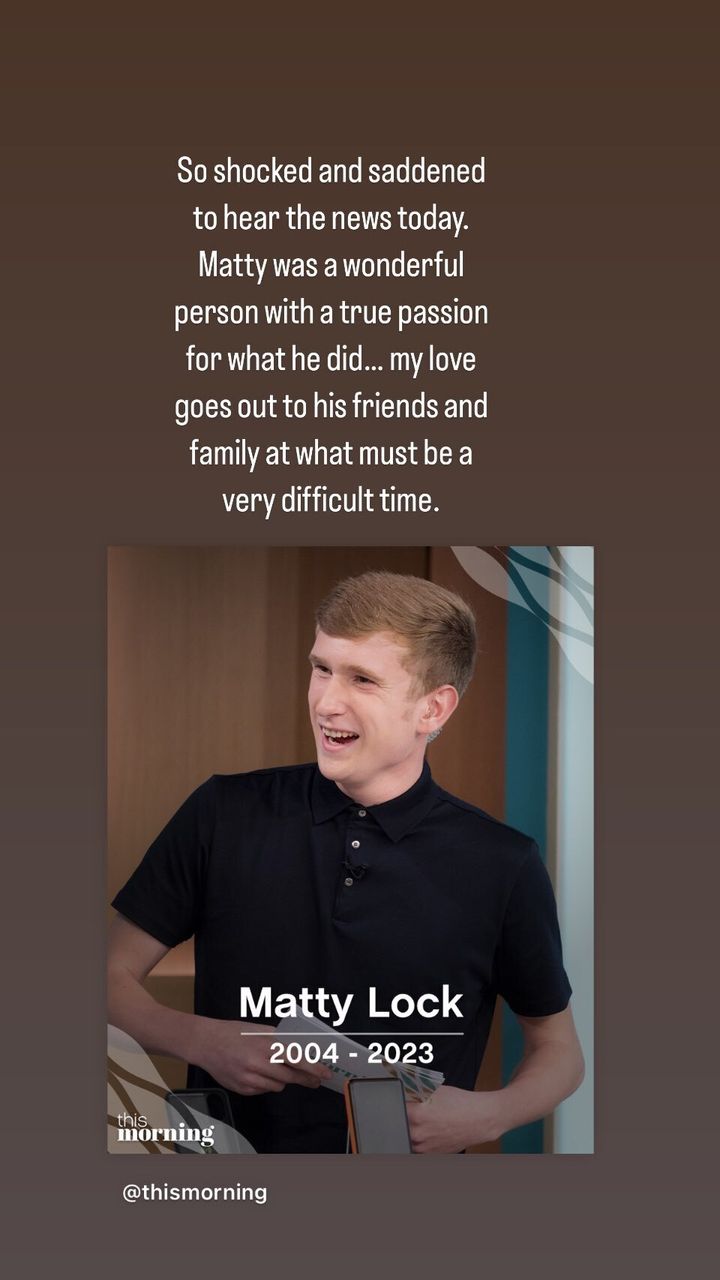
She then shared another tribute to Matty on her Instagram story, where she posted a picture of him alongside the words: “So shocked and saddened to hear the news today. Matty was a wonderful person with a true passion for what he did…

“My love goes out to his friends and family at what must be a very difficult time.”

Holly Willoughby's tribute to Matty Lock
Holly Willoughby’s tribute to Matty Lock

Instagram/Holly Willoughby

Rylan Clark was also among the past and present This Morning stars to share condolences.

“God that’s really sad. Sending love,” he wrote, while Craig Doyle added: “Ah no, what a lovely young man, this is such tragic news. Rest in Peace Matty.”

Such a tragic loss,” wrote ITV vet Dr Scott Miller. “Hard to comprehend. Sending love to Matty’s nearest and dearest.”

“Awful news. What a lovely guy,” said Dermot O’Leary.

Matty was also a member of the Labour party and had recentlybeen elected as a councillor in Maghull, Liverpool. Deputy leader Angela Rayner was also among those to pay tribute.

Rayner said (via the Liverpool Echo): “Incredibly sad news, Matty did so much for his community.

“My love and prayers are with his friends and family.”

Share Button