I Stopped Trying To Make Picture-Perfect Bread And Fell Back In Love With Sourdough

For some people, it’s filtered, airbrushed social media pictures. For others, it’s unrealistic romantic expectations set by movies and TV.

For me, though, my greatest source of insecurity was the r/sourdough forum.

It’s nobody’s fault: if I had created a tall, fluffy masterpiece with a perfect golden crust, I, too, would want to share a shot. If my first-ever loaf looked like it belonged in an ad for artisanal butter, I would indeed want the world to know.

And people share their less successful loaves – a gummy rise, a burnt base – as well.

Still, I couldn’t help it. After a while, I began judging my slightly gummy, slightly deflated loaves a little too harshly. Then, the inevitable turn towards The Product That Solves It All: if I just owned one of these twisty little starter whisks, or a proper starter jar, or a bigger banneton, I’d be (grid) worthy!! I thought.

It sounds silly, because it is. But according to a post shared by u/good-things_ in the group, I’m not alone.

“I don’t use any of the equipment everyone talks about for sourdough. I mix my dough in any bowl available that’s big enough, and I eyeball the rise. Sometimes my bowls are solid and plastic, so I can’t see if there are bubbles,” the poster confessed (mine is metal).

Still, they pointed out, loads of the recommended gear and science-backed rules are relatively new (especially compared to sourdough’s thousands of years of history). Which means my great-great-great-grandma probably didn’t give a hoot about whether the ear of her every loaf curled up like a cowlick.

“I love that people get obsessed and get into the nitty-gritty of how to make a beautiful, perfect loaf. But I also want everyone to know ugly, imperfect loaves are still delicious,” the post continued.

Underneath was a swarm of agreement. “I also admit that my loaves are a bit substandard, but that’s okay with me in the long run. By not stressing about it, I can manage to keep making bread regularly for sandwiches, etc., and not lose enthusiasm,” u/bajajoaquin replied.

“I gave up chasing the perfect loaf with huge holes and a perfect ear, etc. I decided I just wanted to make bread for my own enjoyment… It works for me, and that’s what really matters,” u/dearmax added.

I’ve been through a similar process recently.
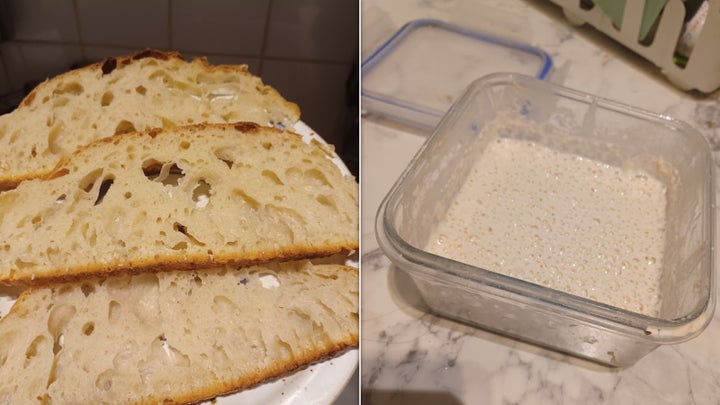
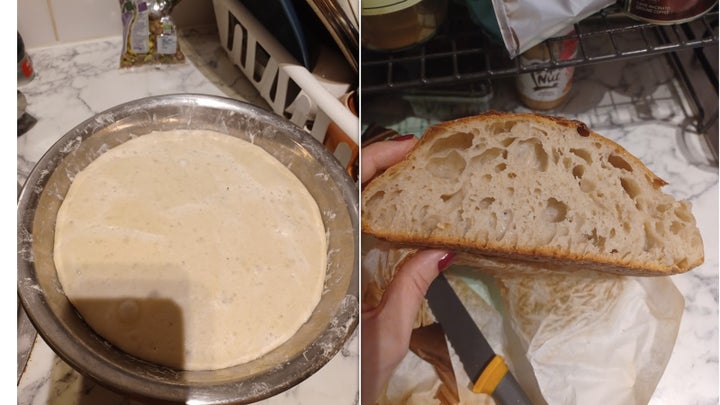
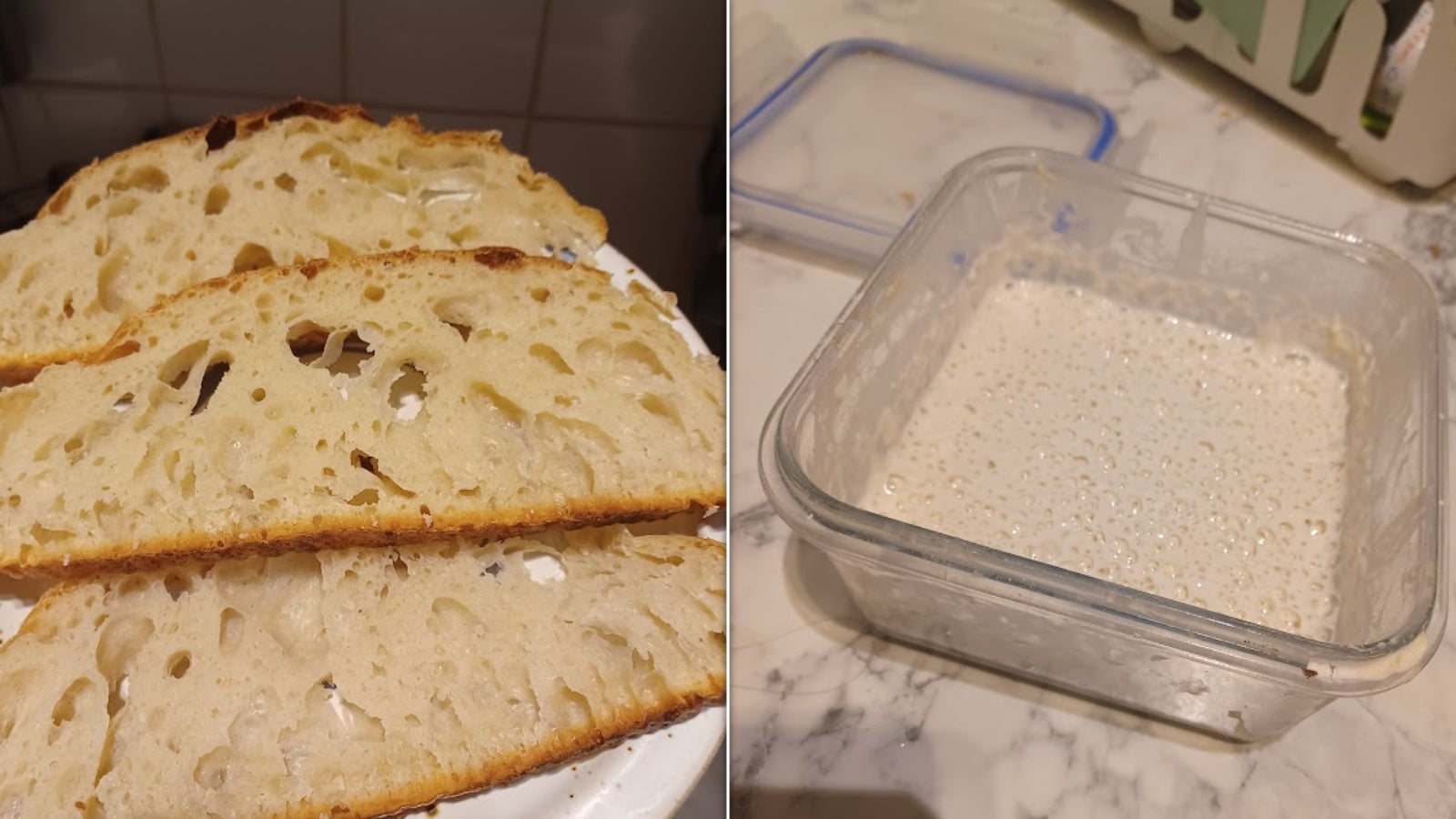
some just-fine bread on the left: a starter that would probably be bubblier if I fed it more on the right

Amy Glover / HuffPost UK

some just-fine bread on the left: a starter that would probably be bubblier if I fed it more on the right

For a couple of months, I stopped making bread entirely. It wasn’t just because I felt mine was subpar, but that was part of it: I felt I was spending so long on something so far from perfect that I got frustrated.

But recently, I’ve fallen back in love with the craft. My new starter (Gluton Airport, if you want her government name) doesn’t have a super-strict feeding schedule, and probably would bubble more enthusiastically if she did.

I’m 99% sure I’m leaving my overnight sourdough out to prove for about two hours too long (I don’t go to sleep immediately after mixing it, and I sleep too late to bake it on time).

A way overproofed, lightly drying dough on the left: some perfectly fine!! resulting bread on the right

Amy Glover / HuffPost UK

A way overproofed, lightly drying dough on the left: some perfectly fine!! resulting bread on the right

Probably as a result, my loaves are somewhat limp, a little gummy, and nowhere near as photogenic as I’d like.

Nonetheless, they’re still delicious. I haven’t splashed out on a pricier shop-bought loaf – a lot of which isn’t technically sourdough – since.

It’s a bit like half-assing my workouts. I don’t give 100% every single time, and it’s made me enjoy the hobby so much more.

Now, I’m more in love with making sourdough – meh as it may be – than ever. Most of all, I’m having fun again (and isn’t that the point of a hobby?).

Share Button

Sourdough Bread May Have Health Benefits, But Some Doctors Recommend Reading The Label Carefully

We don’t know for sure whether sourdough bread definitely has health benefits.

But dietitians like Lizzy Traxler, MS, RDN, also a diabetes educator at University Hospitals, say: “Over time, and in combination with other healthy lifestyle choices and a balanced diet, choosing sourdough over regular bread may provide numerous health benefits.”

These, she told University Hospitals, may include improved digestion. “The improved mineral absorption from the fermentation process supports cardiovascular function,” they add (this might be especially true of sourdough rye bread).

And the British Heart Foundation says sourdough bread may make your blood rise more slowly, too.

So why did Dr Karan Rajan, an NHS surgeon and author, advise we “check the ingredients list” on sourdough loaves before buying?

“Sourfauxs” use different fermentation methods

Quality wholegrain, sourdough, and high-fibre breads may contribute to the “replacement of hyper-palatable baked goods, which are high in sugar, fat, and salt,” which can be beneficial to our health, a 2023 paper reads.

But, they add, one of the reasons sourdough research is so tricky is because “there is no established and internationally recognised legal definition of sourdough bread”. In fact, they found, the artisanal products usually included in trials may differ from the sorts found on most shelves.

“Analysis of bread samples purchased in the market showed that most of these had pH levels of >5.0, substantially above desired levels of pH 4.5 to obtain desired changes in composition,” they wrote.

This paper did not say that this difference definitely meant one was better than the other, or that the higher pH versions were sourfauxs ― though traditional sourdoughs tend to have a lower pH, which is linked to their sour taste.

But if you would like to eat sourdough made from traditional starter, Dr Rajan advises you look at the labels of sourdough breads in search of “added yeast”.

“Authentic sourdough doesn’t mention any added yeast,” he explained, “because it uses a natural fermentation process.”

He added, “Imitation sourdough, or ‘sourfauxs,’ often contain commercial yeast like baker’s yeast and even chemical raising agents like baking powder in addition to, or instead of, live sourdough starter culture.”

To be clear, the doctor didn’t say there’s anything wrong with eating non-sourdough bread.

It’s just that he felt it was important consumers know what they’re really buying (especially considering sourdough bread could be easier for people who usually struggle to digest food to eat).

The Real Bread Campaign has called for more research into the topic. For now, though, the group, which is against “sourfaux” breads, list some studies which suggest the real thing might have some health benefits.

Why might supermarkets create “sourfaux” breads?

“Sourdough” is not a legally-protected term, Swie Joo, head baker at The Palmerston restaurant in Edinburgh, told The Independent (like Dr Rajan, by the way, the chef advised customers to check for the word “yeast” on packages if you want a traditional sourdough loaf).

That means you can add commercial, or non-fermented, yeast to “sourdough” breads.

This can make the rise of bread more predictable and easier to replicate. It can be cheaper and less time-consuming, too.

The combination could make mass production a lot easier.

The Real Bread Campaign write that their campaign “is to better protect us from the risk of being misled by cynical marketing and to allow us all to make better-informed choices about the food we eat”.

Share Button

Trump Bakes A Loaf Of Nonsense With Bizarre Remarks About Grocery Store Purchases

Former President Donald Trump declared that people need identification to purchase groceries as he repeated a wild claim he’s pushed at past rallies on Friday.

“You have voter ID to buy a loaf of bread, you have ID to buy a loaf of bread,” said Trump as he argued that Democrats are “desperate” to stop his movement in remarks at the Concerned Women for America Summit in Washington, D.C.

The former president also received pushback for another food market claim when he said grocery stores would “work along” with federal employees amid the 2019 partial government shutdown.

“Local people know who they are when they go for groceries and everything else… and that’s what happens in times like this – they know the people, they’ve been dealing with them for years and they work along,” he said at the time.

Social media users mocked the former president’s latest grocery remarks, quipping that they got “carded for pumpernickel” the other day.

Share Button