Boundaries Are Fueling A New Wave of Queer Liberation

“I feel the most empowered when I say no,” says Venus Cuffs, an alternative lifestyle expert based in New York City. Cuffs, who once worked as a dominatrix, is part of a lineage of Black femmes who have used their positions to reclaim power — a strategy we’ll unspool post haste.

Mistress Velvet, the late Black femme domme who famously made her white clients read bell hooks, understood the same thing: the queer art of sabotage isn’t about tearing things down. It’s about survival in the form of refusal, boundary and redirection.

“Me saying ‘no’ has been met with like, ‘How dare you?’ My refusal to participate is offensive to people,” Cuffs says, recalling the backlash she faced for refusing race play in predominantly white kink communities. Her words point to a familiar script: the demand that Black femmes be endlessly available, compliant or grateful. Her refusal interrupts that script.

For Cuffs, refusal is the point. Rejecting race play meant rejecting the broader cultural script insisting Black women perform whatever role is demanded of them. “Race is nothing to play about,” she says. That refusal was sabotage. But walking away from the scene allowed Cuffs to stay aligned with her integrity.

Cuffs’ “no” became the foundation for something new. Leaving the scene didn’t just protect her; it opened the door to a creative and personal realignment that became political resistance.

“I broke off from the main scene and started my own dungeon,” she recalls. “I decided I don’t need to deal with this, and neither does my community.”

She founded Spread, a 4,000-square-foot Brooklyn dungeon where queer BDSM practitioners could host sessions and hold power dynamics safely. Spread quickly gained traction. The choice to open it was a declaration as much as a business move: fuck you to exclusionary spaces, fuck yes to something better.

“Refusal means refusing to follow the path we have been told to walk when our instincts tell us otherwise,” Madison Young, a filmmaker and sex educator in the Bay Area, tells me. Queer refusal, they say, looks like “refusing to be someone more palatable in an effort to not cause a disruption. Refusing to be risk-averse.”

Where Cuffs and Velvet confront the racialised demands placed on Black femmes, Young’s dissent takes another form. As a white queer filmmaker, their refusals reject industry scripts demanding palatability and compliance. For Young, refusal has meant creating films and performances that defy neat labels — queer family-making, kink, submission — all centred on authenticity. “I think this is the inherent nature of queerness,” they say. “To exist outside of the lines and boxes drawn for us and to instead follow the path our heart, gut, soul are guiding us toward.”

If refusal is saying “no,” sabotage is building “yes.” Queer sabotage refuses harmful systems not simply for resistance, but to open space for something authentically queer and joyful to emerge.

Young does this through filmmaking. On their sets, they hire predominantly women, nonbinary, and trans crew. “It shifts the dynamic on set when it is a room full of women and queers,” they say. “I can choose whose stories I’m elevating, who I’m collaborating with.” These choices build queer community and disrupt industry norms.

For Madison Young, refusal has meant creating films and performances that defy neat labels — queer family-making, kink, submission — all centered on authenticity.

Photo: Marina Green

For Madison Young, refusal has meant creating films and performances that defy neat labels — queer family-making, kink, submission — all centered on authenticity.

For Tracy Quan, a former escort and author of Diary of a Manhattan Call Girl, sabotage operates more subtly. “I viewed my novels more as a kind of entryism,” she says. Quan smuggles radical ideas into mainstream publishing by infiltrating oppressive spaces from within.

She points to Nancy Mitford, the British novelist who wove antifascist politics into frothy social comedies. “She was a serious antifascist who made the British government pay attention to her fascist sister,” Quan says. “She wrote witty novels that looked fluffy but carried sharp politics.” For Quan, writing sexy books that secrete away radical ideas felt like inserting feminist critique into commercial publishing.

If refusal protects integrity, sabotage extends it. Refusal shuts the door on the status quo. Sabotage opens a new one and creates conditions for a new yes, a yes rooted in creativity rather than compliance.

While Cuffs and Velvet resist the racialized demands placed on Black femmes, Young’s yes shows up in the work itself. “My heart tells me to make a feature film or a TV series or start a queer art gallery, and I just can’t do anything else,” they say. “The calling is strong and defies all logic.”

Early in Young’s career, the call sounded like chaos. “Any time I would even attempt to plug into the matrix, I would sabotage the situation. I just couldn’t do it,” Young explains. What looked like self-destruction was queer self-preservation: an inability to do “normal” — not for money, not for fame.

For Quan, sabotage also meant restraint. For decades, she withheld certain details of her personal life as a deliberate constraint. Instead of confession, she leaned into omission. That discipline, she explains, sharpened her craft. “When you have limits, when you have this denial kind of situation, it can really force you to be more creative,” she told me. What others see as a restriction, she frames as power.

Creating our own boundaries is one of the ways we carve out space for queer joy in a world determined to tell us which boundaries we are allowed to have. “When we state a boundary and work with refusal, we are making room for what we want more of,” Young says.

A no to the wrong collaborator opens a yes to the right one. Setting limits is a prophylactic. “We can protect our collective joy, our queer joy, our relationships, and our connections by being clear about our expectations and needs,” Young says.

Quan echoes that sentiment, describing constraints as creative pleasure rather than deprivation. “To me, creativity is a kind of power, like that’s the kind of power that I enjoy,” she says. For her, withholding shapes a more authentic vision.

Cuffs locates joy in boundaries even more explicitly — in reclaiming time, body, and power. Saying no, walking away from money, setting terms that feel good — each is a reclamation. “I don’t have to show up for anyone when I can’t show up for myself,” she says.

In a political moment defined by rampant transphobia, book bans targeting queer literature, legislative attacks on bodily autonomy, and the ongoing criminalization of sex work, boundaries and refusals are not just private choices. They are collective, political strategies. Our joy is political.

Mistress Velvet knew this when she turned her domme sessions into lesson plans, insisting white submissives grapple with Black feminist thought to earn her attention. Cuffs, Young and Quan know it when they walk away from exploitation, infiltrate hostile industries, or reshape the spaces they inhabit. Sabotage isn’t nihilism. It’s survival. It’s creativity. It’s care.

Cuffs leaves us with a reminder: “Do what feels right for you. Don’t be influenced by the amount of money, the amount of power, what other people tell you it should look like. Slavery is over.”

Share Button

It Was Thrilling Being Mistaken For A Straight Guy. Here’s What Changed My Mind.

It started innocently enough at an Olive Garden in Ohio.

“Would you and your wife like to start with something to drink?” the waitress asked casually.

“I’ll have a club soda and she’ll have a diet coke,” I found myself replying.

I was sitting across the table from my good friend Megan. Of course the server thought we were married. We’re roughly the same age, and we were both wearing wedding bands. Megan is like a beautiful, funny, younger Jessica Lange. Anyone would be thrilled to be married to her. But then again, my husband, Saul, is pretty awesome, too.

Saul and I had recently decided to relocate from New Jersey to Palm Springs. After traveling to California in February for what was supposed to be a two-month visit, we quickly fell for the community of gay men we discovered there after living in a wonderful but mostly straight small town in Jersey.

It took coordinated effort to move two cats, a dog and the two of us 2,600 miles to a new home. After Saul packed up the house and flew the animals west, I volunteered to drive a van with our most cherished possessions across the country with one of my best friends.

My sibling-like bond with Megan was formed through many years of long, gruelling days in television production before both of us got married and changed jobs. We’ve seen much less of each other in the last decade, but we knew we would easily fall back into our familiar friendship groove once we hit the road. But now, our relationship was taking a turn I didn’t expect.

When the waitress returned and placed our unlimited breadsticks on the table, I refrained from complimenting her fabulous multicoloured fake nails.

“I didn’t want her to think I’m some creepy husband flirting in front of his wife,” I explained to Megan a moment later.

“It’s more likely she would have wondered why I was married to a gay man,” she replied dryly.

Our ruse continued through Indiana, Illinois and Missouri. I started calling Megan “honey” in front of others and quickly grabbed the check at the end of each meal. I was determined to be the breadwinner in this fantasy hetero marriage.

I almost blew our cover at a gas station outside of Tulsa, Oklahoma, when a ruggedly handsome cowboy sauntered up to me at the pump.

“Are you looking for diesel?” he asked in a sexy, whiskey-rasped voice.

“It depends. Is your name Diesel?” I almost replied.

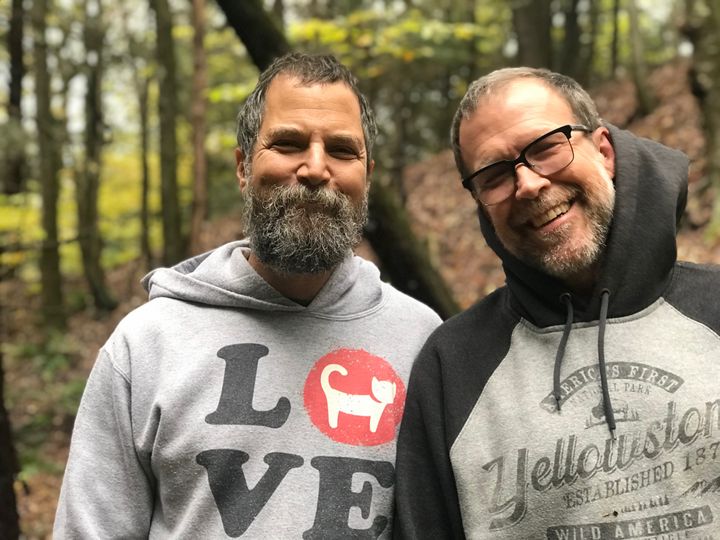
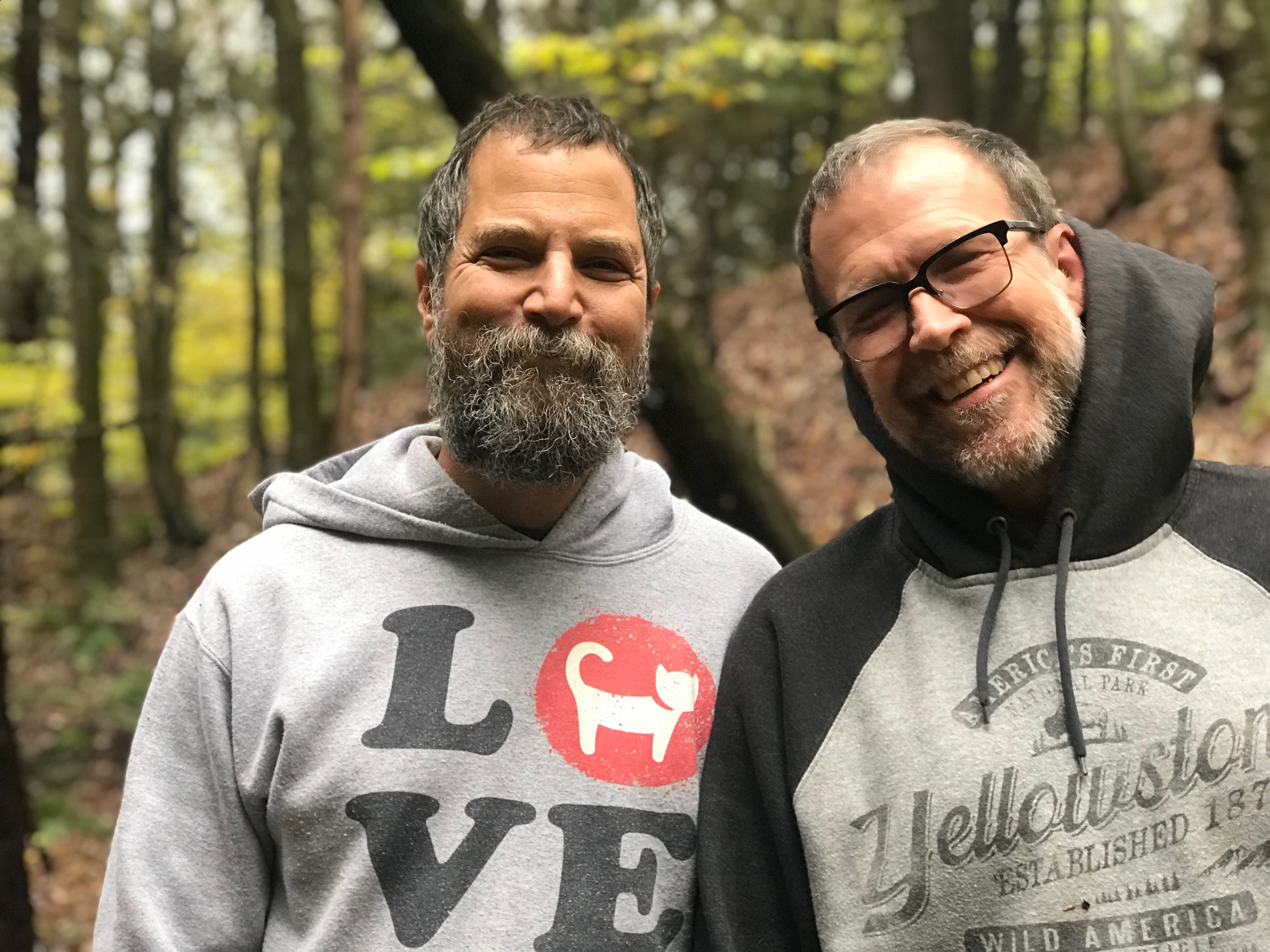
The author (right) in the Catskills with his spouse, Saul.

Courtesy of Keith Hoffman

The author (right) in the Catskills with his spouse, Saul.

But it wasn’t all fun. At a Taco Bell in Texas, we stood in line behind two rough-looking, solidly built women who looked like they didn’t bother to get out of their pyjamas anymore. They had wild bedhead and wore dark makeup over their angry eyes.

“I can’t understand a word anybody says in them damn masks!” one of them complained loudly, glaring at Megan and me. We were the only ones wearing the offending objects.

I had gotten used to the threats that come with being different, but I was definitely out of my comfort zone. I shifted a little closer to my faux wife.

When Megan stepped up to the counter and asked about Taco Bell’s gluten-free options, I went into high alert. I was convinced the women would start taunting us, but to my surprise, they left us alone. I’m not sure that would have been the case if Saul were at my side wearing one of his “I Love My Cats” T-shirts. Avoiding wheat was obviously less offensive than being in love with someone of the same gender.

By the time we got to New Mexico and sat in a tiny diner, happily making small talk with other male-female couples, my transformation was complete. I felt like Eddie Murphy in that classic “Saturday Night Live” skit in which he goes undercover to find out how white people really act when no Black people are around.

Was it wrong that I was getting a thrill out of being thought of as “normal” after a lifetime of internalising messages that gay wasn’t as good as straight and being made to feel like my queerness was, at best, a little weird, and often something much, much more terrible?

I still look for a slight reaction from a cashier when I tell them my grocery discount card is under my husband’s name. And I often think back to the day after my sister died, when an old friend called to tell me she was sorry for my heartbreaking loss before cheerfully adding, “Oh, and I want you to know I’m OK with you being gay!”

I’ve celebrated decades of Pride Months being “here and queer,” and I’ve participated in countless marches. I’ve stood up to homophobia at work, with my family, and in constant daily interactions ever since I came out at the age of 18.

Sometimes being proud is exhausting.

But now I realise it’s actually a luxury that I can “pass” as straight. That isn’t the case for everyone, and those people are often in danger everywhere they go. Being at risk starts early. LBGTQ youth are often targeted and bullied in grade and high school when they are at their most vulnerable. In fact, lesbian, gay and bisexual youth are almost five times more likely to have attempted suicide than heterosexual youth. A survey of trans and nonbinary youth conducted by the Trevor Project found that 60% had considered suicide in 2021.

“I realize it’s actually a luxury that I can ‘pass’ as straight. That isn’t the case for everyone, and those people are often in danger everywhere they go.”

What’s more, there are still so many forces at work trying to limit or roll back the rights of queer people ― especially those who identify as trans. State legislatures are continuing to advance bills targeting transgender and nonbinary people, including criminalising health care for transgender youth, barring access to the use of appropriate restrooms, restricting their ability to fully participate in school sports, allowing religiously motivated discrimination and making it more difficult to get ID documents with their correct name and gender.

These sobering facts make me realise how important it is that we don’t stop fighting. Sometimes that fight involves protesting, voting and speaking up and out about our identities. Sometimes fighting means coming out ― to the grocery cashier, the macho mechanic or the stranger sitting next to us on the plane ― because refusing to “pass” as straight and telling people who we are can be a radical act. It can change someone’s mind about who is queer and what it means to be queer, and that can have incredibly profound consequences. And because not everyone lives in a place or has a life where they’ll be safe if they do come out, it feels that much more important for people like me to do it if and when and as often as we can.

Many people have fought for generations for my right to say the words, “This is my husband, Saul,” and the fight continues. As Megan and I settle back into our own married lives with our respective spouses, one of the most powerful things I can still do is stay visible. So as much as I enjoyed my time in hetero land, it’s time to get back to work.

Keith Hoffman is finishing his memoir, “The Summer My Sister Grew Sideburns.” He has written for television shows such as “The Secret World of Alex Mack,” “Sister Sister” and the popular Nickelodeon cartoon “Doug.” He was a producer for the GLAAD Award winning series “30 Days,” and currently serves as executive producer for Animal Planet/Discovery, where he produced 10 seasons of “Finding Bigfoot.” His essays have appeared in HuffPost, New York Daily News and Grub Street Literary Journal. You can read his blog at TheRavenLunatic.com and find him on Instagram at @Keefhoffman and on Twitter at @khravenlunatic.

Share Button

Bakery Gets Sweet Revenge For Backlash To Its Pride Month Cookies

A Texas bakery hit by anti-gay hate proved that revenge is best served warm, crunchy and delicious.

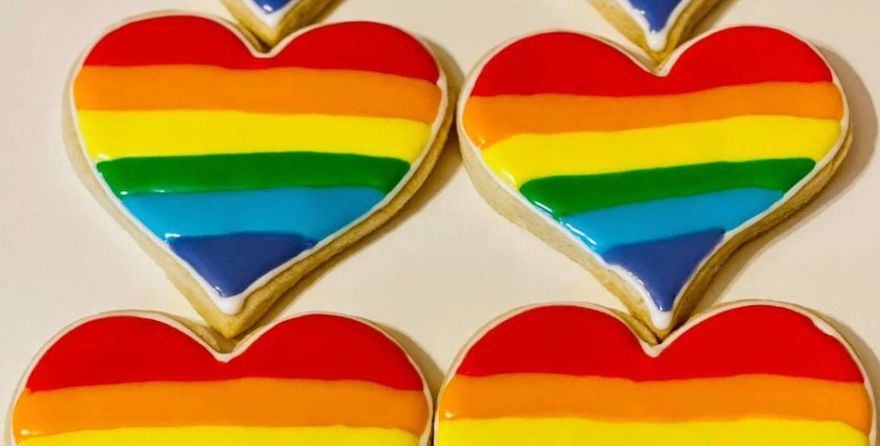
Confections, a shop in Lufkin, Texas, posted an image of heart-shaped cookies iced with the rainbow flag last week to mark Pride Month.

But it later reported on Facebook that bigoted backlash to the message of love left the business “struggling to stay afloat,” with cancelled orders and a plummeting amount of followers on it social media. 

The lament turned into an SOS – and it was answered by thousands of supporters. The response prompted “tears of joy,” Confections wrote on Facebook on Friday: 

The bakery was “overwhelmed by all the sweet words of support posted, messaged and emailed.”

Confections was selling the individual treats from a large order that got canceled. The bakery shared a photo of a customer line wrapped around the block.

Brian Cuban, a Texas lawyer and recovery advocate who’s the brother of Dallas Mavericks owner Mark Cuban, also got involved.

“When things slow down a bit, let us know if shipping is possible. I’d like to support you,” Cuban said, according KYTX. “If shipping isn’t possible, I’ll buy some by phone/email and you can donate my cookies to a local LGBTQ org or children’s charity.”

By Saturday, Confections was sold out of its entire inventory – neither a crumb nor a hater in sight.

So, with nothing to sell, co-owner Miranda Dolder wrote that Confections had given credit-card donations to an animal rescue. More paying it forward.

On Sunday, the shop reported it was hard at work making rainbow bows and said it was working on routing donations to nursing homes.

Cookies and love beat hate every time.

Share Button