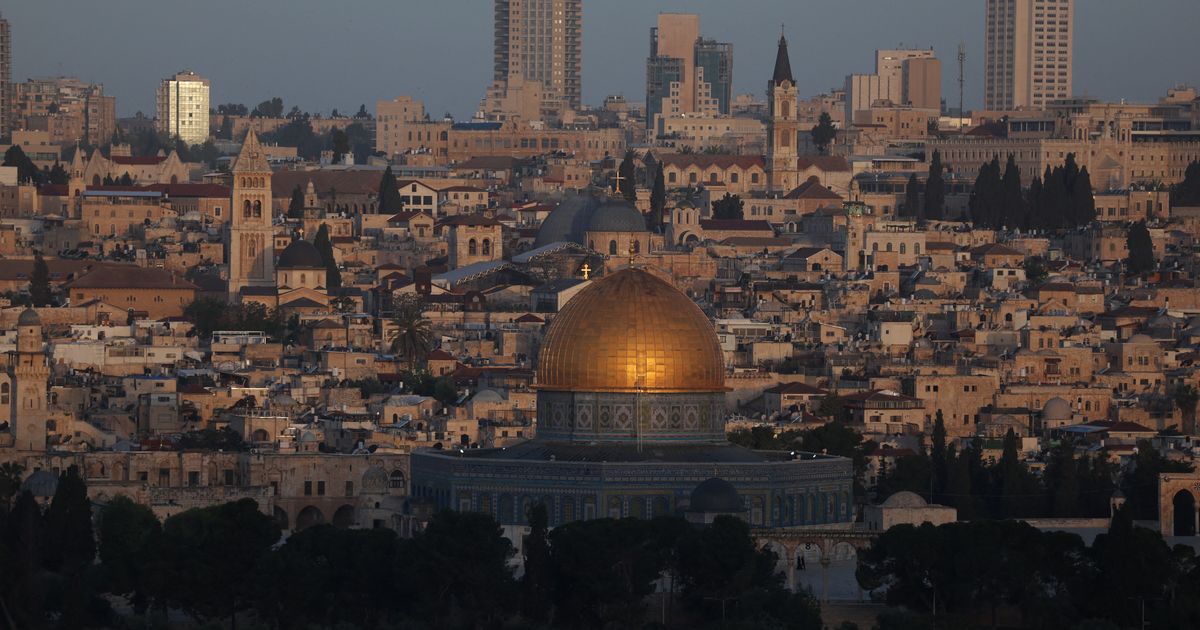
Explosions were heard near the Iranian city of Isfahan, according to an Iranian news agency.
However, an official told the Reuters news agency this was caused by the country’s air defence system, which allegedly destroyed three drones.
Early reports suggest the strike was relatively small. None of the military sites were hit and all nuclear facilities are safe, according to Iran.
Israel’s leadership and military had not commented as of early Friday morning.
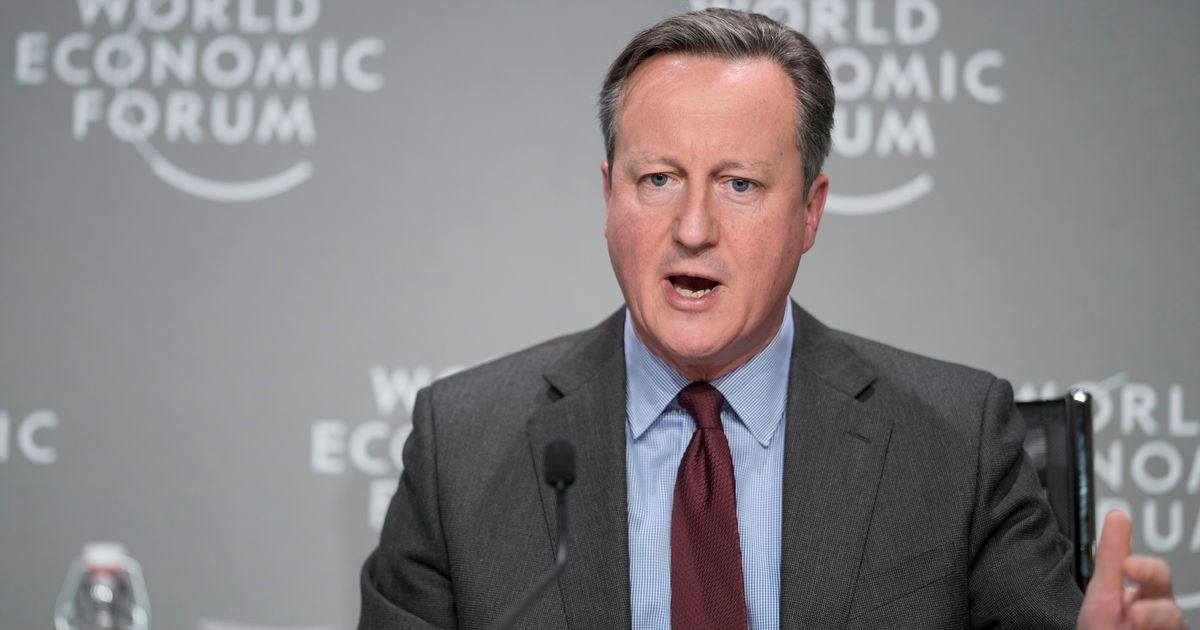

UK foreign secretary David Cameron previously warned that it was clear Israel “is making a decision to act” despite international attempts to de-escalate.
Israel’s military chief of staff Herzi Halevi promised Saturday’s launch would be “met with a response” although he provided no details at the time.
The Israeli foreign minister, Israel Katz, also said he was “leading a diplomatic attack” on Iran earlier this week.
He said he had asked 32 countries to sanction Iran’s missile programme and follow Washington in listing the Revolutionary Guards Corps as a terrorist organisation.
Advertisement
What is the relationship between Israel and Iran?
Tensions between Israel and Iran have been brewing since the latter’s Islamic Revolution in 1979.
Relations then took a turn for the worse when Israel’s war with in the Palestinian territory of Gaza (against the Iran-backed militants of Hamas) began last October.
Hamas killed 1,200 people on Israeli soil on October 7 and took 253 hostages.
Israel declared war on the militants. More than 33,000 Palestinians have been killed in the subsequent Israeli offensive, according to Hamas-run health ministry in Gaza.
Then, on April 1, an air strike – suspected from Israel – killed two Iranian generals and 11 others in an Syria-based Iranian consular building.
While Israel has still not commented on the attack, Tehran vowed to exact revenge.
Have there been efforts to de-escalate?
The West was urgently trying to deter any further attacks in the run-up to Israel’s retaliation.
UN general secretary Antonio Guterres warned an emergency meeting of the security council that the Middle east was “on the brink”.
Rishi Sunak called for “calm heads to prevail” while Cameron said Israel should be “smart as well as tough” and not retaliate.
Advertisement
White House national security spokesman John Kirby said: “We don’t want to see a war with Iran. We don’t want to see a regional conflict.”
However, he added that it was up to Israel to decide “whether and how they’ll respond”.
Joe Biden also told Israeli PM Benjamin Netanyahu at the weekend that the US would not be joining in with any counter-strike, and that Israel should “take the win”.
Sunak revealed that the major democracies of the G7 were working on taking measures against Iran, too.
Russia, an ally of Iran, has also urged against further escalation, although it stopped short of any direct criticism of Tehran.
Yet, after meeting with Israeli politicians days after Iran’s attack, Cameron said: “It’s right to have made our views clear about what should happen next, but it’s clear the Israelis are making a decision to act.
Advertisement
“We hope they do so in a way that does as little to escalate this as possible.”
Israeli PM Benjamin Netanyahu appeared to dismiss diplomatic interventions amid Cameron’s meeting.
While thanking the “friends” who stepped in to support the defence of Israel against Iran, he said: “I want to make it clear: we will make our own decisions, and the state of Israel will do everything necessary to protect itself.”
What happens next?
Iran may look to hit back.
Iranian Deputy foreign minister Ali Bagheri Kani told state TV on Monday that Tehran would retaliate “in a matter of seconds, as Iran will not wait for another 12 days to respond”.
On Thursday – the day before the attack – Iran’s foreign minister Hossein Amir-Abdollahian also warned that Iran’s response to any attack from Israel would be “immediate and at maximum level”.
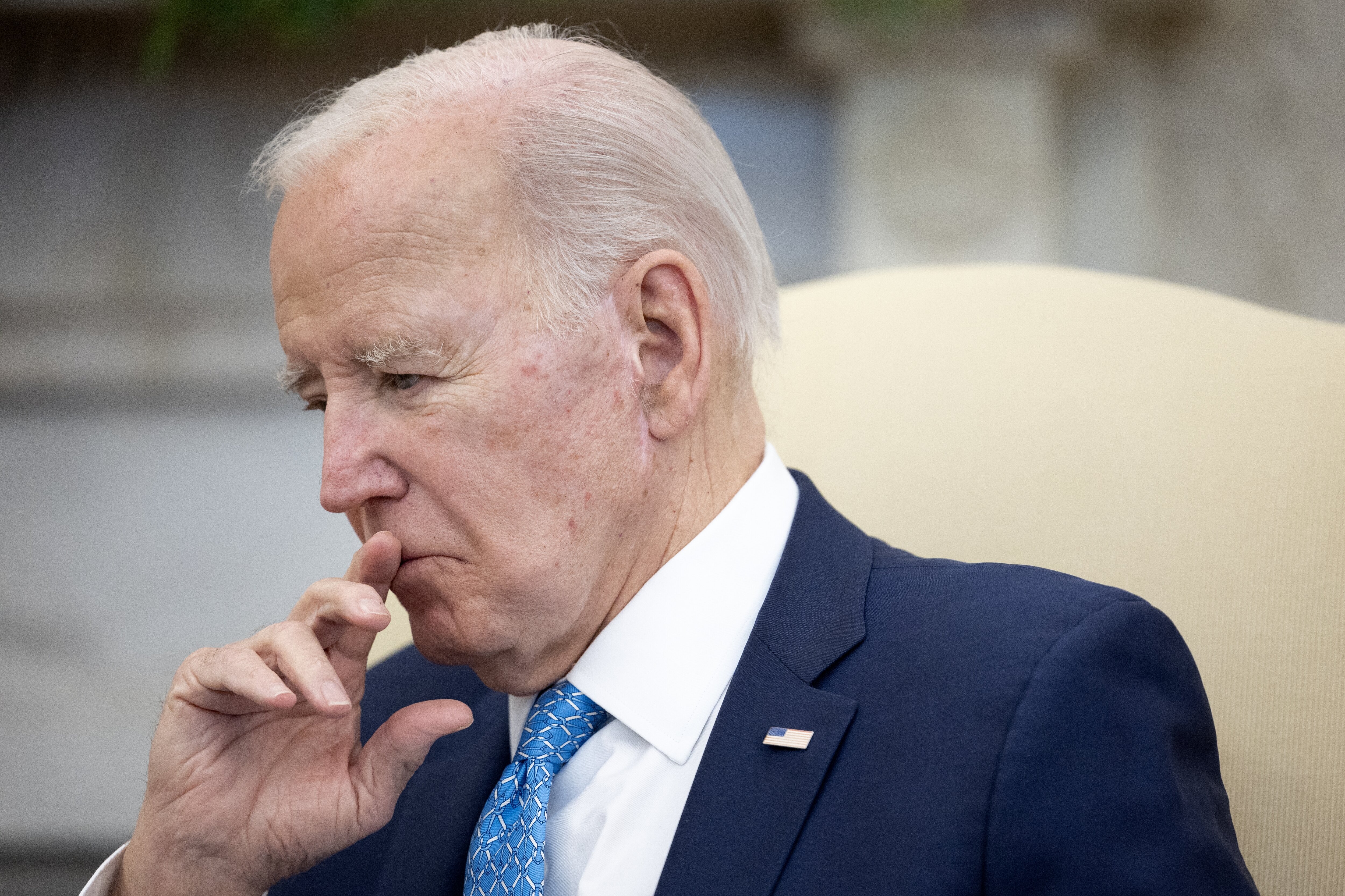
President Joe Biden said in a new interview he does not agree with Israel Prime Minister Benjamin Netanyahu’s ongoing attacks in Gaza, issuing some of his harshest critique of the country’s war with Hamas so far.
“I will tell you, I think what he’s doing is a mistake,” Biden said of his Israeli counterpart in an interview with Univision’s Enrique Acevedo that aired Tuesday. “I don’t agree with his approach.”
Advertisement
The change in tone represents a dramatic shift in the US policy following Hamas’ October 7 attack in Israel that left 1,200 people dead. Israel’s assault in Gaza has since stretched more than six months, leaving at least 32,000 Palestinians dead.
The White House had resisted outright criticism of Netanyahu’s efforts while urging Israel and Hamas to reach a cease-fire agreement, despite the war’s growing civilian toll. But that support changed last week following the deaths of seven aid workers with World Central Kitchen, who were killed in an Israel air strike after delivering food in Gaza.
","type":"video","meta":{"author":"Univision Noticias","author_url":"https://www.youtube.com/channel/UC32TdiIsh_5X8tKr_9rKQyA","cache_age":86400,"description":"In an exclusive interview, President Joe Biden meets with Enrique Acevedo in the Oval Office to talk about immigration, the economy, and ongoing international conflicts. #BidenEntrevista\n\nUnivision Noticias\nSuscríbete: https://www.youtube.com/@univisionnoticias\nInfórmate: http://univisionnoticias.com\n#UnivisionNoticias \n\nSigue a Univision Noticias en: \nFacebook: https://www.facebook.com/univisionnoticias\nInstagram: https://www.instagram.com/uninoticias\nTikTok: https://www.tiktok.com/@uninoticias\nX: https://twitter.com/uninoticias\nWhatsApp: https://bit.ly/3ZE7koB \n\nUnivision Noticias es el lugar donde encontrarás la información más relevante para la comunidad hispana en Estados Unidos, América Latina y el resto del mundo.","options":{"_cc_load_policy":{"label":"Closed captions","value":false},"_end":{"label":"End on","placeholder":"ex.: 11, 1m10s","value":""},"_start":{"label":"Start from","placeholder":"ex.: 11, 1m10s","value":"1840"},"click_to_play":{"label":"Hold load & play until clicked","value":false}},"provider_name":"YouTube","thumbnail_height":720,"thumbnail_url":"https://i.ytimg.com/vi/DsAmO2QwTfI/maxresdefault.jpg","thumbnail_width":1280,"title":"Exclusive interview with Joe Biden on Univision","type":"video","url":"https://www.youtube.com/watch?v=DsAmO2QwTfI","version":"1.0"},"flags":[],"enhancements":{},"fullBleed":false,"options":{"theme":"news","device":"desktop","editionInfo":{"id":"uk","name":"U.K.","link":"https://www.huffingtonpost.co.uk","locale":"en_GB"},"originalEdition":"uk","slideshowAd":{"scriptTags":[],"otherHtml":""},"slideshowEndCard":{"scriptTags":[],"otherHtml":""},"isMapi":false,"isAmp":false,"isVideoEntry":false,"isEntry":true,"isMt":false,"entryId":"66162268e4b035c82d27557f","entryPermalink":"https://www.huffingtonpost.co.uk/entry/president-biden-says-netanyahu-is-making-a-mistake-in-gaza_uk_66162268e4b035c82d27557f","entryTagsList":"joe-biden,israel,hamas,gaza,benjamin-netanyahu,@sensitive,@us_huffpost_now,@widget-imported","sectionSlug":"politics","deptSlug":null,"sectionRedirectUrl":null,"subcategories":"","isWide":false,"headerOverride":null,"noVideoAds":false,"disableFloat":false,"isNative":false,"commercialVideo":{"provider":"custom","site_and_category":"uk.politics","package":null},"isHighline":false,"vidibleConfigValues":{"cid":"60afc140cf94592c45d7390c","disabledWithMapiEntries":false,"overrides":{"all":"60b8e525cdd90620331baaf4"},"whitelisted":["56c5f12ee4b03a39c93c9439","56c6056ee4b01f2b7e1b5f35","59bfee7f9e451049f87f550b","5acccbaac269d609ef44c529","570278d2e4b070ff77b98217","57027b4be4b070ff77b98d5c","56fe95c4e4b0041c4242016b","570279cfe4b06d08e3629954","5ba9e8821c2e65639162ccf1","5bcd9904821576674bc55ced","5d076ca127f25f504327c72e","5b35266b158f855373e28256","5ebac2e8abddfb04f877dff2","60b8e525cdd90620331baaf4","60b64354b171b7444beaff4d","60d0d8e09340d7032ad0fb1a","60d0d90f9340d7032ad0fbeb","60d0d9949340d7032ad0fed3","60d0d9f99340d7032ad10113","60d0daa69340d7032ad104cf","60d0de02b627221e9d819408"],"playlists":{"default":"57bc306888d2ff1a7f6b5579","news":"56c6dbcee4b04edee8beb49c","politics":"56c6dbcee4b04edee8beb49c","entertainment":"56c6e7f2e4b0983aa64c60fc","tech":"56c6f70ae4b043c5bdcaebf9","parents":"56cc65c2e4b0239099455b42","lifestyle":"56cc66a9e4b01f81ef94e98c"},"playerUpdates":{"56c6056ee4b01f2b7e1b5f35":"60b8e525cdd90620331baaf4","56c5f12ee4b03a39c93c9439":"60d0d8e09340d7032ad0fb1a","59bfee7f9e451049f87f550b":"60d0d90f9340d7032ad0fbeb","5acccbaac269d609ef44c529":"60d0d9949340d7032ad0fed3","5bcd9904821576674bc55ced":"60d0d9f99340d7032ad10113","5d076ca127f25f504327c72e":"60d0daa69340d7032ad104cf","5ebac2e8abddfb04f877dff2":"60d0de02b627221e9d819408"}},"connatixConfigValues":{"defaultPlayer":"8b034f64-513c-4987-b16f-42d6008f7feb","clickToPlayPlayer":"5a777b9b-81fe-41a6-8302-59e9953ee8a2","videoPagePlayer":"19654b65-409c-4b38-90db-80cbdea02cf4"},"topConnatixThumnbailSrc":"https://img.connatix.com/985fafd2-dbe9-436d-a2d4-dae96eb13c79/1_th.jpg?crop=629:354,smart&width=629&height=354&format=jpeg&quality=60&fit=crop","customAmpComponents":[],"ampAssetsUrl":"https://amp.assets.huffpost.com","videoTraits":null,"positionInUnitCounts":{"buzz_head":{"count":0},"buzz_body":{"count":0},"buzz_bottom":{"count":0}},"positionInSubUnitCounts":{"article_body":{"count":6},"blog_summary":{"count":0},"before_you_go_slideshow":{"count":0}},"connatixCountsHelper":{"count":1},"buzzfeedTracking":{"context_page_id":"66162268e4b035c82d27557f","context_page_type":"buzz","destination":"huffpost","mode":"desktop","page_edition":"en-uk"},"tags":[{"name":"Joe Biden ","slug":"joe-biden","links":{"relativeLink":"news/joe-biden","permalink":"https://www.huffingtonpost.co.uk/news/joe-biden","mobileWebLink":"https://www.huffingtonpost.co.uk/news/joe-biden"},"relegenceId":3519431,"section":{"title":"News","slug":"news"},"topic":{"title":"2020 US Election","slug":"2020-us-election","overridesSectionLabel":false},"url":"https://www.huffingtonpost.co.uk/news/2020-us-election/"},{"name":"Israel","slug":"israel","links":{"relativeLink":"news/israel","permalink":"https://www.huffingtonpost.co.uk/news/israel","mobileWebLink":"https://www.huffingtonpost.co.uk/news/israel"},"relegenceId":3989007,"url":"https://www.huffingtonpost.co.uk/news/israel/"},{"name":"Hamas","slug":"hamas","links":{"relativeLink":"news/hamas","permalink":"https://www.huffingtonpost.co.uk/news/hamas","mobileWebLink":"https://www.huffingtonpost.co.uk/news/hamas"},"url":"https://www.huffingtonpost.co.uk/news/hamas/"},{"name":"gaza","slug":"gaza","links":{"relativeLink":"news/gaza","permalink":"https://www.huffingtonpost.co.uk/news/gaza","mobileWebLink":"https://www.huffingtonpost.co.uk/news/gaza"},"url":"https://www.huffingtonpost.co.uk/news/gaza/"},{"name":"Benjamin Netanyahu","slug":"benjamin-netanyahu","links":{"relativeLink":"news/benjamin-netanyahu","permalink":"https://www.huffingtonpost.co.uk/news/benjamin-netanyahu","mobileWebLink":"https://www.huffingtonpost.co.uk/news/benjamin-netanyahu"},"relegenceId":3459425,"url":"https://www.huffingtonpost.co.uk/news/benjamin-netanyahu/"}],"isLiveblogLive":null,"cetUnit":"buzz_body","bodyAds":["
The president re-upped his calls for a cease-fire in the Univision interview, which was recorded last week just days after the aid workers were killed. Israel has taken responsibility for their deaths.
“I think it’s outrageous that those … vehicles were hit by drones and taken out on a highway where it wasn’t like it was along the shore, it wasn’t like there was a convoy moving there,” he said. “What I’m calling for is for the Israelis to just call for a cease-fire, allow for the next six, eight weeks total access to all food and medicine going into the country.”
The president added the US had spoken to countries in the region who were prepared to move in food and other humanitarian aid.
“And I think there’s no excuse to not provide for the medical and the food needs of those people,” Biden added. “It should be done now.”
Israel approved the opening of a border crossing in northern Gaza for the first time since October 7 following Biden’s call with Netanyahu.
Advertisement
Secretary of State Antony Blinken said Hamas needed to accept a new cease-fire deal brokered by the U.S. that would include the release of hostages. But Hamas has yet to respond to the proposal, and U.S. officials have said the group’s public statements so far “have been less than encouraging.”
In the Univision interview, Biden also slammed his predecessor and 2024 Republican rival, former President Donald Trump, calling him the greatest threat to the nation. He pointed to Trump’s behaviour surrounding the January 6, 2021, insurrection at the U.S. Capitol, which has resulted in a multi-pronged federal indictment.
“The idea that he would sit in the office … and watch for hours the attack on the capitol and the destruction and the mayhem and the people who were killed, the police officers who died, and call them political heroes? Call them patriots…” Biden said. “I can’t think of any other time in my lifetime that you’ve had somebody who’s had this kind of attitude.”
Six months into a war Hamas started ― with more than 33,000 Palestinians dead, more succumbing to famine daily and Israel determined to continue its aggressive campaign against the organisation with robust American military support ― the militant group says it is confident it will wield significant influence in the future, come what may in Gaza.
Hamas believes its shock October 7 attack on Israel achieved its goal of reigniting global concern for decades-long Palestinian subjugation, and it views the Israelis and Americans as intent on deepening the fighting rather than taking genuine steps toward an Israeli-Palestinian settlement. Additionally, it does not see itself as responsible for civilian deaths during that assault, in which Hamas-led fighters killed about 1,200 Israelis, more than half of them civilians, and took up to 240 hostages in violation of international law.
Advertisement
That’s how Mousa Abu Marzouk and Basem Naim, two senior Hamas leaders, presented their group’s current thinking in two lengthy, separate recent interviews with HuffPost, providing extremely rare hours-long, in-person access to a Western media outlet after complex negotiations and amid an extraordinarily delicate time in the war.
The group acknowledged it still holds dozens of captives ― including about 40 people Hamas counts in a humanitarian category as noncombatants, among them some civilians, and likely five Americans (the number of U.S. citizens a State Department spokesperson said remain unaccounted for since October 7). But the Hamas leaders expressed little faith in negotiations for a pause in combat involving the release of those hostages in exchange for Palestinians held by Israel, the stated goal of President Joe Biden, who in recent days has pushed Israel and intermediaries with Hamas to successfully reach an agreement.
Both Hamas leaders said their group remains committed to a 2017 political document that represented a tempering of its hard-line historic views ― a manifesto that claims Hamas has no quarrel with the Jewish people or Judaism broadly, instead opposing only aggressive actions fueled by Zionism. That suggests Hamas would accept a Palestinian state limited to territories Israel did not control before 1967, aligning it with the idea of a two-state solution.
Like the assertions of any player, particularly actual combatants, in this most sensitive of conflicts, their portrayal of the situation deserves to be taken with a large grain of salt.
Advertisement
Abu Marzouk’s own comments cast doubt on whether Hamas would tolerate a Palestinian state coexisting with Israel, particularly after Israeli-Palestinian bloodshed more extensive than any since the establishment of Israel in historic Palestine in 1948.
“The Israelis are creating generation after generation full of hatred, full of rage, full of a feeling of taking revenge, by killing Palestinians on a daily basis… I think that the Palestinians would not accept Israel in any case, but the Palestinians have no other option: The only option for the Palestinians is to live in this land to resist the occupation,” Abu Marzouk told HuffPost via a translator. Claiming most Israelis have dual citizenship ― an assertion that is not borne out by publicly available evidence and was rejected by an Israeli official who said the government does not have statistics on the matter ― he added: “They have a lot of options. And they can leave the land of Palestine at any time when they feel that it’s not beneficial anymore.”
Meanwhile, international opprobrium over and research on Hamas’ October 7 violence is still growing.
HuffPost this week obtained new information about one major forthcoming report. Belkis Wille, an associate director at Human Rights Watch who has spent months working on an in-depth investigation of the attack, told HuffPost her organisation has verified photo and video evidence of fighters with the al-Qassam Brigades, the military wing of Hamas, “targeting and killing civilians,” citing the attackers’ uniforms and bandannas. Some attackers who were in civilian clothing were also clearly coordinating with al-Qassam fighters, she added.
Still, Western and Arab governments, along with most outside experts, believe Hamas will remain relevant to the future of Israel-Palestine regardless of how the current war concludes. Abu Marzouk and Naim clearly agree.
Advertisement
In speaking with HuffPost about ideas being considered by the U.S., Israel and other players about what comes next for the region, the Hamas leaders expressed deep opposition to proposals that are currently under discussion and a determination to scuttle particular plans.
Abu Marzouk responded to reporteddiscussions about a new military force in Gaza comprising troops from various countries, including Arab states, by saying: “As a movement, we will fight against any force, whether it was from any nationality, in the Gaza Strip.”
Few people would have presumed Hamas to align with American and Israeli goals. However, Abu Marzouk’s reference to nationalities is striking, given the assumption in some circles that Hamas and other militants in Gaza would be loath to fight forces from countries like Egypt due to Palestinians’ links with other Arab nations. His remarks suggest that although Hamas is not outright challenging Arab governments, it does not see a red line in attacking their soldiers.
No Arab country “would participate with the Israeli occupation” or with American policy in Gaza, even if those states are unable to openly confront U.S. or Israeli policies, Abu Marzouk said. “No one has the right to subjugate the Palestinians for slavery or for oppression.”
He and Naim also challenged hopes around the March 14 appointment of economist Mohammed Mustafa as the new prime minister of the U.S.-backed Palestinian Authority, or PA, which controls parts of the occupied West Bank and from which Hamas wrested control of Gaza in 2007. Significantly, they framed their rejection not as a product of factionalism among Palestinians ― Hamas has long despised PA President Mahmoud Abbas, who tapped Mustafa ― but as a reaction to U.S.-driven interference in intra-Palestinian discussions.
Advertisement
“To continue imposing policies and governments and figures on Palestinians, this will never lead to sustainable security or stability or prosperity in the region, not only in Palestine,” argued Naim, who was previously a minister in Hamas’ administration in Gaza. “Hamas is an inherent part of the political fabric of the Palestinians and is a strong power, and no one can easily decide to overcome it or to avoid it. Any agreement with any other party will not lead to stability or a solution.”
This story draws on HuffPost’s interviews and conversations about Hamas over months with dozens of officials and analysts.
Securing access to Abu Marzouk, deputy head of Hamas in the Palestinian diaspora and a prominent politburo member, and Naim, chief of Hamas’ political and foreign relations department and a member of its Gaza bureau, was not easy.
It involved tapping a range of trusted sources to make contact, investing in costly travel and tactfully operating in a sensitive location, given Qatar’s interest in being the chief mediator between Hamas and the outside world and pressure from some in the U.S. over its links to the Palestinian group.
When HuffPost visited Abu Marzouk at a large, beige compound in a suburb of the Qatari capital of Doha ― a world away from the Persian Gulf state’s ritzy sea-front hotels ― a Qatari police officer stationed outside repeatedly challenged the idea that a meeting was scheduled. Inside, another Qatari security official subjected HuffPost to an extensive search, a step Abu Marzouk’s Hamas aides apologized for, seemed embarrassed about and made sure to say was due to Qatar’s requirements. (Notably, Israel has tried to assassinate senior Hamas figures, such as Khaled Meshal, a close associate of Abu Marzouk.)
Advertisement
We also did not take the prospect of hearing and sharing Hamas’ views lightly.
Still, HuffPost assessed that interviewing Abu Marzouk and Naim provided an uncommon opportunity to inform our audience and to question Hamas about global concerns and its actions on matters including harming civilians and the handling of humanitarian relief desperately needed in Gaza.
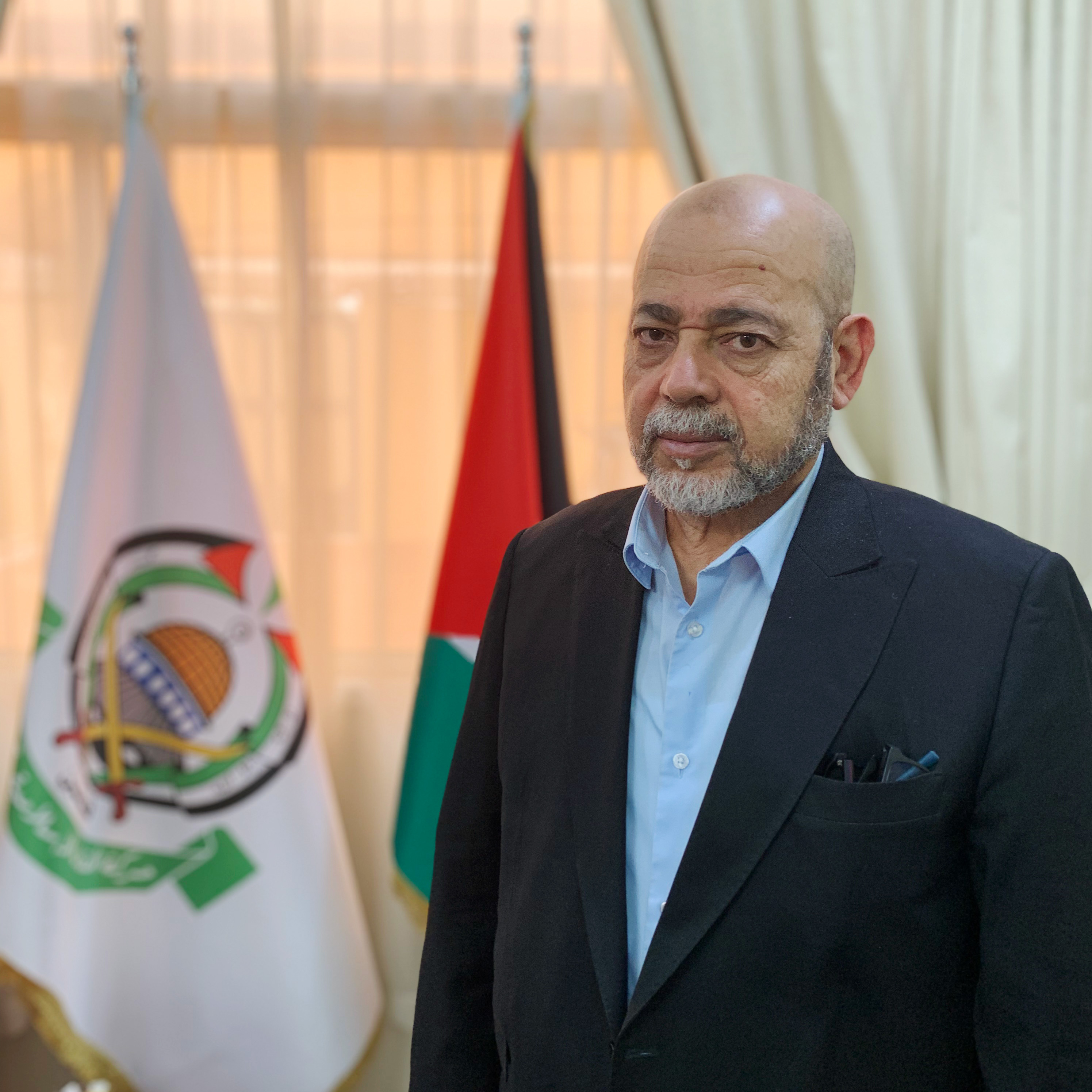
Senior Hamas figure Mousa Abu Marzouk, seen here in Doha, Qatar, on March 30, is the group’s deputy leader outside its base in Gaza.
Akbar Shahid Ahmed/HuffPost
HuffPost this week shared key Hamas statements included in this article with spokespeople at the US State Department, the National Security Council at the White House and Israel’s embassy in Washington.
Only a State Department spokesperson responded, reaffirming the US stance against dealing with Hamas, which it lists as a terrorist group, beyond limited indirect communications through third parties, such as Egypt and Qatar, as it makes plans for a territory where Hamas is deeply ingrained.
“We do not engage in public debates with terrorist organisations like Hamas,” the spokesperson wrote in an email. “The US remains committed to advancing the realization of an independent Palestinian state, standing side by side with Israel in peace and security.”
Advertisement
October 7 Bloodshed And The Hostage Crisis
In Israel, where thousands of anxious people await reunions with the hostages still in Gaza, and in Washington, where Biden administration officials daily promise to help those hostages and the US-Israel alliance is sacrosanct, October 7 is a constant touchstone, so devastating and unprecedented a wound that it feels almost as fresh six months later.
In discussing the assault with Hamas leaders, it is clear it’s not a matter they want to linger on, both because they do not want to dissect responsibility for atrocities committed that day, which are undeniable even for them, and because they see Gaza’s current conditions and their long-term goals as more important.
“History didn’t start on October 7. Before October 7, we were besieged,” Naim said. He said he was out of “the open-air prison” of Gaza “accidentally” because he had traveled to Turkey for meetings prior to the attack; his wife and children remain in Gaza, which Israel and then Egypt blockaded after Hamas took over in 2007, tightly limiting entry and exit.
Naim listed additional developments in the Israeli-Palestinian conflict that Hamas has cited as inspiring the assault: attacks by Israeli extremists on the Haram al-Sharif, or Temple Mount, sacred to Jews and Muslims alike; Israeli steps toward annexing the occupied West Bank; and the “Judaization” of Jerusalem.
“Therefore, we consider this an act of defense. We were squeezed; we were suppressed,” he continued.
Pressed on the brutality of the Hamas incursion, Naim said Hamas told its fighters to avoid noncombatants. He attempted to shift blame for civilian deaths away from the attackers and onto the attacked, saying the Palestinian group was surprised Israel’s defensive lines collapsed so quickly, enabling many people not associated with Hamas to cross from Gaza into Israel.
Advertisement
“There was chaos…. We cannot be responsible for the chaos that has taken place after one, two hours,” he said, pointing to reports that Israeli troops responding to the violence killed some civilians, which the Israel Defense Forces have confirmed and continue to investigate.
“There was no intention to harm or to attack any of the civilians,” Naim claimed. “This operation was designed and conducted and launched only to attack military bases and maybe to take some soldiers hostage to exchange with thousands of Palestinians, some of whom have now spent 44 years in jail, like Nael Al-Barghouti,” whom Israel arrested in 1978, released in 2011 and re-arrested in 2014.
Of the more than 760 casualties on October 7 who were civilians, at least 36 were children, according to Israeli government reports. Hamas’ claim that its fighters did not target civilians is contradicted by Human Rights Watch, Amnesty International and numerous newsreports. Amanda Klasing, the national director for government relations at Amnesty USA, told HuffPost her group has verified footage of “Palestinian fighters shooting at civilians on 7 October.”
“Hamas and other armed groups also took civilians as hostages and have repeatedly fired indiscriminate rockets into Israel, killing and injuring civilians. These attacks are war crimes,” Klasing added.
Did Hamas anticipate the sweeping response to its foray from Biden and Israeli Prime Minister Benjamin Netanyahu?
Advertisement
Abu Marzouk told HuffPost: “We thought that America [would] allow for a partial aggression against Gaza, especially given that most of the victims are civilians.”
“We didn’t expect this brutality of America,” he said, citing an article in The Washington Post published the day before that revealed Biden greenlighted additional bombs and fighter jets for Israel. In the 1990s, the U.S. detained Abu Marzouk for more than a year over terrorism allegations; it deported him and continues to list him as a “specially designated national” under U.S. sanctions.
In Hamas’ view, they have sought negotiations and an end to fighting since soon after the attack. On October 17, an unnamed senior Hamas official told NBC News that the group was willing to release all civilians ― Israelis and foreigners ― if Israel stopped bombing Gaza.
Through intermediaries, Israel and Hamas did a month later agree on a weeklong pause in combat that allowed more than 100 hostages to be released and increased humanitarian aid for Palestinians in Gaza. But that bargain fell apart on Dec. 1, and efforts to secure a similar deal in months since, which intensified in February and March and which Biden has described as a priority, have not borne fruit.
The Hamas leaders described having little optimism over negotiations, which are continuing and have evolved since HuffPost’s interviews and international outrage over Israel’s Monday killing of aid workers associated with the World Central Kitchen nonprofit.
Advertisement
“We cannot say that we have reached common ground… to talk about details,” Naim said on March 29, referring to matters like the timeline and the process of releases or steps toward a possible Israeli withdrawal from Gaza.
In recent days, Israeli officials told reporters that they were becoming flexible on one question: letting displaced Gazans return to the northern part of the territory. On Monday, however, an Israeli source downplayed hopes of a deal in speaking with the Haaretz newspaper. On Thursday, Hamas rejected a framework approved by Israel and the intermediaries, blaming Netanyahu; separately, Biden urged Netanyahu “to empower his negotiators to conclude a deal without delay to bring the hostages home.”
Both Hamas figures argued Netanyahu is personally unwilling to halt the war because it would mean his political collapse ― echoing an assessment that is now widely shared in global capitals. They described frustration with Biden’s continued support for his Israeli counterpart despite that position and deep distrust in the role of the U.S., which has historically attempted to be an intermediary in Israeli-Palestinian negotiations.
“The problem with the Americans is they want to support Israel regardless of the Israeli policies, and this is against the American policies through history,” Abu Marzouk said, describing Americans as “vital collaborators” for Netanyahu rather than “mediators.”
Citing U.S. talk of pausing the Israeli offensive to enable hostage releases and what he cast as Washington’s assessment that Israel had “failed” to achieve its aims, Naim argued: “America is in line strategically with Israel about the war and the goals. No differences. What we observe sometimes is a tactical difference; it is not a strategic difference.”
Advertisement
“During the negotiations, yes, we have seen sometimes that they are pressuring [Israel] to reach something. At the beginning [of the war], we have seen what we called identical positions. … There is a clear shift, but again it is a tactical shift, and I think this is because of the internal pressures [on Biden] in the year of the election; this is because of the fear that the war might be broadened in the region and the Americans want to go out of the region, not to go back to the region; and thirdly, that they see that this is not serving the security and stability of Israel itself in the long run,” he added. “All this together led them to exercise some pressure, but … they have all the cards to end this aggression.”
While CIA Director William Burns is involved in the Israel-Hamas bargaining, and is traveling to Cairo this weekend looking to advance those discussions, the primary players are various Hamas leaders ― notably commanders still in Gaza, led by October 7 planner Yahya Sinwar ― and Israel’s Mossad intelligence agency. On Saturday, Hamas said it would send a new delegation to the discussions but would not abandon its demands for a full cease-fire and Israeli troop withdrawal from Gaza.
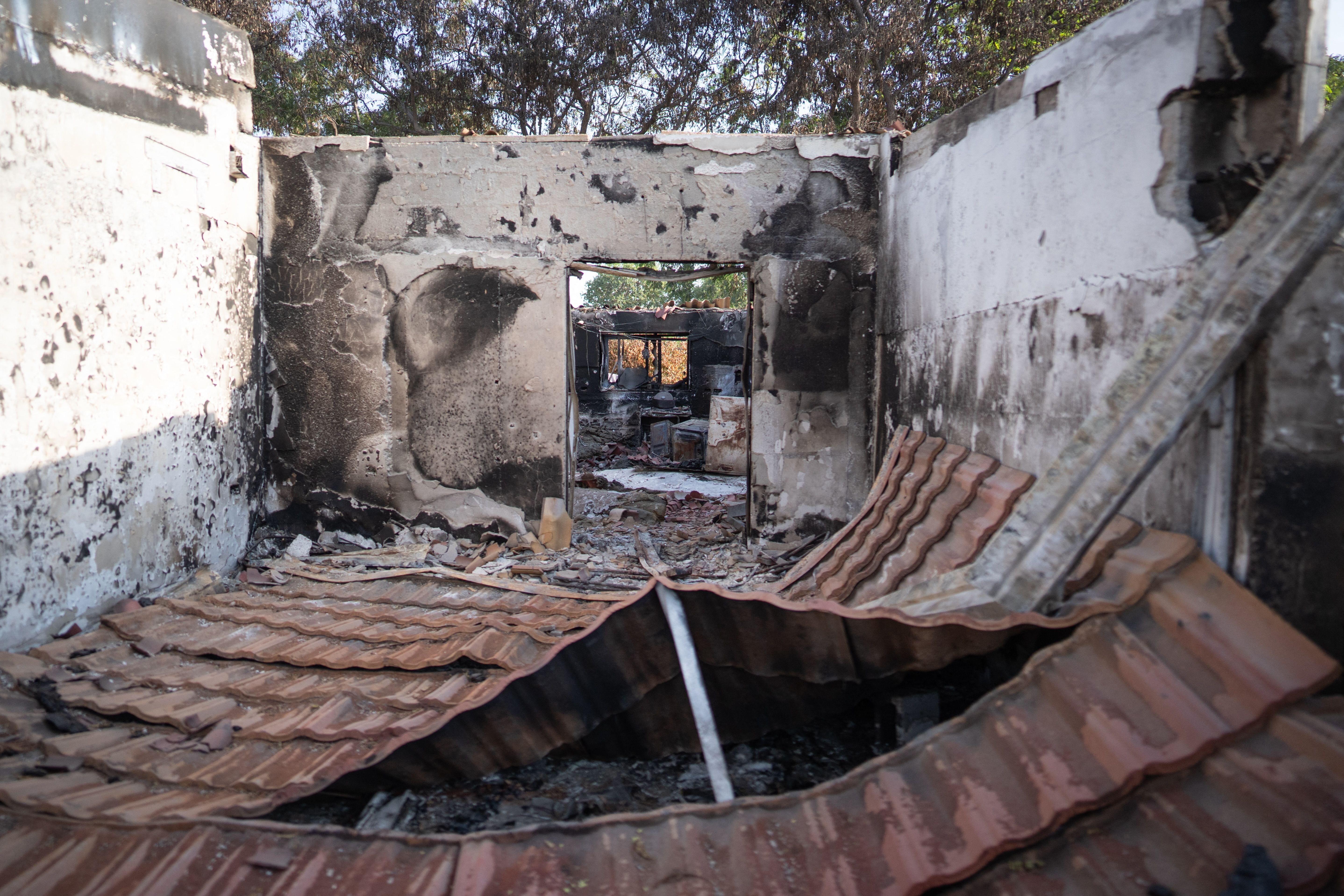
Burned-out houses in Kibbutz Kfar Aza, Israel, where Hamas-led militants massacred and kidnapped residents on Oct. 7, 2023.
DIMA VAZINOVICH/Middle East Images/AFP via Getty Images
Mossad officials had in previous rounds of talks indicated they were keen to reach a deal and viewed Netanyahu as the barrier to a possible agreement, a separate source familiar with the talks told HuffPost.
Naim said Hamas “partially” shares that assessment but added some potential insight into Hamas’ calculus in dealing with Israel’s deeply divided political scene and what may be driving Hamas to accept or reject possible deals.
Advertisement
“I don’t think that is the only cause,” he told HuffPost. He cited polls showing most Israelis support the campaign in Gaza. He also noted fractures within Israel’s society over a judicial power grab by Netanyahu and the question of whether ultra-Orthodox men should perform military service, which drew the Israeli military into polarizing debates.
“After all these discussions, the army started to lose some of its holiness,” Naim said. Then, “when October 7 came, all the security apparatus failed. They are not so eager to end the aggression because they themselves feel that, ‘We have failed and this is our duty.’”
An Israeli official disputed the Hamas version of the negotiations to HuffPost, saying: “Despite what’s being publicly written, Hamas is the one that brings conditions that cannot be met.”
HuffPost asked Naim, in relation to negotiations about halting the fighting, how Hamas sees the possibility of an Israeli attack on the Palestinian town of Rafah, where Netanyahu says he intends to invade, close to 1.5 million Palestinians have taken shelter and the Biden administration says it cannot support an Israeli advance without a meaningful plan to shield civilians.
“We believe that now it is part of the pressure on the negotiators, but at the same time we are preparing ourselves for the worst,” Naim responded.
Advertisement
Then he alluded to a theme that both Hamas figures frequently, and hopefully, referenced: forceful Israeli actions sparking worldwide furor.
Noting Rafah’s location on Gaza’s border with Egypt, which has a 45-year-old peace treaty with Israel but also a population wary of the Jewish state, Naim said Netanyahu’s “mistakes here could flare a bigger war.”
He added: “We have now international awareness about the whole conflict, especially Rafah. It’s totally different from the beginning.”
On Friday, White House spokesperson John Kirby told reporters that the Biden administration plans to continue conversations with Israel about a possible Rafah mission in the coming weeks.
Who Speaks For The Palestinians?
Netanyahu has regularly pledged to “destroy” Hamas, an outcome Biden has repeatedly endorsed.
U.S. intelligence and most independent analysts do not see that as achievable on the battlefield. Last week, the Israeli newspaper Haaretz quoted Israeli military officials as saying their government has overestimated how many Hamas fighters it has eliminated so far, since it is in some zones logging any Palestinian killed, including civilians, as Hamas combatants.
Advertisement
But some outside opponents of the armed Palestinian group describe another way to undercut Hamas: boosting misery and frustration among Gaza’s residents so they fully reject their former rulers, blaming them for a collapse in living standards in the strip that U.S. aid officials describe as “unprecedented in modern history.”
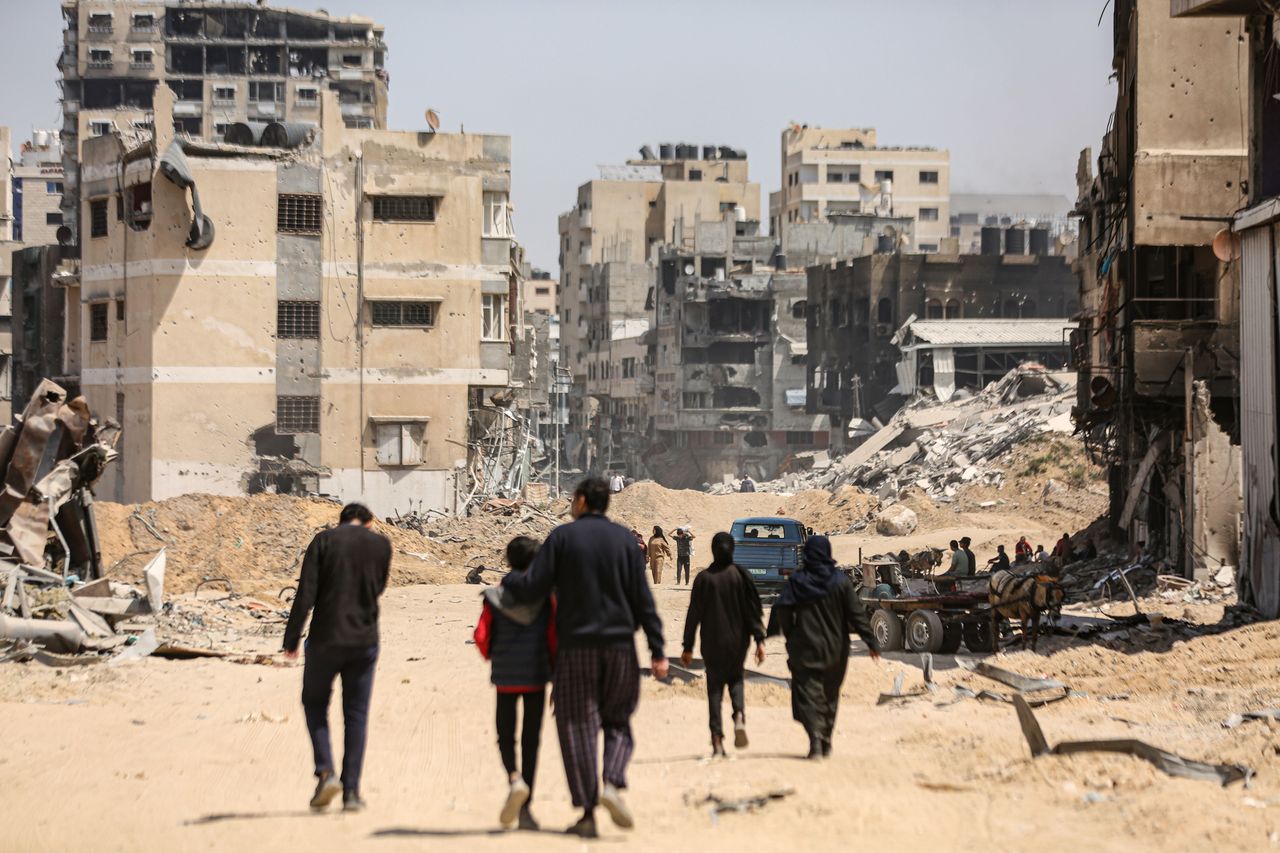
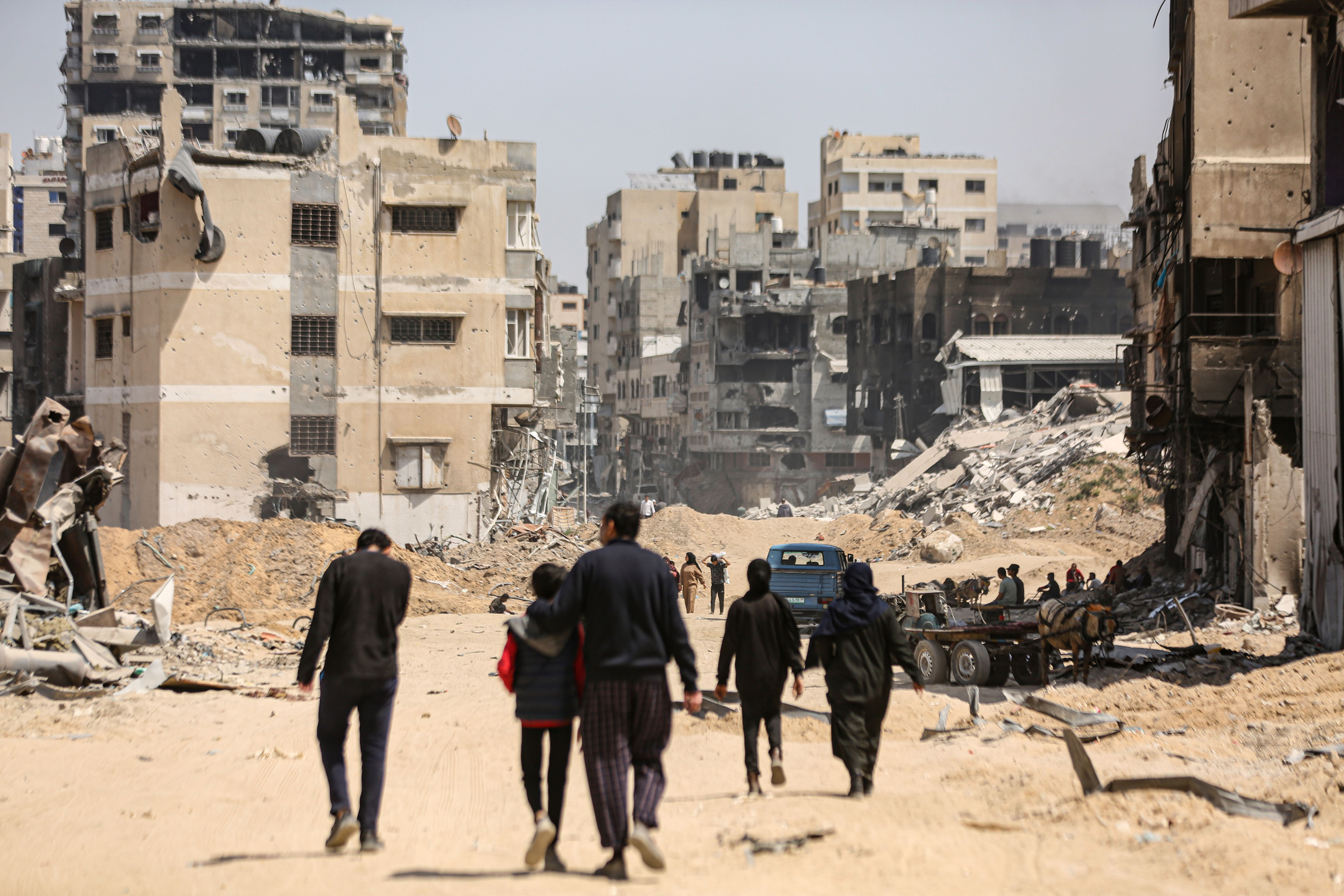
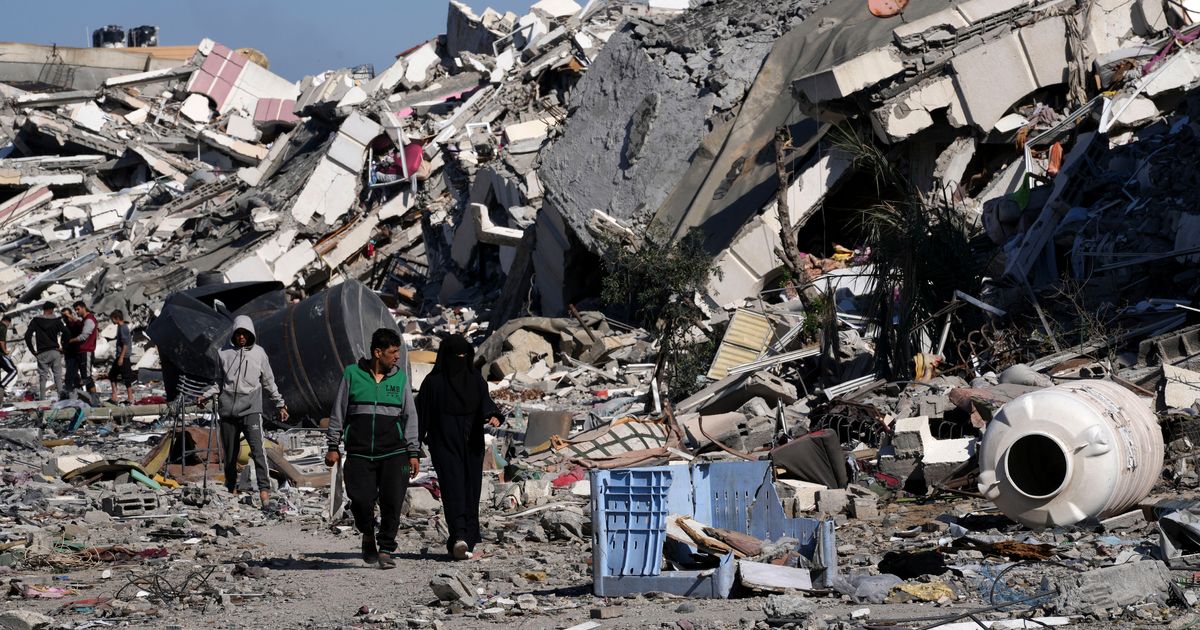
Palestinians walk among extensive destruction Tuesday after the Israeli army withdrew from the Al-Shifa Hospital and the surrounding areas west of Gaza City.
Dawoud Abo Alkas/Anadolu via Getty Images
HuffPost asked the two Hamas leaders about two recent polls of Palestinians that suggested their group is losing some sway.
Amid conversations in Washington and beyond about post-war planning, the question of who can actually speak for the community and build stability amid the envisioned reconstruction of Gaza and renewal of diplomatic negotiations is crucial. It’s even more consequential as various Palestinian groups ― from Abbas’ Fatah party, which runs the PA, to Hamas ― hold first-of-their-kind consultations among themselves.
On March 20, the respected Palestinian pollster Khalil Shikaki published his latest survey of Palestinians in both Gaza and the occupied West Bank, conducted March 5 to 10. He reported “a significant change” compared with his previous poll, in December, in terms of an 11% drop in support for Hamas. Separately, polling over a similar period by a West Bank-based think tank called the Institute for Social and Economic Progress said more than 78% of Gazans want to be governed by the PA or a Palestinian unity government, with only 3% preferring Hamas rule, and it noted Hamas leaders were “very unpopular” in the Gaza Strip.
Advertisement
Abu Marzouk and Naim were immediately familiar with the Shikaki statistics.
Abu Marzouk, who has been central to Hamas since its founding in the 1980s, argued his faction’s support has only increased over time and would understandably fall given Israel’s pummeling of Palestinians. “We know the amount of suffering which has hit the people in Gaza, but this is the occupation’s policy through history,” Abu Marzouk said.
Both he and Naim cast the question of how many Palestinians support Hamas as less significant than what they claimed the organisation represents: the fiercest force for Palestinian rights.
Saying “we are following this closely,” Naim told HuffPost: “I usually refuse to portray this conflict as if it is between Hamas and Israel. It is between Palestinians and Israel…. Today it is with Hamas, 20 years ago it was with Fatah, 30 years ago it was with the old [Popular Front for the Liberation of Palestine or PFLP].”
“There is a small decrease in the popularity of Hamas, but when you look to questions like, for example, supporting resistance in general…. When it comes to how much Palestinians are still supporting the operation of October 7, you will find a huge majority,” Naim said. “When you ask about a political affiliation, there are a lot of people who are supporting Hamas as a resistance movement, but they are not affiliated ideologically to Hamas; they are secular.”
Shikaki’s report said 71% of Palestinians currently support Hamas’ October 7 attack (a similar proportion as in his December poll) and 55% saw armed resistance as the way to break “the stalemate” with Israel, though he noted a drop in overall support for “armed struggle.”
Advertisement
In the Hamas leaders’ telling, their group is aiming not to rule but to work with other Palestinians for a new setup uniting the community.
Both Abu Marzouk and Naim pointed to a summit last month in Moscow that drew 14 Palestinian factions together to discuss establishing a nonpartisan, widely acceptable government ― an outcome Abu Marzouk claimed the U.S. and Abbas sought to stymie by trying “to end any Palestinian internal understanding” through the new PA appointment shortly after the summit.
“America does not want unity among the Palestinians…. Many times the U.S. has claimed that they don’t want the participation of terrorists in any body of the [Palestine Liberation Organisation, the internationally recognized official representative of the Palestinian people], and they are meaning the active factions in the Palestinian arena: Hamas, Palestinian Islamic Jihad and the PFLP,” Abu Marzouk said.
In extensive remarks, Naim promoted Hamas’ evident desire to no longer be perceived globally as overly extreme or too intolerant of other Palestinian forces.
“No one has to be afraid that if the Palestinians sit together, they will go far and extreme to choose, for example, a radical leadership or a radical political track ― I’m sure you will find a very balanced leadership,” he argued. Naim claimed his group is prioritizing Palestinian elections and a way “to launch, with the aid of the international community, a political track which can end with an independent Palestinian state on 1967 borders.”
Advertisement
He asserted these professed goals show Hamas is thinking “rationally,” despite its horror over Israeli actions in Gaza. “It reflects that generally the Palestinian leadership, starting with Hamas and ending with Fatah and in between, they know what’s feasible and what’s not feasible,” he said.
To give credence to its talk of a truly inclusive new Palestinian regime, Hamas will likely need to go beyond rhetoric to address suspicions about its willingness to share power and rule transparently. The group cracked down onprotesters,political opponents and alleged Israeli collaborators when it ruled Gaza, human rights groups say, and outside analysts haveurged it to be more open about its processes of selecting leaders and policies (though, unlike Abbas and the PA, it has had regular leadership changes). It also boycotted PA-organized municipal elections for Palestinians, saying it would only accept elections at all levels, including for Abbas’ post.
The Hamas figures maintained the refusal to achieve Israeli-Palestinian peace comes not from them but from Biden and Netanyahu.
“America is now claiming that they are supporting the two-state solution, but …they are doing their best to undermine the Palestinian side, especially in this open conflict with Hamas, by supporting the weak Palestinian side of the PA in front of the most powerful side, which is Israel supported by the U.S.,” Abu Marzouk said.
Rather than debate the sincerity of his group, he continued, “at least they should put Hamas under the test by allowing the Palestinians to create a state. The ones who are refusing a Palestinian state are the Israelis.”
Advertisement
There’s significant evidence for that final claim.
Netanyahu’s far-right government has long decried the prospect of Palestinian statehood, and earlier this year, more than 80% of Israel’s parliament voted to reject international recognition of a Palestinian state without a deal with Israel, a possibility the U.S. and European states are considering. On Thursday, the same day he held a tense call with Biden, Netanyahu told Republican members of the U.S. Congress that he perceives “an attempt to force, ram down our throats, a Palestinian state, which will be another terror haven.”
The Players On The Board
The Hamas figures’ reading of the politics of their adversaries seemed to temper their expectations of an Israeli-Palestinian settlement soon while making them wary of what might happen if that process is delayed much longer.
Pointing to the rightward shift in Israeli politics, Naim called the trend “so huge and so deep and radical that it is clearly converting this conflict from a political conflict about land and independence and United Nations resolutions into a religious conflict.”
“If we reach this point, this conflict will not be solvable,” he added, contrasting current players with “wiser leaders” of Israel’s past, whom he described as more pragmatic and concerned with at least, as he put it, “pretending” to comply with international norms.
Netanyahu’s coalition government is objectively the most conservative in Israel’s 76-year existence. Experts believe even administrations led by likely alternatives, such as retired Gen. Benny Gantz or Israeli opposition leader Yair Lapid ― both well-liked in Washington, where Gantz visited last month before calling for a fresh Israeli election and where Lapid will go next week ― are likely to be hawkish on Palestinian affairs.
Advertisement
When Lapid was in power in 2021, Naim noted, his administration approved what the European Union deemed an “exponentially high” number of Israeli settlements in occupied Palestinian territory.
Naim expressed interest in nuances of U.S. politics, asking HuffPost whether newly widespread pro-Palestinian sentiment seemed likely to last or to fade away. He viewed Biden’s reelection bid as partially shaping U.S. policy. “Maybe they are still trying in the year of the election to balance the internal pressure because of Muslims, Arabs and leftists, and on the other side, the Jewish lobbies,” Naim said.
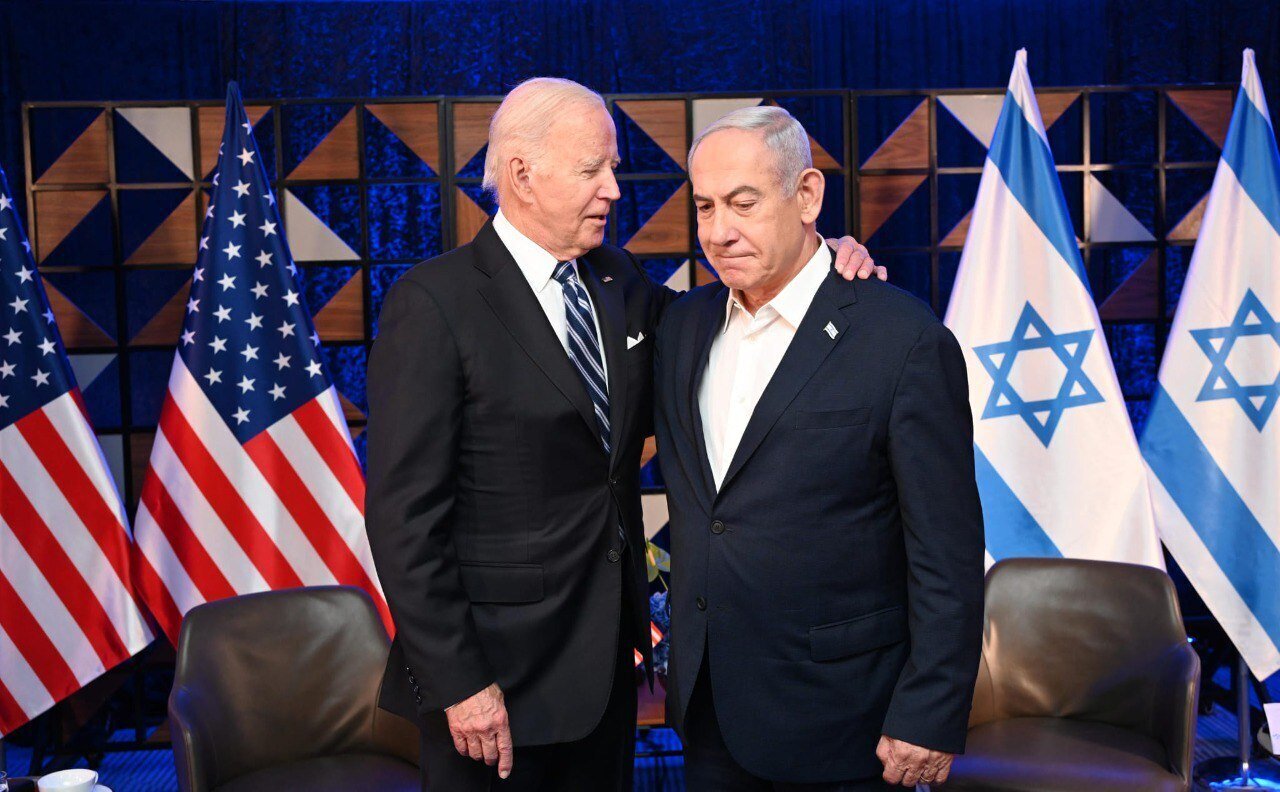
U.S. President Joe Biden, left, and Israeli Prime Minister Benjamin Netanyahu meet in Tel Aviv, Israel, on Oct. 18, 2023.
ISRAELI GOVERNMENT PRESS OFFICE (GPO) / HANDOUT via Getty Images
HuffPost additionally asked the Hamas figures about the role in the war and Israel-Palestine affairs played by the two behemoths in their neighborhood: Iran and Saudi Arabia.
Iran, a US antagonist, has been a Hamas ally for decades, seeking to build popularity in the Muslim-majority world through its links to the Palestinian cause. Saudi Arabia, a U.S. partner, was before October 7 rapidly moving toward establishing diplomatic relations with Israel after decades of shunning the state. But Palestinians said the process — still the chief Middle East focus of the Biden administration — ignored their concerns and risked marginalizing them for good by convincing Israel it could secure Arab allies without resolving its conflict with Palestinians.
Advertisement
Abu Marzouk was careful in discussing both players.
Though disrupting so-called Israel-Saudi “normalisation” is widely seen as one purpose for the war, and though Hamas has had strained ties with the Saudis, Abu Marzouk did not criticise the kingdom, which is trying to combat claims it was willing to sacrifice Palestinian interests. He noted that Saudi Arabia has re-emphasised its 2002 position that all Arab nations would make peace with Israel if it withdrew from Palestinian territories it captured in 1967, recognized a Palestinian state within them and offered a plan for Palestinian refugees displaced by its founding.
Then he offered a narrative that blames Israel for hurting both the Saudis and the Americans ― bolstering Hamas’ overall argument that it’s the Jewish state that is unreasonable and a liability, with an eye toward winning over a U.S. audience.
Washington and Riyadh seek to develop links between the entire Islamic world and Israel, and “to empower the American position in the region to confront China and Russia,” Abu Marzouk argued. “But it’s obvious that the Israeli doings are now eliminating all the American efforts in the region. The big question is to what extent Americans will keep supporting Israel even if it is undermining their strategies… they are destroying the image of the Americans with the whole region.”
In addressing the subject of Iran, the Hamas leader struck a similar note by suggesting Israel is endangering the U.S., telling HuffPost it is “very obvious … Israeli government practices are actually pushing a war between Iran and America.”
Western officials have expressed similar fears to HuffPost, with one U.S official recently saying American intelligence has for months given policymakers “warnings and alarm bells” about Israel pursuing a broader conflict, likely beginning in Lebanon, which, according to The Wall Street Journal, Netanyahu sought to launch a campaign in soon after October 7. An Israeli airstrike killed Iranian officials in Syria this week, and on Friday, CBS News reported that U.S. intelligence agencies believe an Iranian retaliation could come by early next week, potentially fueling a spiral of escalation that ultimately forces the U.S. to become militarily involved in defense of Israel.
Advertisement
Yet Abu Marzouk was circumspect about how Iran itself has stoked regional tensions, in part through its support for Hamas.
“Saying that the Palestinians are resisting the occupation because of Iranian support is false,” he said. “We were confronting the English occupation from 1919 to 1947…. Iranian support came late, after 1990. We are talking about 70 years of resisting occupation before Iranian support.”
Though Naim acknowledged that Hamas receives weapons from other countries, Abu Marzouk claimed the group “is using homemade weapons.”
“If the weapons or assistance came from Iran, the Palestinian resistance would not remain steadfast for six months” amid Israel’s near-total siege on Gaza, he said.
Well before October 7, however, Iran gave Hamas tens of millions of dollars for arms and for training and technical assistance, current and former intelligence officials told The Washington Post.
Advertisement
White House Deputy National Security Advisor Jon Finer has called Iran “broadly complicit” in the attack. Iran rejected that depiction, and Naim rebutted it to HuffPost, saying, “For us, October 7 is a pure Palestinian operation: planning, implementing and paying also the price of the repercussions of the response.”
‘Putting Them On Notice’
HuffPost discussed Hamas’ statements and its role in Israeli-Palestinian developments with two longtime analysts of the conflict.
Both described Abu Marzouk’s comment warning that Hamas would battle any possible multinational force for Gaza as especially noteworthy.
“Any nation that is even considering ― or being pressured by the US to consider ― participating is going to take that seriously… [The comments are] basically putting them on notice that they’re going into what’s still a contested area,” said Lara Friedman, the president of the Foundation for Middle East Peace think tank. “This is the kind of statement which underscores what a big ask that would be and the risk that the members would face.”
Khaled Elgindy, a senior fellow at the Middle East Institute think tank, called Abu Marzouk’s remark “a pretty bold statement intended to dissuade people moving in that line.”
Advertisement
Even if Hamas strategically decided not to attack soldiers sent by Arab states or other Muslim-majority countries, such as Turkey, the group could quietly facilitate attacks by other militants in Gaza, he noted.
Despite Israeli claims of fighting until Hamas is destroyed, “I don’t know anyone who considers the argument that Israel will eradicate Hamas as credible,” Friedman told HuffPost. “Even Israel’s own intelligence and national security forces have weighed in that that is unrealistic… [and] resistance is not merely card-carrying Hamas members.”
Asked whether to take Hamas seriously about its apparent openness to a two-state settlement, the analysts suggested the U.S., long the chief broker in Israeli-Palestinian negotiations, has never done so. America’s approach has been to pursue a peace settlement with parties it defines as “good Palestinians” while seeing little value in Palestinian unity or engaging all parts of the community, said Elgindy, a former adviser to the Palestinian leadership in Ramallah.
Given Hamas’ own interests and its limited capacity, a two-state solution ― requiring the organisation to tolerate Israel regardless of likely deep lingering disdain for it ― might be the only good outcome for the group.
“I don’t see any other way for Hamas to be politically relevant. They’re not going to be the ones who liberate Palestine ‘from the river to the sea,’” Elgindy said. “Like all political movements, they want to lead and govern, and their only hope of doing that is in the context of a state in the West Bank, Gaza and East Jerusalem.”
Advertisement
To Friedman, Hamas’ 2017 statement had represented an opportunity “if someone is looking for a partner and for an offramp that involves, genuinely, two states.”
“I’m not suggesting that Hamas is a good actor here. I’m suggesting we’ve never tested it,” added Friedman, a former State Department official.
But it’s hard to see how all parties involved would shift their positions in the way experts believe necessary for an effective renewed bid to secure an agreement on a mutually coexisting Israel and Palestine.
Israel would need to be convinced to reject the easy-to-sell view that Palestinian statehood after Oct. 7 represents what hard-liners there, like current Finance Minister Belazel Smotrich, describe as “a prize for the terrible massacre.”
Hamas would need to acknowledge how its actions make peace harder to secure ― and cultivate trust in its willingness to cease violence. Though the group is correct to see a rightward trend in Israeli politics, it must see it “helped contribute to that trend,” Elgindy said, and may have “all but guaranteed it.”
Advertisement
“Even though they didn’t invent the trend, the operation of October 7 definitely accelerated and strengthened that trend, so there needs to be a little bit more self-awareness,” he added.
Meanwhile, Abbas would have to allow Palestinian society to evolve a new political dialogue by softening his grip on power, a step he has resisted despite huge pushback. It’s apt to read Mustafa’s appointment as a gambit by Abbas, Elgindy said, a way to send the message: “I have full authority to appoint whomever I want, and it’s not up to Hamas.”
Though that may be true procedurally, “politically it’s a nonstarter,” the analyst said. “Eventually [Abbas] is going to need Hamas approval one way or another. If he’s expecting that Hamas will disappear and therefore he will have a free hand to do whatever he wants, that’s just silly.”
And finally, Washington would need to reconsider a range of policies ― some dating back decades and supported by politicians from both parties, others firmly tied to Biden.
The U.S. has worked for years to block the establishment of a Palestinian administration that includes all factions, Friedman said, using steps such as legislation barring American aid to the PA if it included individuals whom Washington saw as unsuitable to signal “we would put in place all sorts of obstacles to that happening.”
Advertisement
Elgindy honed in on the president’s six-month-old decision to adopt Israel’s war plans wholesale, which many Biden allies now see as a mistake.
“We’ve never had a U.S. administration openly and explicitly working toward the defeat of a particular Palestinian group,” he said. Elgindy noted that President Ronald Reagan did not share Israel’s 1980s goal of destroying the Palestine Liberation Organisation and that President George W. Bush pushed Israel to stop targeting PA leader Yasser Arafat.
“That’s a problem for the U.S. having any kind of role in a peace process or even as a stabilizing force in Gaza going forward,” he told HuffPost.
“I can’t think of any U.S. administration that has been this unconditional in its support for Israeli war aims and actions on the ground,” Elgindy said. “I’ve never seen anything like it.”
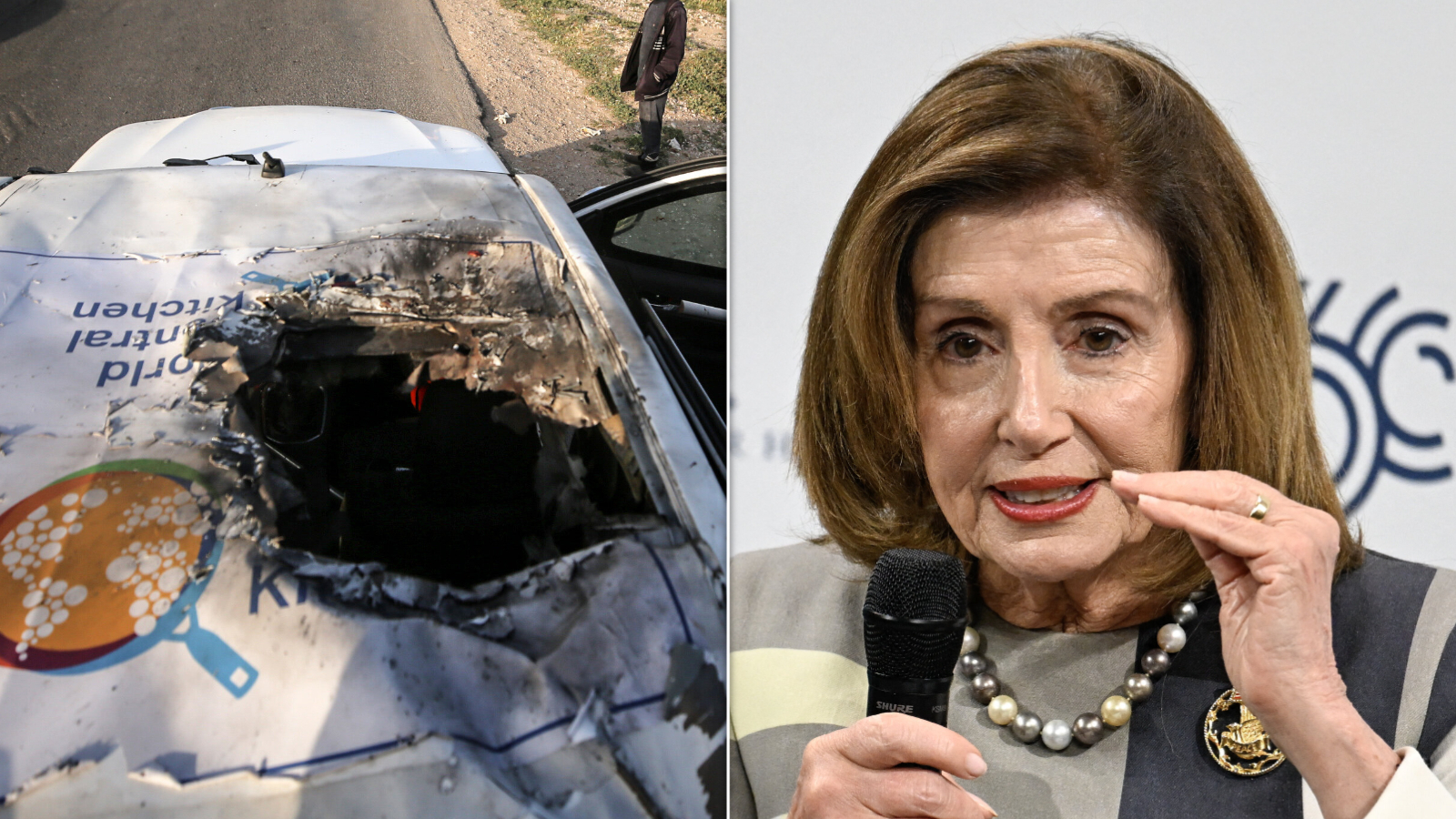
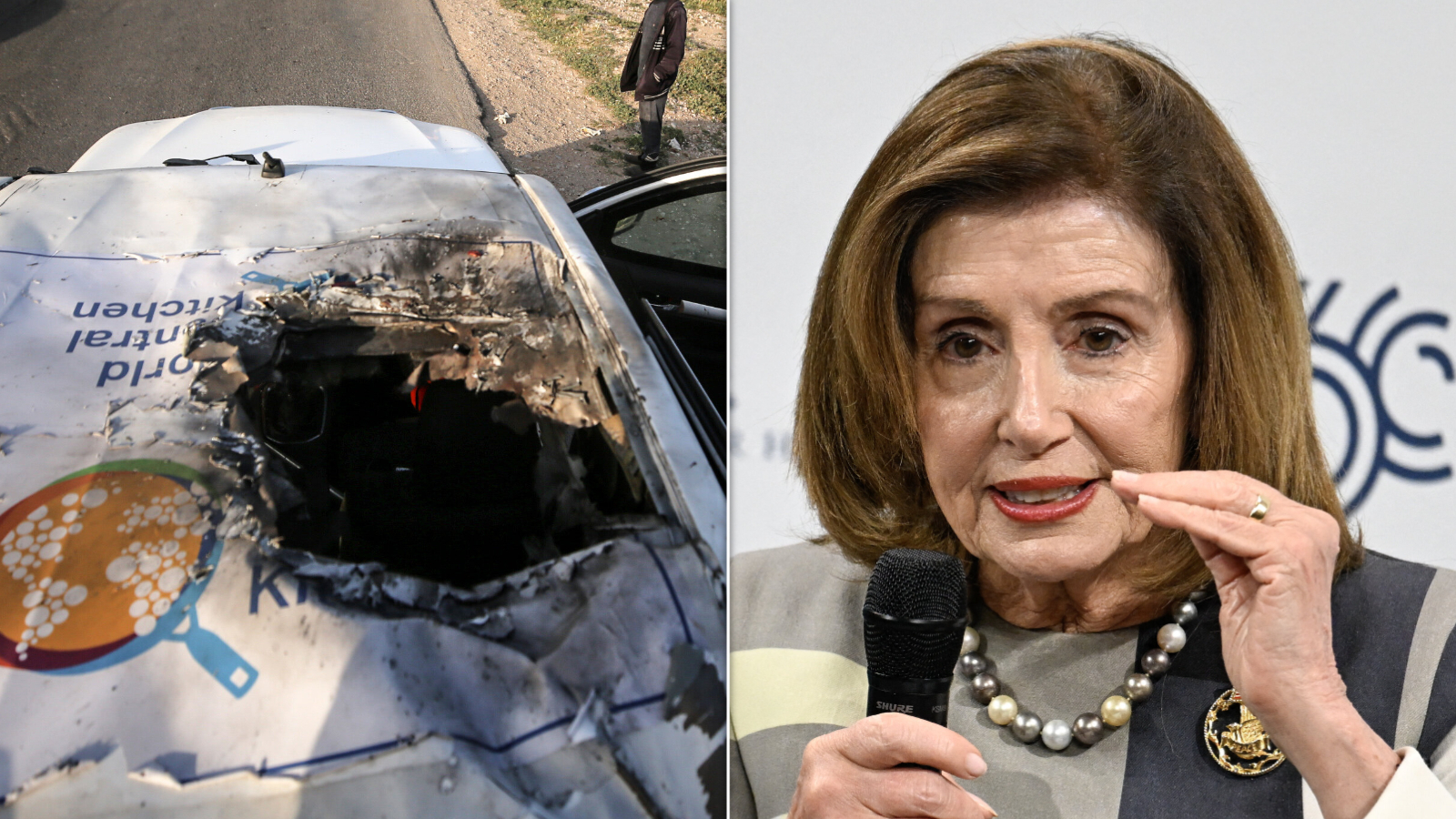
House Speaker Emerita Nancy Pelosi has split with President Joe Biden by joining progressives in their calls to halt both current and future US weapons transfers to Israel.
Forty members of Congress signed a letter to Biden, dated Friday, stating that the deadly attack on World Central Kitchen aid workers necessitates investigation into whether Israel is using US weaponry “in compliance with US and international law.”
Advertisement
Pelosi’s support, though, is particularly significant given her long working relationship with Biden.

Seven aid workers who had coordinated their movements with the Israeli military and traveled in clearly marked vehicles were struck Monday and killed, stirring further global outrage over Israel’s handling of the war.
One of the workers was an American citizen. All were working to feed Palestinians in the Gaza Strip as it faces famine.
On the day of the World Central Kitchen attack, the Biden administration reportedly approved an arms shipment that included hundreds of 2,000-pound bombs and other, smaller bombs. A sale of up to 50 F-15 fighter jets is also reportedly pending.
Advertisement
“We strongly urge you to reconsider your recent decision to authorize the transfer of a new arms package to Israel, and to withhold this and any future offensive arms transfers until a full investigation into the airstrike is completed,” read the letter to Biden and US Secretary of State Antony Blinken.
“If this strike is found to have violated US or international law, we urge you to continue withholding these transfers until those responsible are held accountable,” it continued. “We also urge you to withhold these transfers if Israel fails to sufficiently mitigate harm to innocent civilians in Gaza, including aid workers, and if it fails to facilitate – or arbitrarily denies or restricts – the transport and delivery of humanitarian aid into Gaza.”
Other signees included Representatives Jamaal Bowman, Cori Bush, Debbie Dingell, Barbara Lee, Alexandria Ocasio-Cortez, Ilhan Omar and Rashida Tlaib.
Biden has voiced strong support for Israel since Hamas-led militants killed more than 1,100 people in their Oct. 7 attack on the country — sparking large protest votes in some states’ Democratic primaries.
His tone, however, shifted this week during a discussion with Israeli Prime Minister Benjamin Netanyahu. Biden called for an “immediate cease-fire” and told Netanyahu that future US support will depend on what Israel does to protect civilians and aid workers in the Gaza Strip. The current situation was “unacceptable,” Biden said.
Advertisement
Hours after the discussion, Israel announced that it would be opening two humanitarian aid routes into Gaza.
UK prime minister Rishi Sunak has told Israeli leader Benjamin Netanyahu that he is “appalled” by the killing of aid workers in an Israeli strike in a sign of a growing split between the two allies.
The leaders spoke after it was confirmed three UK citizens were among seven workers for the World Central Kitchen food charity killed in Gaza.
Advertisement
Downing Street said Sunak “demanded a thorough and transparent independent investigation into what happened” and described the situation in Gaza as “increasingly intolerable”.
Britain is a staunch ally of Israeli, but Sunak has become increasingly critical of the conduct of the war. He is under pressure to suspend UK arms exports to Israel.
He told Netanyahu that “Israel’s rightful aim of defeating Hamas would not be achieved by allowing a humanitarian catastrophe in Gaza”.
The UN says at least 180 humanitarian workers have been killed in the war so far.
James Henderson, 33, and John Chapman, 57, were named as two of the Brits who had died in the bombing. On Tuesday night, a third was named as James Kirby by the BBC.
Advertisement
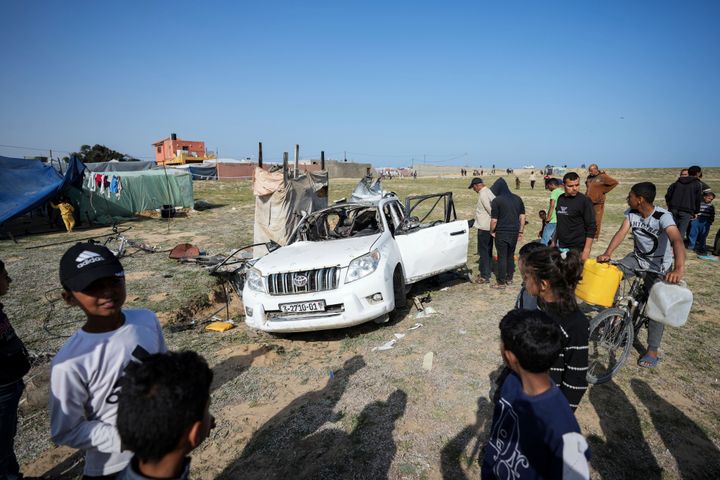
People inspect the site where World Central Kitchen workers were killed in Deir al-Balah, Gaza Strip.
via Associated Press
A Downing Street spokesperson said: “The prime minister spoke to Israel’s prime minister Benjamin Netanyahu this evening.
“He said he was appalled by the killing of aid workers, including three British nationals, in an airstrike in Gaza yesterday and demanded a thorough and transparent independent investigation into what happened.
“The prime minister said far too many aid workers and ordinary civilians have lost their lives in Gaza and the situation is increasingly intolerable.”
Netanyahu has acknowledged that the country’s forces had carried out the “unintended strike” on “innocent people in the Gaza Strip”. He says officials are “checking this thoroughly” and “will do everything for this not to happen again”.
Advertisement
Footage showed the bodies, several wearing protective gear with the charity’s logo, at a hospital in the central Gaza town of Deir al-Balah. Those killed also included an Australian, a Polish national, an American-Canadian dual citizen and a Palestinian, according to hospital records.
A harrowing food insecurity report has concluded that famine is “imminent” in northern Gaza, as millions of starving Palestinians face “catastrophic” food conditions in the territory amid Israel’s continued blockade of humanitarian aid.
According to the report, North Gaza and area governorates are projected to meet the definition of famine ― the IPC’s fifth and most severe phase of acute food insecurity ― anytime between now and May. In North Gaza, food security and malnutrition have become crises at the most dire level of the IPC’s scale.
Gaza’s southern governorates of Deir al-Balah, Khan Younis and Rafah are presently classified as IPC Phase 4 (Emergency) situations in the report. These governorates, however, face a risk of famine through July in a worst-case scenario, according to the data.
Per the ICP, Gaza’s entire population of 2.23 million people are enduring high levels of acute food insecurity. About half of those people are expected to suffer “catastrophic conditions” if Israeli forces launch their planned ground offensive into the packed southern city of Rafah.
Advertisement
“The upward trend in non-trauma mortality is also expected to accelerate, resulting in all famine thresholds likely to be passed imminently,” the group’s report said.
In December, the IPC warned that there needed to be an immediate reduction of hostilities and an increase in humanitarian access in order to prevent a “realistic chance” of starvation in Gaza. The agency’s analysis at the time said that Gaza’s crisis is “the highest share of people facing high levels of acute food insecurity that the IPC initiative has ever classified”.
“If no steps are taken to cease hostilities and to provide more humanitarian access, famine is imminent,” Beth Bechdol, deputy director-general of the United Nations’ Food and Agriculture Organization, said Monday. “It could already be occurring. Immediate access is needed to facilitate delivery of urgent and critical assistance at scale.”
Gaza’s current crisis stems from Israel’s ongoing military campaign launched after Hamas militants attacked that country on October 7, killing about 1,200 people and taking roughly another 250 hostage. More than five months later, the Gaza Health Ministry ― which has a record of providing casualty figures that closely reflect the UN’s own ― reports that Israeli forces have killed more than 31,000 Palestinians, wounded nearly 73,400, displaced almost the entire population and blocked civilians from accessing most aid deliveries of food, water, fuel and medicine.
The dire situation in Gaza is “simply unbearable” and “unjustifiable”, according to Hiba Tibi, country director for aid group CARE International in Gaza and the West Bank. “Our earlier fears that more would die in Gaza from hunger, dehydration and disease than from bombs, were well-founded, sadly. Starvation is cruel. It is a slow and painful death.”
Advertisement
“Our partners who run health centres in Northern Gaza have reported that the number of children categorized as having moderate or severe malnutrition nearly doubled in February, compared to January. Their staff report watching children get thinner and thinner as the days go by and of kids who can barely speak and walk due to starvation,” she continued. “We also hear of kids being born and dying in shelters without even being registered in the hospitals. It’s like they don’t exist.”
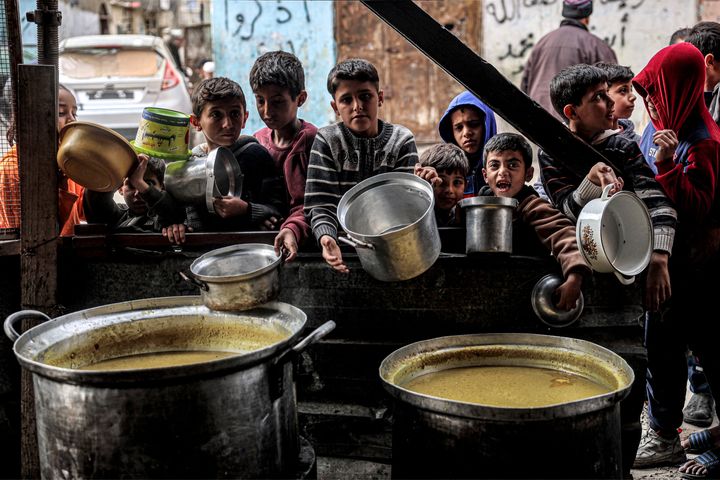
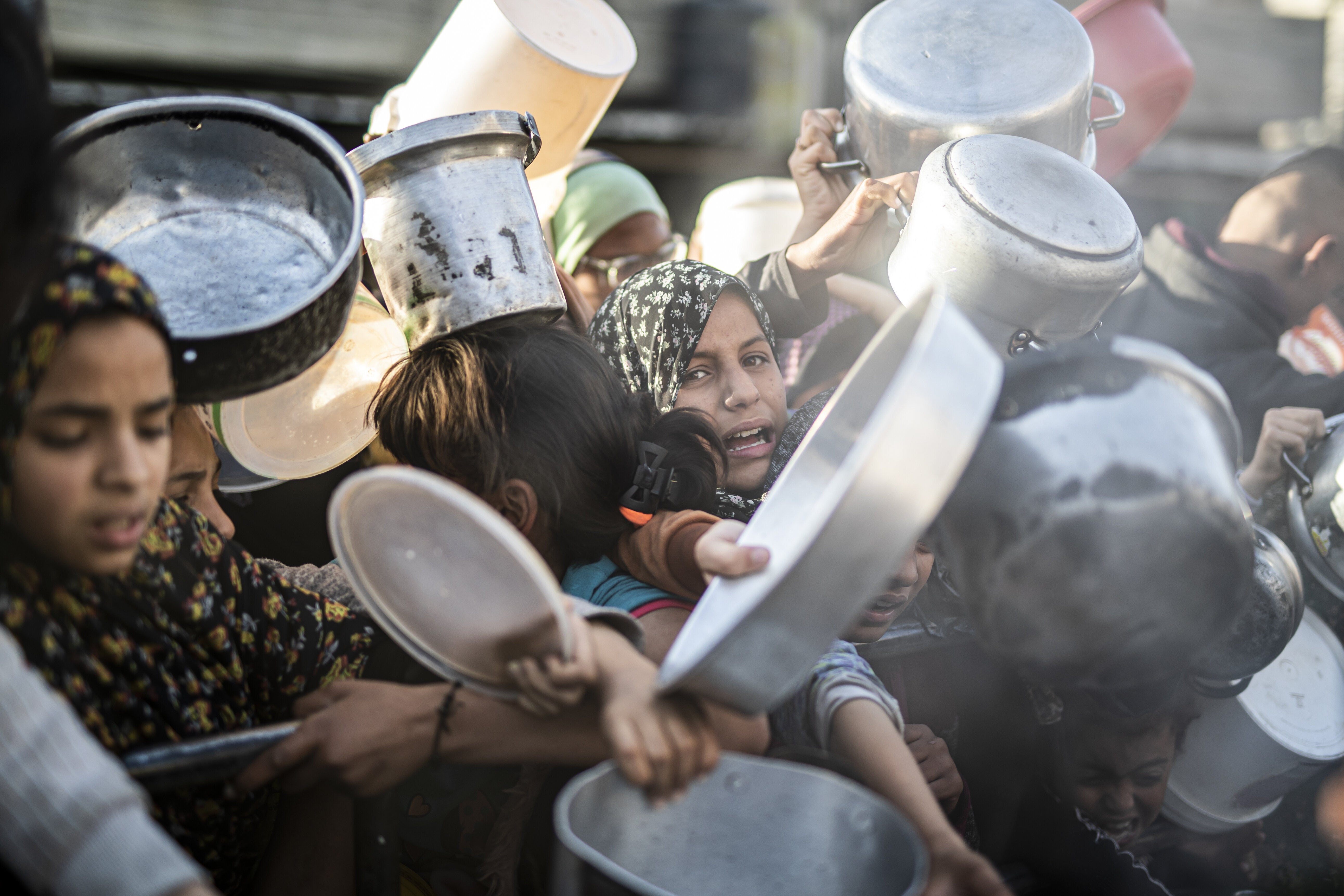
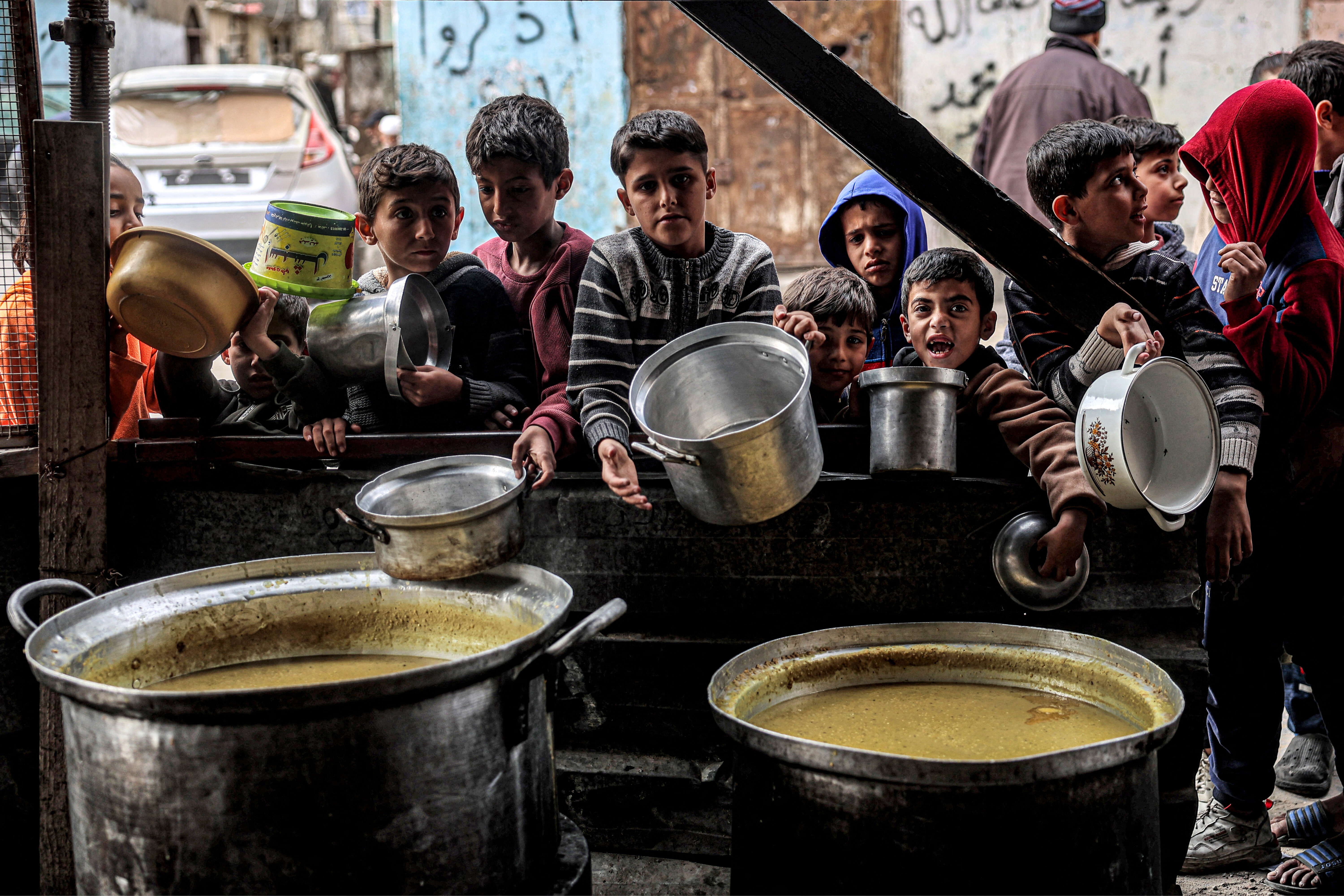
Boys wait while holding empty pots with other displaced Palestinians queueing for meals provided by a charity organization ahead of the fast-breaking “iftar” meal during the Muslim holy month of Ramadan, in Rafah in the southern Gaza Strip on March 16.
Said Khatib/AFP via Getty Images
The UN Children’s Fund recently warned that life-threatening malnutrition was “spreading fast”, supported by the IPC’s report detailing how adults in Gaza have reduced their meals so their children can eat. The FAO said that at least 10 times in the last month, almost two-thirds of northern Gaza households went “entire days and nights” without eating.
Northern Gaza was the first target of Israel’s invasion, and has become the centre of the territory’s humanitarian crisis, with much of the region completely destroyed. A third of children under two years of age in the north are acutely malnourished, according to the FAO, and the Gaza Health Ministry said last week that 27 Palestinians, mostly children, had died of malnutrition in the north.
Monday’s report confirms what aid groups have been trying to convey to the world about the starvation crisis facing Palestinians in the territory. The international community has continued to call for a permanent cease-fire, the release of all remaining hostages, accountability for civilian casualties and the safe passage and distribution of more aid to Palestinians.
Advertisement
“From the destruction of farms, flour mills and food processing sites, to ongoing fighting preventing the safe movement of humanitarian actors, to the blocking of aid, the people of Gaza are being starved to death. What’s worse, they have all too often been killed in attacks when seeking out food to keep their children alive,” Tjada D’Oyen McKenna, CEO of the aid group Mercy Corps, said in a statement, stressing that the denial of humanitarian access violates international law.
“We cannot wait for an official famine declaration in Gaza to act when it is abundantly clear that people are and will continue dying from hunger and malnutrition,” she continued. “Today’s report must be a wake-up call for all parties with leverage over Israel to dramatically change course. Gazans cannot wait any longer.”
Experts have a grim prediction for what might happen in Gaza unless a ceasefire is called – and soon.
MPs have been ripping into each other over parliamentary procedure surrounding different parties’ motions around calling for a ceasefire or a pause in the fighting.
Advertisement
The row has now escalated into a major challenge to speaker Sir Lindsay Hoyle’s job, spinning away from the original matter at hand – the crisis in Gaza.
So it’s worth looking at an independent report which came out this week, from the John Hopkins’ Centre for Humanitarian Health and the London School of Hygiene & Tropical Medicine, which was funded by the government.
Even if there’s a ceasefire, the academics predict around 6,550 people will die between February 7 and August 6.
That’s because malnutrition, infectious diseases like cholera and a lack of care for those who have chronic conditions will continue to drive the numbers of deaths in the Palestinian territory.
Advertisement
If there’s no ceasefire, and the “status quo” stays the same as it is now, the academics believe 58,260 people will die over the next six months.
And if there’s an escalation of violence, up to 74,290 people will die in the same time frame, according to their predictions.
Traumatic injuries will make up the majority of excess deaths in the territory in these two latter scenarios, according to the independent researchers.
The academics’ projected scenario looks even worse if a health epidemic of some kind breaks out.
With a ceasefire and an epidemic, the academics believe there will be a further 11,580 deaths; without a ceasefire, this goes up to 66,720; and if there’s an escalation of violence, it skyrockets to 85,750 extra deaths.
The academics who worked on the report said it did not include Israel because its health system is still functioning.
Advertisement
Experts have been warning about the deteriorating health conditions in Gaza for months now.
A sixth of children under the age of two in the north of Gaza are also acutely malnourished.
According to the Hamas-run health authorities in Gaza, more than 29,000 people have been killed since the war began. The officials do not differentiate between civilians and militants.
Speaking on LBC’s Tonight with Andrew Marr, the Palestinian ambassador to the UK, Dr Hasam Zumlot, said that the scenes in the Commons last night were “disgraceful”, especially considering the state of Gaza right now.
‘It’s disgraceful…today we’ve seen British politics at its worst.’
Palestinian ambassador Dr Husam Zomlot tells @AndrewMarr9 ‘politicians are trying to save themselves rather than saving an entire nation from genocide’, as he condemns today’s arguments in the House of Commons. pic.twitter.com/FB94L3xLJX
He said on Wednesday night: “This is unthinkable, what is happening in Westminster today is simply unthinkable.”
Advertisement
He also predicted that if Israel does invade Rafah in southern Gaza – one of the last places of refuge in the Palestinian territory – “what will follow is World War III”.
He added: “It is as blunt and as simple as that because you have millions of people who will be scattered and dispersed. You will have a regional situation that is already at the brink.”
His comments came after a member of Israel’s war cabinet suggested this offensive would occur on March 10, the start of Ramadan, unless Hamas handed the remaining hostages back.
Zumlot warned: “If we don’t act in the next few days, this is going to be a regional war and a global war.”
MPs have backed calls for an immediate ceasefire in Gaza on a day of chaos in the House of Commons.
A furious row erupted in the chamber over a controversial ruling made by Speaker Lindsay Hoyle before the debate began.
In a highly unusual move, he chose a Labour amendment to an SNP opposition day motion, sparking anger from both Scottish nationalist and Tory MPs.
Advertisement
He told MPs: “It’s important on this occasion that the House is able to consider the widest possible range of options.”
SNP MPs shouted “shame” at Hoyle as he delivered his ruling, which killed off any chance of Keir Starmer suffering a rebellion similar to the one in November which saw 56 Labour MPs defy him over the war.
Owen Thompson, the SNP chief whip, accused Hoyle – who was elected as a Labour MP in 1997 – of “doing things in a way that has never been done before”.
Following four hours of debate, Commons leader Penny Mordaunt then stunned MPs by withdrawing the government’s own amendment calling for a “humanitarian pause” in the conflict.
Advertisement
She said that was in protest at Hoyle’s decision to effectively re-write parliamentary procedure to allow Labour’s amendment to be taken.
Amid chaotic scenes, SNP Westminster leader Stephen Flynn demanded that Hoyle be brought to the chamber and for the Commons proceedings to be suspended.
When that was denied by deputy speaker Rosie Winterton, all of the SNP MPs, and many Tories, walked out.
Meanwhile, Labour was forced to deny claims that senior party figures had warned Hoyle that he would be removed as Speaker after the general election unless he chose their amendment.
Advertisement
A Labour spokesperson told HuffPost UK: “It’s complete rubbish. Untrue.”
HuffPost UK has also been told that dozens of MPs have contacted the Speaker to raise fears about their personal safety as a result of how they vote on the issue.
But Hoyle’s decision was publicly criticised by his top adviser, clerk of the Commons Tom Goldsmith.
In a letter published in the House of Commons library, he said it was “a departure from the long-established convention”.
He said there had only been two occasions in the past 25 years when opposition amendments to opposition motions had been accepted, and on both occasions – unlike today – there had been no government amendment as well.
Goldsmith added: “I know that you understand why I feel compelled to point out that long-established conventions are not being followed in this case.
“I am grateful to you for making every effort to discuss this with me extensively and for taking full account of my views when reaching your decision, which I know was not an easy one, and which of course is one for you to make.”
Foreign secretary Lord David Cameron has expressed concern over the next phase of the Israeli military operation in Gaza, as troops may move to the southern part of the Palestinian territory.
Israeli soldiers are expected to advance into the southern city of Rafah, which borders Egypt.
One of the last remaining areas in Gaza not yet infiltrated by Israeli troops in the four months since the war began, approximately half of Gaza’s 2.3 million population is thought to be sheltering in Rafah.
Advertisement
In a post on X (formerly Twitter) on Saturday evening, Cameron wrote: “Deeply concerned about the prospect of a military offensive in Rafah – over half of Gaza’s population are sheltering in the area.
“The priority must be an immediate pause in the fighting to get aid in and hostages out, then progress towards a sustainable, permanent ceasefire.”
Israeli PM Benjamin Netanyahu rejected Hamas’ proposals for a ceasefire last week, and said in a recent interview that “victory is within reach”.
Advertisement
He added: “Those who say that under no circumstances should we enter Rafah are basically saying, ‘Lose the war. Keep Hamas there.’”
Israel claims Rafah is the last remaining stronghold for the Palestinian militants Hamas.
Netanyahu has called for the evacuation of people in Rafah but it is not clear where any civilians could move to, as Israeli evacuation orders cover two-thirds of Gaza.
There are fears about the general conditions in Gaza are growing, too.
The UN secretary-general Antonio Guterres called for a humanitarian ceasefire before a “gigantic tragedy” develops in Rafah last week.
Joe Biden, president of Israel’s greatest ally the US, also released his strongest rebuke of the country yet on Thursday, saying the country’s recent actions were “over the top”.
Israel declared war on Hamas after the group killed an estimated 1,200 people on Israeli soil on October 7.
Pat McFadden has confirmed a Labour councillor will still be running as the party’s candidate in the upcoming Rochdale by-election, after apologising for “completely wrong” remarks about Israel.
The shadow chancellor of the Duchy of Lancaster appeared on Sky’s Sunday Morning with Trevor Phillips and discussed The Mail on Sunday’s story about Azhar Ali.
Advertisement
According to recordings obtained by the newspaper, the councillor allegedly said Israel deliberately allowed 1,400 people to be killed on its own soil on October 7.
Ali reportedly said Israel did so in order to give the “green light” to invade the Palestinian territory of Gaza, when at a meeting of the Lancashire Labour Party.
When pressed about the incident, McFadden told Phillips: “His comments were completely wrong, he should never have said something like that, it is of course, completely wrong to say that.”
He added: “He’s issued a complete apology and retraction and I hope he learns a good lesson from it, he should never have said something like that.”
He called for the Hamas hostages to be released, recognised rising anti-Semitism in the UK and across the world, and promised to apologise to Jewish leaders “for my inexcusable comments”.
Phillips said: ’An apology is not the same thing as a denial. It seems everyone is agreeing he said it, presumably he thought it.
“Is Labour happy with a candidate who thinks that?”
“No, that’s why he has issued a complete retraction and apology,” McFadden said, “It’s right that he has completely apologised now.”
Asked if he would still be the Labour candidate, McFadden said: “In the upcoming by-election? Yes he will.”
Advertisement
Ali will be defending a Labour seat which has a majority of more than 9,000 after the death of former MP Tony Lloyd.