Scientists reveal how Venus fly trap plants snap shut

Scientists at Scripps Research have revealed the three-dimensional structure of Flycatcher1, an aptly named protein channel that may enable Venus fly trap plants to snap shut in response to prey. The structure of Flycatcher1, published February 14 in Nature Communications, helps shed light on longstanding questions about the remarkably sensitive touch response of Venus fly traps. The structure also gives the researchers a better understanding of how similar proteins in organisms including plants and bacteria, as well as proteins in the human body with similar functions (called mechanosensitive ion channels), might operate.

“Despite how different Venus fly traps are from humans, studying the structure and function of these mechanosensitive channels gives us a broader framework for understanding the ways that cells and organisms respond to touch and pressure,” says co-senior author and Scripps Research professor Andrew Ward, PhD.

“Every new mechanosensitive channel that we study helps us make progress in understanding how these proteins can sense force and translate that to action and ultimately reveal more about human biology and health,” adds co-senior author Ardem Patapoutian, PhD, a Scripps Research professor who won the Nobel Prize in Physiology or Medicine for research on the mechanosensitive channels that allow the body to sense touch and temperature.

Mechanosensitive ion channels are like tunnels that span the membranes of cells. When jostled by movement, the channels open, letting charged molecules rush across. In response, cells then alter their behavior — a neuron might signal its neighbor, for instance. The ability for cells to sense pressure and movement is important for people’s senses of touch and hearing, but also for many internal body processes — from the ability of the bladder to sense that it’s full to the ability of lungs to sense how much air is being breathed.

Previously, scientists had homed in on three ion channels in Venus fly traps thought to be related to the ability of the carnivorous plant to snap its leaves shut when its sensitive trigger hairs get touched. One, Flycatcher1, caught researchers’ attention because its genetic sequence looked similar to a family of mechanosensitive channels, MscS, found in bacteria.

“The fact that variants of this channel are found throughout evolution tells us that it must have some fundamental, important functions that have been maintained in different types of organisms,” says co-first author Sebastian Jojoa-Cruz, a graduate student at Scripps Research.

In the new study, the researchers used cryo-electron microscopy — a cutting-edge technique that reveals the locations of atoms within a frozen protein sample — to analyze the precise arrangement of molecules that form the Flycatcher1 protein channel in Venus fly trap plants. They found that Flycatcher1 is, in many ways, similar to bacterial MscS proteins — seven groups of identical helices surrounding a central channel. But, unlike other MscS channels, Flycatcher1 has an unusual linker region extending outward from each group of helices. Like a switch, each linker can be flipped up or down. When the team determined the structure of Flycatcher1, they found six linkers in the down position, and just one flipped up.

“The architecture of Flycatcher1’s channel core was similar to other channels that have been studied for years, but these linker regions were surprising,” says Kei Saotome, PhD, a former postdoctoral research associate at Scripps Research and co-first author of the new paper.

To help elucidate the function of these switches, the researchers altered the linker to disrupt the up position. Flycatcher1, they found, no longer functioned as usual in response to pressure; the channel remained open for a longer duration when it would normally close upon removal of pressure.

“The profound effect of this mutation tells us that the conformations of these seven linkers is likely relevant for how the channel works,” says co-senior author Swetha Murthy, PhD, of Vollum Institute at Oregon Health and Science University, a former postdoctoral research associate at Scripps Research.

Now that they solved the molecular structure, the research team is planning future studies on the function of Flycatcher1 to understand how different conformations affect its function. More work is also needed to determine whether Flycatcher1 is solely responsible for the snapping shut of Venus fly trap leaves, or whether other suspected channels play complementary roles.

In addition to Jojoa-Cruz, Saotome, Murthy, Patapoutian and Ward, authors of the study, “Structural insights into the Venus flytrap mechanosensitive ion channel Flycatcher1,” are Che Chun Alex Tsui and Wen-Hsin Lee of Scripps Research, and Mark Sansom of University of Oxford.

This work and the researchers involved were supported by funding from the National Institutes of Health (R01 HL143297, R01 HL143297), a Ray Thomas Edwards Foundation grant, the Wellcome Trust (grant 208361/Z/17/Z), the Biotechnology and Biological Sciences Research Council (grants BB/N000145/1 and BB/R00126X/1), the Engineering and Physical Sciences Research Council (grant EP/R004722/1), a postdoctoral fellowship from the Jane Coffin Childs Memorial Fund for Medical Research, the Skaggs-Oxford Scholarship, the Croucher Foundation, and the Howard Hughes Medical Institute.

Share Button

The Cost Of Living Is Crisis Is Biting Single People Hard, Too

As the cost of living crisis hits the UK hard, there’s been a lot of focus on hard-up families struggling to pay bills, feed children and make ends meet.

But let’s not forget that the crisis is biting single people, too.

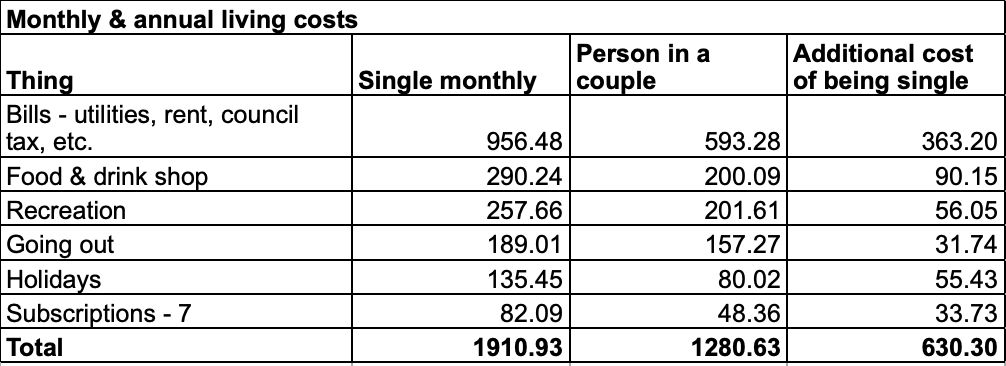
Single people on average are paying £7,564.50 a year more than their coupled-up counterparts on basic household outgoings, according to new analysis – a worrying situation considering living costs are only set to rise in 2022.

Ocean Finance has compared the typical monthly costs for single and coupled-up Brits including utility bills, rent and the monthly food shop, using data from the Office for National Statistics (ONS).

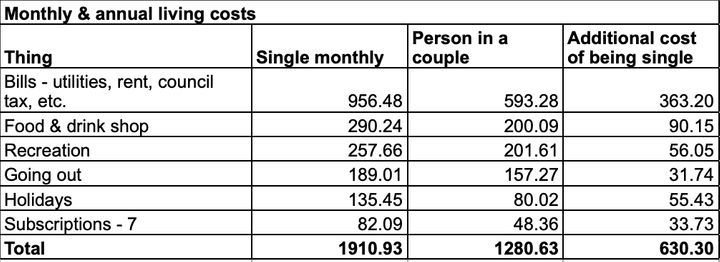
The analysis showed that household monthly bills are £363 more expensive for singles, with rent the biggest contributor.

A single person is paying, on average, £674 a month on rent in the UK and a couple only slightly more at £866 (or £433 per person). There is also a council tax gap – even factoring in the 25% single-person household discount, individuals with partners are paying considerably less than single friends.

This all adds up – with single Brits are paying an average of £630.30 more per month on outgoings than someone in a couple. The ONS estimates there are 7.9 million single-person households in the UK, meaning many are affected.

“The fact is, it is expensive to be single,” Nicola Slawson, founder of The Single Supplement newsletter, tells HuffPost UK.

“It is a totally overlooked problem that many people in relationships simply do not appreciate – and those in power certainly doesn’t seem to care.

Financial difference between singles and couples in the UK

Ocean Finance

Financial difference between singles and couples in the UK

Not being able to share your financial burden with somebody impacts all areas, says Slawson – from household bills, rent, council tax and insurance to the cost of furniture, white goods, and even the weekly food shop. “Most items come in sizes suitable for couples or families. For example, a ready meal designed for two works out cheaper than those made for one person,” she points out.

In turn, these expenses impact a single person’s ability to save for a mortgage and get on the property ladder, something she hears from her readers.

“There are increasing numbers of single people stuck in house shares even though they would love a place of their own but they simply can’t afford it.”

With the cost of living going up this year, the pressure on single people is only likely to worsen, Slawson worries. Take the issue of rising utility bills.

“If they live alone they have no-one to share the bills with and if they live in house shares, they don’t have total control over when things like the heating gets put on,” she says. “I know members of my community are feeling really anxious and are trying to work out where they can cut back but it’s hard.”

There is no shortage of advice being dished out on how to cut costs – partner with a friend, switch to a different tariff, even buy in bulk – but though usually well-intentioned, these tips don’t always help people, says Slawson.

“All the advice will say cancel Netlfix and go out less – but single people who live alone particularly need those things as they don’t have anyone to talk to at home.” But That respite comes at a price – Ocean Finance found single people pay £33 extra per month for multiple subscriptions to stream film and music.

Worse is the suggestion that single people should just go out and get a partner to ease the burden. “It’s not as easy as simply getting into a relationship,” says Slawson. “Many single people are actively looking for a relationship but struggling with dating apps and the sometimes toxic culture around dating.”

And she voices a final worry. “I think it’s also likely that it puts those in unhappy or abusive relationships off leaving because they are worried they simply won’t be able to afford to live alone.”

Share Button

Labour MP Pinpoints Exactly What’s Wrong With No.10’s Levelling Up Agenda In Scathing Video

Zarah Sultana took aim at No.10′s heavily-criticised “levelling up agenda” in a scathing new video circulating on Twitter.

Alluding to the cost of living crisis facing Britons at the moment – as inflation has just hit a 30-year high – the Labour MP claimed the government was doing little to alleviate the problem.

With soaring gas and electricity bills, rising interest rates and an upcoming national insurance hike, the treasury promised it would act to help lower-income households.

Chancellor Rishi Sunak then unrolled a support package earlier this month which supposedly enabled 28 million households to get their council tax bills slashed by £150 along with £200 reduction in energy bills.

However, according to Sultana during a clip shared on news outlet Double Down News, Sunak is “taking the piss” by offering only £200 loans even though energy bills are increasing by £700 due to the global squeeze on wholesale gas prices.

Sunak also ignored Labour’s bid to cut the VAT on fuel bills – even though it was marketed as one of the main benefits of leaving the EU.

Moving onto the startling rise in food prices – as outlined by anti-poverty campaigner Jack Monroe – Sultana continued: “This government likes to talk about levelling up when in truth, we currently have over five million children in poverty.

“Last month, over a million adults went a day without eating because they couldn’t afford to put food on the table.

“Don’t believe their lies on levelling up – they’re busy punching down.

“If we think things are bad, they are going to get a whole lot worse.”

Inflation is rising but salaries are not increasing at the same rate, while the head of the bank of England, Andrew Bailey, has even encouraged people not to ask for a pay rise during this cost of living crisis.

Sultana claimed, “things can be done differently, they just take political will,” adding: “The cost of living crisis isn’t inevitable, it isn’t a natural crisis.”

She also proposed taxing wealth over £100 million instead of increasing the national insurance contributions.

Share Button

Bionic eyes: Obsolete tech leaves patients in the dark

The retinal-implant manufacturer has shifted its focus, leaving users with little or no support.

Share Button

Child Covid vaccinations: Your questions answered

Our health correspondents answer some of your questions.

Share Button

‘I lost my dad to prostate cancer, don’t lose yours’

Danielle Ray’s father died aged 63 and more than 14,000 UK men are thought to be undiagnosed.

Share Button

Exercise: Do you need it if you’re slim?

Mayo Clinic does not endorse companies or products. Advertising revenue supports our not-for-profit mission.

Advertising & Sponsorship

Mayo Clinic Press

Check out these best-sellers and special offers on books and newsletters from Mayo Clinic Press.

Share Button

England to offer Covid jab to five to 11-year-olds

But the rollout will be “non-urgent”, with a focus on parental choice, the government says.

Share Button

Unexpected findings detailed in new portrait of HIV

Using powerful tools and techniques developed in the field of structural biology, researchers at the University of Washington and The Scripps Research Institute have discovered new details about the human immunodeficiency virus, HIV. The findings bring into focus the basic architecture of the virus just above and below its surface and may help in the design and development of a vaccine that can protect against AIDS.

These detailed findings include 3D views of the structure and position of the virus’ envelope “spike” proteins (the Env protein, used when the virus binds with cells) in the context of the full virus. Normally, researchers view the protein particles separated from the virus or expressed as engineered or purified proteins. In another key development, the scientists shed new light on the glycan shields — the sugars on the proteins that can hide it from the body’s immune system.

“We’re looking at the whole virus particle and how this protein on the surface relates to the rest of the virus,” said lead author Kelly Lee, associate professor of medicinal chemistry in the UW School of Pharmacy. “And by looking at the intact virus structure, we can see how the different facets of this ‘face of the virus’ are being displayed and how they would be recognized by or hidden from the immune system.”

This intact view of the virus also allowed the scientists to gain new insights into positioning of the envelope spike protein on the surface relative to the internal protein structure, called the Gag lattice.

“This finding overturns previous models of how the parts of the viruses are assembled and helps to focus our attention on where the docking interaction of these two proteins is likely to be,” Lee said. “This interaction needs to be resolved in more detail, but at least the current work gives us the correct architectural model for the virus assembly.”

It was this particular finding that led to the title of the paper — “Cryo-ET of Env on intact HIV virions reveals structural variations and positioning on the Gag lattice” — published Feb. 4 in the journal Cell. Another finding that had not been previously observed, the scientists pointed out, is that the “stalk” supporting the envelope proteins is flexible and can tilt, presenting both opportunity and challenges to the immune system’s neutralizing antibodies that protect cells from infection.

“Structural biology has driven HIV vaccine design, so as we get a better and better picture of what it is we’re targeting, that inspires innovation and may lead to improved vaccines,” said co-corresponding author Michael Zwick, associate professor of immunology and microbiology at the Scripps Research Institute.

HIV’s envelope presents a particularly difficult target for vaccine development, Zwick added, because the virus displays so few spikes and camouflages them with sugar molecules so as to evade our immune system.

“All these features increase the dynamic variability that the HIV spike protein presents to the immune system,” said Lee, who also directs a UW lab exploring virus structure and dynamics. “This is something that people in HIV vaccine development have grappled with from the very beginning — this virus mutates and changes itself astronomically and rapidly. Each time it infects an individual, you end up with literally thousands of different variants within that one individual, and if you look across populations, it’s multiplied even more.”

In fact, in February, an even more deadly strain of HIV was found to have been circulating in the Netherlands. Luckily, while the strain is a “highly virulent variant,” it still responds to treatment.

“This is just another reminder that these viruses are always changing, so we need scientists to continue studying them,” Zwick said.

Co-authors are Vidya Mangala Prasad, former acting instructor at UW School of Pharmacy, currently at the Indian Institute of Science; Daniel Leaman, Department of Immunology and Microbiology, The Scripps Research Institute; Klaus Lovendahl, Jacob Croft and Edgar Hodge, Department of Medicinal Chemistry, UW School of Pharmacy; and Mark Benhaim, who worked on the project as a graduate student at UW.

Story Source:

Materials provided by University of Washington. Original written by Jake Ellison. Note: Content may be edited for style and length.

Share Button

Lassa fever: NHS services in the East of England hit as staff isolate

Services at two hospitals are affected as staff who were in contact with Lassa fever patients isolate.

Share Button