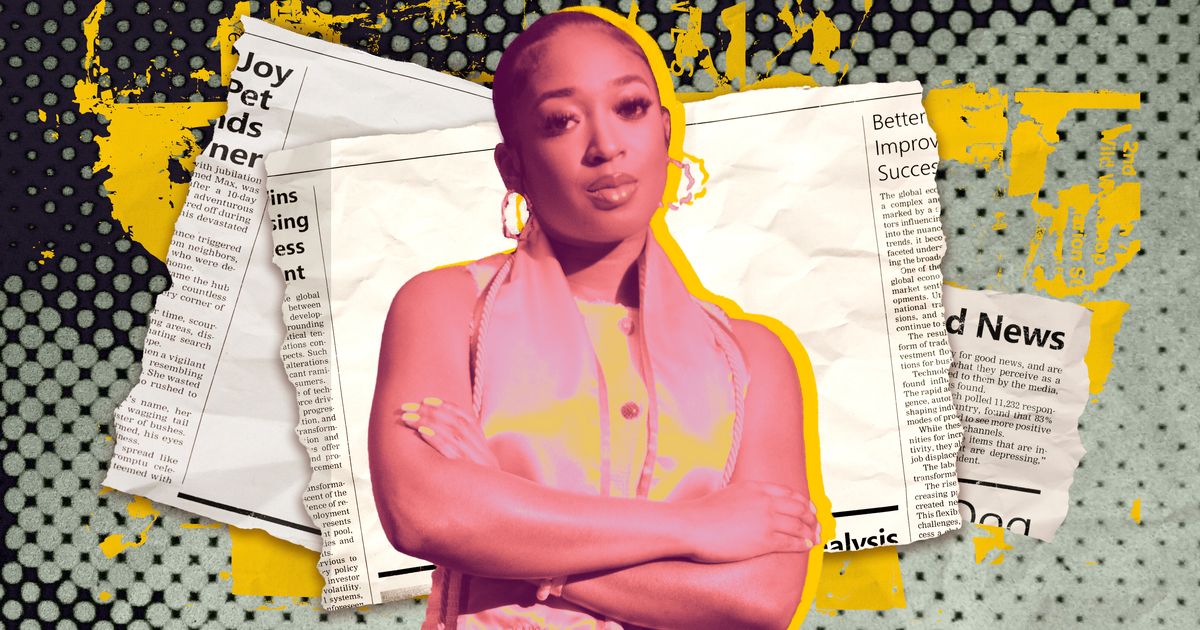
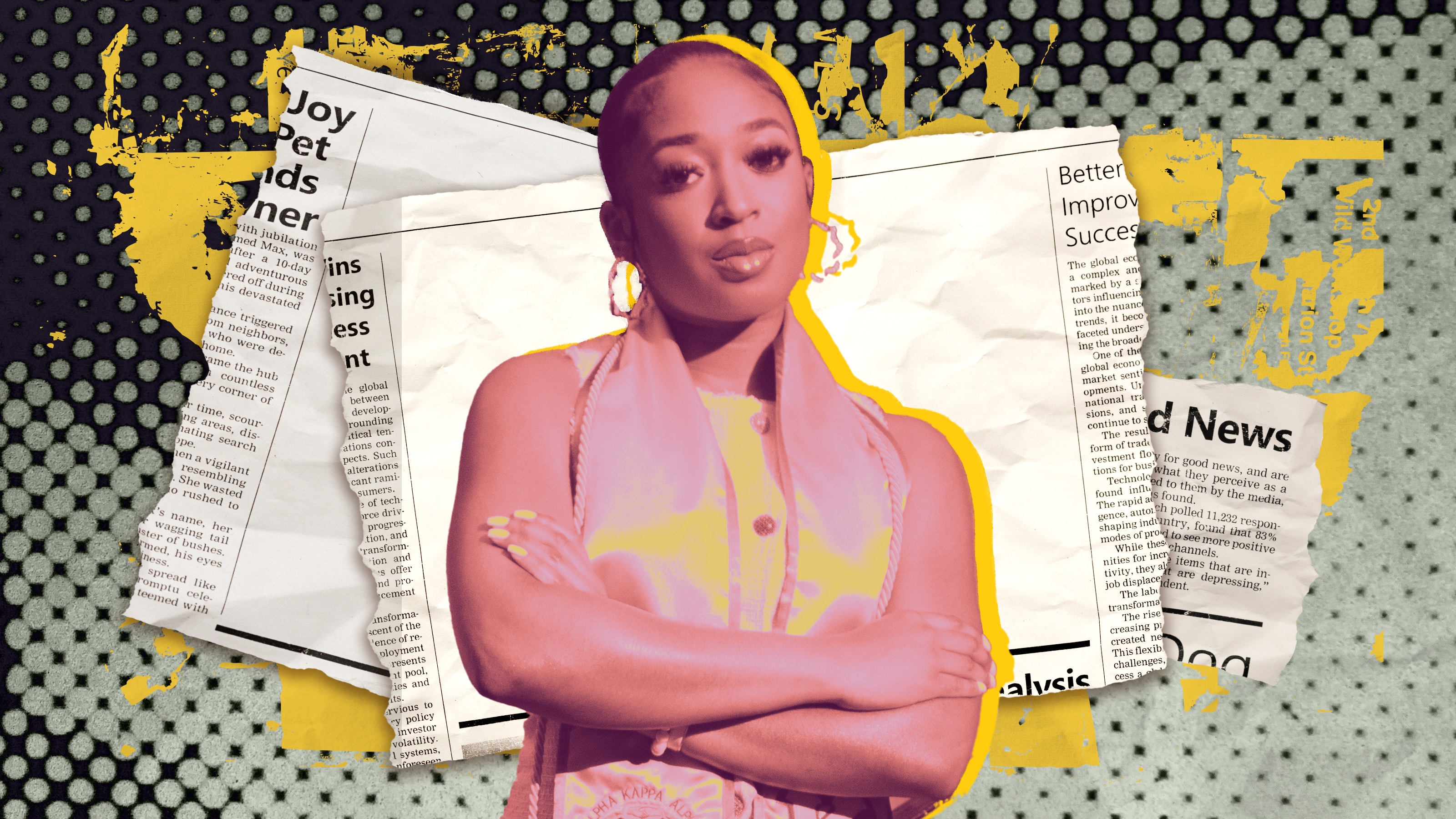
This TikTok Creator Wants Us To Pick Up An Actual Newspaper

Every day, Kelsey Russell wakes up, eats breakfast and scans the day’s top headlines — but not the way you and I do. She props up her phone camera, pulls out a print newspaper or magazine, and hits “record,” spending nearly an hour laying out the deets of an article for her followers. Then, it’s off to class.

Russell, 23, is a pretty unconventional influencer. While her content has landed her at brand events, award ceremonies and even on “The Drew Barrymore Show,” the secret to her success can be found in her daily routine.

After classes — Russell is pursuing a master’s degree in sociology and education at Columbia University — she leaves one educational institution to return to another: her Harlem apartment. She winds down most evenings by scanning news pages, first for her own enjoyment and then for her audience’s clarity-driven consumption. Another hour is spent annotating the pages and researching in preparation for the comprehensive TikTok she’ll film the next morning.

“I got a subscription to the Sunday New York Times — the physical copy — for my birthday, and I think that bad, Gen Z biddies should read the newspaper,” Russell said, in her first media literacy-related piece of content this past summer. “And in order to bring back the newspaper, I’m going to literally document, every day, what I learn.”

This post marked the beginning of her journey to break down articles from various newspapers and magazines on TikTok. In a few months, Russell amassed an audience hooked on her snappy personality and her knack for synthesising information in a palatable and colloquial way.

Sourcing information from both local and national outlets, Russell largely tackles stories abut politics, economics and social justice through the lens of communities of colour. In a time full of uncertainty and a thirst for news and analysis we can rely on, Russell offers a port in the storm of information swirling around us.

Russell credits her father for her penchant for print media. Images of him sitting at the kitchen counter in their Atlanta home, newspaper in hand, are cemented in her mind. During her undergraduate studies at Boston University, he’d often mail her articles that reminded him of her ― most of which Russell kept but ignored. However, in 2020, there was an investigation in her home state that changed her perspective.

When Ahmaud Arbery, a Black man, was killed by three white men in Georgia, Russell’s father quickly became well-versed in the details of the case ― long before most mainstream publications caught on. He felt empowered to be ahead of the curve on news that affected his community, and this got Russell thinking.

“Being Black ― the fact that we’re just out here getting murdered, like everywhere. I realised, there’s something in print media where there are always going to be journalists trying to cover really small local towns,” she says, emphasising the importance of telling our own stories when we need to.

Russell’s lived experience as a Black woman is not the focal point of her videos; she aims to focus mostly on the subjects and sources involved. However, being a Black person wholly informs her quest for knowledge and her digital career.

“I think about it every day,” Russell says, referring to her racial identity. “Coming from a family of educators and entrepreneurs, we value education so much because we know people can’t completely take it away from us, yet they continuously try to.”

At a time when educational gag orders and the striking down of affirmative action threaten access to education for marginalised groups, the Black community’s history of creatively seeking liberation through knowledge seems prescient.

“The oppression of thought, learning and education has not [happened] solely to the Black American community,” Russell says. “That has been a tool used since the beginning of this earth to oppress. But Black Americans are the best example to look at what happens when you limit people’s access to reading, to writing, to education.”

This oppression is part of both our history and our present situation, Russell tells me. And she wants to be part of disrupting that.

There are dangerous and largely false narratives about Black Americans that mainstream media outlets often perpetuate. Our achievements and our agency are often disregarded or omitted, and it’s time to subvert that. “For me, the importance of being a Black woman is that I will continue to interact with these white supremacist media while I also uplift media that is not a part of that regime,” Russell says.

Russell’s TikTok content is as much for herself as it is for her community. Although she has become a trusted news resource for her audience, reading print media has also become integral to maintaining her mental health.

“I felt the sense of anxiety leave my body,” Russell says, recalling how she felt after making her first newspaper-related video. “It was all because I picked up the paper, which seemingly should be a thing that should make me more anxious, more depressed, and it didn’t. It actually felt like a healing moment.”

Russell says she fell back in love with learning about the world, no matter how grimy it is — because there are also beautiful moments of happiness and empathy to home in on.

Just a few months ago, Russell was in the same boat as many Americans, grappling with anxiety and choosing to avoid the news. But drawing on advice from her therapist, Russell invoked her childhood zest for information and read the newspaper to face her fears without potential distraction from digital devices.

Information overload, increased misinformation online and digital fatigue are fixtures of life for Gen Z. Despite this, Russell believes that we should double down on our engagement with news — not turn away from it. We can be the front line of a media literacy revolution if we continue to have discerning, galvanising scholars like Russell to guide us.

“Just because we have so much information doesn’t mean we know how to process it, and doesn’t mean we know what to do with it,” Russell says. “Do everything you can to not go numb, because your emotions are the coolest thing ever. The way you feel about things, that’s what gives you passion. It’s up to us to interact with the news institutions that already exist, to either change or demolish [them], whichever one we want to do.”
Share Button

King Charles Said WHAT To Natalie Portman at The Phantom Menace Premiere?

During the press tour for her new film May December, Natalie Portman is taking time is taking time to reflect on some of her biggest movies to date.

In an interview with Andy Cohen for Watch What Happens Live! recently, the Oscar-winner was asked about her early work, including the 1999 film, Star Wars: Episode I – The Phantom Menace.

Portman starred as Padmé Amidala, a role she would reprise in the sequels Attack of the Clones and Revenge of the Sith, back when she was just 18 years of age.

Whilst discussing her experience on set and her willingness to reprise the role in future Star Wars properties, Cohen asked Portman what she thought of getting to meet The Royal Family at The Phantom Menace premiere back in ’99.

“I remember Prince Charles, he was then Prince Charles, asked me if I was in the originals. I was like, ‘No, I’m 18!’ But he was very friendly.”

The original Stars Wars saga began in 1977 with Star Wars, and kickstarted the careers of leads Mark Hamill, Harrison Ford and Carrie Fisher. Portman, meanwhile, was born only two years old when the final film – Return of the Jedi – was released in 1983.

Then Prince of Wales meets Natalie Portman at The Phantom Menace Royal Film Performance at the Odeon Leicester Square

John Stillwell/PA Images via Getty Images

The actress, who had already starred in blockbuster Léon: The Professional by the time she appeared in her first Star Wars film, also revealed it was her first time working digitally with a green screen, which was “amazing”.

“I don’t think anyone was shooting that way then. It was my first time working with a green screen. It was a whole new set of skills to pick up and a whole new world to enter.”

The Phantom Menace was only Portman’s sixth feature film. She has since gone on to star in the likes of Closer, V for Vendetta, Thor, Jackie and Black Swan, for which she won a Best Actress at the 83rd Academy Awards.

Portman admitted to Cohen that even though no one has asked her to reprise her Star Wars character, she would be open to doing so.

“I’ve been in Star Wars movies”, she told Waititi, who was forced to admit that he had forgotten she’d starred quite significantly in the prequel trilogy.

You can watch Natalie Portman’s Watch What Happens Live appearance here, and catch May December on Sky Cinema in the UK from 8 December.

Share Button

Covid study: mRNA vaccines could be fine-tuned

The revolutionary technology could be updated for even greater accuracy, research suggests.

Share Button

Data breach by Addenbrooke’s Hospital reveals patient information

Cambridge MP calls for a full review after Addenbrooke’s Hospital apologises for two data breaches.

Share Button

Blood in urine cancer warnings to appear in men’s toilets

The awareness messages will be carried on urinal mats as part of efforts to detect male cancers early.

Share Button

Limitations of asteroid crater lakes as climate archives

In southern Germany just north of the Danube, there lies a large circular depression between the hilly surroundings: the Nördlinger Ries. Almost 15 million years ago, an asteroid struck this spot. Today, the impact crater is one of the most useful analogues for asteroid craters on early Mars. Studying the deposits of the former lake that formed in the crater is particularly informative. These deposits have been of great interest ever since NASA began exploring Martian craters for signs of water and life on Mars. However, the chemical development of the former crater lake and its habitable areas is only partially understood.

An international research team led by the University of Göttingen have now uncovered clues about the past: they analysed dolomite rocks in a drill core and found an extremely high proportion of the carbon isotope C-13. Further investigations traced this back to a phase of strong methane formation by microorganisms known as archaea in water with a low sulphate content. In contrast, the sediments of the previous, first phase of the crater lake showed clear traces of high sulphate content and bacterial sulphate decomposition. This change reveals that the groundwater pathways to the lake changed as the crater floor cooled. The results have been published in the journal Geochimica et Cosmochimica Acta.

A 250-metre-long drill core taken in 1981 provided information about the chemical processes during the time periods that sediment was being deposited in the crater lake. Combining sedimentological, biogeochemical and isotope geochemical research methods enabled the researchers to identify a distinctive section, which they investigated in more detail using biomarker analyses. They detected organic biomarkers originating from sulphate-reducing bacteria and “normal” dolomite in older rocks from the crater lake. In the younger rocks, they found dolomite enriched with C-13 and a chemical called archaeol which indicates that archaea were present at that time.

The properties of the rocks reflect the conditions in the crater lake during their formation: the decrease in sulphate is due to degradation by bacteria and the C-13 enrichment is due to the formation of methane by archaea. “This chemical development can only be explained by the change in the groundwater supply during the gradual cooling of the crater floor. This led to a change from deep, hydrothermal groundwater (with sulphate) to cooler water without sulphate that must have flowed through limestone rocks near to the surface,” explains study leader Professor Gernot Arp from the Department of Geobiology at the University of Göttingen.

The findings not only provide important information on the development of the crater lake being investigated, but also, as Arp notes: “Our findings show that the conditions in asteroid crater lakes are strongly controlled by internal processes such as crater floor cooling and water supply. In contrast, climatic changes are of secondary importance, unlike in many other lakes. This must be taken into account when deposits in terrestrial and extraterrestrial craters are used as climate archives to deduce past climate conditions from the sediments.”

Share Button

Plant nurseries are exacerbating the climate-driven spread of 80% of invasive species

Researchers at the University of Massachusetts Amherst recently published a pair of papers that, together, provide the most detailed maps to date of how 144 common invasive plants species will react to 2° Celsius of climate change in the eastern U.S., as well as the role that garden centers currently play in seeding future invasions. Together, the papers, published in Diversity and Distributions and BioScience, and the publicly available maps, which track species at the county level, promise to give invasive species managers in the U.S. the tools they need to proactively coordinate their management efforts and adapt now for tomorrow’s warmer climate.

Mapping Future Abundance

One of the major hurdles in addressing the threat of invasive species is in determining when and where a species crosses the line from being non-native to invasive. A single occurrence of, say, purple loosestrife, does not an invasion make. What invasive plant managers need to know is where a species is likely to take over, outcompeting native plants and altering the ecosystem.

Or, as Bethany Bradley, professor of environmental conservation at UMass Amherst and the senior author of both papers puts it, “managers have very few resources to control invasions, so we don’t want to waste time focusing on species unlikely to become invasive in a given area. But the question of what will become invasive and where has been surprisingly tricky to answer.”

“If we can proactively identify these species and the regions they are most likely to become abundant in as the climate warms, then we can head-off a major ecological threat before it’s too late,” adds Annette Evans, a postdoctoral fellow at UMass Amherst’s Northeast Climate Adaptation Science Center and lead author of the paper on abundance and future invasive hotspots.

To do so, the team combed through 14 current invasive species databases compiled by hundreds of natural resource managers in order to first pinpoint which species are currently abundant and where, geographically, those abundance hotspots occur. They focused on the eastern U.S. (east of the 100th meridian, which runs from the middle of North Dakota through the center of Texas — a follow-up paper will focus on the western U.S.) and discovered that the hottest hotspots are around the Great Lakes, the mid-Atlantic, and along the northeastern coasts of Florida and Georgia. Each of these regions has the right mix of conditions to currently support abundant populations of more than 30 different invasive plants.

They then ran their data on 144 plants through a series of models that predicted where the hotspots would occur under 2° Celsius of warming.

What they discovered is that most of the species will shift their ranges to the northeast by an average of 213 kilometers, a trend also reflected in shifts to abundance hotspot locations. In some states, warming temperatures will make currently unsuitable areas conducive for abundant infestations of up to 21 new plant species, and the range-shifting could exacerbate the effects of up to 40 currently abundant invasives. On the other hand, 62% of currently abundant invasive species will see a decrease in habitat for large populations in the eastern U.S.

But statistics aren’t enough. “We’ve created something even more user-friendly,” says Evans: a series of publicly available range maps for individual species, which can help plant managers triage which plants most need their attention, as well as state-specific watch lists.

How plant nurseries could seed invasion

“When people think of how invasive plant species spread, they might assume species are moving because of birds or the wind dispersing seeds,” says Evelyn M. Beaury, lead author of the paper on horticulture and invasive species, as well as a postdoctoral researcher at Princeton who completed this research as an extension to her graduate studies at UMass Amherst. “But commercial nurseries that sell hundreds of different invasives are actually the primary pathway of invasive plant introduction.”

Though researchers have long known that invasives are linked to the horticulture trade, Beaury and her co-authors, including Evans and Bradley, wondered how often invasives are sold in the same area in which they are abundant? And how might nurseries be exacerbating the problem of climate-driven invasion?

It turns out that the answer to both questions is: a lot.

Using a case study of 672 nurseries around the U.S. that sell a total of 89 invasive plant species, and then running the results through the same models that the team used to predict future hotspots, Beaury and her co-authors found that nurseries are currently sowing the seeds of invasion for more than 80% of the species studied. If left unchecked, the industry could facilitate the spread of 25 species into areas that become suitable with 2°C of warming.

Furthermore, 55% of the invasive species were sold within 21 kilometers (13 miles) of an observed invasion — the median distance people across the U.S. go to buy landscaping plants. In other words, everyday gardeners who buy plants at their local nurseries could unwittingly help perpetuate invasion and associated ecological harm in their literal backyards.

“But there’s good news here,” says Beaury. “This is the first time that we have real numbers to show the connection between plant nursery sales and the spread of invasive species — including invasions that occur down the street from nurseries, as well as across state borders. Now that we have the data, we have an incredible opportunity to be proactive, to work with the industry, consumers and plant managers to think more critically about how our gardens impact U.S. ecosystems.”

The team has also put together a publicly available list of 24 commonly sold invasive plants that could increase in risk with climate change in the northeast, from butterfly bush to English ivy, to be avoided and native alternatives, such as bottlebrush buckeye and wild blue phlox.

“These two papers together make it pretty clear that not only are we facilitating current invasions through the ornamental plant trade, but we are also facilitating future climate-driven invasion,” says Bradley, “But with these papers, maps and watchlists, we can pinpoint which species are most worrisome where, both now and in the coming decades. These are important new tools in invasive plant managers’ toolboxes.”

Share Button

Bacteria’s mucus maneuvers: Study reveals how snot facilitates infection

Sniffles, snorts and blows of runny noses are the hallmarks of cold and flu season — and that increase in mucus is exactly what bacteria use to mount a coordinated attack on the immune system, according to a new study from researchers at Penn State. The team found that the thicker the mucus, the better the bacteria are able to swarm. The findings could have implications for treatments that reduce the ability of bacteria to spread.

The study, recently published in the journal PNAS Nexus, demonstrates how bacteria use mucus to enhance their ability to self-organize and possibly drive infection. The experiments, performed using synthetic pig stomach mucus, natural cow cervical mucus and a water-soluble polymer compound called polyvidone, revealed that bacteria coordinate movement better in thick mucus than in watery substances.

The findings provide insight into how bacteria colonize mucus and mucosal surfaces, researchers said. The findings also show how mucus enhances bacterial collective motion, or swarming, which may increase antibiotic resistance of bacterial colonies.

“To the best of our knowledge, our study is the first demonstration of bacteria collectively swimming in mucus,” said Igor Aronson, Huck Chair Professor of Biomedical Engineering, of Chemistry and of Mathematics at Penn State and corresponding author on the paper. “We have shown that mucus, unlike liquids of similar consistency, enhances the collective behavior.”

Mucus is essential for many biological functions, explained Aronson. It lines the surfaces of cells and tissues and protects against pathogens such as bacteria, fungi and viruses. But it is also the host material for bacteria-born infections, including sexually transmitted and gastric diseases. A better understanding of how bacteria swarm in mucus could pave the way for new strategies to combat infections and the growing problem of antibiotic resistance, according to Aronson.

“Our findings demonstrate how mucus consistency affects random motion of individual bacteria and influences their transition to coordinated, collective motion of large bacterial groups,” Aronson said. “There are studies demonstrating that collective motion or swarming of bacteria enhances the ability of bacterial colonies to fend off the effect of antibiotics. The onset of collective behavior studied in our work is directly related to swarming.”

Mucus is a notoriously challenging substance to study because it exhibits both liquid-like and solid-like properties, Aronson explained. Liquids are typically described by their level of viscosity, how thick or thin the liquid is, and solids are described by their elasticity, how much force it can take before breaking. Mucus, a viscoelastic fluid, behaves as both a liquid and solid.

To better understand how mucus becomes infected, the team used microscopic imaging techniques to observe the collective motion of the concentrated bacteria Bacillus subtilis in synthetic pig stomach mucus and natural cow cervical mucus. They compared those results with observations of Bacillus subtilis moving in a water-soluble polymer polyvidone at a wide range of concentrations, from high to low levels of polyvidone. The researchers also compared their experimental results to a computational model for bacterial collective motion in viscoelastic fluids like mucus.

The team found that the consistency of mucus profoundly affects the collective behavior of bacteria. The results indicated that the thicker the mucus, the more likely the bacteria would exhibit collective movement, forming a coordinated swarm.

“We were able to show how the viscoelasticity in mucus enhances bacterial organization, which in turn leads to coherently moving bacterial groups that cause infection,” Aronson said. “Our results reveal that the levels of elasticity and viscosity in mucus are a main driver in how bacterial communities organize themselves, which can provide insight into how we can control and prevent bacterial invasion in mucus.”

Aronson explained that the team expects human mucus to exhibit similar physical properties, meaning their findings are also relevant for human health.

“The onset of the collective motion of bacteria and their interaction with mucus should be the same as in cow, pig or human mucus since these substances have similar mechanical properties,” Aronson said. “Our results have implications for human and animal health. We’re showing that mucus viscoelasticity can enhance large-scale collective motion of bacteria, which may accelerate how quickly bacteria penetrate mucus protective barrier and infect internal tissues.”

The other co-author on the paper is Wentian Liao, a doctoral candidate in biomedical engineering at Penn State. The National Science Foundation supported the work.

Share Button

UN Warns Of New Growing Threat To Children In Gaza As Israel-Hamas War Resumes

A UNICEF representative has warned there’s a growing risk that disease could end up killing as many children in Gaza as the last eight weeks of bombardment have.

More than 15,500 people are estimated to have been killed in Gaza since the war began on October 7, according to the Palestinian territory’s health ministry – including approximately 6,000 children.

Israel declared war on Hamas almost two months ago after the Palestinian militants killed an estimated 1,200 people on Israeli soil and took around 240 others hostage.

Israel then put Gaza under siege, and launched a series of missile attacks and a ground invasion.

And according to the United Nations International Children’s Emergency Fund (UNICEF), there may soon be another major risk to the displaced Palestinian population – disease.

UNICEF’s James Elder told BBC News on Tuesday that there are some areas which should be safe from bombardments within Gaza.

But, he added: “They are not safe in an international law sense or a moral sense, in terms of safety, but we also mean in terms of food, water, medicine, protection.

“We’re seeing hundreds of thousands of people on their last legs go to a place without a single toilet.

“To dirt, to desert, to bombed out buildings, without any access to water.

“So now we have death from the skies and disease stalking – there’s a perfect storm now.

“We may well see the similar number of children dying, being killed, from disease – if these attacks don’t stop – as we do from the attacks themselves.”

There has been growing international concern about the amount of humanitarian aid reaching Gaza.

On Monday, UN secretary general Antonio Guterres reiterated his call for a “sustained ceasefire in Gaza, the unconditional and immediate release of all hostages and unimpeded and sustained humanitarian aid flow to meet the needs of the people throughout the Gaza Strip”.

It comes as Israel has started to bomb southern Gaza too, weeks after Palestinians in the north of the territory were encouraged to relocate to the south amid an imminent land invasion.

According to the UN’s OCHA, as of November 23, more than 1.7 million Palestinians are already internally displaced in Gaza.

And the World Health Organisation’s Richard Peeperkorn warned on Tuesday that the “situation is getting worse by the hour”.

Speaking to reporters via video link from Gaza, he said: “There’s intensified bombing going on all around, including here in the southern areas, Khan Younis and even in Rafah.”

The WHO’s director-general Dr Tedros Adhanom Ghebreyesus posted on X (formerly Twitter) on Monday over concerns that medical facilities would be at risk in southern Gaza.

He wrote: “Today, @WHO received notification from the Israel Defence Forces that we should remove our supplies from our medical warehouse in southern Gaza within 24 hours, as ground operations will put it beyond use.

“We appeal to #Israel to withdraw the order, and take every possible measure to protect civilians and civilian infrastructure, including hospitals and humanitarian facilities.”

Share Button

‘I’m Not A Clone’: Jamie Foxx Hilariously Denies Conspiracy Theory Following Health Scare

Jamie Foxx delivered a heartfelt speech Monday about his harrowing health scare in April.

The actor accepted the Vanguard Award for his role in “The Burial” (2023) at the Critics Choice Association’s “Celebration of Cinema & Television Honouring Black, Latino & AAPI Achievements” gala when he reflected on his emergency hospitalisation.

“I couldn’t do that six months ago,” Foxx said about walking across the stage, as seen in a video shared by Deadline.

“I wanna thank everybody,” he continued. “I’ve been through something. I’ve been through some things. You know, it’s crazy — I couldn’t do that six months ago. I couldn’t actually walk to [the podium].”

“And I’m not a clone, I’m not a clone,” he said, to laughter.

Foxx faced rabid speculation after he was hospitalised in mid-April, despite efforts from his sister Deidra Dixon and daughter Corinne Foxx to keep the matter private. The specifics remain unknown, spurring theories on social media theories that Foxx died and was replaced by a clone.

“I know a lot of people been saying I was cloned out there,” he said Monday. “Boy, y’all ain’t shit.”

The Oscar winner earnestly thanked his Black fans for their support, joking that they are “harder to impress” than white fans — as “there’s always somebody” that says, “Man, my cousin do the same thing” when he wins an award.

Foxx, who endured weeks of recovery, was nonetheless grateful just to be conscious.

“It feels good to be here,” he said Monday. “I cherish every single minute now, it’s different. It’s beyond. I wouldn’t wish what I went through on my worst enemy, ’cause it’s tough when it’s almost over, when you see the tunnel. I saw the tunnel — I didn’t see the light.”

“It was hot in that tunnel, I don’t know where I was going,” he joked. “Shit, am I going to the right place?”

Foxx was hospitalised in April for an illness that has yet to be publicly disclosed.

LM Otero/Associated Press

The “Django Unchained” star recalled a Black hospital staffer asking to see his veiled face while admitting Foxx, only to recognise him and say, “Lord, have mercy, Jesus.”

“I wanna thank you for all the prayers, because the one thing that I have to get used to now, is the ‘Lord, have mercy, Jesus’ when I see people,” he said Monday. “I be driving and I see people pull up and hit me with that.”

Foxx, who has two children and lost one of his two sisters in 2020, concluded by thanking Dixon and Corinne Foxx — because they “were so great at not letting anybody know anything that happened. And I can only say that you need somebody like that in your corner.”

The actor was accused of sexual assault in a lawsuit last month for allegedly groping a woman at the Catch restaurant in New York City in August 2015. He denied any wrongdoing in a statement from representatives.

Share Button