Women faculty are more likely to leave academia than men faculty throughout all career stages in U.S. universities, University of Colorado Boulder researchers revealed in the most comprehensive analysis of retention in academia to date.
The team published the findings Oct. 20 in the journal Science Advances. The researchers found that a harsh workplace climate, which can include harassment and feelings of not belonging, was the most common reason women left academia. This attrition affects not only early-career professionals, but also those who have achieved the highest ranks in universities, the study found.
This finding helps to explain, in part, why women remain underrepresented among faculty in nearly all academic fields in the U.S., said Katie Spoon, the paper’s first author and a PhD student in the Department of Computer Science. For example, only 28% of professors in science, technology, engineering and math (STEM) fields are women in the U.S., despite women receiving 40% of STEM PhDs for the past 10 to 15 years.
“If you look back at the literature from 20 or 30 years ago, it painted a much bleaker picture than many of the newer studies today,” said Aaron Clauset, the paper’s corresponding author and a professor of computer science. “Things are changing, but there is still a lot of work left to do.”
Previous research on gendered attrition in academia tended to have a limited scope.
Many studies investigated faculty retention only among assistant professors, in STEM fields, or at high-prestige institutions, due to the difficulties in finding and reaching faculty who left academia.
Spoon and her team analyzed a census of employment records of all 245,270 tenure-track and tenured professors from 391 PhD-granting universities and institutions in the U.S. They came from STEM fields, but also disciplines like social sciences and business. The tenure track is a professor’s pathway to promotion. Faculty members usually start as assistant professors without tenure. If they get promoted, they become tenured associate professors, and eventually they can be promoted to full professors, an indefinite appointment that tends to come with more academic freedom and job security.
advertisement
The researchers found women are leaving academia at a higher rate than men at every career stage, especially after they receive full professorship. During their appointment as assistant professors, women are 6% more likely to leave their jobs than men each year. The attrition rate is higher among full professors, where women professors are 19% more likely to leave academia than men each year.
“We were surprised to see the gender gap actually grow after faculty received tenure, given how important the title is,” Spoon said. “This result suggests that perhaps the field has neglected thinking about tenured women and their experiences.”
The team also surveyed more than 10,000 current and former faculty members for factors that led or could lead to their decision to leave a faculty job. The result showed women are more likely to feel pushed by a variety of factors out of their faculty positions, while men are more likely to be pulled toward more attractive jobs elsewhere. The most common reasons women, especially tenured women, reported for leaving academia were harsh workplace climates, which can include dysfunctional leadership, harassment, discrimination and feelings of not belonging.
While previous research has suggested that women are more likely to leave academia in pursuit of better work-life balance, the new paper found that male faculty were about as likely to leave for this reason.
“We see an emphasis on work-life balance among early career faculty members,” said Clauset. “But the issue with workplace climate is the dominating factor among the women tenured professors, a position that lasts the majority of one’s academic career.”
The researchers hope their paper will inspire administrators nationwide to take action.
“It can start with asking faculty, particularly women, what needs to be done, listening, and taking specific, concrete steps to address their concerns,” Spoon said.
The fossils of a 170-million-year-old ancient marine reptile from the Age of Dinosaurs have been identified as the oldest-known mega-predatory pliosaur — a group of ocean-dwelling reptiles closely related to the famous long-necked plesiosaurs. The findings are rare and add new knowledge to the evolution of plesiosaurs. The study has been published in the journal Scientific Reports.
The fossils were found 40 years ago in north-eastern France. An international team of palaeontologists from the Naturkunde-Museum Bielefeld in Germany, the Institute of Paleobiology of the Polish Academy of Sciences in Warsaw, Poland, the Natural History Museum in Luxembourg and The Museum of Evolution at Uppsala University in Sweden have now analysed them and identified them as a new pliosaur genus: Lorrainosaurus.
Pliosaurs were a type of plesiosaur with short necks and massive skulls. They appeared over 200 million years ago, but remained minor components of marine ecosystems until suddenly developing into enormous apex predators. The new study shows that this adaptive shift followed feeding niche differentiation and the global decline of other predatory marine reptiles over 170 million years ago.
Lorrainosaurus is the oldest large-bodied pliosaur represented by an associated skeleton. It had jaws over 1.3 m long with large conical teeth and a bulky ‘torpedo-shaped’ body propelled by four flipper-like limbs.
“Lorrainosaurus was one of the first truly huge pliosaurs. It gave rise to a dynasty of marine reptile mega-predators that ruled the oceans for around 80 million years,” explains Sven Sachs, a researcher at the Naturkunde-Museum Bielefeld, who led the study.
This giant reptile probably reached over 6 m from snout to tail, and lived during the early Middle Jurassic period. Intriguingly, very little is known about plesiosaurs from that time.
“Our identification of Lorrainosaurus as one of the earliest mega-predatory pliosaurs demonstrates that these creatures emerged immediately after a landmark restructuring of marine predator ecosystems across the Early-to-Middle Jurassic boundary, some 175 to 171 million years ago. This event profoundly affected many marine reptile groups and brought mega-predatory pliosaurids to dominance over ‘fish-like’ ichthyosaurs, ancient marine crocodile relatives, and other large-bodied predatory plesiosaurs,” adds Daniel Madzia from the Institute of Paleobiology of the Polish Academy of Sciences, who co-led the study.
advertisement
Pliosaurs were some of the most successful marine predators of their time.
“Famous examples, such as Pliosaurus and Kronosaurus — some of the world’s largest pliosaurs — were absolutely enormous with body-lengths exceeding 10 m. They were ecological equivalents of today’s Killer whales and would have eaten a range of prey including squid-like cephalopods, large fish and other marine reptiles. These have all been found as preserved gut contents,” said senior co-author Benjamin Kear, Curator of Vertebrate Palaeontology and Researcher in Palaeontology at The Museum of Evolution, Uppsala University.
The recovered bones and teeth of Lorrainosaurus represent remnants of what was once a complete skeleton that decomposed and was dispersed across the ancient sea floor by currents and scavengers.
“The remains were unearthed in 1983 from a road cutting near Metz in Lorraine, north-eastern France. Palaeontology enthusiasts from the Association minéralogique et paléontologique d’Hayange et des environs recognised the significance of their discovery and donated the fossils to the Natural History Museum in Luxembourg,” said co-author Ben Thuy, Curator at the Natural History Museum in Luxembourg.
Other than a brief report published in 1994, the fossils of Lorrainosaurus remained obscure until this new study re-evaluated the finds. Lorrainosaurus indicates that the reign of gigantic mega-predatory pliosaurs must have commenced earlier than previously thought, and was locally responsive to major ecological changes affecting marine environments covering what is now western Europe during the early Middle Jurassic.
“Lorrainosaurus is thus a critical addition to our knowledge of ancient marine reptiles from a time in the Age of Dinosaurs that has as yet been incompletely understood,” says Benjamin Kear.
Stimulating muscle fibers with magnets causes them to grow in the same direction, aligning muscle cells within tissue, Massachusetts Institute of Technology (MIT) and Boston University investigators report October 20 in the journal Device. The findings offer a simpler, less time-consuming way for medical researchers to program muscle cell alignment, which is strongly tied to healthy muscle function.
“The ability to make aligned muscle in a lab setting means that we can develop model tissues for understanding muscle in healthy and diseased states and for developing and testing new therapies that combat muscle injury or disease,” says senior author Ritu Raman, an MIT engineer. A better understanding of the rules that govern muscle growth could also have applications in robotics, she adds.
In a previous investigation, Raman and colleagues found that “exercising” muscle fibers by making them contract in response to electrical stimulation for 30 minutes a day over the course of 10 days made the fibers stronger. This time, the researchers wanted to explore whether mechanically stimulating the muscle fibers over the same time frame (rather than letting them respond on their own) would have the same result. To investigate, they developed a method to mechanically stimulate muscle tissue that differs from typical lab techniques.
“Generally, when people want to mechanically stimulate tissues in a lab environment, they grasp the tissue at both ends and move it back and forth, stretching and compressing the whole tissue,” said Raman. “But this doesn’t really mimic how cells talk to each other in our bodies. We wanted to spatially control the forces between cells within a tissue, matching native systems.”
To stimulate the muscle cells in a more true-to-life way, Raman and her team grew cells in a Petri dish on a soft gel that contained magnetic particles. When they would move a magnet back and forth under the gel, the particles moved back and forth, too, which “flexed” the cells. The researchers could precisely control the way the gel moved, and, in turn, the magnitude and direction of the forces the cells within experienced, by changing the strength and orientation of the magnet. To measure the alignment of the muscle fibers within the tissues and whether they contracted in synchrony, the team’s collaborators at Boston University developed a custom software that automatically tracked videos of the muscle and generated graphs of its movement.
“We were very surprised by the findings of our study,” said Raman. While mechanically stimulating the muscle fibers over the 10-day period did not seem to make them any stronger, it did cause them all to grow in the same direction.
“Furthermore, we were excited to find that, when we triggered muscle contraction, aligned muscle was beating synchronously, whereas non-aligned muscle was not beating rhythmically,” said Raman. “This confirmed our understanding that the form and function of muscle are intrinsically connected, and that controlling form can help us control function.”
Raman and colleagues plan to take the study further by investigating how different mechanical stimulation regimens impact both healthy and diseased muscle fibers. Additionally, they plan to study how mechanical stimulation affects other types of cells.
The ability of Mycobacterium tuberculosis (MTB), a serious respiratory infection, to form snake-like cords was first noted nearly 80 years ago. In a study published October 20 in the journal Cell, investigators report the biophysical mechanisms by which these cords form and demonstrate how several generations of dividing bacteria hang together to create these structures that enable resistance to antibiotics.
“Our work clearly showed that cord formation is important for infection and why this highly ordered architecture might be important for pathogenesis,” says senior author Vivek Thacker, who led the work at the Global Health Institute at École Polytechnique Fédérale de Lausannen (EPFL) in Switzerland and is now based at the Department of Infectious Diseases at Heidelberg University in Germany.
The study used a unique combination of technologies to address the role of MTB cord formation. One was a lung-on-chip model, which allowed the researchers to get a direct look at “first contact” between MTB and host cells at the air-liquid interface in the lungs. This revealed that cord formation is prominent in early infection. The researchers also used a mouse model that develops pathologies mimicking human tuberculosis, allowing them to obtain tissue that could be studied using confocal imaging and confirming that cording also occurs early in infection in vivo.
The work yielded several new findings about how these cords interact with and compress the cell nucleus, how this compression affects the immune system and connections between host cells and epithelial cells, and how cord formation affects the alveoli in the lungs. The study also revealed how these cords retain their structural integrity and how they increase tolerance to antibiotic therapy.
“There is an increasing understanding that these mechanical forces influence cellular behavior and responses, but this aspect has been overlooked since traditional cell culture models do not recapitulate the mechanical environment of a tissue,” says Melanie Hannebelle, formerly at EPFL’s Global Health Institute and now at Stanford University. “Understanding how forces at the cellular and tissue level or crowding at the molecular level affects cell and tissue function is therefore important to develop a complete picture of how biosystems work.”
“By thinking of MTB in infection as aggregates and not single bacteria, we can imagine new interactions with host proteins for known effectors of MTB pathogenesis and a new paradigm in pathogenesis where forces from bacterial architectures affect host function,” says Thacker.
Future research will focus on understanding whether cord formation enables new functionality to known effectors of MTB pathogenesis, many of which are located on the MTB cell wall. In addition, it will look at the consequence of tight-packing on the bacteria within the clump and how this may lead to a protective effect against antibiotics.
“Antibiotic therapy is the mainstay of treatment for tuberculosis infections, but therapeutic regimens are long and complicated, with an increasing threat of drug resistance,” says Richa Mishra, the other first author who is currently at EPFL’s Global Health Institute. “There is a recognized need for host-directed therapies or therapies that inhibit specific virulence mechanisms that can shorten and improve antibiotic therapy.”
It comes amid the ongoing row over the corporation’s refusal to describe Palestinian militant group Hamas as terrorists.
However, it is understood Davie’s appearance at Committee Room 14 in the House of Commons was arranged in July, before the controversy.
Advertisement
Asked why he had been invited to attend the meeting, a 1922 Committee source said: “We thought it would be interesting.”
Labour shadow minister Justin Madders said: “If the Director General of the BBC wants to talk to MPs he should talk to all of them of all parties, not just some.”
High-profile figures, including tech billionaire Bill Gates, have spoken to the 1922 committee before.
But Davie’s appearance is controversial because he is a former Tory Party member and twice stood for election as a Conservative councillor in the 1990s.
Many Tory MPs are also highly critical of the BBC’s political coverage, which they believe has a left-wing bias.
Advertisement
BBC sources said Davie meets a range of people as part of his role and will be meeting Labour parliamentarians in the coming weeks.
But Labour sources said there were no plans for him to address a meeting of the Parliamentary Labour Party.
Security minister Tom Tugenhadt criticised the corporation’s reporting of the Al-Ahli hospital blast in Gaza City during an interview on BBC Breakfast yesterday.
A post on X (formerly Twitter) by BBC World said: “Hundreds of people have been killed in an Israeli strike on a hospital in Gaza, according to Palestinian officials.”
Israel has denied responsibility for the carnage, which it has blamed on a misfiring rocket by the Hamas militant group.
Advertisement
US president Joe Biden was due to meet with Arab leaders in the region, but those talks were cancelled in the wake of the blast.
Tugenhandt was asked by presenter Charlie Stayt who the UK government thought was responsible for the hospital deaths.
He said: “We’ve seen some pretty wild speculation and some rushing to headlines in recent days.
“This is first and foremost a human tragedy. We know that some people have been killed there and we also know that the Al-Ahli hospital was offering a service to Palestinian civilians that is incredibly needed at the moment.
“However, the reporting that we’ve seen in recent days has already had a major cost. President Biden was due to meet with Arab leaders, including probably Mahmood Abbas of the Palestinian Authority, and to begin the conversations that could have led to peace.
“Those talks have been stopped – perhaps only pushed back, we hope – and that in itself as a cost. But we’ve also seen the destruction of a synagogue in Tunisia and sadly we’ve seen raising tensions in the United Kingdom.
Advertisement
“This is one of those moments where wild speculation, fast and loose reporting, has real costs and consequences and I’m not going to engage in it.”
Alison Hammond has proven once again that her laugh is a tonic to us all, as she broke into hysterics on Friday’s This Morning.
During a segment on the happiness of finding unexpected change around the house, her co-host Dermot O’Leary outed Alison when she told viewers a story about a time she did a good deed.
Advertisement
Alison told her co-stars: “I did find a note the other day. I was coming out of a car park and I was walking and I looked at the floor and I was like, that looks like a £20 note. It was! I picked it up and I donated it to charity.”
As the guests praised Alison’s actions and she smiled to the camera, Dermot pulled a face and interjected: “Hang on, when you say you donated it to charity…”
TheGreat British Bake Off host kept trying to move on and stick to the schedule, Dermot kept pestering her to “tell the truth” about what she did with the money.
As they both broke into hysterics, Alison wheezed through her infectious laughter: “I’m never telling you anything again!”
Advertisement
Before Dermot revealed her secret to the audience: “She went to the charity shop and she bought a handbag for £15.”
“For charity” she choked through her tears of laughter, as she went on to admit: “I did keep the five pounds and buy some sweets with that one.”
Alison Hammond and Dermot O’Leary on This Morning
Later, Dermot added: “It was a lovely bag print,” as Alison laughed: “I am very grateful.”
Alison escorted the baker back to the house, after Tasha scummed to the intense heat during Chocolate Week.
Advertisement
Her absence then threw the programme’s trusted formula into chaos, as Paul Hollywood and Prue Leith made the decision to not eliminate anyone from the competition, with the caveat that two would leave next week.
On October 1, 2021, after having what I had thought was routine thyroid surgery, I was diagnosed with anaplastic thyroid cancer, a cancer so rare that none of my doctors had ever seen it before. It’s so aggressive that it only exists as Stage IV.
The typical survival rate? Six months or less. One in five patients lives 12 months.
It’s October 2023.
I did a 10K race in July. At 6,000 feet. Last winter, I was a ski instructor. I’m a rock ’n’ roll DJ at the mountain town station that I used to stream when I lived in New York, fantasising that I was living here. Now I am. I have the life I’d longed dreamed of.
Advertisement
Every morning, as I watch the sun come up over the mountains I never thought I’d live in again, I give thanks for everything in my life that brought me to this moment. Especially that diagnosis. It taught me that I had no time to waste. It taught me how much I love life — rough, bumpy and hard as it often is. It taught me how much more I wanted to do. And now I’m doing it.
But on that fall day in 2021, I was terrified. I was also furious.
I was two years out from a divorce after an unhappy marriage that I had long wanted to escape but had been afraid to leave. I felt I’d spent years quashing my voice and my spirit to keep that marriage going. Being a wife had become my identity. When the marriage tanked, I felt betrayed by the society that still pushed the fallacy that a woman had to have a man to be something. I felt betrayed by the husband who dumped me. Most of all, I felt I had betrayed myself by staying instead of standing up for myself and leaving.
I was desperate to resurrect the young woman I’d been back when I’d first gone to New York for grad school after ski bumming in Aspen. That me had planned on spending just a few years in the city before returning to the mountains. But you know how it goes: I met a guy, fell in love, marriage, kids, mortgages. And, hey, New York is pretty damn fun — until it nearly kills you.
Courtesy of Kate Rice
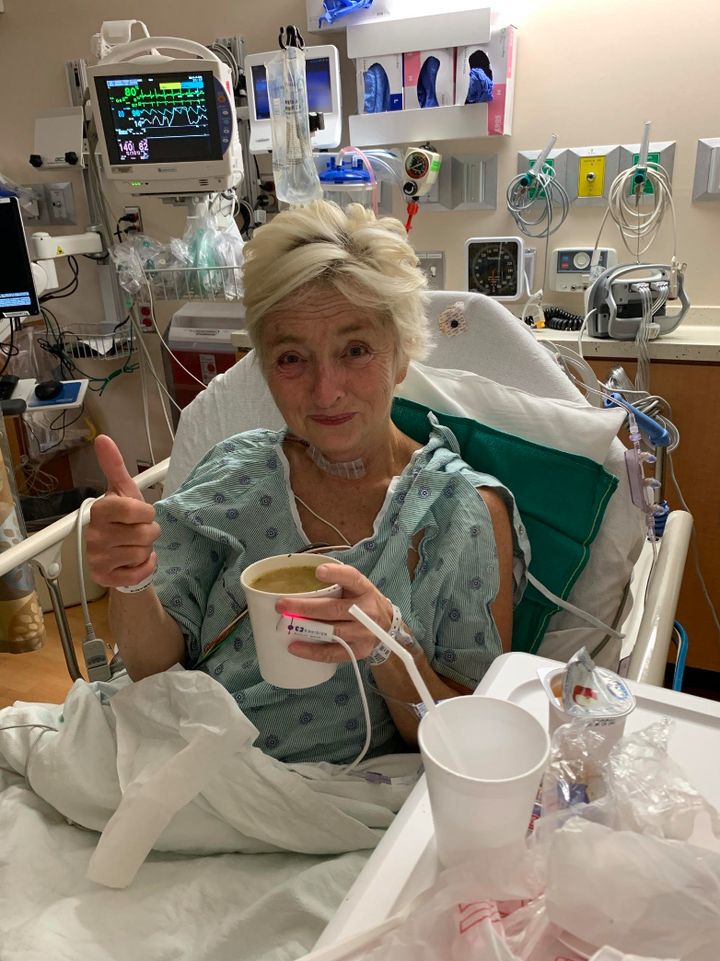
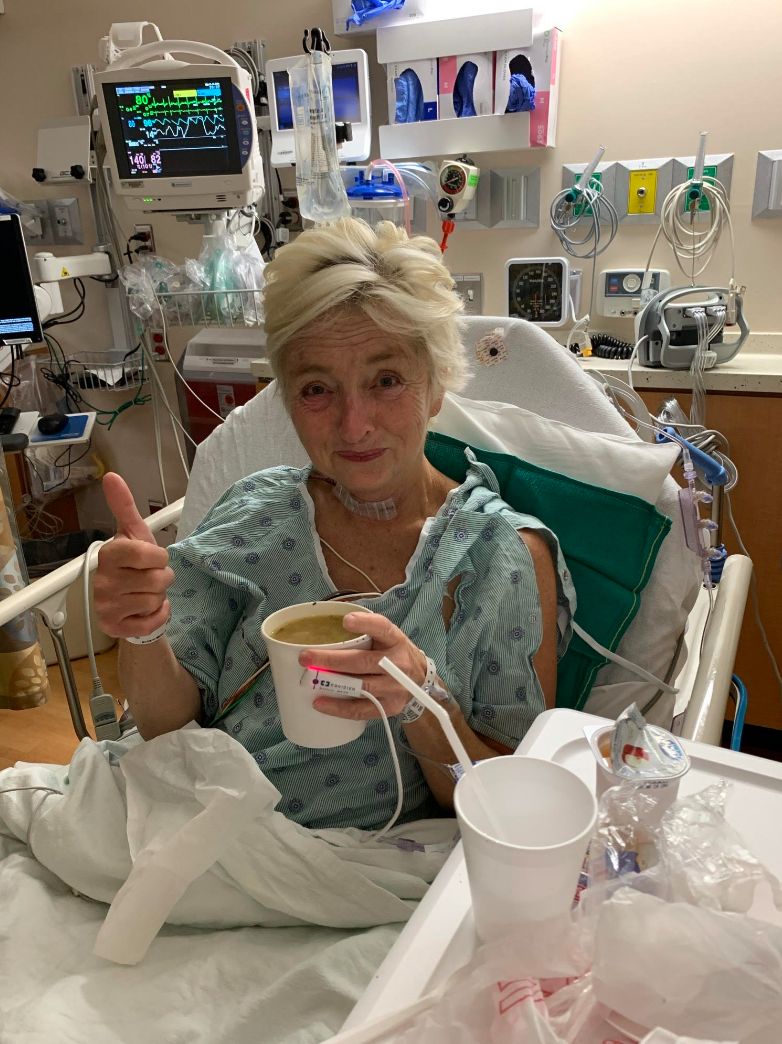
The author after her second surgery, this one at MD Anderson in Houston, in October 2021.
Advertisement
The final years of my marriage, the divorce and its aftermath were brutal. I routinely woke at 3 a.m. staring into the darkness. My weight plummeted. I landed in the ER with what I thought might be a heart attack but was really a panic attack.
I struggled to pull myself together. I kept on running. I became a certified yoga sculpt instructor. I read self-help books. I not only talked to my therapist once a week, I sent her email after email filled with grief and fury.
And then I did something I never thought I would do: I started singing rock ’n’ roll. Onstage! Me! Who had all but died when faced with piano recitals at St. Patrick’s School. In high school plays, I stayed behind the scenes and did makeup and worked on costumes. I was solidly in the audience.
But now I was running from the firestorm of my old life. I came to a cliff, closed my eyes and jumped. I was desperation personified when I took that leap. I was shaky as hell, but singing in the spotlight gave me a solid piece of ground in a world that had turned into quicksand.
The stage was a place where I could escape my pain for a few hours. But it was still there. The wounds wrought by my past were still raw inside me, haunting my dreams and shadowing my days.
Advertisement
COVID hit. Stages everywhere, including mine, went dark. I lost my refuge. I still planned to leave New York and return to the mountains, but I was waiting for my youngest child to graduate from high school.
She went off to college. I stayed in New York. COVID still raged. I rationalised it was a bad time to move to a town where I knew no one. And I thought my kids should still have their mama’s place to come home to in New York, even though my new apartment was a fraction of the size of the one they’d grown up in.
Courtesy of Kate Rice
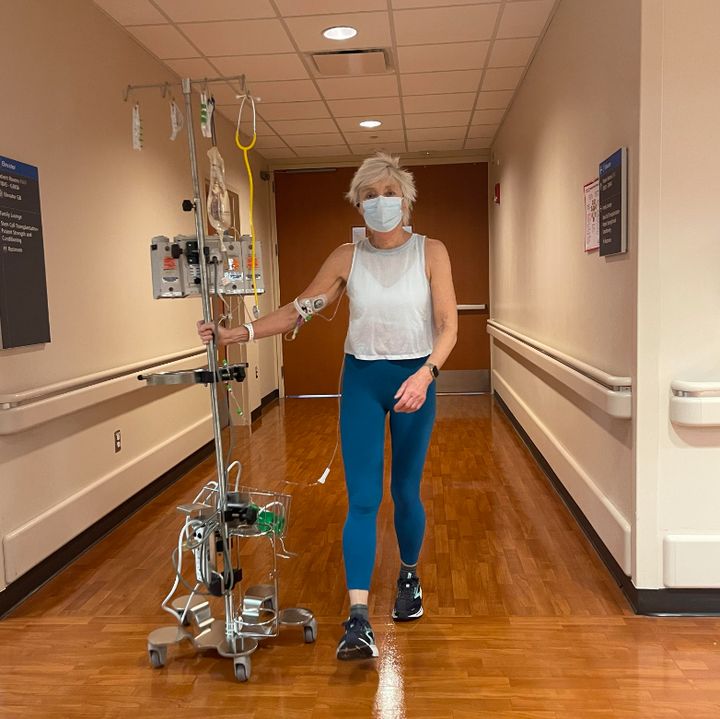
The author power-walking with her IV pole, nicknamed Slim, during her MD Anderson treatment.
What it all boiled down to, though, is that I was afraid to leave. Yet again.
So the universe kicked me in the butt. Hard.
As I lay in my bed on that October night in 2021 after being told I had just months to live, I railed against my fate. What gives, universe?I thought we were in sync! C’mon!
I knew one thing: I was getting the hell out of New York. But I wasn’t going to the mountains. I was going to Houston, one of the flattest places in the United States. It’s also home to the MD Anderson Cancer Center, which my cousin discovered has a special clinic — named FAST — that specializes in my type of cancer.
Advertisement
I packed up what I thought I would need in Houston. I ran around New York gathering my medical records. I went out to dinner and drank margaritas with friends.
And then I bought something many people facing cancer like mine would never think to buy: a T-Card, a discount ski pass for Telluride Ski Resort, near where one of my brothers lives in Colorado.
I bought it because of one line in the anaplastic thyroid cancer printout I’d gotten the day of my diagnosis. After learning I probably had just six months to live, I read this sentence: “Despite these discouraging figures…” (Discouraging? I had thought as I read it. What comedian wrote this?) “…there are some long-term survivors.”
“I’m going to be one of them,” I had promised my daughters. We were all crying. “I don’t know how, but I will.”
And that was why I made the decision to buy that ski pass. I was going to do more than live — I was going to be strong and healthy enough to ski. And this purchase was going to be the thing that kept me fighting no matter what came my way.
Advertisement
See that, universe? I thought as I clicked the “buy now” icon.
Courtesy of Kate Rice
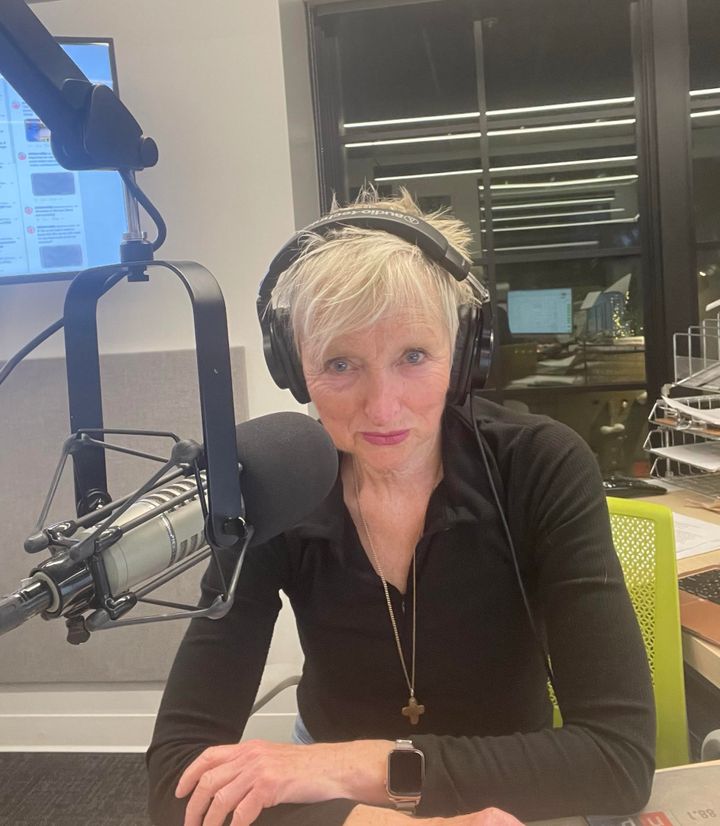
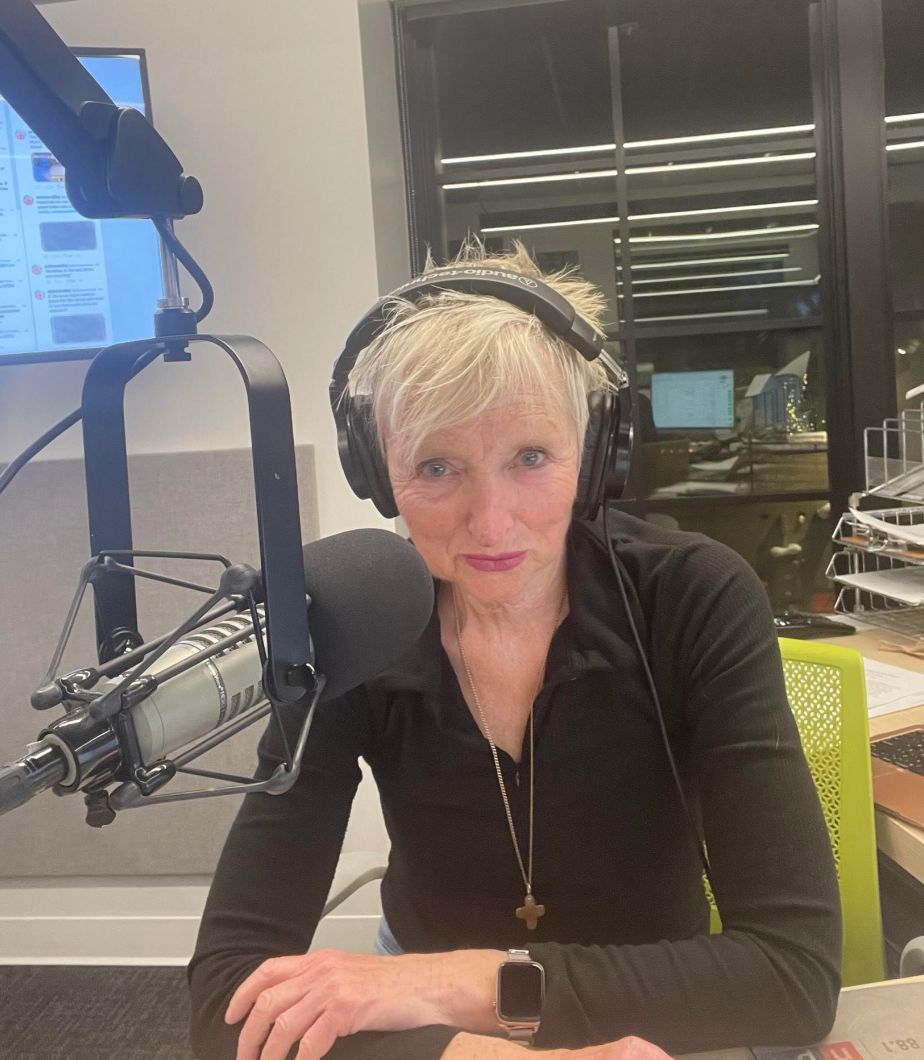
The author at the mic at KPCW radio.
Five days after my diagnosis, I walked in the doors of MD Anderson.
The FAST clinic was aptly named. MD Anderson kept me on the run. I liked that. I had CT scans, PET scans, brain scans, MRIs, blood tests. I even got to look at my vocal cords during a laryngoscopy.
I had a second surgery.
“The odds aren’t good,” the surgeon told me. And then he added, “But we do cure some people with this cancer.”
I had five weeks of radiation and chemo. I stayed with my cousin in Houston. She has a big house, a bigger heart and a long-suffering husband. Both of my daughters, one accompanied by her boyfriend, came to cheer me on. Each of my three brothers (one with his almost house-trained new puppy), my sister and three of my besties from New York came, one after another. We talked. We power-walked. We partied. I had Zoom calls with friends and family. I couldn’t drink alcohol, but I asked everyone I knew to drink for me. And they did.
I finished my treatment. I rang the proverbial bells, one for my last chemo treatment and one for my last rad cure, as I had started calling radiation. But I wasn’t done with MD Anderson. I had to come back every two months to get scanned. Anaplastic thyroid cancer is like Rasputin — it comes roaring back 80% of the time.
Advertisement
At one point, I noticed a small growth on my face. “It looks fine to me,” said my radiation doctor. “But you never can tell with this cancer. I’m sending you to dermatology.”
The growth was benign and the dermatologist just froze it off, but I remembered the doctor’s respect for this cancer and the need for constant surveillance.
I headed to the mountains of Colorado to be near my Telluride brother. I rented an Airbnb near his family’s home in case my radiation side effects got bad. I hired a moving company to empty my apartment back in New York and put my belongings in storage in Hoboken.
I was scared. I could feel unfamiliar prickling sensations in my neck. Was it just after effects of radiation? Or was it something terrible?
Courtesy of Kate Rice
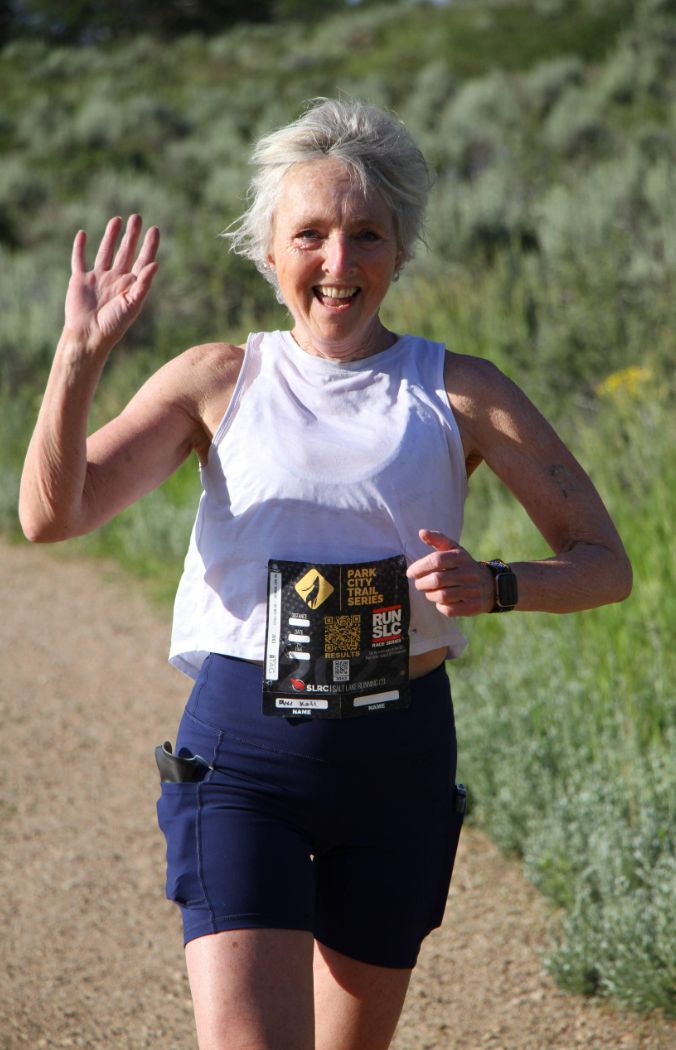
The author running a 10K in Park City, Utah, in July 2023.
Advertisement
Two days before Christmas, I got a call from Houston.
“We think you’re a good candidate for immunotherapy,” the nurse told me. “Can you come back to Houston next week?”
Damn straight I could.
I flew back to Houston. CT and PET scans showed I was still disease-free. I was the perfect candidate for immunotherapy.
“Basically,” my endocrinologist told me, “it opens your immune system’s eyes to cancer.”
It helps my body keep me healthy and disease-free.
“Go back to Colorado and ski,” my endocrinologist told me. “Just don’t break any bones.”
As I walked out of MD Anderson after hearing the good news, I wept tears of joy and gratitude. The deadly cancer I’d been diagnosed with had just become a disease that is chronic but manageable.
On a cold but clear blue-bird-sky January day in 2022, I stepped into my skis and glided over to Lift 7 at Telluride. The liftie scanned my T-Pass and up I went.
On that first run down the hill, I revelled in the moment. The sparkling snow. The crisp air. The sky above me. Skis, mountain, snow, gravity and me, all working together. I was alive!
Advertisement
I wanted to do that first run on my own, but then I caught up with my brother. He and I and one of his ski buddies rode up the Prospect Express lift together.
“What brings you here?” the friend asked me.
I took a deep breath and exhaled.
Courtesy of Kate Rice
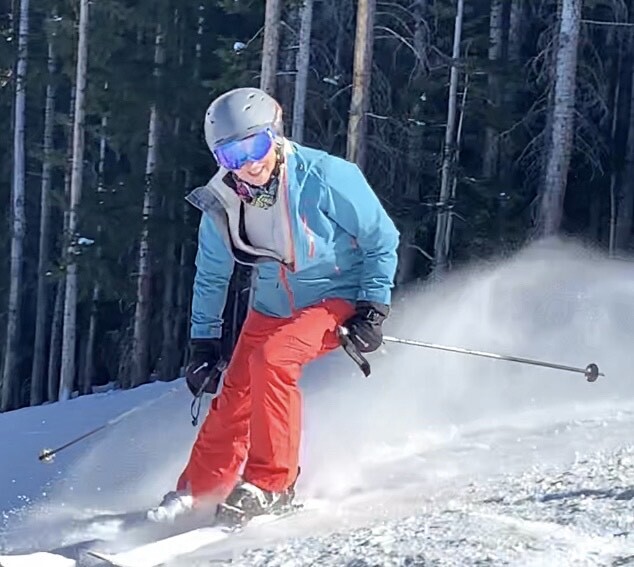
The author’s first time back in her skis and using her T-Pass at Telluride after she finished her cancer treatment (January 2022).
“Well,” I said. And I told my story — Aspen, New York, love, marriage, divorce. And cancer.
“I always planned on returning,” I told him. “And now, finally, I have.”
The friend was silent for a moment and then he looked at me.
“Welcome back,” he said.
Kate Rice is a runner, rock ’n roll singer and stand-up comic who performs mostly in the shower but sometimes on stage. She’s an author and former reporter. She lives in Park City, Utah, where she is a ski instructor and rock ’n roll radio DJ. Her new memoir, “Cured: A Tale of Badassery,” will be released on November 15, 2023.