Multi-site trial of belonging exercise improves college students’ academic persistence

A new study led by Indiana University researchers finds that incoming students who participated in an online belonging exercise completed their first year as full-time college students at a higher rate than their peers, but only when their institution had strong strategies and resources in place to support diverse students’ belonging.

Led by the College Transition Collaborative and the IU Equity Accelerator, the research team offered a brief online reading and writing exercise to nearly 27,000 students from 22 diverse colleges and universities across the United States in fall 2015 and 2016, including IU. These results, the country’s largest multi-site randomized controlled trial of this belonging intervention, were published May 5 in Science.

“There are hundreds of thousands of students being left behind and not supported by institutions in the way they need to be supported,” said IU Equity Accelerator founder Mary Murphy, professor of psychological and brain sciences and Class of 1948 Herman B Wells Endowed Professor in the IU Bloomington College of Arts and Sciences. “The Equity Accelerator is helping institutions understand what they can do to help students feel like they belong, that they are supported academically.

“It is important that students never feel alone, and that the institution offers tangible affordances that are recognized and used by students to help them feel a sense of belonging and to be academically successful in college.”

The researchers found significant effects on students’ persistence, course taking and sense of belonging after engaging with the reading and writing exercise. The intervention increased the rate at which students completed their first year of college as full-time students, especially among students in groups that had historically progressed at lower rates. However, across the 22 institutions, the impacts were much greater when the institutions had strategies and resources in place to help students feel like they belong.

The researchers have calculated that their results can be generalized to more than 1 million students annually at 749 four-year colleges and universities in the United States, where the 12-month drop-out rate for first-time undergraduate freshmen is 24.1 percent, according to the Education Data Initiative. If all schools in the generalizability sample implemented the online social-belonging intervention, 12,136 more full-time students would complete the first year of college each year. The benefits are greatest among historically lower-performing groups — students whose combined race/ethnicity and generation status is historically lower performing at a particular institution — which helps to reduce inequality on campuses.

The social-belonging intervention was delivered through an online module in the summer before students began college, typically as part of a pre-semester checklist of necessary forms and requirements. It included survey results from older students showing that everyday worries about belonging are normal in the transition to college and can improve over time; carefully curated stories from older students describing these worries and how they improved from them; and an opportunity to reflect on these stories in writing.

Results varied across the 22 institutions, since each offers different strategies, resources and programs to support the particular groups of students who historically struggle with first-year college completion. The researchers say institutional transformation and increasing support for students on campus — as well as students’ knowledge of, attitudes about and usage of these resources — are critical to improving student success.

“This work is globally reimagining the role of institutions on student outcomes, not just from an academic perspective but also students’ life outcomes,” said Sara Woodruff, chief strategy officer at the IU Equity Accelerator. “This is a call to action for the ways in which institutions take their power and use it to really move students. Through the Equity Accelerator, we’re helping institutions reexamine the contract they are creating with students, helping them call out inequities that exist and telling them in real, granular terms what they can do to change.”

The IU Equity Accelerator, formed in July 2022, is a focused research organization whose mission is to use and apply social and behavioral science to provide more equitable learning and working environments where everyone can meet their full potential. Institutions nationwide that are working to improve students’ belonging can work with the Equity Accelerator to identify, from their own students’ perspectives, what resources and strategies are needed to facilitate student belonging on campus.

“In addressing equity, it is important to have actionable results that can be used to improve student experiences and outcomes and help them be the people they are meant to be,” Murphy said. “We hope institutions can build on our findings and the work of the IU Equity Accelerator to identify better ways to support their students.”


Share Button

Tiny microbes could brew big benefits for green biomanufacturing

A research team led by Lawrence Berkeley National Laboratory (Berkeley Lab) and UC Berkeley has engineered bacteria to produce new-to-nature carbon products that could provide a powerful route to sustainable biochemicals.

The advance — which was recently announced in the journal Nature — uses bacteria to combine natural enzymatic reactions with a new-to-nature reaction called the “carbene transfer reaction.” This work could also one day help reduce industrial emissions because it offers sustainable alternatives to chemical manufacturing processes that typically rely on fossil fuels.

“What we showed in this paper is that we can synthesize everything in this reaction — from natural enzymes to carbenes — inside the bacterial cell. All you need to add is sugar and the cells do the rest,” said Jay Keasling, a principal investigator of the study and CEO of the Department of Energy’s Joint BioEnergy Institute (JBEI).

Carbenes are highly reactive carbon-based chemicals that can be used in many different types of reactions. For decades, scientists have wanted to use carbene reactions in the manufacturing of fuels and chemicals, and in drug discovery and synthesis.

But these carbene processes could only be carried out in small batches via test tubes and required expensive chemical substances to drive the reaction.

In the new study, the researchers replaced expensive chemical reactants with natural products that can be produced by an engineered strain of the bacteria Streptomyces. Because the bacteria use sugar to produce chemical products through cellular metabolism, “this work enables us to perform the carbene chemistry without toxic solvents or toxic gases typically used in chemical synthesis,” said first author Jing Huang, a Berkeley Lab postdoctoral researcher in the Keasling Lab. “This biological process is much more environmentally friendly than the way chemicals are synthesized today,” Huang said.

During experiments at JBEI, the researchers observed the engineered bacterium as it metabolized and converted sugars into the carbene precursor and the alkene substrate. The bacterium also expressed an evolved P450 enzyme that used those chemicals to produce cyclopropanes, high-energy molecules that could potentially be used in the sustainable production of novel bioactive compounds and advanced biofuels. “We can now perform these interesting reactions inside the bacterial cell. The cells produce all of the reagents and the cofactors, which means that you can scale this reaction to very large scales” for mass manufacturing, Keasling said.

Recruiting bacteria to synthesize chemicals could also play an integral role in reducing carbon emissions, Huang said. According to other Berkeley Lab researchers, close to 50% of greenhouse gas emissions come from the production of chemicals, iron and steel, and cement. Limiting global warming to 1.5 degrees Celsius above pre-industrial levels will require severely cutting greenhouse gas emissions in half by 2030, says a recent report by the Intergovernmental Panel on Climate Change.

Huang said that while this fully integrated system can be envisioned for a large number of carbene donor molecules and alkene substrates, it is not yet ready for commercialization.

“For every new advance, someone needs to take the first step. And in science, it can take years before you succeed. But you have to keep trying — we can’t afford to give up. I hope our work will inspire others to continue searching for greener, sustainable biomanufacturing solutions,” Huang said.

This work was supported by the DOE Office of Science and DOE Office of Biological and Environmental Research. Additional support was provided by the National Science Foundation.

Share Button

Detailed image of the human retina

What cell types are found in which human tissue, and where? Which genes are active in the individual cells, and which proteins are found there? Answers to these questions and more are to be provided by a specialised atlas — in particular how the different tissues form during embryonic development and what causes diseases. In creating this atlas, researchers aim to map not only tissue directly isolated from humans, but also structures called organoids. These are three-dimensional clumps of tissue that are cultivated in the laboratory and develop in a way similar to human organs, but on a small scale.

“The advantage of organoids is that we can intervene in their development and test active substances on them, which allows us to learn more about healthy tissue as well as diseases,” explains Barbara Treutlein, Professor of Quantitative Developmental Biology at the Department of Biosystems Science and Engineering at ETH Zurich in Basel.

To help produce such an atlas, Treutlein, together with researchers from the Universities of Zurich and Basel, has now developed an approach to gather and compile a great deal of information about organoids and their development. The research team applied this approach to the organoids of the human retina, which they derived from stem cells.

Many proteins visible simultaneously

At the heart of the methods the scientists used for their approach was the 4i technology: iterative indirect immunofluorescence imaging. This new imaging technique can visualise several dozen proteins in a thin tissue section at high resolution using fluorescence microscopy. The 4i technology was developed a few years ago by Lucas Pelkmans, a professor at the University of Zurich and coauthor of the study that has just been published in the scientific journal Nature Biotechnology. It is in this study that the researchers applied this method to organoids for the first time.

Typically, researchers use fluorescence microscopy to highlight three proteins in a tissue, each with a different fluorescent dye. For technical reasons, it is not possible to stain more than five proteins at a time. In 4i technology, three dyes are used, but these are washed from the tissue sample after measurements have been taken, and three new proteins are stained. This step was performed 18 times, by a robot, and the process took a total of 18 days. Lastly, a computer merges the individual images into a single microscopy image on which 53 different proteins are visible. They provide information on the function of the individual cell types that make up the retina; for example, rods, cones, and ganglion cells.

The researchers have supplemented this visual information of retinal proteins with information on which genes are read in the individual cells.

High spatial and temporal resolution

The scientists performed all these analyses on organoids that were of different ages and thus at different stages of development. In this way, they were able to create a time series of images and genetic information that describes the entire 39-week development of retinal organoids. “We can use this time series to show how the organoid tissue slowly builds up, where which cell types proliferate and when, and where the synapses are located. The processes are comparable to those of retinal formation during embryonic development,” says Gray Camp, a professor at the University of Basel and a senior author of this study.

The researchers published their image information and more findings on retinal development on a publicly accessible website: EyeSee4is.

Further tissue types planned

So far, the scientists have been studying how a healthy retina develops, but in the future, they hope to deliberately disrupt development in retinal organoids with drugs or genetic modifications. “This will give us new insights into diseases such as retinitis pigmentosa, a hereditary condition that causes the retina’s light-sensitive receptors to gradually degenerate and ultimately leads to blindness,” Camp says. The researchers want to find out when this process begins and how it can be stopped.

Treutlein and her colleagues are also working on applying the new detailed mapping approach to other tissue types, such as different sections of the human brain and to various tumour tissues. Step by step, this will create an atlas that provides information on the development of human organoids and tissues.

Share Button

Scores of local pharmacies closing across England

Data shows there are now fewer local chemists than at any time since 2015, despite rising demand.

Share Button

Furious CEO Of Republic Says Police Should ‘Hang Their Heads In Shame’ Over Arrests

Furious republicans have told the police to “hang their heads in shame” after protesters were arrested at King Charles’ coronation.

Graham Smith, CEO of anti-monarchy group Republic, said the right to protest peacefully in the UK “no longer exists”.

He blasted the Met Police for showing “no judgement, no common sense and no basic decency” after scores of demonstrators were arrested on Saturday.

Smith described it as a “direct attack on our democracy and the fundamental rights of every person in the country”.

He was arrested among 52 people during the king’s coronation on Saturday before being released after nearly 16 hours in police custody.

The Metropolitan Police Service has faced criticism after more than 50 people were arrested for alleged affray, public nuisance and breach-of-the-peace offences.

The arrests were described by human rights organisations as a “dangerous precedent” for a democratic nation.

In a statement following his release, Smith said: “Yesterday, as we prepared for a peaceful and lawful protest, a number of Republic’s team were arrested and detained for the rest of the day.

“These arrests are a direct attack on our democracy and the fundamental rights of every person in the country.

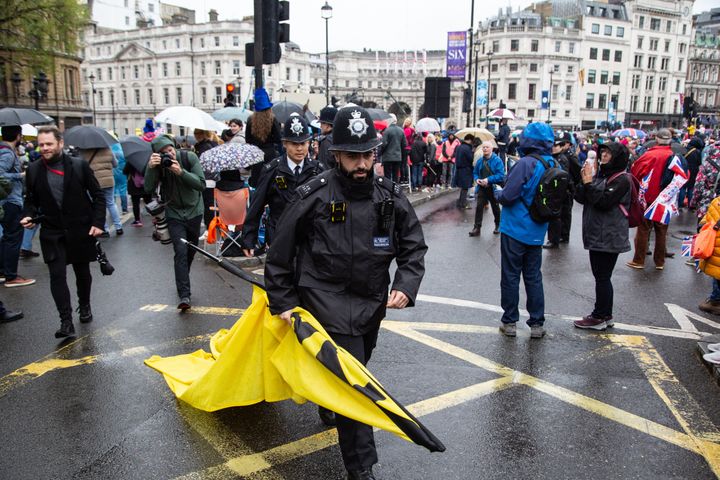
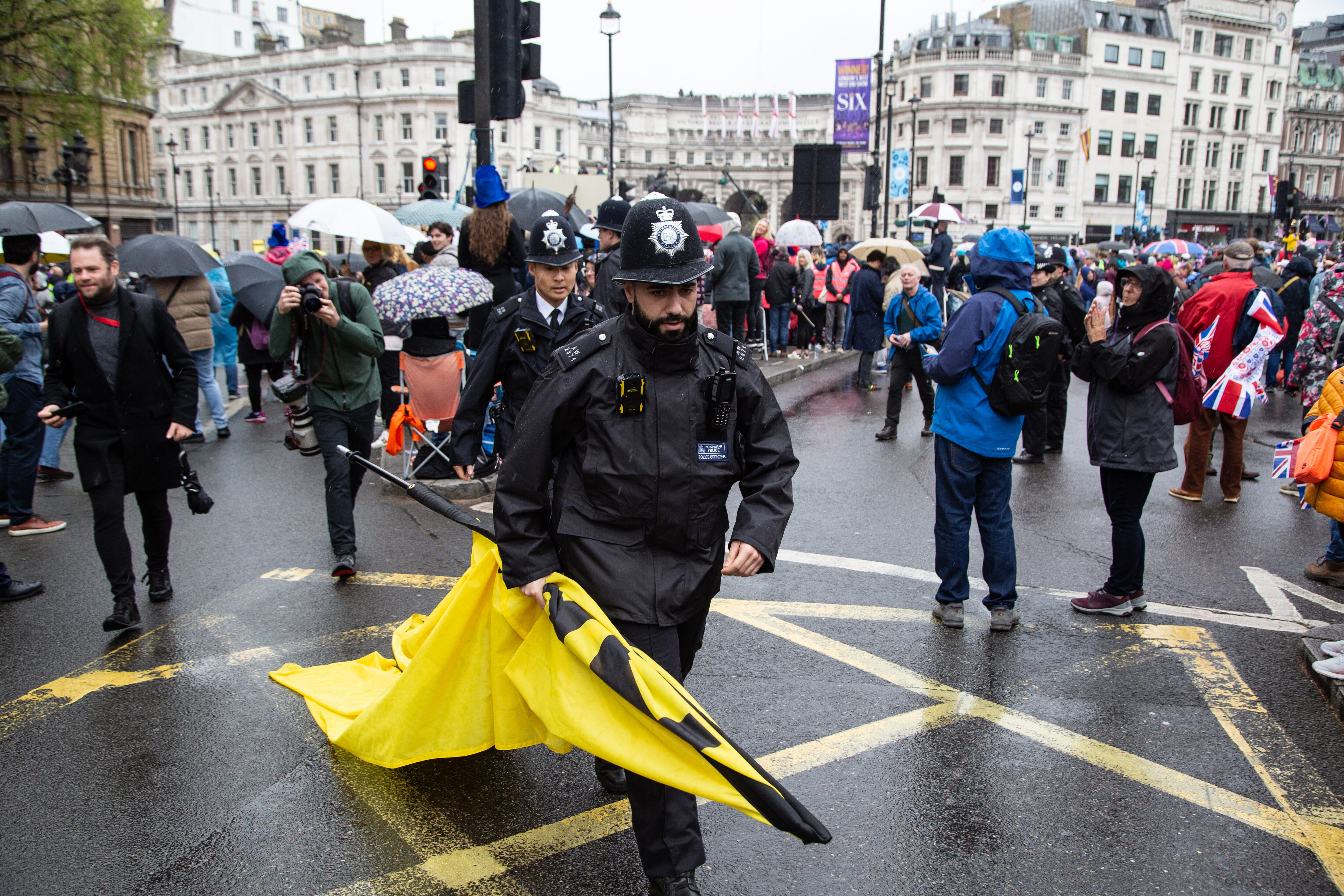
A policeman is seen carrying a banner taken away from protesters during an Anti-monarchist protest during King Charles III's Coronation.
A policeman is seen carrying a banner taken away from protesters during an Anti-monarchist protest during King Charles III’s Coronation.

SOPA Images via Getty Images

“Each and every police officer involved on the ground should hang their heads in shame. They showed no judgement, no common sense and no basic decency.

“This was a heavy handed action which had the appearance of a pre-determined arrest that would have occurred regardless of the evidence or our actions.

“The right to protest peacefully in the UK no longer exists. Instead we have a freedom to protest that is contingent on political decisions made by ministers and senior police officers.”

Smith said the arrests had “destroyed” whatever trust might have existed between peaceful protesters and the Met Police.

He questioned what was the point in the protesters being “open and candid with the police, working with their liaison officers and meeting senior commanders” if this is what happens.

A protester holds a placard which states 'This country is ours' during the demonstration.
A protester holds a placard which states ‘This country is ours’ during the demonstration.

SOPA Images via Getty Images

The campaigner insisted they would not be deterred from further protest, adding: “We will continue to protest with one simple message: Charles is not our king, it is time to abolish the monarchy.”

However, culture secretary Lucy Frazer insisted the police got the “balance right” and denied that officers had gone too far.

She told Sky News’ Sophy Ridge: “I think, overall, they managed to get that balance right.”

Home secretary Suella Braverman also praised the police for their actions, tweeting: “I’m incredibly grateful to the police for all their hard work at today’s coronation celebration to ensure it was safe and passed without incident.”

Met Police commander Karen Findlay acknowledged concerns about the arrest of protesters but defended Scotland Yard’s actions, saying: “Our duty is to do so in a proportionate manner”.

Protestors from the group Republic gather in their hundreds in Trafalgar square to say 'Not My King' in central London.
Protestors from the group Republic gather in their hundreds in Trafalgar square to say ‘Not My King’ in central London.

Andrew Aitchison via Getty Images

She said: “We absolutely understand public concern following the arrests we made [on Saturday morning].

“Protest is lawful and it can be disruptive. We have policed numerous protests without intervention in the build-up to the coronation, and during it.

“Our duty is to do so in a proportionate manner in line with relevant legislation. We also have a duty to intervene when protest becomes criminal and may cause serious disruption.

“This depends on the context. The coronation is a once in a generation event and that is a key consideration in our assessment.

“A protest involving large numbers has gone ahead today with police knowledge and no intervention.”

The Met said it received information that protesters were “determined to disrupt” the coronation – including defacing public monuments with paint, breaching barriers and disrupting official movements.

They confirmed 52 people were arrested for affray, public order offences, breach of the peace and conspiracy to cause a public nuisance around the coronation.

Under the controversial new Public Order Act, protesters who have an object with the intention of using it to “lock on” are liable to a fine, with those who block roads facing 12 months in prison.

Share Button

Tory MP Lee Anderson Rinsed Over Tweet Telling Republican Protesters To ‘Emigrate’

Tory MP Lee Anderson has been accused of trying to “cancel” republican protesters after he told them to leave the country.

The deputy chairman of the Conservative Party told anti-monarchy activists to “emigrate” rather than exercise their right to protest.

He made the comments after dozens of protesters were arrested during King Charles’s coronation.

Sharing an article on the arrests on Twitter, the MP for Ashfield wrote: “Not My King?

“If you do not wish to live in a country that has a monarchy the solution is not to turn up with your silly boards. The solution is to emigrate.”

Twitter users were quick to point out the irony of the hardline MP’s comments given he has previously railed against “cancel culture”.

One person commented: “Telling people who don’t agree with you to leave the country is about as ‘cancel culture’ as it gets.”

Jonathan Harris, a Lib Dem councillor in West Northamptonshire, tweeted: “30 p Lee – Idiot on display. You took the rights away for British people to live and work across the EU, and forget that great democracies are built on and absolutely allow the right to peaceful protest.”

Another described him as being a “liability” when being “this ludicrous” while one drily commented: “If you are leaving your country because you oppose its political system, Mr Anderson will, I’m sure, follow that logic and be the first to welcome you when you arrive at Dover.”

One pointed out: “Deputy chair of the Conservative party rejects freedom of speech.”

Meanwhile, one Twitter user told him: “I think you’re forgetting that the people protesting are the people of this country, they deserve to be able to freely express what they want for their country without being arrested.”

However, some did back Anderson’s view including fellow Tory MP Kevin Hollinrake who wrote: “Quite right Lee Anderson – time and a place for everything. Wrong time, wrong place.”

The Metropolitan Police Service has faced criticism after more than 50 people were arrested for alleged affray, public nuisance and breach-of-the-peace offences.

The arrests were described by human rights organisations as a “dangerous precedent” for a democratic nation.

It is not the first time Anderson has proved controversial, having previously called for the return of the death penalty and claiming people on Universal Credit were not in poverty.

Anderson is a former coal miner who was a Labour councillor in Ashfield before he defected to the Conservative Party in 2018 and went on to serve as a Tory councillor in Mansfield.

He has been dubbed “30p Lee” for claiming that meals could be prepared for that sum and suggesting people using food banks could not budget.

He recently clashed with Met Police commissioner Mark Rowley over the force’s handling of protests, telling him to “leave his ivory tower” to deal with demonstrators in Westminster.

Under the controversial new Public Order Act, protesters who have an object with the intention of using it to “lock on” are liable to a fine, with those who block roads facing 12 months in prison.

Share Button

Labour Tries To Shut Down Talk Of A Coalition Government With The Liberal Democrats

Labour’s Wes Streeting has insisted they are “not entertaining” the prospect of a coalition with the Liberal Democrats.

The shadow health secretary said he did not think it is the “scenario” the country will be in at the next general election.

However, he did not rule out a coalition with the Lib Dems when repeatedly pressed on the possibility in an interview with Sky’s Sophy Ridge.

In separate interview Lib Dem leader Ed Davey explicitly ruled out working with the Tories but did not rule out a coalition with Labour.

Last week’s council results point to a hung parliament at the next general election. They suggest Labour would be the largest party, but short of a majority.

Former prime minister David Cameron and former deputy prime minister Nick Clegg outside 10 Downing Street in London, on May 12, 2010.

AFP via Getty Images

It could be similar to the situation the Tories found themselves in in 2010 when they formed a coalition government with the Lib Dems.

Asked whether Labour would be prepared to go into coalition with the Lib Dems, Streeting said: “We’re not even entertaining that prospect…

“I just don’t think that is the scenario that we are going to be in after the next general election.”

Asked a third time about local election results pointing towards a hung parliament, he said: “This is a process, not an event. We’re not at the final destination yet in terms of the general election.”

Put to him that he was not ruling it out, he gave examples of why “we shouldn’t read the local elections right across”.

He said: “Take Hull, where I saw through gritted teeth the Liberal Democrats did rather well.

“I heard the Lib Dem leader of Hull council the other night saying ‘well, look, locally, people have voted Lib Dem but at the general election people in this city vote Labour’.”

He added: “We’re not complacent about this and there’s so much more still to come.”

When leader Lib Dem leader Davey was asked on the BBC’s Sunday With Laura Kuenssberg show about a coalition with Labour, he said: “That is a hypothetical question because we don’t know what’s going to happen after the next election.”

Put to him that he was ruling out working with the Tories but not Labour, said: “The focus is on getting rid of Conservative MPs. I make no apology for that.”

His deputy leader Daisy Cooper similarly did not rule out a coalition with Labour when challenged.

She told Sky they had “ruled out” working with the Conservatives because of the “damage they are doing to the country”.

But pressed on a coalition with Labour, she replied: “Everything we do between now and the general election will be about focusing on getting Liberal Democrat MPs elected.”

Thursday’s results were disastrous for the Tories who lost some 1,050 seats and control of nearly 50 councils.

It means Labour is now the largest party of local government – overtaking the Conservatives for the first time since 2002.

Share Button

Ed Sheeran Wrote A Song About My Tiny Scottish Town. Here’s Why It’s Completely Deserved

Sitting on a corner, by the only set of traffic lights in the town of Aberfeldy, is the Black Watch pub. It’s here that an impromptu singalong was led by none other than Ed Sheeran.

That was back in 2019. And now, four years later, Sheeran has released his latest album, Subtract, with a closing number called ‘The Hills of Aberfeldy’.

It’s a folk song; the kind of tune a mournful-looking man sings standing by a bar, holding a glass of whiskey; the patrons in silent reverence, heads bowed.

In the video for the song, Sheeran (clad in a toasty-looking white cable knit jumper), sinks into the hills. He emerges from the sea more appropriately dressed in an anorak. In reality, Aberfeldy is as far from the sea as you can get in Scotland. But it does have hills. Lots of them.

<div class="js-react-hydrator" data-component-name="YouTube" data-component-id="5432" data-component-props="{"itemType":"video","index":6,"contentListType":"embed","code":"

","type":"video","meta":{"author":"Ed Sheeran","author_url":"https://www.youtube.com/channel/UC0C-w0YjGpqDXGB8IHb662A","cache_age":86400,"description":"Subtract Visual Album Premiere, May 5th, 4pm BST: https://es.lnk.to/SubtractVisualPremiere\nSubtract, the new album, out now: https://es.lnk.to/subtract\n\nSubscribe to Ed’s channel: http://bit.ly/SubscribeToEdSheeran\n\nFollow Ed on…\nInstagram: http://instagram.com/teddysphotos\nTikTok: https://www.tiktok.com/@edsheeran\nFacebook: http://www.facebook.com/EdSheeranMusic\nTwitter: http://twitter.com/edsheeran\nDiscord: http://discord.gg/edsheeran\nOfficial Website: http://edsheeran.com\n\nDirected by Mia Barnes\nProduced by Roisín Audrey Moloney\nExecutive Producer Nathan Scherrer \nProduction Company Freenjoy \n \nCommissioned by Dan Curwin\nRecord Label Asylum Records\nStyling & Grooming Liberty Shaw & Hilary Owen\n \nService Company LS Productions\nService line producer Ellen De Faux\nService line producer Marii Stoltsen\n \nCinematography Natasha Braier \nProduction Design Sarah Asmail\n1st AD Rawdon De Fresnes\nCamera Operator Ossie Mclean\nGaffer Peter Taylor\nKey Grip Davey Logan\nEdited by Chiao Chen\nSound Design Christian Stropko\nVFX by Mathematic\nColourist Dante Pasquinelli\nColour Studio Ethos\n \nStills Photographer Mark Surridge\nVideographer Nic Minns\n\nLyrics:\n\nOh leaves are covered in snow\nAnd the water’s frozen\nOh I long for you to be the one that I’m holding\nAnd warm me down to my bones\nAs you lay beside me hold me close\n\nOh leaves are starting to fall\nAnd the sun grows cold\nAnd my heart might break from the weight of it all\nFor all that I know, you could be holding somebody else as close\n\nWhen I’m home I’ll hold you like I’m supposed to\nYet I know that I have never told you\nDarling we could fall in love\nNeath the hills of Aberfeldy\n\nOh ground is slowly melting\nAnd the sun beats strong\nAnd I feel like my feet may have wandered too long\nAnd I will remain here alone\n‘Coz I fear that you may have found someone\n\nWhen I’m home I’ll hold you like I’m supposed to\nYet I know that I have never told you\nDarling we could fall in love\nNeath the hills of Aberfeldy\nDarling we could fall in love\nNeath the hills of Aberfeldy\n\nWherever I go I will always find \nAnother stranger to share in the weight of my crimes\nAnd I know you will never find \nAnother heart that wants you more than mine","options":{"_cc_load_policy":{"label":"Closed captions","value":false},"_end":{"label":"End on","placeholder":"ex.: 11, 1m10s","value":""},"_start":{"label":"Start from","placeholder":"ex.: 11, 1m10s","value":""},"click_to_play":{"label":"Hold load & play until clicked","value":false}},"provider_name":"YouTube","thumbnail_height":720,"thumbnail_url":"https://i.ytimg.com/vi/29lq-cvvlSo/maxresdefault.jpg","thumbnail_width":1280,"title":"Ed Sheeran – The Hills of Aberfeldy [Official Video]","type":"video","url":"https://www.youtube.com/watch?v=29lq-cvvlSo","version":"1.0"},"flags":[],"enhancements":{},"fullBleed":false,"options":{"theme":"life","device":"desktop","editionInfo":{"id":"uk","name":"U.K.","link":"https://www.huffingtonpost.co.uk","locale":"en_GB"},"slideshowAd":{"scriptTags":[],"otherHtml":""},"slideshowEndCard":{"scriptTags":[],"otherHtml":""},"isMapi":false,"isAmp":false,"isVideoEntry":false,"isMt":false,"entryId":"6456ab18e4b007e3d7d95bfe","entryPermalink":"https://www.huffingtonpost.co.uk/entry/ed-sheeran-wrote-a-song-about-my-tiny-scottish-town-heres-why-its-completely-deserved_uk_6456ab18e4b007e3d7d95bfe","entryTagsList":"scotland,ed-sheeran","sectionSlug":"lifestyle","deptSlug":null,"sectionRedirectUrl":null,"subcategories":"","isWide":false,"headerOverride":null,"noVideoAds":false,"disableFloat":false,"isNative":false,"commercialVideo":{"provider":"custom","site_and_category":"uk.lifestyle","package":null},"isHighline":false,"vidibleConfigValues":{"cid":"60afc140cf94592c45d7390c","disabledWithMapiEntries":false,"overrides":{"all":"60b8e525cdd90620331baaf4"},"whitelisted":["56c5f12ee4b03a39c93c9439","56c6056ee4b01f2b7e1b5f35","59bfee7f9e451049f87f550b","5acccbaac269d609ef44c529","570278d2e4b070ff77b98217","57027b4be4b070ff77b98d5c","56fe95c4e4b0041c4242016b","570279cfe4b06d08e3629954","5ba9e8821c2e65639162ccf1","5bcd9904821576674bc55ced","5d076ca127f25f504327c72e","5b35266b158f855373e28256","5ebac2e8abddfb04f877dff2","60b8e525cdd90620331baaf4","60b64354b171b7444beaff4d","60d0d8e09340d7032ad0fb1a","60d0d90f9340d7032ad0fbeb","60d0d9949340d7032ad0fed3","60d0d9f99340d7032ad10113","60d0daa69340d7032ad104cf","60d0de02b627221e9d819408"],"playlists":{"default":"57bc306888d2ff1a7f6b5579","news":"56c6dbcee4b04edee8beb49c","politics":"56c6dbcee4b04edee8beb49c","entertainment":"56c6e7f2e4b0983aa64c60fc","tech":"56c6f70ae4b043c5bdcaebf9","parents":"56cc65c2e4b0239099455b42","lifestyle":"56cc66a9e4b01f81ef94e98c"},"playerUpdates":{"56c6056ee4b01f2b7e1b5f35":"60b8e525cdd90620331baaf4","56c5f12ee4b03a39c93c9439":"60d0d8e09340d7032ad0fb1a","59bfee7f9e451049f87f550b":"60d0d90f9340d7032ad0fbeb","5acccbaac269d609ef44c529":"60d0d9949340d7032ad0fed3","5bcd9904821576674bc55ced":"60d0d9f99340d7032ad10113","5d076ca127f25f504327c72e":"60d0daa69340d7032ad104cf","5ebac2e8abddfb04f877dff2":"60d0de02b627221e9d819408"}},"connatixConfigValues":{"defaultPlayer":"8b034f64-513c-4987-b16f-42d6008f7feb","clickToPlayPlayer":"5a777b9b-81fe-41a6-8302-59e9953ee8a2","videoPagePlayer":"19654b65-409c-4b38-90db-80cbdea02cf4"},"customAmpComponents":[],"ampAssetsUrl":"https://amp.assets.huffpost.com","videoTraits":null,"positionInUnitCounts":{"buzz_head":{"count":0},"buzz_body":{"count":0},"buzz_bottom":{"count":0}},"positionInSubUnitCounts":{"article_body":{"count":0},"blog_summary":{"count":0},"before_you_go_slideshow":{"count":0}},"connatixCountsHelper":{"count":0},"buzzfeedTracking":{"context_page_id":"6456ab18e4b007e3d7d95bfe","context_page_type":"buzz","destination":"huffpost","mode":"desktop","page_edition":"en-uk"},"tags":[{"name":"scotland","slug":"scotland","links":{"relativeLink":"news/scotland","permalink":"https://www.huffingtonpost.co.uk/news/scotland","mobileWebLink":"https://www.huffingtonpost.co.uk/news/scotland"},"url":"https://www.huffingtonpost.co.uk/news/scotland/"},{"name":"Ed Sheeran","slug":"ed-sheeran","links":{"relativeLink":"news/ed-sheeran","permalink":"https://www.huffingtonpost.co.uk/news/ed-sheeran","mobileWebLink":"https://www.huffingtonpost.co.uk/news/ed-sheeran"},"url":"https://www.huffingtonpost.co.uk/news/ed-sheeran/"}],"isLiveblogLive":null,"cetUnit":"buzz_body","bodyAds":["

\r\n\r\n HPGam.cmd.push(function(){\r\n\t\treturn HPGam.render(\"inline-1\", \"entry_paragraph_1\", false);\r\n });\r\n\r\n","

\r\n\r\n HPGam.cmd.push(function(){\r\n\t\treturn HPGam.render(\"inline\", \"entry_paragraph_2\", false);\r\n });\r\n\r\n","

\r\n\r\n HPGam.cmd.push(function(){\r\n\t\treturn HPGam.render(\"inline-2\", \"entry_paragraph_3\", false);\r\n });\r\n\r\n","

\r\n\r\n HPGam.cmd.push(function(){\r\n\t\treturn HPGam.render(\"inline-infinite\", \"repeating_dynamic_display\", false);\r\n });\r\n\r\n"],"adCount":0},"isCollectionEmbed":false}”>

From the doors of the Black Watch, a 90 minute walk takes you up a stunning gorge called ‘The Birks’. This was the inspiration for the second most listened to song about this town, famous Scotttish poet Robert Burns’ poem ‘The Birks of Aberfeldy’, written 200 years ago.

Burns fell in love here too, and lyrics from his poem are etched into signs you can spot on the walk – that’s if you can take your eyes off the red squirrels, swooping buzzards, and trickling waterfalls. This is Scotland at its most alluring.

The appeal of Aberfeldy lies in its position: nestled in the rambling Tay Valley, where clouds cling insistently to the green hills all around. It’s a part of the world that oozes romanticism, a place that’s improved by ‘dreich’ weather – the hills look more enticing in the rain, the glens more ethereal. Lichen clings to every branch, moss to every stone.

It’s the kind of stuff that songwriters live for. Sheeran’s clearly enamoured with the weather and the trees:

“Oh, leaves are covered in snow, And the water’s frozen. Oh, I long for you to be the one that I’m holding,” sings Sheeran, in full Van Morrison mode, before continuing, “Oh, leaves are starting to fall, And the sun goes cold. And my heart might break from the way of it all.”

And the leaves are indeed all around; Perthshire is known as Big Tree Country. Neighbouring village Fortingall is home to a 5,000 year old Yew tree, one of the oldest trees in Britain.

Jane Barlow – PA Images via Getty Images

Next door to the Yew, the Fortingall Hotel holds the kind of foot-stomping folk music you might imagine Ed Sheeran enjoying on a Friday night. It’s so remote here, you wouldn’t be surprised if there were Hobbits clanking tankards in a dim corner, too.

But the biggest local nuisance are the beavers, reintroduced in recent years, who leave their tell-tale tooth marks on the trunks of trees along the river. The local Facebook group is up-in-arms about the beavers – best not mention it if you drop into the Black Watch for a pint.

More welcome are the frequent stream of hikers traversing the popular 79-mile long Rob Roy Way. The first pub they come to in town is – yes – the Black Watch.

Back in the 1800s, visitors flocked to Aberfeldy by train. Nowadays the train station is a hotel, and the visitors arrive by 4×4 with stand up paddleboards strapped to their roofs, often heading to Loch Tay, five miles away.

It’s here that Ed Sheeran once hosted a party – renting the entire Hot Box Spa for himself and friends one summer’s afternoon. It’s still open, and visitors can sip champagne in a hot tub with a view of the surrounding mountains before taking the slide into the icy waters.

One of Scotland's best known hills, Schiehallion is one of the easiest Munros to climb on a fine summer's day.

Product of RDPhotography381 via Getty Images

One of Scotland’s best known hills, Schiehallion is one of the easiest Munros to climb on a fine summer’s day.

Looming over the whole area is the iconic peak of Schiehallion – known in Gaelic as Sidh Chailleann, or the ‘Fairy Hill of the Caledonians’. Schiehallion gives its name to a local beer, which is of course served at the Black Watch. Many know Aberfeldy for its eponymous whisky, which is distilled in a beautiful old building, set back from the banks of the Tay on a grassy lawn.

Around the corner is Glen Lyon coffee roastery. The rustic venue hosts a small café where Gaelic singers such as Kim Carnie are known to perform. The roastery recently collaborated with trendy micro-brewery in nearby Blair Atholl on a beer called Volcano Coffee Stout. It’s as dark as the long, Scottish winter nights.

The roastery is named after a local valley dubbed Scotland’s “longest, loneliest and loveliest glen” by legendary Scottish romantic, Sir Walter Scott. Here, a winding, undulating road takes drivers past stone bridges, waterfalls, and moss-clad boulders. In autumn it’s a breath-taking journey among falling golden leaves. One can imagine Sheeran’s cheeky blue eyes grow wider as he ventured down Glen Lyon, scribbling lyrics in his little Ed Sheeran notebook.

Take a walk in any direction and you’ll stumble upon neolithic stone circles, ancient forts or still-inhabited castles.

Back in town, at the market square, are a host of independent shops. The newest of these is ‘The Shop by Ballintaggart’, an outpost of the nearby refined Ballingtaggart Farm and Grandtully Hotel.

There’s an art-deco style cinema too, which shows films, alongside hosting events such as ‘craft and craic’, and a beer club. Add in the rustic homeware store Homer, vintage and vinyl record shop MoJo, bookshop-cum-café in The Watermill, and a zero-waste shop Handam and there’s plenty to keep you busy.

There’s a lot to fall in love with around here, and we haven’t talked about the monthly farmer’s market, quaint putting green, or annual Highland Show. It was clearly enough to turn Sheeran into part folk musician, part romantic poet. With his album surely heading to Number 1, no doubt more are now on their way.

“I have never told you Darling, we fall in love with the hills of Aberfeldy.”

Share Button