Young kids avoid one learning trap that often snares adults

Children have a secret power that helps them avoid a “learning trap” that adults may sometimes fall into: Kids just can’t focus their attention.

A new study used eye-tracking technology to show that kids’ attention wandered all over a computer screen while they were trying to complete a task — even when adults quickly figured out they could do the task more efficiently by focusing on particular objects.

But that tendency to have a wandering eye helped 4- and 5-year-olds when the task unexpectedly changed — and they noticed important things on the screen that adults were not paying attention to.

“The ability of adults to focus their attention is usually very helpful in everyday life,” said Vladimir Sloutsky, co-author of the study and professor of psychology at The Ohio State University.

“But sometimes it helps to see the world more as a kid and to notice things that may not seem that important or relevant at the time.”

Sloutsky conducted the research with Nathaniel Blanco, a postdoctoral researcher, and Brandon Turner, professor, both in psychology at Ohio State. The study was published online recently in the Journal of Experimental Child Psychology.

The study involved 30 4- and 5-year-old children and 38 adults who participated in a lab, where they were fitted with eye trackers that could tell where they looked on a computer screen.

They were then shown colorful images of creatures that had seven identifiable features, including a head, tail and antennae.

Participants were told there were two types of creatures, called Flurps and Jalets, and that they had to figure out which ones were which.

One feature was always different on the two types of creatures — for example, the Jalets may have a blue tail and the Flurps an orange tail. In addition, the children and adults were told that most (but not all) of the Flurps had a certain type of feature, such as pink antennae.

One of the features was never mentioned in the instructions and it did not differ between the types of creatures. This was what the researchers called the “irrelevant feature.”

After training, participants were shown a series of images of the creatures on the computer screen and were told to indicate which type of creature each one was.

During the first part of the experiment, adults quickly learned which feature always determined whether the creature was a Flurp or Jalet, and the eye-tracker showed that they then concentrated nearly all of their attention on that feature.

Children were slower to learn which feature was most important in determining which creature was which — and the eye-tracker showed they continued to look at all the features of the two creatures, even the ones that were not relevant.

“The kids were not as efficient as adults at learning quickly,” Sloutsky said. “They kept looking around even when they didn’t need to.”

But halfway through the experiment, the researchers made an unannounced switch: The irrelevant feature — the body part that previously had no bearing on what type of creature it was — became the feature that would determine whether it was a Flurp or a Jalet. This feature, which had been the same for both creatures before the switch, was now different for each.

After the switch, the adults were more oblivious to the importance of the new feature than the children were. Instead, they were relying on the previously learned less-important features.

Children, on the other hand, had been paying attention to everything, so they noticed more swiftly that the rules had changed.

“The adults were suffering from learned inattention,” Sloutsky said. “They weren’t paying attention to features that weren’t important during the first part of the experiment, so they missed when those features did become important.”

Sloutsky said the brains of 4- and 5-year-olds aren’t mature enough to focus attention in the way adults do. That fact may help them learn more as they explore the world.

And adults certainly have the ability to distribute their attention broadly like the children did in this study — but they often choose selective attention because it is helpful in achieving efficiency, he said.

The lesson for adults, though, is to realize that selective attention, while increasing the efficiency of learning and performance, can also lead to a learning trap in some situations, Sloutsky said.

“When you know something really well or a solution to a problem seems obvious, it may help to broaden your attention, to look for clues that may not seem relevant at first — to think like a kid again.”

The study was supported by grants from the National Institutes of Health.

Share Button

Engineers build a battery-free, wireless underwater camera

Scientists estimate that more than 95 percent of Earth’s oceans have never been observed, which means we have seen less of our planet’s ocean than we have the far side of the moon or the surface of Mars.

The high cost of powering an underwater camera for a long time, by tethering it to a research vessel or sending a ship to recharge its batteries, is a steep challenge preventing widespread undersea exploration.

MIT researchers have taken a major step to overcome this problem by developing a battery-free, wireless underwater camera that is about 100,000 times more energy-efficient than other undersea cameras. The device takes color photos, even in dark underwater environments, and transmits image data wirelessly through the water.

The autonomous camera is powered by sound. It converts mechanical energy from sound waves traveling through water into electrical energy that powers its imaging and communications equipment. After capturing and encoding image data, the camera also uses sound waves to transmit data to a receiver that reconstructs the image.

Because it doesn’t need a power source, the camera could run for weeks on end before retrieval, enabling scientists to search remote parts of the ocean for new species. It could also be used to capture images of ocean pollution or monitor the health and growth of fish raised in aquaculture farms.

“One of the most exciting applications of this camera for me personally is in the context of climate monitoring. We are building climate models, but we are missing data from over 95 percent of the ocean. This technology could help us build more accurate climate models and better understand how climate change impacts the underwater world,” says Fadel Adib, associate professor in the Department of Electrical Engineering and Computer Science and director of the Signal Kinetics group in the MIT Media Lab, and senior author of the paper.

Joining Adib on the paper are co-lead authors and Signal Kinetics group research assistants Sayed Saad Afzal, Waleed Akbar, and Osvy Rodriguez, as well as research scientist Unsoo Ha, and former group researchers Mario Doumet and Reza Ghaffarivardavagh. The paper is published in Nature Communications.

Going battery-free

To build a camera that could operate autonomously for long periods, the researchers needed a device that could harvest energy underwater on its own while consuming very little power.

The camera acquires energy using transducers made from piezoelectric materials that are placed around its exterior. Piezoelectric materials produce an electric signal when a mechanical force is applied to them. When a sound wave traveling through the water hits the transducers, they vibrate and convert that mechanical energy into electrical energy.

Those sound waves could come from any source, like a passing ship or marine life. The camera stores harvested energy until it has built up enough to power the electronics that take photos and communicate data.

To keep power consumption as a low as possible, the researchers used off-the-shelf, ultra-low-power imaging sensors. But these sensors only capture grayscale images. And since most underwater environments lack a light source, they needed to develop a low-power flash, too.

“We were trying to minimize the hardware as much as possible, and that creates new constraints on how to build the system, send information, and perform image reconstruction. It took a fair amount of creativity to figure out how to do this,” Adib says.

They solved both problems simultaneously using red, green, and blue LEDs. When the camera captures an image, it shines a red LED and then uses image sensors to take the photo. It repeats the same process with green and blue LEDs.

Even though the image looks black and white, the red, green, and blue colored light is reflected in the white part of each photo, Akbar explains. When the image data are combined in post-processing, the color image can be reconstructed.

“When we were kids in art class, we were taught that we could make all colors using three basic colors. The same rules follow for color images we see on our computers. We just need red, green, and blue — these three channels — to construct color images,” he says.

Sending data with sound

Once image data are captured, they are encoded as bits (1s and 0s) and sent to a receiver one bit at a time using a process called underwater backscatter. The receiver transmits sound waves through the water to the camera, which acts as a mirror to reflect those waves. The camera either reflects a wave back to the receiver or changes its mirror to an absorber so that it does not reflect back.

A hydrophone next to the transmitter senses if a signal is reflected back from the camera. If it receives a signal, that is a bit-1, and if there is no signal, that is a bit-0. The system uses this binary information to reconstruct and post-process the image.

“This whole process, since it just requires a single switch to convert the device from a nonreflective state to a reflective state, consumes five orders of magnitude less power than typical underwater communications systems,” Afzal says.

The researchers tested the camera in several underwater environments. In one, they captured color images of plastic bottles floating in a New Hampshire pond. They were also able to take such high-quality photos of an African starfish that tiny tubercles along its arms were clearly visible. The device was also effective at repeatedly imaging the underwater plant Aponogeton ulvaceus in a dark environment over the course of a week to monitor its growth.

Now that they have demonstrated a working prototype, the researchers plan to enhance the device so it is practical for deployment in real-world settings. They want to increase the camera’s memory so it could capture photos in real-time, stream images, or even shoot underwater video.

They also want to extend the camera’s range. They successfully transmitted data 40 meters from the receiver, but pushing that range wider would enable the camera to be used in more underwater settings.

This research is supported, in part, by the Office of Naval Research, the Sloan Research Fellowship, the National Science Foundation, the MIT Media Lab, and the Doherty Chair in Ocean Utilization.

Share Button

Hundreds recalled over shoulder op concerns at Walsall hospital

Some patients have lost the full use of their arm after surgery at Walsall Manor Hospital.

Share Button

NHS Scotland strikes are last resort, says union leader

Unite general secretary Sharon Graham warned that NHS union members are prepared to strike.

Share Button

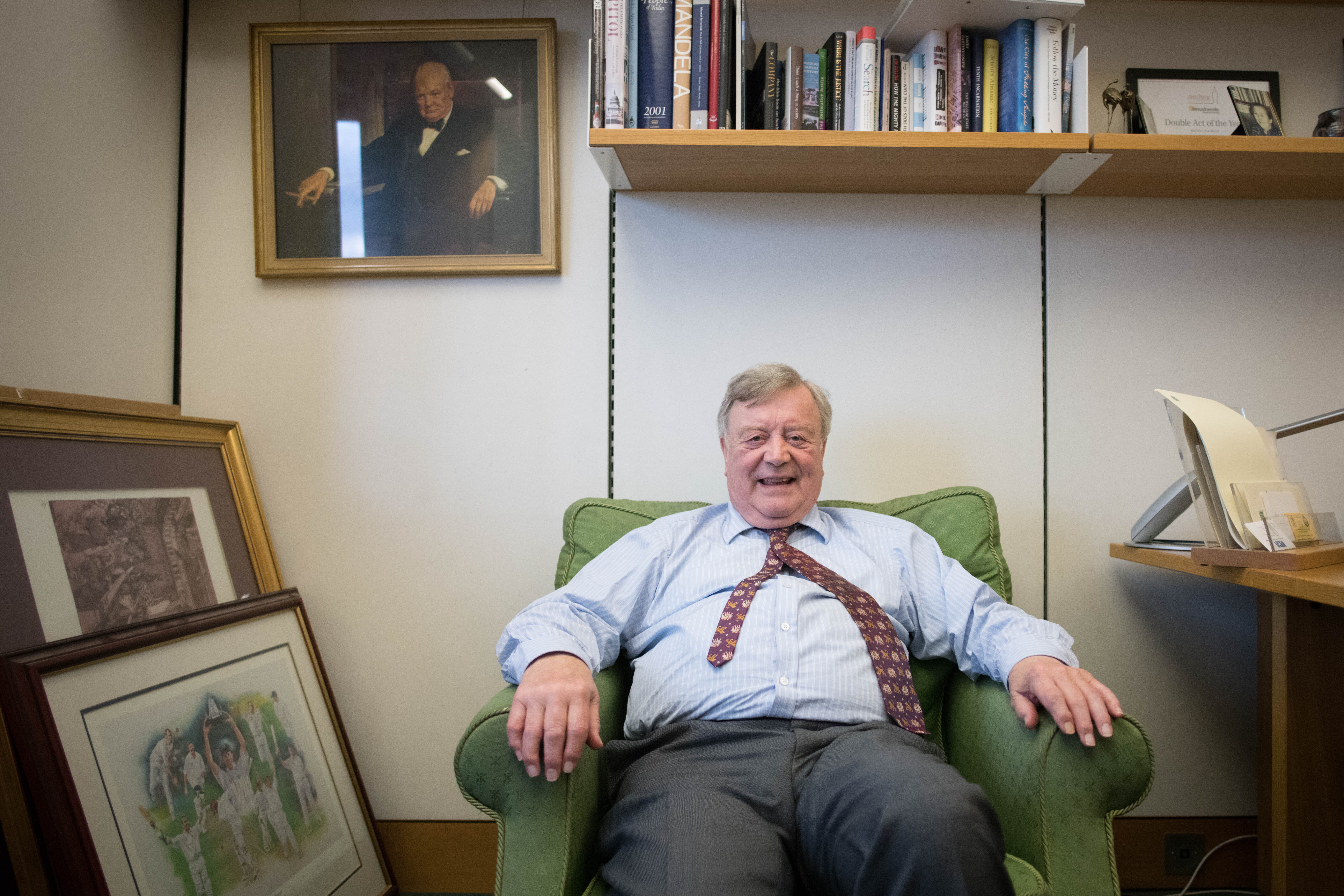
Ken Clarke Says Kwasi Kwarteng’s Tax Cuts Are Like Something Out Of Latin America

Kwasi Kwarteng’s tax giveaway for the rich would not have looked out of place in Latin America and could lead to economic meltdown, according to Ken Clarke.

The Tory grandee – who served as chancellor under John Major – said the decision to scrap the 45p tax rate for high earners could send inflation even higher and cause the value of the pound to collapse.

Kwarteng unveiled a £45 billion package of tax cuts in Friday’s mini-budget, which he said would lead to increased economic growth.

But Clarke, who quit parliament in 2019 after nearly 50 years as an MP, said they would not work.

He told Radio Four’s ‘World At One’ programme: “I don’t accept – I never have, the Conservative party never has – the overall premise of the budget, which is that you make tax cuts for the wealthiest 5 per cent, and it makes them work so much harder, and [there’s a] rush to invest.

“I’m afraid that’s the kind of thing that’s usually tried in Latin American countries without success.

“I do not think you stimulate growth by cutting taxes on the better-off, or taxes on business. If it was so simple, we would have got rid of taxes all together some time ago.

“What the increased spending power … is going to do is run the risk of further stimulating inflation. And we’re going into a serious inflationary recession this winter.”

Kwarteng is paying for the tax cuts by piling another £70 billion on the national debt, which Clarke said was now too high.

He said: “We’re heading in the Italian direction. That is going to be a problem, a very great problem, in the short term if it leads to a collapse in the pound and the loss of confidence in our economy. We’re going to drive investment away, not attract it.

“I don’t think anybody I was ever in government with would have contemplated a budget like this.”

The scrapping of the 45p rate means that those earning more than a million pounds will save £55,000 on their tax bill.

Kwarteng this morning defended his mini-budget, and suggested more tax cuts were on the way.

He said: “We’ve got to have a much more front-footed approach to growth and that’s what my Friday statement was all about.

“I think that if we can get some of the reforms … if we get business back on its feet, we can get this country moving and we can grow our economy, and that’s what my focus is 100 per cent about.”

Labour leader Keir Starmer said he would bring back the 45p tax rate if he becomes prime minister.

He said: “I do not think that the choice to have tax cuts for those that are earning hundreds if thousands of pounds is the right choice when our economy is struggling the way it is, working people are struggling the way they are and our public services are on their knees. So it is the wrong choice.

“I would reverse the decision that they made on Friday, let’s be absolutely clear about that.”

Share Button

Victoria Beckham Gets Saucy About David’s ‘Sticky Stuff’ In Cheeky TikTok

Victoria Beckham served up a side of innuendo to accompany husband David’s latest harvest of honey this weekend.

Posh got rather saucy in a video posted to her TikTok account showing Becks tending to his hives, becoming rather obsessed with his “sticky stuff”.

With her tongue firmly in her cheek, she told her 450k followers: “He’s about to release his sticky stuff… His new batch of sticky stuff.”

As David remarked on the batch of honey’s good “flowage”, Victoria said: “Look at his. It’s pouring out of that one.”

She then said she was “off to sample” said “sticky stuff”.

“I’ll let you know what David’s sticky stuff tastes like,” she added. “I’ll mark it out of 10 and let you know.”

In the comments, one fan wrote: “Victoria doesn’t get enough credit for how hilariously funny she is.”

Another added: “She’s so funny and they’re absolute ‘couple goals’.”

Of course, those who follow the Beckhams on social media will know that Posh and Becks regularly poke fun at one another in their videos.

Share Button

Liz Truss Versus The Trade Unions: The Next Front In The Culture Wars?

Much has been made of Liz Truss’s attempts to emulate her icon, Margaret Thatcher, in her quest to become Tory leader and prime minister.

While she has sought to distance herself from the comparison, there is one thing she does share with her late predecessor: she has taken over as prime minister at a time when Britain’s economy is crumbling and its workforce is more mutinous than ever.

Angered by an inflation rate of 9.9 per cent that is outstripping stagnant wages, trade unions are organising en masse for industrial action that threatens to take Britain back to the turmoil of the 1970s.

One by one, they are rejecting the government’s single-digit pay offers and organising strike ballots. Collectively, they have said “enough is enough”.

Their resistance sets the scene for a new front in the divisive culture wars in which unions fear Truss will attempt to “crush the enemy within” by bringing in a series of measures that will hamper their ability to take industrial action.

Kwasi Kwarteng, Truss’s new chancellor, confirmed this week the government will bring forward legislation making it harder to go on strike.

“What we have is a government that seems to be struggling to come up with answers to the cost of living crisis,” says Tim Sharp, senior policy officer for employment rights at the Trades Union Congress (TUC).

“It appears that some in government would like to distract from that with a culture war against the unions.

“We had a leadership contest in which the candidates had to appeal to some of their more ideological members and that’s why we’ve seen the pledges in terms of anti-union action.”

Which unions are striking?

The RMT and Aslef rail unions, the Communication Workers Union (CWU) representing Royal Mail workers and barristers under the Criminal Bar Association (CBA) have all been on strike over pay and working conditions in recent weeks.

Dockhands represented by Unite have also been striking at the port of Felixstowe and are set to do so again in September, in the shadow of the Labour Party conference in Liverpool.

The National Education Union (NEU), the largest education union in the UK that represents teachers, lecturers and support staff, will open its online preliminary ballot for strike on September 24, before a formal ballot takes place in November.

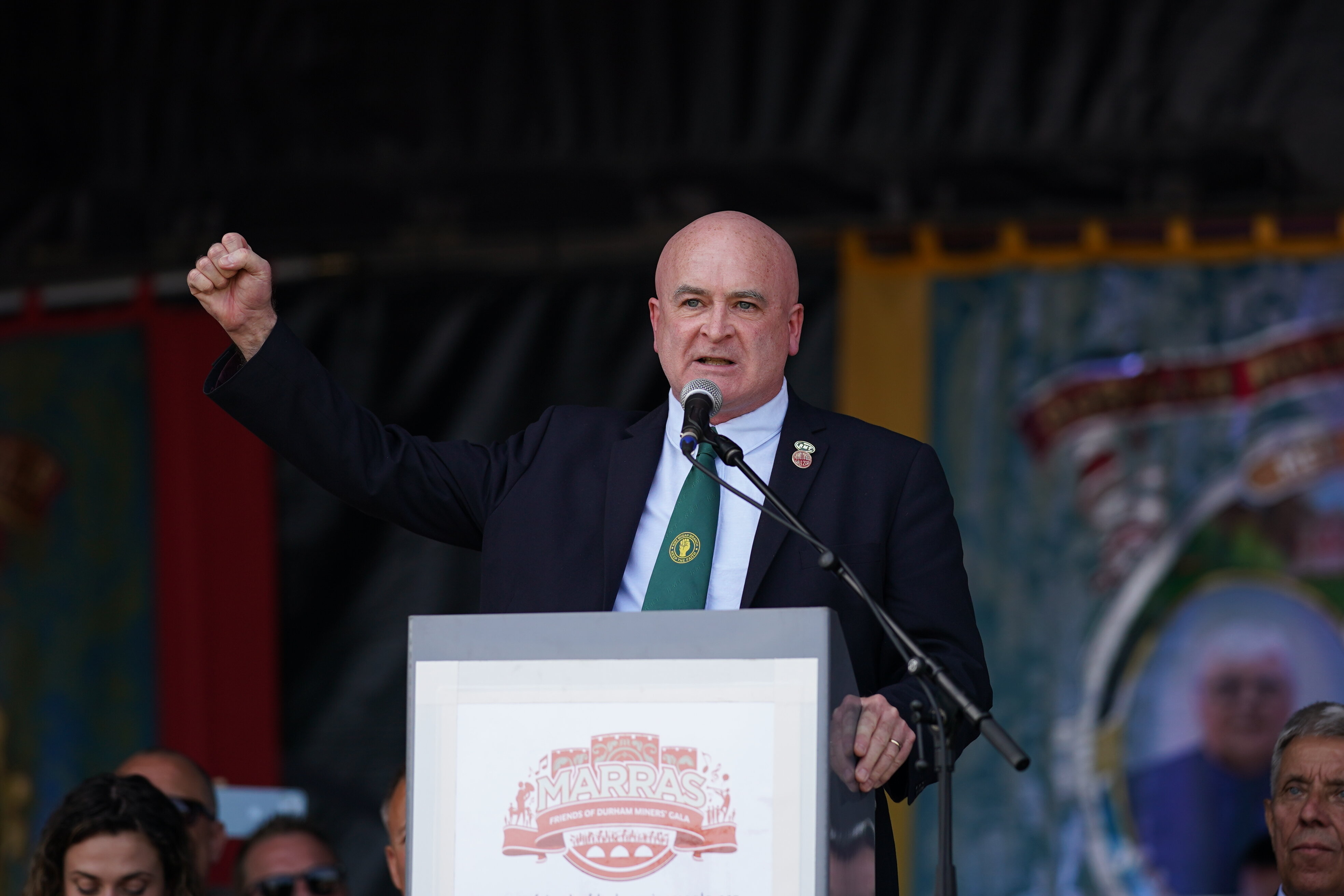
RMT general secretary Mick Lynch has said Britain could be brought to a standstill by a wave of strikes hitting “every sector of the economy”.

Ian Forsyth via Getty Images

The Royal College of Nursing (RCN), whose members include half a million nurses, midwives, nursing support workers and students, opened a postal ballot for strike action on September 15 that will close on October 13.

If enough members vote for industrial action, it will be the first time in the union’s history that its members in England and Wales go on strike.

The British Medical Association (BMA) has also said it will ballot junior doctor members in England for industrial action if the government fails to restore pay to 2008/09 levels by the end of this month.

The public needs to be prepared for the havoc such strikes could wreak on their daily lives.

“Every school in the country is going to be shut bringing total chaos,” one union source says. “Tens of thousands of hospital appointments are going to be cancelled.

“This is the price you pay for a Tory government that has slashed public services.”

The tools in Truss’s arsenal

If Truss is looking at how she might limit trade union rights, David Cameron’s Trade Union Act of 2016 might provide some inspiration.

Billed at the time as some of the most “regressive” anti-union legislation in the world, the law brought in measures such as higher thresholds for success in industrial ballots.

It also increased the notice period unions must give to employers ahead of any strike action from one week to two weeks.

In an ordinary union, there must be a 50 per cent turnout for an industrial ballot in order for their results to be legally valid. A simple majority has to vote in favour of strike action for it to go ahead.

But for workers who deliver “important” public services, not only does the 50 per cent turnout have to be met, the support of 40 per cent of all eligible members must also be attained for the strike action to be legal.

Unions fear that Truss could use a new law to bring in thresholds that are so high that they could make strikes nigh on impossible.

They anticipate that she could also widen the definition of what counts as a public service to include bus drivers and tube drivers, for example, to apply the 40 per cent threshold.

“If she goes in this direction there will be new laws — that’s a fact,” says one union source.

“She’s got a parliamentary majority. You’re not going to stop her legislating.

“If the Tories use an act of parliament to redefine what defines a public service, at a stroke they would cover huge sections of private industry.

“They can make it even more difficult for unions to get through the thresholds. These laws are already the most stringent of anywhere in Europe.”

A new law to guarantee a minimum level of service on “vital national infrastructure” was a key pledge to come out of the leadership campaign, as was a tax on the strike benefit members receive when they don’t go into work.

Truss also suggested brining in a cooling-off period so that unions can no longer strike as many times as they like in the six-month period after a ballot.

Tim Sharp says the effect of Truss’s plans could be that they make union disputes harder to resolve.

“The industrial action we’ve had has been grassroots driven,” he tells HuffPost UK.

“They risk making industrial disputes harder to resolve. You often see a day of strikes here and there, but if a union is being limited in how often it can take industrial action, then what you could see is longer periods of strike action.”

Another union insider agrees: “If Truss thinks she’s going to shut down the unions she’s got another thing coming.

“She will just create so much anger it increases turnout in the many union ballots currently going on.”

Workers of the world unite

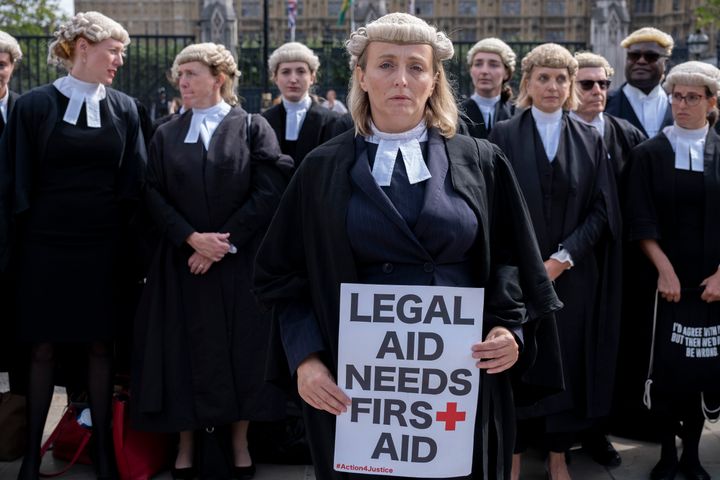
Criminal barristers are on strike over pay for legal aid work.

Mike Kemp via Getty Images

In the unions, Truss has found herself an opponent that will not go down without a fight.

Sharon Graham, the boss of the Unite union, tells HuffPost UK there will be a “prolonged and fierce resistance to Truss attacking workers’ rights”.

“If Liz Truss thinks we have just been sitting waiting for her anti-trade union laws, she’s wrong,” she says.

“We’re ready. If she puts up the thresholds for legal strike action we’ll employ more organisers to get the vote out. If she taxes strike pay, we’ll take more money from the strike fund to hold the real value of strike pay.

“And if she tries to gag trade unions we’ll find ways to speak out more and more.”

And in a swipe at Truss’s own result in the Tory leadership contest Graham says: “Right now if workers plan strike action 50 per of those who can vote in the strike ballot must vote for the strike to be legal.

“It’s a bit rich for Liz Truss to be upping the figures in new laws. In her election for leader she only got 47 per cent of Tory members who were entitled to vote.

“If the Tory Party was bound by the same restraints as the unions Truss would not have made the grade for leader. You could not make it up.”

RMT general secretary Mick Lynch said workers could be forced to take “unlawful industrial action” if the government makes it impossible for legal strikes to take place.

He told Sky News: “We’re fast getting to a situation where we’re going to have laws that are as oppressive as those that exist in Russia and China and back in Poland before Solidarnosc came along and took unlawful industrial action to break free of the oppression of the old Soviet bloc an the communist regime.”

The TUC is already preparing its campaign to appeal to the public when the battle begins.

National rallies will take place in Westminster and there will be a tour of town halls, a national day of action and a lobby of parliament.

The message members have been told to stick to is that Truss plans’ “threaten the right to strike” and are an attempt to distract the public from the burgeoning cost of living crisis.

And crucially, there is the edict to “stay calm: they want us to blow our tops, don’t give them the satisfaction”.

Failing that, the government could find itself in court.

In a sign of the resistance to come, 11 trade unions launched legal action against the government on Tuesday over government plans to replace striking workers with agency staff.

They claim the government has broken the Employment Agencies Act 1973 by failing to consult them on the changes and is violating “fundamental trade union rights” protected by Article 11 of the European Convention on Human Rights.

No pain, no gain

For Truss, a protracted battle with the unions could help her forge her reputation with voters, for whom she remains largely unknown.

According to pollster James Johnson, the co- founder of JL Partners, Truss could win plaudits from the public from sticking to what she thinks is right.

“I don’t think it’s a politically calculated move, I think it comes from a genuine frustration within government,” he says.

“What pays off for Liz Truss is that if they are pursuing what they think is right, even if it doesn’t go down well, that may have a long term effect in popularity in showing that there is a steeliness and sense of inner conviction — and that is what the public do crave.”

By taking such a firm line, she also sets a contrast in voters’ minds between herself and Labour leader Keir Starmer, whom the public still perceive as weak on strikes.

“There are negative views about Starmer because of his position on strike — at first he seemed to back people going out, then he didn’t,” Johnson explains.

“It reinforces that view that he doesn’t stand for anything, and that is fine if the other leading party is seen like that — but if we get that contrast developing between Truss and Starmer, then he could be in trouble.”

The jury is out on whether Truss can recapture the status of a conviction politician — or whether the turmoil that ensues is so great that it would cancel any benefit that came from taking a stand.

Share Button

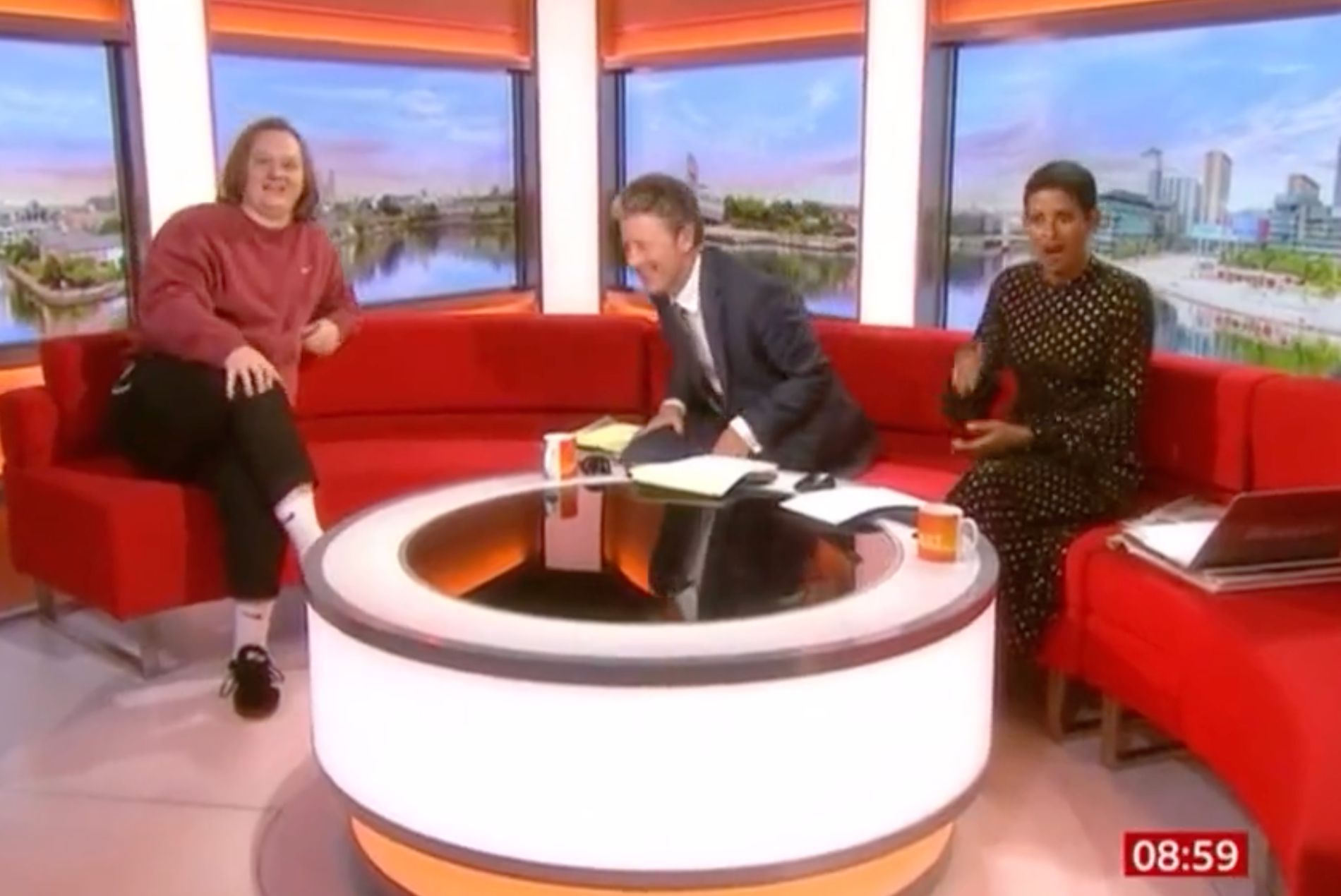
Lewis Capaldi Leaves BBC Breakfast’s Naga Munchetty And Charlie Stayt Speechless After X-Rated ‘Communication Breakdown’

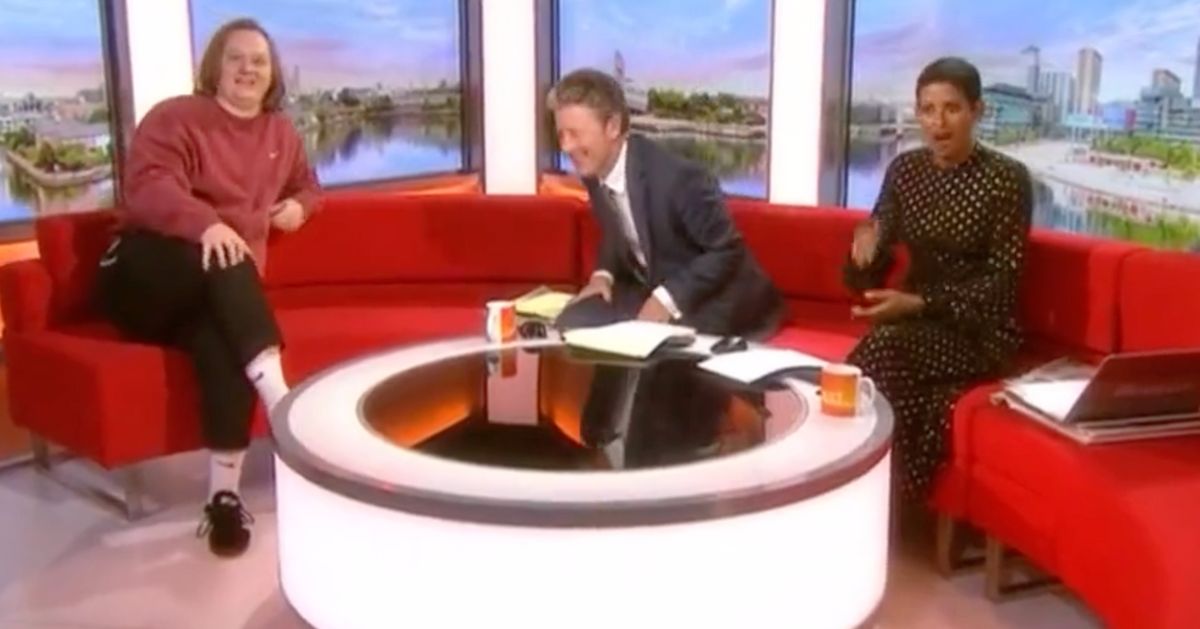
There’s always some laughs guaranteed when Lewis Capaldi pops up on TV and his appearance on BBC Breakfast on Saturday proved to be no different, after what he called “a classic breakdown of communication”.

The Someone You Loved singer left hosts Naga Munchetty and Charlie Stayt speechless after mishearing a comment Naga made at the end of his interview on the show.

The X-rated moment came after Lewis had complimented Charlie on his “great hair”.

“Well you’ve got great hair too,” Charlie replied, before Lewis leaned in for a high-five.

Watching their blossoming bromance, Naga joked: “Would you like a room?”

“I thought you said rim!” Lewis said.

As Naga was left open-mouthed, laughter could be heard from behind the cameras.

“Jeez!” Charlie remarked.

Keen to quickly move things along, a smirking Naga joked she was going to “have a little word with Lewis” as she segued to a news bulletin.

Lewis had been on the show to promote his latest single Forget Me, which hit number one in the Official Chart last week.

BBC Breakfast airs daily from 6am on BBC One and BBC News.

Share Button

James Corden Reflects On ‘Risky’ Decision To Quit The Late Late Show

James Corden has opened up about his decision to quit the The Late Late Show, saying it felt like “a greater risk to stay”.

The Gavin & Stacey star has hosted the US talk show since March 2015, but announced he was stepping down in April this year.

The presenter and actor has extended his contract with CBS to present the show for one more year before finishing in the summer of 2023.

Appearing on BBC Radio 4’s This Cultural Life, James was asked whether he worried his persona as a chat show host stops people seeing him as the kind of performer he would like to be.

He said: “Honestly, I don’t know. I guess we’re about to find out.

“Look, I’m aware that this isn’t a road often travelled. I’m aware that there’s not a plethora of people who have walked away from these late night talk shows, ever. I get why they wouldn’t walk away. It’s amazing.

“And for me really the reason to leave is the same as the reason to do it, which is, I wonder if this is possible.

“And if this is it then, do you know what, it’s been quite a ride anyway. I get that it will be difficult.”

James with guests Kylie and Kris Jenner

CBS Photo Archive via Getty Images

Asked whether he felt it was a risk leaving the show, James replied: “No. I think it’s a greater risk to stay.

“There’s an amazing clip, in which David Bowie talks about never playing to the gallery.

“On the day of the announcement that I was going to walk away, it was still made very clear to me that there was a job here for the next five years and I’m not gonna lie, financially it’s good.”

James said he had watched the clip of Bowie repeatedly as a way of reassuring himself.

Asked whether he felt scared or anxious about the move, he added: “Of course, who wouldn’t.

“Like you say, you’re hoping that maybe there’s one more thing I’ve got to do. Maybe there’s one more adventure. You’ve got to jump, and it might take a minute.

“I’m pretty all right with the idea that I might have to get comfortable in some silence for a minute.

“By the time I finish, I’ll have done 1,235 shows. That is a lot of television.”

as a British host of a US late night show, James has enjoyed immense success with the programme which features scores of celebrity guests and special segments.

His popular Carpool Karaoke series, in which he drives to work with different musicians, singing their back catalogue over the radio and discussing their careers, has included Adele, Justin Bieber, Billie Eilish, Lady Gaga and Ariana Grande.

He previously promised viewers that his final 12 months would be full of fan favourites and “other surprises” which would be “a blast”.

James took over as presenter of The Late Late Show in 2015 from Scottish-born comedian Craig Ferguson, who spent 10 years as host.

This Cultural Life airs at 7.15pm on Saturday on BBC Radio 4 and on BBC Sounds.

Share Button

Can the NHS learn from Germany’s health system?

Despite public support for the NHS, satisfaction levels have fallen, raising thoughts of reform.

Share Button