A study of thousands of women across seven countries tries to discover why there is a strong link.


A study of thousands of women across seven countries tries to discover why there is a strong link.

Under the latest Centers for Disease Control and Prevention guidance, more than half of the U.S. population lives in an area now considered to be low or medium risk for COVID, and residents there can go indoors without a mask. Many states have also loosened mask mandates, and a lot of workplaces no longer require employees to wear masks as a result.
If you’re still most comfortable with a mask on indoors in an office setting, you may suddenly find yourself to be in the minority. And when you are one of the only people with a face mask during meetings, it can feel socially awkward.
Advertisement
That’s why it can help to remember why masks are effective and to have a strategy in place if a colleague does inquire about your mask. Epidemiologists and other COVID experts weighed in on one-way masking benefits, and offered conversation strategies for mask-wearers:
If none of your co-workers are wearing masks, you may wonder if there’s a point to you wearing one. But well-constructed, tightly-fitting masks do offer protection, even when others are not wearing them, too.
“They do work. Somebody who is wearing a respirator in an office setting is going to get a fair degree of protection from doing that,” said Dr. Mark Rupp, chief of the Infectious Diseases Division at the University of Nebraska Medical Center.
Advertisement
“Any mask is better than no mask,” said Jose-Luis Jimenez, a professor at the University of Colorado Boulder and an aerosols scientist. “To make up for the fact that other people are not masking, you should wear a high-quality mask.”
Jimenez described high-quality masks as ones that are breathable, with a good filter that prevents most aerosols from being inhaled, and with a secure fit that has no gaps on your face, such as an N95 mask.
“Have the strength of your convictions and realize you may be the smartest person in the room”
– Dr. Mark Rupp, chief of the Infectious Diseases Division at the University of Nebraska Medical Center
And keep in mind the public health stakes. “What you are doing is minimizing the chance that you inhale a respiratory disease. That’s the big reason to stay masked,” said Charlotte Baker, an epidemiologist in public health at Virginia Tech. Although cases are declining in the U.S., there is still plenty of COVID out there. Around 1,800 deaths continue to be announced most days.
“There is no need to feel embarrassed or apologetic for wearing a mask,” Rupp said. “In most communities in the United States today the level of transmission continues to be substantial. … It’s headed in the right direction, but there is still a lot of COVID that is being transmitted in our communities.”
Advertisement
Rupp said masking should not be seen as a choice between never wearing your mask at work or always having to wear a mask at work. You should be open to changing your mind depending on individual circumstances.
“You may feel safe and not wear a mask going into a setting where there is a lot of room and few people and a short duration of time,” Rupp said. “Whereas you might feel very uncomfortable making that same decision in a smaller, crowded setting that you are going to have to be present for an hour.”
Rupp cited your community’s virus transmission rates, your building’s indoor ventilation, your colleagues’ vaccination status, and your own health risks as factors to consider before taking off your mask. Here’s the CDC tracker for checking out your county’s transmission rates.
Be open to putting a mask back on as we learn more about the latest COVID developments, too. “Six weeks from now, or three months from now as a new variant starts to be described, they may decide, ‘You know it’s time for me to put the mask back on,’” Rupp said.
“Social pressure is very real. We can be talked out of anything if enough people dissent to our point of view,” said clinical psychologist Ramani Durvasula.
She cited social psychologist Solomon Asch’s research on conformity, which found people were more likely to give a wrong answer when they heard other people give that wrong answer out of a motivation to avoid conflict.
Your decision to wear a mask is none of your colleague’s business. You don’t owe anyone an explanation of why you are masking indoors, but if sharing one helps you feel less awkward, keep it brief, Durvasula advised.
“Make it about yourself and don’t turn it into a polemic on public health and responsibility,“ she suggested. “If a person chooses to wear a mask that is their right, but it can turn difficult if the mask-wearer frames it as virtue.”
Advertisement
Whether you are doing so to protect the health of others or for your own personal risk tolerance, Durvasula advised not engaging too much about it in the workplace: “Don’t take the bait.”
Baker said if it makes you feel more comfortable, it’s alright to deflect to another topic if it comes up or “just be stern one time, and say, ‘Look I’m going to wear it, I don’t want to hear anything else about it. It has nothing to do with you.’”
Pep talks can also help when you feel peer pressure, too. Baker shared what she tells herself when she finds herself to be one of the only maskers in social settings.
“I’m immunocompromised, so I tell myself I don’t want to die,” she said. “Two is: ‘I’m doing this for my family.’ I want to see my nieces, I want to see my nephews. I want them to grow up in a healthy world. If I wear my mask, I get to go see them. And I’m also setting a good example. And third is: ‘My mom is senior … and I need to keep myself healthy so I don’t get her sick.’”
Baker noted that for people who have become numb to pandemic risks, external motivations like a vacation or a concert you want to be healthy to go to can also help. “Whatever that motivator needs to be for you, figure out what it is. Write it down, so you see it,” she said.
Once you know your why, remind yourself of it when you want to waver from your original decision to wear a mask. And if you need an affirmation, take it from Rupp.
“Have the strength of your convictions and realize you may be the smartest person in the room,” he said.
Experts are still learning about COVID-19. The information in this story is what was known or available as of publication, but guidance can change as scientists discover more about the virus. Please check the Centers for Disease Control and Prevention for the most updated recommendations.

A new phase of the war between Russia and Ukraine has begun, Ukrainian president Volodymyr Zelenskyy said on Monday night.
“Now we can already state that the Russian troops have begun the battle for the Donbas,” he said in a video address about the long-feared, full-scale offensive to take control of Ukraine’s east.
Advertisement
With a “significant part of the entire Russian army” now deployed in the region, according to Zelenskyy, here’s what you need to know about what could be a turning point in the conflict.
Advertisement
Russia’s invasion has damaged or destroyed up to 30% of Ukraine’s infrastructure at a cost of $100 billion, Ukrainian officials have said, as the United Nations revealed the civilian death toll has now surpassed 2,000. About four million Ukrainians have fled the country.
Advertisement
But Russia’s swift march to victory did not materialise. Driven back by Ukrainian resistance in the north, Moscow has refocused its ground offensive in the two eastern provinces known as the Donbas, while launching long-distance strikes at other targets including the capital, Kyiv.
The Donbas is Ukraine’s mostly Russian-speaking industrial heartland in the east, where Moscow-backed separatists have been fighting Ukrainian forces for the past eight years and have declared two independent republics that have been recognised by Russia.
In recent weeks, the Kremlin declared the capture of the Donbas its main goal of the war after its attempt to storm Kyiv failed. After withdrawing from the capital, it began regrouping and reinforcing its ground troops in the east for what could be a climactic battle.
Advertisement
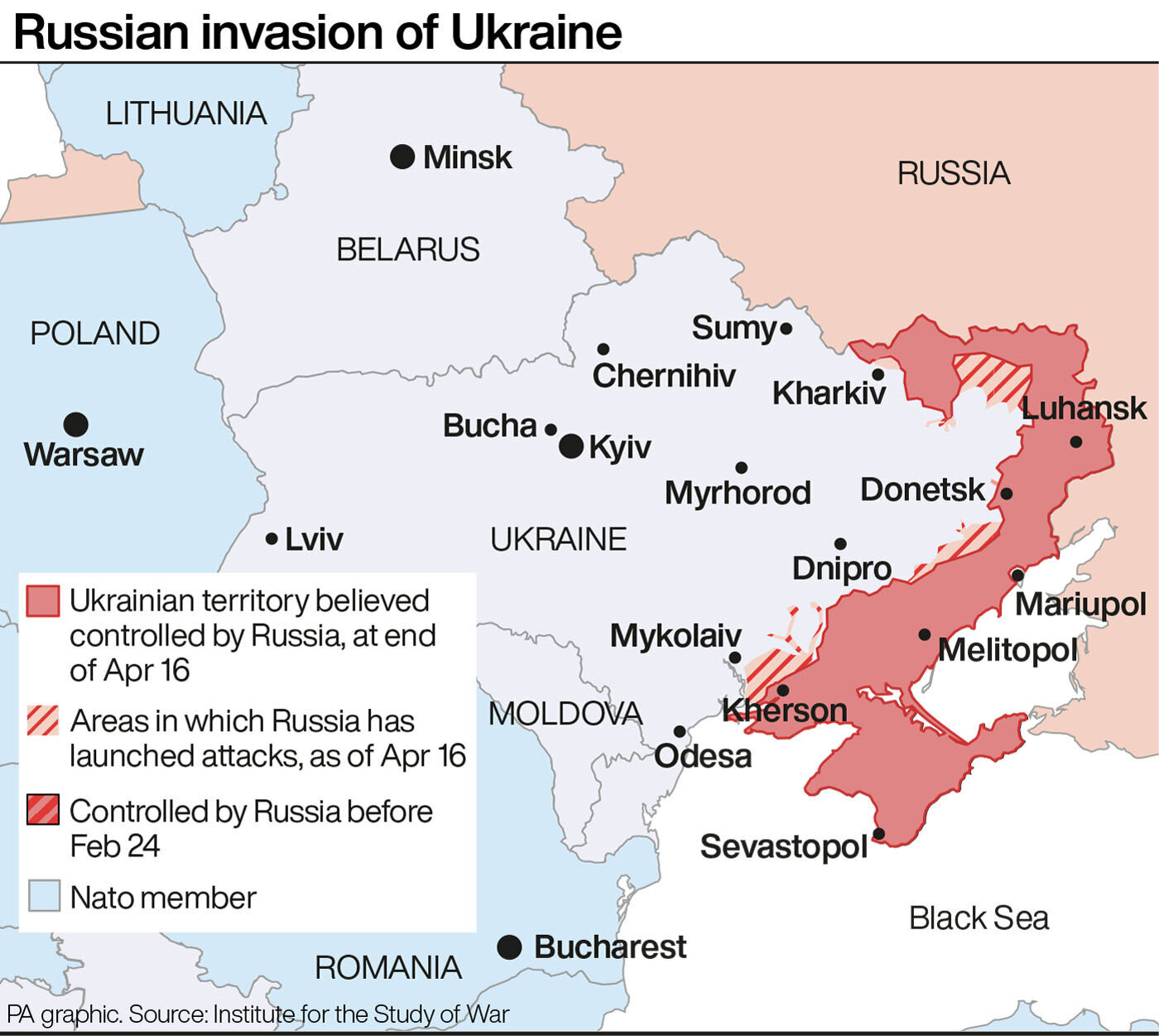
On Monday, Ukraine military generals said Russian forces were increasing assaults in the Luhansk and Donetsk regions – both of which are part of the Donbas – as well as in the area of Zaporizhzhia.
They also said Russia was sending reinforcements to the Crimean peninsula – seized from Ukraine in 2014 – and to the Rostov-on-Don area, which borders Ukraine.
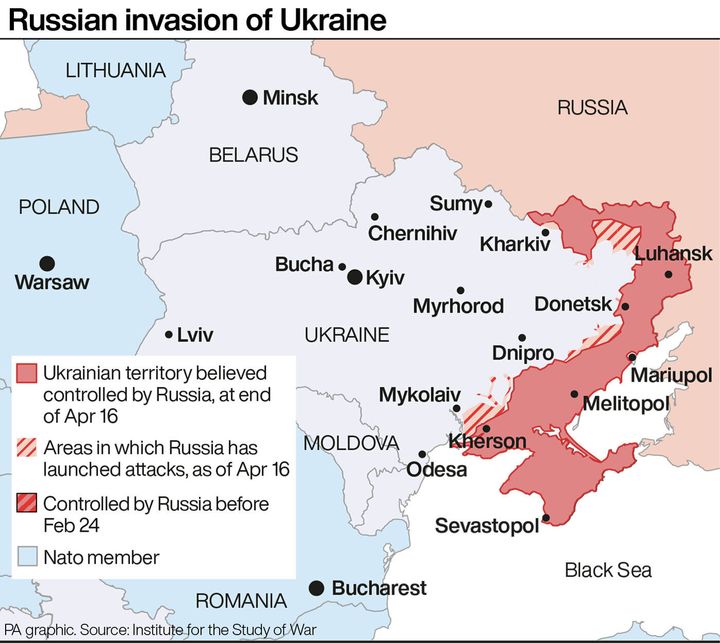
PA Graphics via PA Graphics/Press Association Images
Zelenskyy’s chief of staff Andriy Yermak called it “the second phase of the war” and assured Ukrainians that their forces could hold off the offensive. “Believe in our army, it is very strong,” he said.
The Associated Press reported a senior US defence official saying there are now 76 Russian combat units in eastern and southern Ukraine, up from 65 last week. That could translate to around 50,000 to 60,000 troops.
Russia’s stuttering campaign means control of eastern Ukraine has taken added significance, and may prompt the fiercest fighting yet. Russia needs some kind of “win” – recognising Russia’s claims in the Donbas and Crimea has also been the central plank of Vladamir Putin’s demands at failed peace talks – and following the sinking of its Black Sea lead ship, Putin will not be contemplating further embarrassment.
The new offensive in the east came as a Russian missile attack killed seven people in Lviv, the first civilian victims in the western city about 40 miles from Poland. It was one of a multitude of other targets across Ukraine in what appeared to be an intensified bid to grind down the country’s defences.
Lviv has seen only sporadic attacks during almost two months of war and has become a haven for civilians fleeing the fighting elsewhere.
In other developments, Ukrainian troops remained holed up at a mammoth steel mill in Mariupol, the last known pocket of resistance in the devastated southern port city.
The capture of Mariupol, where Ukraine estimates 21,000 people have been killed, is seen as key, and not just because it would deprive Ukraine of a vital port and complete a land bridge between Russia and the Crimean peninsula.
Advertisement
General Richard Dannatt, a former head of the British Army, told Sky News that Russia is waging a “softening-up” campaign ahead of the Donbas offensive.
The US defence official said that if Russian forces succeed in taking full control of Mariupol, that could free up nearly a dozen combat units for use elsewhere in the Donbas.
Given the changing dynamics of the war, Ukraine is calling for an increasing supply of Western weapons.
Last week, US president Joe Biden announced an additional $800 million in military assistance to Ukraine, expanding the aid to include heavy artillery ahead of the wider Russian assault expected in eastern Ukraine.
The US military expects to start training Ukrainians on using howitzer artillery in coming days, with the training taking place outside Ukraine.
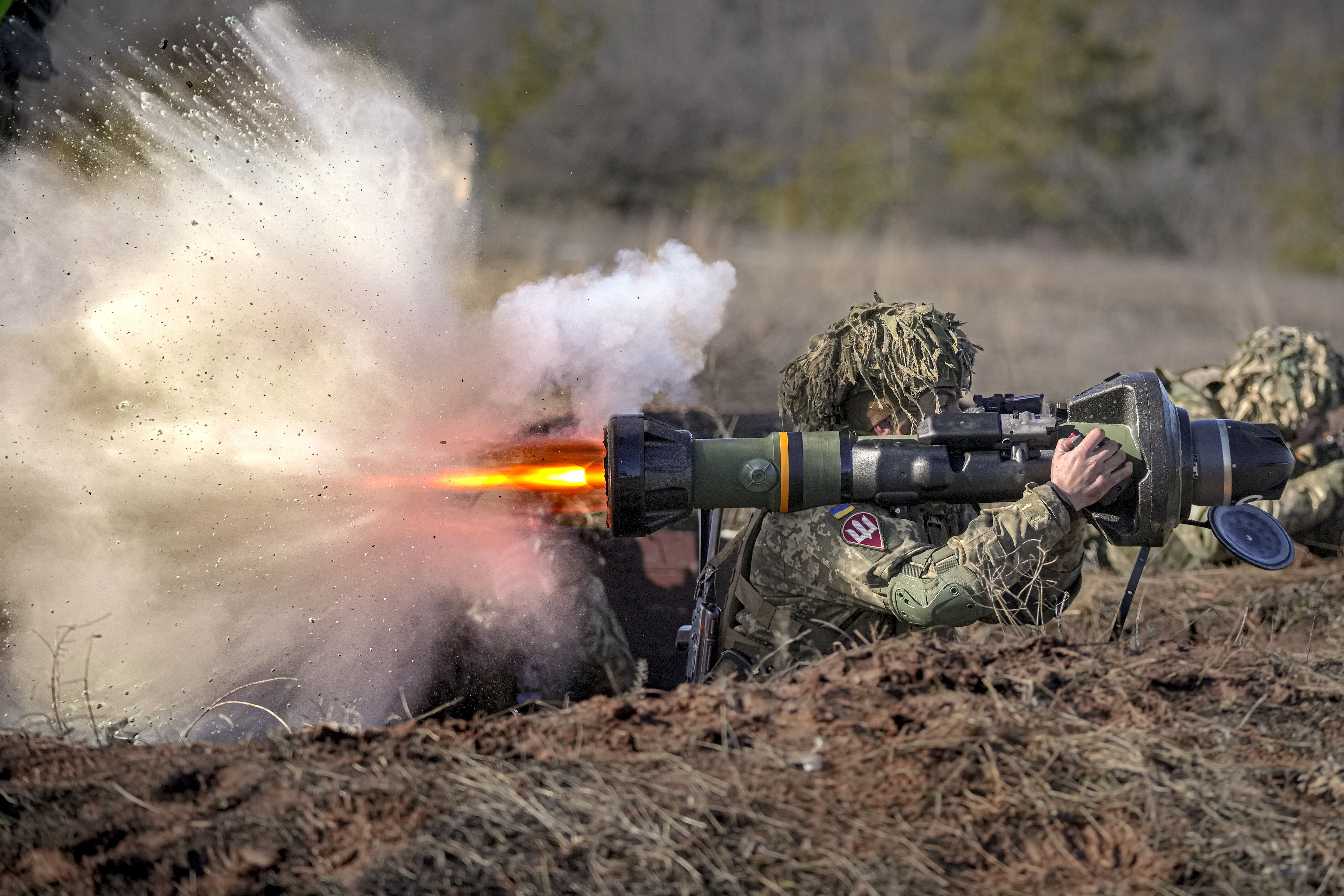
The Sun reported Boris Johnson is set to provide Ukraine with tank-mounted Stormer armoured missile launchers, another sign the West is prepared to offer as much military hardware as possible without triggering a wider Nato vs Russia conflict.
Two young women with ulcerative colitis share photos of their stoma bags to normalise the condition.

An international team of environmental scientists have published a series of significant recommendations to protect, conserve and study the world’s coral reefs — the ‘canaries in the coal mine’ of climate change.
The Vibrant Oceans Initiative presented their white paper on the future of the delicate and crucial habitats at the Our Oceans Conference held in Palau on Thursday.
Drawing on expertise from universities and wildlife conservation groups from across the world, including the University of Leicester, the group provide six key recommendations intended to promote the ‘persistence and survival’ of coral reefs.
Forecasts show that coral reef ecosystems around the globe — key to huge numbers of marine species and a source of food, livelihoods, and cultural heritage for half a billion people — are likely to become functionally degraded by 2050, if the goals of the Paris Agreement are not met.
Even with drastic emission reductions to ensure global warming is kept within 1.5°C above pre-industrial levels, up to 90% of the world’s corals could still vanish in the next three decades, leaving behind a reef structure that will lose many of its functions.
Jens Zinke is a Professor of Palaeobiology at the University of Leicester, whose research examines large coral habitats to track environmental and climate change over the last three centuries into the modern day. Speaking about the report, of which he is a co-author, Professor Zinke said:
“Coral reefs are the ‘canaries in the coal mine’ when it comes to sensing ecosystems under stress from ocean warming due to climate change. Corals can sense when ocean temperatures exceed a dangerous threshold and warn us when we need to take measures.
“Our research has shown that coral reefs have been severely impacted by ocean warming in the past three to four decades, yet some reef locations show lower rates of warming or benefit from mitigating circumstances due to local oceanography.
“Some reefs have the ability to resist or recover from thermal stress faster than others, and these reefs may serve as sanctuaries under future warming. This is a major new research direction — to find those locations and protect them before they are gone.”
In 2018 the Vibrant Oceans group identified 50 reefs that are most likely to resist and survive climate change. The habitats are located largely in the Pacific and Indian oceans, with further reefs in the Caribbean and east of Africa.
Previously the 50 reefs were mainly chosen at sites that escaped climate change. Now, the scientists call for a wider portfolio of reefs that should include resistant and fast-recovering reefs.
The group’s latest recommendations, presented in the white paper ‘Forecasting Climate Sanctuaries for Securing the Future of Coral Reefs’, include:
‘Forecasting Climate Sanctuaries for Securing the Future of Coral Reefs’ is available in full from the Wildlife Conservation Society (WCS): https://wcs.org/coral-science-whitepaper
Funding partners for the initial Vibrant Oceans study include Bloomberg Philanthropies, while ongoing conservation work partners include Oceans 5, the Paul G. Allen Family Foundation, and Tiffany & Co. Foundation.
Conservation partners include the WCS, Rare, The Nature Conservancy, Blue Ventures, and Conservation Ecosystem Partnership Fund.
Story Source:
Materials provided by University of Leicester. Note: Content may be edited for style and length.

A new study finds that a history of infertility is associated with increased risk of heart failure. Published in the Journal of the American College of Cardiology, researchers from Massachusetts General Hospital (MGH) revealed that women who had experienced infertility had a 16% increased risk of heart failure compared with women who did not have an infertility history.
“We are beginning to recognize that a woman’s reproductive history tells a lot about her future risk of heart disease,” says first author Emily Lau, MD, MPH, cardiologist and director of the Menopause, Hormones & Cardiovascular Clinic at MGH. “Whether a woman has difficulty becoming pregnant, what happens during her pregnancies, when she transitions through menopause all influence her risk of heart disease later in life.”
Infertility affects about 1 in 5 US women and includes a spectrum of conception difficulties, but its link with heart failure has not been well-studied until recently. Partnering with the Women’s Health Initiative (WHI), which was designed in the early 1990s and queried a woman’s reproductive history, Lau and colleagues studied postmenopausal women from the WHI and examined whether infertility was associated with development of heart failure.
There are two types of heart failure: heart failure with preserved ejection fraction (HFpEF) and heart failure with reduced ejection fraction (HFrEF). Ejection fraction is a measurement related to the volume percentage of blood that is pumped from the left ventricle of the heart during each beat. An ejection fraction less than 50% is commonly viewed as abnormal or reduced.
The team found an association between infertility and overall heart failure, specifically with HFpEF, a form of heart failure that is far more common in women regardless of fertility history. Among the 38,528 postmenopausal women studied, 14% of the participants reported a history of infertility. Over a 15-year follow up period, the researchers noted that infertility was associated with 16% future risk of overall heart failure. When they examined heart failure subtypes, they found that infertility was associated with a 27% increased future risk of HFpEF.
Over the past decade, HFpEF (where the heart muscle does not relax well) as opposed to HFrEF (where the left ventricle does not pump well), has become the dominant form of heart failure in both men and women. But it remains more common in women. “It’s a challenging condition because we still do not completely understand how HFpEF develops and we do not have very good therapies to treat HFpEF,” says Lau.
“I think our findings are particularly noteworthy because heart failure with preserved ejection fraction is more prevalent in women,” says Lau. “We don’t understand why we see HFpEF more in women. Looking back in a woman’s early reproductive life may give us some clues as to why.” Of note, the team observed that the link persisted regardless of whether an individual eventually conceived or had a live birth.
The increased risk was independent of traditional cardiovascular risk factors and other infertility-related conditions. “There has been some suggestion in previous studies that women with infertility do have more cardiometabolic risk factors,” says Lau, but the team did not find that cardiometabolic risk factors explained the link between infertility with heart failure in this study. They also looked to see if other infertility-related conditions like thyroid disease, irregular menses, and early menopause explained the association between infertility and heart failure but did not evidence to support that hypothesis either.
“So it really begs the question: what are the mechanisms driving the association between infertility and heart failure,” says Lau. Is it shared risk factors, or is infertility on the causal pathway? She mentions vascular and endothelial dysfunction may be involved and plans on eventually clarifying the mechanism underlying the link between infertility and heart failure. In the future, Lau hopes to conduct a prospective study of women with an infertility history involving exercise parameters, vascular measures, and more, to solve the mystery.
“We as scientists and doctors are beginning to recognize how important a woman’s reproductive history is for their future risk of heart disease. Infertility is one of many cardiovascular risk factors, such as hypertension and high blood pressure, but reproductive history is not routinely considered as part of the cardiovascular risk assessment,” says Lau. Since people do not tend to develop heart failure until well in their 60s and beyond, and infertility is mostly experienced in the 20s, 30s, and 40s, many physicians are not thinking about the connection. “We cannot change a woman’s history of infertility, but if we know a woman has had a history of infertility, we can be more aggressive about counseling her about other modifiable risk factors including high blood pressure, high cholesterol, smoking, and beyond.”
This research was supported in part by the National Institutes of Health and American Heart Association.

Sodium is an essential micronutrient, but the amount we need is small. Three slices of bread or one teaspoon of table salt will do it, and chances are your daily sodium intake is far greater. More than 90% of Americans consume too much sodium, which can lead to hypertension, high blood pressure, and increased risk of heart disease and stroke.
Most of the excess sodium comes from processed and packaged foods, so the food industry and food scientists continuously look for ways to reduce sodium. A new paper from the University of Illinois provides a comprehensive review of scientific literature on sodium reduction strategies in food production.
“Sodium overconsumption is a huge health concern, and the FDA has recommended sodium reduction in food since the 1980s, but we haven’t succeeded yet. While the unit volume of salt in the food supply has not increased, the amount of sodium consumption has gone up, because we just consume a lot of food,” says Soo-Yeun Lee, professor in the Department of Food Science and Human Nutrition (FSHN) at U of I and co-author on the paper.
We only need around 450 milligrams (mg) of sodium per day, and the recommended maximum amount is 2,300 mg, or 1,500 mg for those at risk for hypertension. But average consumption exceeds 3,000 to 3,500 mg per day — or 50% to 100% above the upper limit. More than 70% of our sodium intake comes from processed and packaged foods, primarily cured meats, bread, cheese, and soups.
The researchers conducted a scoping review including primary studies, literature reviews, book chapters, and patents covering sodium reduction in food products. They focused on studies that included sensory data with human subjects, because palatability is essential for consumer acceptance.
“In this review, we looked at different food systems. The way you would reduce salt in a solid system, like a topical application on snack foods, such as salted peanuts or salted chips, would be very different from embedded application in semi-solid foods like cheese or bread. And in a liquid system like soup, where it is completely dissolved, it would be really different in the way we could reduce salt yet provide the palatability it gives,” Lee states.
“We’re hoping this work will provide insight into the wide variety of salt-reducing technologies that exist. This can help food companies be more informed to use different strategies than what they have been doing,” she adds.
The researchers identified five main strategies: Salt reduction, salt replacers, flavor modification, physical modification, and functional modification.
“The most obvious one is to remove salt from the recipe, and that is a key component in all of the strategies when sodium reduction is the goal,” says Aubrey Dunteman, graduate student in FSHN and lead author on the paper.
But it is not possible to completely eliminate sodium, because it has both sensory and functional properties. For example, it is used for meat preservation and to make bread dough rise.
“A lot of the studies we looked at combined more than one method, such as salt removal with salt replacers and flavor modification or salt removal and physical modification,” Dunteman says.
Many studies used salt replacers such as potassium chloride, calcium chloride, or other chloride or acid salts. However, these substitutes tend to have a bitter taste, so they are often used in combination with flavor modifications, such as umami substances or bitter blockers.
“Another method is physical modification. For example, you can encapsulate the salt crystals, which changes how the salt is dissolved in the mouth. This can alter the saltiness perception allowing for a reduction in the amount of sodium necessary to create the salty taste. You can also create an uneven distribution of the salt in a product that can further help enhance the perceived saltiness of the food product through taste contrast,” Dunteman explains.
“Finally, there is functional modification. For example, you could move away from a sodium-based preservative in cured meats, perhaps using a celery-powder preservative instead of sodium nitrate.”
Functional modification is less represented in the scoping review because this type of sodium reduction research typically does not incorporate a sensory component as a main assessment method, Dunteman notes.
If consumers want to reduce their salt intake, the best strategy is to cook your own food and limit your consumption of processed and packaged foods. You can also wean yourself off salt with practice, essentially go on a “salt diet.”
“If you’re cooking at home, you can intentionally reduce salt and you’ll appreciate the reduced saltiness perception as time goes on. People can adjust to the reduced salt level, but it’s a learning and adapting process. You can also add flavor enhancers such as herbs and spices,” Lee suggests.
“If you are a consumer of canned soup, for example, you can buy a low-sodium version and add salt. Then you can gradually modify the amount of salt you add, so you can make it palatable to your taste,” she notes.
The research was supported by the Institute for the Advancement of Food and Nutrition Sciences (IAFNS) through an ILSI North America Sodium Committee grant. IAFNS is a non-profit science organization that pools funding from industry collaborators and advances science through the in-kind and financial contributions from public and private sector participants. IAFNS had no role in the design, analysis, interpretation, or presentation of the data and results.

Soccer star Cristiano Ronaldo and his longtime girlfriend, Georgina Rodríguez, on Monday announced the death of their newborn son and the birth of their daughter.
“It is with our deepest sadness we have to announce that our baby boy has passed away,” the two wrote on Instagram, saying it was the “greatest pain that any parents can feel.”
“Only the birth of our baby girl gives us the strength to live this moment with some hope and happiness,” they added. “We are all devastated at this loss and we kindly ask for privacy at this very difficult time.”
Ronaldo, who plays for England’s Manchester United, has four other children: 4-year-old twins, a 4-year-old daughter and an 11-year-old son.

You’re reading Life-Work Balance, a series aiming to redirect our total devotion to work into prioritising our personal lives.
You’ve had a long day at work, your muscles ache for sitting in the same position for too long, or your legs for standing too long, and you’re tired. All you want to do is eat a warm meal and slouch in front of the TV or laptop while you scroll your phone. And then repeat for the next four days.
Advertisement
Work can be draining – you’re required to carry out the same monotonous tasks daily, helping companies get richer, with little regard to own your wellbeing and happiness.
The only relief is the weekend, which is often reserved for refuelling, catching up with loved ones, or completing life admin.
Advertisement
But there are things we do throughout the week that reinvigorate us, make us feel alive and skilled, and happy. Those are hobbies.
While in the last decade, hobbies have taken a turn towards hustle culture – monetising our past-times so we can make more money – the pandemic has allowed us to rediscover the little things that have a big impact on us.
Advertisement
With working from home becoming an ordinary staple, we have more time than ever to cultivate social and personal activities.
We spoke to some people about the hobbies that are changing how they approach work culture.
Marcio Delgado, a London-based and influencer marketing manager, 41, says the pandemic has shifted how he organises his week.
“During lockdown I started to take my dogs for a one-hour walk right in the middle of the day to break the monotony. Although life is fairly back to normal in London now, I have not changed that,” he says.
Advertisement
“Before 2020 I would build my life around my working hours, basically blocking almost any time I possibly had between 9 to 6pm to attend the office and sit in front of a computer. Now that the world is a bit hybrid, I have inverted priorities and still able to work as much – or more – than before.”

Marco Delgado
For Rosie Thomas, an ADHD coach from Berlin, something people don’t often do as a hobby had a significant effect on her.
“Going to sauna regularly has changed my life,” she tells HuffPost.
“I was always against going to saunas because I tend to hate the heat, but in January I decided to try it out. I started going regularly and it has truly been mind blowing.
“I have ADHD so my mind is typically running about eight consecutive trains of thought (minimum). I’ve struggled with meditation, yoga, any form of silence. But the sauna enables me relax and think clearly.”
Not only does it help Thomas relax, the sauna is also useful for her work.
“I’ve come up with some amazing ideas for my business in the sauna, solved a couple of problems I was struggling with, and begun sleeping more deeply,” she says.
“Now, if I’ve got some bad brain fog or I’m feeling a bit low and I have time between my 1:1 coaching clients, I’ll go for a quick sauna session and truly come out feeling like a new person.”

Rosie Thomas
Similarly, Natalie Arney, 39, an SEO consultant from Brighton, has found multiple hobbies bringing life to her week.
Among crafty activities such as punch needle, scrapbooking, and cross stitch, one hobby stands out for Arney – choir.
Advertisement
“I have a couple of things I like to do, but the one that’s impacted me the most so far this year is joining a choir. I started in January this year and it has really helped me with work and my week,” she says.
“I go every Wednesday evening during term time, and this term we had a concert to get ready for. I absolutely love the choir because it gives me something to look forward to, and the community it has created is so supportive and caring.”

Natalie Arney
Choir practice also helps Arney in another area – getting out of the house.
“I struggle with my mental and physical health, and up until I joined choir, I didn’t do much outside of the house that wasn’t to do with work (I’m a freelancer, so it’s easy to lock myself away), but now, aside from going shopping or out for a meal, I’ve also got choir to go to,” she says.
“Singing also really helps you physically and mentally, including helping with breathing, posture and muscle tension, and releases neuro-chemicals too – which as a person who lives with chronic pain, I really benefit from!”
Hobbies are subjective – one person’s enjoyment might be another person’s idea of boredom – but no matter what brings someone happiness, hobbies and interests outside of work are the ultimate acts of resistance against capitalism.
They bring us pleasure without the expectation of procuring money or making us more marketable to recruiters.
So swim in the seas, pamper yourself in a sauna, curl up with a book in a local library, lift weights, knit, shoot hoops.
Whatever brings you joy.

HuffPost UK/ Isabella Carapella
Life-Work Balance questions the status quo of work culture, its mental and physical impacts, and radically reimagines how we can change it to work for us.
Advertisement





The 11,483 people who have taken permanent NHS England jobs include former gym managers and air crew.
