Scientists’ top 10 bee-magnet blooms—turn any lawn into a pollinator paradise

Botanists from the University of Copenhagen and the UK set out to find the best flower combinations for bees and hoverflies. The results make it easier for garden owners and municipalities, among others, to plant the perfect pantries for insects, which also delight the human eye.

Flower strips, seed mixtures, and wild by design. We want to help bees and other vital pollinators, which are in decline all over the world. But which flowers are actually the best?

This question prompted botanists from the Natural History Museum of Denmark at the University of Copenhagen and botanists from the National Botanic Garden of Wales to conduct a scientific study of which flower mixtures attract the most pollinators.

“Much of our knowledge in this area is anecdotal. So, there was a need for a scientific approach, where we systematically test different flowers to be sure how we can best help pollinators, which are extremely important to our ecosystems,” says professor and botanist Natasha de Vere from the Natural History Museum of Denmark.

Yarrow, Garden cosmos, and cornflower are a treat

The researchers reviewed over 400 previous research articles on flowers and insects and investigated how much bees and hoverflies like the finished flower mixtures that are currently sold commercially.

Based on the study, the researchers developed two new seed mixtures, which they evaluated both on the number of insects that visited them and on their aesthetic appeal to humans.

“We can see that seed mixtures containing both non-native and native flowering plants establish themselves better in the soil, bloom for longer, and have more visits from pollinators. And they are also most attractive to the human eye,” says Natasha de Vere.

Based on the study, the researchers recommend choosing seed mixtures with these species if you want to attract bees and hoverflies and are also interested in the aesthetic value of the flowers:

  • Yarrow (Achillea millefolium)
  • Corn chamomile (Anthemis arvensis)
  • Cornflower (Centaurea cyanus)
  • Purple viper’s bugloss (Echium plantagineum)
  • Corn marigold (Glebionis segetum)
  • Common poppy (Papaer rhoeas)
  • Field mustard (Sinapis arvensis)
  • Scentless chamomile (Tripleurospermum inordorum)
  • Garden cosmos (Cosmos bipinnatus)
  • Moroccan toadflax (Linaria maroccana)
  • Common phacelia (Phacelia tanacetifolia)

If everyone does a little, we can help the bees

The reason why the researchers have also included the aesthetic dimension of flower mixtures in their study is, of course, that appearance also has a significant impact on what we choose to plant in our gardens and green spaces.

“It has become quite popular to plant strips of flowers in urban areas and in gardens where there may have been only grass lawns before. This is because flowers are good for bees, but also for our mental health,” says Natasha de Vere.

According to the professor, who has conducted in-depth research into the interaction between plants and pollinators for a number of years, even small areas of flowers are of great importance to our buzzing friends.

Her research shows that gardens and urban areas can be very good for pollinators.

“It is important that everyone does something to help – and even small changes can really make a difference. I myself only have a small backyard, which I have filled with the best plants for pollinators, and it is now full of bees and hoverflies,” she says, adding:

“I hope our new research results can be used to provide evidence-based guidance on how to select plant species – whether you are a garden owner, a municipal gardener, or otherwise involved in producing seed mixtures.”


Share Button

Whispers in the womb: How cells “hear” to shape the human body

Like all complex organisms, every human originates from a single cell that multiplies through countless cell divisions. Thousands of cells coordinate, move and exert mechanical forces on each other as an embryo takes shape. Researchers at the Göttingen Campus Institute for Dynamics of Biological Networks (CIDBN), the Max Planck Institute for Dynamics and Self-Organisation, and the University of Marburg have now discovered a new way that embryonic cells coordinate their behavior. This involves molecular mechanisms previously known only from the process of hearing. The researchers attribute the fact that such different cells use the same proteins for two such different functions to their evolutionary origin. The results were published in Current Biology.

The interdisciplinary research team used an unusual combination of methods from developmental genetics, brain research, hearing research and theoretical physics to make a surprising discovery in cell communication: they found that in thin layers of skin, cells register the movements of their neighboring cells and synchronize their own tiny movements with those of the others. Groups of neighboring cells thus pull together with greater force. Thanks to their high sensitivity, the cells coordinate very quickly and flexibly as these subtle forces are the fastest signals traveling across embryonic tissue. When the cells were genetically deprived of their ability to “listen” to each other, the entire tissue changed and development was delayed or failed altogether.

The researchers integrated cellular coordination into computer models of the tissue . These models showed that the “whispering” among neighboring cells leads to an interwoven choreography of the entire tissue and protects it from external forces. Both effects were confirmed by video recordings of embryonic development and further experiments. “Using AI methods and computer-assisted analysis, we were able to examine about a hundred times more cell pairs than was previously possible in this field,” explains Dr Matthias Häring, group leader at the CIDBN and co-author of the study. “This big data approach gives our results the high level of accuracy needed to reliably get to the bottom of these delicate interactions between cells.”

The mechanisms revealed here in embryonic development were already known to play a role in the process of hearing. For instance, when very quiet sounds are heard, the hair cells in the ear, which convert sound waves into nerve signals, react to tiny mechanical movements. At the threshold of hearing, the cell protrusions bend over distances of only a few atomic diameters. The ear is so sensitive because of special proteins that convert mechanical forces into electrical currents. Until now, almost no one suspected that such sensors of force also play an important role in embryonic development. In principle, this is possible because every cell in the body carries the genetic blueprints for all proteins and may use them as needed.

The phenomenon could also provide insights into how the perception of force at a cellular level has evolved. “The evolutionary origin of these force-sensitive ion channel proteins probably lies in our single-celled ancestors, that we share with fungi and which emerged long before the origin of animal life,” explains Professor Fred Wolf, Director of the CIDBN and co-author of the study. “But it was only with the evolution of the first animals that the current diversity of this protein type emerged.” Future work should determine whether the original function of these cellular “nanomachines” was to perceive forces inside the body rather than, as in hearing, to perceive the outside world.

Share Button

Breakthrough battery lets physicists reverse entanglement—and rewrite quantum law

Just over 200 years after French engineer and physicist Sadi Carnot formulated the second law of thermodynamics, an international team of researchers has unveiled an analogous law for the quantum world. This second law of entanglement manipulation proves that, just like heat or energy in an idealized thermodynamics regime, entanglement can be reversibly manipulated, a statement which until now had been heavily contested. The new research – released on July 2, 2025 in Physical Review Letters – deepens understanding of entanglement’s basic properties and provides critical fundamental insight into how to efficiently manipulate entanglement and other quantum phenomena in practice.

Entanglement is arguably the central feature of quantum mechanics. If two microscopic particles are said to be entangled, then if someone measures a quantum property of one of the particles and then repeats the measurement on its entangled partner, they will always find that the pair is correlated, even when the two particles are separated by vast distances. Therefore, knowing the state of one particle automatically provides information about the other. Entanglement was introduced about 90 years ago as proof of the absurdity of quantum theory if treated as a complete description of nature. Yet it is not regarded as absurd today. After exhaustive proofs of entanglement’s authenticity in the real world, it is now the key resource in quantum information theory, allowing quantum teleportation and quantum cryptography, and offering significant advantages in quantum computing, communication and precision measurements.

Though entanglement still appears counterintuitive to our lived experience of the world, researchers have discovered striking parallels with something much more familiar: thermodynamics. In fact, many similarities have emerged between the theories of quantum entanglement and thermodynamics. For example, ‘entanglement entropy’ is a characteristic of idealised, noiseless quantum systems that mimics the role of thermodynamical entropy.

However, an equivalent to the second law of thermodynamics – which dictates that processes tend towards increasing disorder (the aforementioned entropy) and that perfect reversibility is an attainable though rare and highly efficient ideal – has remained stubbornly out of reach. Here, reversibility does not refer to time symmetry but the ability of an external agent to manipulate the system into a different state and then manipulate it back to its initial state without any loss. “Finding a second law analogous to the second law of thermodynamics has been an open problem in quantum information science,” says study co-author Tulja Varun Kondra. “Solving this has been our primary motivation.”

Much work towards addressing this problem has focused on a scenario in which two distant parties (often called Alice and Bob) want to exchange quantum information, but are restricted to act locally on their quantum systems and communicate classically, by say phone or the internet. This limitation to local operations and classical communication (LOCC) simplifies the situation, meaning whatever Alice and Bob do, they cannot affect the intrinsically nonlocal properties of entanglement between their quantum systems.

“It is known that under LOCC operations in this scenario, entanglement is irreversible,” explains lead author of the study Alexander Streltsov. “So the question is, can we somehow go beyond LOCC in a meaningful way, and recover reversibility?” The team’s answer is ‘yes’, as long as Alice and Bob share an additional entangled system: an entanglement battery.

Just as an ordinary battery stores energy which can be used to inject or store work in the context of thermodynamics, an entanglement battery injects and stores entanglement. The battery can be used in the state transformation process and the state of the battery itself can be changed to perform operations. There is only one rule: whatever Alice and Bob do, they must not decrease the level of entanglement within the battery.

And just as a regular battery allows tasks to be performed that would be impossible without one, so too does an entanglement battery. By assisting standard LOCC operations with their hypothetical entanglement battery, the team demonstrated that any mixed-state entanglement transformation can be made perfectly reversible.

This achievement is a significant contribution to the debate around whether entanglement manipulation is generally reversible. But a more important outcome of this work is that the researchers have shown that the methods they have developed are applicable beyond mixed-state entanglement transformation, allowing them to leverage the entanglement battery to verify reversibility in various scenarios. Proving that entanglement manipulations across all quantum states are reversible is expected to lead to a family of second laws for entanglement manipulation.

The entanglement battery may even find uses outside entanglement theory. For example, the same principles apply to systems involving more than two entangled particles, paving the way for understanding and manipulating complex quantum networks and perhaps developing future, highly efficient quantum technologies.

In addition, generalising the concept of an entanglement battery to a resource battery – an additional quantum system that participates in the transformation process without reducing the resource in question – could allow the systematic demonstration of reversibility across quantum physics based on a minimal set of assumptions. “We can have a battery that is supposed to preserve coherence or free energy, and then we can formulate a reversible framework in this setting where, instead of entanglement, we reversibly manipulate that particular resource of our system,” says Streltsov. “Though many of these other principles of reversibility have already been confirmed via other approaches, our technique offers a unified proof framework based on well-established physical principles.”

Share Button

Tiny quantum drumhead sends sound with 1-in-a-million loss—poised to rewrite tech

When a drummer plays a drum, she sets the drumhead into vibration by hitting it. The vibration contains a signal that we can decode as music. When the drumhead stops vibrating, the signal is lost.

Now imagine a drumhead that is ultra-thin, about 10 mm wide, and perforated with many triangular holes.

Researchers at the Niels Bohr Institute, University of Copenhagen, in collaboration with the University of Konstanz and ETH Zurich, have managed to get vibrations to travel around this membrane, almost without any loss. In fact, so little loss that it is far better than even electronic circuit signal handling. The result is now published in the journal Nature.

Phonons – Sound Signals or Vibrations That Spread Through a Solid Material

The signal consists of phonons – which can be translated to what one might call vibrations in a solid material. The atoms vibrate and push each other, so to speak, so a given signal can move through the material. It is not far-fetched to imagine encoding a signal, which is then sent through the material, and here signal loss comes into play.

If the signal loses strength or parts of the signal are lost in heat or incorrect vibrations, one ends up not being able to decode it correctly.

System Reliability is Crucial

The signals that researchers have succeeded in sending through the membrane are distinguished by being almost lossless. The membrane as a platform for sending information is incredibly reliable.

Loss is measured as a decrease in the amplitude of the sound wave as it moves around the membrane. When researchers direct the signal through the material and around the holes in the membrane – where the signal even changes direction – the loss is about one phonon out of a million.

The amplitude of current fluctuations in a similar electronic circuit decreases about a hundred thousand times faster.

Basic Research with Perspectives

Researchers at the Niels Bohr Institute, Assistant Professor Xiang Xi and Professor Albert Schliesser, explain that the result should not be thought of in a specific, future application – but there are still rich possibilities. Currently, there is a global effort to build a quantum computer, which is dependent on super-precise transfer of signals between its different parts.

Another field within quantum research deals with sensors that, for example, can measure the smallest biological fluctuations in our own body – here too, signal transfer is crucial.

But Xiang Xi and Albert Schliesser are currently most interested in exploring the possibilities even further.

“Right now, we want to experiment with the method to see what we can do with it. For example, we want to build more complex structures and see how we can get phonons to move around them, or build structures where we get phonons to collide like cars at an intersection. This will give us a better understanding of what is ultimately possible and what new applications there are,” says Albert Schliesser. As they say: “Basic research is about producing new knowledge.”

Share Button

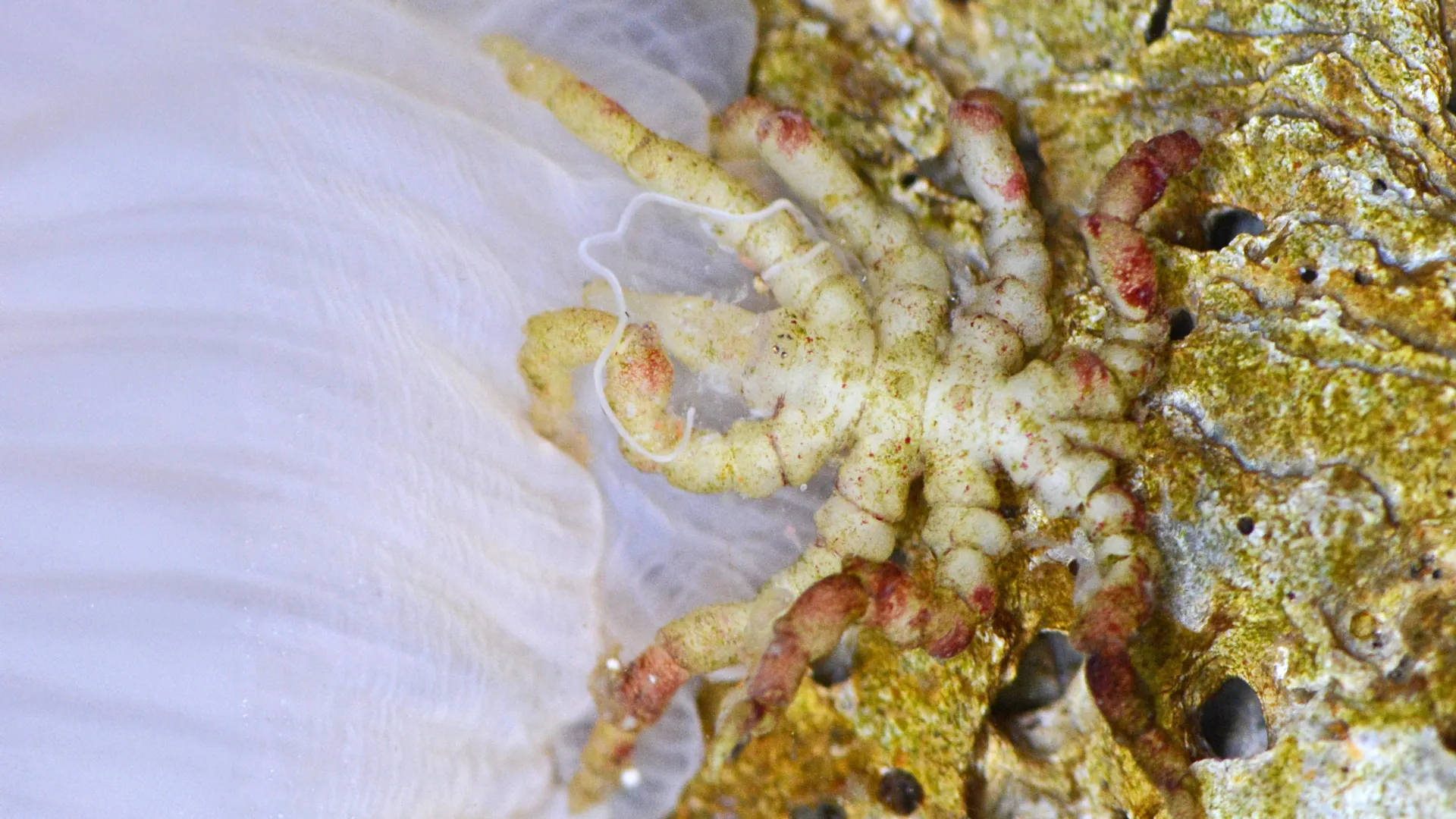
How a lost gene gave the sea spider its bizarre, leggy body

An international collaboration featuring the University of Vienna and the University of Wisconsin-Madison (USA) has led to the first-ever chromosome-level genome assembly of a sea spider (Pycnogonum litorale). The genome informs about the development of the characteristic sea spider body plan and constitutes a landmark for revealing the evolutionary history of chelicerates in general. The study was recently published in BMC Biology.

Sea spiders (Pycnogonida) are marine arthropods with highly unusual anatomy: their trunk is very narrow and short, many of their internal organ systems extend into their long legs, and their abdomen is extremely reduced, to the point of being almost unrecognizable. Together with much better known animals such as spiders, scorpions, mites, or horseshoe crabs, sea spiders belong to the group called chelicerates, named after their claw-like mouthparts, the chelicerae. The bizarre body plan of these “no-bodies” raises fascinating questions: what genetic factors underlie its formation? And what can this tell us about the evolutionary history of chelicerates? The answers lie in their genome.

A high-resolution genome

To produce the genome assembly, researchers combined complementary sequencing technologies. First, the genetic material of a single P. litorale individual was obtained using so-called “long-read sequencing,” a technology that is able to capture very long stretches of DNA. This facilitates the correct assembly of otherwise challenging repeated or complex genomic regions. Then, the spatial organization of the genome was assayed in a second P. litorale individual, revealing which DNA pieces lie close to each other in the cell nucleus. By leveraging the distance information, the correct order of the sequenced DNA stretches can be ascertained. This combination of data sources led to the assembly of 57 pseudochromosomes, representing almost the entirety of the sea spider genome in unprecedented resolution. This was additionally supplemented by novel datasets of gene activity in various developmental stages of P. litorale. “The genomes of many non-canonical laboratory organisms are challenging to assemble, and Pycnogonum is no exception. Only the combination of modern high-throughput data sources made a high-quality genome possible,” says the study’s first author Nikolaos Papadopoulos from the Department of Evolutionary Biology at the University of Vienna. “This can now serve as a stepping stone for further research.”

Lost genes, visible effects

The research team paid special attention to the so-called Hox cluster – a gene family that is evolutionarily conserved across the animal kingdom. “In arthropods, Hox genes play a central role in the correct specification of the different body segments; but also in many other animal groups they are essential ‘master controllers’ during body plan development,” explains Andreas Wanninger, one of the project leads at the Department for Evolutionary Biology at the University of Vienna. The exciting secret of Pycnogonum litorale: a part of the Hox cluster is missing completely from the genome, namely abdominal-A (Abd-A), a gene typically involved in specification and development of the posterior part of the body. Its absence could be linked to the extreme reduction of the pycnogonid abdomen. Similar conditions have been observed in other arthropods with reduced posteriors, such as certain mites and barnacles. Thus, sea spiders offer another example for the well-documented evolutionary relationship between Hox gene loss and body part reduction.

The genome also offers insights into broader evolutionary patterns. Unlike spiders and scorpions, whose genomes show clear signs of ancient whole-genome duplications, no such traces can be found in the genome of P. litorale. As pycnogonids are considered the sister taxon to all chelicerates, this suggests that the genome of the chelicerate ancestor did not already have these duplications; rather, they must have happened much later in evolution, for certain chelicerate sub-groups.

A new reference genome

This newly assembled high-quality genome paves the way for further comparative studies. P. litorale thus becomes a novel valuable reference species in regards to questions about the interrelationships between chelicerates and the evolution of their body plans, as well as the genetic mechanisms that underlie the diversity of arthropods. “From an evolutionary developmental perspective, sea spiders are very interesting: their mode of development may be ancestral for arthropods, but at the same time they boast multiple body plan innovations unique to themselves. Beyond this, they also possess remarkable regenerative abilities,” explains last author Georg Brenneis of the Department of Evolutionary Biology at the University of Vienna. He adds: “Now that we have the genome and comprehensive datasets on gene activities during development, we can systematically study all of these aspects on the molecular level.”

The researchers will use the novel reference genome for further studies on gene regulation, development, and regeneration in chelicerates, aiming to better understand the processes underlying the evolutionary success of this group.

Share Button

Panel Of 2024 Labour Voters Name The 1 Turning Point They Began To Like Farage

A panel of 2024 Labour voters said they started to like Reform UK after watching its leader Nigel Farage on I’m A Celebrity… Get Me Out Of Here!.

Back in late 2023 before he was elected to parliament, Farage caused a huge stir by appearing in the hit reality TV show.

Even the programme’s hosts Ant and Dec urged producers to take a break from having politicians as contestants.

But, Farage still won over voters and ended up in third place.

More than 18 months later, a panel of voters who backed Labour last July told pollsters that his appearance on the show marked the moment they started warming up to the MP for Clacton.

In footage aired by the BBC’s Sunday with Laura Kuenssberg, one voter told pollsters More in Common: “I really like Reform.

“I didn’t [like him], but it was I’m A Celeb… which turned my head for Nigel.

“I really saw a different side to him and I think he’s very misunderstood.”

“He’s more relatable to people, to the average person,” another woman said. “Whereas some politicians at the present seem far removed, they’re so in another world, because they are public school educated, they can’t relate to the average person.”

However, a different person did jump in at this point, saying: “Nigel Farage was publicly educated, while Keir Starmer is working class but he does present that.

“So Nigel Farage puts on this image of being one of the people, but actually he went to private school.”

Even so, some voters suggested they would fire Starmer for his “disappointing” performance over the last year unless he starts to “try harder”.

Good Morning Britain host Susanna Reid also told the BBC that this conversation demonstrated how voters “need to feel a material difference in their lives”.

She noted that they are still struggling with food inflation and cost of living, so the “government are getting this wrong”.

“Perhaps Sir Keir Starmer needs to go on I’m A Celebrity… or Strictly, in order for voters to know who he is,” Reid suggested. “The words that kept coming out of their mouths were: I don’t know who he is.”

The focus group’s findings were published to mark the anniversary of Labour’s landslide victory in the general election as political pundits look at how Starmer has fallen down in the polls ever since.

Sky News had its own devastating way of portraying Labour’s first year in office with some brutal word clouds, again from More in Common.

The pollsters asked the public: “In a word or two, what would you say has been Labour’s biggest achievement in government?”

The largest word by a healthy margin was “nothing”, although – in much smaller fonts – NHS, welfare, winter, election and Ukraine were all visible too.

A More in Common word cloud shown on Sky News
Share Button

Command Of Russian Army ‘Undermined’ After 16 Of Putin’s Generals Killed At War, UK Says

Vladimir Putin has reportedly lost 16 Russian generals in battle since declaring war on Ukraine, according to the UK.

The British Ministry of Defence (MoD) claimed this loss has subsequently undermined command and control in some parts of the army.

The MoD also noted in its latest update on X that two senior generals have died so far in 2025 and five in the last 12 months alone.

The MoD said: “The loss of so many high-ranking officers is likely to have had the effect of undermining command and control in parts of the Russian Armed Forces.

“This has likely contributed to Russian tactical and operational difficulties during the conflict.”

The MoD confirmed that Major General Mikhail Gudkov was the latest to be killed in battle after a Ukrainian strike on a Russian command post.

He died on July 2 in the Kursk oblast in western Russia, the region Ukrainian troops seized in a surprise incursion last August.

Russia has claimed to have retaken the area completely since April, while Ukraine has maintained that the fighting is ongoing.

The MoD said: “It is likely Gudkov was directing marine infantry units attempts to establish a buffer zone in the Ukrainian oblast of Sumy.

“Russia’s advances in Sumy have slowed due to Ukrainian counterattacks and significant Russian losses.”

The MoD has previously claimed Russia has now surpassed a million military losses since Putin first invaded Ukraine back in February 2022.

Despite the staggering attrition rate and Donald Trump’s efforts to secure a peace deal, the Russian president has refused to compromise on any long-term ceasefire deals with Ukraine.

Only last month, he confirmed that he still wants to annex all of Ukraine.

“I have said many times that the Russian and Ukrainian people are one nation, in fact. In this sense, all of Ukraine is ours,” Putin said.

Share Button

‘Tone Deaf!’ Tories Slammed After Strategy Chief Claims Party Has ‘Done The Apologies’

The Conservatives have been accused of being “tone deaf” after the party’s strategy chief claimed they have “done the apologies”.

According to The Telegraph, a leaked recording has revealed that a top ally of leader Kemi Badenoch, Baroness Maclean, told supporters the Tories have “done the mea culpas” now.

Speaking to the Conservative Women’s Organisation on June 18, she said the last government had a “tendency to make announcements without thinking through how they would be delivered.”

But, Maclean – who ran Kemi Badenoch’s leadership campaign – claimed the Tories will now be able to move forward with new policies and rebuild their reputation.

“We’ve done the mea culpas, we’ve done the apologies, we’ve done all that,” she said in the recording.

The Tories were in power for 14 years until they were unceremoniously kicked out of 10 Downing Street in last July’s general election.

Their historic defeat saw them reduced to just 121 MPs.

A year on, the party continue to decline in the polls as voters repeatedly punish them for their time in government.

Pollsters at Ipsos found the Tories were on just 15% in June, a distant third behind their right-wing rivals Reform (34%) and Labour (25%).

The Telegraph’s report comes after Badenoch issued an apology to business leaders, promising they were the “natural party of business”.

She added that she was “sorry if at any time over the last 14 years we did not seem like that.”

Responding to the leaked recording, Labour Party chair Ellie Reeves slammed the Tories for being “out of touch”.

She said: “It shows just how out of touch the Tories are that they believe they have said sorry for their 14 years of failure in government.

“The Conservatives crashed the economy and left working people picking up the tab with sky-high mortgages and rocketing bills. Yet they haven’t apologised even once for their dismal record.

“The Tories’ attitude to the mess they made is completely tone deaf. It’s the same old Tories – they haven’t learned a thing.”

Similarly, Liberal Democrat deputy leader Daisy Cooper said: “The Conservatives are completely deluded if they think the public have forgiven or forgotten the mess they’ve left behind.

“This is a slap in the face for families still paying out more for their mortgage because Liz Truss tanked the economy.

“Kemi Badenoch should urgently confirm whether she agrees with her own senior official on this, or if she will properly apologise to all those who suffered due to years of Conservative chaos under the government in which she served.”

Tory leader Kemi Badenoch

via Associated Press

Share Button

Cough medicine turned brain protector? Ambroxol may slow Parkinson’s dementia

Dementia poses a major health challenge with no safe, affordable treatments to slow its progression.

Researchers at Lawson Research Institute (Lawson), the research arm of St. Joseph’s Health Care London, are investigating whether Ambroxol — a cough medicine used safely for decades in Europe — can slow dementia in people with Parkinson’s disease.

Published on June 30 in the prestigious JAMA Neurology, this 12-month clinical trial involving 55 participants with Parkinson’s disease dementia (PDD) monitored memory, psychiatric symptoms and GFAP, a blood marker linked to brain damage. Parkinson’s disease dementia causes memory loss, confusion, hallucinations and mood changes. About half of those diagnosed with Parkinson’s develop dementia within 10 years, profoundly affecting patients, families and the health care system.

Led by Cognitive Neurologist Dr. Stephen Pasternak, the study gave one group daily Ambroxol while the other group received a placebo. “Our goal was to change the course of Parkinson’s dementia,” says Pasternak. “This early trial offers hope and provides a strong foundation for larger studies.”

Key findings from the clinical trial include:

  • Ambroxol was safe, well-tolerated and reached therapeutic levels in the brain
  • Psychiatric symptoms worsened in the placebo group but remained stable in those taking Ambroxol.
  • Participants with high-risk GBA1 gene variants showed improved cognitive performance on Ambroxol
  • A marker of brain cell damage (GFAP) increased in the placebo group but stayed stable with Ambroxol, suggesting potential brain protection.

Although Ambroxol is approved in Europe for treating respiratory conditions and has a long-standing safety record — including use at high doses and during pregnancy — it is not approved for any use in Canada or the U.S.

“Current therapies for Parkinson’s disease and dementia address symptoms but do not stop the underlying disease,” explains Pasternak. “These findings suggest Ambroxol may protect brain function, especially in those genetically at risk. It offers a promising new treatment avenue where few currently exist.”

Ambroxol supports a key enzyme called glucocerebrosidase (GCase), which is produced by the GBA1 gene. In people with Parkinson’s disease, GCase levels are often low. When this enzyme doesn’t work properly, waste builds up in brain cells, leading to damage. Pasternak learned about Ambroxol during a fellowship at The Hospital for Sick Children (SickKids) in Toronto, where it was identified as a treatment for Gaucher disease — a rare genetic disorder in children caused by a deficiency of GCase.

He is now applying that research to explore whether boosting GCase with Ambroxol could help protect the brain in Parkinson’s-related diseases. “This research is vital because Parkinson’s dementia profoundly affects patients and families,” says Pasternak. “If a drug like Ambroxol can help, it could offer real hope and improve lives.”

Funded by the Weston Foundation, this study is an important step toward developing new treatments for Parkinson’s disease and other cognitive disorders, including dementia with Lewy bodies. Pasternak and his team plan to start a follow-up clinical trial focused specifically on cognition later this year.

Share Button

Multisensory VR forest reboots your brain and lifts mood—study confirms

In Japan, Shinrin Yoku or forest bathing has already been used for therapeutic applications, for instance, to lower blood pressure and stress levels. For their study, the researchers wanted to find out whether forest bathing – consciously immersing oneself in nature – can also be effective when done virtually, and focused on whether the positive effect is stronger when several senses are addressed simultaneously.

For the project, a high-quality 360° VR video was produced in Europe’s largest Douglas fir forest, the Sonnenberg nature reserve near Parchim – complete with original sounds and the scent of essential oils from the Douglas fir. The participants experienced the virtual forest scenery either as a full sensory experience (with images, sound and scent) or in a reduced form whereby forest stimuli appealing to just a single sense – visual, auditory or olfactory – were used. In variants where only hearing or scent was activated, participants were placed in a neutral virtual environment to minimize visual stimuli and the influence of VR technology.

Significantly better effect with sensory combination

More than 130 participants were first put into an acute stress situation using stress-inducing images. Then, equipped with VR glasses, they experienced one of the four forest stimulation/ bathing variants. The results show that the combination of all three sensory stimuli led to a significantly greater improvement in mood and a stronger feeling of connection with nature compared to when individual sensory stimuli were presented. In addition to positive effects on mood, there were also limited improvements in working memory – the cognitive function that enables us to store, process and retrieve information in the short term.

However, the researchers point out that the effects are area-specific and cannot yet be considered universally valid. Further studies with larger samples are needed to confirm the results and provide a better understanding of the mechanisms behind the restorative effects of virtual nature experiences.

“We can already say that digital nature experiences can absolutely produce an emotional effect – even if they don’t replace actual nature,” reports Leonie Ascone, lead author of the study and researcher in the Neuronal Plasticity working group at the University Medical Center Hamburg-Eppendorf (UKE).

Potential for clinics, waiting rooms and urban spaces

Simone Kühn, head of the study and Director of the Center for Environmental Neuroscience at the Max Planck Institute for Human Development, adds: “Especially in places with limited access to nature – such as clinics, waiting areas or urban interiors – multisensory VR applications or targeted nature staging could support mental well-being. The images, sounds and scents of nature offer previously underestimated potential for improving mood and mental performance in everyday situations.” Kühn conducts intensive research into the effects of the environment on the human brain and, together with colleagues from universities in Vienna, Exeter and Birmingham, was recently able to prove that just from watching nature videos, patients perceive physical pain as less intense (Steininger et al., 2025).

In brief:

  • Forest bathing in Virtual Reality improves emotional well-being and increases connectedness to nature, particularly when several senses (sight, hearing, smell) are simultaneously engaged
  • The study used a 360° VR forest video complete with original sounds and the scent of Douglas fir essential oils
  • There is potential for application especially in clinical, urban and other environments with limited access to nature
Share Button