Nicola Sturgeon Cleared Of Wrongdoing In SNP Police Probe

Nicola Sturgeon has been cleared of wrongdoing following an probe into the SNP’s finances.

The party’s former leader was arrested in June 2023 by detectives investigating the whereabouts of £660,000 donated to the party for a second independence referendum campaign.

Her husband and former SNP chief executive Peter Murrell, and the party’s former treasurer Colin Beattie, were also arrested as part of the Operation Branchform probe.

Murrell was subsequently charged with embezzlement and appeared at Edinburgh Sheriff Court today.

In a statement, Police Scotland later confirmed that Sturgeon and Beattie will not be charged.

A spokesperson said: “Following direction from the Crown Office and Procurator Fiscal Service, criminal enquiries into two people arrested as part of the investigation into the funding and finances of the Scottish National Party have now concluded.

“The 73 year-old man arrested on 18 April, 2023, and the 54 year-old woman arrested on 11 June, 2023, have not been charged and are no longer under investigation.”

The police inquiry was launched following allegations that the money, which was meant to be in a ring-fenced fund to pay for a second independence referendum, had been misappropriated.

Sturgeon announced earlier this year that she and Murrell had “decided to end” their marriage.

It was announced earlier this week that her memoir, Frankly, will be published in August.

Speaking outside her home near Glasgow, Sturgeon said: “I am completely in the clear, that is the outcome I would always have expected.

“As I have said to all of you many times, I have done nothing wrong so I was confident of reaching at this point and getting to this outcome.

“For almost two years I have had this cloud of investigation hanging over me.

“I think it won’t surprise anybody to hear me say that it’s not been an easy experience, so to reach this point today it is obviously something I am relieved about.

“I’ve been try to get on with my life and I now intend to do that.”

Share Button

Public data should not conflate sex and gender, review says

Author of government-ordered review says biological sex and gender have become distinct and should be recorded separately.

Share Button

Disabled travel access an ’embarrassment’, MPs say

A report by parliament’s cross-party-transport select committee says accessibility failings are “systematic” across all modes of transport.

Share Button

What nine months in space does to the human body

Astronauts Suni Williams and Butch Wilmore are back on Earth – but what has nine months in space done to them?

Share Button

Unknown microorganisms used marble and limestone as a habitat

In the desert areas of Namibia, Oman, and Saudi Arabia, research work has revealed unusual structures that are probably due to the activity of an unknown microbiological life form. Unusually small burrows, i.e., tiny tubes that run through the rock in a parallel arrangement from top to bottom, were discovered in marble and limestone of these desert regions. “We were surprised because these tubes are clearly not the result of a geological process,” said Professor Cees Passchier from Johannes Gutenberg University Mainz (JGU), who first came across the phenomenon during geological field work in Namibia. During subsequent sample investigations, evidence of biological material was found. Evidently, microorganisms had perforated the rock. “We don’t currently know whether this is a life form that has become extinct or is still alive somewhere,” added Passchier.

Puzzling discovery in Namibia

Geologist Cees Passchier has been working in Namibia for 25 years, among other places. His research focuses on the geological reconstruction of Precambrian terranes. “We look at the structure of the rocks to find out how continents came together to form the supercontinent Gondwana 500 to 600 million years ago,” explained Passchier. At that time, carbonate deposits formed in the ancient oceans and turned into marble due to pressure and heat. “We noticed strange structures in this marble that were not the result of geological events.” Instead of smooth erosion surfaces, tubes could be seen that were about half a millimeter wide and up to three centimeters long, lined up parallel to one another and forming bands up to ten meters long. Some calcrete crusts had formed on the edges.

The first observations of this kind in the Namibian desert were made 15 years ago. In the meantime, Professor Cees Passchier, together with colleagues from the Institute of Geosciences at Mainz University, and Dr. Trudy Wassenaar, head of the consulting company Molecular Microbiology and Genomics Consultants, have continued to investigate the phenomenon. “We think that it must have been a microorganism that formed these tubes.” The tubes were not empty but filled with a fine powder of clean calcium carbonate. It is assumed that microorganisms may have bored the tunnels to use nutrients present in the calcium carbonate, the main component of marble. The fine powder remained behind. Passchier also found very similar structures during field work in Oman and in Saudi Arabia — in Oman in limestone, while in the Saudi Arabian desert they were in marble.

“In any case, these are old structures, perhaps one or two million years old,” said Passchier. “We assume that they were formed in a slightly more humid climate, not in the dry desert climate that prevails today.” However, the organism that caused these structures remains a mystery.

Endolithic microorganisms use rock as a basis for life

Microorganisms such as bacteria, fungi, or lichen are found even in inhospitable or remote corners of the Earth. So-called endolithic microorganisms are not uncommon in desert areas as they can obtain their energy and nutrients from the rocks they live in. “What is so exciting about our discovery is that we do not know which endolithic microorganism this is. Is it a known form of life or a completely unknown organism?” According to Cees Passchier, it must be an organism that can survive without light because the tubes have formed deep inside the rock. The researchers found biological material, but no DNA or proteins that could provide further insights.

Passchier hopes that specialists on endolithic organisms will look into this phenomenon in the future. “This form of life, of which we do not know whether it still exists, could be important for the global carbon cycle. It is therefore essential that the scientific community becomes aware of it.” The release of carbon through the biological activity of microorganisms could also play a major role in the Earth’s CO2 balance.

Share Button

Scientists call for targeted fiber diets to boost health

Australian food scientists have reclassified dietary fibres — beyond just soluble and insoluble — to better guide nutritional decisions and drive targeted health food products.

Dietary fibres in fruit, vegetables, beans and whole grains are some of the most important food components for human health. They help digestion, weight management, blood sugar control, heart health, cancer prevention and more.

But RMIT University food scientist Professor Raj Eri said consumer advice on how best to use them for these various benefits is sorely lacking.

“Quite like how different medicines target different conditions, so too do different types of fibres,” he said.

“For example, apples and bananas are both rich in dietary fibre but the fibre in each works very differently.

“Our research is helping to understand which type of fibres we should eat to help address certain ailments.”

A new model for more tailored diets

In a new study published in Food Research International, the RMIT University team propose a more nuanced fibre classification based on five key features: backbone structure, water-holding-capacity, structural charge, fibre matrix and fermentation rate.

Study lead author and RMIT PhD candidate Christo Opperman said by starting with the key active features of fibre, this ‘bottom-up approach’more accurately described each fibre’s health impacts.

“For example, suppose you want to promote colonic health. In that case, you identify a fibre’s properties as defined by the bottom-up approach, which align with your desired outcome — in this case fermentation rate,” Opperman said.

“Applying this framework can assure consumers, dieticians, clinicians and food technologists that they are receiving their desired health effect, which previously was a vague guessing game.”

Opperman said the RMIT team have now taken 20 different types of fibres and studied how they interact specifically with microbiome in the gut.

“Until now, these types of specific interactions have been understudied, but with this framework as a beginning, we are on the verge of a much more helpful and detailed understanding,” he said.

A global fibre gap

Eri said there was already strong interest among dieticians, clinicians and food technologists — and of course consumers — on how to better integrate fibre into diets.

“In the countries surveyed, including Europe and the USA, every single population had a deficiency of fibre,” Eri said.

“Considering fibre is one of the most important nutrients, this is extremely worrying.”

While recommended dietary fibre intake is 28-42 grams per day, Americans on average get only 12-14 grams per day and Europeans 18-24 grams per day.

Beyond soluble and insoluble

The current classification of dietary fibres has them grouped into soluble and insoluble fibres, which is based on whether they dissolve in water.

Insoluble fibres are seldom fermented in the large intestine and help keep us regular.

Soluble fibres are more readily fermented and can reduce cholesterol, glucose absorption and food craving.

But it’s not always so straightforward. For example, often insoluble fibres can also rapidly ferment and reduce glucose absorption.

“Despite our evolving understanding of how central different types of fibre are to nurturing a healthy gut biome, our dietary fibre classifications remain simplistic between broad categories of soluble and insoluble types,” Eri said.

“This binary classification of soluble and insoluble insufficiently captures the diverse structures and complex mechanisms through which dietary fibres influence human physiology.”

“Our framework is an essential step in addressing this gap,” he said.

The researchers are now planning to investigate how a specific type of fibre (based on our new classification) modulates the microbiota and how we can utilise such knowledge for specific health applications.

Share Button

AI technology improves Parkinson’s diagnoses

Existing research indicates that the accuracy of a Parkinson’s disease diagnosis hovers between 55% and 78% in the first five years of assessment. That’s partly because Parkinson’s sibling movement disorders share similarities, sometimes making a definitive diagnosis initially difficult.

Although Parkinson’s disease is a well-recognized illness, the term can refer to a variety of conditions, ranging from idiopathic Parkinson’s, the most common type, to other movement disorders like multiple system atrophy Parkinsonian variant and progressive supranuclear palsy. Each shares motor and nonmotor features, like changes in gait — but possess a distinct pathology and prognosis.

Roughly one in four patients, or even one in two patients, is misdiagnosed.

Now, researchers at the University of Florida and the UF Health Norman Fixel Institute for Neurological Diseases have developed a new kind of software that will help clinicians differentially diagnose Parkinson’s disease and related conditions, reducing diagnostic time and increasing precision beyond 96%. The study was published recently in JAMA Neurology and was funded by the National Institutes of Health.

“In many cases, MRI manufacturers don’t communicate with each other due to marketplace competition,” said David Vaillancourt, Ph.D., chair and a professor in the UF Department of Applied Physiology and Kinesiology. “They all have their own software and their own sequences. Here, we’ve developed novel software that works across all of them.”

Although there is no substitute for the human element of diagnosis, even the most experienced physicians who specialize in movement disorder diagnoses can benefit from a tool to increase diagnostic efficacy between different disorders, Vaillancourt said.

The software, Automated Imaging Differentiation for Parkinsonism, or AIDP, is an automated MRI processing and machine learning software that features a noninvasive biomarker technique. Using diffusion-weighted MRI, which measures how water molecules diffuse in the brain, the team can identify where neurodegeneration is occurring. Then, the machine learning algorithm, rigorously tested against in-person clinic diagnoses, analyzes the brain scan and provides the clinician with the results, indicating one of the different types of Parkinson’s.

The study was conducted across 21 sites, 19 of them in the United States and two in Canada.

“This is an instance where the innovation between technology and artificial intelligence has been proven to enhance diagnostic precision, allowing us the opportunity to further improve treatment for patients with Parkinson’s disease,” said Michael Okun, M.D., medical adviser to the Parkinson’s Foundation and director of the Norman Fixel Institute for Neurological Diseases at UF Health. “We look forward to seeing how this innovation can further impact the Parkinson’s community and advance our shared goal of better outcomes for all.”

The team’s next step is obtaining approval from the U.S. Food and Drug Administration.

“This effort truly highlights the importance of interdisciplinary collaboration,” said Angelos Barmpoutis, Ph.D., a professor at the Digital Worlds Institute at UF. “Thanks to the combined medical expertise, scientific expertise and technological expertise, we were able to accomplish a goal that will change the lives of countless individuals.”

Vaillancourt and Barmpoutis are partial owners of a company called Neuropacs whose goal is to bring this software forward, improving both patient care and clinical trials where it might be used.

Share Button

Hancock criticises ‘wholly naive’ Covid inquiry

The former health secretary was giving evidence about medical equipment deals during the pandemic.

Share Button

I Tried Nigella Lawson’s Secret To The Thickest, Crumbliest Crumble Topping, And I Could Eat It By Itself

If you’ve read my thoughts on carrot cake, brownies, and rocky road, you’ll know that I’m pretty strict on my baked goods.

To be honest, that’s because I don’t see the point in dirtying dishes, losing hours of my free time, and often spending more on ingredients than I would on a supermarket cake unless the result is really amazing.

Crumble is a rare exception. It doesn’t take long to mix fruit and sugar (for berry-based versions, I don’t even bother stewing them) and place a crown of crumbly, crunchy topping over it; even if you mess it up, the result still tastes good.

But having made over 100 of them in my life, I am no longer satisfied with “good.” I want a fall-apart topping that crumbles gently away to a shortcake-like layer at its base. I want a buttery, butty, toasty-but-not-too-intense flavour that’s so good, I could eat it by itself.

And in my extensive tests, I’ve found only Nigella’s recipe will do.

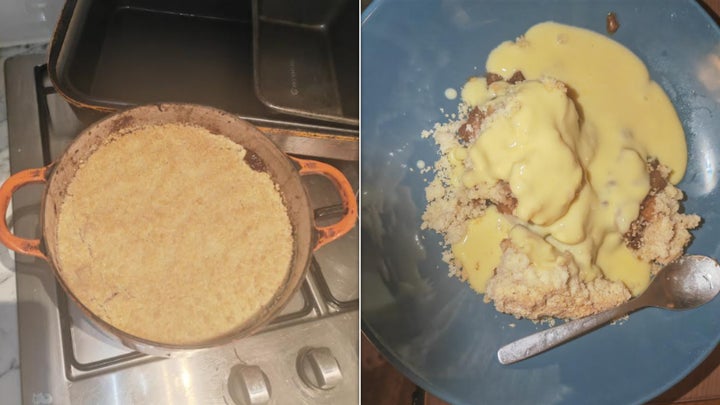
A cooked crumbel on the left: with custard on the right

Amy Glover / HuffPost UK

A cooked crumbel on the left: with custard on the right

Please, please don’t add too many special ingredients

I’ve tried adding oats to the mix (Gordon Ramsay chucks in granola or muesli for a chew, too). I’ve whacked in darker brown sugar for a more treacle-y topping, and included a range of spices.

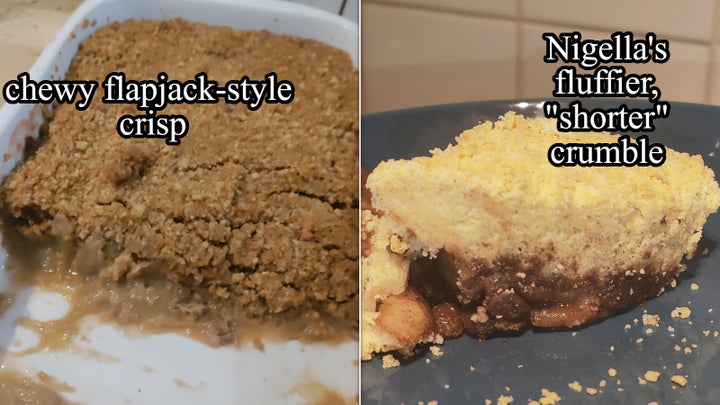
You can see the chewiest, most flapjack-like results I’ve found below (this is the recipe if that’s what you’re after). But, at the risk of sounding grumpy and obstinate, that is not a crumble.

For that, you’ll need to stick to the classics: Nigella uses only sugar (both caster and demerara, though I’ve achieved a happy middle with granulated many times before), butter, and plain flour for the base of her crumble.

But because I want inches of thick crust, her added ingredient – baking soda, which introduces air to the deepest layer of the topping – is key.

She rubs the butter and flour (about 74% butter to flour, one teaspoon of baking powder per 100g flour) together before adding the sugars (half-caster, half-demerara; 60% the volume of flour) to the mix and stirring.

The result is a light, fluffy, buttery but not claggy layer that becomes increasingly pie-crust-like as you spoon deeper into it.

And because of the raising agent, you can dig very, very deep.

A flapjack-like apple crisp topping on the left: fluffier, lighter crumble topping from Nigella on the right

Amy Glover / HuffPost UK

A flapjack-like apple crisp topping on the left: fluffier, lighter crumble topping from Nigella on the right

Any changes I’d make?

Yes – though the baking powder does help to countenance the weight the demerara sugar adds, I actually prefer plain granulated or caster sugar.

That’s because I like mine so thick, though. If I wasn’t as interested in consuming basically nothing but crumble topping in the dessert, I’d probably love the caramel-y addition.

Lastly, as Nigella says, “The crumble topping can be made up to one week ahead and stored in the fridge until needed” or frozen for up to three months and taken out as needed.

I reckon that’s as good an excuse as any to do what I do; make a huge batch in one go and whip it out any time you feel a craving.

Share Button

Trump’s Envoy Had An Eyebrow-Raising Reply To Claims Putin Already Breached Ceasefire Plan

Donald Trump’s envoy has dismissed claims from Ukraine that Vladimir Putin had already breached terms of a partial ceasefire deal overnight.

The US president said on Tuesday that he had managed to persuade his Russian counterpart to agree to halt all strikes on “energy and infrastructure” in Ukraine for 30 days, in what he described as a major step towards peace.

But the Kremlin’s readout of the call was worded slightly differently, saying Moscow had only agreed to a temporary ceasefire on “energy infrastructure”.

Hours later, president Volodymyr Zelenskyy said there had been direct strikes on civilian infrastructure across Ukraine yet again.

European leaders quickly condemned Russia for breaching the terms of the agreement already, but it seems the White House was not so worried.

Steve Witkoff, Trump’s special envoy, told Bloomberg TV he had it on “good information” that Putin had told Russian forces not to strike Ukrainian energy infrastructure within 10 minutes of his call to Trump.

Witkoff said: “Putin issued an order within 10 minutes of his call with the president directing Russian forces not to be attacking any Ukrainian energy infrastructure.

“Any attacks that happened last night would have happened before that order was given.

“In fact, the Russians tell me this morning that seven of their drones were on their way when President Putin issued his order and they were shot down by Russian forces.”

He continued: “So I tend to believe that President Putin is operating in good faith. He said that he was going to be operating in good faith to the President yesterday, and I take him at his word.”

Russia has also accused Ukraine of breaching the truce, saying its defence ministry destroyed 57 Ukrainian drones overnight.

Witkoff then praised the relationship between Putin and Trump, saying he expected to pair to meet soon.

He said: “You know, I can’t speak for them, but my best bet would be that it’s likely to happen. They have a great rapport together. They had a great rapport in the first Trump administration.

“It was on display yesterday. This was really a very positive, very proactive, outcome oriented call, and that’s who President Trump is. He’s there to get to the goal line. And we did a we went a long way yesterday to doing that.”

The envoy’s comments come as Trump and Zelenskyy were having a scheduled phone call about ending the Ukraine war on Wednesday.

Their relationship has been far less “positive” than Trump and Putin’s, especially after the US president chastised Zelenskyy in the Oval Office over his supposed lack of gratitude for America’s support throughout the war.

Trump even withheld military aid and intelligence sharing with Ukraine until Kyiv agreed to a 30-day ceasefire and a mineral-sharing deal with the States as a form of repayment for wartime support.

Although Putin ordered the full-blown invasion of Ukraine in 2022, Trump has not asked the aggressor to make any concessions in the name of peace.

But Trump’s national security adviser Mike Waltz has suggested Ukraine may have to do “some type of territory-for-future-security guarantees” for the country’s future – and a “permanent pathway into Nato is incredibly unlikely”.

Meanwhile, Russian troops continue to advance in eastern Ukraine.

Share Button