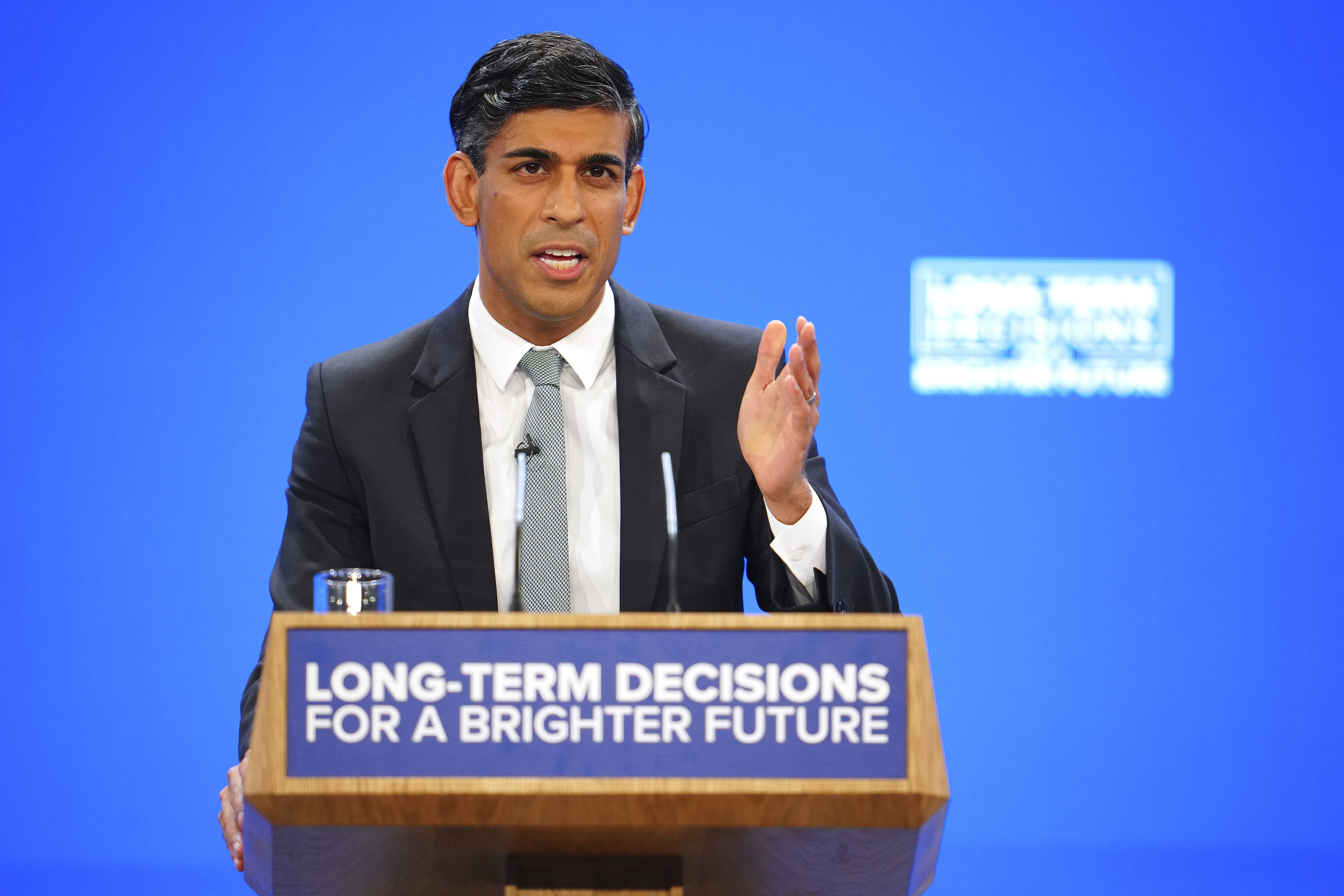
The prime minister says his government is looking at tougher rules to reduce the burden on the NHS.


The prime minister says his government is looking at tougher rules to reduce the burden on the NHS.

The Tories have criticised Labour’s plan to ban smoking outside pubs just months after saying they wanted to make it completely illegal.
The former prime minister’s decision to call an early election meant he ran out of time to turn the policy into law.
Labour have said they will introduce the legislation themselves, and today it emerged that they want to go further by banning smoking in pub gardens, outdoor restaurants and outside sports stadiums and hospitals.
The Conservatives posted on X that was “more evidence that Labour hates freedom”.
“This isn’t about people’s health. It’s about control,” they added.
But embarrassingly for the Tories, a community note was added to the post pointing out the party’s previous support for an outright smoking ban.
Other users of the social media platform were also quick to highlight the Conservatives’ apparent hypocrisy.

Keir Starmer has removed an “unsettling” portrait of Margaret Thatcher from Downing Street.
The painting of the former Tory PM was commissioned by Gordon Brown when she visited No.10 in 2007.
It had been hanging in her former study, which is now known as the Thatcher Room.
But author and journalist Tom Baldwin, who is Starmer’s biographer, has revealed that the PM has decided to take it down.
Speaking at the Aye Write book festival in Glasgow, Baldwin said the pair had recently gone to the study to “have a quiet talk”.
Advertisement
Baldwin said: “We sat there, and I go, ‘It’s a bit unsettling with her staring down at you like that, isn’t it’?”
When Starmer agreed, Baldwin asked if he would “get rid of it”.
He said Starmer nodded, adding: “And he has.”
Downing Street sources confirmed to HuffPost UK that the portrait has now been removed.
The move has been criticised by Russell Findlay, who is the bookies’ favourite to be the next leader of the Scottish Tories.
He said: “Gordon Brown commissioned this portrait after calling the first female Prime Minister ‘a conviction politician who saw the need for change’.
“I agree with Gordon Brown’s reasonable position to treat his political opponents with decency and respect.
Advertisement
“Keir Starmer seems to have a much more petty approach.”


In an Instagram Reel that’s been viewed over 70 million times, site user Hannah Stocking put a book above her loo’s cistern, placed a seat cover on the toilet, and walked out to her partner.
“I have to go,” he said forlornly; “I love you,” they both whispered as he entered the WC.
Arms on a clock span as he played games, scrolled, and generally hung out in there, pants around his ankles. He eventually emerges, bearded and disoriented.
Advertisement
“When your man goes to the bathroom,” the caption reads.
It’s not just an anecdotal thing or a funny post, though; according to a survey run by UK Bathrooms, men spend, on average, one hour and 35 minutes perched on the toilet each week compared to women’s 55 minutes.
It’s not usually stomach issues; or at least, it’s less likely to be that than it is for women.
Dr. Kyle Staller, a gastroenterologist, told Yahoo Life: “It’s true that men do spend longer in the toilet or on the toilet than women do, but in reality are much less likely to have bowel issues and chronic constipation than women are.”
Women’s colons are, on average, 10cm longer than men’s; our hormones also typically fluctuate more often, beleaguering our BMs.
Advertisement
A 2017 study from the University of Oxford and the University of Canberra found that not only are men more likely than women to scroll on the loo (20% vs 26.5%).
A YouGov study also found women feel more nervous about going number two in public loos, where lines are generally also longer than men’s.
But if we’re being real, I reckon we all know the true answer ― a lot of men admit to looking for a bit of an escape and some “me time” on the porcelain throne.
One-third of British men admit to hiding in the loo to escape their families compared to one-fifth of women, according to a survey by bathroom company Pebble Grey.
In a Vice article,
: “Now that I live with my girlfriend, I often use that alone time to plan dinners for the both of us and just generally take stock of the days ahead and what I’ve got going on.”
Well, yes.
“I’ve had some clients tell me that the bathroom allows for the perfect escape from parenting duties,” Jonathan Alpert, a psychotherapist and author, told LiveScience.
Advertisement
“It can be a hideout for people because no one ever asks what you’re doing in there, even if you take a long time. It can truly be a safe place.”
That’s despite Office of National Statistics data that showed fathers of children aged five to 10 enjoyed five hours more leisure time than women per week, and “consistently took more leisure time than women regardless of how old the child in their household was.”
A 2023 Mumsnet post from a poster whose husband took several half-hour-long loo breaks daily reads, “The house would [be] chaos, the family wouldn’t eat and nothing would get done if I took 20 minutes out several times a day.”
Of course, if medical issues are to blame, ensure you see a doctor. And if it’s not a real cause of contention, hey ― scroll away.
Just don’t stay seated while, er, exposed for longer than five minutes (that can cause piles); and if you dash to the bog every time you need an escape, you might want to consider other, less pungent sources of “me time.”
Advertisement

Health experts have welcomed the plans, but hospitality figures have warned of potential economic harm.
Children should be up to date with all vaccinations to protect them and other people, officials say.

The soundtrack of this story begins with a vaguely recognizable and pleasant groove. But if I stop writing and just listen for a second, the music reveals itself completely. In Freddie Hubbard’s comfortable, lilting trumpet solo over Herbie Hancock’s melodic, repetitive piano vamping, I recognize “Cantaloupe Island.” Then, with my fingers again poised at the keyboard, Freddie and Herbie fade into the background, followed by other instrumental music: captivating — but not distracting — sonic nutrition, feeding my concentration and productivity.
Somewhere, I think, Yiren Ren is studying, focused on her research that demonstrates how music impacts learning and memory. Possibly, she’s listening to Norah Jones, or another musician she’s comfortable with. Because that’s how it works: The music we know and might love, music that feels predictable or even safe — that music can help us study and learn. Meanwhile, Ren has also discovered, other kinds of music can influence our emotions and reshape old memories.
Ren, a sixth-year Ph.D. student in Georgia Tech’s School of Psychology, explores these concepts as the lead author of two new research papers in the journals PLOS Oneand Cognitive, Affective, & Behavioral Neuroscience (CABN).
“These studies are connected because they both explore innovative applications of music in memory modulation, offering insights for both every day and clinical use,” says Ren.
But the collective research explores music’s impacts in very different ways, explains Ren’s faculty advisor and co-author of the study, Thackery Brown.
“One paper looks at how music changes the quality of your memory when you’re first forming it — it’s about learning,” says Brown, a cognitive neuroscientist who runs the MAP (Memory, Affect, and Planning) Lab at Tech. “But the other study focuses on memories we already have and asks if we can change the emotions attached to them using music.”
Making Moods With Music
When we watch a movie with a robust score — music created to induce emotions — what we’re hearing guides us exactly where the composer wants us to go. In their CABN study, Ren, Brown, and their collaborators from the University of Colorado (including former Georgia Tech Assistant Professor Grace Leslie) report that this kind of “mood music” can also be powerful enough to change how we remember our past.
Their study included 44 Georgia Tech students who listened to film soundtracks while recalling a difficult memory. Ren is quick to point out that this was not a clinical trial, so these participants were not identified as people suffering from mood disorders: “We wanted to start off with a random group of people and see if music has the power to modulate the emotional level of their memories.”
Turns out, it does. The participants listened to movie soundtracks and incorporated new emotions into their memories that matched the mood of the music. And the effect was lasting. A day later, when the participants recalled these same memories — but without musical accompaniment — their emotional tone still matched the tone of the music played the day before.
The researchers could watch all this happening with fMRI (functional magnetic resonance imaging). They could see the altered brain activity in the study participants, the increased connectivity between the amygdala, where emotions are processed, and other areas of the brain associated with memory and integrating information.
“This sheds light on the malleability of memory in response to music, and the powerful role music can play in altering our existing memories,” says Ren.
Ren is herself a multi-instrumentalist who originally planned on being a professional musician. As an undergraduate at Boston University, she pursued a dual major in film production and sound design, and psychology.
She found a way to combine her interests in music and neuroscience and is interested in how music therapy can be designed to help people with mood disorders like post-traumatic stress disorder (PTSD) or depression, “particularly in cases where someone might overexaggerate the negative components of a memory,” Ren says.
There is no time machine that will allow us to go back and insert happy music into the mix while a bad event is happening and a memory is being formed, “but we can retrieve old memories while listening to affective music,” says Brown. “And perhaps we can help people shift their feelings and reshape the emotional tone attached to certain memories.”
Embracing the Familiar
The second study asks a couple of old questions: Should we listen to music while we work or study? And if so, are there more beneficial types of music than others? The answer to both questions might lie, at least partially, within the expansive parameters of personal taste. But even so, there are limits.
Think back to my description of “Cantaloupe Island” at the beginning of this story and how a familiar old jazz standard helped keep this writer’s brain and fingers moving. In the same way, Norah Jones helps Ren when she’s working on new research around music and memory. But if, for some reason, I wanted to test my concentration, I’d play a different kind of jazz, maybe 1950s bebop with its frenetic pace and off-center tone, or possibly a chorus of screeching cats. Same effect. It would demand my attention, and no work would get done.
For this study, Ren combined her gifts as a musician and composer with her research interests in examining whether music can improve — or impair — our ability to learn or remember new information. “We wanted to probe music’s potential as a mnemonic device that helps us remember information more easily,” she says. (An example of a mnemonic device is “Every Good Boy Does Fine,” which stands for E-G-B-D-F and helps new piano players learn the order of notes on a keyboard.)
This study’s 48 participants were asked to learn sequences of abstract shapes while listening to different types of music. Ren played a piece of music, in a traditional or familiar pattern of tone, rhythm, and melody. She then played the exact same set of notes, but out of order, giving the piece an atonal structure.
When they listened to familiar, predictable music, participants learned and remembered the sequences of shapes quicker as their brains created a structured framework, or scaffold, for the new information. Meanwhile, music that was familiar but irregular (think of this writer and the bebop example) made it harder for participants to learn.
“Depending its familiarity and structure, music can help or hinder our memory,” says Ren, who wants to deepen her focus on the neural mechanisms through which music influences human behavior.
She plans to finish her Ph.D. studies this December and is seeking postdoctoral research positions that will allow her to continue the work she’s started at Georgia Tech. Building on that, Ren wants to develop music-based therapies for conditions like depression or PTSD, while also exploring new rehabilitation strategies for aging populations and individuals with dementia.
“These early studies reveal that music can both help and hinder our memory, depending on its familiarity and structure,” Ren says. “I’m excited to bring together my lifelong love of music with my interest in human memory. Because I think the next phase of my research could provide valuable evidence to support the development of music-based interventions for mental health and cognitive function.”
Three-quarters of requests from prisons did not need an ambulance response, a watchdog finds.

An analysis of more than 1.6 million brain cells from older adults has captured the cellular changes that occur in the early stages of Alzheimer’s disease, potentially revealing new routes for preventing the most common cause of dementia in older individuals.
The study also identified a second community of cells that drives the older brain down a different path that does not lead to Alzheimer’s disease.
“Our study highlights that Alzheimer’s is a disease of many cells and their interactions, not just a single type of dysfunctional cell,” says Columbia neurologist Philip De Jager, who led the study with Vilas Menon, assistant professor of neurological sciences at Columbia University Vagelos College of Physicians and Surgeons, and Naomi Habib of the Hebrew University of Jerusalem.
“We may need to modify cellular communities to preserve cognitive function, and our study reveals points along the sequence of events leading to Alzheimer’s where we may be able to intervene.”
Crunching data from 1.6 million brain cells
The study was a technical marvel, cleverly combining new molecular technologies, machine-learning techniques, and a large collection of brains donated by aging adults.
Though previous studies of brain samples from Alzheimer’s patients have provided insights into molecules involved in the disease, they have not revealed many details about where in the long sequence of events leading to Alzheimer’s those genes play a role and which cells are involved at each step of the process.
“Past studies have analyzed brain samples as a whole and they lose all cellular detail,” De Jager says. “We now have tools to look at the brain in finer resolution, at the level of individual cells. When we couple this with detailed information on the cognitive state of brain donors before death, we can reconstruct trajectories of brain aging from the earliest stages of the disease.”
The new analysis required over 400 brains, which were provided by the Religious Orders Study and the Memory & Aging Project based at Rush University in Chicago.
Within each brain, the researchers collected several thousand cells from a brain region impacted by Alzheimer’s and aging. Every cell was then run through a process — single-cell RNA sequencing — that gave a readout of the cell’s activity and which of its genes were active.
Data from all 1.6 million cells were then analyzed by algorithms and machine-learning techniques developed by Menon and Habib to identify the types of cells present in the sample and their interactions with other cells.
“These methods allowed us to gain new insights into potential sequences of molecular events that result in altered brain function and cognitive impairment,” Menon says. “This was only possible thanks to the large number of brain donors and cells the team was fortunate enough to generate data from.”
Aging vs. Alzheimer’s
Because the brains came from people at different points in the disease process, the researchers were able to solve a major challenge in Alzheimer’s research: identifying the sequence of changes in cells involved in Alzheimer’s and distinguishing these changes from those associated with normal brain aging.
“We propose that two different types of microglial cells — the immune cells of the brain — begin the process of amyloid and tau accumulation that define Alzheimer’s disease,” De Jager says.
Then after the pathology has accumulated, different cells called astrocytes play a key role in altering electrical connectivity in the brain that leads to cognitive impairment. The cells communicate with each other and bring in additional cell types that lead to a profound disruption in the way the human brain functions.
“These are exciting new insights that can guide innovative therapeutic development for Alzheimer’s and brain aging,” De Jager says.
“By understanding how individual cells contribute to the different stages of the disease, we will know the best approach with which to reduce the activity of the pathogenic cellular communities in each individual, returning brain cells to their healthy state,” De Jager says.

New insights into the biology of kidney cancer, including those informed by scientific discoveries that earned a Nobel Prize, have led to advances in treatment and increased survival rates, according to a review by UNC Lineberger Comprehensive Cancer Center’s William Kim, MD, and Tracy Rose, MD, MPH.
Their observations, drawn from a meta-analysis of 89 studies published between January 2013 and January 2024, were published in JAMA Aug. 28.
“The Nobel Prize in Medicine or Physiology in 2019 was awarded for the discovery of how mammalian cells sense oxygen,” said Kim, the Rush S. Dickson Distinguished Professor of Medicine at UNC School of Medicine and co-leader of the UNC Lineberger Cancer Genetics Research Program. “One of the key components of this oxygen sensing pathway is the von Hippel-Lindau tumor suppressor gene, which is mutated in approximately 90% of kidney cancers. This deep understanding of kidney cancer biology has led to several important therapeutic advances in recent years.”
Kim trained as a post-doc with William G. Kaelin, Jr., MD, who was jointly awarded the 2019 Nobel Prize for demonstrating how the von Hippel-Lindau gene influences cellular responses to changing oxygen levels.
The American Cancer Society estimates that more than 81,500 people will be diagnosed with kidney cancer in the United States this year, and the disease will cause 14,300 deaths. While the incidence of kidney cancer has been increasing by approximately 1.5% annually in recent years, deaths have decreased by about 2% each year from 2016 to 2020.
This decline in deaths is largely due to improved treatments and early detection. “The majority of kidney cancer cases are now detected incidentally, often before symptoms appear,” said Kim. He noted that the widespread use of abdominal imaging for unrelated issues has led to the incidental diagnosis of kidney cancer. “More cases are being identified in earlier stages when the cancer is typically more responsive to treatment.”
Cigarette smoking and being overweight are major risk factors for kidney cancer and are linked to nearly half of the cases in the United States. Other risk factors include high blood pressure, a family history of kidney cancer, workplace exposure to certain chemicals, and hereditary conditions, such as von Hippel-Lindau disease.
Current treatment approaches include surgery to remove part or all of the kidney, ablation using targeted heat or cold to destroy the tumor, or active surveillance with imaging technologies to monitor the tumor. For cancers that have metastasized, or spread beyond the kidney, newer treatment options include immune checkpoint inhibitors, tyrosine kinase inhibitors, or a combination of the two approaches.
“Advanced, metastatic kidney cancer is highly treatable with targeted therapy, immunotherapy or a combination of these newer therapies,” said Rose, associate professor of medicine at UNC School of Medicine. “Understanding the science underlying the disease has allowed for the rational development of therapies that have positively affected many patients the past two decades.”
