Watching football is an emotional rollercoaster – but is it good or bad for your health?


Watching football is an emotional rollercoaster – but is it good or bad for your health?
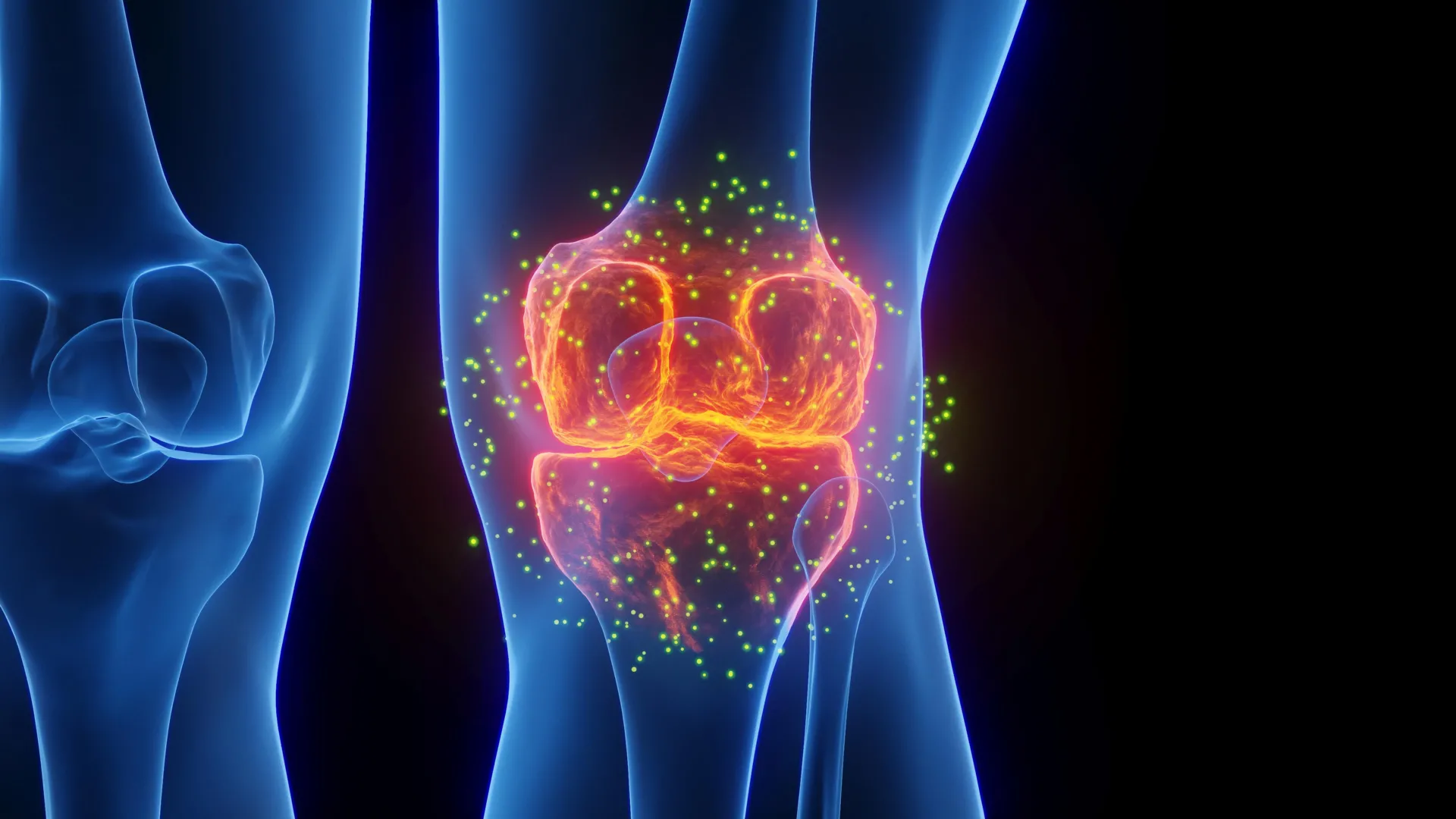
A minimally invasive procedure for chronic knee pain is helping some patients find significant relief without undergoing major surgery.
For Cynthia Schraf-Fletcher, 74, the results were “remarkably” successful.
Nearly a year after receiving genicular artery embolization (GAE) on her right knee, Schraf-Fletcher says the improvement is comparable to the total knee replacement she previously underwent on her left knee.
“I couldn’t be more pleased,” says Schraf-Fletcher, who had the procedure performed by Leigh Casadaban, MD, MS, assistant professor of radiology at the University of Colorado Anschutz School of Medicine.
Today, she says everyday activities such as gardening and riding a stationary bicycle are far more enjoyable because of the reduction in pain.
How Genicular Artery Embolization Works
GAE is an outpatient procedure designed to ease chronic knee pain by reducing blood flow to inflamed areas within the joint. By targeting abnormal blood vessels associated with inflammation, the treatment can help decrease swelling and discomfort.
“For treating osteoarthritis in the knees, we often think of medications, physical therapy, maybe a steroid injection, and then on the far end of the spectrum is a total knee replacement. There really hasn’t been anything for patients in between,” Casadaban, a vascular interventional radiologist, says. “GAE is a promising minimally invasive procedure that may fill that spot for people who have failed conservative treatments but are not yet ready to have a major surgery.”
According to Casadaban, people with mild to moderate osteoarthritis tend to benefit the most. Patients with more advanced disease can also undergo the procedure, although the effects are generally less durable.
“We find about 70% of patients have phenomenal results. They cut their pain scores in half, sometimes more. We have a few patients with no pain at all after the procedure,” Casadaban says. “Patients that have tried a lot of other treatments and haven’t had pain relief are happy to get back to their normal activities.”
After experiencing complications from knee replacement surgery, Schraf-Fletcher was eager to explore another option. Looking back, she says choosing GAE was the right decision.
What Happens During the Procedure?
GAE typically takes between one and two hours and is performed under conscious sedation.
During the procedure, an interventional radiology team makes a small incision near the crease of the leg. Using X-ray imaging and contrast dye for guidance, doctors advance a tiny catheter through the femoral artery until it reaches the genicular arteries around the knee.
Once in position, the team releases microscopic beads that block blood flow to the abnormal vessels located in the painful areas identified by the patient.
Patients are monitored for several hours afterward and are usually able to return home the same day. Doctors generally advise taking it easy for a few days during recovery.
Originally developed in Japan a little more than a decade ago, GAE has steadily gained attention worldwide. Since 2021, the FDA has granted “breakthrough device status” to multiple devices related to the procedure in the United States.
Research Suggests Long Lasting Pain Relief
Early and ongoing research continues to produce encouraging results.
“The theory is that GAE reduces inflammation inside the knee joint, and symptom relief can last years,” Casadaban says. “Four-year data published in Japan shows that if you have one outpatient procedure, your pain relief can last for those four years. In the U.S., we now have two-year data, which shows that if you have a good response, pain relief can last two years. That really speaks to the theory that we’re hopefully modifying something in the joint.”
Casadaban is currently leading two clinical trials at CU Anschutz. One study is examining changes in knee fluid among patients receiving GAE. The other is evaluating a temporary arterial treatment device called Nexsphere-F, which blocks small blood vessels in the knee that may contribute to inflammation and pain.
Expanding Beyond Knee Osteoarthritis
Osteoarthritis is a degenerative joint disease that affects millions of people each year and can occur in many different joints throughout the body.
Although GAE is currently used only for knee conditions, Casadaban says researchers and physicians are beginning to explore its use for other painful musculoskeletal disorders, including frozen shoulder, tennis elbow, and plantar fasciitis.
The immunotherpay can give children and adults three extra years before they need to use insulin.
Dr Hilary Cass says she is “absolutely convinced that more children will be harmed if we don’t do the trial than if we do.”
I am 44 years old and I might be the only woman I know who doesn’t mind getting older. In fact, I relish it.
Don’t get me wrong — I’m not fond of everything that comes with it. My hips hurt. My eyesight is getting worse. I’m forced to decide between a glass of wine or a sleepless night. Gray hair, not-so-fine lines and deep wrinkles are certainly humbling. Oh, and my moisturizers are now more expensive than they’ve ever been.
None of this is fun. But aging has given me something that I didn’t even know I needed: delicious invisibility and freedom from unwanted male attention.
Advertisement
I know that many will take issue with my stance. Society is not kind to women who age, and no one knows that better than women themselves. No one enjoys being ignored when they need something, but the world is not kind to girls or women at any stage, and what I’m talking about is something far more sinister than the store clerk who looks right past me.
I remember the first time a man I didn’t know put his hands on me. It happened in broad daylight at a popular spot in Brooklyn, New York, where locals go to enjoy the view of the Hudson River and the Verrazano-Narrows Bridge that connects my borough to Staten Island. I was 15 years old and enjoying summer break. I spent my days biking around the city and often stopped at this spot, which I’d loved since my parents took me there as a small child.

Courtesy of Christina Wyman
Advertisement
I hopped off my bike and was admiring the whitecaps that rushed under the bridge when I felt his hand up my shorts. Then, just as quickly, he sped away on his bicycle while his friend cheered him on. The assault was fast, calculated and breathtakingly scary. I wonder now how many other unsuspecting women and children he groped before — and after — me.
I never saw the face of that man who made me afraid to go to the promenade by myself from that point forward. Nearly 30 years later, I’ve never forgotten the assault. For too many years I blamed myself for what happened: Maybe if I’d stayed on my bike … Maybe if I hadn’t worn such short shorts … Maybe if I hadn’t been so taken by that view …
That man was not the first or last to challenge my relationship with public spaces. The following year, another guy I didn’t know cornered me against a gate and wrapped his leg around my waist before animatedly thrusting his hips into me until I shoved him away with all the force my teenage body could muster. His friends laughed as I hurried off in the opposite direction, glancing over my shoulder until they were out of sight.
Advertisement
A few years before either of those encounters, I was walking to a family member’s house a few blocks from my own home when a man who appeared to be my father’s age pulled up next to me in a van and said, “Hey, little girl, I have a bag of candy for you.” Though this sounds like something out of an after-school special — almost too cliche to be real — the danger I felt in that moment was visceral, and I ran away from him as quickly as my feet would carry me.

Courtesy of Christina Wyman
I know I’m not the only one who has experienced something like this. Many girls and women are often suddenly confronted by a car horn, a whistle or obscenities being leveled at us by men and boys. It seems to get them off, and I would wager that some of them fully intend to instill a bit of fear in their targets.
Advertisement
A few years ago I was on a walk in a rural town when a man approached me on foot, got uncomfortably close and whispered, “Nice tits,” before rubbing himself and walking away. This happened mere feet from a preschool. It was the first time I called the police during an otherwise peaceful walk in broad daylight. I was on high alert the entire way home. I had no way to prove what had just happened, and I’m not sure the police ever came.
Women and girls are targets for unwanted male attention wherever they find themselves. Everything I’m describing has taken place in cities, suburbs and rural towns, and it’s often much worse. It happens in nightclubs. It happens in grocery stores. It’s happening on busy streets in the middle of the day. Women are told to smile. They’re badgered for their numbers. They’re called names if they don’t respond or dare to call out the behavior. It is relentless. It is daunting. And it’s exhausting.
For many of us, this kind of attention begins in our own homes, long before we’re able to make sense of our experiences. I, like many girls, was conditioned by my family to believe that my body was up for criticism, inspection and commentary. When aunts and uncles comment on the length of your legs, or when your parents talk openly about how you’re “filling out” (or not filling out), or when your grandparents admonish you for not “sitting like a lady” before you have any idea what they mean, you come to accept this hyper fixation on your body as normal.
Advertisement

Courtesy of Christina Wyman
To make matters worse, I was told that unwanted male attention was always the fault of the girl or woman receiving it — no matter what. If I was courageous enough to report these confusing, infuriating and terrifying encounters with strange men and boys to my parents, they would summarily dismiss them as my fault.
Our culture does the exact same thing. Just look at Donald Trump (the former president of the United States!) and the way he has treated women — and how our society has normalized his repugnant behavior. It’s 2024 and we’re still considered playthings for men. And if we don’t like it, we’re labeled rude or frigid, and told we can’t take a joke or don’t know our place.
Advertisement
So, I could not be more thrilled to finally be at an age where I’m mostly unseen by men. With each passing year, I find myself navigating unwanted male attention less and less, which means I can now do something as simple as go for a walk without preemptively bracing myself for rude and hypersexualized comments or uninvited physical contact.
It shouldn’t have to be this way. We shouldn’t have to wait half of our lives to feel safe in our own skin. We shouldn’t have to secure the invisibility that aging offers us to exist in the world without fear of who will approach us and what they’ll say or do. Just think of how much mental and emotional energy we waste — and what we could be capable of if we could spend all of that time and energy creating or connecting with others. What’s more, if women were respected — and desired for more than just their bodies — we might not be rendered invisible as we age (which obviously comes with disadvantages too), and I wouldn’t have to be so overjoyed about finally living undetected.
Unfortunately, it’s too late for me — I’ve already aged out — but it may not be too late for the women and girls coming up after me.
Advertisement

Courtesy of Christina Wyman
As an author, I believe that starting conversations about these kinds of experiences can be a powerful part of the solution. I write children’s books about unpalatable topics like bullying, family dysfunction and gender-based harassment involving minors because I do not want these traumas to continue to thrive in silence. If we can teach children how to resist objectification — and teach boys not to objectify in the first place — we can change the dominant narrative about women in our culture. For me, it all begins with a simple idea: No one is entitled to opinions about — or access to — other peoples’ bodies without their consent. Period. And I will not stop talking with children about these difficult topics until society has turned a corner.
I’m not holding my breath. It won’t be easy. It will take courage, dedication, uncomfortable discussions, and a lot of support and understanding. But it’s worth fighting for. Besides, now that I’m invisible, I’ve got all of that extra time and energy on my hands, so I hope I can help make the world a little more palatable for the girls who will soon inherit it.
Advertisement
Christina Wyman is a USA Today bestselling author and teacher living in Michigan. “Slouch,” her highly anticipated middle-grade novel, is about a tall girl navigating friends, family, self-esteem, boundaries and the terrifying realization that her body no longer seems to belong to her. It is available wherever books are sold, including local independent bookstores, starting in October 2024. Her debut novel, “Jawbreaker,” a middle-grade book that follows a seventh grader with a craniofacial anomaly, was named one of Publishers Weekly’s best books of 2023.
Need help? Visit RAINN’s National Sexual Assault Online Hotline or the National Sexual Violence Resource Center’s website.
This piece was previously published on HuffPost and is being shared again now as part of HuffPost Personal’s “Best Of” series.
Advertisement
Do you have a compelling personal story you’d like to see published on HuffPost? Find out what we’re looking for here and send us a pitch at pitch@huffpost.com.

President Donald Trump slammed Italian Prime Minister Giorgia Meloni again on Sunday, accusing her of refusing to support the US military after he unilaterally waged war against Iran.
In a Truth Social post that did not mention her by name but by her job title, Trump wrote: “After spending Trillions of Dollars on NATO, Italy, and its Prime Minister, wouldn’t even think of becoming involved with the Islamic Republic of Iran and their very serious Nuclear Threat. For decades, we defend them but, when tested, they are not there to defend us, and the rest of the World. Not good!”
A spat that began at the G7 summit last week is boiling over, in part due to Trump’s propensity to beef with fellow world leaders, most of whom are allies.
Trump earlier claimed that Meloni essentially groveled for a photo op with him during the get-together. “She begged me to take a picture with her. She wanted a picture with me so badly. I wouldn’t have taken it, but I felt sorry for her,” he said. He repeated the claim.
Meloni, who reportedly challenged Trump on issues related to the war in Iran during the summit, said he showed more deference to enemies than to allies. She said his claims were “completely made up.”
Trump suggested Meloni was trying to cozy up to him because of her “falling numbers.”
Italian Foreign Minister Antonio Tajani cancelled a visit to the US in the wake of the spat, calling Trump’s accusations “serious and offensive.”
Listen to Commons People, the podcast that makes politics easy. Every week, Kevin Schofield and Kate Nicholson unpack the week’s biggest stories to keep you informed. Join us for straightforward analysis of what’s going on at Westminster.


Keir Starmer’s decision to stand down was hardly a surprise, but politicians across the political spectrum – and around the world – have rallied to pay tribute to the outgoing prime minister.
The PM declared he was standing down as Labour leader on Monday and set out a timetable for his official departure from No.10.
Advertisement
In an emotional speech, he said he was leaving in “good grace” after accepting that the Parliamentary Labour Party did not want him to lead them into the next general election.
It comes after his greatest rival Andy Burnham won the Makerfield by-election last Friday.
As Labour’s most popular politician, the former Greater Manchester mayor was already expected to challenge the prime minister and win any subsequent leadership contest.
Here’s how Starmer’s Labour colleagues, international allies and domestic opponents responded to his resignation.
Advertisement
Burnham, who has already thrown his hat into the ring to be Starmer’s successor, said: “Keir has given huge service to our country and I want to thank him for his leadership and dedication during such a challenging period.
“His decision marks the beginning of a transition and it is important that this process is conducted in an orderly and responsible way.”
Former health secretary Wes Streeting, who was briefly considered a leadership hopeful, said he backed Burnham as Streeting’s replacement and added that Starmer “has made the right decision to stand down as Leader of the Labour Party that he saved”.
Advertisement
Starmer’s cabinet also paid tribute to him, with deputy prime minister David Lammy saying he “incredibly proud to have played my part” in Starmer’s government.
Chancellor Rachel Reeves praised Starmer for “taking our party from the worst defeat in modern history” to a landslide victory in just four years.
Home secretary Shabana Mahmood said Starmer’s achievements “will never be forgotten” and that he put us “on the path to the change we promised at the last election”.
Advertisement
She added: “A devoted and dedicated public servant, we owe him our deepest thanks.”
Foreign secretary Yvette Cooper echoed this sentiment, saying the country is stronger and fairer “because of what Keir has done over the last six years”.
Former deputy PM Angela Rayner extended her sympathies to Starmer, saying: “History will remember not just the challenges he faced but the achievements he oversaw.”
Energy secretary Ed Miliband said Starmer can be “immensely proud of his achievement” and that his statement showed “great dignity and integrity”.
Advertisement
One of Starmer’s closest allies, the attorney general Lord Hermer, told Sky News that the PM was not “angry” at being forced out of office.
He said: “I would be, but I don’t think he is.
“I think he is someone who is genuinely focused on the country and doing the right thing, and you saw that on the podium today.”
Anna Turley, chair of the Labour Party, wrote in a statement: “I’m sorry that the nature of politics now is so impatient, so unforgiving, and so personally brutal.
Advertisement
“You have shown that in a world of easy promises, irresponsible rhetoric and lazy, dangerous populism, it is still possible to do things the right way – to show duty, decency and the real patriotism of hard work and service.”
Leader of the opposition, the Tories’ Kemi Badenoch, was less forgiving.
She wrote on X: “Britain is not ungovernable. Keir Starmer is a terrible Prime Minister.
“But the problem isn’t just Starmer. Labour MPs only want higher taxes to hand out more benefits, as the Welfare Secretary has pointed out. These are Labour’s choices and their values, regardless of who is running the party.”
The Lib Dem leader Ed Davey said: “The British people are sick of being let down by an endless merry-go-round of prime ministers while nothing really changes for them.
Advertisement
“This time must be different. It can’t just be about changing who’s in Number 10, it has to be about changing our broken politics so we can fix our country.”
He added: “Whoever becomes prime minister needs to drop the caution and complacency and show the ambition our country deserves.”
Green Party leader Zack Polanski said: “The country needs a bold change of direction. Starmer lost the confidence of the country because of his abject failure to challenge the power and wealth of an establishment which has taken for themselves while leaving the vast majority in a cost of living crisis and facing the worst impacts of the climate and nature crisis.”
Advertisement
“We are still waiting to see which version of Andy Burnham might going to show up in Downing Street,” he added. “Burnham must be bold or he will be bust.”
Reform UK leader Nigel Farage called for a general election, writing on X: “I’ve had enough of waiting around. Britain needs change – real change, not another washed-up has-been shoved into place by the uniparty.
“If Labour thinks it can shove another professional politician into No 10, it has another thing coming. Reform is ready for an election, and we are ready to deliver radical change.”
Advertisement
SNP leader and Scotland’s first minister John Swinney paid tribute to Starmer in a statement, saying: “On a personal level, I wish the prime minister and his family well.
“Leadership is tough, and can make extraordinary demands both on the leader and their families. Sir Keir Starmer has made the right decision. It was past time for him to face reality and the fact he now has allows some hope that things can change.”
Advertisement
Ukrainian president Volodymyr Zelenskyy thanked Starmer on on X, writing: “The United Kingdom has been, is, and will remain among the world’s leaders.
“Here in Ukraine, we deeply value Britain, and every meeting and every conversation we have had has always been filled with real substance.
“Thank you for always being in touch, always engaged, and always striving to do what is needed and what will truly help.”
Advertisement
He added: “Keir, you are always a welcome guest in Ukraine.”
European Commission president, Ursula von der Leyen, thanked Starmer for his work on rebuilding the UK’s relationship with the EU.
She said: “It can take many leaders years to grow into the statesman you became in just two years.
“European and Ukrainian security is stronger because of you. Thank you, dear Keir.”
Former Czech prime minister Petr Fiala paid tribute to Starmer for his “clear and principled support for Ukraine”, and helped to unlock new levels of UK-EU cooperation.
He added: “Today, rational and decent politicians face an increasingly difficult environment. Starmer moved the Labour Party towards the political centre and strengthened the United Kingdom’s position abroad. In the end, it was not enough.
Advertisement
Australian prime minister Anthony Albanese said in a statement that he considers Starmer “a friend” and notes “politics can also be a harsh business”.
He added: “When the time comes for Keir to leave Downing Street, he can be proud of the contribution he has made to the country he loves and to the Labour party that he led back to government in 2024.”
Listen to Commons People, the podcast that makes politics easy. Every week, Kevin Schofield and Kate Nicholson unpack the week’s biggest stories to keep you informed. Join us for straightforward analysis of what’s going on at Westminster.
Advertisement

From the autumn a new Water Safety Forum is being introduced to primary and secondary schools.

For years, scientists believed Tyrannosaurus rex reached its adult size at around age 25. But a major new study suggests the iconic predator may have taken much longer to mature. According to the research, T. rex likely continued growing for about 40 years before reaching its maximum size of roughly eight tons.
The findings come from an analysis of 17 tyrannosaur fossils spanning a wide range of ages, from young juveniles to massive adults. Researchers say the work provides the most detailed reconstruction yet of how Tyrannosaurus grew throughout its life.
The study was published in the journal PeerJ.
Reading the Growth Rings Hidden Inside Dinosaur Bones
To estimate the age of dinosaurs, paleontologists often examine growth rings preserved inside fossilized bones. These rings are somewhat similar to the annual rings found in tree trunks. Each growth mark can provide clues about how quickly an animal was growing and how old it was when it died.
For decades, scientists have used these rings to reconstruct the life history of Tyrannosaurus rex. However, the new study employed more advanced techniques than earlier investigations. Researchers examined thin slices of fossil bone under specialized lighting that can reveal growth rings that are difficult to detect using standard methods.
The team also used sophisticated statistical models to combine information from multiple specimens. This allowed them to create a more complete picture of growth across the entire lifespan of T. rex.
The results indicate that Tyrannosaurus remained in a growth phase about 15 years longer than previously thought.
In addition, the findings suggest that some fossils traditionally assigned to T. rex may actually belong to other closely related species, or differ for other biological reasons.
Largest T. Rex Dataset Ever Assembled
“This is the largest data set ever assembled for Tyrannosaurus rex,” says Holly Woodward, a professor of anatomy at Oklahoma State University who led the research effort. “Examining the growth rings preserved in the fossilized bones allowed us to reconstruct the animals’ year-by-year growth histories.”
Unlike a tree stump, which preserves rings from an organism’s entire life, dinosaur bones provide only a partial record. A cross section of a T. rex leg bone typically preserves information from just the final 10 to 20 years of the animal’s life.
To overcome that limitation, the researchers combined growth records from multiple individuals of different ages.
“We came up with a new statistical approach that stitches together growth records from different specimens to estimate the growth trajectory of T. rex across all stages of life in greater detail than any previous study,” explains Nathan Myhrvold, a mathematician and paleobiologist at Intellectual Ventures who led the statistical analysis.
“The composite growth curve provides a much more realistic view of how Tyrannosaurus grew and how much they varied in size.”
A Slower Path to Becoming a Giant Predator
The new results paint a different picture of Tyrannosaurus development than earlier studies.
Instead of rapidly reaching adulthood, T. rex appears to have grown at a steadier pace over several decades. According to the researchers, this prolonged growth period may have helped younger tyrannosaurs occupy different ecological niches as they matured.
In ecology, a niche refers to the role an organism plays within its environment, including what it eats, where it lives, and how it interacts with other species.
“A four-decade growth phase may have allowed younger tyrannosaurs to fill a variety of ecological roles within their environments,” says coauthor Jack Horner of Chapman University. “That could be one factor that allowed them to dominate the end of the Cretaceous Period as apex carnivores.”
The Cretaceous Period ended about 66 million years ago, shortly before the extinction of non-avian dinosaurs.
Are Some Famous T. Rex Fossils Actually Different Species?
The study also contributes to an ongoing debate among paleontologists.
Although Tyrannosaurus rex is one of the most famous dinosaurs ever discovered, some researchers have argued that not every fossil labeled as T. rex necessarily belongs to the same species.
One controversial proposal suggests that several smaller fossils represent a separate dinosaur called Nanotyrannus rather than young Tyrannosaurus individuals. Other researchers have proposed that even some large specimens may belong to multiple closely related species.
The issue remains unresolved.
To investigate the question, the researchers included 17 fossils belonging to what they describe as the “Tyrannosaurus rex species complex,” a term acknowledging the possibility that more than one species or subspecies could be represented.
Two particularly famous specimens, nicknamed “Jane” and “Petey,” stood out from the rest. Their growth patterns differed significantly from those of the other fossils in the study.
While growth data alone cannot determine whether these animals belonged to different species, the unusual patterns make that possibility worthy of further investigation.
The researchers note that a separate recent study by Zanno and Napoli reached a similar conclusion using different methods, classifying Jane and Petey as two distinct species of Nanotyrannus.
Hidden Growth Rings Could Change Dinosaur Research
Another important finding involves the discovery of previously overlooked growth markers inside dinosaur bones.
Woodward, Myhrvold, and Horner found that circularly polarized and cross-polarized light can reveal a new type of growth ring. These hidden features may help explain discrepancies that have puzzled researchers studying dinosaur growth.
Because the approach is supported by strong statistical evidence, it could influence how scientists examine fossils in future studies, not only for T. rex but for many other dinosaur species as well.
“Interpreting multiple closely spaced growth marks is tricky,” Myhrvold says. “We found strong evidence that the protocols typically used in growth studies may need to be revised.”
A New Look at the Life of Tyrannosaurus Rex
More than a century after Tyrannosaurus rex was first described by scientists, the giant predator continues to reveal new surprises.
By combining a larger fossil sample, improved imaging techniques, and innovative statistical analysis, the new research provides one of the clearest views yet of how T. rex developed from a young dinosaur into one of the largest and most formidable land predators in Earth’s history.
The findings suggest that the king of dinosaurs may have taken far longer to grow up than anyone previously realized.

Researchers are taking a closer look at how different types of dietary fat may influence the risk of type 2 diabetes, a disease that affects millions of people worldwide and is linked to serious health complications and premature death. A new review published in Trends in Endocrinology & Metabolism (Cell Press) explores the contrasting effects of two major fatty acids found in the diet: palmitic acid and oleic acid.
The work was led by teams from the CIBER Area for Diabetes and Associated Metabolic Diseases (CIBERDEM) at the University of Barcelona.
“Palmitic acid, a saturated fatty acid widely found in foods, is associated with impaired insulin sensitivity, whereas oleic acid, abundant in olive oil, may have a protective effect against these metabolic disorders,” says Professor Manuel Vázquez-Carrera, from the UB’s Faculty of Pharmacy and Food Sciences, the UB Institute of Biomedicine (IBUB), the Sant Joan de Déu Research Institute (IRSJD) and CIBERDEM.
Other contributors include Ricardo Rodríguez-Calvo of CIBERDEM at the Pere Virgili Institute for Health Research (IISPV), Marta Tajes of the CIBER Area for Cardiovascular Diseases (CIBERCV) at the Bellvitge Biomedical Research Institute (IDIBELL), and Walter Wahli of the University of Lausanne (Switzerland).
According to Vázquez-Carrera, the findings suggest that the type of fat people consume may be more important than the overall amount.
“This review highlights the significant role of the quality of dietary fat, rather than the total amount consumed,” notes Professor Manuel Vázquez-Carrera, who is a group leader at CIBERDEM at the UB.
How Palmitic Acid May Promote Diabetes
The researchers examined evidence showing that palmitic acid can trigger several biological processes linked to metabolic disease.
As Xavier Palomer (UB-IBUB-CIBER-IRSJD), the article’s first author, says, “at the molecular level, palmitic acid promotes the accumulation of potentially toxic bioactive lipids, fosters low-grade chronic inflammation, and contributes to the dysfunction of cellular organelles, such as the endoplasmic reticulum and the mitochondria.”
The team notes that these cellular changes “are closely linked to impaired insulin action and the progression of metabolic disease.”
Oleic Acid Shows Protective Effects
The picture looks quite different for oleic acid, a monounsaturated fat found in high amounts in olive oil.
According to the review, oleic acid encourages the body to store fats in forms that are metabolically less disruptive and have little effect on normal cellular function. It also helps maintain healthy insulin signaling in important metabolic tissues, including the liver, muscles, and adipose tissue.
Researchers say oleic acid may also offset many of the harmful effects associated with palmitic acid. This could help explain why eating patterns rich in monounsaturated fats, including the Mediterranean diet, are consistently linked to a lower risk of type 2 diabetes and other metabolic disorders.
Improving Nutrition Strategies for Diabetes Prevention
The authors emphasize that more targeted research is needed to better understand differences seen across population studies.
“It is important to consider variables such as the source of fatty acids, their dietary context, interactions with other nutrients, and different food processing methods,” says Manuel Vázquez-Carrera.
The researchers believe that gaining a clearer understanding of these factors will improve scientists’ ability to evaluate how different fats affect metabolic health. In turn, that knowledge could support the development of more effective dietary approaches for preventing and managing type 2 diabetes.
