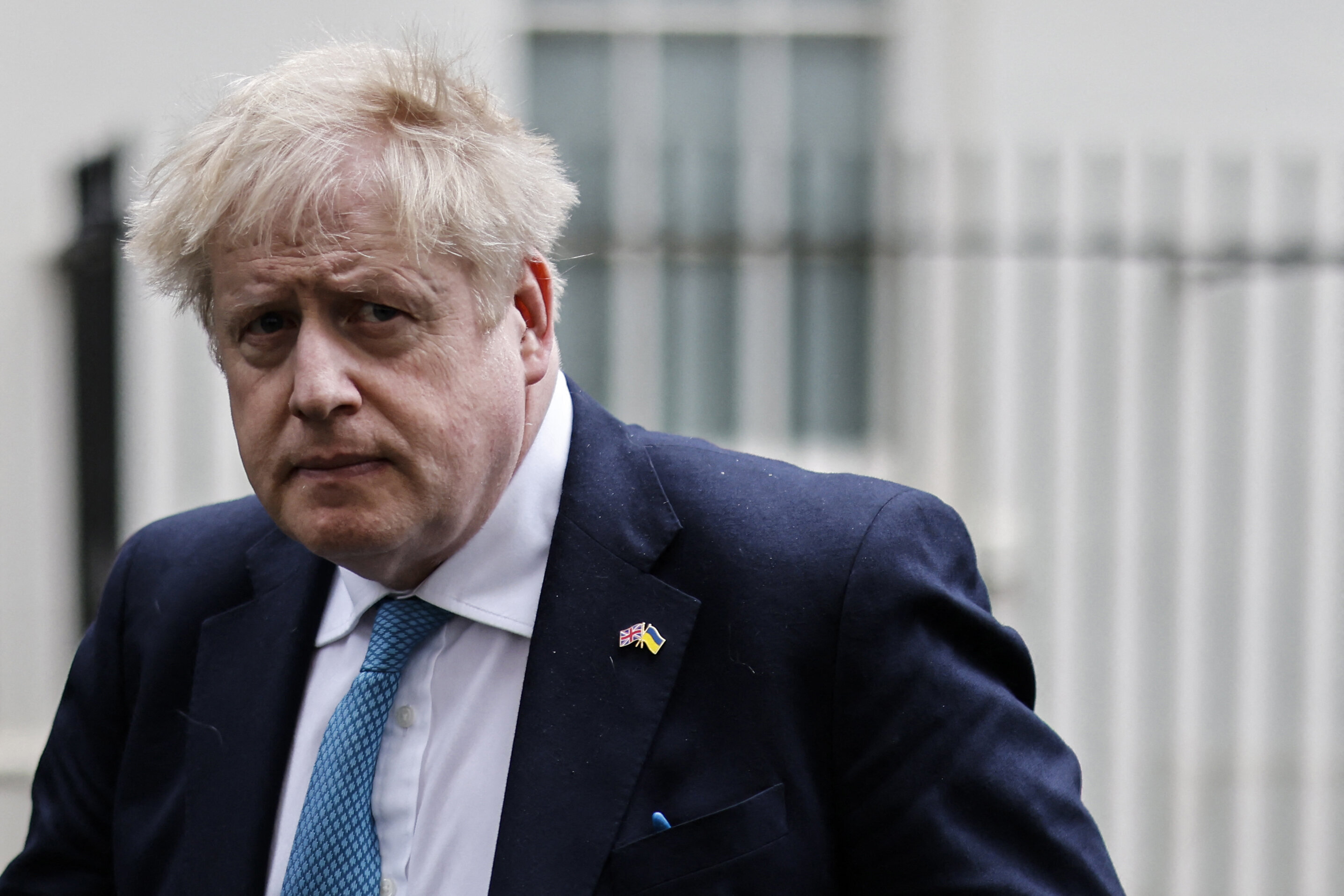
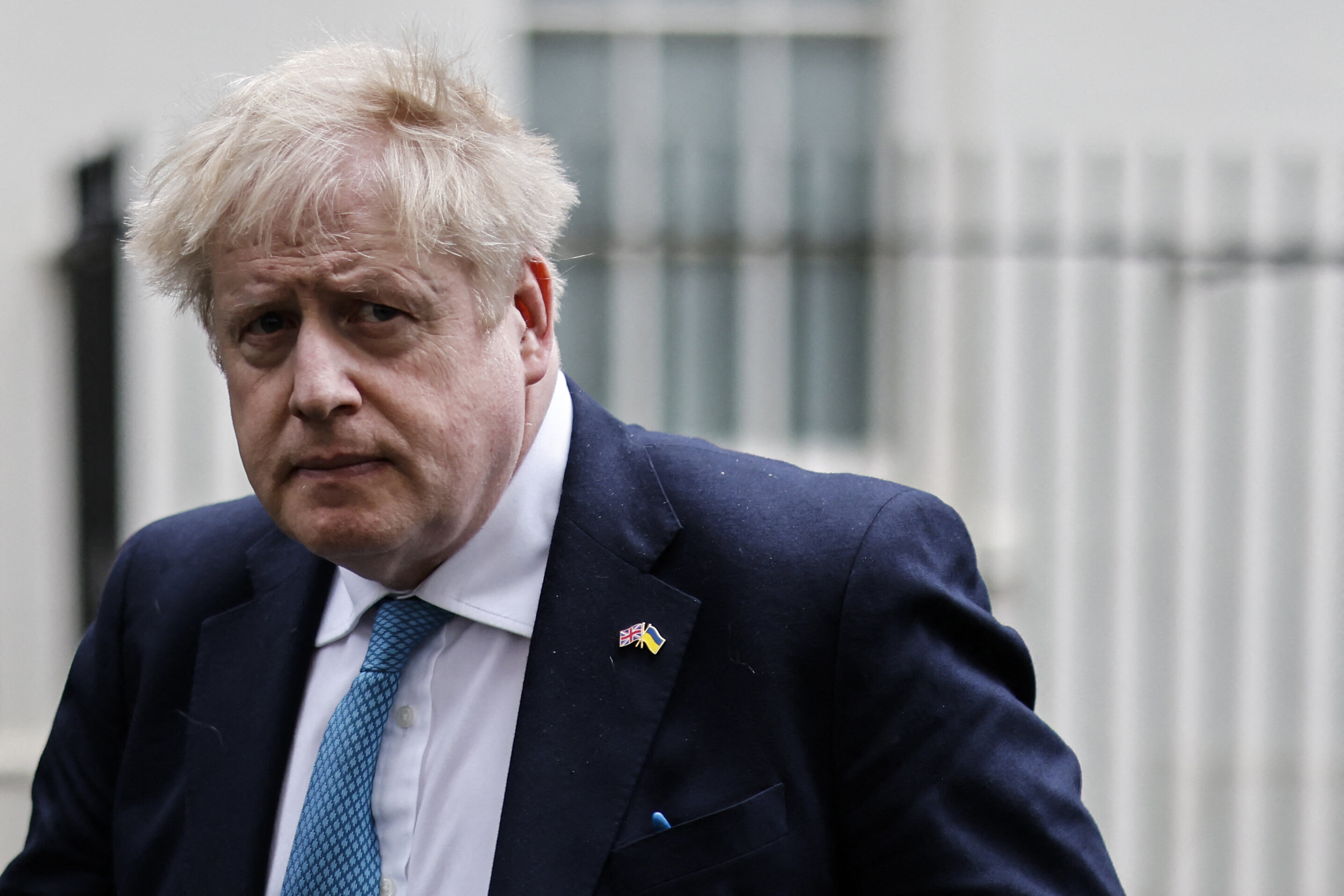
Up to 117 people have potentially been exposed to asbestos in parliament, it was revealed today.
It comes after HuffPost UK revealed that renovation work had to be halted and the Health and Safety Executive launched an investigation after a leak last October.
Advertisement
Dr John Benger, clerk of the Commons, told MPs that 81 contractors and 36 parliamentary staff were among those affected.
Most were not informed until more than four months after the leak started, and two months after he learnt about it himself.
Advertisement
Benger faced a grilling from the public accounts committee in which he conceded that lessons must be learnt, adding: “It’s not a defensible position. It shouldn’t have happened”.
The committee heard that asbestos was released during works on the Speaker’s bedrooms over four days in October but not noticed until nearly four weeks later on November 19.
Advertisement
The site was immediately closed and three members of staff working on the project were informed.
However, it was not reported to the HSE until February 10 and the full number of those who may have come into contact with the deadly substance were not informed until February 17.
Asked why everyone potentially exposed to the leak was not informed before then, Benger replied: “Icompletely agree that they should have been told far more quickly than they were.”
He suggested one of the reasons it took “such a long time” was because there was a dispute over whether the incident “crossed the threshold” at which any notification was required and a discrepancy over who had a duty to report it.
Advertisement
The leak was said to have taken place between October 23 and 27, but Benger said the first he heard about it was when he read a safety report on December 10.
He told the committee: “That indicated that three staff were potentially affected whereas our current belief is that potentially 117 staff were in the area.”
He said the level of seriousness did not look as great then as it did now and that parliament’s lawyers were not notified until February,
Committee chair Dame Meg Hillier said: “It seems like lots of people were dancing on pinheads about who was responsible.”
Benger replied: “I agree with that. I think there are definitely lessons to be learned. We’ve already started learning lessons in terms of immediate safety.
“We stood down all works on the parliamentary estate on February 9, which is a huge number of projects.”
When Hillier told him that was two months after they knew about the leak, he replied: “I’m not for a minute saying that this is a defensible position. It’s not a defensible position. This shouldn’t have happened.”
Benger said the building was “full of asbestos” and they have incidents “about once a year”.
Tory MP Sir Geoffrey Clifton-Brown referred to HuffPost UK’s exclusive coverage of the leak last month, telling him:“It does sort of give an impression that there was an element of cover-up going on.
“Surely these things should be put in the public domain as soon as they happen? So that everybody else can be aware of what’s happened?”
Advertisement
Benger replied: “I’m not aware of any cover-up. What I do think is the case is that there is great disagreement between the different parties whose fault it was and whose duty it was to notify.”
Benger replied: “I’m not aware of any cover-up. What I do think is the case is that there is great disagreement between the different parties whose fault it was and whose duty it was to notify.” pic.twitter.com/0PT6JJKeb6
Jawad Raza, from the civil servants’ union the FDA, said: “Successive reports have determined that the safest and cheapest option is to decant from the Palace of Westminster whilst necessary repair work is carried out.
“Today’s updated figures relating to asbestos exposure only highlights the continued risk to the workplace of parliamentary staff, MPs and all those who visit. It is imperative that both houses now work quickly, including engaging with its staff to find a solution.”
It comes after a recent report outlined how the crucial works needed to save the Palace of Westminster could cost up to £22 billion and last 76 years.
Walking home from secondary school with my sister many years ago, I spotted a London bus plastered with a depressing advert, solemnly warning of the dangers of diabetes. “What’s the big deal?” I asked rhetorically. “Diabetes for an Asian person is a regular Tuesday.”
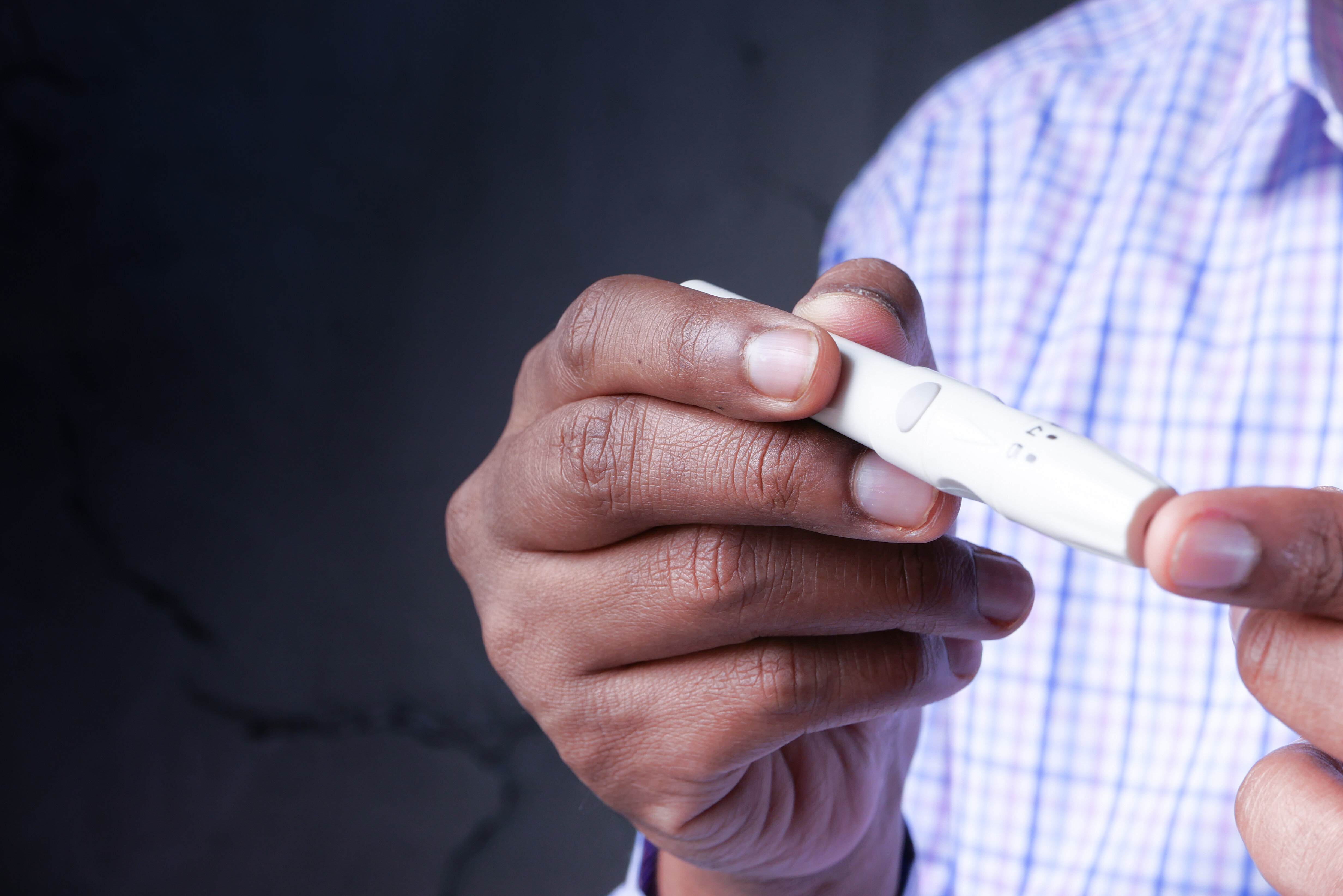
Though I was being facetious, I wasn’t wrong. South Asians do seem more susceptible to diabetic conditions. According to Diabetes.co.uk, the likelihood of developing type 2 diabetesis reported to be as much as six times higher in South Asians than in Europeans, with a number of factors – mostly linked to lifestyle – believed to be behind this increased risk.
Advertisement
But have we also considered the role history plays here? Is colonialism another overlooked factor that contributes to South Asian bodies? It’s well understood that people can inherit psychological trauma from previous generations but, for many racialised people, there can be physical consequences, too.
Think back to GSCE history. You may have learned the Indian subcontinent was subject to many famines, with some particularly severe ones occurring under British rule. For centuries, up until India gained independence in 1947, starvation plagued the nation, in part a byproduct of colonial times.
Advertisement
The East India Company’s raising of taxes, policy failures (including a “denial of rice”), resources being deployed to the military, and droughts that were met with British inaction, resulted in the deaths of millions. In 1943, West Bengal saw the worst of it all, a famine in which up to three million people died of malnutrition.
Yet, famines in the British era were not due to a lack of food, but due to the inequalities in the distribution of that food, Nobel Prize winning economist Amartya Sen argues, linking this inequality to what he describes as the fundamentally undemocratic nature of the British Empire.
Advertisement
You might wonder what’s all this got to do with South Asians now? Well, not only was the “great famine” in Bengal only 79 years ago (for some, a part of living memory), but when a group of people are exposed to starvation on this scale, it can affect subsequent generations.
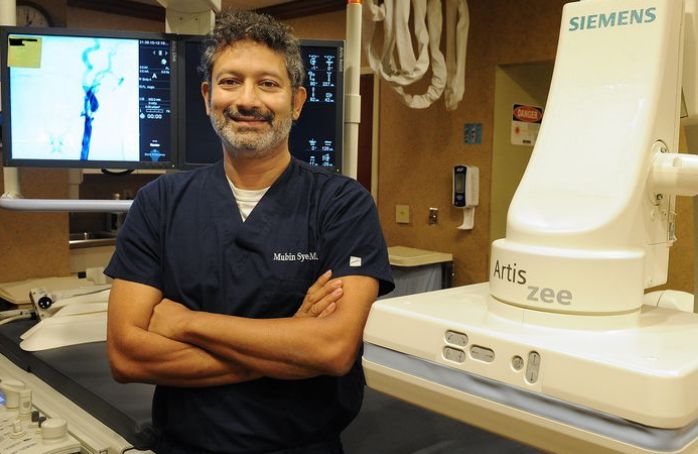
Dr Mubin Syed, a 56-year-old radiologist from Ohio who also works in vascular and obesity medicine, recently went viral on TikTok and Instagram for making this crucial link.
As he explains in his video, South Asians have a tendency to generate and store fat and not burn it off, amassing low lean muscle mass. This, he points out, is because South Asians are “starvation-adapted”, due to having to survive at least 31 famines, especially during the 18th and 19th century.
Surviving just one famine doubles the risk of diabetes and obesity in the next generation, even without a famine, according to a study by Brown university. The risk of cardiovascular disease increases 2.7 times for their grandchildren.
Advertisement
Dr Syed, whose research in this area for the past five years led him to these conclusions, tells HuffPost UK: “Exposure to even one famine has a multi-generational effect of causing metabolic disorders including diabetes, hyperglycemia and cardiovascular diseases. Imagine having an exposure to at least 24 major famines in a 50-year period.”
And the problem carries through to the present.
“In the modern era of abundance, it becomes an evolutionary mismatch. Our adaptation to scarce food availability is no longer suitable for our environment of food abundance,” he says.
So, storing nutrients was an evolutionary response to famine, but now, where scarcity is no longer a problem for much of the modern, western world, it creates a conflict, heightening our risk of certain health conditions.
“South Asians have a unique physiology,” Dr Syed explains. “For instance, we have higher body fat percentage and lower lean muscle mass. We have a six times greater risk of developing diabetes, one of the highest rates of diabetes and pre-diabetes in the world, and a four times greater risk to have a heart attack before the age 50. Furthermore, one in three South Asians will die of heart disease before 65.”
While our genes, inherited from our ancestors, can explain some of these predispositions, diet is another contributor – though not in a straightforward way. “It’s a multifactorial perfect storm,” says Dr Syed. :Genetics is one issue, but of course, lifestyle is always important. But, South Asians have to exercise twice as much as Caucasians to get the same health benefits.”
Mubin Syed
Dr Syed has been researching this area for half a decade
It certainly feels like Indians, Bangladeshis, and Pakistanis, who once made up India, are still reeling from the effects of colonialism, mentally and physically.
My family are certainly still feeling its effects. Though my parents weren’t around when the Bengal famine took place, their generation is impacted; my dad is diabetic while my mum is prediabetic, and this leaves me in a precarious position, too.
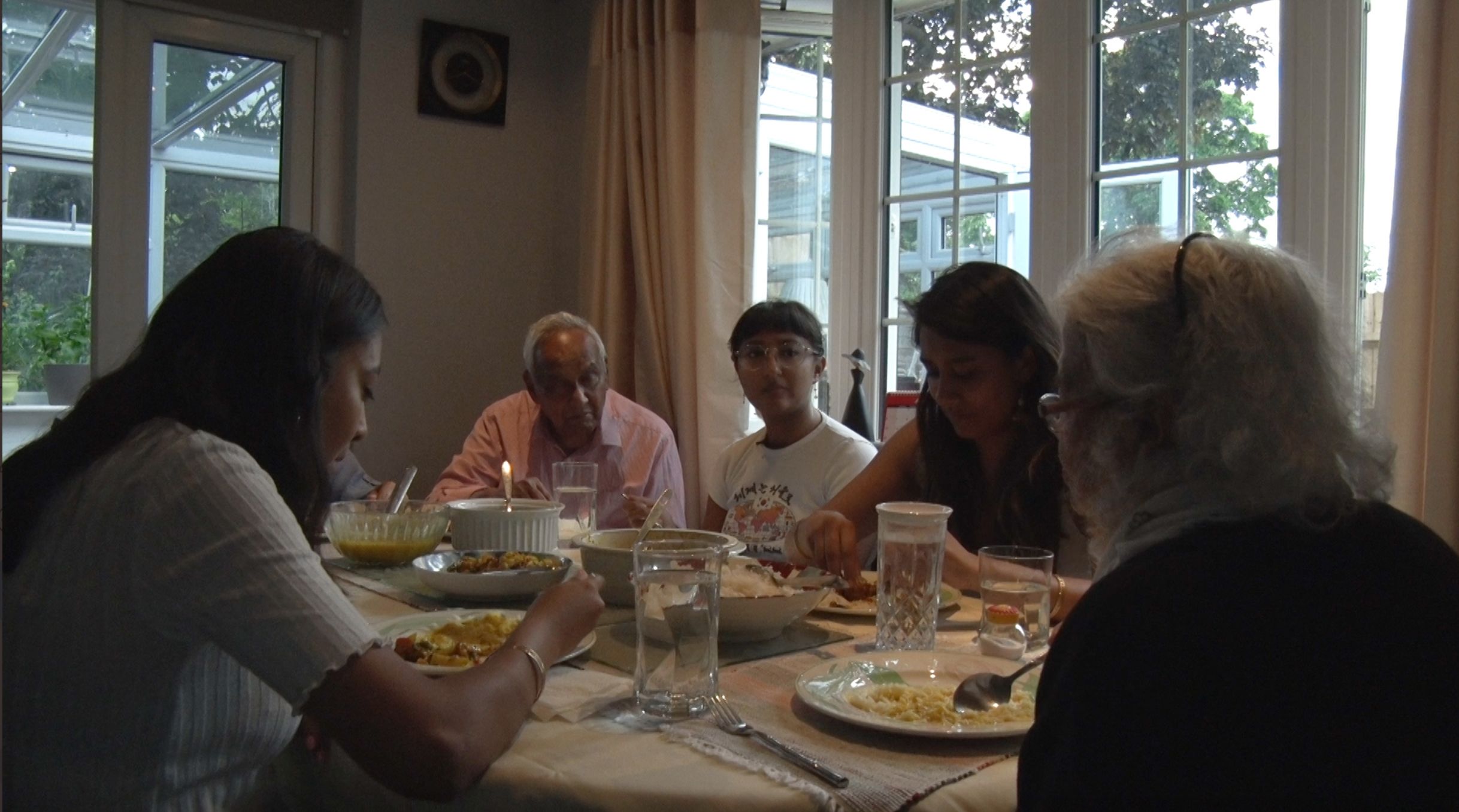
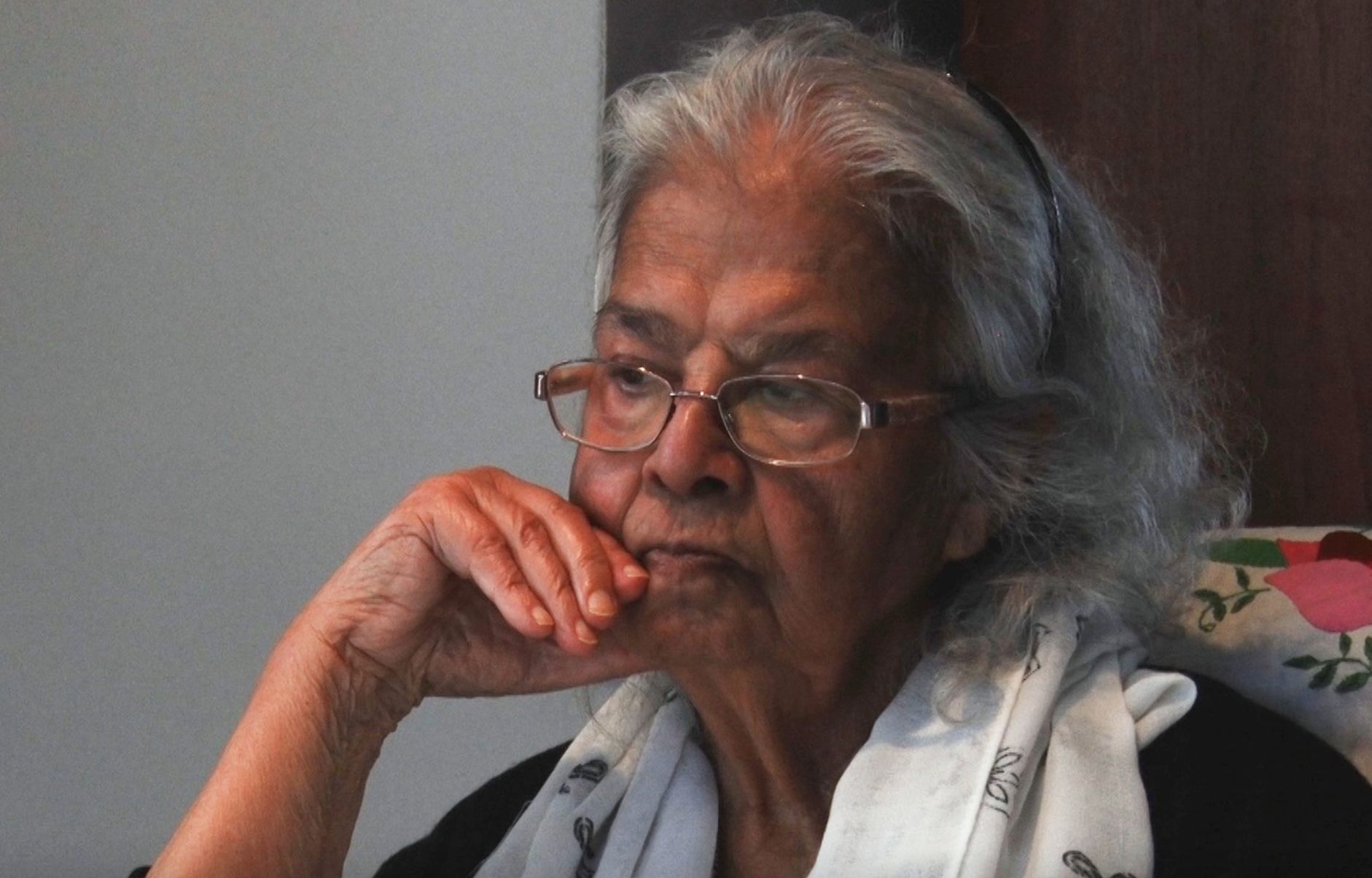
Another concern for the community is a lack of awareness about how our past informs our future. This is why filmmaker Phelan Chatterjee, 26, set out to create a short documentary, Straining The Rice that captures the trauma endured by Bengali people, told through the lens of a grandmother, Nana (not his own).
The London-based producer laments how little people know of the famine and how it affects us today.
Advertisement
He tells HuffPost UK: “I had a lot of conversations with Asian friends and family in the UK. I found very little mention or memorialisation of the catastrophe, despite the enormous number of people who died, and its effects today.
“The sheer number of lives lost, the brutal way in which they perished and the helplessness of those demanding change at the time. It’s difficult to come to terms with the fact that it’s not a part of our national conversation in any meaningful way.”
Phelan Chatterjee
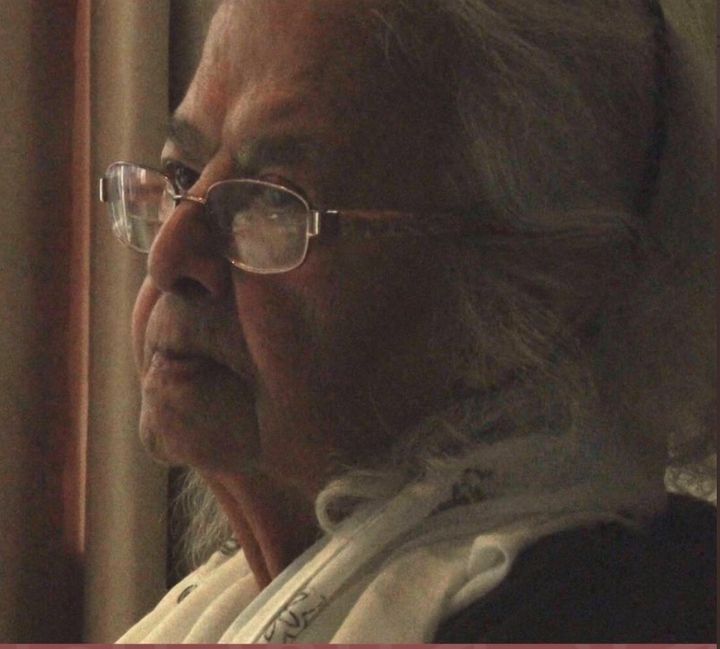
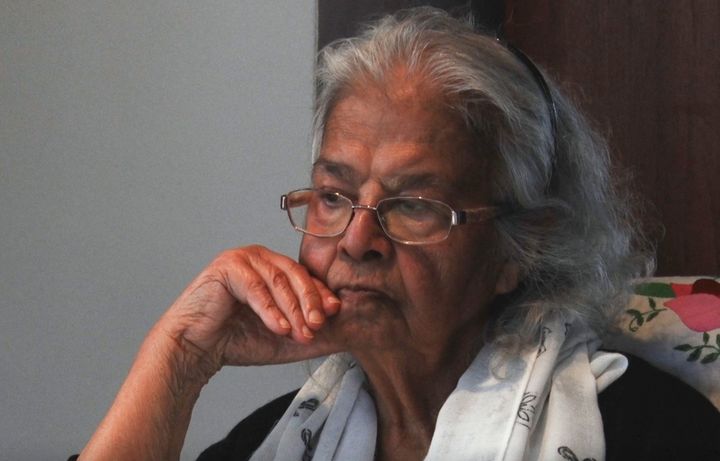
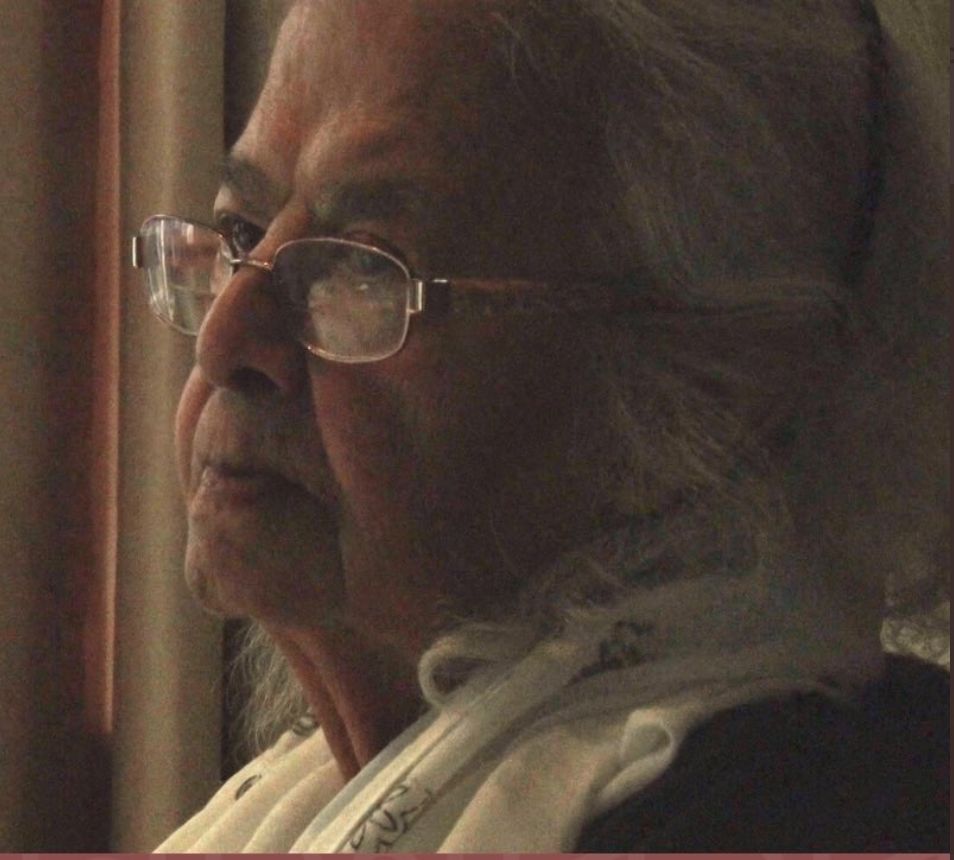
Phelan’s film Straining the Rice includes testimony from Nana, who experienced the famine as a child.
Chatterjee questions those who say the famine was simply an environmental consequence, and asks why there’s no accountability for why such conditions were created.
“The protagonist of the film, an elderly Bengali woman says the famine sparked a great deal of protest against the colonial government of the day,” he says.
“This suggests there had always been a keen awareness of the links between policy choices and the famine. But frequently, I’ve experienced famines and similar events to be thought of as beyond human control.
“I wonder what a reappraisal of those policies might bring, and how that could inform the way we understand contemporary famines, global inequality – including health inequality – and climate change.”
Phelan Chatterjee
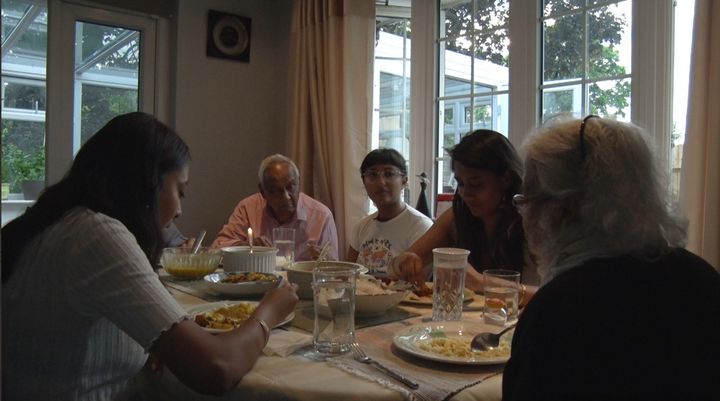
Straining the Rice focuses on a family discussion of the Bengal famine
If schools, for instance, taught students about these historical atrocities and their contemporary implications on us mentally and physically, we might have a better understanding of how to navigate our lives now. Healthcare research and responses might even cater better to our bodies, as a result.
But, despite the risks and impact of inequalities on South Asians today, Dr Syed says it doesn’t mean ill health is inevitable for us.
“It’s not a doom and gloom scenario,” he says. “The risks are avoidable, we just have to pay closer attention to diet, exercise/fitness, sleep, stress and other substances.” This means how much alcohol and tobacco we consume, says Dr Syed, and for South Asians who enjoy it, consumption of betel nut or supari.
Phelan Chatterjee
Nana remembers how beggars would ask for the starchy rice water
“Even our dental health,” he adds. “The key thing is awareness, getting regular check-ups, including lipid profiles, is critical. Do not assume you are healthy, as normal height/weight BMIs are misleading for South Asians.”
Advertisement
Many South Asians in the West who are told “colonialism was a long time ago” and not to “dwell on the past” will struggle with all these conflicting messages. We certainly can’t nor should forget a history that still continues to impact us. And there are many who still remember the harshness of colonial times.
For those who came before us, as well as ourselves, it’s imperative we keep educated and informed of our past and how plays a crucial role in our future.
British MPs have given a standing ovation to Ukrainian president Volodymyr Zelenskyy as he gave an historic address to the House of Commons.
MPs took to their feet even before Zelenskyy, who appeared via a live video link from Ukraine, had said a word.
Echoing Winston Churchill, a defiant Zelenskyy said: “We will continue fighting for our land, whatever the cost. We will fight in the forests, the fields, the shores and in the streets.”
Concluding his speech, he thanked Boris Johnson by name and called on the UK for more support.
Speaking through a translator provided by Parliament TV, he said: “We are looking for your help, for the help of Western counties.
“We are thankful for this help and I am grateful to you Boris.
“Please increase the pressure of sanctions against this country (Russia) and please recognise this country as a terrorist country.
“Please make sure sure that our Ukrainian skies are safe.
“Please make sure that you do what needs to be done and what is stipulated by the greatness of your country.
“Glory to Ukraine and glory to the United Kingdom.”
Russia has announced new “humanitarian corridors” to provide safe passage for Ukrainian civilians fleeing the invasion instigated by Vladimir Putin.
But the limited ceasefire was dismissed by Ukraine and Western allies as an immoral stunt, as the escape routes would only take displaced people to Russia and its ally Belarus.
Advertisement
What are humanitarian corridors?
A humanitarian corridor is a temporary pause of armed conflict, agreed by both sides, to allow food and medical aid to be brought to a warzone, or for civilians to evacuate.
Advertisement
These demilitarised zones are in most cases negotiated by the United Nations, and are seen as vital to avoiding a humanitarian catastrophe, especially when international law is breached by the shelling of civilians.
Humanitarian corridors have been used since the mid-20th century. During the so-called Kindertransport from 1938 to 1939, Jewish children were evacuated to the UK from areas under Nazi control. They were also created during the siege of Sarajevo, Bosnia, in the 1990s and the 2018 evacuation of Ghouta, Syria.
Advertisement
Access is typically limited to neutral parties, such as the UN or aid organisations including the Red Cross.
What has been proposed?
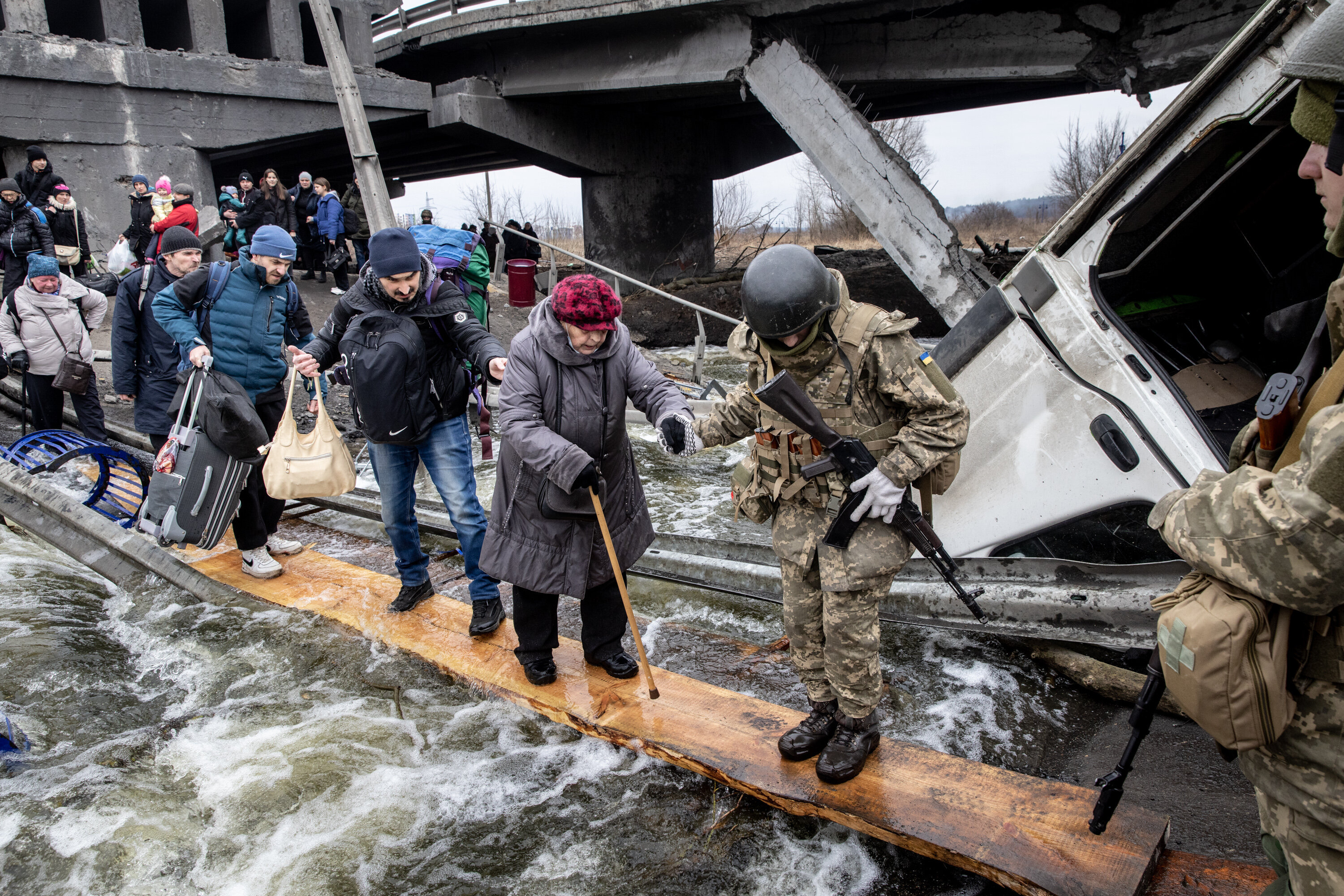
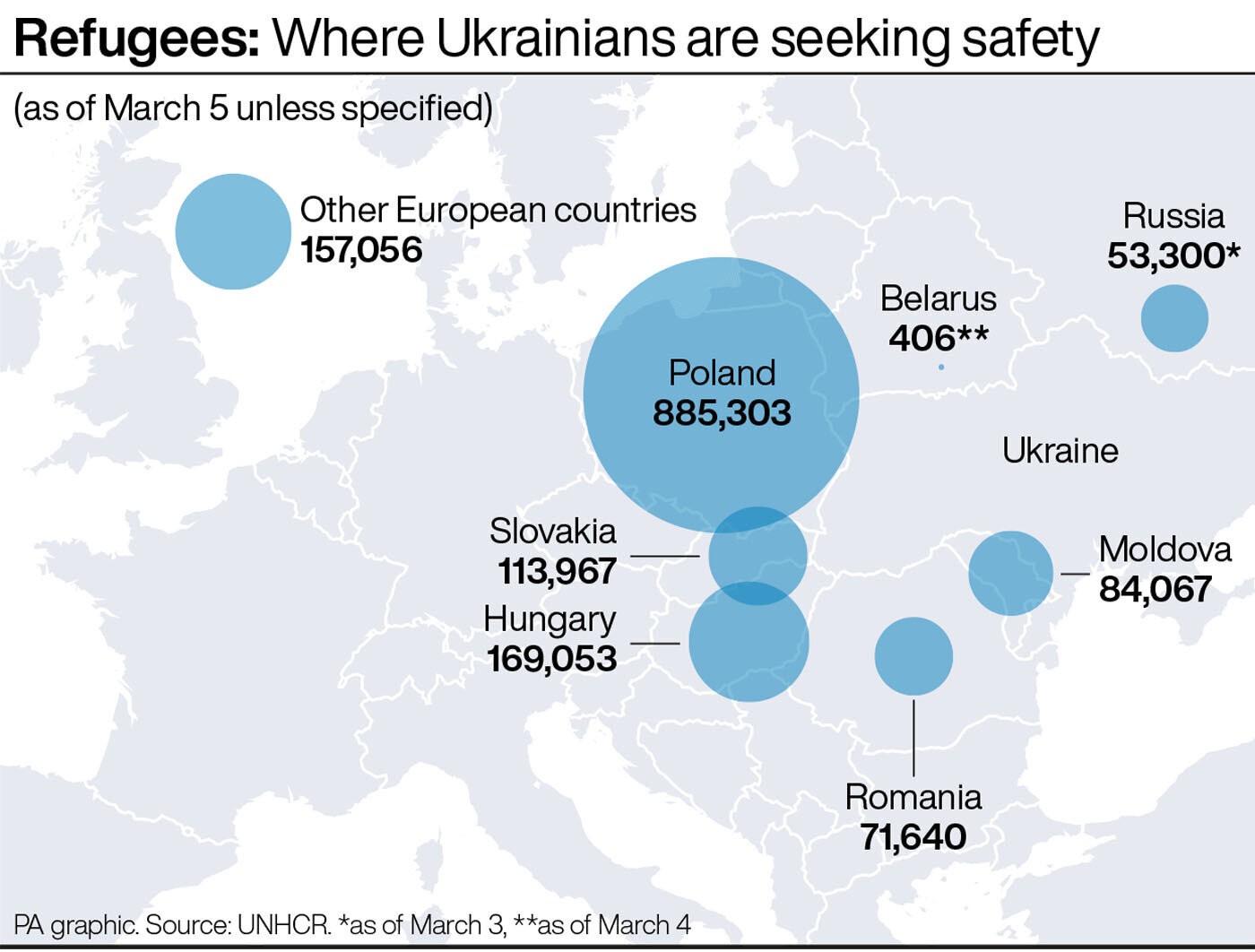
The Russian invasion has pushed 1.5 million people to flee the country, creating what the head of the UN refugee agency called “the fastest-growing refugee crisis in Europe since World War II”.
Two planned evacuation operations from Mariupol and the nearby city of Volnovakha have failed over the last two days as the sides accused each other of failing to stop shooting and shelling.
Advertisement
In Mariupol alone, Ukrainian authorities have said they planned to evacuate over 200,000 civilians, or half of the city’s population.
Ahead of a third round of talks between Russia and Ukraine planned for Monday, Moscow said it would open six humanitarian corridors – passages would open for civilians from the capital of Kyiv, the southern port city of Mariupol, and the cities of Kharkiv and Sumy.
But Ukraine rejected the plan given the proposed routes led into Russian or Belarusian territory. These are unlikely destinations for many Ukrainians who would prefer to head towards countries on the western and southern borders. Belarus is a key ally of Putin and served as a launching ground for the invasion.
Where Ukrainians are seeking safety.
PA Graphics via PA Graphics/Press Association Images
According to maps published by the RIA news agency, the corridor from Kyiv will lead to Belarus, and civilians from Kharkiv will only have a corridor leading to Russia. Corridors from Mariupol and Sumy will lead both to other Ukrainian cities and to Russia.
What has Russia said?
The Russian taskforce said the new pledge for humanitarian corridors was announced at the request of French president Emmanuel Macron, who spoke to Putin on Sunday. Macron’s office said he asked for a broader end to military operations in Ukraine and protections for civilians.
“Attempts by the Ukrainian side to deceive Russia and the whole civilised world…are useless this time,” the Russian defence ministry said after announcing the corridors.
What has Ukraine said?
Ukrainian deputy prime minister Irina Vereshchuk called the proposed evacuation routes to Russia and Belarus “unacceptable”. “Our people won’t go to Belarus and to Russia,” she told a news briefing, claiming that Russia was seeking to manipulate Macron’s sincere desire to help.
Macron criticised the proposal as a case of “cynicism”. “I don’t know many Ukrainians who want to seek refuge in Russia. That’s hypocrisy,” he said.
Advertisement
A spokesperson for Ukrainian president Volodymyr Zelenskyy said the Russian proposal was “completely immoral”. “They are citizens of Ukraine, they should have the right to evacuate to the territory of Ukraine,” the spokesperson said.
The International Red Cross has confirmed that the “humanitarian corridor” prepared by Russia for civilians from #Mariupol was full of mines. This is terrible!#Russia was preparing a massacre. This is the genocide of #Ukrainians! It is good that we managed to avoid it this time.
The Ukrainian government is proposing eight humanitarian corridors, including from Mariupol, that would allow civilians to travel to the western regions of Ukraine where there is no Russian shelling.
The Russian proposal was reminiscent of similar ones in Syria. In 2016, a joint Russian and Syrian proposal to set up humanitarian corridors out of besieged opposition-held eastern Aleppo was criticised on humanitarian grounds.
Human rights activists said the tactic, coupled by brutal sieges, effectively gave residents a choice between fleeing into the arms of their attackers or dying under bombardment.
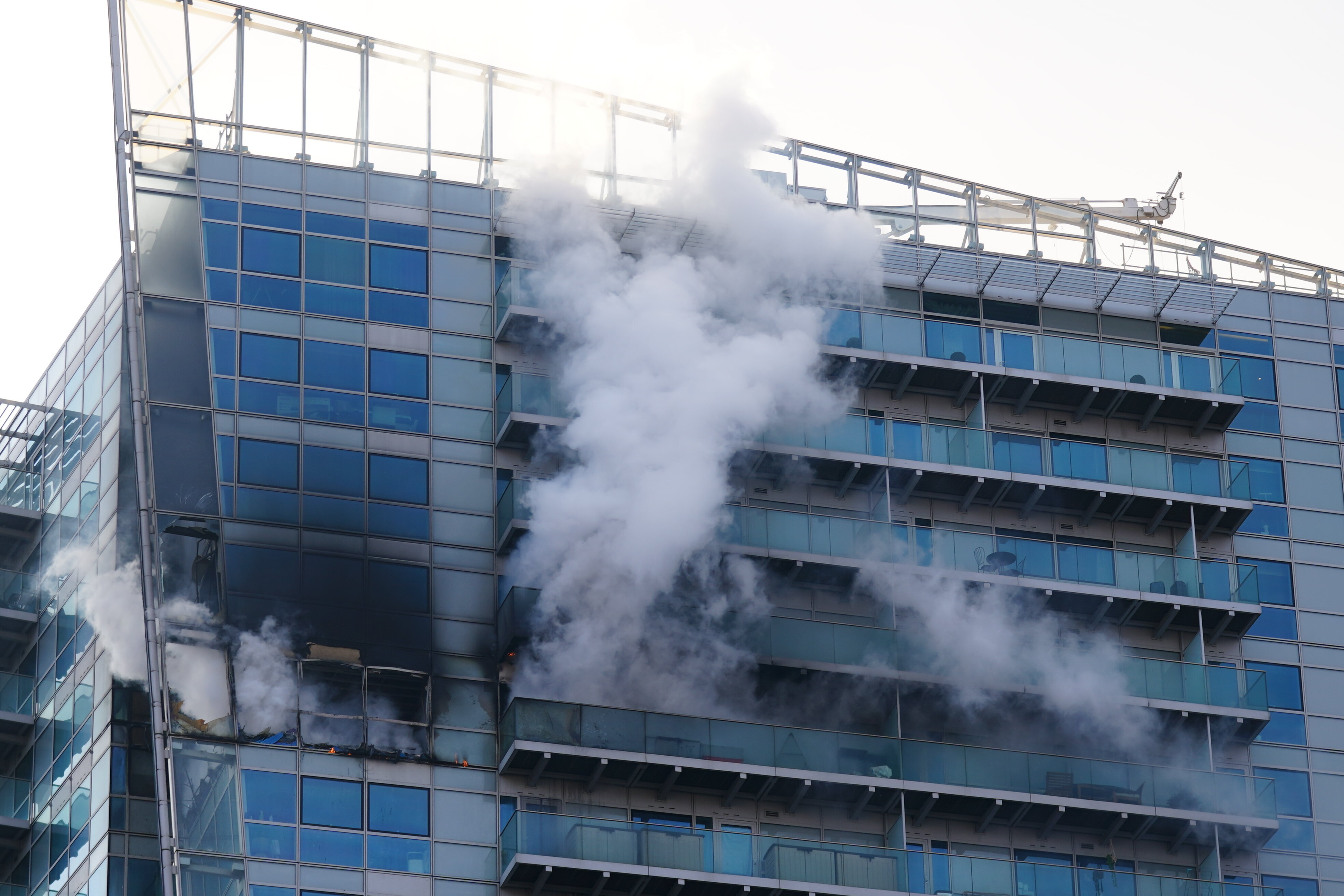
A fire broke out at 22-storey building in east London – with footage from the scene showing bright orange flames burning through a floor of the building as debris falls off the side.
London Fire Brigade said they were called to the Relay Building in Whitechapel High Street shortly before 4pm on Monday after a fire started in a 17th-floor flat.
Advertisement
At least 20 fire engines and 125 firefighters tackled the blaze, which could be seen for miles as social media captured glass panels falling to the ground.
The brigade said a woman was trapped by the blaze and firefighters rescued her by using a fire escape hood.
Advertisement
It also took one patient to hospital and crews checked a small number of people at the scene.
Screengrab taken from footage posted on Twitter by Alexander Best of a fire which has broken out in a block of flats in east London.
Alexander Best via PA Media
Speaking to residents who had gathered at The Corner cafe on Whitechapel Road following the fire, Richard Tapp, borough commander at Tower Hamlets said the building was “structurally sound”.
Advertisement
He told the residents that the fire was “all but extinguished” but debris like glass was still unstable.
London Ambulance Service spokesperson said: “We were called at 4:07pm today to reports of a fire at a high-rise building on Whitechapel High Street.
“We sent an ambulance crew, an incident response officer, a team leader in a fast response car and members of our hazardous area response team.”
London mayor Sadiq Khan said he was in “close contact” with London Fire Brigade’s Commissioner Andy Roe.
Advertisement
David Zambrana via PA Media
Lynn Ling, a London School of Economics student from China – who lives on the 20th floor with her husband Yuri, said the whole incident has been “very scary”.
Ling, who was wearing a silver security blanket because she forgot her coat in the scramble to evacuate, told the PA news agency that she was alerted to the fire by a friend who FaceTimed her from the street at about 4:30pm.
She said: “I did not hear an alarm.
“I think there was a fire alarm on the ground floor but I could not hear it clearly on the 20th.
“I went out of my door but I found there was smoke in the corridor so I went downstairs.
“I forgot to take my coat.
“It was very scary.”
She added that a fireman in the 19th floor was knocking on people’s doors to tell them to leave.
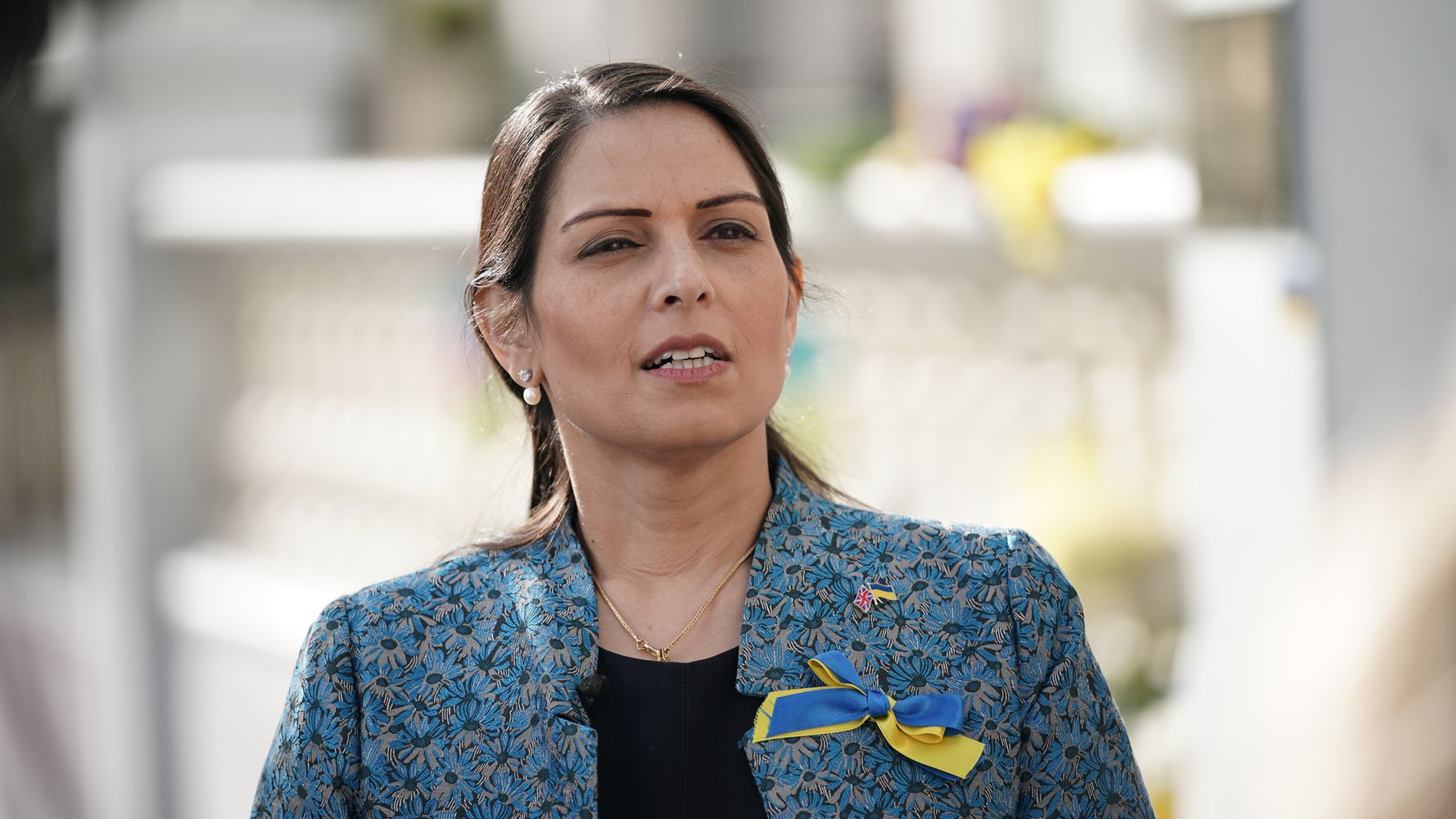
Figures issued by the Home Office showing that only 50 Ukrainian refugees had been given visas to come to the UK were “absolutely innacurate”, Priti Patel has said.
In an extraordinary development, the Home Secretary said the true figure will not be known until this evening.
Advertisement
Her comments came following intense criticism over the apparent failure of the UK’s refugee scheme to admit enough people fleeing war in their homeland.
Addressing MPs as she launched the Economic Crime Bill, which is aimed at cracking down on Russian oligarchs, the home secretary said: “It’s important for all colleagues in the house to know that the first quality assured figures on the Ukrainian families scheme will come this evening.
Advertisement
“The figures that are in the public are absolutely inaccurate and have not been assured by the Home Office, so I do just want to make that abundantly clear.”
She added: “Our scheme is the first of its kind in the world and we cannot measure it against any other countries.
Advertisement
“We have had already 14,000 people apply, we also have a sponsorship scheme that will be announced later on.”
The Home Office issued an update later on Monday saying 300 visas had been confirmed and 17,700 applications made.
The UK Government’s Ukraine Family Scheme is the first visa scheme in the world to launch since President Putin’s invasion of Ukraine.
It gives Ukrainian people the freedom and means to support themselves while they are here in the United Kingdom. (1/2) pic.twitter.com/DluYW3RfYk
Patel is also at odds with Boris Johnson after she appeared to suggest that a third refugee scheme, aimed at allowing more Ukrainians to arrive on humanitarian grounds, was being set up.
The government has already announced that Ukrainians in the UK will be able to bring family members from their home country.
Advertisement
In addition, British people and companies will be able to sponsor Ukrainian refugees.
But speaking to The Sun yesterday, the Home Secretary suggested the government was prepared to go further.
She said: “In response to the desperation I saw with my own eyes at the Polish border two days ago, I’m urgently escalating our response to the growing humanitarian crisis.
“I am now investigating the legal options to create a humanitarian route.
“This means anyone without ties to the UK fleeing the conflict in Ukraine will have a right to come to this nation.”
But the PM appeared to reject this idea while speaking during a visit to RAF Northolt, insisting the UK has “two very, very generous routes already” which could see “hundreds of thousands” of Ukrainians come to this country.
Meanwhile, Patel also rejected claims that the UK was not providing any support to refugees arriving at Calais and wanting to go on to the UK.
Pictures emerged on Twitter of signs, apparently in northern France, saying UK visas will not be provided there and advising people to apply online or travel to Paris or Brussels to make an application.
But Patel insisted there are British officials in Calais and “support on the ground”, telling the Commons: “It is absolutely right that we’ve already had people in Calais”, adding: “It is wrong to say we’re just turning people back – we’re absolutely not, we’re supporting those that have been coming to Calais.”
She warned that people-smuggling gangs are “roaming around Calais” and “human trafficking cases are now manifesting at the border”, adding: “It’s absolutely right that we have the right processes in place to check people and to safeguard people.”
Priti Patel has defended the government’s Ukrainian refugee scheme as it emerged that only around 50 visas have been granted since it was set up.
Some 5,535 applications have been completed and submitted online, the Home Office said, while a further 2,368 people had booked a visa appointment to submit their application and biometric information.
Advertisement
In addition, 11,750 people have started but not completed an online application.
Under the government’s scheme, Ukrainians with family members in the UK can apply to stay in this country for up to three years.
Advertisement
Boris Johnson has said that around 200,000 Ukrainians could benefit from the scheme.
The home secretary has previously rejected calls for all refugees to be offered visas, blaming security concerns.
Advertisement
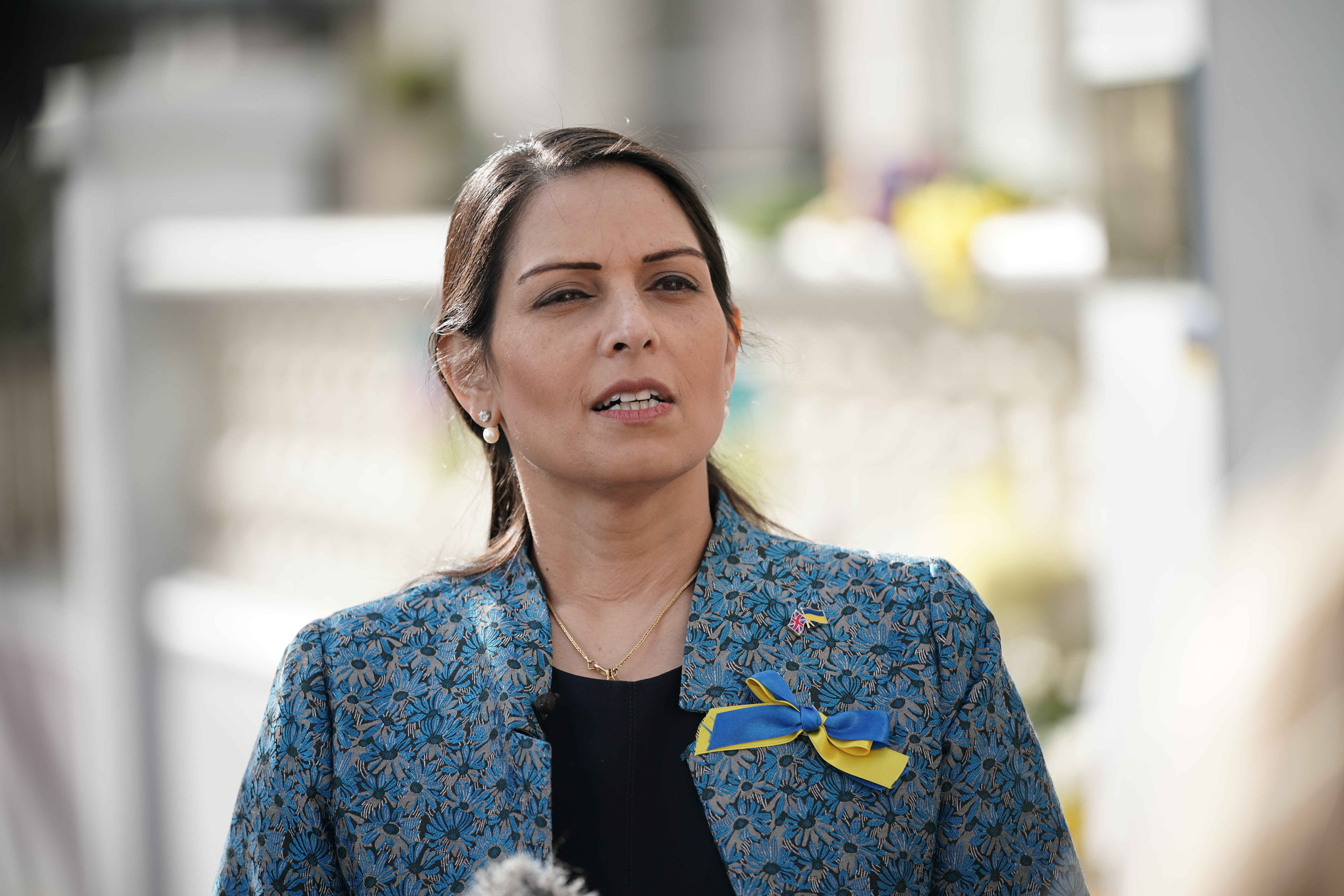
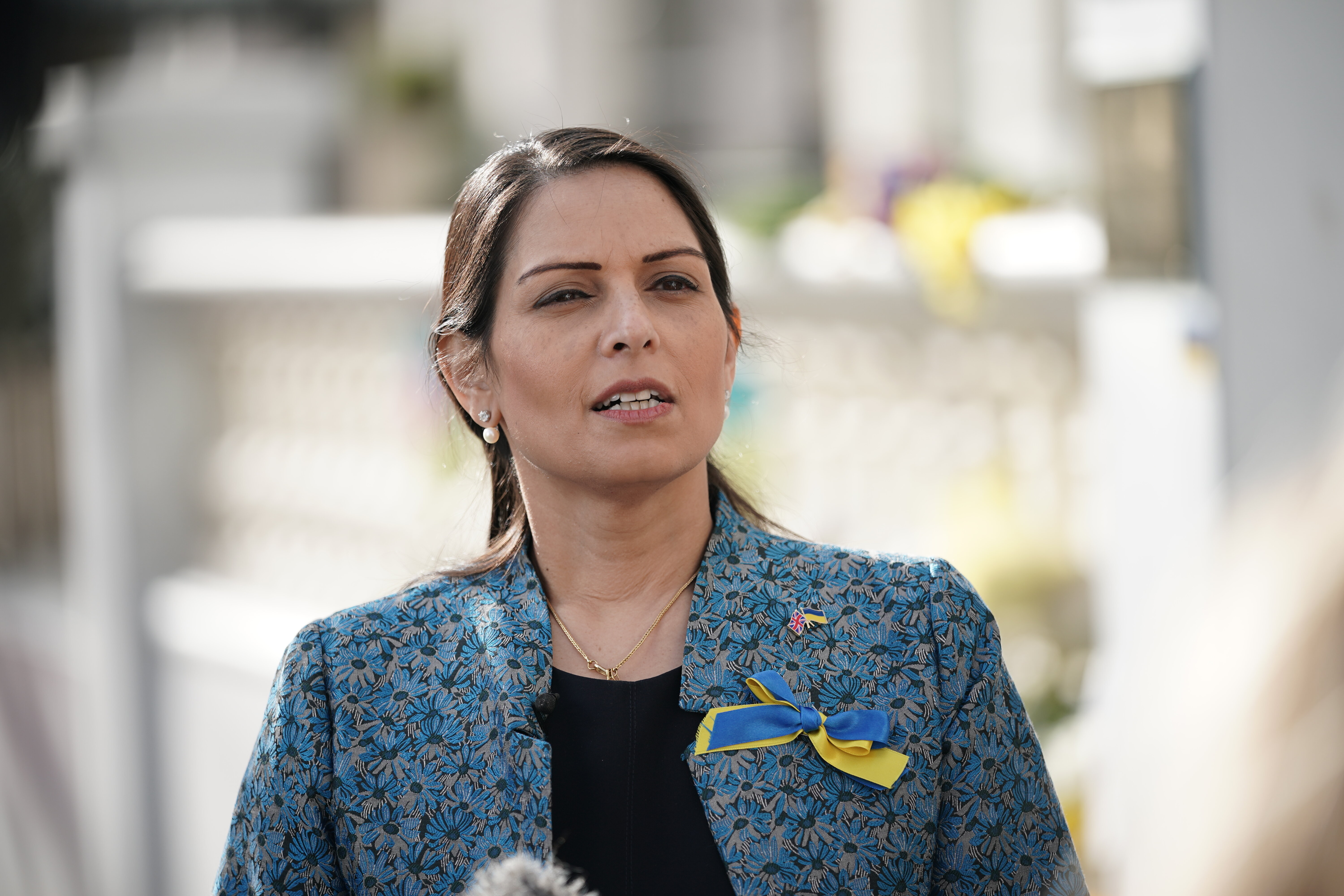
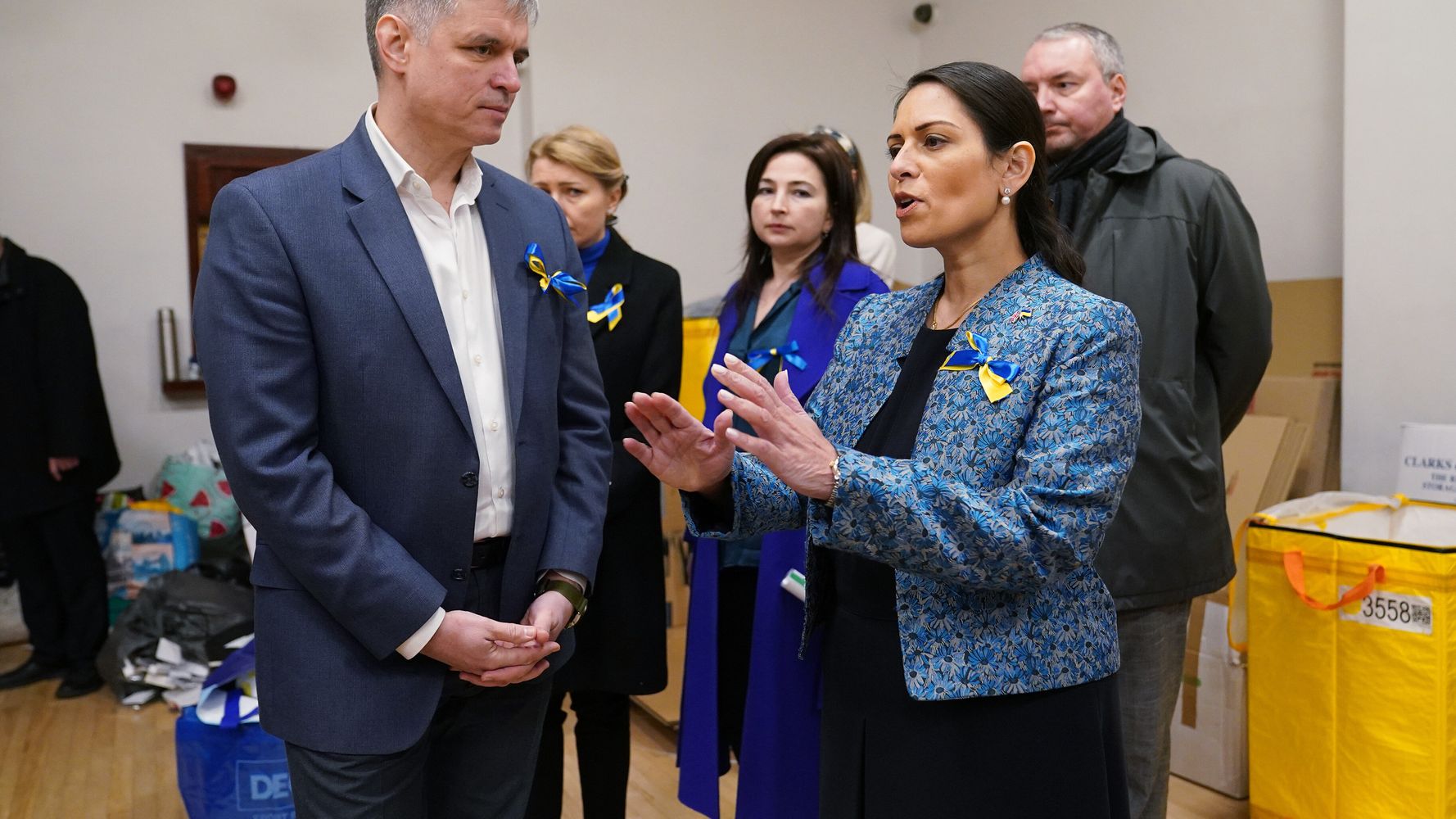
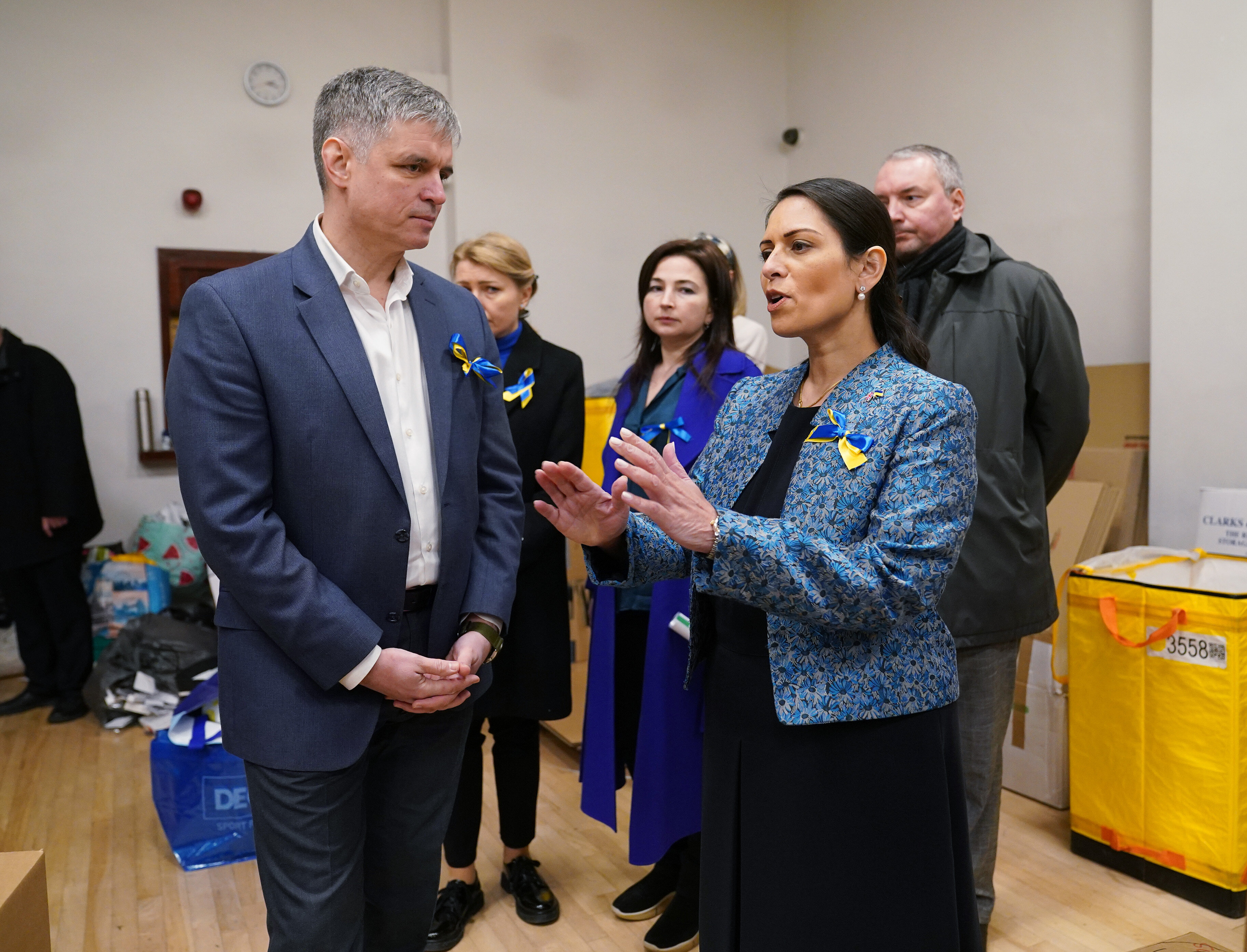
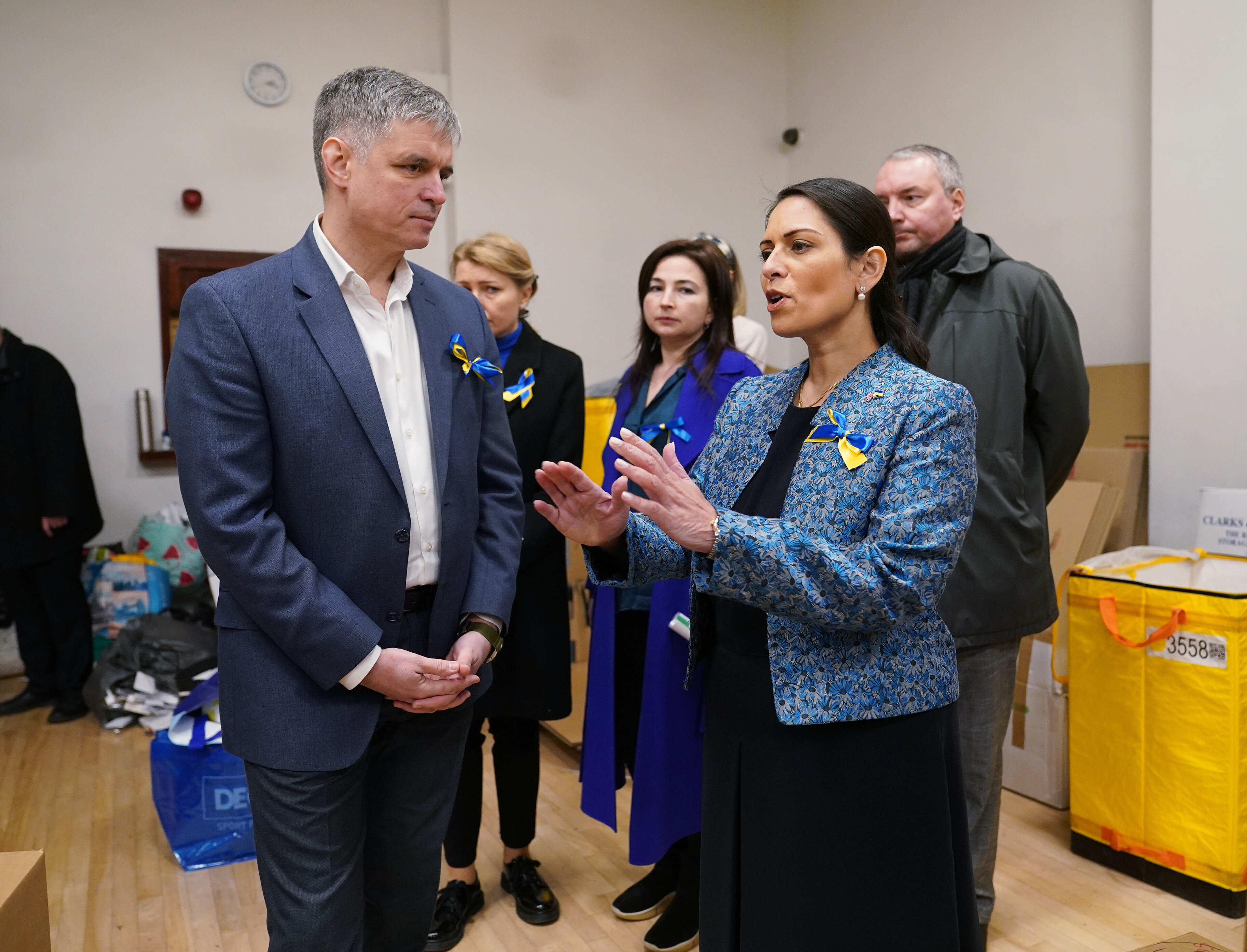
Visiting the Ukrainian Social Club in Holland Park, London, Patel insisted everything was being done to process as many applications as possible.
She said: “Let’s be clear, this is the first scheme in the world that’s up and running in this short period of time.
“Ten thousand applications and yes, grants are happening as we stand here right now and are speaking.
“So I’m surging staff across all application centres across the entire European Union as well as in the border countries such as Poland, where I was the other day and obviously where huge numbers of people are coming through.”
Advertisement
Patel added: “This is an incredible scheme and we are doing everything possible, surging capacity across every single application centre across the EU.”
She said staff are being flown into border countries “so we can fast track and speed up applications and it’s right that we do this.”
Patel also hit back at French interior minister Gerald Darmanin, who accused the UK of a “lack of humanity” amid reports that 150 Ukrainians were turned away at Calais for not having visas to enter Britain.
The home secretary said: “Let me just correct what has been said by the French government. The British Government is not turning anybody around or turning anybody back at all.
“And I think it’s really important to emphasise that, particularly at this time, when all nations across Europe must work together to help and support people in need and fleeing Ukraine at this awful, awful time.”
Meanwhile, Ukraine’s ambassador to the UK, Vadym Prystaiko, said the visa process for refugees fleeing his homeland for the UK could be simplified.
Speaking outside the Ukrainian embassy in west London, he said: “We believe that some of the procedures can be really simplified.
“We will sort it out later, now we have to let as maximum people we can have as possible.
“All the security checks should be in place for obvious reasons because it is a war.”
But he said he believes the UK is “on the forefront of the effort” to help Ukraine.
The recurring game sees Ant and Dec giving different celebrity guests an earpiece and feeding them silly lines and commands while they chat to unwitting members of the public.
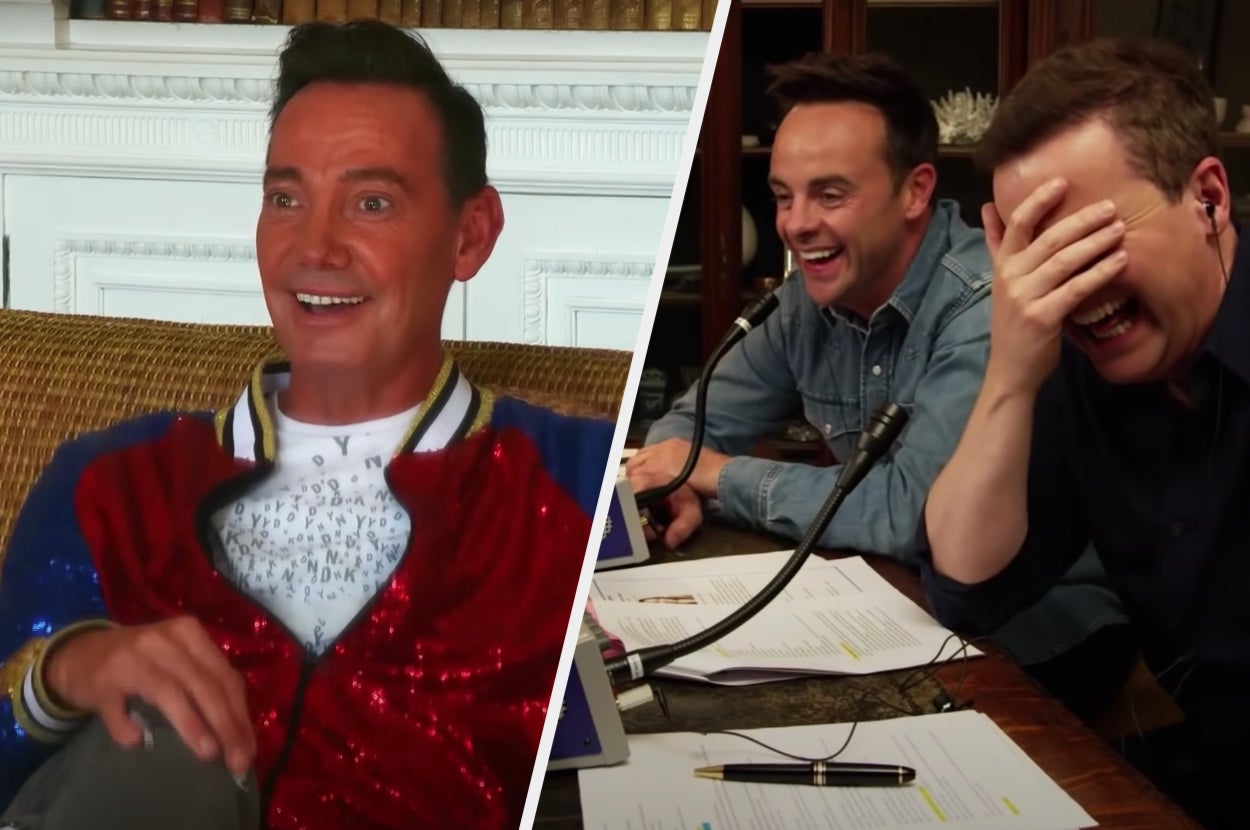
This week, it was Strictly Come Dancing favourite Craig’s turn to embarrass himself, as he chatted to three prospective wedding planners about his upcoming nuptials.
However, at Ant and Dec’s request, he actually spent his time with them jumping out from behind a sofa, doing a dramatic reading of the Home & Away lyrics and smashing an “antique” vase (only to then blame it on one of the wedding planners).
Adding to the ridiculousness of the scene was the fact that Craig appeared to be having a bit of trouble understanding Ant and Dec in his earpiece, leading to him claiming to one of the wedding planners that his friend invented “fidget smithers” and another that his pet hamster “sneezed and turned himself into a rat”.
And the less said about his didgeridoo playing the better…
Despite Craig’s occasional faux pas, the scene went down a storm with Saturday Night Takeway viewers, who were left howling as the prank played out:
Ant And Dec’s Saturday Night Takeaway continues (surprisingly enough) on Saturday night at 7pm on ITV.
The head of the armed forces has urged British people not to travel to Ukraine to take part in the war with Russia.
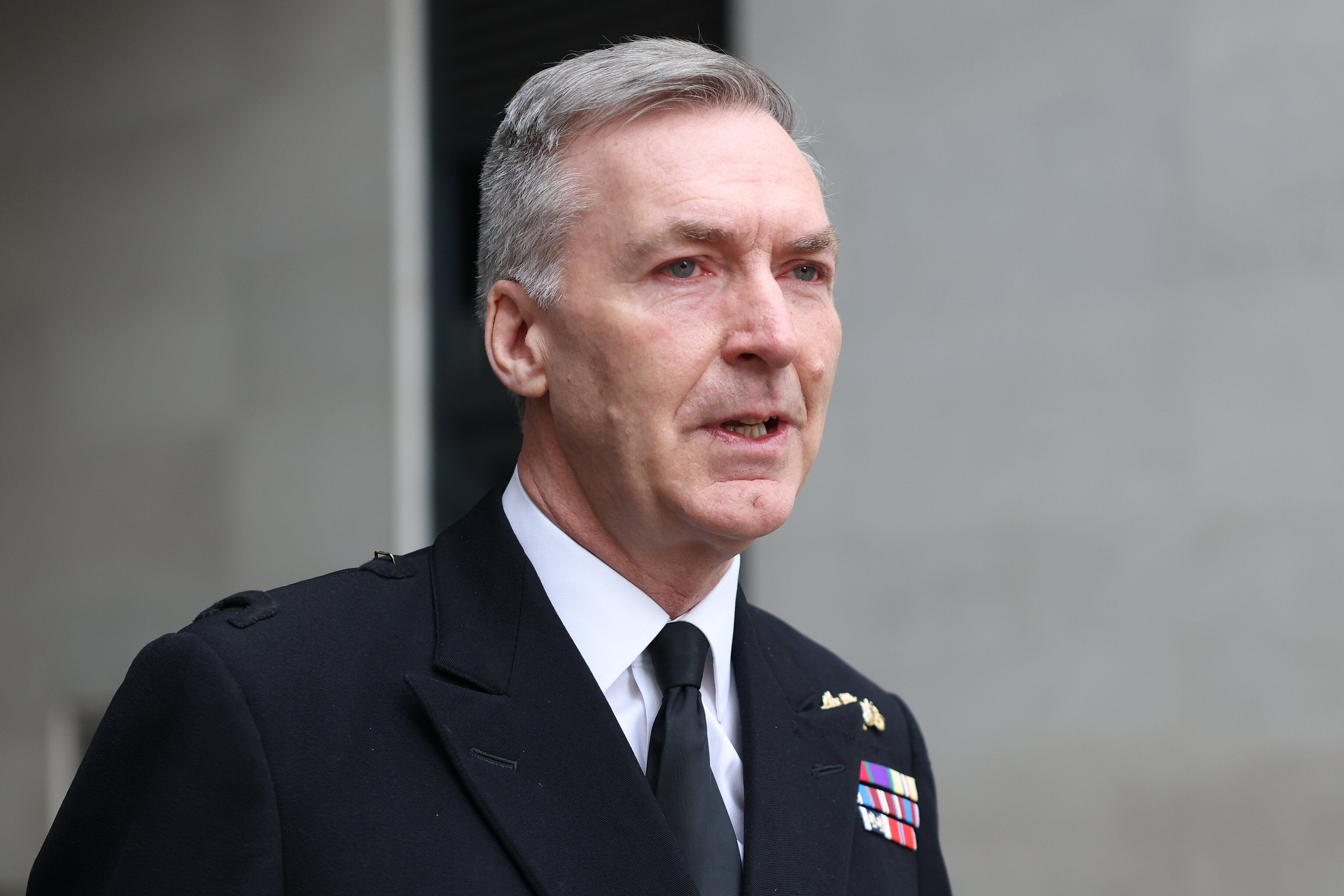
Admiral Sir Tony Radakin’s said it was “unlawful as well as unhelpful” for anyone from the UK to get involved in the conflict.
Advertisement
His comments put him at odds with foreign secretary Liz Truss, who last week said she would support anyone from Britain who wanted to fight Vladimir Putin’s forces.
She said: “The people of Ukraine are fighting for freedom and democracy, not just for Ukraine, but for the whole of Europe. Because that is what president Putin is challenging.
Advertisement
“And absolutely, if people want to support that struggle, I would support them in doing that.”
But appearing on the BBC’s Sunday Morning programme, Radakin said: “Support from the UK, support in whatever way you can. But this isn’t really something that you want to rush to in terms of the sound of gunfire. This is about sensible support based in the UK.”
Advertisement
Asked if Liz Truss should not have said she would support anyone who wanted to fight, he added: “I think she was reflecting (that) she could and that we can all understand that sentiment, and that sentiment needs to be channelled into support for Ukraine.
“But we’re saying as professional military people, that actually that is not necessarily the sensible thing to be doing.”
Boris Johnson, meanwhile, has unveiled a six-point plan aimed at defeating Putin.
He is calling for an international humanitarian coalition to help Ukraine and for the maximum economic pressure to be placed on Putin’s regime.
Johnson will meet with leaders from Canada, the Netherlands and central Europe on Monday as he seeks to bolster the global anti-Putin coalition.
He will tell them that Ukraine must receive more military and humanitarian support if Russia is to be beaten.
“Putin must fail and must be seen to fail in this act of aggression,” the PM will say.
Advertisement
“It is not enough to express our support for the rules-based international order – we must defend it against a sustained attempt to rewrite the rules by military force.
“The world is watching. It is not future historians but the people of Ukraine who will be our judge.”
Boris Johnson will tell fellow leaders that “the people of Ukraine will be our judge” if the west fails to defeat Vladimir Putin.
The Prime Minister will say “the world is watching” as he unveils a six-point plan of action to help preserve Ukraine’s independence in the face of mounting Russian aggression.
Advertisement
Johnson will this week meet with leaders from Canada, the Netherlands and central Europe as he seeks to bolster the global anti-Putin coalition.
He will tell them that Ukraine must receive more military and humanitarian support if Russia is to be beaten.
Advertisement
“Putin must fail and must be seen to fail in this act of aggression,” the PM will say.
“It is not enough to express our support for the rules-based international order – we must defend it against a sustained attempt to rewrite the rules by military force.
Advertisement
“The world is watching. It is not future historians but the people of Ukraine who will be our judge.”
Johnson will unveil his his six-point plan in a New York Times article on Sunday.
He is calling for an international humanitarian coalition to help Ukraine and for the maximum economic pressure to be placed on Putin’s regime.
The ”creeping normalisation of what Russia is doing in Ukraine” must be prevented, according to the PM, while diplomacy aimed at the de-escalation of Russian aggression must be stepped up and fully involve the Ukrainian government.
Advertisement
Finally, Downing Street said Johnson wants to see “a rapid campaign to strengthen security and resilience across the Euro-Atlantic area.
Canadian prime minister Justine Trudeau and Dutch prime minister Mark Rutte will meet with the PM in Downing Street on Monday to discuss the Ukraine crisis.
It follows talks on Friday with French president Emmanuel Macron and the leaders of Turkey and Serbia.
On Tuesday, Johnson he will host leaders of the ‘V4’ group of central European nations – the Czech Republic, Hungary, Poland and Slovakia – which are already experiencing first-hand the humanitarian crisis caused by Russia’s invasion of Ukraine.
The government has said that Ukrainian refugees with family members in the UK will be able to live here for up to three years, a move which ministers claim could potentially benefit 200,000 people fleeing the war.