The Ideal Amount Of Time You Should Spend Having A Poo, According To Experts

How long do you spend going for a poo? Two minutes? Seven minutes? 20 minutes? Well, it turns out there is a line between spending too long in the bathroom and having a quick and healthy bowel movement.

Spending too much time pooping can lead to health problems and can even be a sign that there’s something larger going on in your gastrointestinal tract.

Here’s what gastrointestinal doctors want you to know.

It should take no more than 5 minutes to have a bowel movement – and maybe even a little less.

Spending more than several moments on the toilet when you poop is too long, doctors say. Exactly how long is too long depends, but around five minutes (or a little less) is a good goal.

Dr. Melissa Hershman, an assistant professor of medicine in the division of gastroenterology and hepatology at Oregon Health and Sciences University, said “an appropriate time to spend on the toilet is no more than three minutes at a time”.

Leslie Waid, a nurse practitioner in gastroenterology at the University of Pittsburgh Medical Center, was a little more lenient with the time, but not by much. According to Waid, it shouldn’t take more than five to 10 minutes to have a bowel movement.

Dr. Valentine Millien, a gastroenterologist at Houston Methodist Hospital, said closer to five minutes is best.

“You should sit down, you should easily pass a bowel movement, feel empty, you get cleaned up and you leave,” Waid said.

“There shouldn’t be any straining or spending time sitting there waiting for stools to pass,” Waid noted.

Straining and excessive pushing motions can “create pelvic trauma, injury,” added Hershman.

For example, straining can cause hemorrhoids, Waid said.

“There are other things that can happen with straining, including anal fissures, and those are tears in the lining of the anal canal, and they can be very painful,” Waid said.

Straining on the toilet can also cause pelvic floor damage and weaken the pelvic floor muscles, Waid added.

“Really, after five minutes, and nothing is happening, we usually tell patients to leave and then wait again to get the urge, and then come back to the bathroom,” Millien noted.

Hopefully, when you return, you’ll be able to evacuate your bowels in just a couple of minutes.
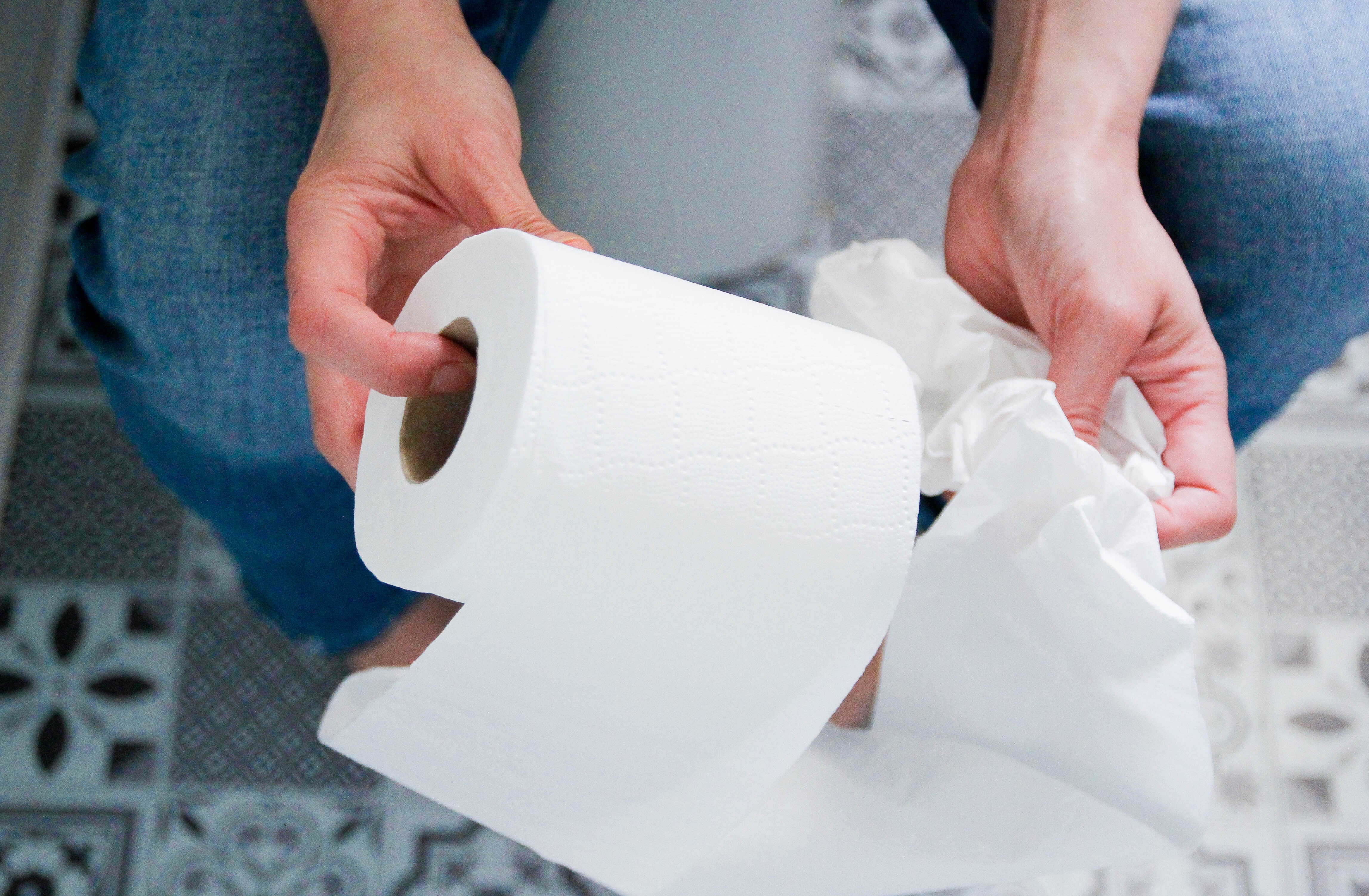
One way to spend less time in the bathroom? Stop bringing your phone in with you.

Kinga Krzeminska via Getty Images

One way to spend less time in the bathroom? Stop bringing your phone in with you.

If you spend more than 5 or 10 minutes in the bathroom, there are things you can do to improve your bowel health

If straining and spending 5 or 10 minutes on the toilet is your norm, there are a few things you can do to reduce the time it takes you to poop.

First, positioning is important, said Waid, so stools like Squatty Potty can be helpful.

Millien agreed, “a lot of Asian countries and a lot of African countries, their toilet is actually, even if it’s a ceramic toilet, it’s usually lower to the ground, so that forces you to squat.”

When you squat, “you’re removing some of that pressure of the rectum, and actually allowing gravity to help you evacuate,” Millien said.

And, while it’s common to bring your smartphone everywhere (including in the bathroom), it’s a good idea not to. Research shows that people who bring their phone into the bathroom spend more time in the bathroom and have a higher risk of hemorrhoids, Millien said.

Tried-and-true lifestyle habits are also important for bowel regularity, such as drinking plenty of fluids and exercising, said Waid.

“Exercise is an excellent way to promote bowel motility. I often tell patients that your gut doesn’t move if you don’t,” said Hershman.

Your diet choices also impact your bowel movements. “It’s important to have adequate dietary fibre,” Waid noted. This includes fruits, vegetables, whole grains, certain cereals, oatmeal, chia seeds, beans, and more.

Fibre helps add bulk to stools and makes bowel movements easier to pass.

“If patients feel like they’re not eating enough fibre, or just need a little bit something more for regularity, they can add in a fibre supplement,” Waid said.

“We really want to target at least 25 grams of fibre per day,” said Hershman. For reference, one apple has about 4.5 grams of fibre, one cup of quinoa has 5 grams and one cup of lentils has 15.5 grams of fibre.

In some cases, bowel movement issues can be a sign of colorectal cancer

Rates of colorectal cancer are rising in younger adults, and the signs of colorectal cancer can overlap with some of the problems that come from straining while pooping, too.

“Blood in the toilet – the assumption used to be that this was all hemorrhoids, but it’s also important to talk to your physician,” said Millien.

More, if you notice a change in your bowels, like if you used to have regular bowel movements but are now having frequent constipation or diarrhea, you should also mention that to your doctor, she said.

“Because it could be a sign of inflammation in the colon, or it can be a sign of an obstruction in the colon,” added Millien.

“If there’s any concern in your bowel habits, if anything has changed in your bowel habits, any blood, don’t just minimise [it],” she added.

“A lot of young patients with colon cancer now are actually asymptomatic, other than just intermittent rectal bleeding,” Millien noted.

If you notice anything suspicious about how long it takes you to have a bowel movement, blood in the toilet or any concerning changes, talk to your physician, she stressed.

Share Button

New research reveals the hidden pollution left behind by fireworks

Fireworks may dazzle crowds with brilliant colors and loud explosions, but new research suggests their effects continue long after the show ends. Three recent studies published in American Chemical Society (ACS) journals examined what fireworks leave behind, from discarded debris and airborne particles to chemical compounds released into the atmosphere.

Together, the findings offer a clearer picture of how fireworks can influence air quality, water chemistry, and potentially both human health and the environment.

Firecracker Debris Can Alter Water Chemistry

Once fireworks burn out, they leave behind more than ash. Spent firecrackers scatter residue that contains partially burned fuel, metal salts, additives, and pieces of charred packaging.

In a laboratory study published in Environmental Science & Technology, researchers found that this debris released significant amounts of metal ions (e.g., potassium and manganese) and dissolved organic matter (e.g., simple phenols and sulfur-containing compounds) when placed in lake and river water. At the same time, the leftover solid material absorbed some dissolved substances that were already present in the water, including larger, more complex compounds.

According to the researchers, these chemical changes could interfere with microbial communities and aquatic ecosystems, particularly if large amounts of firecracker litter are repeatedly washed into rivers and lakes after festivals or celebrations. Properly collecting and disposing of spent fireworks could help reduce these environmental effects.

Fireworks Add to Air Pollution During Large Events

Fireworks are only one source of pollution at major public celebrations, but researchers wanted to understand how much they contribute compared with other activities.

In a study published in ACS ES&T Air, scientists monitored particulate matter during a large, multi-day athletic event in the United Kingdom. They detected sharp, short-lived increases in both coarse and fine airborne particles throughout the event.

The team linked much of the pollution to cooking emissions from food vendors and dust stirred up by vehicles. During the opening and closing ceremonies, however, they observed two distinct spikes in fine particulate matter. The first occurred as crowds arrived and dust levels increased, while the second, slightly smaller spike coincided with the fireworks displays.

The researchers estimated that people who attended every day of the event were exposed to air pollution levels exceeding the World Health Organization’s recommended limits, suggesting that large celebrations can significantly increase exposure to fine particulate matter.

Fireworks Release More Than Smoke Into the Air

Another study focused on chemicals called amines, which are included in some firework formulations. These compounds can react in the atmosphere to form aerosols that contribute to haze and reduced air quality.

To determine what happens to these chemicals during fireworks displays, researchers measured amines in both gases and airborne particles during Lunar New Year celebrations in a suburban area of China.

The findings, published in Environmental Science & Technology Letters, revealed substantial increases in several amines compared with a non-celebratory period. The biggest increases occurred during the largest fireworks displays. Scientists also recorded higher levels of other firework-related pollutants, including fine particulate matter and sulfate and potassium ions.

The researchers say the results suggest that fireworks contribute more than visible smoke to the haze that often lingers after major celebrations, adding another layer to their environmental impact.

Share Button

How to walk 30 minutes a day – your tips

From walking the dog before breakfast to getting off the bus a stop early, readers share their tips for building a daily walking habit.

Share Button

Scientists discover why some brains resist Alzheimer’s

Some people remain mentally sharp even though their brains contain the biological changes associated with Alzheimer’s disease. A new study from the Netherlands Institute for Neuroscience suggests that the answer may lie in how a rare group of brain cells, called immature neurons, responds to damage. The findings offer new insight into cognitive resilience, the brain’s ability to continue functioning despite disease.

One of the biggest unanswered questions in Alzheimer’s research is why the disease affects people so differently. While many develop memory loss and dementia as Alzheimer’s progresses, others show little or no cognitive decline despite having the same underlying brain pathology.

“Around 30 percent of older adults who develop Alzheimer’s disease never experience its symptoms,” says senior author Evgenia Salta. “We really don’t know why. That’s a big mystery, and a very important one.”

Understanding what protects these individuals could eventually point scientists toward new ways to treat or even prevent dementia.

“If we understand what protects these brains, it could eventually lead to new therapeutic strategies.”

Can the aging brain replace damaged cells?

One possibility is that resilient brains are better at repairing themselves.

“Perhaps they can add new brain cells to a network that is degenerating,” Salta says.

This idea centers on adult neurogenesis, the process through which new neurons are generated in the adult brain. While adult neurogenesis is well documented in many animal species, scientists have long debated how much, if any, occurs in humans.

To investigate, Salta and her colleagues examined donated brain tissue from the Netherlands Brain Bank. The samples included healthy individuals, people with Alzheimer’s disease, and people whose brains showed Alzheimer’s pathology even though they never developed dementia.

The researchers concentrated on a small region within the brain’s memory center, one of the few places where new neurons may still develop.

“These cells are extremely rare, so we had to develop new ways to find them,” Salta says. “We really zoomed in on the exact spot where we expected them to be.”

The team also applied newly developed analytical methods designed specifically for human tissue, reducing reliance on assumptions based on animal studies.

Rare immature neurons persist into old age

The researchers identified the cells they were searching for: so called immature neurons, which resemble young neurons that have not yet fully matured.

“Even at an average age of over 80, we still found these immature neurons in all groups,” Salta says.

The result confirmed that these unusual cells remain present even in very old brains.

What surprised the researchers, however, was that resilient individuals did not have dramatically larger numbers of immature neurons than people with Alzheimer’s disease.

Brain cell behavior may matter more than numbers

Instead, the most important difference appeared to be how the cells behaved.

“In resilient individuals, these cells seem to activate programs that help them survive and cope with damage,” Salta says. “We also see lower signals related to inflammation and cell death.”

The findings suggest that these immature neurons may do more than simply replace cells lost during disease.

“It might not be (only) about replacing lost neurons,” Salta explains. “It could be that these cells support the surrounding tissue and help the brain stay functional and ‘youthful’. They may act as a sort of fertilizer in a garden that has started falling apart.”

Even so, Salta cautions that these ideas remain hypotheses. Because this study examined donated brain tissue, the researchers cannot directly observe how the cells function in living brains.

“We assume the cells’ function based on the data, but we cannot confirm it in this type of study,” she explains.

She also emphasizes that Alzheimer’s resilience is unlikely to have a single explanation.

“This is one piece of a very large puzzle,” she concludes. “There will never be just one factor that explains resilience.”

A new direction for Alzheimer’s research

The study also highlights a broader question about aging itself.

“Somewhere along this trajectory, there’s a kind of decision point,” Salta explains. “Some people remain stable, others develop dementia. We want to understand what drives that difference.”

Future research will explore how immature neurons communicate with other brain cells and whether those interactions help preserve memory and cognitive function.

Although the study does not explain why these cells behave differently in resilient individuals than in people who develop dementia, it reflects a growing shift in Alzheimer’s research. Instead of focusing only on how the disease damages the brain, scientists are increasingly asking why some brains can withstand that damage.

“Cognitive resilience is extremely exciting,” Salta says. “If we understand what protects these brains, it could eventually lead to new therapeutic strategies.”

For now, the findings add to growing evidence that the aging brain is more adaptable, and more complex, than scientists once believed.

Share Button

Do you have heart palpitations?

What are heart palpitations and when should you be concerned?

Share Button

German row over plan for workers to need sick note on first day of illness

A doctors’ group says it “borders on madness” that patients will have to obtain the note in person.

Share Button

How to calm an overstimulated mind

Kimberley asks her guest, chartered psychologist Dr Ellie Buckley, why we get sensory overload.

Share Button

Here’s How The Great British Bake-Off Handled This Year’s Heatwaves

Usually, The Great British Bake-Off is filmed between April and June.

So perhaps it’s no surprise that fans have been wondering whether the most recent batch of bakers would be subjected to multiple record-breaking heatwaves.

The show (partly) addressed the problem directly on its Instagram page on May 27, soon after we saw the hottest May day on record.

“Us filming chocolate week,” they wrote over a clip of the iconic GBBO tent. The video was overlaid with the sound of comedian Peter Kay’s famous bit: “I like it warm, but I don’t like it this warm!”

“It’s always chocolate week when we have a heatwave,” a commenter wrote.

The Mirror reported that the show’s filming is still “underway”, and that its cameras were rolling during the June heatwave, too.

That meant amateur bakers had to continue to work their culinary magic while schools had closed due to the heat, and travellers had been advised to avoid “non-essential” journeys.

Though some fans worried filming would have to stop, the publication confirmed the show went on.

A source from the show told The Mirror, “Every measure that could be taken has been, to make the bakers comfortable. The lighting gaffer from the crew who’s in first every morning, opens up the tent, takes down the sides and gets airflow moving before everyone arrives.

“Earlier in the run, when temperatures were the opposite and it was freezing, he was doing the same thing in reverse, arriving early to put the heaters on and warm the tent up before the bakers and crew got in.

“Production runners have also kept everyone going in the heat by handing out ice lollies to bakers and crew throughout the day.”

Another source reportedly told The Mirror that the tent’s location near a cooling river, and a “welcome” breeze in the final weekend of May, made filming possible.

In 2018, then-hosts Paul Hollywood and Dame Prue Leith shared how heatwaves affect bakers’ creations.

Prue told Rolling Stone conditions were “Worse for the bakers than for us, because we just come in briefly and go out. They’re in there all the time,” while Paul added: “Yeah, chocolate week suffered a little bit. Caramel sugarwork suffered a little bit”.

Ironically, he added, bread week – when warm conditions would have made loaves rise faster – was a little cooler that year.

New host Nigella Lawson has previously said she is “allergic to the sun”, so time will only tell how she handled the hotter temps.

HuffPost UK has reached out to Channel 4 for more details.

Share Button

Doctors vote to take strike action in row over pay

The British Medical Association is in dispute with Manx Care over “pay erosion since 2008”.

Share Button

Andy Burnham Has Been Tipped To Bring Another New Labour Big Beast Into Government

Andy Burnham has been tipped to bring back another senior figure from the New Labour era in his new-look government.

The former mayor of Manchester – who served as a minister under both Tony Blair and Gordon Brown – will officially take over as prime minister from Keir Starmer on July 20.

It has already emerged that his close friend James Purnell, who also served in cabinet during Labour’s last time in power, will be the new No.10 chief of staff.

David Miliband, another New Labour figure, could also be given a seat in the House of Lords in order to become foreign secretary.

Meanwhile, the i newspaper reported that Ed Balls could also be handed a peerage and given a role in Burnham’s government.

HuffPost UK has learned that another New Labour big beast who could make a dramatic comeback is Alan Milburn.

The former health secretary has held talks with Burnham about his review into record levels of unemployment among 18 to 24-year-olds.

In a speech last week, the PM-in-waiting said he wanted to introduce major education reforms which would place greater emphasis on technical qualifications rather than forcing pupils to study at university.

One minister said: “I can see Alan being brought into Andy’s government. He seems to like what Milburn has been saying about getting young people into work.”

Another source said: “Andy keeps referencing Milburn in his speeches, and Alan is clearly up for it.

“It would make sense to allow Alan to drive through his own reforms on youth unemployment as a minister.”

Asked whether Milburn could be handed a role once Burnham becomes prime minister, a source close to the new Makerfield MP insisted he had offered “no jobs and no deals”.

Milburn, who was the MP for Darlington from 1992 until 2010, was seen as an arch-Blairite during his time in government.

As well as being health secretary, he also serves as chief secretary to the Treasury and Chancellor of the Duchy of Lancaster under the former prime minister.

After leaving Westminster, he was chair of the Social Mobility Commission between 2012 and 2017.

Like David MIliband, he would need to be made a peer in order to re-enter government.

Listen to Commons People, the podcast that makes politics easy. Every week, Kevin Schofield and Kate Nicholson unpack the week’s biggest stories to keep you informed. Join us for straightforward analysis of what’s going on at Westminster.

Share Button