Solid tumors use a type of T cell as a shield against immune attack

An unexpected trick in cancer’s playbook may fool an important component of our immune systems into knocking down our natural defenses against solid tumors.

Scientists at Fred Hutchinson Cancer Center say this newfound vulnerability involves a misuse of a type of T cell, part of a large family of blood cells that are essential to a functioning immune system.

A team led by Hutch immunologist Dr. Martin Prlic, staff scientist Dr. Florian Mair and postdoctoral fellow Dr. Jami Erickson published the findings in Nature. They identified a subset of T cells that show up in great numbers in head and neck tumors, but not in similar tissues of the mouth inflamed by common ailments such as gum disease.

It seems that this odd group of T cells have mixed up their highly specialized assignments within our immune systems and are now working to protect tumor cells.

The evidence Prlic, Mair, and Erickson uncovered might help explain why cutting-edge immunotherapies that work against blood cancers are less effective against solid tumors (such as breast, prostate, kidney and colorectal cancers), which are responsible for most cancer deaths. Researchers say it points the way for future drugs that might strip away that protection, making current therapies work better for more people.

“Ironically, this is not what we tried to do,” Prlic said. “We were just interested in general about what makes the tumor environment different from ordinary inflammation. It was as if you were not looking for treasure, but then you stumble upon something many others have been looking for.”

New methods reveal unnoticed T cell trait

The discovery came after the Hutch team developed new methods to analyze cells in inflamed tissues and applied complex computer analyses to their studies. They compared the kinds of immune cells found in and around patients’ head and neck tumors with those that appeared in tissue samples from patients treated for gum diseases.

As they suspected, the immune cells responding to the tumor were very similar to those in the inflamed gum tissues — until they took a closer look at their data and uncovered a surprising difference in one type of T cell drawn to the cancer samples.

T cells carry out a variety of tasks in the immune system. One of the most important is to stir up an inflammatory response, a coordinated assault to destroy cells damaged by infectious agents or cancer. Mobs of T cells do much of this killing themselves.

Other types of T cells work to calm their over-active brethren. Known as regulatory T cells, or T-regs, they typically tamp down inflammation, quieting that mob and thereby protecting nearby healthy tissues. Without enough T-regs, people can be vulnerable to unchecked abuses of their own immune system, suffering autoimmune diseases such as lupus or rheumatoid arthritis.

What Prlic and his colleagues found was a different flavor of T-regs. These immune-suppressing cells, swarming in the tumor-environment specimens, were different from T-regs found elsewhere in the body. Their cell surfaces are marked by two distinct protein receptors. These specially marked T-regs were particularly good at tamping down inflammation, expanding in number and protecting the tumor cells from attack by other types of T cells.

“A very large fraction of these critical, immunosuppressive cells in the tumor have this trait,” said Mair, who began work on the study with Erickson five years ago. “You don’t see it in T-regs that circulate in the blood, while in the tumor we see that up to 75% of the T-regs make these receptors.”

To a casual observer, the T-regs from the tumor samples would look no different from those found elsewhere in the body. But the team used new techniques that allow scientists to identify characteristics of tens of thousands of individual cells in a sample, and advanced computing methods to sift through data. It allowed them to spot two types of receptor proteins on the surfaces of T-regs collected from the tumor. The telltale proteins have names only a scientist could love: IL-1R1 and ICOS.

“What makes these cells unique is that they express [display] both those proteins,” Prlic said. “You just don’t see that co-expression on other T-reg cells.”

As soon as this duo of molecular-scale markers was discovered, the researchers knew that T-regs bearing them would be easy to spot with a simple test — an antibody that binds to the markers and carries a fluorescent tag.

Once revealed, a cancer trick could be undone

One reason this pair of proteins may have been overlooked by researchers previously is that they occur in human T-regs, not in those of mice. Much of laboratory work in immunology relies on mouse “models” of the immune response, but this study focused on human tissues, taken from patients who either had cancer or non-cancerous lesions.

“This doesn’t take anything away from the importance of mouse models. It just highlights that we also need to study human tumor tissues, so we don’t miss out on things like this,” Prlic said.

These human tumor-related T-regs were clustered in the thicket of blood cells and connective tissues in and around the malignant mass — a site of biological territory known as the tumor microenvironment. And because these cells are easy to spot, in theory they also can be easily targeted by anticancer drugs.

“All of a sudden, we now have a way of specifically targeting T-regs that only appear in tumors, and that is something that wasn’t possible before,” Prlic said.

Prlic and his team hypothesize that these tumor-resident T-regs have been tricked by cancer into working for the wrong team. Surrounded by T cells searching for cancer cells to destroy, the tumors acquired an ability to either attract or generate a blanket of these ICOS/IL-1R1-bearing T-regs. Exactly how they did so is not clear, but their impact is to build up an “immunosuppressive” environment, protecting the tumor from ordinary T cells doing their jobs.

While the research focused on head and neck tumors, Mair, Erickson and Prlic believe that their discovery may be important for many more types of cancer. Once they learned that presence of these markers was important, the Hutch researchers scanned a database of genes activated in specimens representing 21 different cancer types. Looking only for the gene encoding the rarer IL-1R1 protein, they saw it pop up, at varying levels, among all 19 solid-tumor cancer types, but not in the remaining two, which were blood cancers.

If a drug can be designed to knock out only T-regs in tumors, but not harm these immune-suppressing cells elsewhere, it might be an effective way to disable solid-tumor defenses. If the rogue immune cells can be rooted out, cancer-fighting T cells would be able to attack the tumor, while ordinary T-regs could do their job — keeping inflammation from damaging healthy tissues.

Prlic and his colleagues are hoping to develop a “bispecific” antibody — one that can grab two different molecular targets at the same time. In this case, one arm of the Y-shaped antibody protein would bind to the ICOS receptor; the other arm would lock on the IL-1R1 receptor.

The purpose of the bispecific antibody would be to disable or mark for destruction all the tumor-resident T-regs, while not harming these inflammation-calming cells elsewhere in the body. Previous efforts by drug developers to target T-regs failed because they lacked the precision to destroy only the T-regs protecting the tumor.

Now, scientists may have a path to only targeting T-regs that have been tricked into protecting tumors, perhaps freeing the rest of the immune system to do its job.


Share Button

Offer women oral tablet to treat fibroids, NHS advised

It could help thousands of women avoid invasive surgery, experts advising the NHS say.

Share Button

Large-scale ocean sanctuaries could protect coral reefs from climate change

Earth’s oceans are home to some of the most diverse ecosystems on the planet, but warming temperatures are causing many marine animals, including coral, to die out. A new study into managing the effect climate change has on these organisms says that more international collaboration is needed to ensure the future of the more than 6,000 coral species.

“Coral reefs are an essential ecosystem on our planet,” said Andrea Grottoli, co-author of the study and a professor in earth sciences at the Ohio State University. “Coral reefs are really important for humans in that they provide protection to coastlines from erosion and storms, and they’re essential for certain services like tourism and other parts of the economy.”

The study, published in the journal Global Change Biology, advocates for the use of mesoscale sanctuaries, or areas that can stretch thousands of miles, often across national boundaries, to protect these ocean environments.

“Global warming is the No. 1 threat to coral reefs right now,” Grottoli said. “So when we think about coral reef conservation, we can’t limit ourselves to arbitrary geographic boundaries.”

Providing a “continuum of conservation” would benefit reefs immensely, Grottoli said. But because conservation policies differ between various governments and politicians, that can make it hard to protect the environment.

Although coral reefs occupy less than 0.1% of the surface area in Earth’s oceans, about 30% of all marine species are in some way associated with them, Grottoli said. But due to the stress of rising sea temperatures, coral reefs all over the world have experienced higher rates of coral bleaching, or the visible paling of the coral surface.

Under coral bleaching, the animal’s skeleton, once obscured, becomes visible, and effectively turns the creature a faded, ghostly white. Although bleached coral is not immediately dead, it can lead to mass mortality. Researchers say mass bleaching events are an indicator of an ecosystem’s declining health.

Many people may be most familiar with coral via the Great Barrier Reef, a complex coral system so large that the living structure can be spotted from space. Located just off the coast of Australia, upwards of 2 million tourists visit the region each year. The attraction brings in an annual estimated economic value of about $36 billion.

Yet despite being the world’s most protected marine area, the GBR was recently hit by another mass bleaching event, the fourth time in only six years.

While climate change has undoubtedly contributed to the increases in frequency and intensity of these events, warming seas are also changing the composition and architectural complexity of coral reefs. “Under this reality, the future of coral reefs may appear grim,” the paper said.

But there is some good news. Even as the global population of coral dwindles, the genetic diversity of coral species helps ensure that some corals may be able to adapt and recover. And while there is an urgent need to reduce global greenhouse gas emissions, the study also suggests that in the meantime, we need to take broad transdisciplinary approaches to creating both local and large-scale ocean sanctuaries.

Grottoli believes much of the heavy lifting of saving coral will happen through education.

“People who understand coral reefs, and who understand the value of coral reefs, are much more likely to do something to help protect them,” she said. “If you don’t know anything about coral, and you’ve never seen one, how can you have any empathy or feel any connection to that ecosystem?”

In her role as president of the International Coral Reef Society, Grottoli and her colleagues even put together a series of actions individuals can take at home to help scientists’ conservation efforts.

This research was supported by the National Science Foundation.

Story Source:

Materials provided by Ohio State University. Original written by Tatyana Woodall. Note: Content may be edited for style and length.

Share Button

Chicken products recalled over salmonella fears

Sainsbury’s, Tesco and Aldi are among grocers asking some products to be returned to stores.

Share Button

Covid inquiry broadens scope to include children

The impact on their health, wellbeing and education will now be considered after originally being omitted.

Share Button

Selena Gomez Clears Things Up After Fans Accuse Her Of Making Fun Of Hailey Bieber

Selena Gomez is shutting down rumours that she threw shade at Hailey Bieber.

After Selena posted a look at her skin care routine on TikTok earlier this week, some fans accused her of subtly mocking a video that Hailey had posted just hours earlier.

Hailey, who married Selena’s ex Justin Bieber in 2018, shared a “get ready with me” video to TikTok showing fans her beauty routine. Later, Selena posted a video of her own, showcasing her skin care routine to Fleetwood Mac’s Dreams.

Selena – whose 2019 song Lose You To Love Me was widely thought to be about Justin Bieber – took to her comments section to clear the air about the misunderstanding.

“This is why I believe in taking care of your mental health. Guys no idea what I did but I really am sorry. Zero bad intention. Deleting soon,” Selena commented on her video, as seen in a screenshot from a fan.

Still, some fans continued to speculate about possible tension between Selena and Hailey, given the timing of Selena’s video.

“LOL I know who she’s referring to,” one commenter wrote on Selena’s TikTok video. “Wait … is she tryna make fun of you know who,” another commenter wrote.

The Wizards of Waverly Place leading lady later turned off comments on the video.

Selena said goodbye to her on-and-off relationship with Justin months before he wedded Hailey. The couple have been married since 2018.

Over the years, fans have theorised that Selena and Hailey Bieber hold resentment toward each other, but the two women have always denied the rumours.

Last month, Hailey addressed the issue in a TikTok, pleading with trolls to finally let the drama end.

“Leave me alone at this point,” she said. “I’m minding my business. I don’t do anything, I don’t say anything. Leave me alone, please. Enough time has gone by where it’s valid to leave me alone. I beg of you, truly. That’s my only request.”

“Be miserable somewhere else, please,” she added.

Share Button

Blake Lively Tried And Failed To Impress Her Kids With This Iconic Met Gala Look

Blake Lively may have played Serena van der Woodsen, hung out with Karl Lagerfeld, graced the cover of Vogue and co-chaired the 2022 Met Gala — but her kids couldn’t care less.

The Gossip Girl star participated in Vogue’s Life in Looks video series Monday, in which stars take a walk down fashion-memory lane by reminiscing about some of the most stylish looks they’ve worn throughout their careers.

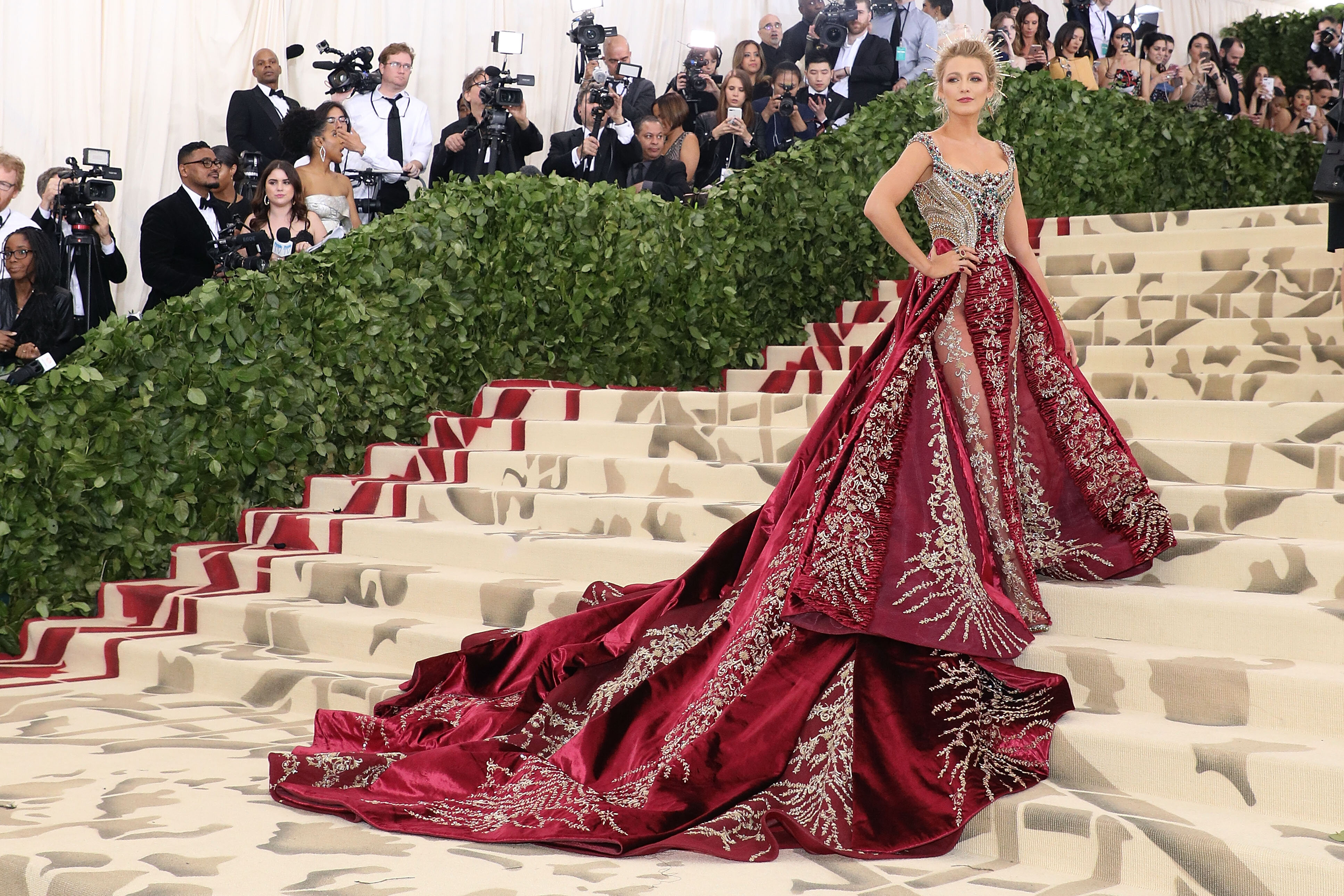
During the video, Blake got especially excited while discussing the Versace gown and Lorraine Schwartz crown she wore to the 2018 Met Gala, and describes it to the magazine as “without a doubt my favourite look of all time.”

Blake Lively at the 2018 Met Gala, which had the theme Heavenly Bodies: Fashion & the Catholic Imagination.

Taylor Hill via Getty Images

But she was also quick to point out that her three young daughters — James, 7, Inez, 5, and Betty, 2 — that she shares with Ryan Reynolds don’t exactly share the same opinion.

“It’s something that when my kids are giving me attitude, I’m like, ‘This is your mom,’ I mean, come on!” Blake said, gesturing to a photo of herself in the stunning dress.

“I try to tell them that I’m real-life royalty and that they’re lucky that I’m raising them.”

Blake then began laughing, and self-deprecatingly added, “They don’t buy it. They don’t believe it.”

<div class="js-react-hydrator" data-component-name="YouTube" data-component-id="8513" data-component-props="{"itemType":"video","index":12,"contentListType":"embed","code":"

","type":"video","meta":{"url":"https://www.youtube.com/watch?v=ShMRAN78598","type":"video","version":"1.0","title":"Blake Lively Breaks Down 19 Looks From 2005 to Now | Life in Looks | Vogue","author":"Vogue","author_url":"https://www.youtube.com/channel/UCRXiA3h1no_PFkb1JCP0yMA","provider_name":"YouTube","description":"Blake Lively dives into her Life in Looks—from Gossip Girl to the Met Gala. “I don’t work with a stylist, I never have,” the star tells Vogue.\r\n\r\nDirector: Posy Dixon    \r\nDP: Mike Lopez    \r\nEditor: Phil Ceconi, Michael Suyeda\r\nProducer: Nicola Pardy\r\nAssistant Camera: Ian Havens    \r\nAudio: Sean Paulsen    \r\nGaffer: Zane Shaffer    \r\nAssociate Producers: Krissy Engelson, Qieara Lesesne\r\nProduction Assistant: Lea Donenberg     \r\nSet Designer: Taylor Horne       \r\nProp Stylist: Javi Scalley \r\nHair Stylist: Jennifer Yepez\r\nMakeup Stylist: Kris Buckle\r\nNail Stylist: Elle Gerstein\r\nCovid Supervisor: Jodi Katzman\r\nProduction Coordinator: Jane DiBartolo\r\nProduction Manager: Victor Cifrè II\r\nProduction Manager: Kit Fogarty\r\nAssistant Editors:\r\nJustin Symonds, JC Scruggs, Andy Morell, Billy Ward & Cory Stevens\r\nPost Production Coordinator: Andrea Farr\r\nPost-Production Supervisor: Marco Glinbizzi\r\nFilmed on location: The Greenwich Hotel\r\nEntertainment Director, Vogue: Sergio Kletnoy\r\nDirector of Content Production, Vogue: Rahel Gebreyes\r\nExecutive Producer: Ruhiya Nuruddin\r\nManager, Creative Development: Alexandra Gurvitch\r\nDirector, Creative Development: Anna Page Nadin\r\nSenior Director, Programming, Vogue: Linda Gittleson\r\nVP, Digital Video Programming and Development, Vogue: Joe Pickard\n\nStill haven’t subscribed to Vogue on YouTube? ►► http://bit.ly/vogueyoutubesub\r\nGet the best of Vogue delivered right in your inbox ►► https://bit.ly/3xAZyQg\r\nWant to hear more from our editors? Subscribe to the magazine ►► http://bit.ly/2wXh1VW\r\nCheck out our new podcast ‘In Vogue: The 1990s’ ►► https://link.chtbl.com/iv-yt-description\r\n \r\nABOUT VOGUE\r\nVogue is the authority on fashion news, culture trends, beauty coverage, videos, celebrity style, and fashion week updates.","thumbnail_url":"https://i.ytimg.com/vi/ShMRAN78598/hqdefault.jpg","thumbnail_width":480,"thumbnail_height":360,"cache_age":86400,"options":{"_start":{"label":"Start from","value":"717","placeholder":"ex.: 11, 1m10s"},"_end":{"label":"End on","value":"","placeholder":"ex.: 11, 1m10s"},"_cc_load_policy":{"label":"Closed captions","value":false},"click_to_play":{"label":"Hold load & play until clicked","value":false}}},"fullBleed":false,"flags":[],"enhancements":{},"options":{"theme":"news","device":"desktop","editionInfo":{"id":"uk","name":"U.K.","link":"https://www.huffingtonpost.co.uk","locale":"en_GB"},"slideshowAd":{"scriptTags":[],"otherHtml":""},"slideshowEndCard":{"scriptTags":[{"attribs":{},"scriptBody":"\r\n (function(){\r\n var c = document.getElementById(‘taboola-endslate-thumbnails’);\r\n c.id += ‘-‘ + Math.round(Math.random()*1e16);\r\n \r\n var taboolaParams = {\r\n loader: \"//cdn.taboola.com/libtrc/aol-huffingtonpost/loader.js\",\r\n mode: \"thumbnails-b\",\r\n container: c.id,\r\n placement: \"Endslate Thumbnails\",\r\n target_type: \"mix\"\r\n };\r\n \r\n if (typeof window.modulousQueue === \"function\") {\r\n \twindow.modulousQueue.add(function(){ doTaboola(taboolaParams); });\r\n } else {\r\n \tdoTaboola(taboolaParams);\r\n }\r\n }());\r\n"}],"otherHtml":"

"},"isMapi":false,"isAmp":false,"isVideoEntry":false,"isMt":false,"entryId":"627cab1be4b010453ae0e736","entryTagsList":"uk-celebrity,met-gala,blake-lively,@goodnews,@widget-imported","sectionSlug":"entertainment","deptSlug":null,"sectionRedirectUrl":null,"subcategories":"","isWide":false,"headerOverride":null,"noVideoAds":false,"disableFloat":false,"isNative":false,"commercialVideo":{"provider":"custom","site_and_category":"uk.entertainment","package":null},"isHighline":false,"vidibleConfigValues":{"cid":"60afc140cf94592c45d7390c","disabledWithMapiEntries":false,"overrides":{"all":"60b8e525cdd90620331baaf4"},"whitelisted":["56c5f12ee4b03a39c93c9439","56c6056ee4b01f2b7e1b5f35","59bfee7f9e451049f87f550b","5acccbaac269d609ef44c529","570278d2e4b070ff77b98217","57027b4be4b070ff77b98d5c","56fe95c4e4b0041c4242016b","570279cfe4b06d08e3629954","5ba9e8821c2e65639162ccf1","5bcd9904821576674bc55ced","5d076ca127f25f504327c72e","5b35266b158f855373e28256","5ebac2e8abddfb04f877dff2","60b8e525cdd90620331baaf4","60b64354b171b7444beaff4d","60d0d8e09340d7032ad0fb1a","60d0d90f9340d7032ad0fbeb","60d0d9949340d7032ad0fed3","60d0d9f99340d7032ad10113","60d0daa69340d7032ad104cf","60d0de02b627221e9d819408"],"playlists":{"default":"57bc306888d2ff1a7f6b5579","news":"56c6dbcee4b04edee8beb49c","politics":"56c6dbcee4b04edee8beb49c","entertainment":"56c6e7f2e4b0983aa64c60fc","tech":"56c6f70ae4b043c5bdcaebf9","parents":"56cc65c2e4b0239099455b42","lifestyle":"56cc66a9e4b01f81ef94e98c"},"playerUpdates":{"56c6056ee4b01f2b7e1b5f35":"60b8e525cdd90620331baaf4","56c5f12ee4b03a39c93c9439":"60d0d8e09340d7032ad0fb1a","59bfee7f9e451049f87f550b":"60d0d90f9340d7032ad0fbeb","5acccbaac269d609ef44c529":"60d0d9949340d7032ad0fed3","5bcd9904821576674bc55ced":"60d0d9f99340d7032ad10113","5d076ca127f25f504327c72e":"60d0daa69340d7032ad104cf","5ebac2e8abddfb04f877dff2":"60d0de02b627221e9d819408"}},"connatixConfigValues":{"videoPagePlayer":"19654b65-409c-4b38-90db-80cbdea02cf4"},"customAmpComponents":[],"ampAssetsUrl":"https://amp.assets.huffpost.com","videoTraits":null,"positionInUnitCounts":{"buzz_head":{"count":0},"buzz_body":{"count":0},"buzz_bottom":{"count":0}},"positionInSubUnitCounts":{"article_body":{"count":3},"before_you_go_slideshow":{"count":0}},"connatixCountsHelper":{"count":1},"buzzfeedTracking":{"context_page_id":"627cab1be4b010453ae0e736","context_page_type":"buzz","destination":"huffpost","mode":"desktop","page_edition":"en-uk"},"cetUnit":"buzz_body"}}”>

[embedded content]

Maybe her kids need a stronger visual representation of how their mum tends to wear jaw-dropping pieces. May we suggest she show her kids the transformative gown she wore to the 2022 Met Gala — ya know, the one that made her husband react like this?

Share Button