Boris Johnson Accused Of ‘Ignoring The Science’ On Covid

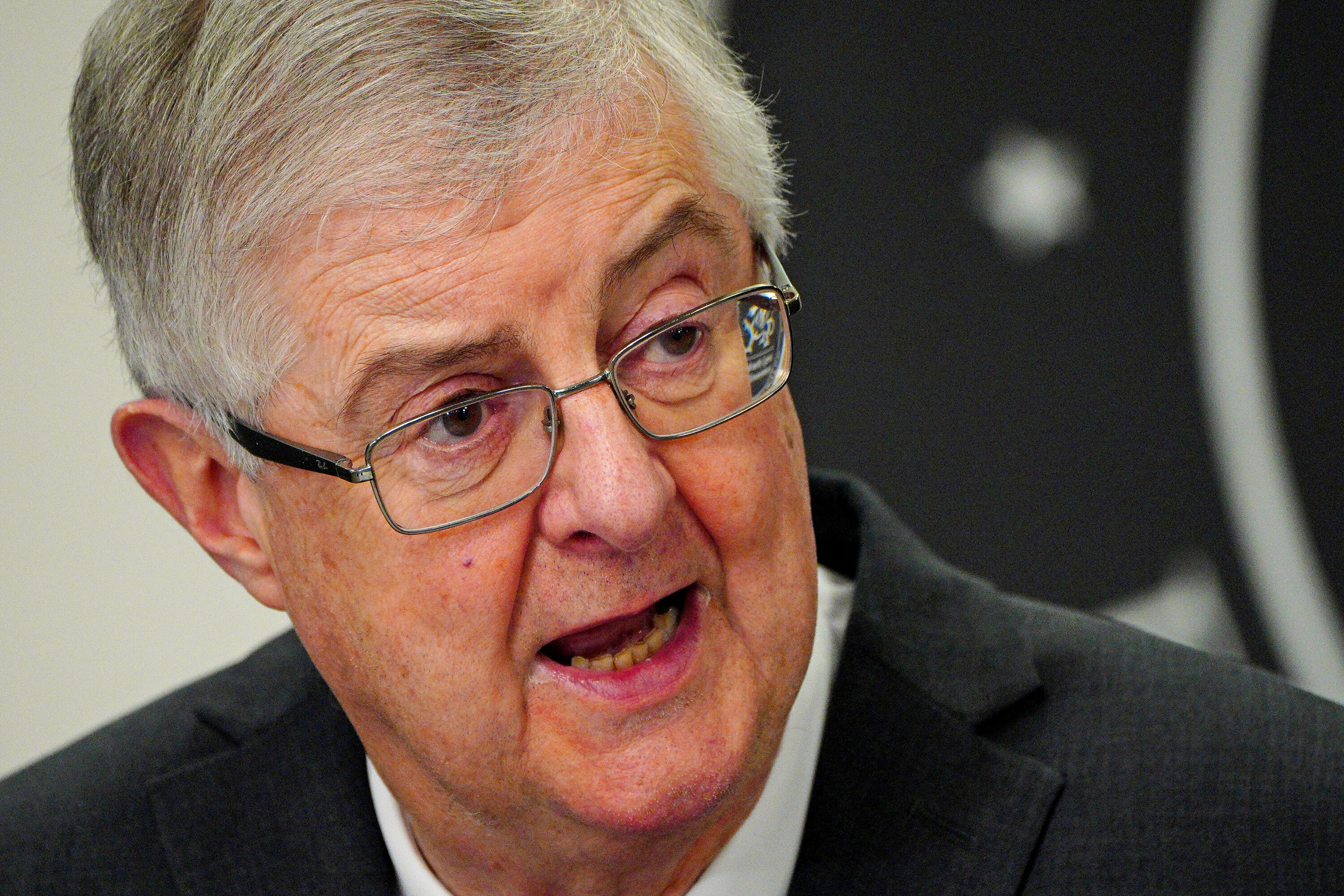
Boris Johnson has been accused by Wales’s First Minister Mark Drakeford of “ignoring the science” in refusing to introduce tighter coronavirus restrictions in England.

Drakeford defended his earlier comments that England was the “global outlier” in the fight against the Omicron variant.

On Friday, he had launched a blistering attack on Boris Johnson, accusing him of leading a Government which was “politically paralysed”.

Speaking on Sky’s Trevor Phillips on Sunday, Drakeford said: “I’m asked time after time why isn’t Wales doing the same things as England?

“My answer was to point out that in this debate it is not Wales that is the outlier.

“Wales is following the same path of putting protections in place that is being followed by Scotland, Northern Ireland, and not just devolved governments in the UK, but governments across Europe and across the world.

“The questions as to why the UK Government has decided not to follow that course of action are for them to answer, not for me.

“I think they have not done what the science would have told them they should do.

“But that’s decisions for them to answer for – I’m answerable for the decisions we take here in Wales.”

Alert level 2 restrictions remain in Wales, including wearing face coverings indoors, groups in public places such as restaurants limited to six people, and working from home if possible.

Indoor events of more than 30 people or outdoor events for more than 50 people are not allowed.

On Friday there was 994 people with Covid-19 being treated in Welsh hospitals while around 40 are in critical care – the majority of whom are unvaccinated.

Drakeford said that having different restrictions in both England and Wales made public health communications “more difficult”.

“When we have different messages across our border that does make it more difficult for us,” he told Sky News.

“We have faced this in the past and we go on doing as we see it as the right thing to protect lives and livelihoods here in Wales.”

He also said he was hopeful the restrictions could be lifted in Wales as he was expecting a steep decline in infections once the peak in the next couple of weeks was reached.

“As soon as we are in a position to see the peak past and the position improving, of course we will want to revert to the far more modest level of protections we had in place only a few weeks ago,” he said.

“We’re hopeful that the level of protections we currently have in place will be sufficient to mitigate the impact of Omicron to help our NHS to deal with the astonishing pressures which it’s having to deal with every day.”

Share Button

Loose Women Deny Latest Reports Of Supposed Behind-The-Scenes Drama

Loose Women bosses have denied fresh rumours of alleged behind-the-scenes tension among some of the show’s panellists.

A report published in the Mail On Sunday claimed that Nadia Sawalha was refusing to appear on the panel alongside Coleen Nolan, due to derogatory comments allegedly made by Coleen’s agent about Nadia on Twitter last year.

The article also alleged that Stacey Solomon had requested she no longer appear on the show with Coleen, when the former I’m A Celebrity winner returns from maternity leave later this year.

However, a representative for the ITV daytime show has dismissed the rumours outright, claiming that members of the Loose Women panel don’t actually have any say in who they share the episode with.

Nadia Sawalha was one of Loose Women's original presenters when it launched in 1999
Nadia Sawalha was one of Loose Women’s original presenters when it launched in 1999

Ken McKay/ITV/Shutterstock

A spokesperson told HuffPost UK the Mail’s “story is untrue”, adding: “Panellists are chosen for each show by the Loose Women Editor and senior production team, not the panellists themselves.”

Coleen also denied the reports on her official Twitter page, stating that “nothing printed in the Mail article today is true”.

She added that she was “taking legal advice” on the matter, and would be also be addressing it on Loose Women in the days to come.

The former Celebrity Big Brother winner’s publicist also denied the reports, telling HuffPost UK they were “100% untrue”.

Coleen also received a message of support from her fellow Loose Women panellists Janet-Street Porter:

Nadia Sawalha’s spokesperson had no comment when approached by HuffPost UK.

Stacey Solomon is currently on maternity leave from her role as a Loose Women presenter

Ken McKay/ITV/Shutterstock

Coleen first joined Loose Women in 2000, staying with the show on-and-off for 11 years before deciding to take a break.

She later returned as a full-time member of the panel in 2013.

Towards the end of last year, Coleen spoke out about how the show had changed since she first joined, admitting she felt it had become less “free” in recent times.

“It’s a very different show, because the world has changed – and I have to say [it’s changed] for the better in a lot of respects,” she said. “You cannot get away with certain things now. However, it was a much easier show to do in those days.”

Nadia is also among Loose Women’s longest-serving stars, and was among its original presenters when it launched in 1999.

She stepped down in 2002, but eventually returned in 2013, around the same time as Coleen.

Meanwhile, Stacey became a permanent Loose Women panellist in 2016, after a string of guest appearances went down a storm with viewers.

She has been credited with bringing a fresh energy to the show, alongside more recent additions like comedian Judi Love and news anchor Charlene White.

Share Button

Covid-19: Cutting self-isolation to five days would be helpful says Nadhim Zahawi

The UK’s former vaccines minister says reducing the quarantine period would ease staff pressures.

Share Button

Covid: UK records more than 150,000 deaths

The UK is the seventh country to pass this number, after the US, Brazil, India, Russia, Mexico and Peru.

Share Button

NASA’s Webb Telescope reaches major milestone as mirror unfolds

NASA’s James Webb Space Telescope team fully deployed its 21-foot, gold-coated primary mirror, successfully completing the final stage of all major spacecraft deployments to prepare for science operations.

A joint effort with the European Space Agency (ESA) and Canadian Space Agency, the Webb mission will explore every phase of cosmic history — from within our solar system to the most distant observable galaxies in the early universe.

“Today, NASA achieved another engineering milestone decades in the making. While the journey is not complete, I join the Webb team in breathing a little easier and imagining the future breakthroughs bound to inspire the world,” said NASA Administrator Bill Nelson. “The James Webb Space Telescope is an unprecedented mission that is on the precipice of seeing the light from the first galaxies and discovering the mysteries of our universe. Each feat already achieved and future accomplishment is a testament to the thousands of innovators who poured their life’s passion into this mission.”

The two wings of Webb’s primary mirror had been folded to fit inside the nose cone of an Arianespace Ariane 5 rocket prior to launch. After more than a week of other critical spacecraft deployments, the Webb team began remotely unfolding the hexagonal segments of the primary mirror, the largest ever launched into space. This was a multi-day process, with the first side deployed Jan. 7 and the second Jan. 8.

Mission Operations Center ground control at the Space Telescope Science Institute in Baltimore began deploying the second side panel of the mirror at 8:53 a.m. EST. Once it extended and latched into position at 1:17 p.m. EST, the team declared all major deployments successfully completed.

The world’s largest and most complex space science telescope will now begin moving its 18 primary mirror segments to align the telescope optics. The ground team will command 126 actuators on the backsides of the segments to flex each mirror — an alignment that will take months to complete. Then the team will calibrate the science instruments prior to delivering Webb’s first images this summer.

“I am so proud of the team — spanning continents and decades — that delivered this first-of-its kind achievement,” said Thomas Zurbuchen, associate administrator for the Science Mission Directorate in NASA Headquarters in Washington. “Webb’s successful deployment exemplifies the best of what NASA has to offer: the willingness to attempt bold and challenging things in the name of discoveries still unknown.”

Soon, Webb will also undergo a third mid-course correction burn — one of three planned to place the telescope precisely in orbit around the second Lagrange point, commonly known as L2, nearly 1 million miles from Earth. This is Webb’s final orbital position, where its sunshield will protect it from light from the Sun, Earth, and Moon that could interfere with observations of infrared light. Webb is designed to peer back over 13.5 billion years to capture infrared light from celestial objects, with much higher resolution than ever before, and to study our own solar system as well as distant worlds.

“The successful completion of all of the Webb Space Telescope’s deployments is historic,” said Gregory L. Robinson, Webb program director at NASA Headquarters. “This is the first time a NASA-led mission has ever attempted to complete a complex sequence to unfold an observatory in space — a remarkable feat for our team, NASA, and the world.”

NASA’s Science Mission Directorate oversees the mission. NASA’s Goddard Space Flight Center in Greenbelt, Maryland, manages the project for the agency and oversees the Space Telescope Science Institute, Northrop Grumman, and other mission partners. In addition to Goddard, several NASA centers contributed to the project, including Johnson Space Center in Houston, the Jet Propulsion Laboratory in Pasadena, Marshall Space Flight Center in Huntsville, Alabama, Ames Research Center in Silicon Valley, and others.

For more information about the Webb mission, visit:

https://www.nasa.gov/webb

Story Source:

Materials provided by NASA. Note: Content may be edited for style and length.

Share Button

‘Flurona’: What To Know About Getting Covid And Flu At The Same Time

At every stage in the pandemic, we’ve added new terms to our everyday vocabulary: coronavirus, Covid-19, social distancing, Delta, Omicron… the list goes on and on.

The latest grabbing international headlines is “flurona,” a term that describes people who are infected with both the coronavirus and influenza at the same time. Confirmed cases have popped up in the US, Israel, Brazil and elsewhere.

Wondering what it means for you? Here’s what you need to know.

‘Flurona’ isn’t actually new

The term “flurona” may be new and catchy, but the phenomenon isn’t, as Raghu Adiga, chief medical officer at Liberty Hospital in Kansas City, Missouri, pointed out in this Scientific American explainer. News reports that make it sound like a “nightmare” are blowing the whole situation out of proportion – and missing the fact that it’s happened before, Adiga said.

“The way this story was taken out of context is yet another example of the kind of internet-based misinformation that haunts all of us who are trying to fight the real crisis at hand,” he wrote in the piece.

When a pandemic with millions of new cases daily collides with seasonal influenza “among a world population largely unvaccinated against either Covid-19 or flu, it is reasonable to find patients who may catch both viruses around the same time,” Adiga continued. Health care providers can run diagnostic flu and/or Covid tests to detect what you’ve been infected with.

And again, there have been documented (or suspected) cases of Covid/flu co-infection basically since the pandemic began. We may start seeing more of them now because the 2021 flu season was so benign (likely because of lockdowns, school closures and widespread masking), and there are concerns that this year’s flu season could be much worse. We’re also, of course, in the middle of an omicron surge that is driving up cases nationwide.

It can be serious, but experts say it’s not super common right now

While the recent flood of stories about “flurona” is arguably over-the-top, medical experts say it is important to take both Covid and the flu very seriously right now. Yes, the vast majority of people who get the flu or Covid recover. But there have also been more than 800,000 Covid-related deaths in the United States since the pandemic began, and more than 150,000 in the UK, while in any given year, the flu results in 12,000 to 52,000 US deaths and between 10,000 and 25,000 in the UK.

So even though co-infections are nothing new, they are something to be aware of. They can certainly put extra stress on people’s immune systems and increase the likelihood that you’ll get ill, particularly if you’re older or immunocompromised, for example.

“It is true that when you’re infected, your immune system is under attack. Therefore your immune defences are weakened. And therefore your ability to defend against another infection is reduced,” said David Edwards, an aerosol scientist, faculty member at Harvard University and inventor of FEND, a nasal mist that aims to trap and flush out tiny pathogens.

That said, your personal odds of being exposed to both viruses simultaneously are pretty low, particularly if people around you are doing their part and staying home if they’re experiencing any symptoms.

“The probability of being exposed to both at the same time is quite small. It’s important for people to understand that when they hear the term ‘flurona,’ it’s not as though there’s this big, bad new combined viral infection that’s going to overtake omicron,” Edwards told HuffPost. “But it happens.”

Be on the lookout for typical COVID and flu symptoms

The hallmark symptoms of Covid-19 are the same as they’ve been throughout the pandemic: fever, cough, chills, muscle aches, shortness of breath and/or loss of taste or smell. But milder symptoms are also possible, such as a runny nose or a headache. Also, some people experience gastrointestinal symptoms rather than what people think of as more typical respiratory effects.

Symptoms of the flu are pretty similar, and as the US Centers for Disease Control and Prevention notes on its website, there’s a lot of overlap. Again, be on the lookout for a cough, stuffy nose, fever, aches, fatigue, etc. With the flu, symptoms typically appear one to four days after exposure. With the coronavirus, the timeline is more like two to 14 days (with the average being about five days) – though there’s growing evidence that Omicron symptoms show up faster than with previous variants.

You can prevent flurona by taking all the right measures we’ve learned about during the pandemic

You really do not have to reinvent the wheel to protect yourself against flurona.

“The key best practices continue to remain getting vaccinated for flu, getting vaccinated and boosted for Covid when eligible, wearing masks and maintaining physical distancing from others, good hand-washing, staying home when sick, and getting tested for flu and Covid when sick,” said Matthew Kronman, associate medical director of infection prevention at Seattle Children’s in Washington.

Many experts say that now is a good time to upgrade to a KN95 or N95 mask if you haven’t already. Also, really err on the side of caution if you have any symptoms at all, even just one. It’s impossible for doctors to determine whether you’ve got a cough and runny nose because you’ve got omicron, because you’re developing a case of the flu, because you’ve got both, or whether you’re dealing with something else altogether – unless they test you.

So do your part to protect others. Stay home until you know what’s what and once you’re cleared of any infection.

Experts are still learning about Covid-19. The information in this story is what was known or available at the time of publication, but guidance could change as scientists discover more about the virus. To keep up to date with health advice and cases in your area, visit gov.uk/coronavirus and nhs.uk.

Share Button

Piers Morgan Opens Up About ‘Bruising’ Good Morning Britain Exit

Piers Morgan has spoken out about his much-publicised exit from Good Morning Britain, admitting he found his departure a “bruising” experience.

The former daytime star quit GMB in March 2021, after casting doubt on claims made by Meghan Markle that she had experienced suicidal thoughts during her time as a senior member of the Royal Family.

He announced he was immediately stepping down on the same night Ofcom announced they would be launching an investigation about his remarks, with the TV watchdog eventually receiving a record number of complaints about the incident, including one from the Duchess herself.

Ofcom ruled six months later that the broadcast was not in breach of their code, with Piers having now landed new roles as a presenter on an upcoming talkTV show and a columnist in The Sun.

Speaking to the tabloid a week before the launch of his column, Piers said: “The column is called Uncensored because it does what it says on the tin.

“Effectively I was censored at my previous job and told to apologise to Meghan Markle for an honestly-held opinion, which obviously I wasn’t going to do.”

Alongside a few predictable jibes at the Duchess of Sussex, Piers added: “It was a pretty bruising experience on Good Morning Britain but I’m now working somewhere where I’m free to express my opinions.”

HuffPost UK has contacted ITV for comment.

Piers presented Good Morning Britain for six years alongside Susanna Reid

ITV/Shutterstock

Since he stepped down from GMB in March 2021 – following his infamous walk-off live on air – Piers has made a number of seemingly conflicting comments about the nature of his exit.

The morning after the news of his exit, Piers told reporters: “I had a good chat with ITV and we agreed to disagree. I’m just going to take it easy and see how we go.”

“If I have to fall on my sword for expressing an honestly-held opinion about Meghan Markle and that diatribe of bilge that she came out with in that interview, so be it,” he added t the time.

After it was reported that Piers would not be invited back to GMB despite Ofcom’s ruling that his comments were not in breach of their code, the divisive presenter then insisted he wouldn’t return even if he were asked – unless ITV were to apologise to him publicly.

Share Button

Sinéad O’Connor Announces Her Son Shane Has Died, 17

Sinéad O’Connor has announced that her 17-year-old son Shane has died.

The singer shared the tragic news in the early hours of Saturday morning, two days after the teenager – whose father is Irish folk musician Dónal Lunny – was reported as missing.

“My beautiful son, Nevi’im Nesta Ali Shane O’Connor, the very light of my life, decided to end his earthly struggle today and is now with God,” she wrote.

“May he rest in peace and may no one follow his example. My baby. I love you so much. Please be at peace.”

In a subsequent tweet, Sinéad again described Shane as the “light of my life”.

“You will always be my light,” she said. “We will always be together. No boundary can separate us.”

The Irish police force An Garda Síochána had been appealing for information after Shane went missing from an area in Dublin, Ireland on 6 January.

A spokesperson has since confirmed to the Irish Examiner: “Following the recovery of a body in the Bray area of Wicklow on Friday, 7 January 2022, a Missing Person Appeal in respect of Shane O’Connor, 17 years, has been stood down.

“An Garda Síochána would like to thank the media and public for their assistance in this matter. No further action is required and no further information is available at this time.”

Help and support:

  • Mind, open Monday to Friday, 9am-6pm on 0300 123 3393.
  • Samaritans offers a listening service which is open 24 hours a day, on 116 123 (UK and ROI – this number is FREE to call and will not appear on your phone bill).
  • CALM (the Campaign Against Living Miserably) offer a helpline open 5pm-midnight, 365 days a year, on 0800 58 58 58, and a webchat service.
  • The Mix is a free support service for people under 25. Call 0808 808 4994 or email help@themix.org.uk
  • Rethink Mental Illness offers practical help through its advice line which can be reached on 0808 801 0525 (Monday to Friday 10am-4pm). More info can be found on rethink.org.
Share Button

Tangled messages: Tracing neural circuits to chemotherapy’s ‘constellation of side effects’

Severe and persistent disability often undermines the life-saving benefits of cancer treatment. Pain and fatigue — together with sensory, motor, and cognitive disorders — are chief among the constellation of side effects that occur with the platinum-based agents used widely in chemotherapy treatments worldwide.

A new study by Georgia Tech researchers in the lab of Timothy C. Cope has found a novel pathway for understanding why these debilitating conditions happen for cancer patients and why scientists should focus on all of the possible neural processes that deliver sensory or motor problems to a patient’s brain — including the central nervous system — and not just the “peripheral degeneration of sensory neurons” that occurs away from the center of the body.

The new findings “Neural circuit mechanisms of sensorimotor disability in cancer treatment” are published in the Proceedings of the National Academy of Sciences (PNAS) and could impact development of effective treatments that are not yet available for restoring a patient’s normal abilities to receive and process sensory input as part of post cancer treatment, in particular.

Stephen N. (Nick) Housley, a postdoctoral researcher in the School of Biological Sciences, the Integrated Cancer Research Center, and the Parker H. Petit Institute for Bioengineering and Bioscience at Georgia Tech, is the study’s lead author. Co-authors include Paul Nardelli, research scientist and Travis Rotterman, postdoctoral fellow (both of the School of Biological Sciences), along with Timothy Cope, who serves as a professor with joint appointments in the School of Biological Sciences at Georgia Tech and in the Coulter Department of Biomedical Engineering at Emory University and Georgia Tech.

Neurologic consequences

“Chemotherapy undoubtedly negatively influences the peripheral nervous system, which is often viewed as the main culprit of neurologic disorders during cancer treatment,” shares Housley. However, he says, for the nervous system to operate normally, both the peripheral and central nervous system must cooperate.

“This occurs through synaptic communication between neurons. Through an elegant series of studies, we show that those hubs of communication in the central nervous system are also vulnerable to cancer treatment’s adverse effects,” Housley shares, adding that the findings force “recognition of the numerous places throughout the nervous system that we have to treat if we ever want to fix the neurological consequences of cancer treatment — because correcting any one may not be enough to improve human function and quality of life.”

“These disabilities remain clinically unmitigated and empirically unexplained as research concentrates on peripheral degeneration of sensory neurons,” the research team explains in the study, “while understating the possible involvement of neural processes within the central nervous system. The present findings demonstrate functional defects in the fundamental properties of information processing localized within the central nervous system,” concluding that “long-lasting sensorimotor and possibly other disabilities induced by cancer treatment result from independent neural defects compounded across both peripheral and central nervous systems.”

Sensorimotor disabilities and ‘cOIN’

The research team notes that cancer survivors “rank sensorimotor disability among the most distressing, long-term consequences of chemotherapy. Disorders in gait, balance, and skilled movements are commonly assigned to chemotoxic damage of peripheral sensory neurons without consideration of the deterministic role played by the neural circuits that translate sensory information into movement,” adding that this oversight “precludes sufficient, mechanistic understanding and contributes to the absence of effective treatment for reversing chemotherapy-induced disability.”

Cope says the team resolved this omission “through the use of a combination of electrophysiology, behavior, and modeling to study the operation of a spinal sensorimotor circuit in vivo” in a rodent model of “chronic, oxaliplatin (chemotherapy)-induced neuropathy: cOIN.”

Key sequential events were studied in the encoding of “propriosensory” information (think kinesthesia: the body’s ability to sense its location, movements, and actions) and its circuit translation into the synaptic potentials produced in motoneurons.

In the “cOIN” rats, the team noted multiple classes of propriosensory neurons expressed defective firing that reduced accurate sensory representation of muscle mechanical responses to stretch, adding that accuracy “degraded further in the translation of propriosensory signals into synaptic potentials as a result of defective mechanisms residing inside the spinal cord.”

Joint expression, independent defects

“These sequential, peripheral, and central defects compounded to drive the sensorimotor circuit into a functional collapse that was consequential in predicting the significant errors in propriosensory-guided movement behaviors demonstrated here in our rat model and reported for people with cOIN,” Cope and Housley report. “We conclude that sensorimotor disability induced by cancer treatment emerges from the joint expression of independent defects occurring in both peripheral and central elements of sensorimotor circuits.”

“These findings have broad impact on the scientific field and on clinical management of neurologic consequences of cancer treatment,” Housley says. “As both a clinician and scientist, I can envision the urgent need to jointly develop quantitative clinical tests that have the capacity to identify which parts of a patient nervous system are impacted by their cancer treatment.”

Housley also says that having the capacity to monitor neural function across various sites during the course of treatment “will provide a biomarker on which we can optimize treatment — e.g. maximize anti-neoplastic effects while minimizing the adverse effects,” adding that, as we move into the next generation cancer treatments, “clinical tests that can objectively monitor specific aspects of the nervous system will be exceptionally important to test for the presence off-target effect.”

Share Button

Fully 3D-printed, flexible OLED display

In a groundbreaking new study, researchers at the University of Minnesota Twin Cities used a customized printer to fully 3D print a flexible organic light-emitting diode (OLED) display. The discovery could result in low-cost OLED displays in the future that could be widely produced using 3D printers by anyone at home, instead of by technicians in expensive microfabrication facilities.

The OLED display technology is based on the conversion of electricity into light using an organic material layer. OLEDs function as high quality digital displays, which can be made flexible and used in both large-scale devices such as television screens and monitors as well as handheld electronics such as smartphones. OLED displays have gained popularity because they are lightweight, power-efficient, thin and flexible, and offer a wide viewing angle and high contrast ratio.

“OLED displays are usually produced in big, expensive, ultra-clean fabrication facilities,” said Michael McAlpine, a University of Minnesota Kuhrmeyer Family Chair Professor in the Department of Mechanical Engineering and the senior author of the study. “We wanted to see if we could basically condense all of that down and print an OLED display on our table-top 3D printer, which was custom built and costs about the same as a Tesla Model S.”

The group had previously tried 3D printing OLED displays, but they struggled with the uniformity of the light-emitting layers. Other groups partially printed displays but also relied on spin-coating or thermal evaporation to deposit certain components and create functional devices.

In this new study, the University of Minnesota research team combined two different modes of printing to print the six device layers that resulted in a fully 3D-printed, flexible organic light-emitting diode display. The electrodes, interconnects, insulation, and encapsulation were all extrusion printed, while the active layers were spray printed using the same 3D printer at room temperature. The display prototype was about 1.5 inches on each side and had 64 pixels. Every pixel worked and displayed light.

“I thought I would get something, but maybe not a fully working display,” said Ruitao Su, the first author of the study and a 2020 University of Minnesota mechanical engineering Ph.D. graduate who is now a postdoctoral researcher at MIT. “But then it turns out all the pixels were working, and I can display the text I designed. My first reaction was ‘It is real!’ I was not able to sleep, the whole night.”

Su said the 3D-printed display was also flexible and could be packaged in an encapsulating material, which could make it useful for a wide variety of applications.

“The device exhibited a relatively stable emission over the 2,000 bending cycles, suggesting that fully 3D printed OLEDs can potentially be used for important applications in soft electronics and wearable devices,” Su said.

The researchers said the next steps are to 3D print OLED displays that are higher resolution with improved brightness.

“The nice part about our research is that the manufacturing is all built in, so we’re not talking 20 years out with some ‘pie in the sky’ vision,” McAlpine said. “This is something that we actually manufactured in the lab, and it is not hard to imagine that you could translate this to printing all kinds of displays ourselves at home or on the go within just a few years, on a small portable printer.”

In addition to McAlpine and Su, the research team included University of Minnesota mechanical engineering researchers Xia Ouyang, a postdoctoral researcher; Sung Hyun Park, who is now a senior researcher at Korea Institute of Industrial Technology; and Song Ih Ahn, who is now an assistant professor of mechanical engineering at Pusan National University in Korea.

Video: https://youtu.be/k7KV_lOIp8o

The research was funded primarily by the National Institute of Biomedical Imaging and Bioengineering of the National Institutes of Health (Award No. 1DP2EB020537) with additional support from The Boeing Company and the Minnesota Discovery, Research, and InnoVation Economy (MnDRIVE) Initiative through the State of Minnesota. Portions of this study were conducted in the Minnesota Nano Center, which is supported by the National Science Foundation through the National Nano Coordinated Infrastructure Network (NNCI).

Share Button