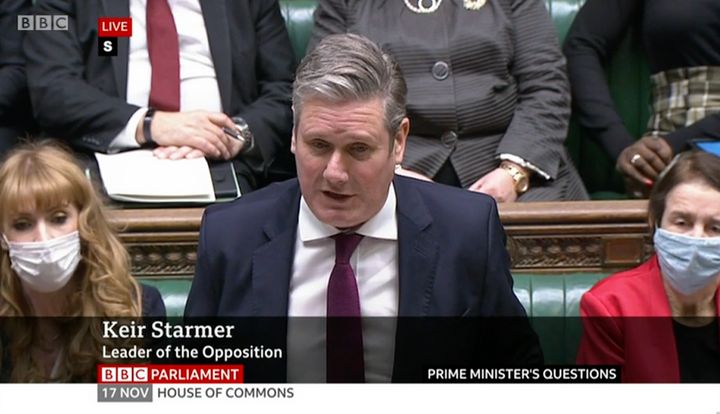
Keir Starmer Forced To Withdraw ‘Coward’ Insult At Boris Johnson During Testy PMQs

Labour leader Keir Starmer has been forced to withdraw comments in which he called Boris Johnson a “coward not a leader” following a rebuke from the Speaker.

During a fiery and ill-tempered session of prime minister’s questions, Starmer called on Johnson to apologise for his handling of the Owen Paterson scandal, in which the government sought to overturn punishment for the former Cabinet minister and paid lobbyist.

The Labour leader pointed out that while the business secretary, Kwasi Kwarteng, and the leader of the House, Jacob Rees-Mogg, had both apologised for their role in the affair, Johnson was yet to do the same.

“Across the country and belatedly across this house, there is now agreement that Owen Paterson broke the rules and that the government should not have tried to let him off the hook,” Starmer said.

“Many members opposite have apologised. The business secretary has apologised for his part. The leader of the House has apologised for his part, but they were following the prime minister’s lead.

“So will he do the decent thing and just say sorry for trying to give the green light to corruption?”

Johnson replied that it was “certainly a mistake” to conflate reform of the standards system with Paterson’s case before moving on to challenge Starmer’s former paid work at the law firm Mishcon de Reya.

Starmer hit back: “That’s not an apology. Everybody else has apologised for him, but he won’t apologise for himself.”

He continued: “A coward not a leader. Weeks defending corruption. Yesterday a screeching last-minute U-turn to avoid defeat on Labour’s plan to ban MPs from dodgy second contracts.

“But waving one white flag won’t be enough to restore trust.”

Starmer’s uncharacteristically strong language was seized on by Tory MP Michael Fabricant, who used a point of order to urge the Labour leader to withdraw his comment.

Speaker Lindsay Hoyle noted: “Coward is not what is used in this House.”

Starmer replied: “I withdraw it, but he’s no leader.”

During the session the Speaker repeatedly made clear his anger at the mood and rough language used in the House, especially in the aftermath of the death of Tory MP David Amess and the conversation it sparked about language in politics.

Hoyle also clashed with Johnson over his attempts to question Starmer’s links to Mishcon de Reya. Starmer turned down a second job with the law firm in the summer of 2017 following accusations it conflicted with his role as shadow Brexit secretary.

Hoyle told the PM: “I don’t want to fall out about it, I’ve made it very clear – it is prime minister’s questions, it’s not for the Opposition to answer your questions.

“Whether we like it or not those are the rules of the game that we’re all into and we play by the rules, don’t we? And we respect this House, so let’s respect the House.”

Despite the reprimand, Johnson attempted to ask again about the issue in a later exchange, to which the Speaker said: “Prime minister, sit down!

“I’m not going to be challenged, you may be the prime minister of this country but in this House I’m in charge.”

Johnson later accused Starmer of “Mish-conduct”, a play on words that prompted outcry from the Labour benches.

At the end of the session, Hoyle lamented the conduct of MPs and said the House had not done “any good” today.

“I’ll be quite honest, I think it’s been ill-tempered, I think it shows the public that this House has not learnt from the other week, I need this House to gain respect but it starts by individuals showing respect for each other,” he said.

Share Button

Boris Johnson Firmly Put In His Place By The Commons’ Speaker: ‘Sit Down Prime Minister!’

Boris Johnson was told off by the speaker of the House of Commons during prime minister’s questions on Wednesday during a rather embarrassing exchange.

Sir Lindsay Hoyle spoke over the prime minister when he was tried to dodge a question from Sir Keir Starmer and reminded Johnson: “I’m not going to be challenged.

“You may be the prime minister of this country – but in this house, I’m in charge!”

The leader of the opposition – Labour’s leader, Starmer – was pressing the prime minister over former Tory MP Owen Paterson, who was a paid lobbyist for health company Randox and briefly defended by the government before a dramatic U-turn.

This firm won government contracts worth almost £600 million without competition, triggering concerns about how Downing Street spent taxpayer’s money.

Starmer asked: “There’s only one way to get to the bottom of this – if he [the prime minister] votes for Labour’s motion this afternoon, that [Randox] investigation can start. Will he vote for it or will he vote for another coverup?”

Johnson replied: “I’m very happy to publish all the details of the Randox contract, which is being investigated by the National Audit Office already.

“Talking of coverups – I’m sorry Mr Speaker, but we still have not heard why the honourable gentleman will not –”

Hoyle interrupted the attempts to talk about Starmer’s own work outside of Parliament when he was a backbencher, urged the prime minister to “sit down” and told him “that’s the end of that” to the cheers of the opposition benches.

Johnson tried to quiz Sir Keir Starmer on his own second job outside parliament

BBC Parliament

Hoyle had already called for order repeatedly in the Commons just 10 minutes into the weekly prime minister’s questions.

He also reminded Johnson “although I don’t want to fall out”, this time of the week is for prime minister’s questions, not questions to the opposition about their conduct.

“Whether you like it or not, those are the rules of the game that we are into, and and we play by the rules don’t we? And we respect the house so let’s respect the house,” Hoyle said pointedly.

When MPs continued to shout across the house at each other, Hoyle told them: “Look, we’ve already lost a dear friend – I want to show that this house has learnt from it.”

He was referring Paterson, who resigned in November after his breach of parliamentary lobbying rules triggered a sleaze scandal.

The government briefly tried to get Paterson off the hook for breaching lobbying rules but it has since turned into a national row about MPs’ standards and has centred on behaviour in the Tory Party.

Hoyle continued: “I don’t want each other to be shouted down. I want questions to be respected, I want the public to actually be able to hear the answers – because I’m struggling in this chair. I need no more.”

Share Button

‘Pity I’m Not The One Who Gives Out Handshakes’: Prue Leith Is All Of Us

Warning: this article contains spoilers for the GBBO 2021 semi-final.

It was a heart-wrenching moment when Jürgen Krauss, possibly the best-loved contestant in Great British Bake Off history, presented his semi-final signature bake to the judges.

Paul Hollywood declared “I like it, but I don’t love it” and declined to give Jürgen one of his famed “Hollywood handshakes”, when the other three contestants each received one.

Jürgen looked towards Prue for redemption and thankfully, she loved the bake. But alas, it seems her opinion wasn’t enough.

“It’s a pity I’m not the one who gives out handshakes,” lamented Prue – while women watching the TV screamed in unison: “Why not!?”

Paul’s handshakes started as a bit of fun, where, back in the Mary Berry days of season three, he whipped out his palm to congratulate contestant Ryan Chong for some stellar sweet dough.

But the shakes have since morphed into something so much more – a symbol of success that’s almost as coveted as the “star baker” title.

In what was a close-knit episode – with the contestants almost impossible to separate – many on social media have speculated that Paul’s lack of handshake was the final nail in the coffin for Jürgen, who was voted off ahead of the final.

Women have also questiond why Paul’s handshake holds so much power – and suggested it’s just another example of a man’s opinion being held in higher esteem than a woman’s.

Of course, we mustn’t forget that this is a light-hearted baking show, and the contestants clearly do adore being recognised for their hard work with Hollywood’s extended hand.

Still, the unequal power dynamic between Paul and Prue is increasingly hard to ignore – and reminds us of every time an experienced woman has been overlooked in the workplace in favour of a confident man.

We’d like to petition for Prue to have her own handshake – the ‘Prue Pat’, as some on social media have called it. Or, as others have suggested, she could bestow her signature necklace on successful bakers like a medal, instead.

Now, that’s a prize we’d truly appreciate.

Share Button

Concerns over regulation of electroconvulsive therapy in NI

ECT involves passing electric currents through the brain to treat conditions such as depression.

Share Button

Hidden pandemic of antibiotic-resistant infections, health officials warn

Antibiotics should be taken only when really needed – and not for coughs, colds or sore throats.

Share Button

Artificial intelligence successfully predicts protein interactions

UT Southwestern and University of Washington researchers led an international team that used artificial intelligence (AI) and evolutionary analysis to produce 3D models of eukaryotic protein interactions. The study, published in Science, identified more than 100 probable protein complexes for the first time and provided structural models for more than 700 previously uncharacterized ones. Insights into the ways pairs or groups of proteins fit together to carry out cellular processes could lead to a wealth of new drug targets.

“Our results represent a significant advance in the new era in structural biology in which computation plays a fundamental role,” said Qian Cong, Ph.D., Assistant Professor in the Eugene McDermott Center for Human Growth and Development with a secondary appointment in Biophysics.

Dr. Cong led the study with David Baker, Ph.D., Professor of Biochemistry and Dr. Cong’s postdoctoral mentor at the University of Washington prior to her recruitment to UT Southwestern. The study has four co-lead authors, including UT Southwestern Computational Biologist Jimin Pei, Ph.D.

Proteins often operate in pairs or groups known as complexes to accomplish every task needed to keep an organism alive, Dr. Cong explained. While some of these interactions are well studied, many remain a mystery. Constructing comprehensive interactomes — or descriptions of the complete set of molecular interactions in a cell — would shed light on many fundamental aspects of biology and give researchers a new starting point on developing drugs that encourage or discourage these interactions. Dr. Cong works in the emerging field of interactomics, which combines bioinformatics and biology.

Until recently, a major barrier for constructing an interactome was uncertainty over the structures of many proteins, a problem scientists have been trying to solve for half a century. In 2020 and 2021, a company called DeepMind and Dr. Baker’s lab independently released two AI technologies called AlphaFold (AF) and RoseTTAFold (RF) that use different strategies to predict protein structures based on the sequences of the genes that produce them.

In the current study, Dr. Cong, Dr. Baker, and their colleagues expanded on those AI structure-prediction tools by modeling many yeast protein complexes. Yeast is a common model organism for fundamental biological studies. To find proteins that were likely to interact, the scientists first searched the genomes of related fungi for genes that acquired mutations in a linked fashion. They then used the two AI technologies to determine whether these proteins could be fit together in 3D structures.

Their work identified 1,505 probable protein complexes. Of these, 699 had already been structurally characterized, verifying the utility of their method. However, there was only limited experimental data supporting 700 of the predicted interactions, and another 106 had never been described.

To better understand these poorly characterized or unknown complexes, the University of Washington and UT Southwestern teams worked with colleagues around the world who were already studying these or similar proteins. By combining the 3D models the scientists in the current study had generated with information from collaborators, the teams were able to gain new insights into protein complexes involved in maintenance and processing of genetic information, cellular construction and transport systems, metabolism, DNA repair, and other areas. They also identified roles for proteins whose functions were previously unknown based on their newly identified interactions with other well-characterized proteins.

“The work described in our new paper sets the stage for similar studies of the human interactome and could eventually help in developing new treatments for human disease,” Dr. Cong added.

Dr. Cong noted that the predicted protein complex structures generated in this study are available to download from ModelArchive (https://modelarchive.org/doi/10.5452/ma-bak-cepc). These structures and others generated using this technology in future studies will be a rich source of research questions for years to come, she said.

Dr. Cong is a Southwestern Medical Foundation Scholar in Biomedical Research. Other UTSW researchers who contributed to this study include Jing Zhang and Josep Rizo, Ph.D., who holds the Virginia Lazenby O’Hara Chair in Biochemistry.

Collaborating institutions include: Harvard University, Wayne State University, Cornell University, MRC Laboratory of Molecular Biology, Memorial Sloan Kettering Cancer Center, Gerstner Sloan Kettering Graduate School of Biomedical Sciences, Fred Hutchinson Cancer Research Center, Columbia University, University of Würzburg in Germany, St Jude Children’s Research Hospital, FIRC Institute of Molecular Oncology in Milan, Italy, and the National Research Council, Institute of Molecular Genetics in Rome, Italy.

This work was supported by Southwestern Medical Foundation, the Cancer Prevention and Research Institute of Texas (CPRIT) (RP210041), Amgen, Microsoft, the Washington Research Foundation, Howard Hughes Medical Institute, National Science Foundation (DBI 1937533), National Institutes of Health (R35GM118026, R01CA221858, R35GM136258, R21AI156595), UK Medical Research Council (MRC_UP_1201/10), HHMI Gilliam Fellowship, the Deutsche Forschungsgemeinschaft (KI-562/11-1, KI-562/7-1), AIRC investigator and the European Research Council Consolidator (IG23710 and 682190), Defense Threat Reduction Agency (HDTRA1-21-1-0007), and the National Energy Research Scientific Computing Center.

Share Button

Research in mice shows how diet alters immune system function through a gut microbe

The cliché “you are what you eat” has been used for hundreds of years to illustrate the link between diet and health. Now, an international team of researchers has found the molecular proof of this concept, demonstrating how diet ultimately affects immunity through the gut microbiome.

The work, conducted in mice, reveals that what animals consume initiates the release of a metabolic byproduct from a specific gut microbe that, in turn, modulates the animals’ gut immunity.

The findings, published Nov.10 in Nature, offer a unifying explanation for the complex interplay between diet, gut microbiota, and immune function. They are the result of collaboration among scientists at Harvard Medical School, Brigham and Women’s Hospital, Seoul National University, and Monash University in Australia.

The experiments pinpoint a microbial molecule, the synthesis and release of which are influenced by host diet. That molecule, in turn, stimulates the activation and signaling of a subset of cells known as natural killer (NK) T cells, which are involved in immune regulation and implicated in a range of inflammatory conditions.

While scientists have surmised for a long time that diet plays a role in immune health, the new study elucidates the precise molecular cascade behind this interplay, said study senior author Dennis Kasper, professor of immunology in the Blavatnik Institute at Harvard Medical School.

“We have shown how diet affects the immune system through a microbial mediator in the gut, and this is a really striking example of the diet-microbiota-immunity triad at play,” Kasper said. “What this work really does is provide a step-by-step pathway from beginning to end that explains how and why this triad works and how diet ultimately affects the immune system.”

If confirmed in larger animals and eventually in humans, the findings can help inform the design of small-molecule treatments that enhance both intestinal and overall immunity, the researchers said.

“Gut-resident microbes produce molecules with enormous structural diversity. We used microbial and chemical tools to elucidate how these molecules are synthesized by gut bacteria and how they act in the host gut,” said study first author Sungwhan Oh, a principal investigator at the Center for Experimental Therapeutics and Reperfusion Injury at Brigham and Women’s Hospital and a former postdoctoral fellow in the Kasper lab.”Our findings yield fascinating insights about the microbiome, diet, and immune function and provide interesting clues about how molecules made by our inner neighbors can be used to design therapies.”

In a series of experiments, the team identified the immune-signaling cascade triggered by the metabolic breakdown of dietary amino acids in the mouse gut. This multistep pathway begins with an animal consuming food that contains branched-chain amino acids, so named for the tree branch-like structure of one of their molecular chains. The branched-chain amino acids are then taken up by B. fragilis, a gut-resident microbe, and converted by a specific enzyme into sugar-lipid molecules that also have branched chains. B. fragilis then releases branched-chain molecules that are spotted and picked up by a class of immune-signaling cells known as antigen-presenting cells, which in turn induce NK T cells to exercise their immunoregulatory response through upregulating inflammation-controlling genes and immune-regulatory chemicals.

Notably, the experiments demonstrated that it is the branching of the chain structure that initiates the cascade. Straight-chain versions of the molecule did not yield the same effect. Furthermore, the team found that B. fragilis alters the structure of the sugar-lipid molecules that it metabolizes and renders them better capable of binding to receptors on specific immune cells and initiating a signaling cascade that culminates in downregulating inflammation.

The work also showed that each of three different branched-chain amino acids consumed by mice yielded slightly different structural changes to the bacterial lipid molecules, resulting in different patterns of binding with immune cells.

Study coinvestigator Seung Bum Park, professor of chemistry at Seoul National University, synthesized, and the Harvard team tested, 23 different configurations of the microbe-made immunomodulatory molecule to determine how each one interacts with the immune cells that regulate inflammation.

The Harvard team’s experiments revealed that synthetic, lab-made branched-chain lipid molecules induced NK T cells to release the immune-signaling chemical IL-2, whereas the lab-made straight-chained versions of these molecules did not. Thus activated, the NK T cells, in turn, induced the expression of genes that regulate immunity but not of genes that drive inflammation.

Using a structural biology approach, Jamie Rossjohn, professor of biochemistry and molecular biology at Monash Biomedicine Discovery Institute in Australia, elucidated how the lipid structure engages with and binds to antigen presenting cells — the immune cells that give NK T cells the go-ahead to produce anti-inflammatory chemicals.

In a final step, the researchers treated mice with ulcerative colitis with the branched-chain sugar-lipid molecule. Animals that received treatment with the branched-chain molecule fared much better than untreated animals. They not only gained weight, but when researchers examined the gut cells of the mice under a microscope, they observed that these cells also had minimal signs of colon inflammation.

Taken together, the experiments provide a structural and molecular explanation of previously observed anti-inflammatory effects of this class of sugar-lipids produced by the gut microbe B. fragilis.

“This work offers a great example of transdisciplinary discovery-based research aimed at answering a major question in biomedical sciences, namely, how the immune system can be modulated by the interplay between diet and the microbiota,” Rossjohn said.

In 2014, Kasper and colleagues published a study showing that a sugar-lipid molecule released by B. fragilis had anti-inflammatory effects on the gut and protected mice from colitis, but the scientists did not know how these molecules were made by the microbe, nor the specific structural features of the sugar-lipids that conferred the anti-inflammatory effect. The current study answers this question demonstrating that the sugar-lipid molecules made by this particular organism are branched-chain and it is precisely that branched-chain structure that allows them to bind to immune cells in a way that dampens these cells’ proinflammatory signaling.

“Our new work demonstrates that the branching of the lipid structure induces a very different response — the branching in the structure induces an anti-inflammatory rather than a proinflammatory response,” Kasper said.

The findings offer hope that inflammatory diseases mediated by these NK T cells could one day be treated with inflammation-dampening microbial molecules made in the lab, the researchers said.

The exact function of NK T cells — the immune cells that the microbe-made molecule ultimately activates to control colonic inflammation in mice — is not well-understood, Kasper said. However, given that these cells line the human gastrointestinal tract and the lungs and are also found in the liver and spleen, they likely play a significant role in immune regulation. Previous research points to these cells’ likely involvement in a range of inflammatory conditions, including ulcerative colitis, and to a possible role in airway inflammatory conditions such as asthma.

“We can never isolate enough of these immune-modulatory molecules from bacteria for therapeutic use, but the beauty of this is now we can synthesize them in the lab,” Kasper said. “The idea would be that we’d have a drug that can modulate inflammation in the colon and beyond.”

Co-authors included T. Praveena, Heebum Song, Ji-Sun Yoo, Da-Jung Jung, Deniz Erturk-Hasdemir, Yoon Soo Hwang, ChangWon Lee, Jérôme Le Nours, Hyunsoo Kim, Jesang Lee, and Richard Blumberg.

The work was supported by National Institutes of Health grants K01-DK102771, R01-AT010268, and R01-DK044319; by Department of Defense grant W81XWH-19-1-0625; by Brigham and Women’s Hospital Department of Anesthesiology, Perioperative and Pain Medicine Basic Science Grant; by the National Research Foundation of Korea grants 2014R1A3A2030423 and 2012M3A9C404878; and by the Australian Research Council grant CE140100011 and Australian Research Council Laureate Fellowship and Future Fellowships.

Relevant disclosures

Oh, Blumberg, and Kasper have filed a patent for Bacteroides fragilis α-galactosylceramides(BfaGCs) and related structures. Oh, Park, and Kasper have filed a patent on the functions of BfaGCs and related structures.

Share Button

Why drug used to treat critically ill COVID-19 patients may only benefit males

A new study from the University of Calgary shows how dexamethasone, the main treatment for severe COVID-19 lung infections, alters how immune cells work, which may help male patients, but has little to no benefit for females.

These remarkable findings are the result of a multidisciplinary study published in Nature Medicine, led by Dr. Jeff Biernaskie, PhD, professor, Comparative Biology and Experimental Medicine in the Faculty of Veterinary Medicine (UCVM) and Dr. Bryan Yipp, MD, associate professor, Department of Critical Care Medicine, Cumming School of Medicine.

“We found that the males derived benefit from the steroids, and the females, at both the cellular level and at the population level, received limited benefit,” says Yipp, Tier II Canada Research Chair in Pulmonary Immunology, Inflammation and Host Defense. “Currently, it’s possible the mainstay therapy for severe COVID-19 that we’re giving everybody is only benefiting half the population. This is a big problem.”

How do our bodies battle COVID-19 infection?

At the onset of the pandemic, hospitals’ treatments of the severely ill were not yet informed by research into how effective the drugs were under COVID-19 conditions. Steroids were the first identified drugs with proven benefit, but they were only moderately successful at reducing deaths, and exactly what they did was not understood.

In addition, when the study began, no one knew exactly how immune cells would react to COVID-19 infection at a cellular level. Why did some people get really sick while others did not? Why did certain drugs help some but not others?

“To be able to develop new treatments, we wanted to study how different people respond to SARS-CoV2 infection and how different immune responses dictate the severity of their disease,” says Biernaskie, the Calgary Firefighters Burn Treatment Society Chair in Skin Regeneration and Wound Healing.

Yipp and Biernaskie sought to better understand how steroids helped and, at the same time, evaluate why a clinical trial of steroids in COVID-19 showed they only helped some males, but not females.

When Yipp accessed the provincial eCRITICAL database of all ICU admissions during the pandemic, he discovered that the introduction of dexamethasone therapy in Alberta reduced the number of males dying but had no affect on the female population. “That was an unsettling observation.”

Analyzing thousands of immune cells from ICU patients

Blood was collected from both COVID-19 and non-COVID-19 patients who were admitted to Calgary ICUs in severe respiratory distress. Researchers in the Biernaskie lab used cutting-edge single cell RNA sequencing and bioinformatics techniques to simultaneously analyze the functional states of thousands of immune cells from each patient. This allowed them to document cellular behaviours at different stages of the disease (COVID-19 or non-COVID infections) and to measure treatment effects.

“We sampled as many patients as we could, not just at one time point but at a follow-up time point so we could get an idea of the evolution of the disease and the evolution of the immune response,” says Biernaskie.

In most viral infections, proteins called interferons work to clear the virus quickly. But with COVID-19, rather than working fast, “the interferon response trickles along, which actually fuels the fire of inflammation, and then you get worse organ damage,” says Yipp.

“What we found was that specifically in males, we see an exaggerated neutrophil interferon response, that is significantly restrained when a patient is given dexamethasone,” says Biernaskie. “But with females, relative to males, their neutrophil interferon response was much more tempered, so dexamethasone had little effect.”

Find therapies that benefit more people

After identifying the reasons why there’s a sex bias in the way dexamethasone works, Yipp believes that the way forward is for researchers to figure out how to make therapies that benefit more people, or individualized therapies, also known as precision or personalized medicine, so that a blanket approach isn’t being used.

Biernaskie and Yipp credit significant contributions from the trainees and junior scientists involved in the research, including Dr. Nicole Rosin and Sarthak Sinha who spent countless hours managing the project and analyzing the results.

The project was supported by a grant Biernaskie and Yipp received from the Thistledown Foundation and by the Calgary Firefighters Burn Treatment Society, “who enthusiastically supported my request to divert some of the CFBTS Chair funds to support this initiative early on in the pandemic,” Biernaski says.

Share Button

Rare case of woman’s body ridding itself of HIV

The patient’s immune cells appear to have eliminated the virus without drugs or therapy.

Share Button

5 Myths Debunked About How The Covid Vaccine Affects Pregnancy And Fertility

There is no pattern from any reports so far which suggest any of the vaccines used in the UK, or reactions to them, increase the risk of miscarriage or stillbirth, the Medicines and Healthcare products Regulatory Agency (MHRA) said.

It said the numbers of reports of miscarriages and stillbirth are “low in relation to the number of pregnant women who have received Covid-19 vaccines to date and how commonly these events occur in the UK outside of the pandemic”.

Myth 2: The jab will affect your fertility

There is no evidence to indicate the Covid-19 vaccine will affect fertility or the ability to have children, according to the UK’s medical regulator.

The rigorous evaluation completed to date did not show a link between changes to menstrual periods and related symptoms and Covid-19 vaccines.

The number of reports of menstrual disorders and vaginal bleeding is low in relation to both the number of people who have received vaccines to date and how common menstrual disorders are generally.

The menstrual changes reported are mostly transient in nature. There is no evidence to suggest that Covid-19 vaccines will affect fertility and the ability to have children.

Myth 3: The vaccine will affect birth outcomes

There is no evidence that having the coronavirus vaccine when pregnant is altering birth outcomes, a UK study concluded.

The research – which was the first from the UK focusing on safety outcomes for pregnant women – found similar birth outcomes for those who have had a Covid-19 vaccine and those who have not. Similar studies have been conducted abroad.

There were no statistically significant differences in the data, with no increase in stillbirths or premature births, no abnormalities with development and no evidence of babies being smaller or bigger, the research team at St George’s, University of London said.

Thousands of pregnant women in England have been vaccinated against coronavirus, with no safety concerns reported.

Myth 4: The vaccine is riskier than Covid

Some parents-to-be are worried about what the vaccine will mean for their unborn child. However, several studies have shown that the vaccine is safe for pregnant mums and their babies, especially as the vaccine does not include a live strain of the virus.

In fact, if mums choose not to get vaccinated but catch Covid, this is more likely to affect the baby.

Pregnant women who do get symptomatic Covid-19, particularly in the third trimester, are two to three times more likely to give birth to their baby prematurely, according to data from the UK Obstetric Surveillance System. Premature birth remains the leading cause of death, illness and disability in babies.

Myth 5: There are too many ‘mixed messages’ about the vaccine

Over half of pregnant women (58%) have declined the Covid-19 vaccination, according to the Royal College of Obstetricians and Gynaecologists (RCOG) and the Royal College of Midwives (RCM). The groups blame “mixed messages” about the vaccine and pregnancy earlier in the pandemic.

However, both the NHS and CDC (US Centres for Disease Control), plus the UK’s Medicines and Healthcare products Regulatory Agency (MHRA), all recommend vaccinations for pregnant people.

Earlier in the pandemic, when the vaccine was newer and research only emerging, healthcare officials did warn against vaccinations for expectant mums. However, we now know far more about the virus and the vaccines, and earlier on in the year, healthcare officials said it was safe for this cohort to get the jab and actively encouraged them to do so.

So, there are plenty of reasons to go for the jab. If you have any other concerns about the jab while pregnant or trying for a baby, chat to your doctor or midwife.

Share Button