Emma Stone Reveals Why She Suspects Leonardo DiCaprio Thinks She’s ‘A Little Weird’

While Emma Stone is a Hollywood legend in her own right, it’s good to know she’s as goofy around other big stars as we would be. 

The La La Land actor has said she is convinced Leonardo DiCaprio thinks she’s “a little weird” after her behaviour around him. 

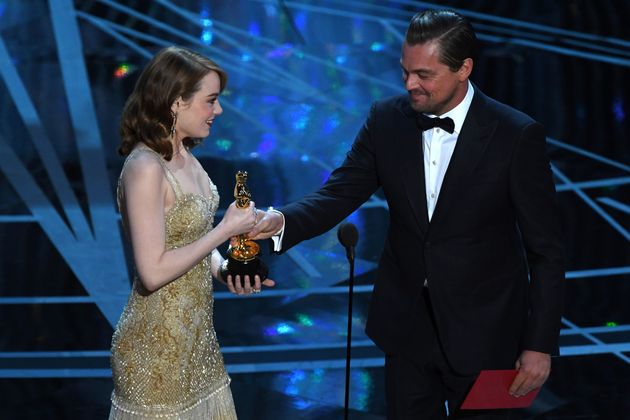
Emma is a self-confessed Leo super fan, and described meeting the Titanic star when he presented her with her Oscar in 2017 as “the most surreal moment of my life”. 

Getty

Emma Stone and Leonardo DiCaprio

“I was like, I’d seen Titanic seven and a half times in theatres. He was the love of my life,” Emma told SiriusXM’s Jess Cagle. 

“I had a picture of him in my bedroom that was signed, that I had gotten for my birthday when I was like 12 years old and I was walking to Leo. I was like, this is officially the most surreal moment of my life. I could not believe it.”

Emma, who won the Best Actress Academy Award for her role in La La Land, continued: “I think he probably thinks I’m like a little weird, cause whenever I see him, I’m kind of like, ‘Hey, how’s it going?’ You know, just in little moments when you’re at the same event or something. He’s very sweet though.”

MARK RALSTON via Getty Images

Leo presented Emma with her Oscar for Best Actress in 2017 

Asked to expand on what Leo is like IRL, Emma continued: “He’s very tall and he’s so lovely.

“It doesn’t really seem fair because then it’s like putting someone in a place that like no human beings should really be in that kind of place,” she said. “That’s silly—like nobody’s any different than anybody.” 

However, Emma added that to her, Leo will always be his heartthrob character from Titanic.

“He’s stuck in my head as Jack Dawson. He just always will be,” she said. 

Share Button

Now Health Minister Says Holidays Abroad Are ‘Dangerous’

A health minister has added to the confusion over coronavirus travel rules after saying going abroad is “dangerous” and “not for this year”.

Lord Bethell’s comments come after environment secretary George Eustice was slapped down by No.10 for suggesting people could travel to so-called “amber list” countries to visit friends.

Boris Johnson also later stressed that amber list countries were “not somewhere you should be going on holiday”.

But Bethell went much further than government rules, which allows people to travel to Portugal, Iceland and nine other countries without having to quarantine on their return, opening the door to summer holidays.

The peer’s comments are the latest example of chaotic messaging on foreign travel from the government, and are likely to fuel confusion following the lifting of the ban on foreign holidays on Monday.

He made his remarks amid continuing concern over the rise in cases of the potentially more transmissible variant that originated in India in parts of England.

Labour said the confusion had created “dangerous chaos” and called for “a pause on international travel”, while Johnson’s former aide Dominic Cummings has labelled the UK’s border policy a “joke”.

Going much further than the government position, Bethell said: “Travelling is dangerous. That is not news to us or to the people who get on those planes in the first place.

“We do ask people, particularly as we go into the summer, travelling is not for this year, please stay in this country.”

Gareth Fuller – PA Images via Getty Images

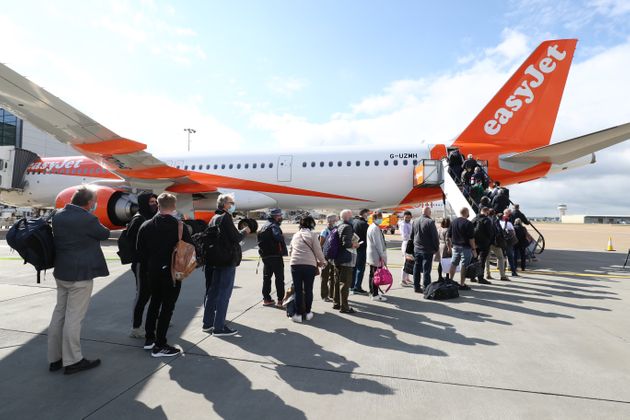
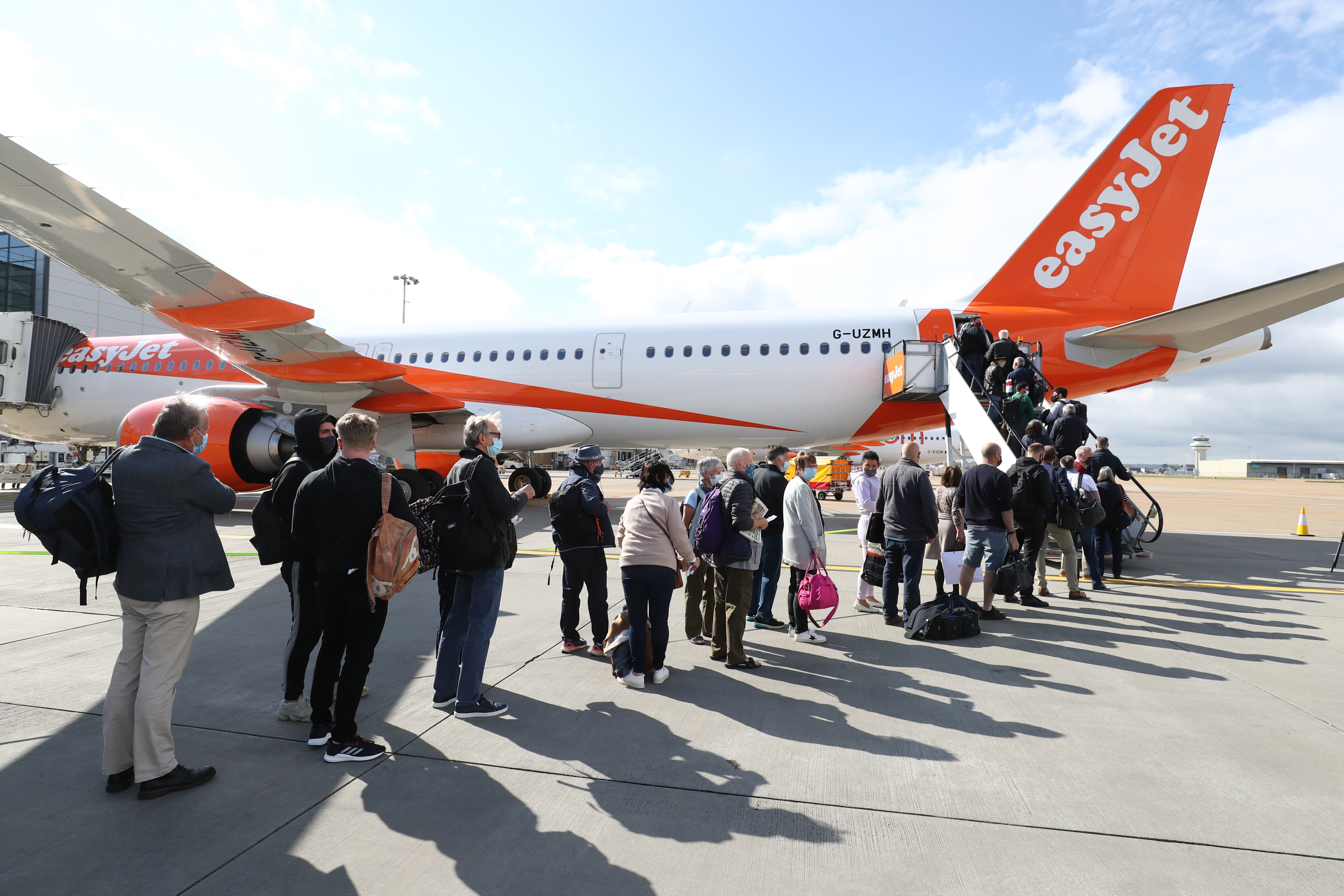
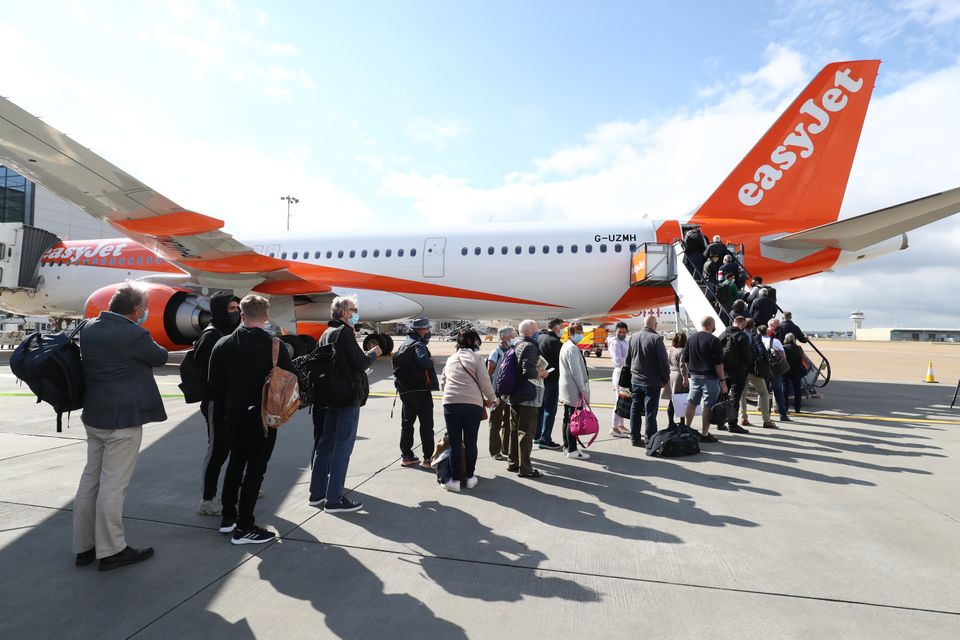
Passengers prepare to board an easyJet flight to Faro, Portugal, at Gatwick Airport on Monday

Earlier, Eustice struck a markedly different tone, suggesting people could travel to even amber list countries if they “feel the need” to visit family or friends.

But the prime minister’s official spokesperson said travel to amber list countries was only permitted for a very limited number of reasons.

“The position remains that people should not travel to amber list countries and that is to protect public health,” they said.

“We recognise that the restrictions that have been placed are difficult for the public. 

“There may be essential reasons for which people still have to travel to amber list countries but of course strict quarantine and testing measures will apply.

“There are some limited reasons why it might be acceptable to travel – for work purposes, protecting essential services or compassionate reasons such as a funeral or care of a family member but otherwise people should not be travelling to these countries.”

Shadow home secretary Nick Thomas-Symonds said: “The Conservatives’ border policies have unravelled into dangerous chaos within a matter of hours since international travel was opened up.

 “There is a lack of strategy, which has meant the UK government, and their own ministers, are giving out conflicting and confused advice about whether people are allowed to travel, especially between ‘amber list’ countries.

“Labour has been clear that there should be a pause on international travel, to guard against further importing of dangerous strains, setting back hopes for ending restrictions.”

Share Button

Icing muscle injuries may delay recovery

A study using a mouse model of eccentric contraction (*1) has revealed that icing injured muscles delays muscle regeneration. The discovery was made by a research group including Associate Professor ARAKAWA Takamitsu and then PhD. Student KAWASHIMA Masato from Kobe University’s Graduate School of Health Sciences, and Chiba Institute of Technology’s Associate Professor KAWANISHI Noriaki et al. In addition, the researchers illuminated that this phenomenon may be related to pro-inflammatory macrophages’ (*2, 3, 4) ability to infiltrate damaged cells. This research raises questions as to whether or not severe muscle injuries (such as torn muscles) should be iced.

These research results were published online as one of the Journal of Applied Physiology‘s Articles in Press on March 25, 2021.

Main points

  • The research results revealed that applying an ice pack to a severe muscle injury resulting from eccentric contraction may prolong the time it takes to heal.
  • The cause of this phenomenon is that icing delays the arrival of pro-inflammatory macrophages, which are responsible for the phagocytosis (*5), or removal, of damaged tissue. Furthermore, this makes difficult for the macrophages to sufficiently infiltrate the damaged muscle cells.

Research Background

Skeletal muscle injuries encompass a range of damage to muscles; from a microcellular level to a severe level. These injuries include not only those that happen during sports or schools’ physical education lessons but also external injuries that occur as a result of accidents and disasters.

‘RICE treatment’ is a common approach for skeletal muscle injuries, regardless of the extent of the injury. This acronym stands for Rest, Ice, Compression and Elevation and is often used in physical education, sports and even medicine. Ice is commonly applied regardless of the type of muscle injury, yet little is known about the long-term effects of icing.

Ice is used to suppress inflammation, however, inflammation in response to tissue injury is one of the body’s healing mechanisms. This has come to be understood as a vital response for tissue regeneration. In other words, suppressing inflammation with ice may also inhibit the body’s attempt to repair itself.

Experiments investigating the effect of icing muscles after injury have produced conflicting results. Some have reported that it delays muscle regeneration while others have stated that it doesn’t inhibit this process. However, none of the research up until now has investigated the effects of icing using an injury model that mimics common sports injuries caused by muscle contraction.

Using a mouse model of eccentric contraction injury, the current research team decided to observe the effects of post-injury icing. In this mouse model, injuries were induced to resemble severe torn muscles.

Research Methodology and Results

Eccentric contraction was induced by electrically stimulating the leg muscles of the mice and then exerting a stronger force during this stimulation to make the leg muscles move in the opposite direction. After this, the muscles were harvested. Icing was performed by placing polyurethane bags of ice on top of the skin over three 30 minute sessions per day, with each session being 2 hours apart. This was continued until two days after the injury. The icing was based on the usual clinically recommended method.

The researchers investigated the regenerated skeletal muscle two weeks after injury, comparing the icing group with the non-icing group. A significantly higher percentage of smaller regenerated muscle fibers were found in cross-sections from the icing group, with a greater number of medium to large fibers in the non-icing group. In other words, this revealed that skeletal muscle regeneration may be delayed as a result of icing.

Next, the researchers periodically took samples of muscle from the icing and non-icing groups of animals in order to investigate what was happening in the regeneration process up until this point.

In the regeneration process, inflammatory cells gather at the site of the injury, remove the debris from the damaged muscle and then begin to build new muscle. However, the results revealed that it is harder for inflammatory cells to enter the injured muscle cells if ice is applied.

Macrophages are typical of the inflammatory cells that enter the injured muscle. These consist of pro-inflammatory macrophages, which phagocyte damaged tissue thus causing inflammation, and anti-inflammatory macrophages (*6), which suppress the inflammatory reaction and promote repair. It is thought that pro-inflammatory macrophages change their characteristics, becoming anti-inflammatory. The results of this research team’s experiments showed that icing delays the arrival of pro-inflammatory macrophages at the site of the injury.

These results indicate the possibility that macrophages are unable to sufficiently phagocyte the damaged muscle when ice is applied after severe muscle injuries caused by eccentric contraction, consequently delaying the formation of new muscle cells.

Comment from Associate Professor Arakawa

In sports, the mantra of immediately applying ice to an injury is commonplace, regardless of the injury’s severity. However, the mechanism that we illuminated through this research suggests that not icing a severe muscle injury may lead to faster recovery. The idea of immediately cooling any type of injury is also entrenched in schools’ physical education classes. I hope that in the future, the alternative option of speeding up recovery by not cooling severe muscle injuries will become known.

However, even though icing may disrupt the recovery process for severe muscle injuries, there is no denying the possibility that there are degrees of mild muscle injuries that can be iced. The next issue is to work out where to draw the line. We are now in the middle of investigating what effect icing has on slight muscle injuries.

Next, we will continue to investigate how icing should be carried out according to the extent of the muscle injury. We aim to contribute guidelines that will enable people in sports and clinical rehabilitation to make accurate judgements about whether or not to ice an injury.

Glossary

1. Eccentric contraction: Normally, muscles get shorter when they contract. Eccentric contraction is when the opposite happens and the muscles lengthen as they contract. This can occur due to strenuous activity, which overburdens the muscles and can easily cause injury.

2. Macrophage: A type of white blood cell found in the blood. There are two known types of macrophage: pro-inflammatory and anti-inflammatory.

3. Pro-inflammatory macrophage: These are macrophages that immediately gather at the site of a tissue injury after it occurs. They phagocytose the damaged tissue and trigger inflammation.

4. Inflammation: A pathological reaction that occurs when living tissue is damaged. Symptoms include rubefaction (reddening of the skin), feverishness, swelling and pain.

5. Phagocytosis: When macrophages surround and remove damaged tissue.

6. Anti-inflammatory macrophage: It is said that inflammatory macrophages change into this type. They suppress inflammation and recruit substances for tissue repair.

This research received funding from the Japan Society for the Promotion of Science (JSPS KAKENHI grant number JP17K01501).


Share Button

Spintronics: Improving electronics with finer spin control

Spintronics is an emerging technology for manufacturing electronic devices that take advantage of electron spin and its associated magnetic properties, instead of using the electrical charge of an electron, to carry information. Antiferromagnetic materials are attracting attention in spintronics, with the expectation of spin operations with higher stability. Unlike ferromagnetic materials, in which atoms align along the same direction like in the typical refrigerator magnets, magnetic atoms inside antiferromagnets have antiparallel spin alignments that cancel out the net magnetization.

Scientists have worked on controlling the alignment of magnetic atoms within antiferromagnetic materials to create magnetic switches. Conventionally, this has been done using a ‘field-cooling’ procedure, which heats and then cools a magnetic system containing an antiferromagnet, while applying an external magnetic field. However, this process is inefficient for use in many micro- or nano- structured spintronics devices because the spatial resolution of the process itself is not high enough to be applied in a micro- or nano-scale devices.

“We discovered that we can control the antiferromagnetic state by simultaneously applying mechanical vibration and a magnetic field,” says Jung-Il Hong of DGIST’s Spin Nanotech Laboratory. “The process can replace the conventional heating and cooling approach, which is both inconvenient and harmful to the magnetic material. We hope our new procedure will facilitate the integration of antiferromagnetic materials into spintronics-based micro- and nano-devices.”

Hong and his colleagues combined two layers: a cobalt-iron-boron ferromagnetic film on top of an iridium manganese antiferromagnetic film. The layers were grown on piezoelectric ceramic substrates. Combined application of mechanical vibration and a magnetic field allowed the scientists to control the alignments of magnetic spins repeatedly along any direction desired.

The team aims to continue the search and development of new magnetic phases beyond conventionally classified magnetic materials. “Historically, new material discovery has led to the development of new technologies,” says Hong. “We want our research work to be a seed for new technologies.”

Story Source:

Materials provided by DGIST (Daegu Gyeongbuk Institute of Science and Technology). Note: Content may be edited for style and length.

Share Button

Colonization of the Antilles by South American fauna: Giant sunken islands as a passageway

Fossils of land animals from South America have been found in the Antilles, but how did these animals get there? According to scientists from the CNRS, l’Université des Antilles, l’Université de Montpellier and d’Université Côte d’Azur, land emerged in this region and then disappeared beneath the waves for millions of years, explaining how some species were able to migrate to the Antilles. This study will be published in June 2021 issue in Earth-Science Reviews.

Fossils of land animals from the Antilles, including mammals and amphibians, have their closest relatives in South America. The crossing of the Caribbean Sea from South America was therefore possible, but how?

As swimming across the continent must be ruled out, given that several hundred kilometres separate the South American continent from the Antilles, the dispersal of this fauna has been attributed either to natural rafts coming out of the continent’s flooded rivers, or to the existence of land bridges that are now submerged.

A scientific project involving geologists, palaeontologists and geophysicists1 is now solving some of the mysteries related to these terrestrial species in the Antilles. The researchers have reconstructed the geography of the northern Lesser Antilles over the last 40 million years and have shown that the movements of the tectonic plates at the junction between the Lesser Antilles, the Greater Antilles and the Aves Ridge (an underwater mountain), have several times given birth to archipelagos and islands quite close to each other, which were then swallowed up in the course of time.

In addition to tectonic movements, the glacial-interglacial cycles for 1.5 million years (Quaternary) have favoured the appearance and disappearance of archipelagos. Indeed, during these cycles, the sea level decreases or increases according to the storage of water in the ice caps or their melting (the duration of these cycles is about 100,000 years). The formation of these archipelagos could thus have favoured terrestrial connections between the Aves Ridge, the Greater Antilles and the Lesser Antilles.

Scientists will now extend their studies southward, between Guadeloupe and South America, to reconstruct the past geography of the entire Caribbean Plate, in order to define more precisely the nature of the terrestrial species’ dispersal paths between the Americas.

Story Source:

Materials provided by CNRS. Note: Content may be edited for style and length.

Share Button

Coronavirus: Ministers to step up vaccine take-up calls amid variant fears

Matt Hancock is urging anyone who is unsure about having a Covid jab to “look at the situation in Bolton”.

Share Button

Over a million hospital admissions for obesity

The record number provides the clearest indication yet of the scale of the problem in 2020.

Share Button

Covid: Indian variant cases in 86 council areas – Hancock

It’s not just Bolton and Blackburn, says the health secretary, as he urges people to get vaccinated.

Share Button

Ariana Grande Confirms She Married Dalton Gomez Over The Weekend

Ariana Grande has confirmed she married her partner Dalton Gomez over the weekend.

On Monday, TMZ reported that Ariana married the real estate agent – who she began dating around a year and a half ago – at her home in California.

A rep for the chart-topping singer has now confirmed this to be the case, telling People magazine: “They got married. It was tiny and intimate — less than 20 people.

“The room was so happy and full of love. The couple and both families couldn’t be happier.”

Instagram/Ariana Grande

Ariana Grande and Dalton Gomez pictured last year

The happy couple began dating in January 2020, with Ariana confirming her new relationship when Dalton made a brief appearance in the music video for her Justin Bieber collaboration Stuck With U.

She confirmed their engagement in an Instagram post in December, sharing a slideshow of photos – including a close-up of her eye-catching diamond ring – alongside the message: “Forever n them some.”

Ariana has largely kept the romance private from her fans, but has shared occasional snaps of Dalton on Instagram, including a special birthday post back in August.

“HBD to my baby my best friend my fav part of all the days,” she wrote at the time. “I love u.” 

Last year, Ariana topped the UK singles chart with her solo hit Positions, as well as the Lady Gaga duet Rain On Me.

She later enjoyed huge success with her sixth studio album, also named Positions, and teamed up with Mariah Carey and Jennifer Hudson on a remix of the former’s festive hit Oh Santa.

Share Button

Zoe Ball Quits Strictly Come Dancing Spin-Off It Takes Two After 10 Years

Zoe Ball has announced that she won’t be returning to Strictly Come Dancing spin-off It Takes Two, after 10 years at the helm of the show.

On Monday evening, Zoe shared a statement on her Instagram page explaining her decision to “waltz away” from the BBC companion show. 

“Dance lovers, after 10 joyous years I am waltzing away from It Takes Two,” she wrote.

“As a massive [Strictly] fan I have loved spending my autumn teatimes with the celebrity dancers, the gorgeous & awesome pro dancers, the judges, my girl Vicky Gill, Rylan [Clark-Neal], Gethin [Jones] and of course my main man Ian Waite. Time now for some new cha cha challenges.”

Zoe insisted that she will “continue to support the Strictly family” on her Radio 2 breakfast show, adding that she “can’t wait to watch the Class Of 2021 from my sofa”.

She added: “Huge love & grateful thanks to Tess & Claude & the whole Strictly clan, the ITT fans, my Glam Squad, Eve Winstanley, Alex McLeod, the BBC2 gang, & of course the best telly crew ever. I will miss you all immensely. As Iveta would say ‘Friends for the life’.”

BBC

Zoe Ball has hosted It Takes Two since 2011

Zoe has been the host of the Strictly companion show since 2011, when she took over from regular presenter Claudia Winkleman.

Since taking over the Radio 2 breakfast show in 2019, she has shared presenting duties on the nightly show with Rylan Clark-Neal.

As well as hosting It Takes Two, Zoe was a contestant on Strictly back in 2005, finishing in third place.

She went on to host the show’s live tour in 2011 and 2015. 

Share Button