People in prison were three times more likely to die than others from the virus.


People in prison were three times more likely to die than others from the virus.

The electron is one of the fundamental particles in nature we read about in school. Its behavior holds clues to new ways to store digital data.
In a study published in Nano Letters, physicists from Michigan Technological University explore alternative materials to improve capacity and shrink the size of digital data storage technologies. Ranjit Pati, professor of physics at Michigan Tech, led the study and explains the physics behind his team’s new nanowire design.
“Thanks to a property called spin, electrons behave like tiny magnets,” Pati said. “Similar to how a bar magnet’s magnetization is dipolar, pointing from south to north, the electrons in a material have magnetic dipole moment vectors that describe the material’s magnetization.”
When these vectors are in random orientation, the material is nonmagnetic. When they are parallel to each other, it’s called ferromagnetism and antiparallel alignments are antiferromagnetism. Current data storage technology is based on ferromagnetic materials, where the data are stored in small ferromagnetic domains. This is why a strong enough magnet can mess up a mobile phone or other electronic storage.
Depending on the direction of magnetization (whether pointing up or down), data are recorded as bits (either a 1 or 0) in ferromagnetic domains. However, there are two bottlenecks, and both hinge on proximity. First, bring an external magnet too close, and its magnetic field could alter the direction of magnetic moments in the domain and damage the storage device. And, second, the domains each have a magnetic field of their own, so they can’t be too close to each other either. The challenge with smaller, more flexible, more versatile electronics is that they demand devices that make it harder to keep ferromagnetic domains safely apart.
“Ultrahigh-density data packing would be a daunting task with ferromagnetic memory domains,” Pati said. “Antiferromagnetic materials, on the other hand, are free from these issues.”
On their own antiferromagnetic materials aren’t great for electronic devices, but they’re not influenced by outside magnetic fields. This ability to resist magnetic manipulation started getting more attention from the research community and Pati’s team used a predictive quantum many-body theory that considers electron-electron interactions. The team found that chromium-doped nanowires with a germanium core and silicon shell can be an antiferromagnetic semiconductor.
Several research groups have recently demonstrated manipulation of individual magnetic states in antiferromagnetic materials using electrical current and lasers. They observed spin dynamics in the terahertz frequency — much faster than the frequency used in our current data storage devices. This observation has opened up a plethora of research interests in antiferromagnetism and could lead to faster, higher-capacity data storage.
“In our recent work, we have successfully harnessed the intriguing features of an antiferromagnet into a low-dimensional, complementary metal-oxide compatible semiconductor (CMOS) nanowire without destroying the semiconducting property of the nanowire,” Pati said. “This opens up possibilities for smaller and smarter electronics with higher capacity data storage and manipulation.”
Pati adds that the most exciting part of the research for his team was uncovering the mechanism that dictates antiferromagnetism. The mechanism is called superexchange and it controls the spin of electrons and the antiparallel alignment that makes them antiferromagnetic. In the team’s nanowire, germanium electrons act as a go-between, an exchanger, between unconnected chromium atoms.
“The interaction between the magnetic states of the chromium atoms is mediated by the intermediate atoms they are bonded to. It is a cooperative magnetic phenomenon,” Pati said. “In a simple way, let us say there are two people A and B: They are far apart and cannot communicate directly. But A has a friend C and B has a friend D. C and D are close friends. So, A and B can interact indirectly through C and D.”
Better understanding how electrons communicate between atomic friends enables more experiments to test the potential of materials like chromium-doped nanowires. Better understanding the germanium-silicon nanowire material’s antiferromagnetic nature is what boosts potential for smaller, smarter, higher capacity electronics.
Story Source:
Materials provided by Michigan Technological University. Original written by Allison Mills. Note: Content may be edited for style and length.

Certain brightly colored coral species dotting the seafloor may appear indistinguishable to many divers and snorkelers, but Florida State University researchers have found that these genetically diverse marine invertebrates vary in their response to ocean warming, a finding that has implications for the long-term health of coral reefs.
The researchers used molecular genetics to differentiate among corals that look nearly identical and to understand which species best coped with thermal stress. Their research was published in the journal Ecology.
“Being able to recognize the differences among these coral species that cannot be identified in the field — which are known as ‘cryptic species’ — will help us understand new ways for how coral reefs maintain resilience in the face of disturbance,” said Associate Professor of Biological Science Scott Burgess, the paper’s lead author.
The researchers were studying the coral ecosystem at the island of Moorea in French Polynesia when a coral bleaching event struck in 2019.
Corals get their color from algae that live in their tissues and with which they have a symbiotic relationship. But when corals are stressed — by high water temperature, for example — algae leave the coral, which turns white, hence the term “bleaching.” Bleached corals are not dead, but they are more vulnerable and more likely to die.
Most of the coral at Moorea belong to the genus Pocillopora. During the event, the researchers saw that about 72 percent of the coral colonies from this genus bleached, and up to 42 percent died afterward.
At first, it seemed that the largest colonies were more likely to bleach, but when the scientists examined tissue samples from the coral, they found that colonies belonging to a certain genetic lineage, not coral size, was most important in determining the fate of the corals.
“Because Pocillopora species look so similar, they cannot be reliably identified in the field, which, in the past, has forced researchers to study them as a single group,” said Erika Johnston, a postdoctoral researcher in the Department of Biological Science and a co-author of the paper. “Molecular genetics allows us to reconstruct their evolutionary ancestry and are an essential step to species identification in this case.”
About 86 percent of the Pocillopora corals that died belonged to a group that shares a set of DNA variations, which is known as a haplotype and reflects their common evolutionary ancestry.
“The good news is that not all of the corals died from bleaching, and many species survived,” Burgess said. “The bad news is that the species that died is, as far as we are aware at the moment, endemic to that specific region. So on the one hand, we’re worried about losing an endemic species, but on the other hand, our results show how co-occurring cryptic species can contribute to coral resilience.”
It’s an ecological analogy to having a diverse financial portfolio, where a variety of investments decreases the likelihood of a complete loss.
“Having multiple species that perform a similar function for the reef ecosystem but differ in how they respond to disturbances should increase the chance that Pocillopora corals continue to perform their role in the system, even though the exact species may be shuffled around,” Burgess said.
Maintaining healthy ecological portfolios may be a better management option than attempting to restore a specific species.
“If we maintain the right type of diversity, nature in a way can pick the winners and losers,” Burgess said. “However, the worry for us scientists is that unless the leaders of governments and corporations take action to reduce CO2 emissions, ecological portfolios that can maintain coral reef resilience will be increasingly eroded under current and ongoing climate change. This is concerning because coral reef ecosystems provide economic, health, cultural and ecological goods and services that humans rely on.”
Future research will look into the composition of the algae that live inside the coral, the depth distributions of each cryptic coral species and the evolutionary relationships among the cryptic species.
Researchers from the Hong Kong University of Science and Technology, the Scripps Institution of Oceanography and California State University, Northridge contributed to this study.
This work was conducted as part of a National Science Foundation grant awarded to Burgess.
In January I deleted my Facebook and Instagram accounts, so I launched the new Amplify course without social media and with no advertising. I did share the invitation video on YouTube, but it only had a few hundred views there.
I felt attracted to the idea of pulling my business focus inward. Instead of reaching out to people on other sites and platforms, I wanted to just focus on the community that’s closest to my central online world – namely my blog readers, email subscribers, course customers, and CGC members.
I really don’t need social media or advertising to run a sustainable business and have a good life, and the closer I stick to the core audience, the more I seem to enjoy the experience. That’s good for my motivation too.
One of the key themes I’ve been sharing in the Amplify course is how important it is to focus on your relationship with your creative flow. Be wary of anything that potentially weakens or damages this relationship.
I like to practice what I preach, and every time I develop a new course, it makes me think more deeply about how to apply the ideas to my own life and work. I always make some improvements because of that.
I think this launch would have been a bit higher if I’d spent thousands of dollars on Facebook ads like I did with the Submersion and Stature launches. The ads were profitable in the past. But that requires having a Facebook account, and I like not having one right now. So I willingly let that extra revenue go. Being Facebook-free is worth it.
I’ve also found that when I focus on alignment, motivation, and positive relationships instead of income as a top priority, my income always seems to be just fine. Plenty of support flows my way with relative ease.
Moreover, I also find that when I let go of misaligned ideas, it frees up my mind to receive much better ideas. For instance, when I let go of advertising revenue, the following year I started doing live workshops, and I met my wife Rachelle at the very first one. I’d much rather have her in my life than the ad revenue. And my income is better today than it was with the ads anyway, even though my web traffic isn’t nearly as high as it was back then. Plus I feel a lot more aligned and motivated by my current income streams. I didn’t want to be in the business of selling ads.
There is one very weird thing that I do marketing-wise though. I do it because it only takes a few minutes, and it somehow seems to work. I don’t enitrely know why it works, but I keep seeing evidence that it’s having a positive effect.
Whenever I launch a new course, I put out a certain type of spiritual request. In my mind’s eye, I gather a bunch of spirit guides together and ask them to find people who’d be a good match for the course and to nudge them to join, such as by giving them encouraging signs or synchronicities. I picture myself chatting with the guides to tell them about the course and what it will do for people. Then I ask that if they know any humans who’d benefit, to please direct their human clients to the course. I let them figure out how to do that.
To me this is just a frame. No belief in spirit guides is required since it’s just an action. It’s quick and easy, and I figure it can’t hurt. And it does seem to work. I always hear stories of interesting synchronicities and signs that people experience that nudged them in the direction of the course. This encourages me to keep doing it. In fact, I actually have this as a to-do item on my course launch checklist now, so I remember to do it each time.
Would you be surprised to know that I’m not the only creative pro who assigns tasks to spirit guides like this? I know some other people who use a similar method, and they seem to find it effective too. And again, it’s just an action, so you don’t have to believe in spirit guides to do it.
I think tools are more useful than beliefs – a belief is just a tool that you’ve glued to your palm (or your eyeballs).
I wouldn’t rely only on this one spiritual marketing idea, but it’s a good example of an aligned action that I feel no resistance to doing. Hence it seems like a better tool to keep in my toolbox than being on Facebook, which I do feel some resistance to doing.
Sometimes moving away from resistance and towards new areas of flow takes you in unusual directions. I like it because it adds some spice and variety to life, and it keeps my creative work from feeling too boring or predictable.
I think a lot of people fear that if they let go of a tool or opportunity that’s a partial match, they won’t find anything better to replace it with. Maybe it will just hurt their business. I prefer to have more trust in my intuition and to place more value on my happiness. That makes me feel more resourceful, and I eventually come up with better ideas that feel more aligned and which are actually more effective.
More than three months after his coming out captured global attention, Elliot Page has opened up further about his journey to embracing his authentic self.
The Oscar-nominated star of Juno and Umbrella Academy sat down with Time magazine for an emotional interview and photo essay unveiled this week, making him the magazine’s first transgender male cover star.
In the interview, Elliot said that while reactions to his announcement have been widely mixed, “letting myself fully become who I am” has been worth the scrutiny he has had to endure.
“What I was anticipating was a lot of support and love and a massive amount of hatred and transphobia,” Elliot explained. “That’s essentially what happened.”
Still, at a time when hate crimes against transgender people and transphobic rhetoric are on the rise, the 34-year-old felt a deep responsibility to serve as a visible advocate for that community.
“My privilege has allowed me to have resources to get through and to be where I am today, and of course I want to use that privilege and platform to help in the ways I can,” he added.
“Extremely influential people are spreading these myths and damaging rhetoric — every day you’re seeing our existence debated. Transgender people are so very real.”
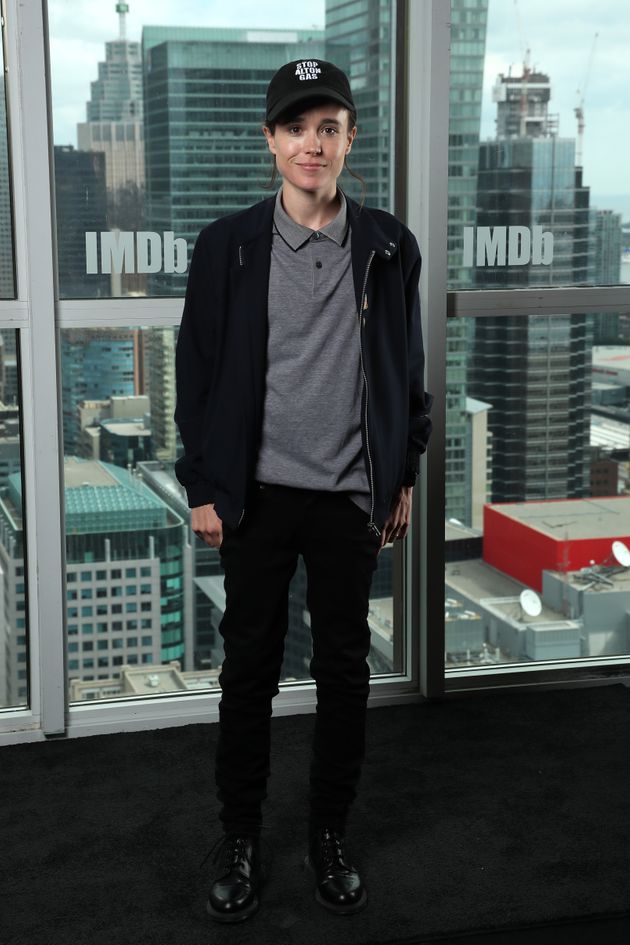
Rich Polk via Getty Images for IMDbRich Polk/Getty Images for IMDb
Elsewhere in the interview, Elliot touched on his recent divorce from his ex-wife Emma Portner ― the couple actually separated last summer but only formalised the split in January ― as well as how his mother, the daughter of a minister, reacted to her son’s gender identity.
He also said his time spent in isolation during the Covid-19 pandemic had affected his decision to come out.
“I had a lot of time on my own to really focus on things that I think, in so many ways, unconsciously, I was avoiding,” he said, naming Janet Mock and Laverne Cox as two of his personal inspirations.
One thing Elliot said he needn’t have been concerned about was the impact that living his truth would have on his career.
The actor’s team has seen a renewal of interest in his work, including offers to direct and produce, as well as some “dude roles,” presumably referring to opportunities to play cisgender men.
“I’m really excited to act, now that I’m fully who I am, in this body,” he said. “No matter the challenges and difficult moments of this, nothing amounts to getting to feel how I feel now.”
This article originally appeared on the US edition of HuffPost.
Useful websites and helplines:


Making time to work out while remaining on top of all-important household jobs can be difficult, but have you ever thought about combining the two?
Johnny, from Lytham St Annes, is one of the many Brits who wants to get fitter but lacks the motivation to hit the gym.
Thankfully, there are plenty of ways to work out without leaving the house. You don’t necessarily need a YouTube tutorial or instructor-led Zoom class either, as many household chores involve getting your body moving and muscles working.
In the video above, Meerkat Mindset expert Russell Kane sets Johnny a challenge that will get his pulse rate up and make sure key jobs are completed.

“I’m going to get you motivated, pumped and you’re going to get chores done,” Russell explains. “Everything going to be sparkling – even your six pack. Let’s get this gym dodger into gear.”
Johnny has just one hour to clean the car, rid the hot tub of dirty water, rake the garden leaves, mop the kitchen and move a stack of boxes from the house to the garage.

The average gym membership costs £500 a year, so completing the physically demanding chores will save Johnny money as well as time, giving him more cash and precious hours to spend doing the stuff he loves.
How does he get on with the chores? And does completing them feel like a proper workout? Watch the video above to find out.
Meerkat Your Bills, Meerkat Your Life with Compare the Market’s online comparison tools


Ian West/PA
Downing Street has awkwardly dodged a string of questions about claims that Boris Johnson said ignoring Covid would be “the best thing” early in the pandemic.
The prime minister’s spokesperson ignored every opportunity to contradict the claims made in a bombshell BBC report, which also says cabinet ministers felt the PM should have installed a tougher lockdown last autumn to save more lives.
The documentary further claimed Johnson’s aides explicitly advised him to tell the public to stop shaking hands – despite which he boasted about shaking hands with hospital staff during an early press conference.
The PM’s spokesperson was asked four times on Tuesday about the central claim that Johnson was overheard saying at the start of the pandemic that “the best thing would be to ignore it”.
The BBC says he repeatedly warned that an overreaction could do more harm than good.
The spokesperson refused to deny the words had been said. “I would point back to what the prime minister said and set out at the time. It has always been our focus to reduce the cases of transmission, to protect the NHS and to ultimately protect lives.
“That’s what we did when we first locked down the country last year and that’s what we have sought to do throughout the pandemic.”
Put to him that he was not denying the allegation, the spokesperson said: “I’m pointing out that throughout the pandemic what we have done is do what we think was the best course of action in terms of protecting lives and in terms of protecting the NHS. That has been our focus throughout the pandemic.”
One source told the BBC’s Laura Kuenssberg there was a “lack of concern and energy” in No.10 as the virus began to hit the UK. “The general view was it is just hysteria. It was just like a flu.”
The BBC also quoted an unnamed cabinet minister’s frustration with the PM’s unwillingness to tighten restrictions in September as a second wave of infections began to appear.
“We knew there was going to be a second wave and there was a row about whether people should work from home or not – it was totally ridiculous,” they said.
No.10 also tried to dodge questions about a Daily Telegraph report saying the role of the Sage advisory committee of scientists would be “reviewed” after the pandemic, because they hold “too much sway” over ministerial decisions.
“We’ve said previously, there will be a time in the future to look back and analyse and reflect on all aspects of the pandemic,” the spokesperson said.
“But Sage continues and will continue to provide scientific evidence and information to the prime minister, the health secretary, and to the wider government as we move through implementing the roadmap.”



The hummingbird is named after its pleasant humming sound when it hovers in front of flowers to feed. But only now has it become clear how the wing generates the hummingbird’s namesake sound when it is beating rapidly at 40 beats per second. Researchers from Eindhoven University of Technology, Sorama, a TU/e spin-off company, and Stanford University meticulously observed hummingbirds using 12 high-speed cameras, 6 pressure plates and 2176 microphones. They discovered that the soft and complex feathered wings of hummingbirds generate sound in a fashion similar to how the simpler wings of insect do. The new insights could help make devices like fans and drones quieter.
The team of engineers succeeded in measuring the precise origin of the sound generated by the flapping wings of a flying animal for the first time. The hummingbird’s hum originates from the pressure difference between the topside and underside of the wings, which changes both in magnitude and orientation as the wings flap back and forth. These pressure differences over the wing are essential, because they furnish the net aerodynamic force that enables the hummingbird bird to liftoff and hover.
Unlike other species of birds, a hummingbird wing generates a strong upward aerodynamic force during both the downward and upward wing stroke, so twice per wingbeat. Whereas both pressure differences due to the lift and drag force acting on the wing contribute, it turns out that the upward lifting pressure difference is the primary source of the hum.
The difference between whining, humming, buzzing and wooshing
Professor David Lentink of Stanford University: “This is the reason why birds and insects make different sounds. Mosquitoes whine, bees buzz, hummingbirds hum, and larger birds ‘woosh’. Most birds are relatively quiet because they generate most of the lift only once during the wingbeat at the downstroke. Hummingbirds and insects are noisier because they do so twice per wingbeat.”
The researchers combined all measurements in a 3D acoustic model of bird and insect wings. The model not only provides biological insight into how animals generate sound with their flapping wings, it also predicts how the aerodynamic performance of a flapping wing gives the wing sound its volume and timbre. “The distinctive sound of the hummingbird is perceived as pleasant because of the many ‘overtones’ created by the varying aerodynamic forces on the wing. A hummingbird wing is similar to a beautifully tuned instrument,” Lentink explains with a smile.
High-tech sound camera
To arrive at their model, the scientists examined six Anna’s hummingbirds, the most common species around Stanford. One by one, they had the birds drink sugar water from a fake flower in a special flight chamber. Around the chamber, not visible to the bird, cameras, microphones and pressure sensors were set up to precisely record each wingbeat while hovering in front of the flower.
You can’t just go out and buy the equipment needed for this from an electronics store. CEO and researcher Rick Scholte of Sorama, a spin-off of TU Eindhoven: “To make the sound visible and be able to examine it in detail, we used sophisticated sound cameras developed by my company. The optical cameras are connected to a network of 2176 microphones for this purpose. Together they work a bit like a thermal camera that allows you to show a thermal image. We make the sound visible in a ‘heat map’, which enables us to see the 3D sound field in detail.”
New aerodynamic force sensors
To interpret the 3D sound images, it is essential to know what motion the bird’s wing is making at each sound measurement point. For that, Stanford’s twelve high-speed cameras came into play, capturing the exact wing movement frame-by-frame.
Lentink: “But that’s not end of story. We also needed to measure the aerodynamic forces the hummingbird’s wings generates in flight. We had to develop a new instrument for that.” During a follow-up experiment six highly sensitive pressure plates finally managed to record the lift and drag forces generated by the wings as they moved up and down, a first.
The terabytes of data then had to be synchronized. The researchers wanted to know exactly which wing position produced which sound and how this related to the pressure differences. Scholte: “Because light travels so much faster than sound, we had to calibrate each frame separately for both the cameras and the microphones, so that the sound recordings and the images would always correspond exactly.” Because the cameras, microphones and sensors were all in different locations in the room, the researchers also had to correct for that.
Algorithm as a composite artist
Once the wing location, the corresponding sound and the pressure differences are precisely aligned for each video frame, the researchers were confronted with the complexity of interpretating high volume data. The researchers tackled this challenge harnessing artificial intelligence, the research of TU/e PhD student, and co-first author, Patrick Wijnings.
Wijnings: “We developed an algorithm for this that can interpret a 3D acoustic field from the measurements, and this enabled us to determine the most probable sound field of the hummingbird. The solution to this so-called inverse problem resembles what a police facial composite artist does: using a few clues to make the most reliable drawing of the suspect. In this way, you avoid the possibility that a small distortion in the measurements changes the outcome.”
The researchers finally managed to condense all these results in a simple 3D acoustic model, borrowed from the world of airplanes and mathematically adapted to flapping wings. It predicts the sound that flapping wings radiate, not only the hum of the hummingbird, but also the woosh of other birds and bats, the buzzing and whining of insects and even the noise that robots with flapping wings generate.
Making drones quieter
Although it was not the focus of this study, the knowledge gained may also help improve aircraft and drone rotors as well as laptop and vacuum cleaner fans. The new insights and tools can help make engineered devices that generate complex forces like animals do quieter.
This is exactly what Sorama aims to do: “We make sound visible in order to make appliances quieter. Noise pollution is becoming an ever-greater problem. And a decibel meter alone is not going to solve that. You need to know where the sound comes from and how it is produced, in order to be able to eliminate it. That’s what our sound cameras are for. This hummingbird wing research gives us a completely new and very accurate model as a starting point, so we can do our work even better,” concludes Scholte.
Eleven European countries have suspended use of the vaccination over concerns about side effects.
Nearly 50 cancer charities send a stark warning about the impact Covid-19 has had on UK cancer care.
