New Covid-19 variants keep appearing – and their mutations are very different to the comic book kind.


New Covid-19 variants keep appearing – and their mutations are very different to the comic book kind.
The UK’s Covid R rate has risen to between 0.7 and 0.9, scientists advising the government have said.
It represents an increase after R was estimated to be between 0.6 and 0.9 last week, and suggests coronavirus is spreading slightly more than it was previously.
R measures the number of people, on average, that each sick person will infect.
If R is greater than 1 the epidemic is generally seen to be growing; if R is less than 1 the epidemic is shrinking.
The estimate was published on Friday and provided by the Scientific Advisory Group for Emergencies (Sage) and the Department for Health and Social Care.
Separately, official figures showed the number of people with Covid-19 in homes across England continues to fall.
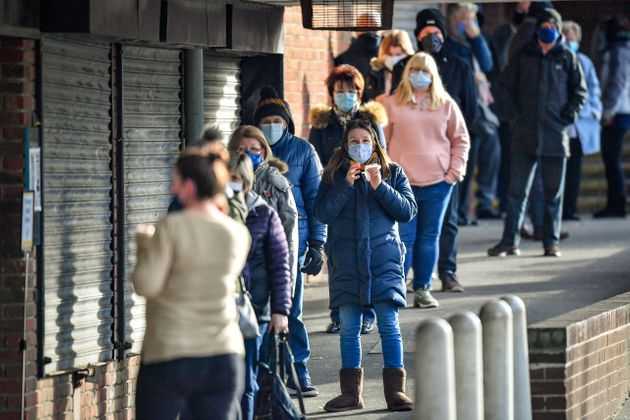
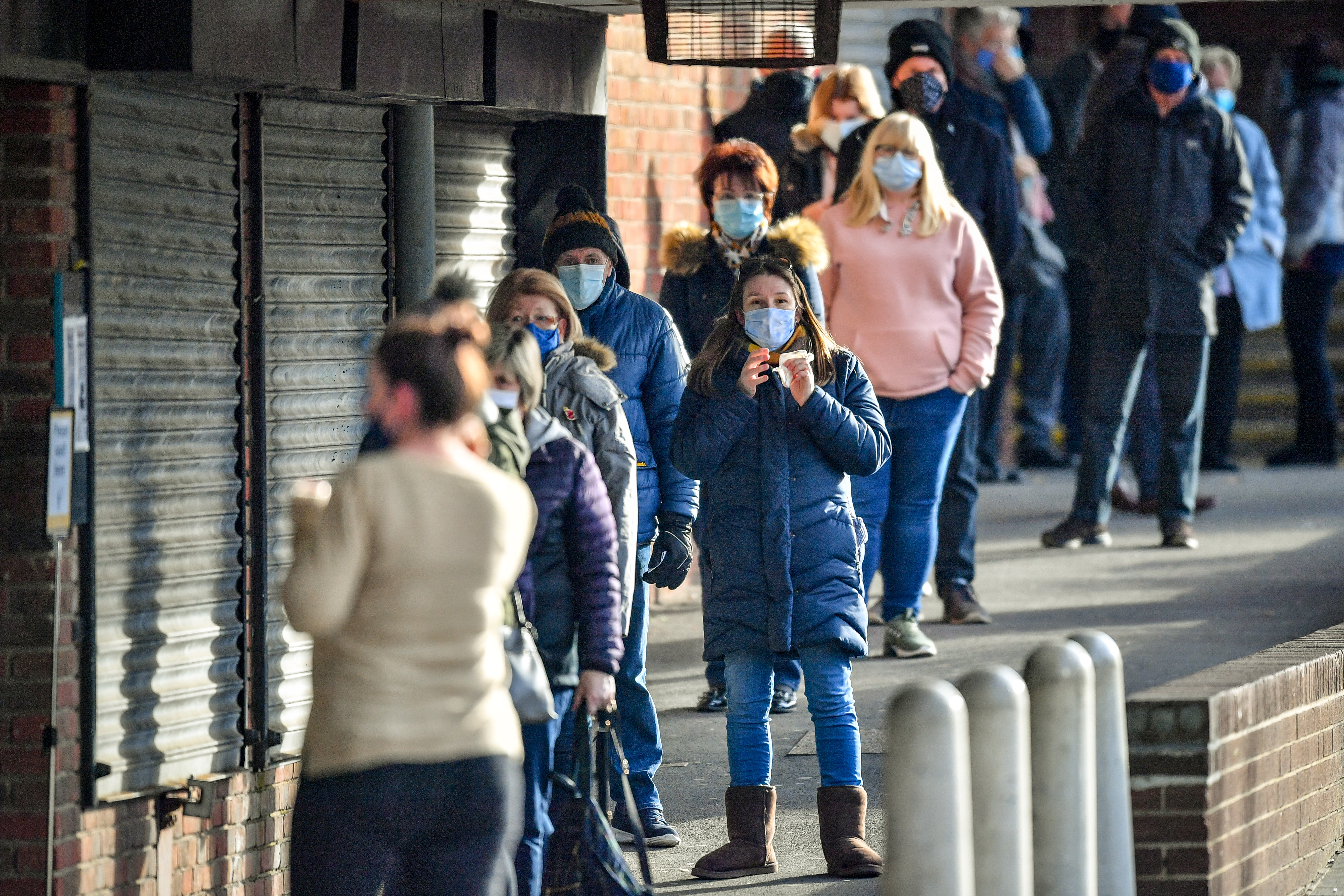
Ben Birchall/PA Images
Figures from the Office for National Statistics (ONS) estimate that around one in 220 people in private households in England had Covid-19 between February 21 and 27 – the equivalent of 248,100 people.
The figure is down from around one in 145, or 373,700 people, for the period February 13 to 19, and is the lowest figure since the week to October 1 when it was one in 240.
However, the number of people infected in England is still high when compared to last summer. In the week to August 25, around one in 2,000 people had coronavirus.
The ONS said the percentage of people testing positive for Covid-19 in the latest figures had decreased in all regions except for north-east England, the East Midlands and eastern England, where it said the trend was uncertain.
In Wales, the latest estimate was one in 285, down from 205, and in Northern Ireland it was one in 325, down from one in 195.
The estimate for Scotland for the week to February 27 was around one in 335 people, down from one in 225.
The latest data is based on swab tests from 684,875 people in the UK, regardless of whether they had symptoms, and does not include hospitals and care homes.
It comes after a government scientific adviser said society will need to learn to live with a “substantial” number of Covid-19 deaths.
Professor Andrew Hayward, who sits on Sage, said the number of deaths will continue to drop as vaccination kicks in, and death rates could begin to look more like those for flu.
Other experts, including Professor Paul Hunter, from the University of East Anglia, have said the UK can expect a wave of deaths next winter, mostly among the unvaccinated and those for whom vaccines do not provide total protection.
Prof Hayward told Times Radio: “I think given the societal trade-offs, we are going to have to live with a degree of mortality that will be substantial.
“I think it will get less over time as more people get vaccinated, and as more people get immune, and I do believe that we’ve been through the worst of this.”
Meghan Markle had to turn down a previous chance of an interview with Oprah Winfrey, claiming that was “not her choice to make”.
US television network CBS has released a full excerpt from Oprah’s upcoming interview with Meghan and Prince Harry, which is set to air in the US on Sunday.
In the clip, Oprah reveals she called Meghan prior to the couple’s wedding in 2018 to ask her for an interview, to which the Duchess Of Sussex claimed she couldn’t even speak about the possibility of it without royal interference.
Meghan says: “I remember that conversation very well, I wasn’t even allowed to have that conversation with you personally, right? There had to be someone – people from the comms – sitting there. Everything was…”
Oprah says: “Yeah, there were other people in the room when I was having that conversation. You turned me down nicely and said, ’Perhaps there will be another time, when there is the right time.’”
Asked what made now the right time, Meghan takes a long pause, before saying: “Well, so many things, that were on the other side of life experience that’s happened, and that we have the ability to make our own choices in a way that I couldn’t have said yes to you then. That wasn’t my choice to make.”
Explaining the difficulties she faced living with the restrictions of royal life, Meghan continues: ″As an adult who lived a really independent life, to then go into this construct that is… different than what I think people imagine it to be, it’s really liberating to be able to have the right and the privilege, in some ways, to be able to say yes and that I’m ready to talk.
“To just be able to make a choice on your own and be able to speak for yourself.”

CBS/PA
In one of two clips released earlier this week, Harry said he feared “history repeating itself” in a reference to his mother’s death as he recounted his royal life with Meghan.
In the second video, Harry said he is grateful to have had Meghan’s support throughout his exit from royal life, while also expressing admiration for what his mother Diana, Princess of Wales, had to endure under similar circumstances.
He told Oprah: “I’m just really relieved and happy to be sitting here, talking to you, with my wife by my side, because I can’t begin to imagine what it must have been like for her, going through this process by herself, all those years ago.
“Because it has been unbelievably tough for the two of us, but at least we had each other.”
Another trailer was then released on Wednesday, in which Meghan claimed the palace is “perpetuating falsehoods about us”.
Asked how she felt about the “palace hearing you speak your truth”, she replied: “I don’t know how they could expect that after all of this time we would still just be silent if there is an active role that The Firm is playing in perpetuating falsehoods about us.
“And if that comes with risk of losing things, I mean ― there’s a lot that has been lost already,” the Duchess added.





A staff nurse who held a phone to the ear of a dying patient on a Covid ward so he could say goodbye to his family has blasted the government for its “pitiful” 1% pay increase.
Alex Oldham told HuffPost UK that the NHS has had the “year from hell” and that he backed proposals for strike action in response to the gesture.
Oldham, who works in Bristol, said: “We’ve been working through a year-long pandemic where at times we’ve had nurses wearing binbags for PPE, there’s been 850 NHS workers who have died of Covid.
“Yes, we’ve had nice things like Clap for Carers on Thursdays, and when ministers have given praise and kind words, but we now know those words are hollow and not worth anything.”
The main nurses’ union is to set up a £35m industrial action fund in response to the government’s recommendation.
The council of the Royal College of Nursing (RCN) made the decision amid growing anger over the pay of health staff who have been under unprecedented pressure during the coronavirus crisis.
Dozens of healthcare workers have also been tweeting their disgust at the proposal.
PPE Selfies were so last wave.
But I’m more tired, more worn out and even more deflated after today’s news of a measly 1% pay rise for NHS Staff.
I hope @theRCN make it clear in their statement, that we will no longer accept this rubbish treatment pic.twitter.com/ELBgCHbN34
— Sam W (@SamAWillc) March 4, 2021
I’m a senior (band 6) Nurse.
A 1% pay rise only puts an extra £6 in my pocket each week, which doesn’t even cover how much I get charged for parking at work.
— Callum Bell (@Callum_Bell8) March 4, 2021
Unite, which represents tens of thousands of NHS workers, is also warning of industrial action. Some of the hardships endured by NHS workers have seen using foodbanks, moving out of family homes to live closer to the hospitals and cover staff sick leave and living in complete isolation in order to protect their families.
A survey of RCN members last year revealed that more than one in three were thinking of leaving the profession, with many citing pay as the main reason.
Oldham said: “Strike action, in whatever form that may be might have to be the only option, obviously with patient safety carefully considered.”
When asked if he was tempted to leave, Oldham replied: “It does make me consider. There are other avenues to earning more money – like being an agency nurse, but that just doesn’t sing with my values. I like the ethos of the NHS, I like how it all works and the goodwill of it. But we can’t keep running on empty.”
Downing Street has defended the figure, saying it was what was “affordable” and Health Minister Nadine Dorries has said she was “pleasantly surprised” at the proposal.
Oldham said he was reminded of Prime Minister Boris Johnson’s vow to lead a government of substance, not gestures, adding: “Here we are, really not seeing any substance. Even as a gesture it’s pretty pitiful.
“The government also have a pledge for wanting to put an extra 50,000 nurses on the wards by the end of their term in government, but how are they going to achieve that when they are offering, in terms of retention and appealing to people, a £3.50 a week pay rise?
“That’s an extra cup of coffee. That’s what that equates to, that’s the reality. And we also have to think about the human cost of the nurses on the frontline. I’ve held a phone to the ear of a dying patient, to their relatives who are crying on the phone because they can’t come in and see them.
“This pandemic will ripple for years to come because of the PTSD that nurses and many other NHS workers will suffer. It’s a real insult, I’m absolutely fuming.
“This request for a pay rise is not driven by greed. This is driven by the fact we are exhausted. We are on our knees and we are fed up of being treated like this. We want a substantial pay rise to put food on the table, pay the mortgage and pay for childcare.”


R remains below 1, and a survey of community infections suggest around 1-in-230 people has the virus.
What was Matt Hancock criticised for and how does government procurement work?
Knowing which windows to open and having shorter lessons could help when children return to school.
Some are not being prioritised if they haven’t been to hospital recently for the condition.

Volcanic eruptions, not natural variability, were the cause of an apparent “Atlantic Multidecadal Oscillation,” a purported cycle of warming thought to have occurred on a timescale of 40 to 60 years during the pre-industrial era, according to a team of climate scientists who looked at a large array of climate modeling experiments.
The result complements the team’s previous finding that what had looked like an “AMO” occurring during the period since industrialization is instead the result of a competition between steady human-caused warming from greenhouse gases and cooling from more time-variable industrial sulphur pollution.
“It is somewhat ironic, I suppose,” said Michael E. Mann, distinguished professor of atmospheric science and director, Earth System Science Center, Penn State. “Two decades ago, we brought the AMO into the conversation, arguing that there was a long-term natural, internal climate oscillation centered in the North Atlantic based on the limited observations and simulations that were available then, and coining the term ‘AMO.’ Many other scientists ran with the concept, but now we’ve come full circle. My co-authors and I have shown that the AMO is very likely an artifact of climate change driven by human forcing in the modern era and natural forcing in pre-industrial times.”
The researchers previously showed that the apparent AMO cycle in the modern era was an artifact of industrialization-driven climate change, specifically the competition between warming over the past century from carbon pollution and an offsetting cooling factor, industrial sulphur pollution, that was strongest from the 1950s through the passage of the Clean Air Acts in the 1970s and 1980s. But they then asked, why do we still see it in pre-industrial records?
Their conclusion, reported today (Mar. 5) in Science, is that the early signal was caused by large volcanic eruptions in past centuries that caused initial cooling and a slow recovery, with an average spacing of just over half a century. The result resembles an irregular, roughly 60-year AMO-like oscillation.
“Some hurricane scientists have claimed that the increase in Atlantic hurricanes in recent decades is due to the uptick of an internal AMO cycle,” said Mann. “Our latest study appears to be the final nail in the coffin of that theory. What has in the past been attributed to an internal AMO oscillation is instead the result of external drivers, including human forcing during the industrial era and natural volcanic forcing during the pre-industrial era.”
The researchers looked at state-of-the-art climate models both for preindustrial times over the past thousand years where external factors such as solar and volcanic drivers were used, and unforced, “control” simulations where no external drivers were applied and any changes that happen are internally generated. When they looked at simulations for the short, 3- to 7-year El Niño Southern Oscillation (ENSO) cycles, they found that these cycles occurred in the models without adding forcing by climate change, volcanic activity, or anything else.
However, when they looked for the AMO, it did not occur in the unforced model and only appeared in modern times using climate change variables as forcing and in preindustrial times with forcing by volcanic eruptions.
“The models do show intrinsic internal oscillations on a 3- to 7-year time scale characteristic of the established El Niño phenomenon, but nothing on the multi-decadal scale that would be the AMO,” said Byron A. Steinman, associate professor of Earth and environmental sciences, University of Minnesota Duluth, who was also on the project. “What we know is an oscillation like El Niño is real, but the AMO is not.”
Mann suggested that while some influential scientists continue to dismiss certain climate change trends as the result of a supposed internal AMO climate cycle, the best available scientific evidence does not support the existence of such a cycle.
Other researchers from Penn State on this project were Daniel J. Brouillette and Sonya K. Miller, both researchers in meteorology.
The National Science Foundation partially funded this research.
Story Source:
Materials provided by Penn State. Original written by A’ndrea Elyse Messer. Note: Content may be edited for style and length.

Texas A&M University researchers have recently shown superior performance of a new oxide dispersion strengthened (ODS) alloy they developed for use in both fission and fusion reactors.
Dr. Lin Shao, professor in the Department of Nuclear Engineering, worked alongside research scientists at the Los Alamos National Laboratory and Hokkaido University to create the next generation of high-performance ODS alloys, and so far they are some of the strongest and best-developed metals in the field.
ODS alloys consist of a combination of metals interspersed with small, nanometer-sized oxide particles and are known for their high creep resistance. This means that as temperatures rise, the materials keep their shape instead of deforming. Many ODS alloys can withstand temperatures up to 1,000 C and are typically used in power generation and engines within aerospace engineering, as well as cutlery.
The nuclear community has a high need for reliable and durable materials to make up the core components of nuclear reactors. The material must be high strength, radiation tolerant and resistant to void swelling (materials develop cavities when subjected to neutron radiation, leading to mechanical failures).
Nuclear researchers like Shao are consistently seeking to identify quality creep-resistant and swelling-resistant materials for their use in high-temperature reactors.
“In general, ODS alloys should be resistant to swelling when exposed to extreme neutron irradiation,” said Shao. “However, the majority of commercial ODS alloys are problematic from the beginning.”
This is because almost all commercial ODS alloys are based on the ferritic phase. Ferritic alloys, classified by their crystalline structure and metallurgical behavior, have good ductility and reasonable high-temperature strength. However, the ferritic phase is the weakest phase when judged by its swelling resistance, therefore making the majority of commercial ODS alloys fail in the first line of defense.
Shao, known internationally for his pioneering work in radiation materials science, directs the accelerator laboratory for testing alloys under extreme irradiation conditions. Shao and his research team collaborated with the Japanese research group at Hokkaido University led by Dr. Shigeharu Ukai to develop various new ODS alloys.
“We decided to explore a new design principle in which oxide particles are embedded in the martensitic phase, which is best to reduce void swelling, rather than the ferritic phase,” said Shao.
The resulting ODS alloys are able to survive up to 400 displacements per atom and are some of the most successful alloys developed in the field, both in terms of high-temperature strength and superior-swelling resistance.
Details of the complete project were published in the Journal of Nuclear Materials along with the most recent study. The team has since conducted multiple studies and attracted the attention from the U.S. Department of Energy and nuclear industry. The project resulted in a total of 18 journal papers and two doctoral degree dissertations.
Story Source:
Materials provided by Texas A&M University. Original written by Laura Simmons. Note: Content may be edited for style and length.
