Families had been calling for Sir Julian’s resignation over poor maternity care at Leeds Teaching Hospitals NHS Trust.


Families had been calling for Sir Julian’s resignation over poor maternity care at Leeds Teaching Hospitals NHS Trust.
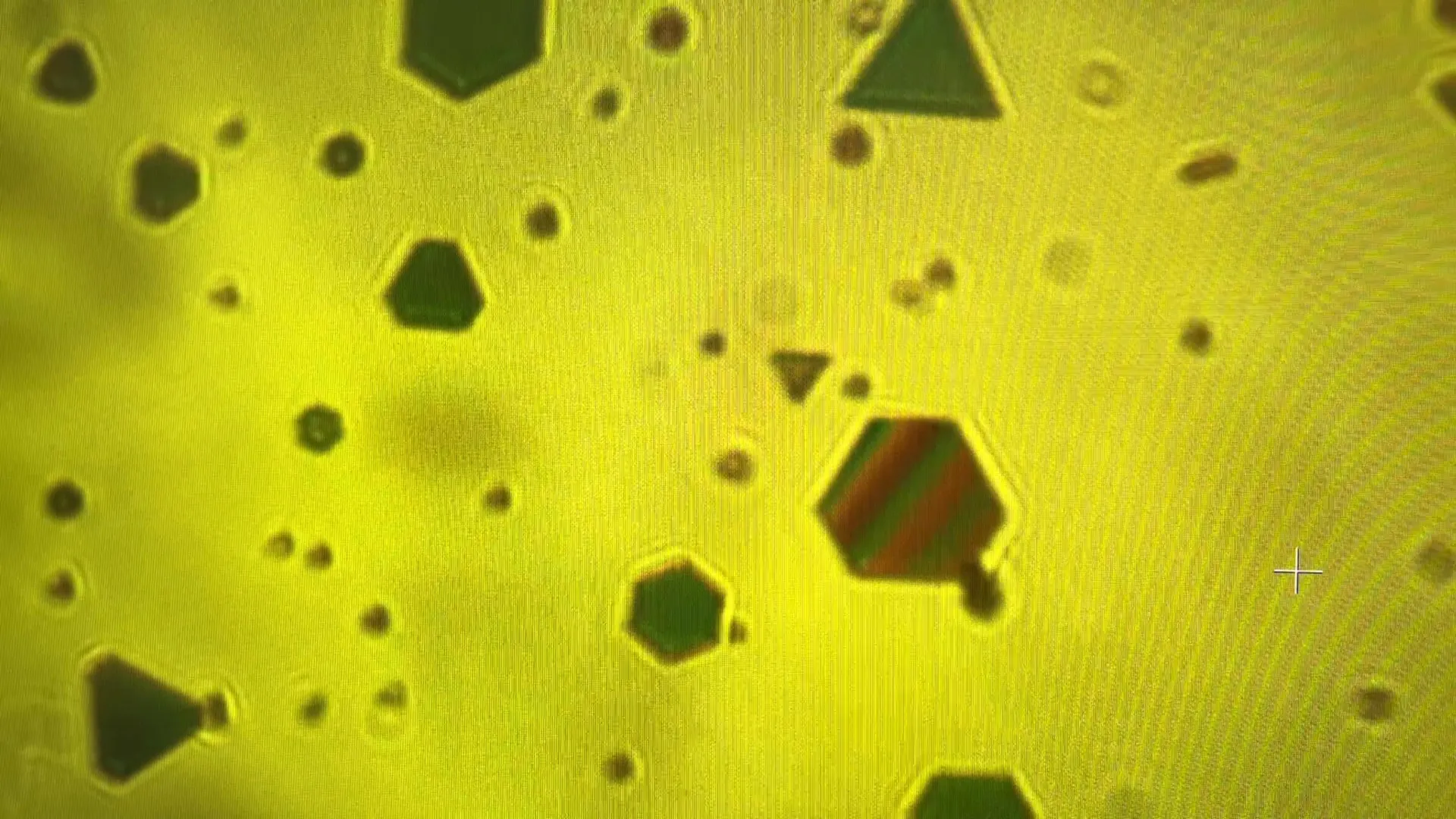
When dust clings to a surface or a gecko walks across a ceiling, it happens thanks to what scientists call “nature’s invisible glue.” Researchers at Chalmers University of Technology in Sweden have developed a fast and simple way to observe these hidden forces that hold the tiniest objects in the universe together. By combining gold, salt water, and light, they have built a special platform where these forces can actually be seen as colorful patterns.
In one of Chalmers’ physics labs, doctoral student Michaela Hošková demonstrates the setup. She holds a glass container filled with millions of microscopic gold flakes suspended in a salt solution. With a pipette, she places a single drop of this liquid on a gold-coated glass plate positioned under an optical microscope. Almost immediately, the gold flakes are drawn toward the surface, but they stop just short of touching it, leaving behind extremely thin gaps measured in nanometers. These tiny cavities act as miniature light traps, causing light to reflect back and forth and produce vivid colors. When illuminated by the microscope’s halogen lamp and analyzed through a spectrometer, the light separates into different wavelengths. On the connected monitor, flakes shimmer and shift between hues of red, green, and gold as they move across the surface.
Studying ‘nature’s glue’ using light trapped in tiny cavities
“What we are seeing is how fundamental forces in nature interact with each other. Through these tiny cavities, we can now measure and study the forces we call ‘nature’s glue’ — what binds objects together at the smallest scales. We don’t need to intervene in what is happening, we just observe the natural movements of the flakes,” says Michaela Hošková, a doctoral student at the Department of Physics at Chalmers University of Technology and first author of the scientific article in the journal PNAS in which the platform is presented.
The light confined inside these nanoscopic cavities allows scientists to explore a delicate equilibrium between two competing forces: one that pulls the flakes toward the surface and another that pushes them apart. The attractive force, known as the Casimir effect, causes the gold flakes to draw closer together and toward the substrate. The opposing electrostatic force, generated by the charged particles in the salt solution, prevents them from sticking completely. When these forces reach perfect balance, a process called self-assembly occurs, creating the cavities that make this phenomenon visible.
“Forces at the nanoscale affect how different materials or structures are assembled, but we still do not fully understand all the principles that govern this complex self-assembly. If we fully understood them, we could learn to control self-assembly at the nanoscale. At the same time, we can gain insights into how the same principles govern nature on much larger scales, even how galaxies form,” says Michaela Hošková.
Gold flakes become floating sensors
The Chalmers researchers’ new platform is a further development of several years of work in Professor Timur Shegai’s research group at the Department of Physics. From the discovery four years ago that a pair of gold flakes creates a self-assembled resonator, researchers have now developed a method to study various fundamental forces.
The researchers believe that the platform, in which the self-assembled gold flakes act as floating sensors, could be useful in many different scientific fields such as physics, chemistry and materials science.
“The method allows us to study the charge of individual particles and the forces acting between them. Other methods for studying these forces often require sophisticated instruments which cannot provide information down to the particle level,” says research leader Timur Shegai.
Can provide new knowledge on everything from medicines to biosensors
Another way to use the platform, which is important for the development of many technologies, is to gain a better understanding of how individual particles interact in liquids and either remain stable or tend to stick to each other. It can provide new insights into the pathways of medicines through the body, or how to make effective biosensors, or water filters. But it is also important for everyday products that you do not want to clump together, such as cosmetics.
“The fact that the platform allows us to study fundamental forces and material properties shows its potential as a truly promising research platform,” says Timur Shegai.
In the lab, Michaela Hošková opens a box containing a finished sample of the platform. She lifts it with tweezers and shows how easily it can be placed in the microscope. Two thin glass plates hold everything needed to study nature’s invisible glue.
“What I find most exciting is that the measurement itself is so beautiful and easy. The method is simple and fast, based only on the movement of gold flakes and the interaction between light and matter,” says Michaela Hošková, zooming the microscope in on a gold flake, the colors of which immediately reveal the forces at play.
How the researchers study ‘nature’s invisible glue’
Gold flakes approximately 10 micrometers in size are placed in a container filled with a salt solution, i.e. water containing free ions. When a drop of the solution is placed on a glass substrate covered with gold, the flakes are naturally attracted to the substrate and nanometer-sized cavities (100-200 nanometers) appear. Self-assembly occurs as a result of a delicate balance between two forces: the Casimir force, a directly measurable quantum effect that causes objects to be attracted to each other, and the electrostatic force that arises between charged surfaces in a salt solution.
When a simple halogen lamp illuminates the tiny cavities, the light inside is captured as if in a trap. This allows the researchers to study the light more closely using an optical microscope connected to a spectrometer. The spectrometer separates the wavelengths of the light so that different colors can be identified. By varying the salinity of the solution and monitoring how the flakes change their distance to the substrate, it is possible to study and measure the fundamental forces at play. To prevent the saline solution with the gold flakes from evaporating, the drop of gold flakes and saline are sealed and then covered with another glass plate.
The platform was developed at Chalmers’ Nanofabrication Laboratory, Myfab Chalmers, and at the Chalmers Materials Analysis Laboratory (CMAL).
More about the research
The scientific article Casimir self-assembly:A platform for measuring nanoscale surface interactions in liquids has been published in PNAS (Proceedings of the National Academy of Sciences). It was written by Michaela Hošková, Oleg V. Kotov, Betül Küçüköz and Timur Shegai at the Department of Physics, Chalmers University of Technology, Sweden, and Catherine J. Murphy at the Department of Chemistry, University of Illinois, USA.
The research was funded by the Swedish Research Council, the Knut and Alice Wallenberg Foundation, the Vinnova Centre 2D-Tech and Chalmers University of Technology’s Nano Area of Advance.
Despite the change – which will happen in 2026 – campaigners warn some women will lose out because the number who attend is too low.
Pelvic organ prolapse affects around one in 12 mothers, but many people have never even heard of it.
Tracey Connolly was first jailed in 2009 over the death of her of toddler son Peter in north London.
Benedict Blythe’s parents say lives and money could be saved by giving allergy pens to all schools.

Let’s get the obvious irony out of the way. I like to think of myself as something of a museum buff, and London really panders to this curiosity with a spectrum of exhibitions that span from obvious to obscure.
Yet the one–plenty famous–cultural space that many immigrants, including me, struggle to walk up to is the British Museum. Or as some historians would call it, the grand British repository of stolen artefacts that were forcibly taken from people of colour during the colonial rule.
Advertisement
Now that you have the context in place, imagine the absolute shock that swept over when the British Museum announced that the theme for its first ever fundraising ball, an across-the-Atlantic parallel to the revered Met Gala, is inspired by ancient India. Call it internalised colonialism, but the idea of this massive, momentous occasion being anchored to desi textiles and crafts felt exhilarating, as if it was validating some long held desire for approval.
Immediately taken in, I did all the research I could. Held on October 18 for 800 exclusive guests who pay £2000 each to enter, the event marks the end of the museum’s Ancient India: Living Traditions exhibition.
It also serves a dual purpose: first, to solidify London’s position as the global centre of culture and second, to raise money for the museum’s many international partnerships, ranging from archeological projects in Ghana and Iraq to Mumbai.
Advertisement
And then came the fine text: “the theme for 2025 is pink, drawing inspiration from the colours and light of India…” Wait, what?
How did the organisers whittle down centuries of Indian design and culture to a singular colour? Who was in this room and how did they all nod to this bizarrely random choice? I remember looking around in disbelief as I read the announcement, confused that no one else was kicking and throwing their arms in protest.
Well, fortunately, PhD candidate, podcast host and Substacker Maalvika Bhat resonates with the sentiment. “To say ‘inspired by India’ and then arrive at ‘pink gowns’ feels like a quiet tragedy, a flattening of textile history, trade, and storytelling,” she says. “Indian fashion has never just been decorative; it’s been migratory, political, and philosophical, it is a record of movement, resistance, and craft.” I couldn’t agree more, but a part of me really wanted this big Ball to be a reclamation of years of wrongdoing and a tiny step towards accountability.
Advertisement
So I reasoned with myself to be patient, to wait until the evening arrives and hold a little space to be pleasantly surprised. Also the museum’s British Ball 2025 Committee List stockpiled some South Asian names, from luxury couturier Sabyasachi Mukherjee and Bollywood actor Sonam Kapoor to The Business of Fashion’s founder Imran Amed and a string of Indian billionaires.
Surely, these many fashion biggies in a room will platform indigenous crafts and age-old textile practices, right?!
Turns out, most of the people from that committee didn’t show up to the Pink Ball, or in the off chance that they did, they were not covered by any media which, let’s be real, is implausible.
Advertisement
And from the creme of London that did attend, here are some standout looks: Janet Jackson wore a rouge Stephane Rolland gown, Adot Gak arrived in Miss Sohee, Adwoa Aboah in Saint Laurent, Lady Kitty Spencer in Dolce & Gabbana and Naomi Campbell took the cake by wearing a Givenchy ode to the Union Jack flag. This longlist is so obviously jarring it feels like a prank.
I can count on one hand how many famous people actually wore Indian designers or textiles. There’s Isha Ambani, billionaire heiress and co-chair of the Ball, in a two-piece, hand embroidered set by Abu Jani Sandeep Khosla, her mother and patron of the arts Nita Ambani in a sari by Swades and actor-creator Uorfi Javed in another AJSK look. Maybe if you screen the internet with a microscope you can find a couple more looks. Everyone else just wore gowns and Western Formals in various tonalities of pink and dubbed that as effort enough towards an India-inspired dress code.
This utter lack of thought is more striking in the UK where Asians are the largest minority. “Even if people didn’t want to wear homegrown designers, they had the opportunity to work with British-Indian names like Harri, Ahluwalia, Ashish or Supriya Lele,” says fashion and culture writer Avani Thakkar, frustrated that the gala was reduced to just another red carpet.
Advertisement
Meanwhile, culture creator and strategist Pranjal Jain draws attention to the disparity in rigour and care between the British Museum’s India-inspired Ball versus its recently concluded exhibition. “The resources, attention to detail, and respect given to that exhibit far exceeded what this high-budget, highly publicized event invested in its programming. This dissonance raises a question: why does an academic exhibit get thorough research and thoughtful curation, while a gala with presumably more visibility and budget doesn’t,” asks Jain. “It points to a broader pattern where performative nods to culture—without depth, context, or narrative—are considered sufficient for social events, even when the opportunity to do better is obvious.”
The closer you look, the more hollow the attempts at representation feel. In the name of driving in Indian culture, the Pink Ball served attendees a desi culinary fare in hand painted tiffin boxes. Even if the effort was well intentioned, the lack of context positions it better as mockery than celebration. Instead of borrowing rich Indian textiles such as Kanjivaram silks, sheer mulmul cotton woven with chikankari or rolls of ikat as drapes and finery, the gala filled the museum with pink light as decor. Imagine the gall of having Sabyasachi, among the most aspirational craft names of the world, on your committee and not leaning on him for curatorial guidance on traditional design?
The timing further heightens the disappointment. The British Museum’s apparent ode to India came in when anti-immigrant sentiment in the UK continues to rise. On September 13, mere weeks before attendees wore pink to the Ball, 150,000 people took part in a London march organised by far-right activist Tommy Robinson to ‘Unite the Kingdom’ against residents from the embittered “outside”. Beyond the political anxiety brewing on ground, rooms of art and culture have also echoed this failure to credit. Only a few months ago the internet misappropriated the Indian dupatta as a Scandinavian scarf while Prada crafted footwear inspired by regional Kolhapuri slippers without so much as a mention to the artisanal communities.
Advertisement
“So much of the world already wears India without realising it, in the plaid that began as Madras checks…and the bandanas that were once wrapped around the heads of Indian workers before they became American symbols,” explains Bhat. And this refusal to acknowledge and to appreciate remains the issue.
Sure, the British Museum’s Ball could not undo decades of deep rooted bias and appropriation but by platforming Indian crafts head on, it had a real opportunity to make a statement. To make millions feel seen and their place in this country secured just a little safer.
But sadly, the Pink Ball was far from it, rather it was just another tokenistic jab at diversity where India, once known as the land of snakecharmers and colourful bazaars, was still just that. Only now packaged marginally more politically correct.
Advertisement
Same essence, different fonts.

A coroner says some of the care Cerys Lupton-Jones was given at a mental health unit was a “shambles”.

Robert Pattinson has discovered that his memory of first meeting Jennifer Lawrence was wrong all along.
The pair star opposite each other in upcoming dark comedy-drama Die, My Love, and have been busy promoting the movie with appearances at the likes of Cannes and London Film Festival.
Advertisement
In a new interview with MUBI, the pair were recollecting when they first met, with Robert musing: “I think I met you at a Comic Con, at the Hard Rock Hotel.”
Cue, a confused looking Jennifer.
Turns out, Robert’s memory had deceived him, mixing up meeting the star in person with watching her on-screen persona, Katniss Everdeen.
“No, now I remember what it was,” he corrected himself. “That was when I was watching Hunger Games… I was watching it in a hotel room,” with Jennifer quipping, “By that measure a lot of people have met me!”
Advertisement
The actor starred as protagonist Katniss Everdeen in the dystopian film franchise for one of her breakout roles, with the character famously volunteering “as tribute” to save her sister from entering into the deadly game.
In Die, My Love, Jennifer stars as Grace, a woman who falls into postpartum psychosis while holed up in a remote house as her husband Jackson (Robert) goes off to work.
Advertisement
In an earlier press conference, reported by the Guardian, Jennifer spoke about drawing on her own experiences as a mother to help her in her role, also expressing the struggle of separating her own actions with her character Grace’s.
“There’s not really anything like postpartum,” she said. “It’s extremely isolating. The truth is extreme anxiety and extreme depression is isolating no matter where you are. You feel like an alien.”
The movie is directed by Scottish filmmaker Lynne Ramsay, who also picked apart unconventional threads of motherhood in acclaimed 2011 psychological drama We Need To Talk About Kevin, which starred Tilda Swinton.
Advertisement
Die, My Love is in cinemas on Friday 7 November.


Another day, another 24 hours wishing and waiting for our nerves to be destroyed with a new series of Line Of Duty, one of the best British cop dramas to ever do it.
Since the last series wrapped in 2021, viewers have been eagerly awaiting news of a seventh season, but so far there hasn’t been any solid confirmation either way from the cast or creator, Jed Mercurio.
Advertisement
Now, Vicky McClure – who played main character Kate Fleming in the show – has spoken about where she’s at in terms of Line Of Duty’s future, teasing a potential reunion with her co-stars, though not in the way viewers might expect.
In a new interview with the Radio Times, Vicky said she didn’t have any updates regarding the return (or not) of the show, but added: “I don’t want to give anyone any false hope. We’ve all been very clear that we’d absolutely love to do another series.”
Advertisement
Line Of Duty also starred Adrian Dunbar and Martin Compston as Ted Hastings and Steve Arnott respectively, who together with Kate formed the anti-corruption unit AC-12, given the unpopular job of ‘policing the police’ to weed out corrupt officers.
And while Vicky might not have delivered the news fans were hoping for, she did tease a potential collaboration with her co-stars that sounds more Place In The Sun than police procedural.
“Adrian, Martin and I have been talking about doing a travel show together,” she said. “If any of us ever has any spare time, we’ll do it. Line of Duty gave us two brilliant things – our careers and our friendship.”
Advertisement
Vicky, Martin and Adrian would join a long list of celebrities who have taken to documenting their travels for TV, with everyone from Jack Whitehall to Gordon Ramsay appearing on our screens in the growing format.
In fact, Martin himself has already starred in his own travel show, with his BBC Fling miniseries taking him to Scotland and Norway, meaning he’d be well-prepared to lead the charge in a Line Of Duty travel reunion.