Tidal range schemes are financially viable and could lower energy bills say researchers.
Research by Lancaster University’s School of Engineering and the UK Centre for Ecology and Hydrology combined a tidal range power generation model with its cost model to demonstrate the viability of tidal power.
Professor George Aggidis, Head of Energy Engineering at Lancaster University, said: “The obvious question for the UK, with one of the best tidal resources globally, is why haven’t we already got a tidal barrage scheme?”
The research published in Energy demonstrates the benefits of tidal energy, which does not suffer from unpredictable intermittency as power is generated both day and night.
The creation of a tidal barrage could operate for 120 years or more to meet future demand and storage problems.
Professor Aggidis said: “There is an urgent need to kick-start the selection and development of schemes around Britain. Tidal range generation is predictable renewable energy driven by the gravitational pull of the moon and sun. The environmental and economic benefits are huge as barrages can protect coastal areas from flooding and sea level rise. With two-way generation and pumping, the full range of existing tides can be maintained within impoundments to protect and support low-lying intertidal areas such as saltmarshes and mudflats.
Our studies show that with modern technology and operating procedures, estuarine barrages are the only practical way to protect these vital habitats. Coastal lagoons have also been proposed for several locations around Britain’s coast. Schemes will provide jobs in construction and manufacturing for generations to come as well as opportunities for transport, communication, conservation, and recreation. In the long-term they will provide reliable power with reduced costs.”
The UK has the second highest tidal range in the world and offers the UK a level of independence from global prices and in the long-term cheap clean power.
Currently the Tidal Range projects under commercial consideration offer an achievable 10 GW installed capacity, delivering over 20TWh/y, about 5% of UK energy use. Based on the UK relevant resource availability there is the potential to further increase this installed capacity over 4 to 5 times with other tidal range project sites around the UK.
Such developments are essential to assist the UK to reduce its carbon emissions by replacing fossil fuel power stations. The current UK total generating capacity is around 42.8 GW that includes fossil fuels (19.2GW 44.9%), renewables (16.5GW, 38.5%), and low carbon (7.1GW — 16.6%). The La Rance Tidal Range plant in France today generates the cheapest electricity in the EDF fleet — cheaper than nuclear.
I love how friendly and open the vibe is here at Psychedelic Science 2023 in Denver.
As we were heading down the elevator in our hotel yesterday, we got to chatting with an enthusiastic attendee on the way out. She told us they had to cap registrations at 11,500 and turn away 70 interested vendors. That doesn’t surprise me. We’re clearly in a wave of surging interest in psychedelics. I’m here because I’m keenly interested to learn more about the potential for using psychedelics for self-development. I’ve only done a few psychedelic journeys so far, and I’d say there’s a 99% chance I’ll do more this year.
Since the main conference doesn’t start till this morning, the only thing we had access to yesterday was the Psychedelic Cinematheque, which was a one-room film festival at the Colorado Convention Center. Rachelle and I watched 5 films yesterday, and every one was packed, some with people sitting on the floor and standing around the perimeter. At one film people were even sitting on the stage to claim a spot. There were vibrant and supportive Q&As with the filmmakers after each one. We saw:
Descending the Mountain – This was a zen-like and peaceful film about psychedelic experiments at a zen monastery on a mountain in Switzerland. The surprising amount of humor and cute animations got a lot of laughs from the audience.
We Are the Medicine – This was a short film about the BIPOC perspective on psychedelics. I loved the line about how white people’s medicine doesn’t serve white people well either. There were some emotional moments with the cast and writer / producer afterwards. I really wish this film had better sound since it was hard to make out what people were saying in some parts, especially the opening scene where people were conversing in a busy restaurant. Perhaps they could upgrade the audio quality with Descript’s “studio audio” filter.
Eskawata Kayawai: The Spirit of Transformation – This was an insightful deep dive into the Huni Kuin indigenous people in the Amazon Rainforest and how they’ve been rekindling their long-term relationship with ayahuasca after losing touch with it for decades. The location was so remote that it took the filmmakers nearly a week to travel to these villages, including four days on a riverboat. The director said it took six years to make this film – wow.
Wider Than Our View – This was a three-minute, digitally hand-drawn animated short, representing a mystical experience during a psychedelic journey. I found it a delight to watch and got to see it twice. I did a double-take when I saw the filmmaker’s name: Sasha Frost. Rachelle and I had playfully done Wordle while having lunch shortly before seeing this, and the word was FROST. We’ve been running into synchronicities like this all week.
Better Living Through Chemistry – This documentary explored the life and work of Sasha Shulgin. He worked for Dow Chemical and then set up his own home lab, where he developed almost 200 psychedelic substances. First he tested them on himself; then he invited a group of friends and colleagues to partake and document their experiences. For the past year and a half, a group in Berkeley has been continuing his work, and they claim to have a couple of new substances that should be starting clinical trials soon.
More films will be shown throughout the rest of the week, but I’m not planning to see any of those since the main conference kicks off today, and there are hundreds of live sessions to choose from. Before arriving in Denver, I mapped out my schedule for the next three days pretty well (allowing for some options as I go). That was tough because there are so many overlapping sessions of interest. This conference has tracks on science, therapy, plant medicine, studies, clinical trials, policy, society, veterans, and more.
There’s also an experiential zone here call Deep Space. I’m going to try to weave in some time there as well, but I really feel like I’d have to clone myself 5-6 times to see and experience everything here that I’d love to see. During breaks I’ll try to check out the Expo too, which has a couple hundred exhibitors.
I’m looking forward to starting the main conference today with the opening keynotes, including one by Colorado Governor Jared Polis. Then I plan to attend at least one morning sessions on microdosing, followed by a variety of other sessions throughout the day. Paul Stamets is speaking this afternoon, so I want to catch his talk on shrooms too. You may have seen him in the film Fantastic Fungi.
The son of a good friend of ours is hosting a panel tomorrow morning on sports medicine with players from the NFL, NHL, and NBA, sharing about their psychedelic journeys. We’ll be sure to attend his session and say hi.
PS2023 really goes all out with the emotional and spiritual support. One room in the convention center is set aside as a quiet room. Across from that is a meditation / reflection room. Why do they need both? Perhaps the quiet room is for people who just want quiet but without the reflection.
There’s even a room where people can play with dogs for extra comfort and connection. I noted that the doggie room is pretty close to the other two rooms, so hopefully the dogs won’t be too loud.
In addition to the conference, we signed up for a couple of related evening social events / parties, one on Thursday night (which goes till 4am) and one on Saturday night. I’ll do my best to pace myself, but part of me also wants to soak up as much as possible while I’m here.
We arrived early so we also had a little time to squeeze in some touristy stuff, including exploring the lovely Denver Botanic Gardens. Here’s a pic I took there:
I figured that spending several hours around plants would be a nice way to gear up for the conference.
We also keep noting that the vibe in Denver (and the general look of the areas we’ve seen so far) keeps reminding us of Canadian cities. There are some parts that remind us of Winnipeg, others of Toronto, Calgary, or Montreal.
Set and Setting
Lately I’ve been pondering how the psychedelic concepts of set and setting (i.e. mindset and environment) also apply to our broader lives. For instance, I was in a great place to write this post this morning, feeling wide awake around 5am, taking a hot shower, and feeling inspired to share about the experience of being here. I wrote this on a cozy couch in our hotel suite while Rachelle slept in the bedroom (so I wasn’t disturbing her). I love to write from a mindset and heartset of openness, curiosity, reflection, and connection.
So I’ll leave you with this as something to ponder for yourself. How’s your set (mindset) right now? How’s your setting (environment)? Are these conducive to your experiencing the kind of flow you desire? If not, where are your leverage points for making some positive changes or upgrades? Remember that you have the power to move your body to a different location, to change your social circle, and to shift your mental focus and your emotional state.
One of the five people in a missing submersible craft that was exploring the Titanic wreckage is a record-setting daredevil who has flown to space and traversed the planet’s deepest underwater trenches, and who has acknowledged that being rescued is not always a possibility.
“If something goes wrong, you are not coming back,” British explorer and businessman Hamish Harding told the Indian newsmagazine The Week in 2021 after completing a record-setting dive in the Mariana Trench, the world’s deepest part of the ocean.
Advertisement
That four-hour dive explored the bottom of Challenger Deep, which has a depth of 35,860 feet. For comparison, the Titanic is nearly 13,000 feet below sea level.
Hamish Harding, a British businessman and explorer, is among the five people missing while traveling in a submersible vessel to the Titanic wreckage in the Atlantic Ocean.
JANNICKE MIKKELSEN via Reuters
Harding said he was too busy to be scared during his dive, though he acknowledged its great risks, including that no other submersible “is capable of going down there to rescue you”.
“It will take three years to build another one,” he said of the specialised vessel that’s designed to withstand water pressure that’s roughly a thousand times the standard atmospheric pressure at sea level. He likened this force to 8,000 double-decker buses.
Advertisement
Harding earned two Guinness World Records for that dive — for the longest time spent traversing the deepest part of the ocean on a single dive and for the farthest distance traveled along the deepest part of the ocean. He earned a third record in 2019 for completing the fastest circumnavigation of the Earth by airplane.
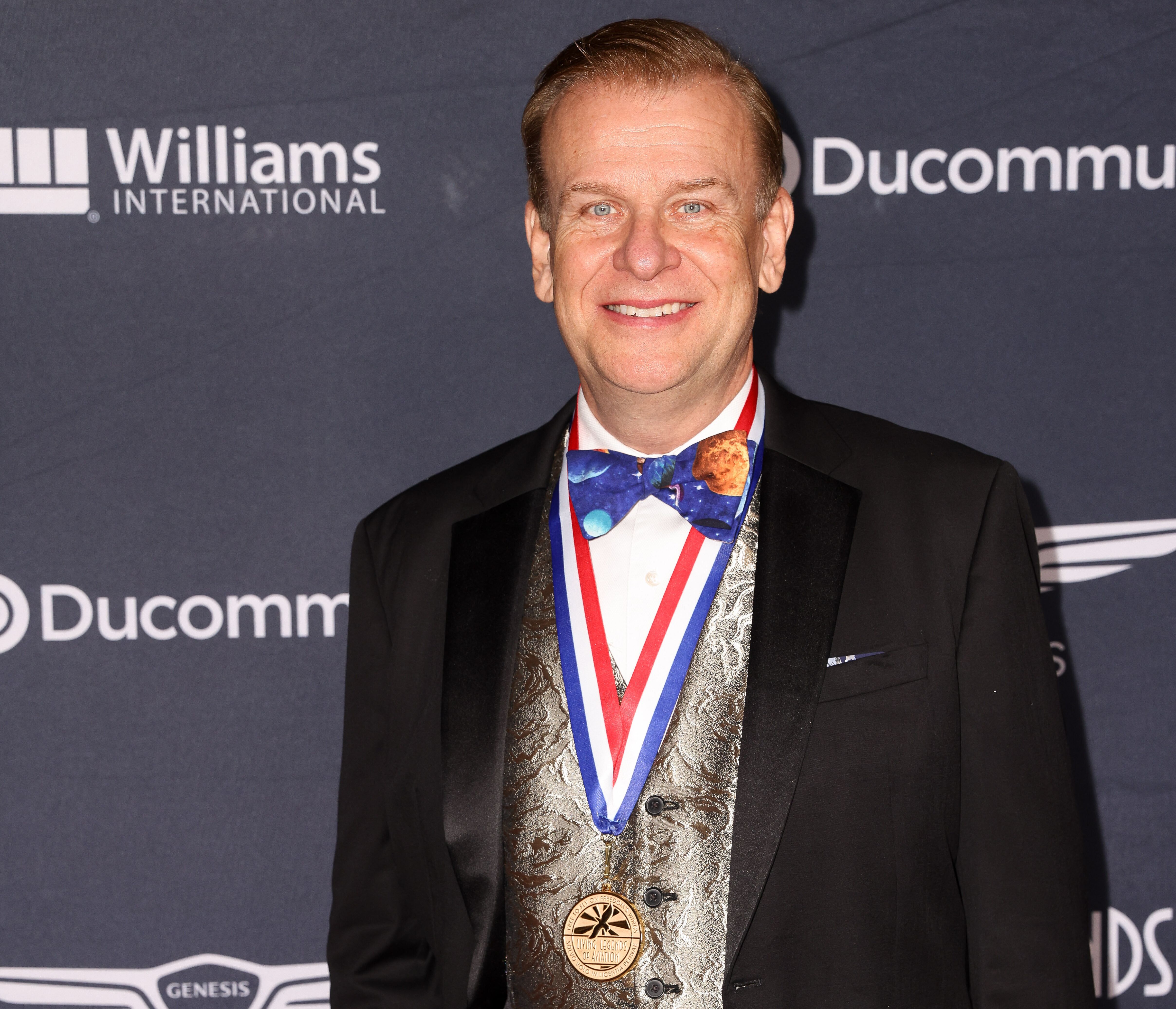
Harding attends the Living Legends of Aviation Awards in California in January. Harding has three Guinness World Records for his explorations of both the sky and the ocean.
Victoria Sirakova via Getty Images
One year after his historic dive, Harding flew to space in Jeff Bezos’ Blue Origin rocket, New Shepard.
The search continued on Tuesday for the five-person submersible that went missing on Sunday morning while taking tourists to view the sunken wreckage of the Titanic off the coast of southeast Canada.
Along with Harding on the vessel are Pakistani businessman Shahzada Dawood and his son Suleman. Two others believed to be on board are French Navy veteran PH Nargeolet, who would be operating the vessel, and Stockton Rush, CEO of OceanGate Expeditions.
Advertisement
The US Coast Guard said on Tuesday afternoon that the missing vessel was estimated to contain less than two days’ supply of oxygen.
Action Aviation, an aircraft brokerage company that Harding founded, recognised his many accolades in a statement Tuesday that praised him as “an extraordinarily accomplished individual who has successfully undertaken challenging expeditions”, including multiple trips to the South Pole.
“The team at Action Aviation are extremely proud of Hamish and we look forward to welcoming him home,” his company said.
Several media outlets have described Harding as a billionaire, though he is not listed on Forbes’ list of billionaires.
Self-driving electric vehicles still face steep hills on the road to reliability. Researchers from the Department of Energy’s Oak Ridge National Laboratory and Western Michigan University are working together to drive solutions from outside the car: sensors and processing embedded in road infrastructure.
Working with partners, ORNL engineers are placing low-powered sensors in the reflective raised pavement markers that are already used to help drivers identify lanes. According to a paper in IEEE Sensors by ORNL researcher Ali Ekti with lead author Sachin Sharma of WMU, microchips inside the markers transmit information to passing cars about the road shape. They are effective even when vehicle cameras or remote laser sensing called LiDAR are unreliable because of fog, snow, glare or other obstructions.
“We are working to make autonomous driving features accurate and safe in more remote areas,” Ekti said. “And we are doing it by converting a dummy piece of infrastructure into something with many more uses.”
Not only does the technology provide more accurate information about the driving environment, but it also shifts some of the processing load from the car’s software onto infrastructure. This saves electric vehicle battery power, extending driving range to promote wider EV adoption. Compared with a leading camera and LiDAR-based autonomous driving technology, the chip-enabled pavement markers can reduce navigational power consumption by up to 90%, the authors reported in a technical paper.
The technology has potential for use with not only tomorrow’s self-driving vehicles, but also today’s common autonomous driving features, such as lane assist.
The effort is part of a larger project led by WMU, which is teaming with research and industry partners to develop related sensor and autonomous driving technologies such as radar retro-reflectors, high-definition mapping, computational offloading and weather sensing. WMU researchers are also using a vehicle driving on a closed course to measure the reduction in vehicle energy use that is enabled by these technologies, said Zachary Asher, assistant professor of mechanical and aerospace engineering and director of the WMU Energy Efficient and Autonomous Vehicles Lab.
ORNL researchers experimented to find the best combination of transceiver, battery and antenna for the sensor package inside standard road markers, as well as those that are designed to withstand snowplows. They then utilized a communications protocol that involves hopping across a particular radio frequency spectrum up to 50 times a second. “It’s hard to detect, works well against interference, is low cost and doesn’t consume a lot of power,” Ekti said. Adjustments to the equipment could ensure its battery would last for the same replacement cycle as the pavement markers, typically a year.
Ekti’s team created algorithms that triangulate among the GPS coordinates of lane markers to reconstruct an image of the drivable area. One algorithm is embedded in a microchip inside the pavement marker, while a decoding algorithm is incorporated into the car’s software.
ORNL researchers field-tested the sensor platform in a variety of weather conditions and in a remote national park in Montana with no wireless access. They found that it transmits more than five times beyond the original 100-meter goal.
“It’s amazing how far it can transmit — over hills, in snow. It’s a big deal,” Asher said. “Every step of the way, we’re surprised at how well this technology is working, and we’re finding some really cool ways it could be integrated.”
The sensors could also signal temporary lane shifts or closures in construction zones when high-definition maps might be out of date. Marker sensors could eventually convey information about temperature, humidity and traffic volume, Ekti said. The project team plans to work with students to build a smaller microchip for the markers as a substitute for more expensive off-the-shelf products.
Asher is planning road demonstrations for stakeholders including the Tennessee and Michigan departments of transportation, the Michigan Office of Future Mobility and the City of Chattanooga. These government agencies decide which technologies are implemented in infrastructure, so their involvement in the development process is critical, Asher said.
Venture capitalists and Silicon Valley have typically regarded self-driving vehicles as a software problem, Asher said. “With the hindsight of 10 years of highly- funded development, we now know that software and cameras alone don’t provide an easy solution,” he said. “Perhaps a more patient approach, using infrastructure-based hardware in coordination with government transportation agencies, is the way to achieve zero-accident vehicles which actually use energy sustainably.”
Part of the ORNL research was conducted at DOE’s National Transportation Research Center. The Vehicle Technologies Office under DOE’s Office of Energy Efficiency and Renewable Energy provided funding. Contributing ORNL researchers include Ross Wang, Jason Richards, Elizabeth Piersall, David Pesin, Ozgur Alaca and Shean Huff.
Chancellor Jeremy Hunt will hold a meeting with Britain’s major banks on Friday to discuss how they can help homeowners hit by rising mortgage costs, after saying the government would not offer borrowers significant financial help.
The Bank of England has raised interest rates 12 times since December 2021, but the impact for many mortgage holders is only starting to be felt now as low fixed rates agreed during the Covid-19 pandemic start to expire.
Advertisement
Some politicians have called on the government to consider financial aid for those worst hit, but Hunt rejected this in a parliamentary question-and-answer session.
“We won’t do anything that would mean we prolonged inflation,” Hunt said when asked about possible aid. “Schemes which involve injecting large amounts of cash into the economy right now will be inflationary.”
Conservative MP Jake Berry asked Jeremy Hunt whether it was time to consider mortgage interest relief at source. Jeremy Hunt also told MPs that he will meet mortgage lenders about what relief they can offer to their customers.https://t.co/MN45tfGyF1pic.twitter.com/T0hlw2V3Sy
The Bank of England is expected to raise interest rates again on Thursday by a quarter point to a 15-year high of 4.75% in a bid to fight unexpectedly sticky inflation, which was running at 8.7% in April. Official inflation data for May will also be published on Wednesday.
Advertisement
Hunt said he would talk with major lenders later this week to discuss the challenges faced by some borrowers.
Three sources – two from the banking industry and one in the government – said that meeting would take place on Friday and focus on how best to support customers facing big increases in their repayments this year, and those who have refinanced at higher rates and are already struggling to cope.
“I’ll be meeting the principal mortgage lenders to ask what help they can give to people struggling to pay more expensive mortgages and what flexibilities might be possible for families in arrears,” Hunt said.
The 2008 financial crisis did not lead to a big wave of home repossessions in Britain, but lending rules were tightened afterwards to ensure homebuyers taking out mortgages would still be able to cope with a significant rise in interest rates.
However, mortgage rates have risen rapidly in recent weeks as markets bet the BoE may have to raise its own interest rate as high as 6% next year to tackle persistent inflation.
Advertisement
Trade body UK Finance estimates 800,000 Britons will need to refinance loans in the second half of this year, and a further 1.6 million in 2024.
The Resolution Foundation think-tank estimated that the average homeowner who refinances a mortgage in 2024 will have to pay an extra £2,900 pounds a year.
Most British residential mortgages have interest rates fixed for two or five years, after which borrowers pay a floating rate or switch to a new fixed rate.
“I don’t care what my fucking son did, if I was getting crowned — he would sit in the very front row,” Welch said.
Osbourne didn’t agree, saying: “I think Harry’s a fucking twat.”
But she didn’t stop there.
“I think he’s a fucking twat,” she repeated, before piling on. “He’s a whining, whingeing, complaining, woe is me. ‘I’m the only one that’s ever had mental problems. Like my life was so hard.’”
Osbourne noted that “everybody’s fucking life is hard”, before going even further with her attack.
“You were the prince of a goddamned country who dressed up as a fucking Nazi and now you’re trying to come back as the Pope. Suck it,” Osbourne added.
You can hear her complete comments below, starting around the 38-minute mark.
Advertisement
Attacking the Duke and Duchess of Sussex is sort of an Osbourne family tradition.
Back in 2018, Osbourne’s mother, Sharon Osbourne, was caught on tape claiming that Harry’s wife, Meghan Markle, wasn’t really Black.
And Kelly Osbourne isn’t the only celebrity who recently had harsh words for Prince Harry.
Last week, sports writer and Spotify executive Bill Simmons called Harry and Meghan “fucking grifters” on his podcast after it was announced that the production company founded by the couple would be parting ways with the streaming platform less than a year after the debut of their podcast “Archetypes.
“‘The fucking grifters.’ That’s the podcast we shoulda launched with them,” Simmons said. “I gotta get drunk one night and tell the story of the Zoom I had with Harry to try and help him with a podcast idea. It’s one of my best stories.”