The increase, with an estimated one in 35 people testing positive, is being driven by newer variants.


The increase, with an estimated one in 35 people testing positive, is being driven by newer variants.
You’ve got to hand it to Steph McGovern. She’s been subjected to quite a bit of challenging stuff on her weekday Channel 4 show, Steph’s Packed Lunch.
Whether it’s going (freezing) cold-water swimming in Leeds dock in the depths of December or being forced to try one of chef Simon Rimmer’s more unique dishes, Steph has been up for it.
Advertisement
But the presenter has revealed there’s actually one thing she always says ‘no’ to when it’s suggested by producers of her show.
“I’m not great with animals because I’m not an animal person,” she tells HuffPost UK.
“So normally you will notice now that I’ll often avoid being the person holding a pet in a pet item so I do say no to stuff like that.”
But before all you animal lovers start, Steph is quick to point out that there’s a very good reason why she doesn’t want to do anything involving the feathery or furry.

via PA Features Archive/Press Association Images
Advertisement
“I also don’t want to look like I don’t know what I’m doing either because it’s an animal, so I don’t want to hurt it or be scared of it and drop it.
“But I’m just not very good with dogs because I don’t have a very good rapport with them and they sense that.
“The worst thing I ever had to do on the telly was wash a dog. I had to wash a poodle and I just felt really sorry for it. I thought ‘I’m doing a terrible job, you’re not enjoying yourself, and I’m not enjoying it’, so there we are.
She continues: “I get Denise [Van Outen] to do the animal things, or Kate Bottley.”
However, there is a certain type of animal that Steph has no issues with.
“Weirdly, I can do exotic pets,” she reveals. “I’m alright with the snakes and the frogs and the tarantulas.”
Read our exclusive interview with Steph in full this weekend on HuffPost UK.



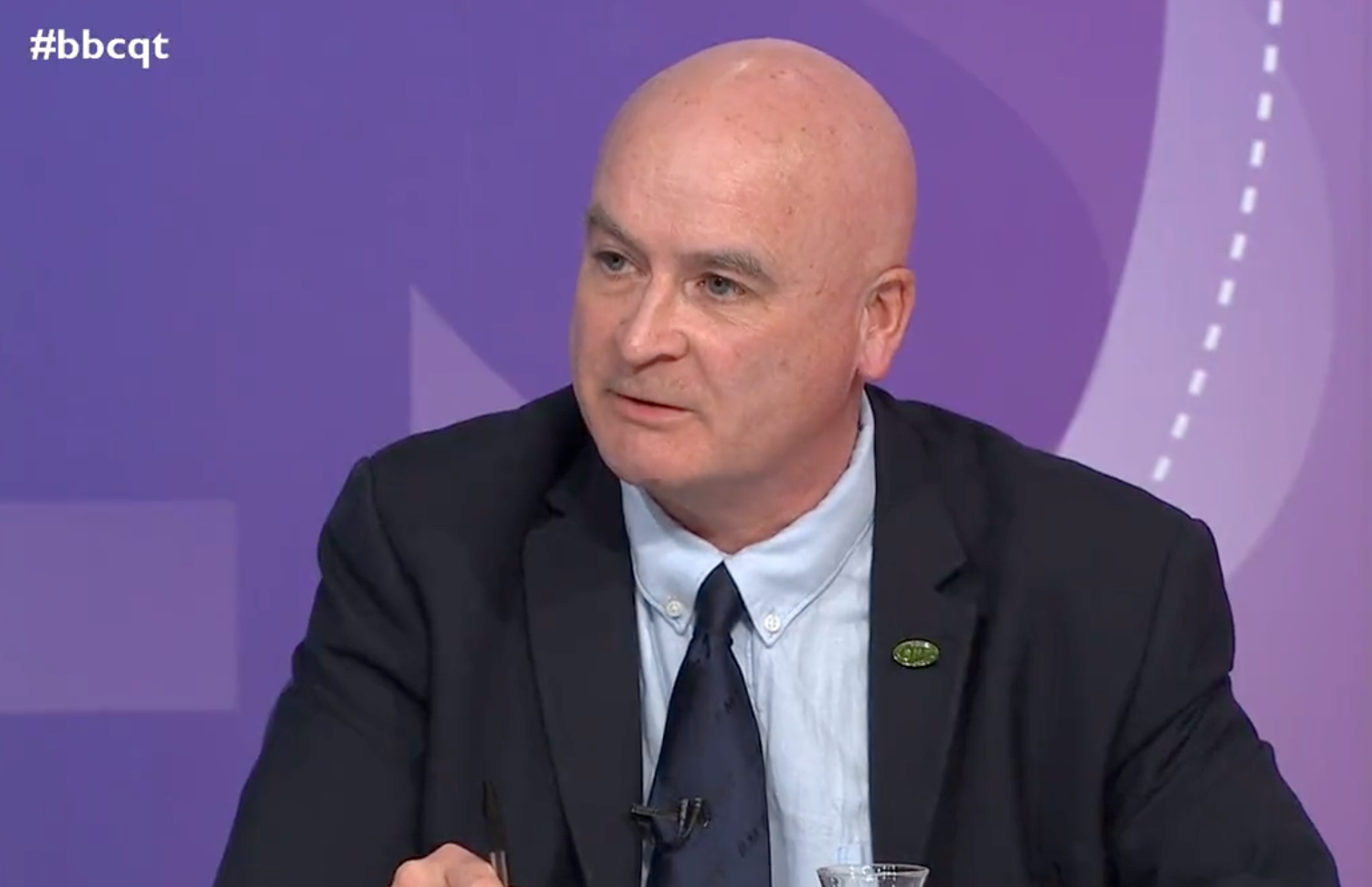
Mick Lynch invented a new word to sum up the prime minister on BBC Question Time on Thursday night.
As he was explaining his frustration towards Downing Street – and speaking just hours before the results from two separate by-elections were announced – Lynch described Boris Johnson as “unembarrassable”.
The RMT general-secretary has gained a surprise legion of fans in the past week due to his no-nonsense media appearances amid backlash over the rail strikes, and he may have acquired just a few more after last night.
Advertisement
“I hope he loses both of these elections, and I hope he’s undermined, you wouldn’t expect anything else from me,” Lynch said.
“His main problem is he is ‘unembarrassable’.
“No matter what he does, he’s not embarrassed by his failures, by the image he gives off, and by his behaviour.
“And he’s supported in that by his mates in the establishment.
″We’ve got a very strange society where he’s propped up by the press, propped up by the media, propped by the city.”
Alluding to the fixed penalty notice which Johnson received over attending a party during lockdown, the union boss claimed: “No matter what he does, no matter how badly he behaves – up to and including breaking the law – they won’t go against him.”
Advertisement
Lynch also explained his surprise that Conservative MPs opted to keep Johnson in his role (albeit by a small margin) in last month’s confidence vote.
“Nevertheless, they lie in their own nest and support him,” the RMT boss continued. “So I don’t know what will make him go, but I think ultimately the Tories will get rid of him before the ballot box gets rid of him, because that’s in their interest.”
The prime minister has been heavily criticised in recent months, over everything from partygate and his decision to change the ministerial code to the Rwanda asylum policy.
Following the double whammy of the by-election defeats early this morning, Johnson told the press: “Historically in the last 50 years, more, you’ve seen governments being punished at the polls during mid-term, when people are particularly feeling economic pressures.”
Advertisement
He also blamed Covid and the cost of living crisis, but did not acknowledge how the blows to his reputation may have had an impact.
A particularly loyal member of his cabinet, Tory party chair Oliver Dowden, even resigned over the by-election defeats this morning, claiming that someone “must take responsibility” for the humiliating losses.
In his reply, Johnson thanked Dowden for his time in the cabinet, expressed his sorrow he was leaving but maintained that the current government was elected on a “historic mandate” back in 2019.

Lord Frost is very prominent these days, isn’t he?
The man responsible for negotiating Brexit, who later quit because he didn’t think the government was Tory enough, seems to be everywhere.
Yesterday he delivered a speech about how Brexit was a roaring success.
Sticking with the far-fetched theme, this morning
It’s important to cut through the noise and spin on the Wakefield and Tiverton results.
Both are terrible for @Conservatives.
Neither is particularly good for @labour or @LibDems.
Why? (1/4)
— David Frost (@DavidGHFrost) June 24, 2022 ” target=”_blank” class=” js-entry-link cet-internal-link” data-vars-item-name=”he opined” data-vars-item-type=”text” data-vars-unit-name=”62b58e1be4b06594c1e2bddf” data-vars-unit-type=”buzz_body” data-vars-target-content-id=”https://www.huffingtonpost.co.uk/
It’s important to cut through the noise and spin on the Wakefield and Tiverton results.
Both are terrible for @Conservatives.
Neither is particularly good for @labour or @LibDems.
Why? (1/4)
— David Frost (@DavidGHFrost) June 24, 2022
” data-vars-target-content-type=”feed” data-vars-type=”web_internal_link” data-vars-subunit-name=”article_body” data-vars-subunit-type=”component” data-vars-position-in-subunit=”0″>he opined that last night’s by-election results were “not particularly good” for Labour and the Lib Dems.
Advertisement
Yes, you read that correctly. The two by-elections – which saw the Tories comfortably lose to Labour in Wakefield and be humiliated by the Lib Dems in Tiverton and Honiton – were actually underwhelming for the victors.
Try telling that to Lib Dem leader Ed Davey and his new MP Richard Foord, who celebrated their result by declaring it was “time to show Boris the door” by, er, standing next to a door.
To be fair, Lord Frost concede that the results were also “terrible” for his own party.
But he said an analysis of the results showed that the combined Lab/Lib vote share only went up marginally in Devon and actually fell in west Yorkshire.
Advertisement
The real story of the night, he insisted, was that traditional Tory voters opted to stay at home. “We as Conservatives must decide why that is, and what we do about it,” he added, in a less-than-subtle hint that it may well be time to give Johnson the heave-ho.
Of course, Lord Frost wasn’t the only Tory trying to rain on the Labour and Lib Dem parades.
The heroic spin coming out of CCHQ was that history shows that Tory governments lose by-elections but then go on to win the subsequent by-elections.
Even the resignation of party chairman Oliver Dowden failed to persuade them that things in the Conservative garden are far from rosey.
But what that thesis fails to acknowledge is that after 1992, the Tories lost no fewer than eight by-elections before going on to lose by a landslide to Tony Blair’s New Labour in 1997.
Advertisement
It also ignores the fact that in Tiverton and Honiton, the Lib Dems came from 27,000 votes behind the Tories in 2019 to win by more than 6,000.
And while Labour’s performance in Wakefield didn’t trouble the political Richter scale, if they repeated it across the country, it would be enough to send Keir Starmer into Number 10.
Senior Conservatives have an awful lot of thinking to do over the coming weekend. It would help if they started by dealing in reality, rather than fantasy.

Lateral flow tests will continue to be available for free for people in Wales with Covid symptoms.

When diagnostic tests for the heart were first created, scientists at the time did not fully consider that no two bodies are the same, especially between the sexes.
According to University of Florida College of Nursing associate professor Jennifer Dungan, many of the current symptom profiles and lab tests for heart disease do not accurately reflect known differences in women’s heart disease. This oversight has led to increased gaps in health care equity.
“Because of this disparity, women are more likely than men to report heart disease symptoms that appear out of the norm, experience delayed treatment for heart disease and even have undiagnosed heart attacks,” Dungan said. “For reasons that remain uncertain, women can experience heart disease differently than men. This can lead to inequities for women that need to be addressed.”
Dungan said cardiac researchers believe that some of these differences in symptoms and outcomes may be due to genetic variation between men and women. She has identified a specific gene she believes may be responsible, named RAP1GAP2.
“RAP1GAP2 is a strong candidate for sex-linked effects on women’s heart disease outcomes,” Dungan said. “Certain DNA markers in this gene are thought to manage the activity of platelets, colorless blood cells that help our blood clot. This also presents a heart attack risk. An overactive gene could cause too many platelets to respond to the clot, which could block the flow of blood and oxygen to the heart muscle and lead to a heart attack.”
Since RAP1GAP2 was not linked to poor heart outcomes among men in her team’s study, she believes this gene may work differently in women. Her team included faculty from UF’s colleges of Medicine, Pharmacy, and Public Health and Health Professions. Their findings were recently published in American Heart Journal Plus.
Even less is known about such differences among races and ethnicities. Black women and some Hispanic women are at an even greater risk of poor heart disease outcomes, due to many factors that Dungan believes may include genetics.
Unfortunately, the traditional ways that racial and ethnic groups are studied tends to produce results that are not relevant, Dungan said.
“The goal is not to find biological differences between groups of people. Our goal instead is to find the gene markers most accurately linked to heart disease for all women,” she said. “And to do that, we need to consider genetic variation within women, too.”
To discover how the gene may impact cardiac disease risks among women of different backgrounds, Dungan’s newest project, supported by a two-year grant from the National Institute on Aging, a division of the National Institutes of Health, aims to find the specific RAP1GAP2 gene markers that most strongly correlate with disease symptoms, heart attacks and death in women from different racial and ethnic groups.
Using health data from 17,000 postmenopausal women, Dungan and her team will use statistical genetics methods to analyze if there is a link between certain DNA markers on RAP1GAP2 and heart disease. Her team will also use genetic ancestry markers rather than arbitrary racial categories to account for natural diversity in our genetic code. According to Dungan, this will assure that her team finds gene markers that reflect all women’s heart disease risk, not just for certain groups.
“At the end of the study, if RAP1GAP2 gene markers accurately reflect women’s heart symptoms and predict their likelihood of a future heart attack, stroke or death, then those gene markers could help us be more confident in their diagnosis and future prognosis,” she said. “Having more accurate biomarkers for women would save lives and improve health equity for all women.”
Research reported in this publication was supported by the National Institute on Aging of the National Institutes of Health under Award Number R21AG077715. The content is solely the responsibility of the authors and does not necessarily represent the official views of the National Institutes of Health.
Story Source:
Materials provided by University of Florida. Original written by Kyle Chambers. Note: Content may be edited for style and length.

When asteroid 2019 OK suddenly appeared barreling toward Earth on July 25, 2019, Luisa Fernanda Zambrano-Marin and the team at the Arecibo Observatory in Puerto Rico jumped into action.
After getting an alert, the radar scientists zoned in on the asteroid, which was coming from Earth’s blind spot — solar opposition. Zambrano-Marin and the team had 30 minutes to get as many radar readings as they could. It was traveling so fast, that’s all the time she’d have it in Arecibo’s sights. UCF manages the Arecibo Observatory for the U.S. National Science Foundation under a cooperative agreement.
The asteroid made headline news because it appeared to come out of nowhere and was traveling fast.
Zambrano-Marin’s findings were published in the Planetary Science Journal June 10, just a few weeks before the world observes Asteroid Day, which is June 30 and promotes global awareness to help educate the public about these potential threats.
“It was a real challenge,” says Zambrano-Marin, a UCF planetary scientist. “No one saw it until it was practically passing by, so when we got the alert, we had very little time to act. Even so, we were able to capture a lot of valuable information.”
Turns out the asteroid was between .04 and .08 miles in diameter and was moving fast. It was rotating at 3 to 5 minutes. That means it is part of only 4.2 percent of the known fast rotating asteroids. This is a growing group that the researchers say need more attention.
The data indicates that the asteroid is likely a C-type, which are made up of clay and silicate rocks, or S-type, which are made up of silicate and nickel-iron. C-type asteroids are among the most common and some of the oldest in our solar system. S-type are the second most common.
Zambrano-Marin is now inspecting the data collected through Arecibo’s Planetary Radar database to continue her research. Although the observatory’s telescope collapsed in 2020, the Planetary Radar team can tap the existing data bank that spans four decades. Science operations continue in the areas of space and atmospheric sciences, and the staff is refurbishing 12-meter antennae to continue with astronomy research.
“We can use new data from other observatories and compare it to the observations we have made here over the past 40 years,” Zambrano-Marin says. “The radar data not only helps confirm information from optical observations, but it can help us identify physical and dynamical characteristics, which in turn could give us insights into appropriate deflection techniques if they were needed to protect the planet.”
There are almost 30,000 known asteroids according to Center for Near Earth Studies and while few pose an immediate threat, there is a chance one of significant size could hit the earth and cause catastrophic damage. That’s why NASA keeps a close watch and system to detect and characterize objects once they are found. NASA and other space agencies nations have been launching missions to explore Near-Earth Asteroids to better understand what they are made of and how they move in anticipation of having to divert one heading for earth in the future.
The OSIRIS REx mission, which includes UCF Pegasus Professor of Physics Humberto Campins, is headed back to Earth with a sample of asteroid Bennu, which gave scientists a few surprises. Bennu was first observed at Arecibo in 1999. A new mission — NASA’s Double Asteroid Redirection Test (DART) mission — aims to demonstrate the ability to redirect an asteroid using the kinetic energy of a projectile. The spacecraft launched in November 2021 and is expected to reach its target — the Dimorphos asteroid — on September 26, 2022.
Zambrano-Marin and the rest of the team at Arecibo are working on providing the scientific community with more information about the many kinds of asteroids in the solar system to help come up with contingency plans.
This week the team at the Arecibo Observatory is holding a series of special events as part of the Asteroid Day awareness campaign. They include presentations, “ask a scientist” stations for those visiting the science museum at Arecibo, and on June 25 presentations about the DART mission in English and Spanish. The timing couldn’t be better as there are five known asteroids from the size of a car to a Boeing 747 that will be buzzing Earth before Asteroid Day, according to the Jet Propulsion Laboratory that keeps track of the celestial bodies for NASA. The closest approach is on June 25 with an object coming within 475,000 miles of Earth. For comparison, the moon is about 239,000 miles from Earth.
Zambrano-Marin has multiple degrees including a bachelor’s degree in applied physics from the Ana G. Mendez University System and a master’s in space sciences from the International Space University in France. She has published more than 20 articles and is a frequent speaker and presenter at conference around the world. She previously worked at the Vatican Observatory and as a consultant to the Caribbean University president. In addition to working on the planetary radar group at Arecibo, Zambrano-Marin also created the Arecibo Observatory Space Academy, an 18-week research program for pre-college students in Puerto Rico.
The other team members on the study are: Sean Marshal, Maxime Devogele, Anne Virkki, and Flaviane Venditti from the Arecibo Observatory/UCF; Dylan C. Hickson formerly from Arecibo/UCF and now at Center for Wave Phenomena, Colorado School of Mines; Ellen S. Howell from Lunar and Planetary Laboratory, University of Arizona, Tucson; Patrick Taylor and Edgard Rivera-Valentin from Lunar and Planetary Institute, Universities Space Research Association, Houston; and Jon Giorgini from Solar System Dynamics Group, Jet Propulsion Laboratory.

A new study reveals important molecular information that could help scientists develop more effective treatment and prevention strategies for a difficult-to-treat form of melanoma skin cancer.
In this new report, The Ohio State University Comprehensive Cancer Center — Arthur G. James Cancer Hospital and Richard J. Solove Research Institute (OSUCCC — James) researchers identify and describe key features of a gene mutation responsible for 15 to 20% of all melanomas.
Using a preclinical laboratory model, the team establishes that the frequency at which a specific NRAS gene mutation occurs in human melanoma is directly related to the ability of that gene mutation to initiate spontaneous melanoma formation.
“This means that properties of the mutant itself — rather than the ease at which that specific gene mutation occurs — is the cause of cancer formation,” said corresponding author Christin Burd who serves an associate professor of molecular genetics in The Ohio State University College of Arts and Sciences, Department of Molecular Genetics and a member of the OSUCCC — James Molecular Carcinogenesis and Chemoprevention Program.
“NRAS-mutant cancers are challenging to treat because effective therapies beyond immunotherapy don’t exist yet,” said Burd. “Each cancer type seems to prefer a specific ‘flavor’ of mutant NRAS, and it has not been clear why this is.”
The OSUCCC — James wanted to know what made the melanoma-promoting NRAS mutants different than those that promote other cancer types. Scientists say this knowledge could help investigators pinpoint the early events required for melanoma formation and develop treatments that prevent the disease.
Burd and colleagues report their findings in the June 7, 2022, issue of Nature Communications.
Study design and methods
To conduct this study, OSUCCC — James researchers developed genetically engineered models that would allow them to activate one of nine different NRAS-mutant variations in melanocytes, the pigment cells that form melanoma.
“Amazingly, when we activated these gene mutations only those found in the human disease caused melanoma to develop,” said Burd. “Some mutants never led to melanoma, yet we know that they cause leukemia. This finding shows that selection of NRAS mutations is specific to each tumor type and occurs during cancer initiation, rather than in response to a specific mutagenic event like sun exposure.”
Collaborating with Sharon Campbell, a structural biologist at the University of North Carolina (UNC) Chapel Hill, and Debbie Morrison at the National Institutes of Health, Burd’s team identified that slight variances in the outward facing structure of NRAS mutants capable of initiating melanoma that made these proteins better able to interact with the signaling pathways that drive melanoma growth.
“Now we will work to target this unique structural feature of the melanoma-inducing NRAS mutants to prevent and/or treat the disease,” said Burd. “Our work also demonstrates and confirms what was — until now — only speculation: that minor differences between the RAS mutants determine which ‘flavors’ can cause a particular cancer. Such a concept could be used to find vulnerabilities in other RAS-driven tumor types.”
To facilitate similar discoveries, the team generated eight new and publicly available genetically engineered mouse models that will serve as an essential toolkit for the entire RAS community. Burd says these models can be used to activate and study the role of NRAS is other relevant cancer types such as colon cancer, leukemia, myeloma, and thyroid cancer. They can also be used to investigate new drugs for these diseases.
This research was supported with funding from the Damon Runyon Foundation and the Pelotonia Graduate Fellowship of study coauthor Brandon Murphy, who is now a postdoctoral fellow at the University of Utah.
The preclinical research models developed in Burd’s lab and used for this research are publicly available to scientists conducting research about other RAS-driven cancer types or working to develop new cancer therapies through the National Institute of Health’s repository.
Additional study coauthors include Elizabeth M. Terrell, Venkat R. Chirasani, Tirzah J. Weiss, Rachel E. Lew, Andrea M. Holderbaum, Aastha Dhakal, Valentina Posada, Marie Fort, Michael S. Bodnar, Leiah M. Carey, Min Chen, Craig J. Burd, Vincenzo Coppola and Sharon L. Campbell.
Matthew Caseby fled a mental health hospital by climbing a fence and was hit by a train.
Authorities say they do not have enough data to be sure Juul’s e-cigarettes meet health standards.
