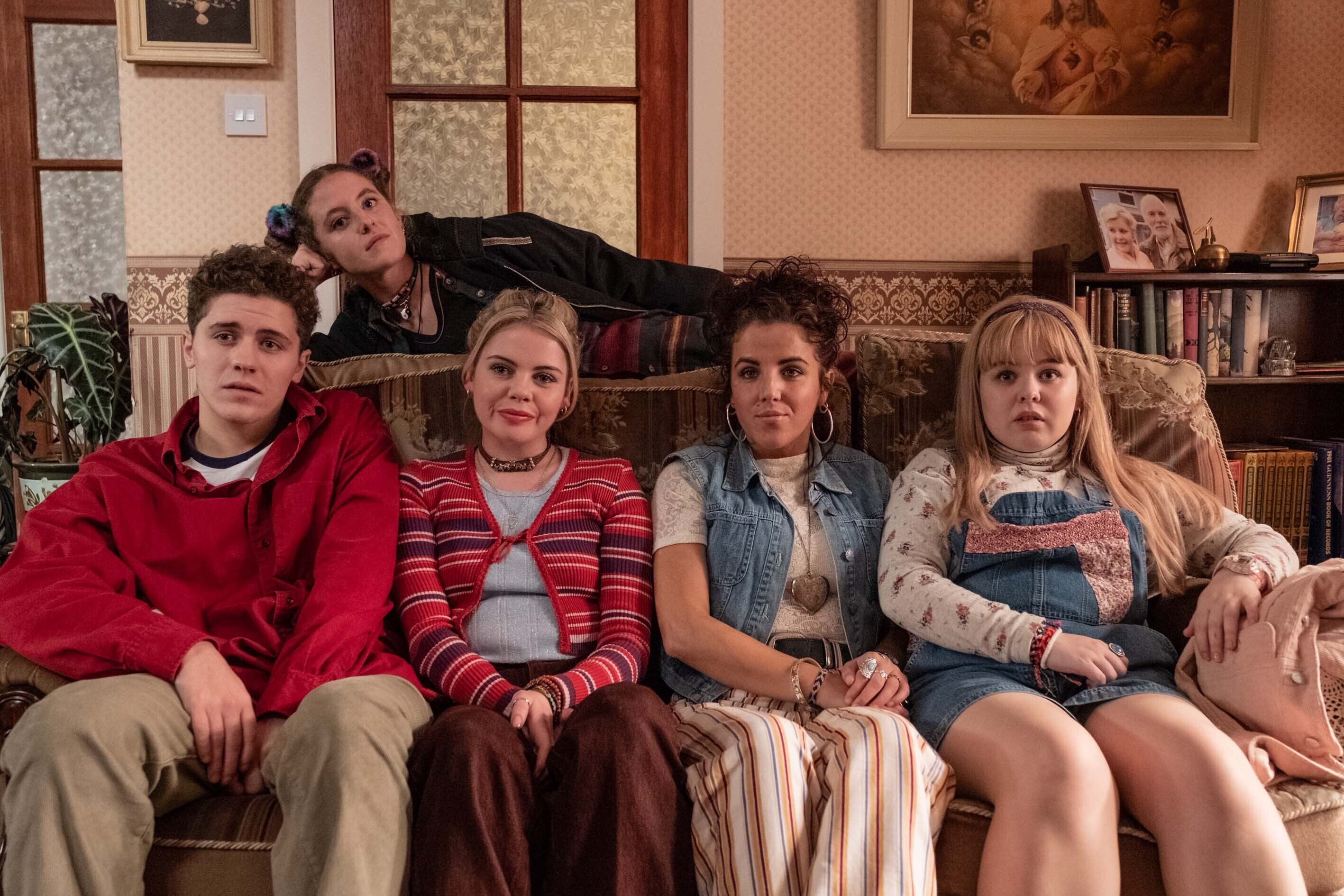
Nicola Coughlan Reveals Why She’s Yet To Watch Derry Girls Finale

Nicola Coughlan has revealed she is putting off watching the finale of Derry Girls.

The hit Channel 4 sitcom ended its three-season run last month, with Nicola – who plays Clare Devlin in the show – admitting she is unsure when she would take the plunge and watch the last episode.

Speaking to the PA news agency, she said: “You know what, I haven’t watched the finale yet, because I was in LA when it came out.

“That day I just cried and cried because it felt like such an ending of an era, it’s been five years of my life.

“It was such a huge job for me to get and people connected with it so much, so I’m holding on to watch it.

“I don’t know when I’m going to because I know I’m going to cry a lot, so I’m just waiting, but the response to it was insane and amazing.”

Nicola (right) with her Derry Girls co-stars

via PA Features Archive/Press Association Images

Derry Girls’ last ever episode was a stand-alone special set around the time of the Good Friday Agreement vote, which happened to coincide with Orla’s 18th birthday.

It aired the day after the final episode of series three, which saw Clare discover hat her father had been taken to hospital after suffering an aneurysm.

The final moments showed his coffin being carried into a church, with the cast all gathering at Clare’s the side.

Nicola added that it was important that writer Lisa McGee had “tackled” the subject of the 1998 Good Friday Agreement in the show as there was still “a great deal of misunderstanding” in the UK about its meaning.

“There are a lot of MPs in government that admit to never having read it, and peace in Northern Ireland is very fragile and precious,” she said.

“Derry Girls is a comedy, it’s not a comedy drama… but the fact that Lisa McGee can infuse it with that message shows how important it is because it’s real people’s lives in a real day to day so I think it’s brave and brilliant and necessary.”

All episodes of Derry Girls are available to stream now on All4.

Share Button

Tories Accused Of Squandering ‘Astronomical’ Amounts Of Taxpayer Money

The Tory government has been accused of “astronomical” waste as it emerged that £15bn worth of taxpayers’ money has been lost on faulty PPE and servicing government debt.

The Department for Health and Social Care (DHSC) is under fire after it was revealed that £4bn worth of unusable personal protective equipment (PPE) left over from the Covid-19 pandemic will be burned “to generate power”.

A report by parliament’s Public Accounts Committee (PAC) claimed that DHSC lost 75 per cent of the £12bn it spent on PPE in the first year of the pandemic due to inflated prices and kit that did not meet the required standards — including £4bn going to waste.

A DHSC spokesperson said a number of claims in the PAC report were “misleading” and that they made “no apology for procuring too much PPE rather than too little”.

“The story of PPE purchasing is perhaps the most shameful episode in the UK Government response to the pandemic.”

– Dame Meg Hillier

Meanwhile, chancellor Rishi Sunak also stands accused of losing £11bn of taxpayers’ money by paying too much interest on UK debt, according to the Financial Times.

The losses were said to exceed the amount that the Conservatives have accused Labour former chancellor Gordon Brown of losing when he sold some of the UK’s gold reserves at rock bottom prices.

It comes as people struggle with the mounting cost of living crisis which has seen the average cost of filling up a typical family car reach the £100 mark for the first time.

Labour’s Meg Hillier MP, chair of the PAC, said the purchasing of PPE was “perhaps the most shameful episode the UK government response to the pandemic”.

“At the start of the pandemic health service and social care staff were left to risk their own and their families’ lives due to the lack of basic PPE,” she said.

“In a desperate bid to catch up the government splurged huge amounts of money, paying obscenely inflated prices and payments to middlemen in a chaotic rush during which they chucked out even the most cursory due diligence.

“This has left us with massive public contracts now under investigation by the National Crime Agency or in dispute because of allegations of modern slavery in the supply chain.

“Add to that a series of inappropriate, unauthorised severance payoffs made by clinical commissioning groups in the first year of the pandemic and the impression given falls even further from what we expect.

“DHSC singularly failed to manage this crisis, despite years of clear and known risk of a pandemic, and the challenges facing it now are vast, from getting the NHS back on its feet to preparing for the next major crisis. There are frankly too few signs that it is putting its house in order or knows how to.”

In the FT article, the National Institute of Economic and Social Research (NIESR) attributed the £11bn loss to the chancellor’s failure to insure against interest rate rises.

NIESR’s Professor Jagjit Chadha told the Financial Times Sunak had left the country with “an enormous bill and heavy continuing exposure to interest rate risk”.

In response, Tulip Siddiq, Labour’s shadow economic secretary to the Treasury, accused the chancellor of “severe wastefulness”.

“These are astronomical sums for the chancellor to lose, and leaves working people picking up the cheque for his severe wastefulness while he hikes their taxes in the middle of a cost of living crisis,” she said.

“This government has played fast and loose with taxpayers’ money, failing to recover money lost to fraud and handing covid contracts to their friends.

“Britain deserves a government that respects public money and delivers for people across the country.”

A DHSC spokesperson said: “A number of these claims are misleading, including the claims that we are burning £4bn of unusable PPE and that there is no clear disposal strategy for excess PPE.

“In the face of an unpredictable and dangerous virus, we make no apology for procuring too much PPE rather than too little, and only 3 per cent of the PPE we procured was unusable in any context.

“At the height of the pandemic, there was unprecedented global demand for and massive inflation in prices of PPE. But despite these global challenges, we delivered over 19.8 billion items of PPE to frontline staff to keep them safe.

“Now we are confident we have sufficient PPE to cover any future Covid demands, we are taking decisive action and have reduced storage costs by 82 per cent since October 2020.”

A HM Treasury spokesperson said: “Proposals such as this risk undermining the independence of the Bank of England and forcing commercial banks to swap reserves for gilts would be an act of financial repression. This would be hugely damaging to the credibility of the UK’s macroeconomic framework and weaken the wider economy.

“The £11bn figure is based on the implausible assumption that it would be possible to undertake action of this scale in a single transaction.”

Share Button

Transgender Sussex paramedic says patients refuse her help

Steph Meech has been spat at and verbally abused by patients she has treated.

Share Button

Shop-bought menopause tests not worth it, women advised

The kits, sold on the High Street, are not predictive enough to pinpoint the change of life, top UK doctors warn.

Share Button

Wreck of historic royal ship discovered off the English coast

The wreck of one of the most famous ships of the 17th century — which sank 340 years ago while carrying the future King of England James Stuart — has been discovered off the coast of Norfolk in the UK, it can be revealed today.

Since running aground on a sandbank on May 6, 1682, the wreck of the warship the Gloucester has lain half-buried on the seabed, its exact whereabouts unknown until brothers Julian and Lincoln Barnwell, with their friend James Little, found it after a four-year search.

Due to the age and prestige of the ship, the condition of the wreck, the finds already rescued, and the accident’s political context, the discovery is described by maritime history expert Prof Claire Jowitt, of the University of East Anglia (UEA), as the most important maritime discovery since the Mary Rose.

The Gloucester represents an important ‘almost’ moment in British political history: a royal shipwreck causing the very near-death of the Catholic heir to the Protestant throne at a time of great political and religious tension.

Now a major exhibition is planned for Spring 2023, the result of a partnership between the Barnwell brothers, Norfolk Museums Service, and academic partner UEA. Running from February to July at Norwich Castle Museum & Art Gallery, the exhibition will display finds from the wreck — including the bell that confirmed the ship’s identity — and share ongoing historical, scientific and archaeological research.

Prof Jowitt, a world-leading authority on maritime cultural history, is a co-curator of the exhibition. “Because of the circumstances of its sinking, this can be claimed as the single most significant historic maritime discovery since the raising of the Mary Rose in 1982,” she said. “The discovery promises to fundamentally change understanding of 17th-century social, maritime and political history.

“It is an outstanding example of underwater cultural heritage of national and international importance. A tragedy of considerable proportions in terms of loss of life, both privileged and ordinary, the full story of the Gloucester’s last voyage and the impact of its aftermath needs re-telling, including its cultural and political importance, and legacy. We will also try to establish who else died and tell their stories, as the identities of a fraction of the victims are currently known.”

The Barnwell brothers are Norfolk-based printers, licensed divers and Honorary Fellows in the School of History at UEA. Lincoln said he was partly inspired to search for the wreck after watching the lifting of the Mary Rose on television as a child.

“It was our fourth dive season looking for Gloucester,” he said. “We were starting to believe that we were not going to find her, we’d dived so much and just found sand. On my descent to the seabed the first thing I spotted were large cannon laying on white sand, it was awe- inspiring and really beautiful.

“It instantly felt like a privilege to be there, it was so exciting. We were the only people in the world at that moment in time who knew where the wreck lay. That was special and I’ll never forget it. Our next job was to identify the site as the Gloucester.”

Julian added: “When we decided to search for the Gloucester we had no idea how significant she was in history. We had read that the Duke of York was onboard but that was it. We were confident it was the Gloucester, but there are other wreck sites out there with cannons, so it still needed to be confirmed.

“There is still a huge amount of knowledge to be gained from the wreck, which will benefit Norfolk and the nation. We hope this discovery and the stories that are uncovered will inform and inspire future generations.”

Lord Dannatt, Norfolk Deputy Lieutenant and longstanding resident of the county, is lending his skills and support to the historic rescue project. As former head of the British Army, he works with charities and organisations that have links to the armed services.

“This is going to be Norfolk’s Mary Rose,” said Lord Dannatt. “Julian and Lincoln have touched history, history that could have changed the course of this nation. It’s such an amazing story to tell. Our aim is to bring that story to life and to share it with as many people as possible.”

The Gloucester was commissioned in 1652, built at Limehouse in London, and launched in 1654. In 1682 it was selected to carry James Stuart, Duke of York, to Edinburgh to collect his heavily pregnant wife and their households. The aim was to bring them back to King Charles II’s court in London in time, it was hoped, for the birth of a legitimate male heir.

The ship had set sail from Portsmouth with the Duke and his entourage joining it off Margate, having travelled by yacht from London. At 5.30am on May 6, the Gloucester ran aground some 45km off Great Yarmouth following a dispute about navigating the treacherous Norfolk sandbanks. The Duke, a former Lord High Admiral, had argued with the pilot for control over the ship’s course.

Within an hour the vessel sank with the loss of hundreds of the crew and passengers. The Duke barely survived, having delayed abandoning ship until the last minute.

As well as the Duke of York, the Gloucester carried a number of prominent English and Scottish courtiers including John Churchill, later the 1st Duke of Marlborough.

Diarist and naval administratorSamuel Pepys, who witnessed events from another ship in the fleet, wrote his own account — describing the harrowing experience for victims and survivors, with some picked up “half dead” from the water.

Together with their late father Michael, and two friends including James Little, a former Royal Navy submariner and diver, the Barnwell brothers found the wreck site in 2007, with the Gloucester split down the keel and remains of the hull submerged in sand.

The ship’s bell, manufactured in 1681, was later recovered, and in 2012 it was used by the Receiver of Wreck and Ministry of Defence to decisively identify the vessel.

Due to the time taken to confirm the identity of the ship and the need to protect an ‘at risk’ site, which lies in international waters, it is only now that its discovery can be made public. As well as the Receiver of Wreck and Ministry of Defence, the wreck has been declared to Historic England.

Following the discovery, the brothers completed an underwater archaeology course with the Nautical Archaeology Society.

Artefacts rescued and conserved include clothes and shoes, navigational and other professional naval equipment, personal possessions, and many wine bottles.

One of the bottles bears a glass seal with the crest of the Legge family — ancestors of George Washington, the first US President. The crest was a forerunner to the Stars and Stripes flag. Uniquely, in addition there were also some unopened bottles, with wine still inside – offering exciting opportunities for future research.

The accompanying historical research project, funded by the Leverhulme Trust and led by Prof Jowitt, will explore not only the failures of command at sea before the Gloucester sank, but conspiracy theories about the tragedy’s causes and its political consequences.

It is also hoped that UEA’s scientific expertise and facilities will be used to analyse some of the finds from the wreck.

The Ministry of Defence’s position is that all artefacts remain the property of the Ministry of Defence; however, where items are positively identified as personal property, ownership will then default to the Crown.

Partners already involved in the landmark project alongside the Barnwells, UEA and Norfolk Museums Service include the Ministry of Defence, the National Museum of the Royal Navy in Portsmouth, York Archaeology, the Leverhulme Trust and Maritime Archaeology Trust. The project is also being generously supported by Alan Boswell Group and Birketts LLP.

Share Button

Growing ‘mortality gap’ detected between Democratic and Republican counties

A new study highlights how closely connected politics and health outcomes have grown over time. Investigators from Brigham and Women’s Hospital examined mortality rates and federal and state election data for all counties in the U.S. from 2001 to 2019. The team found what they call a “mortality gap” — a widening difference between age-adjusted death rates in counties that had voted for a Democrat or a Republican in previous presidential and governor elections. The team found that mortality rates decreased by 22 percent in Democratic counties but by only 11 percent in Republican counties. The mortality gap rose across top disease areas, including heart disease and cancer, and the mortality gap between white residents in Democratic versus Republican counties increased nearly fourfold during the study period. Results are published in the British Medical Journal.

“In an ideal world, politics and health would be independent of each other and it wouldn’t matter whether one lives in an area that voted for one party or another,” said corresponding author Haider Warraich, MD, of the Division of Cardiovascular Medicine at the Brigham. “But that is no longer the case. From our data, we can see that the risk of premature death is higher for people living in a county that voted Republican.”

Warraich and colleagues used data from the Wide-ranging OnLine Data for Epidemiologic Research (CDC WONDER) database and the MIT (Massachusetts Institute of Technology) Election Data and Science Laboratory. They classified counties as Democratic or Republican based on the way the county had voted in the previous presidential election and adjusted for age when calculating mortality rates.

Overall, the team found that mortality rates in Democratic counties dropped from 850 deaths per 100,000 people to 664 (22 percent), but in Republican counties, mortality rates declined from 867 to 771 (11 percent). When the team analyzed by race, they found that there was little gap between the improvements in mortality rates that Black and Hispanic Americans experienced in Democratic and Republican counties. But among white Americans, the gap between people living in Democratic versus Republican counties was substantial.

The mortality gap remained consistent when the researchers looked only at counties that had voted Republican or Democratic in every presidential election year studied and when they looked at gubernatorial elections. Democratic counties experienced greater reductions in mortality rates across most common causes of death, including heart disease, cancer, chronic lower respiratory tract diseases, diabetes, influenza and pneumonia, and kidney disease.

The authors note that the widening gap in death rates may reflect the influence of politics on health policies. One of the inflection points detected in the study corresponds to the Affordable Care Act (ACA), which was passed in 2010. More Democratic states than Republican states adopted Medicaid expansion under the ACA, which expanded health insurance coverage to people on a low income.

The study detects an association between political environment and mortality but does not definitively determine the direction of the association or the specific factors that may explain the link between the two. The authors did not study the effect of flipping political environments — that is, counties that switched from voting Democratic or Republican to voting for the other party — on health outcomes, which could be an area of future study. The study period ended in 2019, before the start of the COVID-19 pandemic, which may have had an even more profound impact on the mortality gap.

“Our study suggests that the mortality gap is a modern phenomenon, not an inevitability,” said Warraich. “At the start of our study, we saw little difference in mortality rates in Democratic and Republican counties. We hope that our findings will open people’s eyes and show the real effect that politics and health policy can have on people’s lives.”

Disclosures: Warraich is an advisor for Embrace Prevention Care; co-author Rishi Wadhera receives research support from the National Heart, Lung, and Blood Institute (grant K23HL148525-1); co-author Karen E. Joynt Maddox previously did contract work for the U.S. Department of Health and Human Services.

Story Source:

Materials provided by Brigham and Women’s Hospital. Note: Content may be edited for style and length.

Share Button

Scientists discover new molecule that kills hard-to-treat cancers

A new molecule synthesized by a University of Texas at Dallas researcher kills a broad spectrum of hard-to-treat cancers, including triple-negative breast cancer, by exploiting a weakness in cells not previously targeted by other drugs.

A study describing the research — which was carried out in isolated cells, in human cancer tissue and in human cancers grown in mice — was published online June 2 in the journal Nature Cancer.

Dr. Jung-Mo Ahn, a co-corresponding author of the study and a UT Dallas associate professor of chemistry and biochemistry in the School of Natural Sciences and Mathematics, has been passionate about his work designing small molecules that target protein-protein interactions in cells for over a decade. Using an approach called structure-based rational drug design, he previously developed potential therapeutic candidate compounds for treatment-resistant breast cancer and for prostate cancer.

In the current work, Ahn and his colleagues tested a novel compound he synthesized called ERX-41 for its effects against breast cancer cells, both those that contain estrogen receptors (ERs) and those that do not. While there are effective treatments available for patients with ER-positive breast cancer, there are few treatment options for patients with triple-negative breast cancer (TNBC), which lacks receptors for estrogen, progesterone and human epidermal growth factor 2. TNBC generally affects women under 40 and has poorer outcomes than other types of breast cancer.

“The ERX-41 compound did not kill healthy cells, but it wiped out tumor cells regardless of whether the cancer cells had estrogen receptors,” Ahn said. “In fact, it killed the triple-negative breast cancer cells better than it killed the ER-positive cells.

“This was puzzling to us at the time. We knew it must be targeting something other than estrogen receptors in the TNBC cells, but we didn’t know what that was.”

To investigate the ERX-41 molecule, Ahn worked with collaborators, including co-corresponding authors Dr. Ganesh Raj, professor of urology and pharmacology at the Harold C. Simmons Comprehensive Cancer Center at UT Southwestern Medical Center, as well as Dr. Ratna Vadlamudi, professor of obstetrics and gynecology at UT Health San Antonio. Dr. Tae-Kyung Lee, a former UTD research scientist in Ahn’s Bio-Organic/Medicinal Chemistry Lab, was involved in synthesizing the compound.

The researchers discovered that ERX-41 binds to a cellular protein called lysosomal acid lipase A (LIPA). LIPA is found in a cell structure called the endoplasmic reticulum, an organelle that processes and folds proteins.

“For a tumor cell to grow quickly, it has to produce a lot of proteins, and this creates stress on the endoplasmic reticulum,” Ahn said. “Cancer cells significantly overproduce LIPA, much more so than healthy cells. By binding to LIPA, ERX-41 jams the protein processing in the endoplasmic reticulum, which becomes bloated, leading to cell death.”

The research team also tested the compound in healthy mice and observed no adverse effects.

“It took us several years to chase down exactly which protein was being affected by ERX-41. That was the hard part. We chased many dead ends, but we did not give up,” Ahn said.

“Triple-negative breast cancer is particularly insidious — it targets women at younger ages; it’s aggressive; and it’s treatment resistant. I’m really glad we’ve discovered something that has the potential to make a significant difference for these patients.”

The researchers fed the compound to mice with human forms of cancerous tumors, and the tumors got smaller. The molecule also proved effective at killing cancer cells in human tissue gathered from patients who had their tumors removed.

They also found that ERX-41 is effective against other cancer types with elevated endoplasmic reticulum stress, including hard-to-treat pancreatic and ovarian cancers and glioblastoma, the most aggressive and lethal primary brain cancer.

“As a chemist, I am somewhat isolated from patients, so this success is an opportunity for me to feel like what I do can be useful to society,” Ahn said.

Ahn is a joint holder of patents issued and pending on ERX-41 and related compounds, which have been licensed to the Dallas-based startup EtiraRX, a company co-founded in 2018 by Ahn, Raj and Vadlamudi. The company recently announced that it plans to begin clinical trials of ERX-41 as early as the first quarter of 2023.

Ahn’s research on this project is supported by the National Cancer Institute, part of the National Institutes of Health (1R01CA223828); the Cancer Prevention and Research Institute of Texas; and The Welch Foundation.

In addition to researchers from UT Southwestern and UT Health San Antonio, other study authors from Howard Hughes Medical Institute’s Janelia Research Campus, Northwest A&F University in China and the Medical College of Xiamen University in China contributed.

Share Button

Labour queries PPE contracts and Baroness Mone links

Angela Rayner says there is “suspicion” about contracts for a firm she says is linked to a Tory peer.

Share Button

Law change to let pharmacists sign people off sick

Patients in England, Wales and Scotland will no longer need to see their GP to receive a “fit note”.

Share Button

Increase Smoking Age By One Year Every Year Until No-One Can Buy Tobacco – Government Review

The age at which people can legally buy tobacco in England should increase by one year every year, a government-commissioned review has said.

It recommended the legal age of sale should steadily rise from the current age limit of 18 and millions of pounds be invested to stop smoking.

The independent review by Dr Javed Khan made 15 recommended interventions, including an extra £125 million per year invested in smoke-free policies and a further £70 million per year ringfenced for stop smoking services.

The review also said vapes should be promoted as an effective “swap to stop” tool to help people quit smoking and there should be improved prevention in the NHS offering smokers advice and support to quit.

Dr Khan, former chief executive of children’s charity Barnardo’s, said: “Without immediate and sustained action, England will miss the smoke-free target by many years and most likely decades.

“A smoke-free society should be a social norm – but to achieve this, we must do more to stop people taking up smoking, help those who already smoke and support those who are disproportionately impacted by smoking.

“My holistic set of recommendations for government will deliver this, whilst saving lives, saving money and addressing the health disparities associated with smoking.

“My proposals are not just a plan for this government, but successive governments too. To truly achieve a smoke-free society in our great country, we need to commit to making smoking obsolete, once and for all.”

Dr Khan also called for a “tobacco licence” for retailers to limit the availability of tobacco across the country, a rethink of the way cigarette sticks and packets look to reduce their appeal, and a mass media campaign to encourage smokers to quit.

Almost six million people in England smoke, and tobacco remains the single biggest cause of preventable illness and death, the Department of Health said.

Share Button