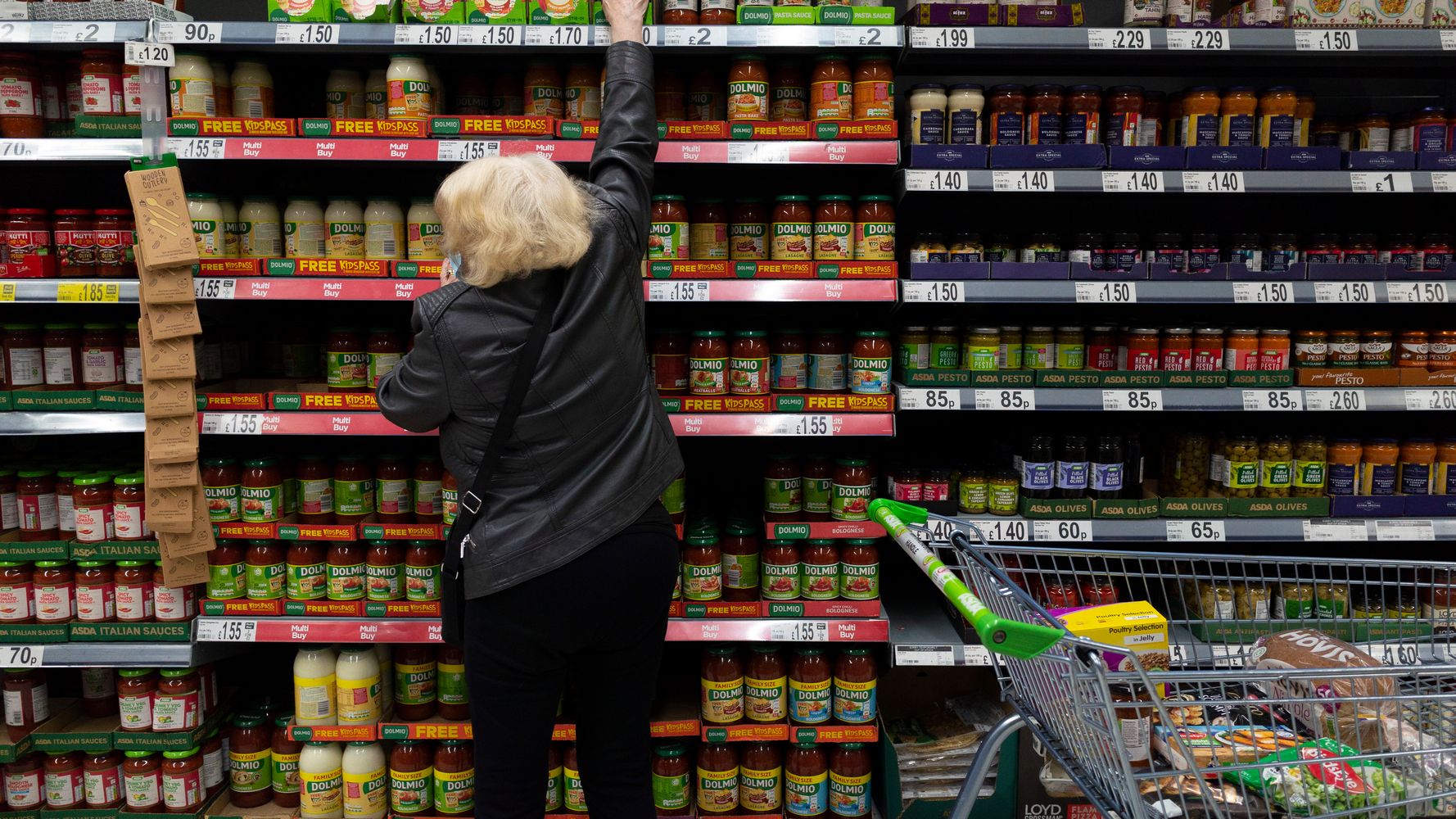
‘Buy Value Brands,’ Minister Tells Families Struggling With Cost Of Living

Families struggling with the cost of living crisis should consider buying value products, a cabinet minister said today.

George Eustice said that by going for cheaper “value” goods, families can “contain and manage their household budget”.

The environment secretary said household spending on food in the UK was “the lowest in Europe” but sharp rises in other costs “adds to household pressures”.

He made the comments as shop prices increased at their fastest rate in more than a decade last month, according to the British Retail Consortium.

Asked what his advice was to people who want a Sunday roast with a chicken but cannot afford it, Eustice told Sky News: “Generally speaking, what people find is by going for some of the value brands rather than own-branded products – they can actually contain and manage their household budget.

“It will undoubtedly put a pressure on household budgets and, of course, it comes on top of those high gas prices as well.”

He said rising fertiliser and feed costs had hit the farming industry, partly as a result of soaring energy prices.

Eustice said the better news was that the UK has a “very competitive” retail market with 10 big supermarkets and the four main ones competing “very aggressively”.

He said this meant they competed to keep costs down on everyday value items such as spaghetti.

Eustice added: “Where it gets harder is on things like chicken and poultry, and some fresh produce, where those increased feed costs do end up getting passed through the system because these people work on wafer-thin margins and they have to pass that cost through.”

Shop prices are up 2.7 per cent on last year marking their highest rate of inflation since September 2011, figures show.

The impact of rising energy prices and the conflict in Ukraine continued to feed through into April’s retail prices, with no sign of them abating, according to the BRC-NielsenIQ Shop Price Index.

Global food prices have also reached record highs, seeing a 13 per cent rise on last month alone, and even higher for cooking oils and cereals amid warnings that they will place further upward pressure on UK food prices as they filter through the supply chain over coming months.

Non-food products, particularly furniture, electricals and books, have seen the highest rate of inflation since records began in 2006, accelerating to 2.2 per cent in April from 1.5 per cent in March, exacerbated by disruption at the world’s largest seaport, following Shanghai’s recent lockdown.

British Retail Consortium chief executive Helen Dickinson said: “Retailers will continue to do all they can to keep prices down and deliver value for their customers by limiting price rises and expanding their value ranges, but this will put pressure on them to find cost-savings elsewhere.

“Unfortunately, customers should brace themselves for further price rises and a bumpy road ahead.”

Share Button

Most Of Blake Lively’s Met Gala Looks Share A Satisfying But Overlooked Detail

We wouldn’t expect anything less from the woman who played Serena van der Woodsen on Gossip Girl — a character who not only was fashion forward but also spent a lot of time on the steps of the Metropolitan Museum of Art.

There has been a certain theory swirling around the internet about Blake Lively’s outfits at the Met Gala over the years — and learning it will further affirm her keen eye for pleasing aesthetics (which was already clear because, well, Ryan Reynolds).

As one Twitter user pointed out Monday night during the 2022 Met Gala, the actor has a tendency to match her outfit to the event’s red carpet.

So, let’s take a look and see if this theory rings true, shall we?

Here’s her outfit from the 2016 Gala:

Blake Lively at the "Manus x Machina: Fashion In An Age Of Technology" event in 2016.
Blake Lively at the “Manus x Machina: Fashion In An Age Of Technology” event in 2016.

Karwai Tang via Getty Images

And here’s another number from 2017:

Lively at the 2017 Met Gala, which had the theme "Art of the In-Between."
Lively at the 2017 Met Gala, which had the theme “Art of the In-Between.”

John Shearer via Getty Images

Her 2018 dress seems to compliment the patterns on the red carpet:

Lively in 2018 at the gala for "Heavenly Bodies: Fashion & The Catholic Imagination."
Lively in 2018 at the gala for “Heavenly Bodies: Fashion & The Catholic Imagination.”

John Shearer via Getty Images

And her 2022 Met Gala gown seemed to follow the same theme:

<img class="img-sized__img portrait" loading="lazy" alt="The theme for 2022 — "In America: An Anthology of Fashion" — had a dress code of "gilded glamour."” width=”719″ height=”1080″ src=”https://www.wellnessmaster.com/wp-content/uploads/2022/05/most-of-blake-livelys-met-gala-looks-share-a-satisfying-but-overlooked-detail-8.jpg”>
The theme for 2022 — “In America: An Anthology of Fashion” — had a dress code of “gilded glamour.”

Theo Wargo via Getty Images

If the coordination is intentional, it’s unclear how Blake could pull it off — though she was a co-host at the 2022 event, which may explain her getting some intel.

According to a piece in Curbed about the history of the gala’s literal red carpet, more work goes into its design than one would think.

Phillip Bland, a decorative artist on Long Island who came into the job seven years ago after working with Anna Wintour on her various homes, is responsible for painting it. And although he’s one of the first people to know the gala’s theme each year, he implied that most celebrities are unaware of his final design.

“My hope is when the final design comes out, it doesn’t clash too much,” the designer says of the stars walking the carpet.

“If someone spent all this money on this beautiful dress and all of a sudden they get out there — I’m sure they don’t know what the carpet is gonna look like.”

Mm-hmm, sure. So we’re starting a new internet theory — that Blake’s got Phillip’s number in her contacts.

Share Button

Seashell-inspired shield protects materials in hostile environments

Word of an extraordinarily inexpensive material, lightweight enough to protect satellites against debris in the cold of outer space, cohesive enough to strengthen the walls of pressurized vessels experiencing average conditions on Earth and yet heat-resistant enough at 1,500 degrees Celsius or 2,732 degrees Fahrenheit to shield instruments against flying debris, raises the question: what single material could do all this? The answer, found at Sandia National Laboratories, is sweet as sugar.

That’s because it is, in fact, sugar — very thin layers of confectioners’ sugar from the grocers, burnt to a state called carbon black, interspersed between only slightly thicker layers of silica, which is the most common material on Earth, and baked. The result resembles a fine layer cake, or more precisely, the organic and inorganic layering of a seashell, each layer helping the next to contain and mitigate shock.

“A material that can survive a variety of insults — mechanical, shock and X-ray — can be used to withstand harsh environmental conditions,” said Sandia researcher Guangping Xu, who led development of the new coating. “That material has not been readily available. We believe our layered nanocomposite, mimicking the structure of a seashell, is that answer.”

Most significantly, Xu said, “The self-assembled coating is not only lightweight and mechanically strong, but also thermally stable enough to protect instruments in experimental fusion machines against their own generated debris where temperatures may be about 1,500 C. This was the initial focus of the work.”

“And that may be only the beginning,” said consultant Rick Spielman, senior scientist and physics professor at the Laboratory for Laser Energetics at the University of Rochester, credited with leading the initial design of Sandia’s Z machine, one of the destinations for which the new material is intended. “There are probably a hundred uses we haven’t thought of.” He envisions possible electrode applications delaying, rather than blocking, surface electron emissions. Aiding the nuclear survivability mission

The coating, which can be layered on a variety of substrates without environmental problems, was the subject of a Sandia patent application in June 2021, an invited talk at a pulsed power conference in December 2021 and again in a recent technical article in MRS Advances, of which Xu is lead author.

The work was done in anticipation of the increased shielding that will be needed to protect test objects, diagnostics and drivers inside the more powerful pulsed power machines of the future. Sandia’s pulsed-power Z machine — currently the most powerful producer of X-rays on Earth — and its successors will certainly require still greater debris protection against forces that could compare to numerous sticks of dynamite exploding at close range. Chad McCoy loads sample coatings at Sandia’s Z machine

Physicist Chad McCoy at Sandia National Laboratories’ Z machine loads sample coatings into holders. When Z fires, researchers will observe how well particular coatings protect objects stacked behind them. (Photo by Bret Latter) Click the thumbnail for a high-resolution image.

“The new shielding should favorably impact our nuclear survivability mission,” said paper author and Sandia physicist Chad McCoy. “Z is the brightest X-ray source in the world, but the amount of X-rays is only a couple percent of the total energy released. The rest is shock and debris. When we try to understand how matter — such as metals and polymers — interacts with X-rays, we want to know if debris is damaging our samples, has changed its microstructure. Right now, we’re at the limit where we can protect sample materials from unwanted insults, but more powerful testing machines will require better shielding, and this new technology may enable appropriate protection.”

Other, less specialized uses remain possibilities.

The inexpensive, environmentally friendly shield is light enough to ride into space as a protective layer on satellites because comparatively little material is needed to achieve the same resilience as heavier but less effective shielding currently in use to protect against collisions with space junk. “Satellites in space get hit constantly by debris moving at a few kilometers per second, the same velocity as debris from Z,” McCoy said. “With this coating, we can make the debris shield thinner, decreasing weight.”

Thicker shield coatings are durable enough to strengthen the walls of pressurized vessels when added ounces are not an issue. Dramatic cost reduction anticipated

According to Guangping, the material cost to fabricate a 2-inch diameter coating of the new protective material, 45 millionths of a meter and microns thick, is only 25 cents. In contrast, a beryllium wafer — the closest match to the thermal and mechanical properties of the new coating, and in use at Sandia’s Z machine and other fusion locations as protective shields — costs $700 at recent market prices for a 1-inch square, 23-micron-thick wafer, which is 3,800 times more expensive than the new film of same area and thickness.

Both coatings can survive temperatures well above 1,000 C, but a further consideration is that the new coating is environmentally friendly. Only ethanol is added to facilitate the coating process. Beryllium creates toxic conditions, and its environs must be cleansed of the hazard after its use. How testing proceeded

The principle of alternating organic and inorganic layers, a major factor in seashell longevity, is key to strengthening the Sandia coating. The organic sugar layers burnt to carbon black act like a caulk, said Sandia manager and paper author Hongyou Fan. They also stop cracks from spreading through the inorganic silica structure and provide layers of cushioning to increase its mechanical strength, as was reported 20 years ago in an earlier Sandia attempt to mimic the seashell mode.

Greg Frye-Mason, Sandia campaign manager for the Assured Survivability and Agility with Pulsed Power, or ASAP, Laboratory Directed Research and Development mission campaign funding the research, initially had his doubts about the carbon insertion.

“I thought that the organic layers would limit applicability since most degrade by 400 to 500 C,” he said.

But when the carbon-black concept demonstrated robustness to well over 1,000 C, the positive result overcame the largest risk Frye-Mason saw as facing the project.

Seashell-like coatings initially tested at Sandia varied between a few to 13 layers. These alternating materials were pressed against each other after being heated in pairs, so their surfaces crosslinked. Tests showed that such interwoven nanocomposite layers of silica with the burnt sugar, known as carbon black after pyrolysis, are 80% stronger than silica itself and thermally stable to an estimated 1,650 C. Later sintering efforts showed that layers, self-assembled through a spin-coating process, could be batch-baked and their individual surfaces still crosslinked satisfactorily, removing the tediousness of baking each layer. The more efficient process achieved very nearly the same mechanical strength.

Research into the coating was funded by ASAP to develop methods to protect diagnostics and test samples on Z and on next-generation pulsed power machines from flying debris.

“This coating qualifies,” Frye-Mason said.

Share Button

Mental illness plays havoc with the mind as well as the heart

University of South Australia scientists have uncovered another reason why society should be paying more attention to mental health: it is closely aligned to blood pressure and heart rate variations.

A new study published in BioMedical Engineering draws a link between mental illness and widely fluctuating blood pressure, which can lead to cardiovascular disease and organ damage.

UniSA researcher Dr Renly Lim and colleagues from Malaysian universities say there is clear evidence that mental illness interferes with the body’s autonomic functions, including blood pressure, heart rate, temperature and breathing.

“We reviewed 12 studies on people with anxiety, depression and panic disorders and found that, regardless of age, mental illness is significantly associated with greater blood pressure variations during the day,” Dr Lim says.

“We also found that for people who are mentally ill, their heart rate does not adapt to external stressors as it should.

“Contrary to what many people think, a healthy heart is not one that beats like a metronome. Instead, it should adjust to withstand environmental and psychological challenges. A constantly changing heart rate is actually a sign of good health.”

Reduced heart rate variation (HRV) is common in people with mental illness and indicates that the body’s stress response is poor, exacerbating the negative effects of chronic stress.

Unlike a person’s heart rate — how many times a heart beats in a minute — which is usually consistent, HRV is more complex and is the time between two heartbeats, which should change according to external stressors.

“What we aim for is not a constantly changing heart rate but a high heart rate variation. This is achieved through a healthy diet, exercise, low stress and good mental health.”

Low HRV occurs when a person’s body is in fight-or-flight mode, easily stressed and common in people with chronic diseases, including cardiovascular and mental health problems.

While large blood pressure variations (BPV) during the day are not ideal, at night the systolic pressure should dip by between 10-20 per cent to allow the heart to rest. The researchers found that in people with mental health issues, their blood pressure does not drop sufficiently at night.

The reduced dipping — under 10 per cent — can be caused by many factors, including autonomic dysfunction, poor quality of sleep and disrupted circadian rhythms that regulate the sleep-wake cycle.

“The takeout from this study is that we need to pay more attention to the physical impacts of mental illness,” Dr Lim says.

“It is a major global burden, affecting between 11-18 per cent (one billion) of people worldwide. Since mental illness can contribute to the deterioration of heart and blood pressure regulation, early therapeutic intervention is essential.”

The research was undertaken at the University of Malaya, University of South Australia, Universiti Kebangsaan Malaysia, and Universiti Tunku Abdul Rahman.

Story Source:

Materials provided by University of South Australia. Note: Content may be edited for style and length.

Share Button

New portal improves forecasts of devastating storms in West Africa

An online portal developed by the UK Centre for Ecology & Hydrology (UKCEH) will enable forecasters in West Africa to provide communities with earlier and more reliable warnings about large storms.

Storms in the Sahel region, which can reach over 100km in size, have become more extreme since the 1980s due to global warming, with more intense rainfall.* Severe flooding during the monsoon from June to September causes human and livestock deaths, plus damages property and infrastructure, leaving thousands of people without homes and livelihoods.

State-of-the-art weather forecast models struggle to predict where new storms will hit and how strong they will be, which makes it difficult to provide warnings to people in affected areas so they can protect their property and livestock or get out of harm’s way.

National forecasting agencies in Africa can already make predictions of how storms will behave in the next couple of hours by observing current atmospheric conditions, and analysing hundreds of historical storms.

Now, thanks to a recent breakthrough by UKCEH scientists, they can make these short-term forecasts, known as ‘nowcasts’, for six hours ahead and with a higher degree of accuracy. The new research found drier soils can increase the intensity of storms when they are on the move, affecting where they travel and the amount of rainfall they produce.

These novel nowcasting predictions and related satellite observations for West Africa are available via UKCEH’s new free portal, which has been funded by the Natural Environment Research Council (NERC).

National forecasters can interpret the data and make localised forecasts, sending out warnings to people in areas that are expected to be hit by a storm. Last year, as part of a trial of the nowcasting tool, forecasters in Senegal used it to issue a severe weather warning to the public via text message.

Dr Steven Cole of UKCEH says: “The portal is a great example of how new scientific understanding can be translated into useable real-time tools by working with forecasters. Importantly, this will support communities in West Africa to better manage flood risk from intense rainfall.”

A recent study found that using data about land surface temperatures improves predictions about the path and strength of an approaching mesoscale convective system (MCS) up to 12 hours ahead. These ‘megastorms’ can be bigger than the size of England and unleash over 100mm of rainfall in just an hour.

“We found a surprising level of predictability of storms from land surface temperatures when testing our methodology on historical data, and West African forecasters are finding our approach very useful for their work,” says Professor Chris Taylor of UKCEH.

“We would expect mesoscale convective systems elsewhere in the world to also be influenced by drier soils. Therefore, our methodology could potentially be used to improve storm and flood warning systems in tropical regions such as South Asia and Australia, as well as parts of USA and South America.”

The new nowcasting portal allows forecasters to observe storm clouds in near real-time via satellite and compare them with historical storm behaviour, plus view data on current land surface conditions. The online tool then uses these data, updated every 15 minutes, to calculate the probability of a mesoscale convective system reaching different areas of the Sahel between the current time and six hours ahead.

UKCEH scientists are continuing to work with forecasting services in West Africa to increase the advance warning time and its reliability by combining more factors influencing storm behaviour within their nowcast modelling, in addition to land surface temperature. These include soil moisture, atmospheric humidity, wind conditions and the amount of rainfall there has been in preceding days.

As part of a collaboration with ANACIM, the national meteorological service in Senegal, UKCEH has also developed short-term forecasts of potential flood impacts and risk in Dakar which are available on the portal. It also hopes to work with other forecasting services to provide this service for other areas.

Share Button

Gaia Pope: Coroner notes ‘concern’ over teen’s epilepsy care

Gaia Pope’s body was found near a Dorset coastal path 11 days after she went missing in 2017.

Share Button

Roe v Wade: US Supreme Court may overturn abortion rights, leak suggests

Millions could lose the legal right to abortion this summer, a leaked Supreme Court document shows.

Share Button

Food apps and online gaming driving obesity – WHO

The World Health Organization’s report on Europe targets new forms of buying and selling food.

Share Button

Christie cancer patient gives birth to ‘little miracle’ baby

Sammy Gray, 26, is one of the first patients in the UK to give birth following the treatment.

Share Button

I’ve had two children after being diagnosed with MND

Lucy Lintott was told she had the disease at the age of 19 – and warned she would never be able to have a family.

Share Button