However, Donna Ockenden’s offer to get involved in other inquiries is rejected by the health secretary.


However, Donna Ockenden’s offer to get involved in other inquiries is rejected by the health secretary.
Walkout will be the 13th of long-running dispute between government and British Medical Association.
The Accounts Commission says the amount councils are spending on culture and leisure services is not keeping up with rising costs.
John Bishop has admitted he’s finding it both “brilliant” and “bizarre” that Bradley Cooper has turned his life story into one of the year’s most-hyped films.
Earlier this year, it was announced that John’s story was being adapted into the comedy Is This Thing On?, helmed by the A Star Is Born and Maestro director with Arrested Development star Will Arnett in the lead role.
Advertisement
The film centres around a man who turns to stand-up comedy when his marriage starts falling apart.
While the movie’s characters are fictional (Will plays aspiring comic Alex Novak while Oscar winner Laura Dern plays his wife, Tess), the story is based on events from John’s own life.
He told BBC Merseyside he found it “so weird” that “this is happening, but so brilliant at the same time”.

via Associated Press
Advertisement
Recalling the first time he introduced his wife to the Oscar nominee, John said: “[Bradley Cooper] gave Melanie a hug and then Melanie had a minute with him, talking to him, but she was whispering in his ear.
“We come back to the hotel and I was saying ‘This has been a mad few days’. I said: ‘What are you going to remember most about it?’ She said: ‘Whispering in Bradley Cooper’s ear’. That kind of doesn’t make me feel great…”
During an appearance on the podcast RHLSTP earlier this year, comedian Chloe Radcliffe (who plays a supporting role in Is This Thing On), explained: “I think Will and John sat next to each other at a dinner 10 years ago, and Will heard his story, and was like, ‘That rules, I want to do that someday’.”
Advertisement

Anthony Harvey/Shutterstock
John first pursued a career in 2000, following a brief break in his marriage to his wife Melanie (the pair eventually reunited and share three sons, Joe, Luke and Daniel).
He opened up about his first time performing during Graham Norton’s 2024 New Year’s Eve special, claiming he put his name down to appear at an open night mic on a whim.
Advertisement
“It was four pounds. I was going through a divorce. I thought, ‘Well, that’s four pounds she’s not getting’,” he quipped.
John added: “I was meant to do seven minutes but because there was no one there, they let me carry on, and I did about 25 minutes. When I walked off I remember Mick, the compere, and the fella who ran the place, Dave Perkin, coming up to me and saying, ‘Where have you been doing your stand-up?’. I said ‘I’ve never done it in my life’. And he said, ’Well some of that was really good, some of that was fun. The bit where you started talking about getting divorced and started crying… don’t do that again. But come back’.”
Advertisement
Elsewhere in his BBC Merseyside interview, John revealed that he was able to commemorate the 25th anniversary of his first stand-up performance at the same venue on his latest tour.
The next night, he attended the London Film Festival for a premiere screening of Is This Thing On?.
You couldn’t write it,” he enthused. “You couldn’t line things up like that as perfectly [as they have]. It’s been odd trying to get my head around it.”
Is This Thong On? hits US cinemas in December, with a UK release date yet to be confirmed.






Mataha is having a bit of a moment – especially in the age group the BBC has dubbed “the matcha generation” (Gen Z).
The TikTok-viral drink, which is packed with antioxidants, is touted as both a luxurious treat and a health booster: it offers potentially anti-inflammatory ingredients, tastes great with strawberry, and looks grid-worthy in a see-through cup.
Advertisement
But, a video by surgeon Dr Karan Rajan revealed, too much can sometimes cause health issues.
Very high consumption over a long period of time can inhibit iron absorption, and women “of reproductive age” (so a lot of the trendy drink’s fans) might be at a higher risk, he added.
Here, we spoke to Dr Suzanne Wylie, GP and medical adviser for IQdoctor, about how much matcha is too much, and why it might affect your health.
Advertisement
Speaking to HuffPost UK, Dr Wylie said that there really may be some health advantages to the popular green drink.
“Matcha, a finely ground powdered green tea, is celebrated for its high antioxidant content, notably epigallocatechin gallate (EGCG), which is linked to various health benefits, including improved focus and metabolism,” she explained.
“However, matcha also contains tannins and catechins, polyphenolic compounds that can bind to non-heme iron (the type found in plant-based foods) in the digestive tract, reducing its absorption.
Advertisement
“This effect is more pronounced in matcha due to its concentrated form, which retains the whole tea leaf, unlike traditional steeped teas.”
Therefore, she explained, it’s important to drink it in moderation.
Wondering how much is too much? “For most individuals, moderate matcha consumption, typically one cup per day, is considered safe and unlikely to cause significant health issues,” she said.
“However, excessive intake, especially when consumed with iron-rich meals or supplements, can lead to decreased iron absorption over time.”
Advertisement
The first step is to drink less of it if you’re having loads, but Dr Wylie said those aren’t the only steps matcha lovers can take.
“It’s advisable to consume matcha between meals rather than with or immediately after meals rich in non-heme iron,” she said.
Advertisement
“Additionally, pairing iron-rich foods with vitamin C can enhance iron absorption. If iron supplementation is necessary, it’s best to take it at least one to two hours apart from matcha consumption.”
Those who should pay particular attention to their intake include vegetarians, vegans, menstruating individuals, and those with known iron deficiencies.
“Symptoms of iron deficiency may include fatigue, weakness, and pale skin,” the GP ended.
If you think you might have iron deficiency anaemia, the NHS says you should see your doctor.

Families had been calling for Sir Julian’s resignation over poor maternity care at Leeds Teaching Hospitals NHS Trust.
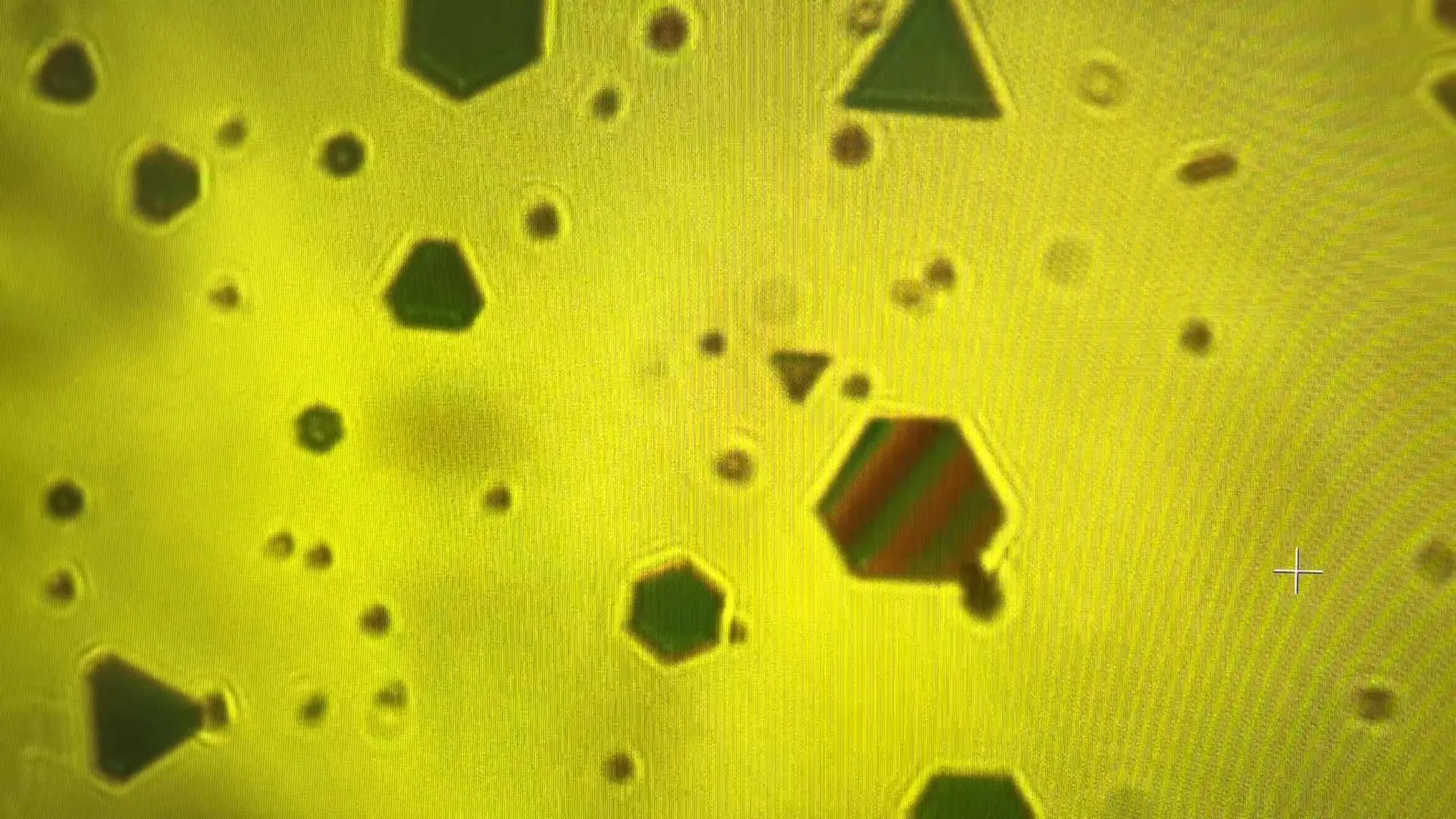
When dust clings to a surface or a gecko walks across a ceiling, it happens thanks to what scientists call “nature’s invisible glue.” Researchers at Chalmers University of Technology in Sweden have developed a fast and simple way to observe these hidden forces that hold the tiniest objects in the universe together. By combining gold, salt water, and light, they have built a special platform where these forces can actually be seen as colorful patterns.
In one of Chalmers’ physics labs, doctoral student Michaela Hošková demonstrates the setup. She holds a glass container filled with millions of microscopic gold flakes suspended in a salt solution. With a pipette, she places a single drop of this liquid on a gold-coated glass plate positioned under an optical microscope. Almost immediately, the gold flakes are drawn toward the surface, but they stop just short of touching it, leaving behind extremely thin gaps measured in nanometers. These tiny cavities act as miniature light traps, causing light to reflect back and forth and produce vivid colors. When illuminated by the microscope’s halogen lamp and analyzed through a spectrometer, the light separates into different wavelengths. On the connected monitor, flakes shimmer and shift between hues of red, green, and gold as they move across the surface.
Studying ‘nature’s glue’ using light trapped in tiny cavities
“What we are seeing is how fundamental forces in nature interact with each other. Through these tiny cavities, we can now measure and study the forces we call ‘nature’s glue’ — what binds objects together at the smallest scales. We don’t need to intervene in what is happening, we just observe the natural movements of the flakes,” says Michaela Hošková, a doctoral student at the Department of Physics at Chalmers University of Technology and first author of the scientific article in the journal PNAS in which the platform is presented.
The light confined inside these nanoscopic cavities allows scientists to explore a delicate equilibrium between two competing forces: one that pulls the flakes toward the surface and another that pushes them apart. The attractive force, known as the Casimir effect, causes the gold flakes to draw closer together and toward the substrate. The opposing electrostatic force, generated by the charged particles in the salt solution, prevents them from sticking completely. When these forces reach perfect balance, a process called self-assembly occurs, creating the cavities that make this phenomenon visible.
“Forces at the nanoscale affect how different materials or structures are assembled, but we still do not fully understand all the principles that govern this complex self-assembly. If we fully understood them, we could learn to control self-assembly at the nanoscale. At the same time, we can gain insights into how the same principles govern nature on much larger scales, even how galaxies form,” says Michaela Hošková.
Gold flakes become floating sensors
The Chalmers researchers’ new platform is a further development of several years of work in Professor Timur Shegai’s research group at the Department of Physics. From the discovery four years ago that a pair of gold flakes creates a self-assembled resonator, researchers have now developed a method to study various fundamental forces.
The researchers believe that the platform, in which the self-assembled gold flakes act as floating sensors, could be useful in many different scientific fields such as physics, chemistry and materials science.
“The method allows us to study the charge of individual particles and the forces acting between them. Other methods for studying these forces often require sophisticated instruments which cannot provide information down to the particle level,” says research leader Timur Shegai.
Can provide new knowledge on everything from medicines to biosensors
Another way to use the platform, which is important for the development of many technologies, is to gain a better understanding of how individual particles interact in liquids and either remain stable or tend to stick to each other. It can provide new insights into the pathways of medicines through the body, or how to make effective biosensors, or water filters. But it is also important for everyday products that you do not want to clump together, such as cosmetics.
“The fact that the platform allows us to study fundamental forces and material properties shows its potential as a truly promising research platform,” says Timur Shegai.
In the lab, Michaela Hošková opens a box containing a finished sample of the platform. She lifts it with tweezers and shows how easily it can be placed in the microscope. Two thin glass plates hold everything needed to study nature’s invisible glue.
“What I find most exciting is that the measurement itself is so beautiful and easy. The method is simple and fast, based only on the movement of gold flakes and the interaction between light and matter,” says Michaela Hošková, zooming the microscope in on a gold flake, the colors of which immediately reveal the forces at play.
How the researchers study ‘nature’s invisible glue’
Gold flakes approximately 10 micrometers in size are placed in a container filled with a salt solution, i.e. water containing free ions. When a drop of the solution is placed on a glass substrate covered with gold, the flakes are naturally attracted to the substrate and nanometer-sized cavities (100-200 nanometers) appear. Self-assembly occurs as a result of a delicate balance between two forces: the Casimir force, a directly measurable quantum effect that causes objects to be attracted to each other, and the electrostatic force that arises between charged surfaces in a salt solution.
When a simple halogen lamp illuminates the tiny cavities, the light inside is captured as if in a trap. This allows the researchers to study the light more closely using an optical microscope connected to a spectrometer. The spectrometer separates the wavelengths of the light so that different colors can be identified. By varying the salinity of the solution and monitoring how the flakes change their distance to the substrate, it is possible to study and measure the fundamental forces at play. To prevent the saline solution with the gold flakes from evaporating, the drop of gold flakes and saline are sealed and then covered with another glass plate.
The platform was developed at Chalmers’ Nanofabrication Laboratory, Myfab Chalmers, and at the Chalmers Materials Analysis Laboratory (CMAL).
More about the research
The scientific article Casimir self-assembly:A platform for measuring nanoscale surface interactions in liquids has been published in PNAS (Proceedings of the National Academy of Sciences). It was written by Michaela Hošková, Oleg V. Kotov, Betül Küçüköz and Timur Shegai at the Department of Physics, Chalmers University of Technology, Sweden, and Catherine J. Murphy at the Department of Chemistry, University of Illinois, USA.
The research was funded by the Swedish Research Council, the Knut and Alice Wallenberg Foundation, the Vinnova Centre 2D-Tech and Chalmers University of Technology’s Nano Area of Advance.
Despite the change – which will happen in 2026 – campaigners warn some women will lose out because the number who attend is too low.
Pelvic organ prolapse affects around one in 12 mothers, but many people have never even heard of it.
Tracey Connolly was first jailed in 2009 over the death of her of toddler son Peter in north London.
