Benedict Blythe’s parents say lives and money could be saved by giving allergy pens to all schools.


Benedict Blythe’s parents say lives and money could be saved by giving allergy pens to all schools.

Let’s get the obvious irony out of the way. I like to think of myself as something of a museum buff, and London really panders to this curiosity with a spectrum of exhibitions that span from obvious to obscure.
Yet the one–plenty famous–cultural space that many immigrants, including me, struggle to walk up to is the British Museum. Or as some historians would call it, the grand British repository of stolen artefacts that were forcibly taken from people of colour during the colonial rule.
Advertisement
Now that you have the context in place, imagine the absolute shock that swept over when the British Museum announced that the theme for its first ever fundraising ball, an across-the-Atlantic parallel to the revered Met Gala, is inspired by ancient India. Call it internalised colonialism, but the idea of this massive, momentous occasion being anchored to desi textiles and crafts felt exhilarating, as if it was validating some long held desire for approval.
Immediately taken in, I did all the research I could. Held on October 18 for 800 exclusive guests who pay £2000 each to enter, the event marks the end of the museum’s Ancient India: Living Traditions exhibition.
It also serves a dual purpose: first, to solidify London’s position as the global centre of culture and second, to raise money for the museum’s many international partnerships, ranging from archeological projects in Ghana and Iraq to Mumbai.
Advertisement
And then came the fine text: “the theme for 2025 is pink, drawing inspiration from the colours and light of India…” Wait, what?
How did the organisers whittle down centuries of Indian design and culture to a singular colour? Who was in this room and how did they all nod to this bizarrely random choice? I remember looking around in disbelief as I read the announcement, confused that no one else was kicking and throwing their arms in protest.
Well, fortunately, PhD candidate, podcast host and Substacker Maalvika Bhat resonates with the sentiment. “To say ‘inspired by India’ and then arrive at ‘pink gowns’ feels like a quiet tragedy, a flattening of textile history, trade, and storytelling,” she says. “Indian fashion has never just been decorative; it’s been migratory, political, and philosophical, it is a record of movement, resistance, and craft.” I couldn’t agree more, but a part of me really wanted this big Ball to be a reclamation of years of wrongdoing and a tiny step towards accountability.
Advertisement
So I reasoned with myself to be patient, to wait until the evening arrives and hold a little space to be pleasantly surprised. Also the museum’s British Ball 2025 Committee List stockpiled some South Asian names, from luxury couturier Sabyasachi Mukherjee and Bollywood actor Sonam Kapoor to The Business of Fashion’s founder Imran Amed and a string of Indian billionaires.
Surely, these many fashion biggies in a room will platform indigenous crafts and age-old textile practices, right?!
Turns out, most of the people from that committee didn’t show up to the Pink Ball, or in the off chance that they did, they were not covered by any media which, let’s be real, is implausible.
Advertisement
And from the creme of London that did attend, here are some standout looks: Janet Jackson wore a rouge Stephane Rolland gown, Adot Gak arrived in Miss Sohee, Adwoa Aboah in Saint Laurent, Lady Kitty Spencer in Dolce & Gabbana and Naomi Campbell took the cake by wearing a Givenchy ode to the Union Jack flag. This longlist is so obviously jarring it feels like a prank.
I can count on one hand how many famous people actually wore Indian designers or textiles. There’s Isha Ambani, billionaire heiress and co-chair of the Ball, in a two-piece, hand embroidered set by Abu Jani Sandeep Khosla, her mother and patron of the arts Nita Ambani in a sari by Swades and actor-creator Uorfi Javed in another AJSK look. Maybe if you screen the internet with a microscope you can find a couple more looks. Everyone else just wore gowns and Western Formals in various tonalities of pink and dubbed that as effort enough towards an India-inspired dress code.
This utter lack of thought is more striking in the UK where Asians are the largest minority. “Even if people didn’t want to wear homegrown designers, they had the opportunity to work with British-Indian names like Harri, Ahluwalia, Ashish or Supriya Lele,” says fashion and culture writer Avani Thakkar, frustrated that the gala was reduced to just another red carpet.
Advertisement
Meanwhile, culture creator and strategist Pranjal Jain draws attention to the disparity in rigour and care between the British Museum’s India-inspired Ball versus its recently concluded exhibition. “The resources, attention to detail, and respect given to that exhibit far exceeded what this high-budget, highly publicized event invested in its programming. This dissonance raises a question: why does an academic exhibit get thorough research and thoughtful curation, while a gala with presumably more visibility and budget doesn’t,” asks Jain. “It points to a broader pattern where performative nods to culture—without depth, context, or narrative—are considered sufficient for social events, even when the opportunity to do better is obvious.”
The closer you look, the more hollow the attempts at representation feel. In the name of driving in Indian culture, the Pink Ball served attendees a desi culinary fare in hand painted tiffin boxes. Even if the effort was well intentioned, the lack of context positions it better as mockery than celebration. Instead of borrowing rich Indian textiles such as Kanjivaram silks, sheer mulmul cotton woven with chikankari or rolls of ikat as drapes and finery, the gala filled the museum with pink light as decor. Imagine the gall of having Sabyasachi, among the most aspirational craft names of the world, on your committee and not leaning on him for curatorial guidance on traditional design?
The timing further heightens the disappointment. The British Museum’s apparent ode to India came in when anti-immigrant sentiment in the UK continues to rise. On September 13, mere weeks before attendees wore pink to the Ball, 150,000 people took part in a London march organised by far-right activist Tommy Robinson to ‘Unite the Kingdom’ against residents from the embittered “outside”. Beyond the political anxiety brewing on ground, rooms of art and culture have also echoed this failure to credit. Only a few months ago the internet misappropriated the Indian dupatta as a Scandinavian scarf while Prada crafted footwear inspired by regional Kolhapuri slippers without so much as a mention to the artisanal communities.
Advertisement
“So much of the world already wears India without realising it, in the plaid that began as Madras checks…and the bandanas that were once wrapped around the heads of Indian workers before they became American symbols,” explains Bhat. And this refusal to acknowledge and to appreciate remains the issue.
Sure, the British Museum’s Ball could not undo decades of deep rooted bias and appropriation but by platforming Indian crafts head on, it had a real opportunity to make a statement. To make millions feel seen and their place in this country secured just a little safer.
But sadly, the Pink Ball was far from it, rather it was just another tokenistic jab at diversity where India, once known as the land of snakecharmers and colourful bazaars, was still just that. Only now packaged marginally more politically correct.
Advertisement
Same essence, different fonts.

A coroner says some of the care Cerys Lupton-Jones was given at a mental health unit was a “shambles”.

Robert Pattinson has discovered that his memory of first meeting Jennifer Lawrence was wrong all along.
The pair star opposite each other in upcoming dark comedy-drama Die, My Love, and have been busy promoting the movie with appearances at the likes of Cannes and London Film Festival.
Advertisement
In a new interview with MUBI, the pair were recollecting when they first met, with Robert musing: “I think I met you at a Comic Con, at the Hard Rock Hotel.”
Cue, a confused looking Jennifer.
Turns out, Robert’s memory had deceived him, mixing up meeting the star in person with watching her on-screen persona, Katniss Everdeen.
“No, now I remember what it was,” he corrected himself. “That was when I was watching Hunger Games… I was watching it in a hotel room,” with Jennifer quipping, “By that measure a lot of people have met me!”
Advertisement
The actor starred as protagonist Katniss Everdeen in the dystopian film franchise for one of her breakout roles, with the character famously volunteering “as tribute” to save her sister from entering into the deadly game.
In Die, My Love, Jennifer stars as Grace, a woman who falls into postpartum psychosis while holed up in a remote house as her husband Jackson (Robert) goes off to work.
Advertisement
In an earlier press conference, reported by the Guardian, Jennifer spoke about drawing on her own experiences as a mother to help her in her role, also expressing the struggle of separating her own actions with her character Grace’s.
“There’s not really anything like postpartum,” she said. “It’s extremely isolating. The truth is extreme anxiety and extreme depression is isolating no matter where you are. You feel like an alien.”
The movie is directed by Scottish filmmaker Lynne Ramsay, who also picked apart unconventional threads of motherhood in acclaimed 2011 psychological drama We Need To Talk About Kevin, which starred Tilda Swinton.
Advertisement
Die, My Love is in cinemas on Friday 7 November.

Another day, another 24 hours wishing and waiting for our nerves to be destroyed with a new series of Line Of Duty, one of the best British cop dramas to ever do it.
Since the last series wrapped in 2021, viewers have been eagerly awaiting news of a seventh season, but so far there hasn’t been any solid confirmation either way from the cast or creator, Jed Mercurio.
Advertisement
Now, Vicky McClure – who played main character Kate Fleming in the show – has spoken about where she’s at in terms of Line Of Duty’s future, teasing a potential reunion with her co-stars, though not in the way viewers might expect.
In a new interview with the Radio Times, Vicky said she didn’t have any updates regarding the return (or not) of the show, but added: “I don’t want to give anyone any false hope. We’ve all been very clear that we’d absolutely love to do another series.”
Advertisement
Line Of Duty also starred Adrian Dunbar and Martin Compston as Ted Hastings and Steve Arnott respectively, who together with Kate formed the anti-corruption unit AC-12, given the unpopular job of ‘policing the police’ to weed out corrupt officers.
And while Vicky might not have delivered the news fans were hoping for, she did tease a potential collaboration with her co-stars that sounds more Place In The Sun than police procedural.
“Adrian, Martin and I have been talking about doing a travel show together,” she said. “If any of us ever has any spare time, we’ll do it. Line of Duty gave us two brilliant things – our careers and our friendship.”
Advertisement
Vicky, Martin and Adrian would join a long list of celebrities who have taken to documenting their travels for TV, with everyone from Jack Whitehall to Gordon Ramsay appearing on our screens in the growing format.
In fact, Martin himself has already starred in his own travel show, with his BBC Fling miniseries taking him to Scotland and Norway, meaning he’d be well-prepared to lead the charge in a Line Of Duty travel reunion.


A new review suggests that vitamin D supplements may help protect the ends of our chromosomes, known as telomeres, which play a vital role in slowing the aging process. This finding has raised hopes that the “sunshine vitamin” could support longer-lasting health.
Researchers found that taking 2,000 IU (international units, a standard measure for vitamins) of vitamin D daily helped preserve telomeres — the tiny protective caps on our DNA that function like the plastic tips on shoelaces, preventing damage each time a cell divides.
Why Telomeres Matter
Each of our 46 chromosomes is capped with a telomere that becomes shorter every time a cell replicates. When these structures get too short, cells stop dividing and eventually die.
Shortened telomeres have been linked to major age-related diseases such as cancer, heart disease, and osteoarthritis. Factors like smoking, chronic stress, and depression can speed up this shortening process, while inflammation in the body also contributes to it.
More Than Just Bone Support
Most people know vitamin D for its essential role in building strong bones by helping the body absorb calcium. Children, teenagers, and those with darker skin or limited exposure to sunlight especially need sufficient levels to maintain bone strength.
Vitamin D also supports the immune system. Evidence shows that supplements can reduce the risk of respiratory infections, particularly in people who are deficient. Early research indicates that it might even help prevent autoimmune diseases such as rheumatoid arthritis, lupus, and multiple sclerosis, though more studies are needed to confirm this.
Because inflammation can accelerate telomere damage, vitamin D’s anti-inflammatory properties may help explain its apparent protective effects.
Inside the Study
The recent research, conducted at Augusta University in the United States, followed 1,031 adults with an average age of 65 over five years. Participants were randomly assigned to take either 2,000 IU of vitamin D daily or a placebo. Their telomere lengths were measured at the beginning, after two years, and again after four years.
Results showed that those taking vitamin D maintained their telomeres by 140 base pairs compared with the placebo group. Considering that telomeres naturally shorten by roughly 460 base pairs over ten years, this preservation could be significant.
This study adds to previous research suggesting similar benefits. Diets rich in anti-inflammatory foods, such as the Mediterranean diet, have also been linked to longer telomeres.
What Scientists Still Don’t Know
Despite the promising results, experts caution against jumping to conclusions. Some scientists note that overly long telomeres might actually raise the risk of certain diseases, suggesting there could be an ideal range that remains unclear.
There is also no universal agreement on the right dosage. The 2,000 IU used in the Augusta study is much higher than the recommended daily intake of 600 IU for adults under 70 and 800 IU for older adults. Other studies have suggested that even 400 IU per day may help prevent common infections such as colds.
Specialists emphasize that the optimal dose likely depends on individual factors like current vitamin D levels, diet, and how other nutrients interact in the body.
A Balanced Approach to Healthy Aging
While these findings are intriguing, researchers agree it’s premature to rely on high-dose vitamin D supplements as an anti-aging strategy. The strongest evidence for maintaining long-term health still points to the basics: eating a balanced diet, exercising regularly, getting enough sleep, avoiding smoking, and managing stress — all of which support telomere health naturally.
However, for those who are vitamin D deficient or at risk of bone problems, supplementation remains a well-supported and practical choice. As scientists continue to explore how aging works at the cellular level, vitamin D may turn out to be one important factor in a much larger picture of how to stay healthy as we grow older.

When the massive subduction zone lying under the Pacific Northwest shifts, it does so violently. A magnitude 9 or higher earthquake in this region would unleash catastrophic shaking, followed by tsunamis and landslides that multiply the destruction. Now, new research published in the journal Geosphere suggests that this “really big one” might not stop there — it could also set off a major quake in California.
“It’s kind of hard to exaggerate what a M9 earthquake would be like in the Pacific Northwest,” says Dr. Chris Goldfinger, a paleoseismologist at Oregon State University and lead author of the new study. “And so the possibility that a San Andreas earthquake would follow, it’s movie territory.”
Two Powerful Fault Systems on the Move
The Pacific coast of the United States sits at the boundary of several massive tectonic plates. North of Cape Mendocino, California, the Juan de Fuca plate dives beneath North America along a megathrust subduction zone known as Cascadia. To the south, the Pacific and North American plates grind past each other along the San Andreas Fault, occasionally producing devastating earthquakes such as the 1906 San Francisco event.
If both of these enormous fault systems were to rupture in close succession, it would redefine the seismic threat facing the entire western United States.
A Lucky Mistake at Sea
The discovery linking the two fault zones happened by accident. During a 1999 research cruise, scientists planned to collect sediment cores off the Pacific Northwest to study ancient Cascadia earthquakes. However, a graduate student accidentally entered an incorrect latitude, sending the ship roughly 90 kilometers south of the intended site — outside the Cascadia margin and into San Andreas territory.
“We wound up off northern California,” says Goldfinger. “When I woke up, I was pretty hot. But, once we were there, I thought, ‘well, let’s take a core here.'”
Strange Layers in the Sediment
The core retrieved from the submarine Noyo Canyon near Fort Bragg revealed something unexpected. Over the past 3,000 years, it contained a repeating pattern of turbidites — sediment layers deposited by underwater landslides known as turbidity currents. Normally, these deposits show a simple pattern with coarse grains at the bottom and finer grains on top. Yet many of the layers in both the Noyo Canyon and Cascadia cores appeared in distinctive pairs.
“There were these big, thick, sandy doublet events where it had a fine-grained element, and on top of it was a very coarse grained sandy unit. And we were just scratching our heads,” says Goldfinger.
Evidence of Linked Megaquakes
Radiocarbon dating revealed that many of these paired deposits north and south of Cape Mendocino formed at nearly the same time, within the limits of dating accuracy. That synchronicity was too frequent to be coincidental. After excluding other possible explanations, the researchers concluded that the first deposit in each pair likely resulted from a major earthquake on the Cascadia megathrust, while the second was caused by movement along the nearby San Andreas Fault.
“A lightbulb went on and we realized that the Noyo channel was probably recording Cascadia earthquakes, and that at a similar distance, Cascadia sites were probably recording San Andreas earthquakes,” says Goldfinger. “Well, what if? What if Cascadia went off and triggered a weak turbidity current near the San Andreas, and then the San Andreas went off some time later and triggered a very coarse, sandy deposit to come down. It would create this upside-down doublet stratigraphy.”
Could Two Quakes Strike Within Hours?
Exactly how much time might separate these linked events remains unclear, since later activity may have eroded some sediment between layers. However, in several cores, the second deposit appears to have formed within minutes or hours of the first. If that interpretation is correct, it suggests that a Cascadia megathrust quake could quickly trigger a massive San Andreas event, shaking nearly the entire Pacific coast in rapid succession.
Such a cascading sequence would pose a severe threat to lives, infrastructure, and emergency preparedness across the region.
“I’m from the Bay Area originally,” says Goldfinger. “If I were in my hometown of Palo Alto, and Cascadia went off, I think I would drive east. There looks to me like a very high risk the San Andreas would go off next.”
Our Milky Way is constantly in motion: it spins, it tilts, and, as new observations reveal, it ripples. Data collected by the European Space Agency’s Gaia space telescope show that our galaxy is not only rotating and wobbling but also sending out a vast wave that travels outward from its center.
For about a century, astronomers have known that the Milky Way’s stars orbit its core, and Gaia has precisely tracked their speeds and trajectories. Since the 1950s, scientists have also recognized that the galactic disc is not flat but warped. Then in 2020, Gaia uncovered that this warped disc slowly oscillates over time, similar to the motion of a spinning top.
Now, researchers have identified an enormous wave that moves through the Milky Way, influencing stars tens of thousands of light-years from the Sun. The phenomenon is like a rock dropped into a pond, where the resulting ripples spread outward — only here, the “ripples” are made of stars, stretching across the galaxy’s outer regions.
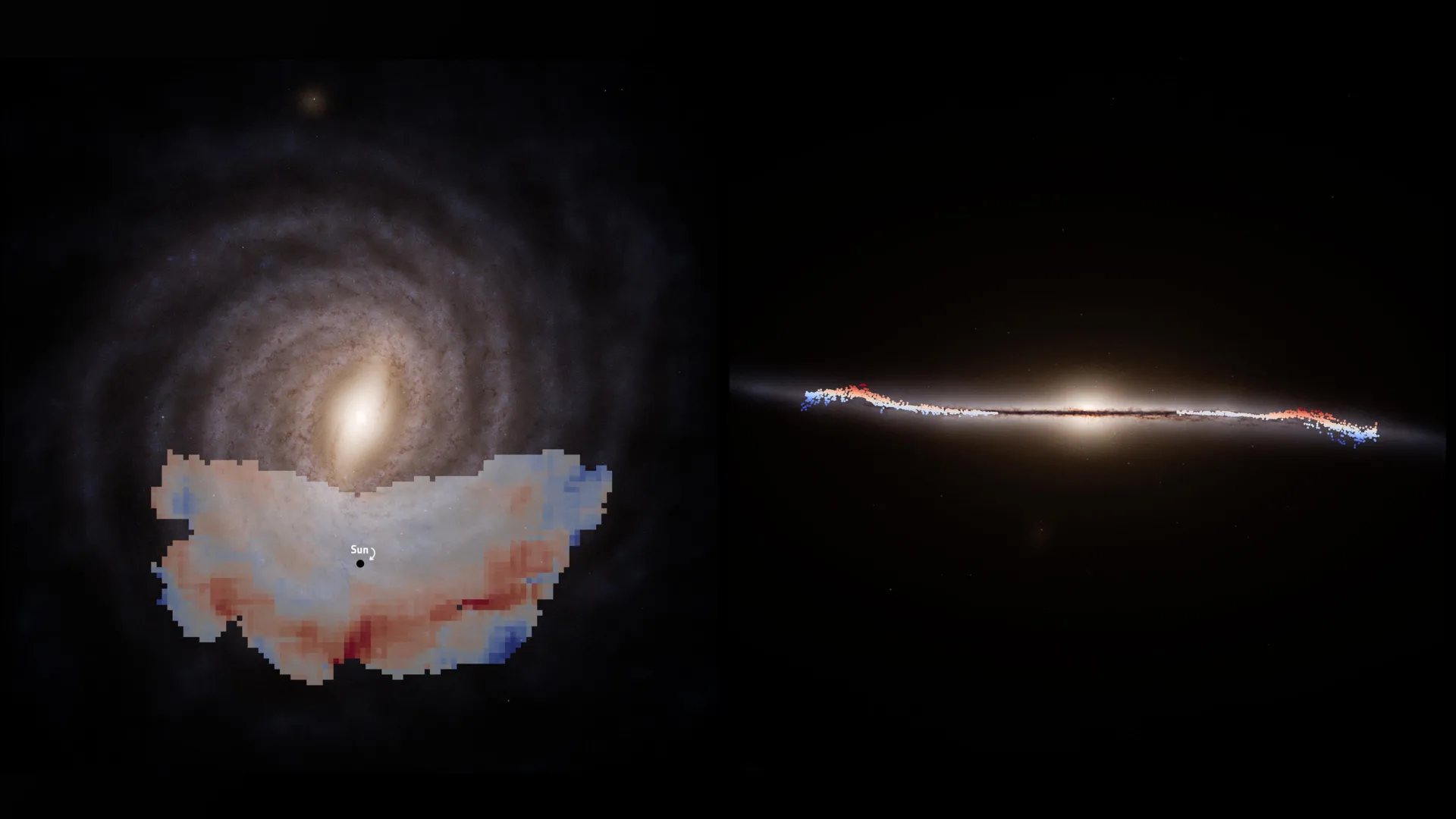
The newly revealed wave is illustrated in the figure above. Thousands of bright stars, shown in red and blue, are overlaid on Gaia’s detailed map of the Milky Way.
In the image on the left, we see our galaxy from a top-down perspective. The right panel shows a side view, cutting vertically through the galactic plane. From this angle, the left portion of the galaxy curves upward while the right side bends downward (this is the warp of the disc). The red and blue regions mark the newly discovered wave: red areas indicate stars located above the warped plane, while blue areas show stars lying below it.
Although no spacecraft can venture beyond the galaxy, Gaia’s remarkably precise measurements — covering all three spatial dimensions (3D) and three components of motion (toward and away from us, and across the sky) — allow scientists to construct these top-down and edge-on views of the Milky Way.
These maps reveal that the wave extends over a vast section of the disc, affecting stars located about 30,000 to 65,000 light-years from the galactic center (the Milky Way itself measures about 100,000 light-years across).
“What makes this even more compelling is our ability, thanks to Gaia, to also measure the motions of stars within the galactic disc,” says Eloisa Poggio who is an astronomer at the Istituto Nazionale di Astrofisica (INAF) in Italy, and led the team of scientists that discovered the wave.
“The intriguing part is not only the visual appearance of the wave structure in 3D space, but also its wave-like behavior when we analyze the motions of the stars within it.”
In the edge-on view of the Milky Way linked below (“The Milky Way’s great wave in motion”), white arrows show how the stars move. The vertical motion of the stars (represented by these arrows) is slightly shifted sideways compared to the pattern of their positions (shown by the red and blue colors).
“This observed behavior is consistent with what we would expect from a wave,” Eloisa explains.
She compares the phenomenon to a stadium crowd performing a wave. If we could freeze that moment in time, some people would be standing upright, others would just have sat down (after the wave passed), and some would be about to stand (as the wave approaches). Galactic timescales are far longer, but the principle is similar.
In this comparison, the people standing upright correspond to the red regions in Gaia’s maps, while those about to rise — moving upward with the greatest vertical speed — are represented by the longest white arrows pointing up, just ahead of the wave’s crest.
Eloisa and her team detected this remarkable motion by carefully studying young giant stars and Cepheid stars, both of which vary in brightness in predictable ways that make them easy for Gaia to observe across large distances.
Because these stars seem to move with the wave, the researchers suspect that gas in the galactic disc may also participate in this large-scale motion. Newly formed stars could retain information from the gas they were born from, preserving a kind of “memory” of the wave.
The cause of the galaxy’s vast oscillations is still uncertain. One possibility is that the Milky Way experienced a past encounter or collision with a smaller, dwarf galaxy, but further analysis is needed to confirm this.
This newly found “great wave” might also have some link to a smaller undulating structure known as the Radcliffe Wave, which lies roughly 500 light-years from the Sun and extends about 9,000 light-years across.
“However, the Radcliffe Wave is a much smaller filament, and located in a different portion of the galaxy’s disc compared to the wave studied in our work (much closer to the Sun than the great wave). The two waves may or may not be related. That’s why we would like to do more research,” Eloisa adds.
“The upcoming fourth data release from Gaia will include even better positions and motions for Milky Way stars, including variable stars like Cepheids. This will help scientists to make even better maps, and thereby advance our understanding of these characteristic features in our home galaxy,” says Johannes Sahlmann, ESA’s Gaia Project Scientist.
Find out which to avoid if you are concerned about weight gain.
Common dolphins, among the most abundant marine mammals on Earth, are living significantly shorter lives in the North Atlantic. A new study published on October 10 in Conservation Letters reports that their lifespan has dropped sharply in recent decades.
Researchers from the University of Colorado Boulder found that female common dolphins are living an average of seven years less than they did in 1997. The team warns that this decline threatens not just the species but also the ocean ecosystems they help sustain.
“There is an urgent need to manage the population better,” said Etienne Rouby, a postdoctoral researcher at the Institute of Arctic and Alpine Research (INSTAAR). “Otherwise, there is a risk for decline and, ultimately, extinction.”
Dolphins of the Bay of Biscay
Roughly 6 million common dolphins inhabit tropical and temperate waters worldwide, making them the most numerous members of the cetacean family, which includes whales and porpoises. One of their key winter gathering spots is the Bay of Biscay, off the coast of France, where nutrient-rich waters attract anchovies, sardines, and other small fish that serve as food for the dolphins.
However, this same region is also one of Europe’s busiest fishing zones. While dolphins are not the intended catch, many become accidental victims of fishing operations. Known as “bycatch,” this phenomenon causes thousands of dolphin deaths each year. In 2021 alone, bycatch was estimated to have killed about 6,900 dolphins out of the bay’s winter population of 180,000.
Despite such figures, past surveys suggested that dolphin numbers in the area were stable.
A New Way to Measure Decline
Traditional monitoring methods rely on counting dolphins spotted from ships or aircraft. Because the animals are constantly moving, these surveys can overlook population changes until they become severe. For species like dolphins, which reproduce slowly and live for decades, that delay can make recovery extremely difficult once the decline becomes visible, Rouby explained.
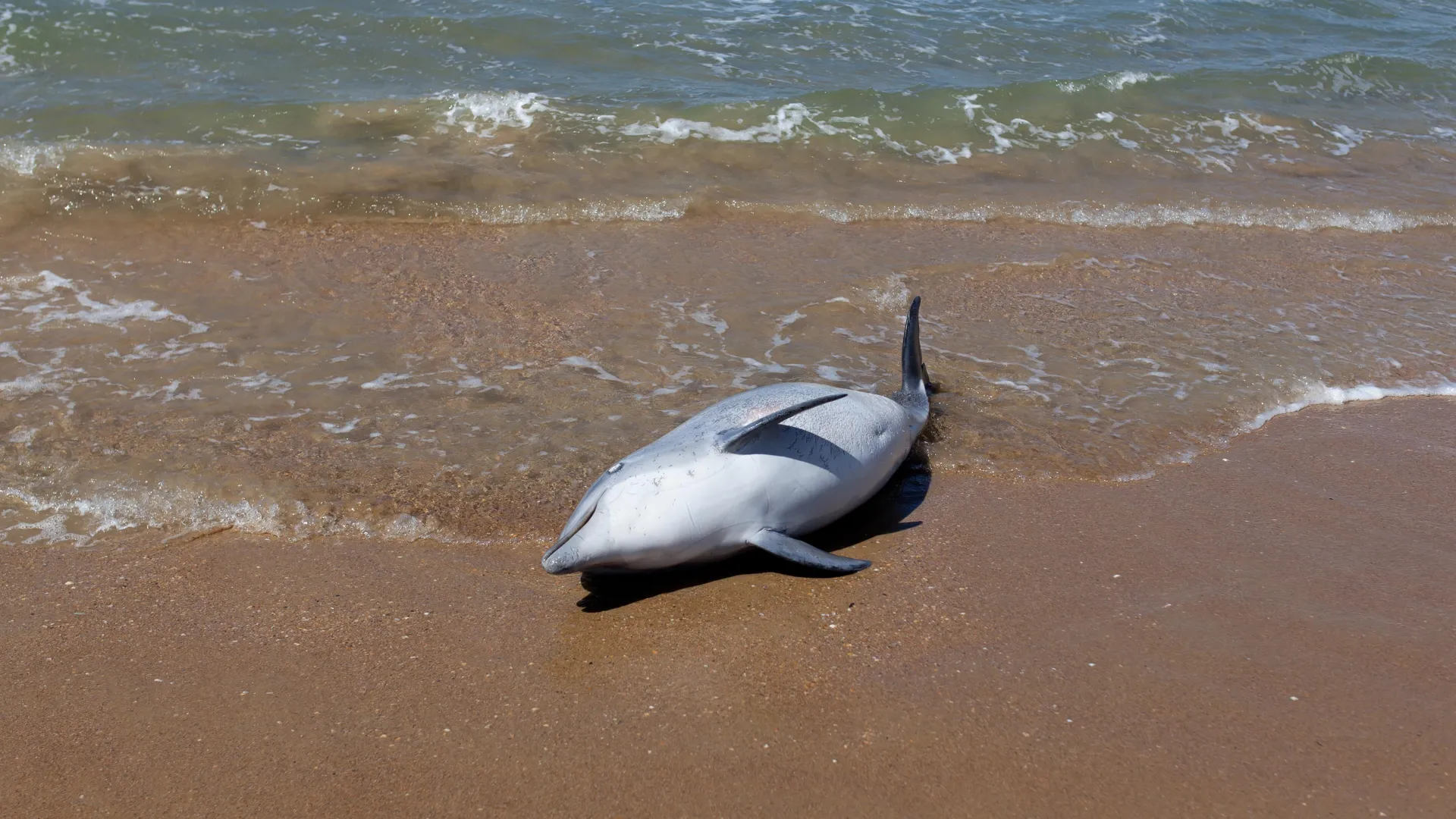
To better track survival trends, the research team took a different approach by examining stranded dolphins that had washed ashore along the Bay of Biscay. Dolphins usually beach themselves when sick, injured, or disoriented, and most do not survive. Although stranded animals represent only about 10% of total deaths, their condition over time can reveal important patterns in population health.
The researchers analyzed 759 stranded common dolphins collected between 1997 and 2019.
“We wanted to capture changes in the population’s survival and fertility rates. These are more sensitive indicators of population health, and they enable us to identify the problems before they become irreversible,” Rouby said.
Evidence in the Teeth
By studying the growth layers in dolphin teeth, the scientists determined the ages at which the animals died. Their findings showed that the average lifespan of female dolphins in the Bay of Biscay fell from 24 years in the late 1990s to only 17 years by 2019. This decrease has also resulted in fewer calves being born, signaling a broader reproductive decline.
The study found that population growth has slowed by 2.4% since 1997. Under ideal conditions, common dolphin numbers can increase by about 4% per year, meaning that growth in 2019 was likely only around 1.6%.
“The numbers are likely to be lower in reality,” Rouby said. He warned that if this trend continues, growth could eventually turn negative, marking the beginning of an overall population decline.
Policy Changes and Future Action
Since 2024, the French government has implemented a one-month annual fishing ban in the Bay of Biscay each January to protect dolphins. Although initial reports show the measure may be helping, Rouby suggested that adjusting the ban’s timing based on dolphin migration patterns could make it more effective. Because dolphins do not always arrive at the same time each year, matching the closure to their movements would offer better protection.
Other North Atlantic cetaceans, including harbor porpoises and bottlenose dolphins, may be facing similar pressures. Understanding these patterns could help strengthen marine protection policies such as the US Marine Mammal Protection Act and the European Marine Strategy Framework Directive.
Why Dolphins Matter
“Dolphins are the top predators in the Bay of Biscay, and they play a very important role in the ecosystem,” Rouby explained. “Without these predators, fish populations could become out of control, and they would in turn consume too much plankton and vegetation until the system collapses.”
He emphasized the need for swift, informed action. “As humans, we should make conscious decisions to protect the living and non-living things around us. Facing evidence of viability loss, we need to act before it is too late.”
