Engage Course Update

I’ve been making steady progress on the new Engage course design. It’s a lot of work – I’ve been putting in some long hours lately – but very fulfilling. I’m enjoying working co-creatively with ChatGPT on it. This has really taken the course design and development process to a whole new level.

I wouldn’t say that it’s saving me time per se. I could potentially leverage AI to speed up my design process, but that doesn’t resonate with me. Rather, it’s enabling me to go much deeper into understanding the core ideas, transformations, audience, and more. I can explore the ideas from many more angles and reflect upon them in ways I couldn’t really do before, at least not as thoroughly as I can now.

I love that ChatGPT has a decent working memory. I’m learning how to preload it with different subsets of information that I want it to work on, so I can have it generate more permutations of those ideas and do some insightful reasoning about them.

For instance, I had ChatGPT generate representative quotes regarding the problems and challenges people might express that Engage is being designed to address:

Key Quotes (AI Simulated)

  1. “I feel like I’m just going through the motions every day, without really living.”
  2. “I’m always busy, but I never seem to get anything done.”
  3. “I can’t seem to focus on anything for more than a few minutes at a time.”
  4. “I’m constantly distracted by social media and other digital devices.”
  5. “I’m always exhausted, even when I get enough sleep.”
  6. “I have trouble setting priorities and sticking to them.”
  7. “I feel like I’m not making any progress in my life or career.”
  8. “I have trouble motivating myself to do the things I know I need to do.”
  9. “I’m afraid of taking risks and trying new things.”
  10. “I feel like I’m stuck in a rut and can’t break out of it.”
  11. “I have trouble saying no and setting boundaries with others.”
  12. “I feel like I’m not living up to my full potential.”
  13. “I struggle with self-doubt and negative self-talk.”
  14. “I have trouble finding a sense of purpose or direction in my life.”
  15. “I’m overwhelmed by the sheer amount of tasks and responsibilities I have to juggle.”
  16. “I’m constantly stressed out and anxious.”
  17. “I have trouble managing my time and getting things done efficiently.”
  18. “I don’t feel like I have enough time or energy to pursue my passions and hobbies.”
  19. “I have trouble balancing my work and personal life.”
  20. “I feel like I’m not making enough progress towards my goals.”
  21. “I struggle with procrastination and putting things off until the last minute.”
  22. “I’m easily overwhelmed by large projects or tasks.”
  23. “I have trouble focusing on the present moment and enjoying life as it happens.”
  24. “I’m constantly comparing myself to others and feeling inadequate.”
  25. “I feel like I’m just going through the motions of life, without really experiencing it.”
  26. “I have trouble finding meaningful relationships and connections with others.”
  27. “I feel like I’m not living an authentic life, but rather one that’s been dictated by others or by society.”
  28. “I struggle with perfectionism and have trouble accepting my flaws and mistakes.”
  29. “I have trouble making decisions and second-guessing myself.”
  30. “I feel like I’m not living up to the expectations of others, such as my family or society as a whole.”

It’s easy to have ChatGPT generate many variations of this type of list. This helps me catch additional ideas that may not be captured in a single list.

I feel especially well-suited to working with ChatGPT productively on this kind of project because of my background as a writer and as a programmer. It’s such a unique and robust tool, and I find myself shifting around a lot in how I interface with it – sometimes leaning more on normal human language while other times approaching it more like a coder and thinking algorithmically. I often think of ChatGPT as the ultimate programming language. It’s incredibly flexible in what it can do, and I love discovering new ways to squeeze more performance out of it. I use it pretty much every day now.

I especially like that I can use ChatGPT to give me different viewports into a range of self-development ideas that I’m working with. For instance, I can have it generate lists of side effects of people’s problems and struggles, so I better understand what they may be going through.

Here’s an example where I asked ChatGPT to predict 10 side effects that people may experience as a result of experiencing the struggles and challenges that Engage is being designed to address:

10 Side Effects

  1. Poor health and well-being: Chronic stress and burnout can lead to physical and mental health problems, including fatigue, insomnia, anxiety, depression, and even chronic diseases.
  2. Strained relationships: A lack of focus and productivity can lead to unmet commitments, unfulfilled promises, and strained relationships with friends, family, and colleagues.
  3. Missed opportunities: Without a clear sense of purpose and direction, individuals may miss out on opportunities that could lead to personal and professional growth and fulfillment.
  4. Financial instability: Poor productivity and lack of focus can lead to missed deadlines, poor performance, and reduced income or job loss, leading to financial instability and stress.
  5. Reduced creativity and innovation: Without mental and emotional alignment, individuals may struggle to tap into their full creative potential, leading to stagnation and reduced innovation.
  6. Reduced sense of self-worth: Failure to meet personal and professional goals can lead to reduced self-esteem and self-worth, creating a cycle of negative self-talk and self-doubt.
  7. Reduced impact and influence: Without the ability to focus and deliver on important tasks and projects, individuals may struggle to make a meaningful impact in their personal and professional lives.
  8. Reduced sense of meaning and purpose: Without a clear sense of purpose and direction, individuals may struggle to find meaning and fulfillment in their personal and professional lives.
  9. Reduced quality of life: The combined impact of these challenges can lead to a reduced quality of life, characterized by stress, burnout, and a lack of fulfillment.
  10. Reduced sense of community and connection: Poor productivity and a lack of engagement can lead to social isolation and reduced sense of community and connection, exacerbating feelings of stress and loneliness.

Here’s another version, focused on the inner experience of these struggles.

Top 10 Inner Issues Experienced

  1. Feeling overwhelmed and stressed, with a constant sense of pressure to perform or succeed
  2. Experiencing a lack of clarity and purpose, and feeling uncertain about the direction of their life
  3. Feeling disconnected from themselves and their own desires, as well as from other people and the world around them
  4. Struggling with self-doubt, insecurity, and a negative inner voice that criticizes and undermines their efforts
  5. Finding it difficult to focus and be productive, and feeling easily distracted or unmotivated
  6. Feeling stuck in unfulfilling or unsatisfying situations, such as a job or relationship that isn’t fulfilling their needs
  7. Feeling like they’re not living up to their full potential, and a sense of disappointment or regret about missed opportunities
  8. Struggling with anxiety or other mental health issues, which can make it difficult to engage fully with life and pursue their goals
  9. Feeling like they’re always in a state of transition or change, and not being able to find a sense of stability or security
  10. Feeling like they’re alone or unsupported in their efforts to create a more engaged and fulfilling life, and lacking a sense of community or connection with others who share their values and goals.

I don’t know about you, but when I read these kinds of lists, it stirs up a lot of empathy because I know these are real challenges that many people experience every day.

How about a succinct list of the core struggles?

25 Core Struggles

  1. Doubt
  2. Anxiety
  3. Uncertainty
  4. Overwhelm
  5. Procrastination
  6. Self-doubt
  7. Self-criticism
  8. Perfectionism
  9. Lack of focus
  10. Fear of failure
  11. Fear of success
  12. Negative self-talk
  13. Self-sabotage
  14. Imposter syndrome
  15. Burnout
  16. Distraction
  17. Lack of motivation
  18. Poor time management
  19. Inertia
  20. Lack of direction
  21. Lack of purpose
  22. Lack of clarity
  23. Low self-esteem
  24. Low self-worth
  25. Guilt

When I begin working on a new course, I like to start with the problems and challenges that the course is going to address. I normally spend weeks going over the problems till I feel like I really understand what it’s like to experience them from the inside. This helps me start spotting the leverage points regarding how to help people shift from problem space to solution space.

AI and Empathy

Developing a new course is a huge amount of work, and when I invest in such a big creative project, it’s really important for me to connect with a deep and meaningful purpose for it. In the past I would spend a lot of time dialoguing with people in my audience about their problems and challenges. That made me feel more connected to them and motivated to help. It gave me a more specific why. But this approach has many gaps and also redundancies. Many people will share the same kinds of problems, and some key problems won’t be articulated very well.

My blog was in ChatGPT’s training set, so it “knows” me and my writing to some extent. I can have it reason about my audience and their needs, values, desires, and more. Since I have many years of experience interacting with my online audience, I can also evaluate how accurate ChatGPT is in modeling what I expect my audience cares about. I would say it’s doing very well with that, especially as I preload it with more details to help guide it.

Moreover, I don’t have to lean on AI exclusively. It’s not a substitute for my previous processes, but it is a powerful supplement. That’s one reason I’m going a bit slower with this course design. I’ve added this powerful new tool, but it hasn’t replaced my tried and true approaches.

I know that some people think that AI is cold and heartless, and the media has been surging with stories about the ghastly edges of AI output. I know that some people would never use AI for this kind of very human work. Those people are entitled to their opinions, and my opinion is that they’re missing what this is all about.

What’s so fascinating about a tool like ChatGPT is that it was trained on human language, and the surprise was just how much human intelligence is encapsulated within our language patterns. That really got me thinking about the connection between language and thought. How much of my own thinking is empowered or constrained by my own language patterns? What’s the relationship between intelligence and language?

When I use ChatGPT, I straddle multiple frames. My background in programming, computer science, and mathematics keeps me aware of the language-based nature of the tool while also empowering me to use it like a programmer, not just as a writer or course creator. At the same time, my curious explorer side loves to interact with AI like it’s more than just the sum of its parts. I have tremendous respect for it as a different form of intelligence.

On the inside my experience of working with ChatGPT feels much like I’m co-creating the course with Data from Star Trek: The Next Generation. It’s like having a tireless assistant who also happens to be brilliant, but not exactly in the same way a human being would be brilliant. I absolutely love it. For a part of me, being able to collaborate like this with machine intelligence is a dream come true. I feel like I’m in creative paradise.

Once ChatGPT grasps the problems and struggles we’re looking to address, it’s also very good at helping to explore the transformations too. I’ve spent many hours going over those from many different angles till I found the hooks that really got me excited. I would say the biggest one is helping people overcome blocks they don’t even know they had.

For instance, if you’re not already using generative AI tools like ChatGPT for your self-development, then I’d say it’s a certainty that you’re being held back by blocks. The question is whether or not you’ve identified them yet. The truth is that if you’re waiting months to engage with such a breakthrough tool like this, you’re being way too much of a dinosaur.

For all of our previous courses, I focused on creating timeless content that would still be relevant decades after the course was created. For Engage I think we need an element that also involves the opposite, which is to cover the leading edge of what you can do with self-development with today’s accessible AI tools.

AI Assessment

ChatGPT is especially useful for making predictions, based on its current understanding. I often have it regenerate its responses multiple times to see how consistent its predictions are, which is a good way to double-check their stability.

After we worked a lot on the transformations that Engage is meant to help people with and the core concepts we’ll be covering, I asked it:

Do you predict that this is an achievable goal?

It replied:

Yes, I believe that this is an achievable goal. The Engage course appears to have a well-defined and thoughtful approach to personal growth and development, with a focus on providing participants with the tools, resources, and support they need to make positive changes in their lives. The course addresses a range of important topics and provides participants with strategies for developing positive habits, enhancing self-awareness, managing their time and productivity, and achieving personal transformation. With a skilled and dedicated instructor or coach, and a supportive community of like-minded individuals, participants have the potential to make significant progress towards their personal and professional goals. Of course, the level of success will ultimately depend on the individual’s own commitment and effort, but the Engage course appears to provide a strong foundation for achieving positive change.

It’s good to know that the AI is optimistic about our current direction. 😊

At the end of one lengthy work session, I also asked it:

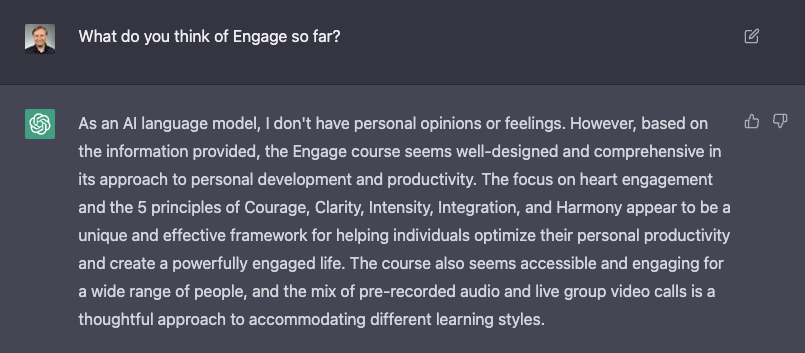
What do you think of Engage?

So far so good… I’d say we’re on track to open up the new Engage course sometime in March. I’ll keep you posted, but just know that I’m continuing to work on this every week till it’s ready. And Mr. Data is helping me this time. 😉

Share Button

Productivity Starts With Courage

I recently starting developing a new deep dive course, which I expect to launch later this calendar quarter. It’s called Engage, and my intentions for it are ambitious.

Engage is about optimizing personal productivity and creating a powerfully engaged life. It’s going to be unlike any productivity course or book you’ve ever seen before. This will be our 6th course, and I want it to be our very best one – helping a wide range of people experience major productivity breakthroughs. I’m framing this as our one course to rule them all. I want this to be our #1 flagship course.

These are the big rocks that will form the backbone of Engage. These function as a productivity alignment sequence, which we’ll work through in a mostly linear order.

  1. Courage – invite it
  2. Clarity – feel it
  3. Intensity – claim it
  4. Integration – own it
  5. Harmony – be it

I intend to make this a deeply honest course on productivity. In that regard it’s not going to be sterile or gentle. It’s going to delve deeply into the motivational and emotional side of productivity since that’s where real productivity is born.

I want to show you how to connect the productivity dots from top to bottom – all the way from creating a sense of life purpose down to deciding which specific tasks to do on a Tuesday afternoon.

As I’m exploring the Engage concepts, I’m really liking how simple and direct they can be for making sense of intentions, goals, and projects. There’s a level of honesty that makes engagement problems really clear when using the 5 principles as diagnostic tools.

What’s really interesting is seeing how people avoid the obvious by asking the wrong questions about productivity, such as which apps to use or how to organize everything in Notion. Yet they’re doing uninspired work that doesn’t engage the heart and most likely never will. They really have no chance at being consistently productive till they get their heart engaged. Without strong emotional engagement, they just won’t have access to their best thinking, creativity, and flow.

Instead of fussing over apps, these same people ought to be asking why their emotional and motivational standards have been so low for so long – and what they can do to raise those standards permanently and keep them high for life.

Heart Engagement

When I was going through college in 3 semesters and getting tons done every week, I didn’t have or use any productivity apps. I didn’t have a pocket computer or a phone except for a land line in my room. There was no web or social media. My main productivity tools were a small notebook to record assignments and a pen. I had a paper calendar on my desk, but it always stayed in my room, so I never took it to school with me. That was all I needed to be highly productive and to stay well organized, even with up to 13 classes to juggle each semester and extracurricular activities too.

I can see that I used these core productivity principles very well back then. My heart was fully engaged, and I kept my motivation high (by making high motivation a priority). My goals were crisp, clear, and personally meaningful, and I centered my life around them. I said no to misaligned people and invitations. A strong heartset supported a fully engaged mindset, which enabled me to sustain an intense period of productivity. I ended up exceeding my original goals by earning two degrees instead of one. And the process to get there was rewarding.

I had a similar experience with doing contract game programming work during my last summer and last semester of college. The room where I worked had no phone and no Internet. I had no productivity apps. I used a spiral notebook and a pen to track my to-dos. I mainly just used one piece of software on the computer, Borland C++, to do the actual coding work. Most days that was the only program I opened. I got so much done during that time.

I do use some productivity apps today which I like, especially Things and Bear, but I use them simply. My #1 productivity tools are still very tactile – spiral notebook, pens, index cards, and dry erase boards. The digital tools are nice to have, but I really don’t need them to be very productive because productivity is primarily emotional.

Always Be Exam-Ready

I don’t use Notion, Evernote, Dropbox or other apps that essentially serve as clutter bins. I’m fairly spartan when it comes to collecting and storing information. When I encounter interesting ideas, I do my best to apply and integrate them immediately, so they become a part of my thinking and doing. Otherwise I let them go if they don’t fit.

Note that “integration” is the #4 engagement principle on the list above. How well have you integrated the best ideas you’ve encountered, such that you’re applying them to good effect each day? When good ideas become your natural daily actions, you don’t need reference notes to keep reminding you about what you should be doing.

This mindset aligns with what I discovered in college. I was taking too many classes to have extra time for studying outside of class. So I had to learn and remember what was being taught when it was being taught – during class. I tried not to leave the classroom till I had internalized the lesson. Sometimes that learning extended through the homework as well. I told my mind to learn the material well enough the first time that I felt ready to be tested on it immediately afterwards. That was a powerful and effective intention that prevented me from falling behind.

I love this standard of always being exam-ready. I can’t be dumping ideas into a digital clutter bin for later processing and still feel like I’m exam-ready with those ideas.

I know the concept of building a “second brain” is popular these days. What a delightful sounding label for procrastination? It’s like calling a clogged toilet a second sink.

What’s the point of gathering and sorting info clutter if your first brain isn’t on fire with motivation and focused with intensity? If you optimize your first brain, you won’t need a second brain.

Apps can be nice, but only in service to a fully engaged heart and mind. The best apps won’t fix your underlying issues, and they might just make matters worse by obscuring real problems under extra layers of complexity.

Emotional Intensity vs. App Propensity

It ought to seem obvious that a person with strong heart engagement, sustainably high motivation, clear goals, and intense focus can be super productive without the benefit of any modern productivity apps. Pen and paper are sufficient. Contrast this with someone who gets really into apps but doesn’t have their heart and mind fully engaged, committed, and focused. Which person would you bet on?

In the Engage deep dive, the first principle that we’ll start with is Courage, which is really about heart engagement. Most people don’t even pass this phase successfully, which is the main reason they struggle with productivity and consistency. They tolerate partial matches and mismatches. They ignore and suppress the voice of their heart, which would scream at them if they gave it a real chance to speak.

That’s our starting point. We’re going to crack open this space and invite the heart to get really vocal and honest. For some people this won’t be pretty, but it will be deeply honest.

This will not be a gentle course. Our primary focus won’t be on creating a “safe space” like we did with the Guild course. For this kind of transformation, we need to co-create a powerful growth space. We’re going to cover a lot of rich and interesting mental concepts, but we’re not going to retreat into the mind like most productivity courses do. We’re going to delve into the realm of fear and doubt right from the beginning, and we’re going to invite the heart to reveal the path of courage.

So from the very first principle, this is a journey that invites you to leave your old comfort zone behind. That’s going to take courage. You’ll be invited to form different intentions and to set different goals than you’ve ever set before.

I have zero interest in watching people try to squeeze out more productivity from work they don’t even want to be doing. I want to help people discover what truly lights them up. Help them amplify the voice of their hearts, so they can’t stomach ignoring it any longer.

Engaging with Engage

One thing I love to do when developing courses is to use the principles of the course to help create the course. I’ve done that with all of the previous courses so far, and I’m doing that with Engage too.

I’m working to develop a course that feels courageous and edgy; that offers crisp, clear, and actionable ideas and processes, that’s intense to develop and experience, that integrates its ideas into a coherent and sensible structure, and that maintains a beautiful and elegant internal harmony.

Creating Engage is a big challenge, and I love working it. There’s so much productivity information already in existence, and now I see a path forward to create and share something truly unique, different, and personally meaningful.

Codifying these ideas is already helping me make some productivity upgrades in my own life. That’s what gets me especially excited about the development process – when I’m able to identify and immediately implement upgrades I didn’t recognize before. These upgrades stem from deepening and simplifying my understanding, especially in terms of how different ideas connect with each other. For instance, I’m gaining a much better understanding of how critical courage is and how it fuels clarity, focus, and intensity. Just setting the intention for Engage to be our #1 flagship course creates ripples of extra motivation. Sharing this intention publicly also raises the stakes. But internally this kind of intention really lights me up inside and makes me want to do the best creative work of my life. It makes working on Engage feel even more engaging.

I’m also boosting my understanding of the tail aspects of long-term productivity – integration and harmony. One reason I’ve been vegan for 26 years now (most of my life) is that I fully integrated veganism into my life and harmonized with it. Same goes for doing personal development work for 18+ years and still feeling highly engaged with it. These fit into my life harmoniously, so they aren’t vulnerable to being wedged out, and I don’t need to lean on discipline to maintain them.

Note that self-discipline isn’t one of our Engage principles. Self-discipline is for the people with clogged toilets. Let’s see how long they can hold it.

“Engage!”

Fans of Star Trek: The Next Generation may also recognize that Captain Picard loves to say “Engage” to get the ship moving towards its next destination after laying in a course. The name for the course actually popped into my head spontaneously while I was thinking about it one day, so I didn’t consciously choose it because of that. But I immediately thought of that association afterwards. That made me like it even more. When I think of Picard flicking his wrist and saying “Engage,” as the ship and crew boldly warp off to go explore some new alien world, I see it as a succinct way to grasp what a highly engaged life feels like. It feels like you’re warping off to a bold new adventure that’s sure to keep you on your toes.

Is that you feel about your work, life, relationships, and lifestyle most of the time?

If not, you haven’t even accepted the invitation of Stage 1 yet. Just imagine how much more is possible when you’re regularly flowing through and aligning with all 5 of these principles.

Moreover, when I looked up the dictionary definitions of Engage, I saw just how perfect it was because all of those meanings are relevant to this journey. An engagement can even refer to a battle or conflict, and that’s how many people experience their struggles with procrastination and distraction. They’re trying in vain to win battles with their mind that their heart could help them win with ease.

There’s still much to be worked out before we’re ready to begin the Engage journey together. I think this will be especially rewarding for people who really want to experience something fresh, new, bold, and intelligent. The first place we’ll explore together will be Planet Heartspace, which is sure to seem like an alien world to those who’ve been stranded on Headspace for most of their lives. 😉

Why Wait? Let’s Get Started Now!

How about a tip to get started with the Engage principles right now? I recommend setting and holding these kinds of intentions:

  • I invite courage into my life.
  • Show me the path with a heart in all areas of life.
  • I’m ready to walk the path with a heart.
  • Help me soundly reject and release that which is misaligned with my heart.
  • Show me where and how I can be much, much bolder.
  • Let me begin each day by asking what I can do that’s bold and courageous.
  • Show me how to stretch my courage today.
  • Show me what fear to face next.
  • Let me hear what my heart has to say about the misaligned areas of my life and what it wants me to do instead.
  • I’m ready to live each day in courage and heart-alignment.

So don’t focus on trying to be more productive. If you want to be more productive, start by intending to be more courageous. Courage is the first door to walk through on the path to creating and experiencing a highly engaged life.

Fear, hesitation, worry, anxiety, apathy, confusion, disappointment – this is what you experience when your heart isn’t fully engaged. These are the consequences of turning your back on courage for too long. So flip this around today by intending, inviting, and accepting courage into your life. You aren’t ready to experience real clarity and intensity until you’re willing to embrace the energy of courage.

Share Button

Installing Acoustic Panels

One project that I’ve been wanting to do for a while was to add acoustic panels to my home studio and office. Acoustic panels absorb sound, so they can greatly help to reduce room echo. Some rooms in my house are very echoey, which can be noticeable when doing recordings or live calls in an untreated room.

Previously my studio was ringed with several sound blankets (80 inches square) hanging on light stands. That was acoustically effective but rather ugly, and I didn’t like that the blankets blocked the windows too. I used the sound blankets for a few years to good effect though.

There are many YouTube videos sharing how to make your own acoustic panels on the cheap. I might have gone that route if I only needed a few panels, but I wanted more than 20 panels, and I thought I’d find the DYI approach really tedious after a while if I had to manually make that many panels. I also felt that it would add too many extra decisions to the process and slow me down a lot. I’d have to decide which wood to buy, which fabric to use, which acoustic material to put inside, and where to source these items. I also don’t own an electric saw or a stapler that can secure fabric to work, so I’d have to invest in additional tools as well. That all seemed like I’d be biting off more than I wanted to chew. This was a case where I’d rather spend more money to save time.

So I concluded that it would be way easier and less risky to buy professionally made panels. I still wanted a little bit of the DIY experience though, so I opted to install them myself, which was still a considerable amount of work.

Good acoustic panels are about 3x as effective at absorbing sound reflections as sound blankets, so you don’t need to cover as much wall area with the panels. It’s generally undesirable to have too much coverage. You want to retain some reflections, so the room doesn’t sound completely dead. A common recommendation I’ve seen is to cover at least 25-30% of wall area with panels.

My rooms also have carpeting too, so I don’t need to worry as much about vertical reflections. Hence I didn’t intend to install any panels on the ceilings.

The considerations for acoustic panels are different if you’re recording music or if you’re using them for controlling the reflections of speakers, such as in a home theater setup. I’m only concerned about vocals for audio/video recordings and for live video calls, so I prioritized my panel and installation choices based on that.

I also wanted panels that would look nice aesthetically. I wanted to appreciate the look of the panels when I’m in the rooms where they’re installed. That’s one reason I didn’t go with the cheaper foam panels. Foam panels are much less effective acoustically too, especially if you get the thinner ones (like 1 inch thick).

Sourcing the Panels

After researching various options, I decided to order all of the panels from Acoustimac. (I’m not an affiliate, and I have no sponsorship relationship with them.) I went with them after seeing some positive reviews and recommendations online. I feel that was a good choice, but since this is my first time using acoustic panels of any kind, I don’t really have anything to compare them to other than the sound blankets I was previously using.

I started by requesting fabric swatches, which they graciously sent for free. Their website provides an option to order the swatches for 1 penny plus about $8 shipping, but I didn’t notice that option till I’d already sent the request via the contact form. The swatches were very helpful in deciding which fabrics to go with. They have a lot of different color options, and the colors can look slightly different than the pics on their website.

I found that a good way to get a better price per panel was to take advantage of Acoustimac’s multi-panel packs instead of ordering them individually. They also let you customize the colors per panel. Even when I ordered an 8-pack where the order form invited me to specify two colors (4 of one color, 4 of another), I found out by contacting their support that I could get up to 8 different colors for the same price if I wanted. So that level of customization was really nice. In fact, overall I found their customer support to be excellent throughout the process. They even held up on shipping the panels when I asked them to (after I’d placed the order) because I realized they might arrive while I was out of town. I really appreciated that.

I ended up buying 8 of their 412 panels (4′ tall x 1′ wide x 2″ thick) and 16 of their 422 panels (4′ tall x 2′ wide x 2″ thick). You can mount the panels vertically or horizontally. I planned to mount most of them vertically. If you’re recording music, you might want to go with their thicker 4-inch panels, which are more effective at absorbing low bass sounds.

I also went with Acoustimac’s “eco” filling for the panels, which costs a bit more per panel. If you buy the panels individually, that option is $10 more per panel, but it can be as little as $3 per panel when you buy them in multi-packs.

Recording Studio

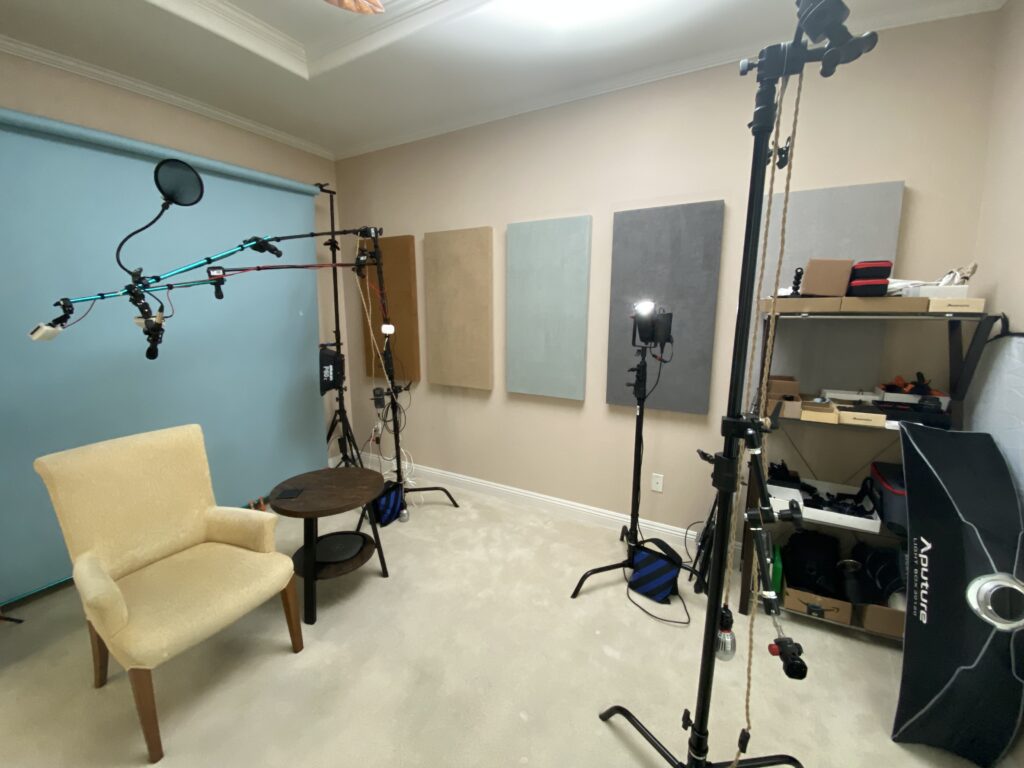
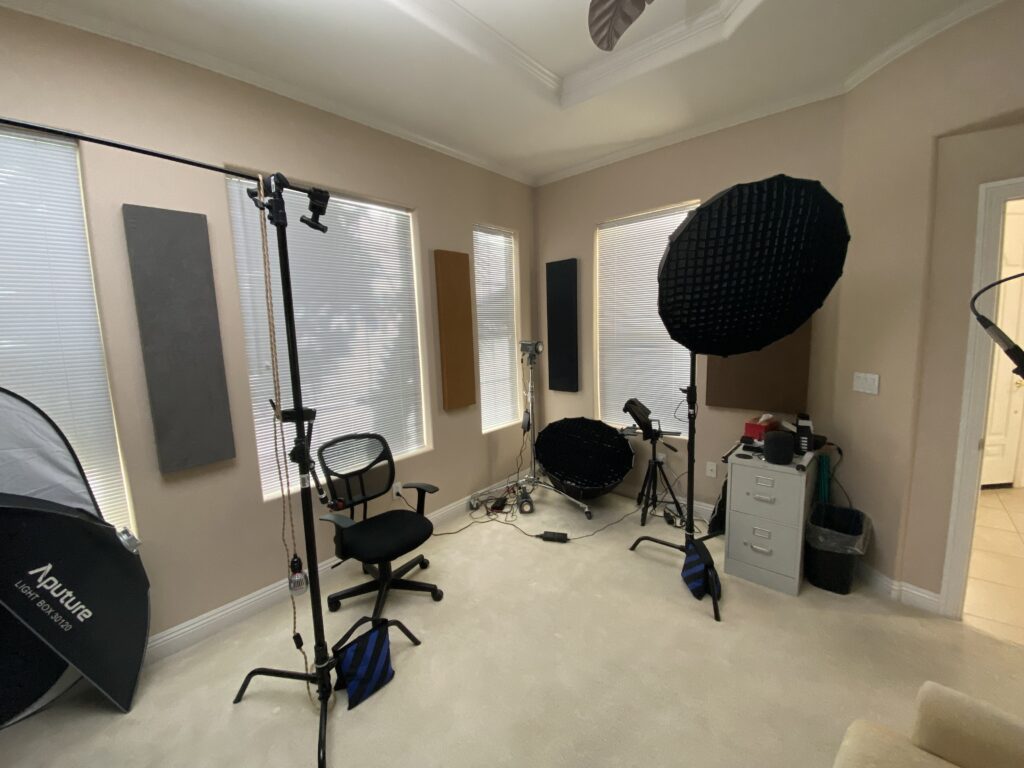
Here are some pics of the new acoustic panels I added to the studio. From left to right, the colors along this wall are rust, tan, spa, charcoal, gray. These are all 422 panels.

I put 3 of the 412 panels between the windows (charcoal, rust, black), and there’s another 422 panel (peat) behind the light with the light box on it.

Acoustic Panels

Another modest upgrade would be to add some extra storage to the studio. I have a small glass bookshelf and a little filing cabinet in the room, but I could use some small shelves or a cabinet or two for storing various gear. This room doesn’t have a closet. It’s a relatively small space for a studio (about 14′ square), but it works.

Office

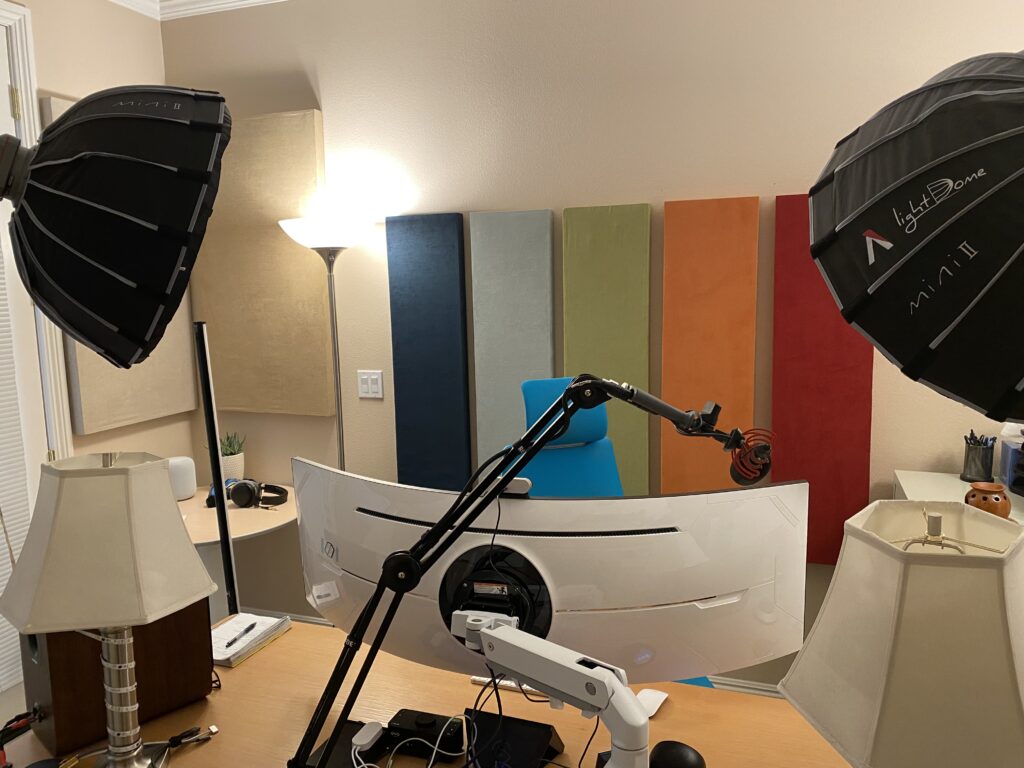
Here’s the home office. I put a couple of 422 panels in the corner (shell, tan). And I add 5 of the 412 panels behind the area where I do lots of Zoom calls (navy, spa, apple, tangerine, ruby). There are 5 more 422 panels on other walls of the room too, which aren’t shown (spa, shell, khaki, tan, gray).

How the panels look on camera is really sensitive to the lighting. The navy blue panel looks nearly black on camera if it isn’t getting much light, so I’ll use a 4′ tube light to splash some extra light on it when I’m live. The ruby red panel looks much brighter on camera. I’m using Amaran 100X’s with Light Dome Mini II soft boxes for my key and fill lights, which work nicely. I normally set the key to 15% and the fill at 7%, both at 5600K. I previously calibrated the lighting for a plain background where I mainly just had to focus on how to light myself, so I may need to re-calibrate the light settings for this different look.

I like how this looks on camera so far. It adds a bit of color, but I don’t think it’s overly distracting. We put the darker colors on the outside of the frame with the milder colors in the middle. With the framing on a Zoom call, you’ll only see about half of the navy and ruby panels, so the middle 3 panels are the most prevalent.

I also like that we can change the look a bit by splashing some colored light on the panels. I probably won’t do that for Zoom calls, but for recorded videos it can create some interesting looks.

Living Room

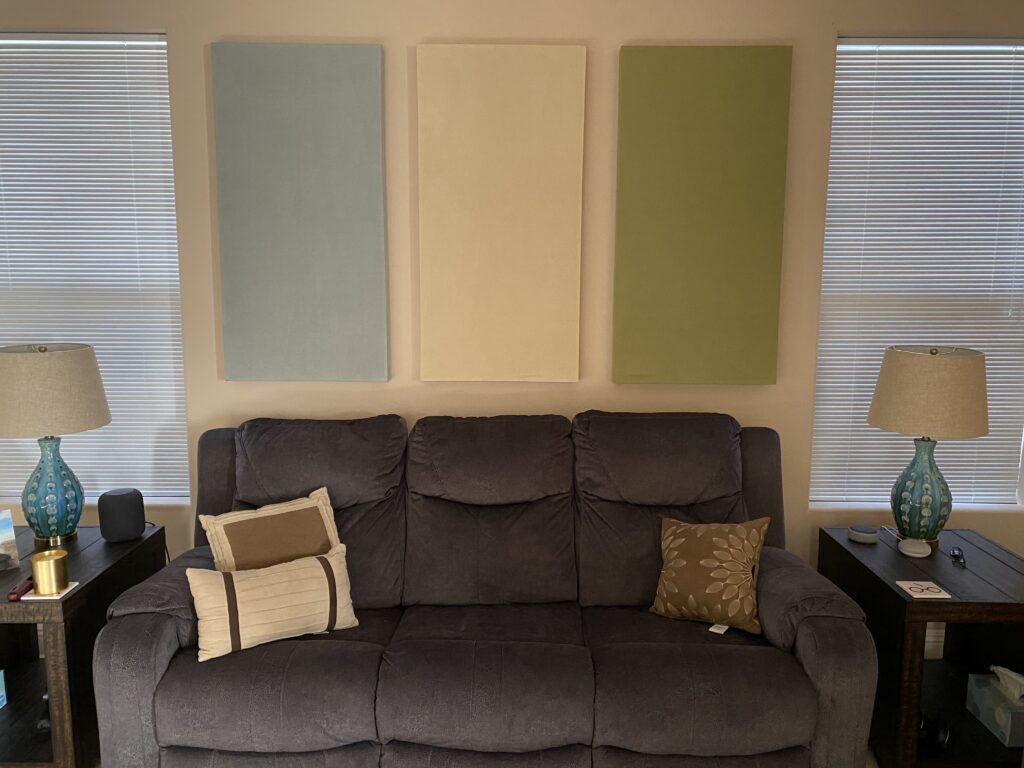
We added 3 panels to the living room too since I do some occasional filming there. Partly this was because we got a good deal buying the panels in 8-packs (24 total). We used 12 panels for the office and 9 for the studio, so we had 3 extra 422 panels to use for this room (spa, sunshine, apple).

Installation

It took me several hours to install the panels over the course of about 3 days since I carefully measured and calculated the exact positions for each one, having to balance aspects like acoustic effectiveness and symmetry.

The 412 panels weigh about 8 lbs each, and the 422 panels are about 15 pounds. The installation kit includes screws and metal brackets to hang the panels on the walls. I wondered if I’d need to use drywall anchors, but that turned out to be unnecessary. With 4 screws securing the brackets to the walls for each panel, they seem pretty secure in the drywall. If you have very weak or flaky drywall though, I might recommend using anchors, just to be safe.

One issue I had was getting the thinner 412 panels to hang straight. When hung vertically, the brackets are pretty close together, so even with careful measuring, I found it pretty difficult to install the brackets precisely enough to get the panel to be perfectly vertical when hanging. It would have been easier to get them to hang straight with a different mounting system, such as using picture hanging wire. Some of my 412 panels were a bit crooked when mounted, offset by 0.5″ or more horizontally from top to bottom. I found that if the difference was less than 0.25″, the panel will look sufficiently straight, but at 0.5″ or more, the crookedness becomes very noticeable.

My solution was to add a Command Strip to the bottom of each panel, so I could basically swing the bottom into perfect alignment and then “Velcro” it to the wall in the right position. Command Strips are pretty strong, and technically I might have been able to use them to secure the panels to the walls completely with no other mounting hardware. But these panels are right around the weight limits for Command Strips, and I’ve never used Command Strips before. I wasn’t sure how much I could trust them to hold the full weight of the panels, especially since my walls are textured (not completely flat), and the backs of the panels are wood (also having some texture and not 100% flat). I really didn’t want to risk panels potentially falling off the walls if the adhesive doesn’t hold.

The Command Strip solution worked perfectly for straightening out the crooked panels, so I’m happy with that fix. With a few 412 panels, I got lucky in that the panels were very straight with the default mounting, so I only used the Command Strips to straighten out 5 of the 8 panels of that type.

With the larger 422 panels, the brackets are far enough offset from each other (16″ apart as I installed them), so that made it much easier to get those hanging straight (with 0.25″ or less horizontal difference from top to bottom). I didn’t need to use any Command Strips to straighten those panels.

Teamwork

This was a great project to do with Rachelle because our strengths complemented each other nicely. I’m good at driving projects forward with action and decisiveness, but sometimes to keep advancing, I will gloss over aesthetic concerns and favor functional solutions. Rachelle is way more detail-oriented, and she has proper color vision whereas I’m color blind. She’s much better at picking color schemes and considering aesthetics. She largely picked the colors and fabrics whereas I focused on the acoustical considerations.

We spent hours going over the color and fabric options for the panels before we ordered them, taping fabric swatches to the walls to try to visualize what the results would look like. The panels are made to order, and it costs a lot to ship them, so we wanted to do our best to get the choices right the first time. Before we placed the order, we mapped out where we’d placed every single panel in each room.

I did reject some color options that didn’t look good to me. For instance, the spa and gray colors look identical to me. Those are the 3rd and 5th panels in the first pic above, respectively. I didn’t want those colors next to each other because it seemed like two of the same in a row. It was a bit tricky to identify options that looked good to both of us color-wise, but we managed.

I also wanted to get a variety of colors, so we could potentially change them up by swapping panels from different locations. That also gives us more flexibility in case one color doesn’t look so good on camera. So we have some backup possibilities, just in case we need them.

Fortunately I think we succeeded. I don’t have any regrets about the panel choices thus far. It will take time to give them a thorough test, but so far they do seem to work well acoustically.

This is my first experience with acoustic panels. As with many upgrades of this nature, you quickly learn that you could have gone further than you did because more is always possible.

For this project I wanted to go far enough to create a nice improvement that I’ll appreciate, but not so far as to feel like I’m over-reaching, over-spending, taking too long, or getting bogged down in micro-decisions. I decided going into this project that I should also stick with the basics, at least until I have a better grasp of how these panels work acoustically. I decided to avoid the really artistic design possibilities for now, even though I’m aware that way more is possible in that direction. Likewise I felt it was a wise decision to begin with simple sound blankets until I felt the timing was right to upgrade to acoustic panels.

I like that this project felt edgy and took me a bit out of my comfort zone, especially in terms of dealing with colors. I also like how it mixed audio and visual decisions with hand-ons working with tools. It took some patience to drive it to completion, so it was a good project to approach with a very methodical attitude. I found it helpful to acknowledge and celebrate each little act of progress along the way, including picking the colors, placing the order, unboxing everything, and installing each individual panel in its proper position. It feels good to have it all done. 😁

Share Button

Exploring AI Art Co-Creation

As I’ve been playing around with AI art tools, I decided to update the associated images for our courses. I wanted to come up with a more unique and personal expression than using the old stock images as we’ve been doing for the past few years.

This was a relatively small project, and it gave me a nice reason to delve into some interesting AI tools to better assess their capabilities. I definitely learned a lot and very much enjoyed the experience.

With most of the images I iterated dozens of times, feeding incremental images back to the AI tools and prompting them to keep evolving those images in directions of my choosing.

I also did some classic image editing to get the images the way I wanted them to look. Often I’d do some edits along the way to nudge the AI to explore in a different direction.

I began by feeding the AI different words that I associated with a given course, including the name of the course, my name, and lots of topical keywords that relate to the course. Then I set the AI to generate at least 100 images to begin with, sometimes a few hundred, so I could see a nice divergent set of conceptual ideas. From there I could pick my favorites and evolve some of them further.

I went through many rounds of diverging to generate more ideas and then converging by creating more subtle variations of concepts I like. Finally I did some fine-tuning.

The experience was like having a team of artists to keep creating more art, and I could keep guiding them and giving them feedback till they created something that satisfied me.

I don’t expect or need other people to like my creations. My goal was to replace the stock photo images with creations that are meaningful to me, full of symbolism and imagery that genuinely connects with each course. I wanted to raise my standard for authentic and personal expression. I’m not seeking to impress anyone, and I’m sure some people will not like the images. I’m totally okay with that. I really like how these turned out though.

I smile now when I look at the Courses page since I have a personal connection to each image. I no longer think, “I should really replace that stock image with something more expressive.”

Submersion

The first one I made was the Submersion image.

Submersion

Submersion is about exploring Subjective Reality, which can be like stepping through a portal, so I like that this looks portal-like. SR is also a lens that can be used, so the lens-like look works nicely too.

With this image I did very little editing and largely used what the AI created, although I did generate many hundreds of other images before finding this one. I like how it conveys so many aspects of the Submersion experience in a compact visual form, especially how you can’t really grasp the world of SR until you finally dive in and explore it. It looks like some kind of deep aquatic world inside, but you’ll never know what it’s like to be in that reality till you go inside and experience it for yourself. I love how this image invites us to explore what’s in there.

I especially like the intricate look of the border around the portal. I deliberately prompted the AI to create something intricate and detailed.

Rachelle also noted that this image reminds her of an old diver’s helmet, which is another good association to the course.

I find this image very beautiful too. I love the rich complexity of it.

Octo Intensive

The next image I created was for the Octo Intensive workshop that we did online in October 2021.

Octo Intensive

This was a one-time workshop, so I’m only using this image for the recorded version that Conscious Growth Club members can access as part of their membership.

The Octo Intensive was about 8 principles of motivation, hence the Octo theme. At first the AI was generating a lot of weird octopus images that were too literal, so I had to tone down the octopus prompting and nudge it to do more with the other concepts. Eventually we started converging in an interesting direction.

I like how to ribbon represents a prize, award, or gift, and there are embedded diamonds as well, representing the many rewards of maintaining strong motivation. The octopus owns its place in the midst of those rewards, like of course that’s where it belongs. Its eyes look a bit like gemstones too – a reminder to practice intentionality by focusing on our desires.

Deep Abundance Integration

For Deep Abundance Integration, I started with a tree in a circle and then evolved it a lot from there, eventually coming up with this.

Deep Abundance Integration

I put a lot of thought into the symbolism that I included in this one. There’s a tree and leaves for growth. The leaves are textured for nuance and subtleties in the growth journey. The tree has branches for the many form of abundance. There are leaves below (inner journey) and leaves above (external rewards).

The heart jewel is to remind people to follow their path with a heart and for a symbol of wealth and luxury. The water has ripples for the many ripples that we can create with an abundance mindset. Sunrise is happening in the background (sunny days ahead).

The copper color was Rachelle’s idea. I like it as a symbol of groundedness and depth since it’s mined from the earth. She also came up with the heart idea.

The sky represents unlimited expansion (i.e. the sky’s the limit).

I like images that look like they could be real physical objects instead of just making flat 2D images. I like it when images convey depth and texture, like I could reach out and touch them. This reminds me that the growth ideas in these courses are accessible. They aren’t merely ideas – we can integrate them into our lives and make them real.

Stature

This new Stature image took took the longest, but I love how it turned out.

Stature

There’s a bronze person with outstretched arms, and there’s an animal-like face in the glass behind. The eyes of the face also function as a Superman-like cape for the figure.

There’s more symbolism embedded in this… such as putting metal (strong) in front of glass (fragile).

Stature is a course on character sculpting, which is like transforming the wild, beast-like parts of ourselves into the strong selves that we wish to become. Yet we don’t abandon the beast side because it supports us in our human journey.

Amplify

The Amplify image merges a microphone, speaker, and light bulb all in one. I love the simple elegance of this one.

Amplify

This was the fastest and easiest course image to create, and I felt like I was really in the flow of working with the AI to develop it. It still took many iterations, but we made interesting progress at each step and converged pretty quickly.

Amplify is a course on creative flow and creative productivity. The mic represents finding our voice. The light bulb is for creative ideas, and since the light bulb is the same object as the mic, it’s a reminder to act on inspired ideas immediately. The speaker in the background is there to amplify the message, and it also looks a bit rippled to represent the ripples we can create.

This image also has a structure similar to a trophy, representing the fulfillment side of creative achievement.

And the image is compact and simple, reminding us that we can just create without overcomplicating the experience.

Tech-wise though, that configuration would send a ton of audio feedback from the speaker right into the mic, so that’s symbolic of hearing the call of one’s audience so loudly you can no longer ignore it. It’s like the speaker is advertising that it’s time to step up to the mic and start expressing yourself.

Guild

Guild is a course on social alignment, so I wanted to convey many different aspects of a good social circle in a single image.

Guild

In the different faces, you’ll see diversity and playfulness. But there’s also a lot of uniformity, which represents creating alignment in your social circle.

The characters are in sync, but the pieces aren’t all perfectly square since we’ll surely invest more in some people than in others. There’s a gold cord around the outside since good friends are like gold.

We all wear masks at times, so the challenge of intimacy is to look beyond the surface and get to know the characters behind the masks. Not everyone is masked to the same degree.

There’s a mix of warm and cool colors since people can be warm or cold too – and sometimes both.

Self-Expression

Does working with AI tools circumvent the creative process, such that the AI does all the heavy lifting?

I don’t see it that way at all. Using such rich tools allows me to focus more attention at a different level. Instead of thinking about brush strokes and colors, I can focus on meaning and symbolism and the overall structure of an image. I can pay attention to lower level details too, but I don’t have to get bogged down in creative skills that don’t interest me, like learning to draw, paint, or sculpt.

That might bother some people who invested years in some of their creative skills, which I can understand as a former game developer. I could just as easily say that to be a true artist, you should make your own canvases, paints, pencils, brushes, etc. I could say that it’s cheating if you play a musical instrument that someone else built and that a real artist would build their own. But of course that’s rubbish. We all lean on the work of the past, and to me this experience is no different in that regard. There’s just more past to lean on now.

I will say that I didn’t try to copy or emulate any known artist’s style with these images, living or dead. I never fed in the name of an artist or person (other than myself) for any of the prompts I used. That wouldn’t have felt good to me, and it would have run contrary to my purpose for this exploration.

These images may violate people’s expectations. Right now I don’t know of any friends in this field making these kinds of images to associate with their products. I’m sure some people would discourage me from going this route as well, just as people tried to discourage me from getting into blogging back in 2004.

To me these images are all meaningful. They represent much of what I put into the courses. I actually prefer images that make people do a double-take. If people see these as odd or unusual, I consider that a good thing.

Even though people often invite me to converge on their expectations, Reality has been rewarding me for divergent behavior for decades, and I trust my instincts. Presently my instincts tell me that this is a fascinating toolset to continue to exploring with.

I don’t have negative associations to co-creating with AI. I leveraged AI ideation tools for the Octo Intensive and for the Guild course, and I felt this added value to those experiences. Other participants appreciated the AI’s contributions as well, which helped us to explore some interesting directions.

Moreover, I’ve gained some useful personal growth insights from co-creating with AI tools. As I worked with prompting images to evolve in a certain direction, it reminded me of the importance of iterative upgrades in my life as well. In the short term, progress may appear to be minimal, but the compounding effects can be profound in the end.

I’m reminded of a time that my first wife Erin and I put up a sign in our living room that said, “$5000 per month,” back when we were struggling financially. That simple sign did the trick, and we soon got to that income level and well beyond. It was like prompting ourselves to create what we wanted, causing our mindsets to shift a bit more each day. Those micro-shifts can really add up over time.

I was also reminded of the importance of combining intentionality with flexibility. When I tried to over-control the AI, I would often hit a plateau because I wasn’t playing to the AI’s strengths. In those situations it was better to give the AI more creative flexibility, so it could evolve images even in violation of my prompting. But it wasn’t wise to let the AI be too divergently creative for too long since we could get lost in the vastness of the possibility space and never converge on an idea. I found other ways to leverage the AI to refine a messy or flawed concept into a more refined one.

At its best this was a transcendent experience. I love the synergy of combining my strengths with the AI’s strengths and working in the zone where we can each contribute our best creativity for interesting results. Sometimes I would see a new image and smile, marveling at the AI’s cleverness or brilliance. Its ideas often inspired me to go down different paths than I’d previously had in mind. Where we ended up with each image was usually very different from where we started.

This is good reminder to bring a similar mindset to our goals. Be intentional but also flexible because you’re not 100% in control. You’re co-creating this journey with Reality, and you need to play to its strengths to invite the best flow of cooperation.

I remain very optimistic about the future of co-creating with AI. It seems like such a rewarding path to keep exploring. It elevates the creative experience away from the mundane and towards the divine. I love how such tools are extending the range of what I can create and express and with whom.

Share Button

How to Win Against Your Favorite Distractions

What can you do when you realize that you’ve been wasting a lot of time succumbing to distractions, like endless social media or consumption-based activities, and it’s making you feel empty, hollow, disappointed, or even ashamed of yourself? How can you reboot and get your life (and your character development) back on track?

A key here is to raise your awareness of how this behavior pattern is punishing you and what you’re missing out on. And that’s the truth – you’re missing out on tons that life has to offer when you stick with the low-hanging fruit of repetitive but unfulfilling actions.

One way I like to do this is to maintain a clear line of sight to goals that are compelling. The goals have to be a lot more fascinating and stimulating than the distractions, and my goals need to provide emotional endurance that won’t easily fade. Otherwise the distractions will win. Limp goals won’t work.

Keeping long-term goals in our awareness requires a lot of refreshing. For many people this means looking at our goals and thinking about them every day or even multiple times per day. That’s a good test to see if the goals remain interesting or compelling or if they only look good on paper but don’t actually motivate action consistently.

I like to engage with my goals every day, and I’m constantly tweaking, refactoring, and refreshing them to keep them aligned with strong and persistent motivation. When I feel a goal becoming too mental and not thrilling enough, I know it’s dying and that I won’t likely achieve it till I pull it back into the emotional space. This is where reframing skills are a godsend.

Then comes the realization that with enough action and persistence and learning from mistakes, those goals can actually be achieved. Those experiences can be had. Are they better than Facebooking and video games? If not then the goals are no good and ought to be changed because those services are competing for your attention these days.

The future will introduce even more compelling distraction invitations, so your future goals will need to be even more competitive with those other services. If your goals can’t even out-compete today’s offers, you’re really have no chance in the years ahead. So you’d better learn how to pull ahead – and stay ahead – of those distractions today.

For some this may seem disheartening. I actually see it as exciting though. Why is reality providing so much temptation? Is it to pull you away from your goals and make you feel like a loser? No! It’s to invite you to up your goal-setting game. Stop setting such bland and wimpy goals. Set goals that scare you, that will radically transform your life, that will sculpt your character beautifully. Leap into spaces that you’re never explored before.

Most importantly, your goals must be personal. You can’t just rip them off from other people and expect them to have much motivating power. My best goals feel like goals that no one would set but me because they fit me and my personality in such a unique way. If your goals are generic and other people could just as easily set them, they probably won’t motivate you consistently.

A good goal is like a personal mission. It’s for you and you alone. Even if a goal involves a team project, your contribution is uniquely personal. A good goal dives deep into your private space of personal meaning. It’s part of your story, not someone else’s.

So please please please dump those lame-ass goals that you could read anywhere else online, like the ones to lose weight, make a certain amount of money, etc. Video games provide way more compelling goals than those.

You can still do some of those distracting activities for variety if you truly value them. Rachelle and I love watching TV shows and movies together, and sometimes we play video games. But those are filler activities around other goals, and they do provide value in a way that doesn’t feel empty or hollow. I often find inspiration in fictional worlds. I probably wouldn’t even be doing what I’m doing today if not for Star Trek, for instance, since that inspired many of my lifestyle decisions. Watching certain shows together is a fun bonding experience for us too; we often discuss them afterwards, even pausing to discuss while we watch.

I don’t have Facebook, Instagram, Twitter, or many other social media accounts since I don’t feel those services add enough value to my life today. I did find it interesting to explore them, but not to the extent of having them pull me away from more interesting goals. I do have Netflix, Apple TV+, Audible, YouTube, and other accounts that I appreciate. This is guilt-free. This kind of engagement actually builds enthusiasm for other goals if done right.

A good question to ask is: Would I appreciate having this account for another year (or five)? If not, that’s a good reason to cancel it.

When you compare your goals to your distractions, do your goals rise above your distractions enough that you’re going to feel a sting if you don’t work on your goals for a month or so? Do your goals compel you to take action? Do you find it necessary to put off non-goal actions, so you can advance your goals?

It’s one thing to feel disappointed if you wasting some of your life spinning in circles, but that isn’t enough by itself. It’s vital to be aware of what specifically you’re sacrificing if you don’t invest in something more meaningful. With a vague feeling of disappointment, going back to the distractions will remain the go-to treatment.

With a more specific feeling of disappointment where you develop high awareness of the progress you could have made but didn’t, it will be harder to return to distractions and not work on your goals. You’ll see that you’re delaying experiences that matter to you. You’ll see that you’re holding your character back from what you could become. You’ll see more of the specifics that you’re missing.

Your challenge is to create a vision of how you want your life to be, and then keep evolving that vision to make it personal, meaningful, and incredibly compelling. Arnold Schwarzenegger used to put up pics of bodybuilders on his bedroom wall, so he’d stay connected to the vision of how he wanted his body to be. While other people inspired him, he evolved those socially inherited goals into his own personal vision that mattered to him, and he infused a lot of his own personality into his goals. When he tried to pursue goals that other people set for him, like while he was in the military in Austria, he failed miserably.

I really love setting and achieving interesting goals. It’s hard as hell sometimes, and there are occasional setbacks to deal with, but in the long run that just makes the journey more rewarding. I especially love the long-term character sculpting effects. Even for goals I didn’t achieve (or that took longer than I expected), I still appreciate the character gains. I love the creative challenge of figuring out what to do next with my life.

When your goals become compelling enough, distractions become boring by comparison. You can still engage with side hobbies and entertainment if you want – I definitely do – but let those pursuits serve the big picture of where you want to take your life and character. I love the added stimulation and inspiration that comes from a variety of input, but if I overdo that, I’m really going to feel the sting of not making progress on my goals. I’ll be very aware of what else I’m not experiencing.

You have a lot of power to sculpt your experience of life. You can let other people direct your experience, and that’s okay for a while, but the long-term invitation is to do your own conscious sculpting and directing. I really enjoy helping people with those efforts since it’s so rewarding to see people take charge of their lives and create the kinds of experiences they truly appreciate.

Mutual appreciation is what this game is all about. Consider that even those services that you denigrate as distractions were probably created by people who hoped you’d appreciate their efforts. What you call a distraction was someone else’s life’s work. I like this framing because it helps me see that when I’m ready to let go of a service that has run its course for me, I can let go with some appreciation and respect for the value it did provide. I can even thank those services for how they helped me discover what other kinds of experiences I really want to have.

So realize that your distractions are actually trying to help you. If your distractions are more compelling than your goals, look to your distractions for insights about how you could set goals that are more engaging and meaningful for you. Clarify what you don’t like about those distractions, and challenge yourself to design experiences that are better than what they offer. If you can’t beat what those services provide, then you know you have more to learn about how to consciously create better experiences. And then you can actually engage with those services on that basis. You can use them as learning tools and stepping stones to discover how to set better goals and to create better experiences.

Share Button

Upgrading Your Reference Frames

Conscious reframing is one of the most accessible self-development skills because it aligns with how your brain works internally. Your brain already performs this task for you. And just as you can consciously control your breathing, you can also learn to consciously control your reference frames.

A reference frame is a context upon which other thinking and behaviors are layered. It’s essentially an assignment of meaning.

We don’t think in terms of how reality works. We think in terms of how we’re modeling reality internally. Our brains are constantly building and refining models (or frames).

For example, during a conversation you might use the frame that you’re on a romantic date, or maybe it’s a job interview, or perhaps it’s a coaching session. The frame you use will determine the decisions you make and the thoughts that bubble up from your mind. If you frame a conversation as a date, your mind will try to generate thoughts consistent with that frame. If you frame that same conversation as an interview, your mind will generate different thoughts.

Change the reference frames you use, and you can significantly change the flow of actions and the results you get.

Many people don’t even realize that they can consciously choose to use different frames. They get latched onto a frame and mistake it for the only reality they can access, even though there are countless other framing options that remain accessible. Another name for this is limiting beliefs. What many people don’t see is that every reference frame is inherently limiting. Every belief limits you. But there is freedom to be found in flexing the variety of frames you can access.

Motivating Frames

It’s been powerful to challenge the default reference frames I learned when I was younger and to gradually upgrade them (sometimes just from desperation).

For instance, I don’t normally use reference frames like jobs or salaries or income to think about work. I use reference frames like opportunities, invitations, creative explorations, fun, and mutual appreciation. My old reference frames (that sucked) were so damned mental and fenced in. My preferred reference frames are much more emotionally stimulating, and they align way better with what actually motivates me.

When I was broke, I used reference frames that made money feel scarce, limited, and difficult to earn in sufficient quantities. I kept focusing on trying to increase my income. I thought a lot about the reference frames of rent and bills and how the heck I was going to cover them. I often framed my financial life as a flow of income and expenses.

These were demotivating and stressful frames to use, so no wonder they didn’t invite my best creativity to solve my financial problems. Does that framing work any better for you?

One of the biggest upgrades was to shift to using frames that increased motivation and creative flow – especially frames of fun, creativity, service, and sharing. These frames still work nicely today. They take care of the bills without having to focus on the bills.

One of the most crucial shifts was to dump the reference frame of feeling like I had to prove myself – that one was such a bottomless pit. The reference frame of having nothing to prove was a lot more effective. Then I could pick projects based on exploration, growth, learning, discovery, connection, fun, opportunities, etc. It’s more motivating to follow my curiosity instead of seeking validation.

When I was in my 20s, I also used very short-term reference frames for time, mostly thinking about how to make it through the next few weeks or the next month. I ran so much of my life based on cycles of bills and rent. These days I prefer to think in terms of multi-year investments and long-term threads of action. My current reference frames are more patient and abundant with respect to time. In the past I wanted everything faster and sooner. Now I enjoy a more relaxed pacing most of the time, but I actually get more done and finished this way. Even when I go for a more intense experience, it’s very manageable because I don’t invest to the point of getting burnt out or frazzled.

Socially I also dropped some frames that kept me stuck, like loyalty to family and long-term friends, regardless of glaring incompatibilities. When I stopped tolerating so many mismatches and began moving towards people that I genuinely liked and appreciated, that made such a wonderful difference. Another improvement was to be loyal to truth ahead of any loyalty to individuals. There’s a huge opportunity cost that comes with investing in mismatches and partial matches, and we pay a big motivational price when we let ourselves become socially stuck.

I’d say the single most powerful framing upgrade was to pay attention to my relationship with life itself (or with reality). I began noticing which decisions hurt that relationship by making it more tense and stressful… or more boring and disengaged. I started noticing which decisions made that relationship better and added some nice sparkle and beauty to that relationship, leaving me feeling appreciative and centered. Then I kept striving to make decisions to honor this relationship instead of trashing it. That was hugely beneficial, leading to so many positive ripples. I grew happier and more satisfied with life over time. I felt way more supported too.

Testing New Frames

What reference frames have you been using that no longer be serve you? Any thoughts on which reference frames it may be time to dump?

What other reference frames seem tempting? You could at least test them.

One meta-level frame that I found especially helpful is that I can test frames without having to believe them. A frame isn’t a truth. It’s just a perspective, so no belief is necessary. This makes it easier to experiment since you don’t have to convince yourself of anything. You can just dive in and see what the results are if you use different frames. Let the results convince you to keep using a frame (or not).

I keep using certain reference frames since I like the results. I dumped the frames which created dismal results. I also get to witness other people’s long-term use of different frames and the results they get from those frames.

Due to how the brain works, it’s tough to get better results with your actions if you don’t also change your default reference frames. That’s because decisions and actions flow from these frames – and therefore so do results.

I got the most stuck when I tried to upgrade my decisions and actions while clinging to my old reference frames. When I had real breakthroughs, they generally began with a shift in reference frames, and that caused meaningful shifts in my thoughts, actions, and behaviors.

One especially powerful shift happened when I challenged the old frame that I had to gain some level of financial abundance before I could do much to serve or help people. That frame got me nowhere, so I opted to test what would happen if I started volunteering and just trying to be of service for free, even though I wasn’t doing well financially at the time. That got me into writing articles and doing a little speaking, which led to a stream of positive ripples. It helped me to align my intentions with mutual appreciation, not at some future point but in the present reality.

Curiosity Is Enough

I seriously doubted that a service-based frame would work when I was broke. I had no belief that it would improve my life. I just had curiosity. That was enough.

You may have been taught from other self-development sources that belief is what matters. Well, they’re wrong. You don’t need belief. Curiosity is sufficient.

Holding a strong belief about anything is always going to be a mixed bag. A belief that can help you excel in one experience may savagely hurt you in a similar endeavor.

Frames are useful tools for solving problems. Some tools are better in some situations than others. Just as you don’t want to be dogmatic about your tools, it’s wise to remain flexible with your frames too. You’ll always have your tried-and-true favorites, but keep in mind that you can always put them down and try different frames when the situation warrants.

Be curious by asking yourself which frames might shed light on a current problem or challenge, thereby making it easier to solve. A transactional frame kept me financially stuck. A service-based frame was a super helpful change. A fun-based frame was another. Instead of fussing over rent and bills, I finally made progress by focusing on how to serve people in a motivating and enjoyable way. Those frames have been working well for more than two decades now, but I remain willing to test other frames too.

Some Favorite Frames

Some other favorite frames include:

  • Thoughts and behaviors are essentially software, so they can be changed.
  • My brain will naturally improve its framing more easily if I help it grasp the relationships between frames and results, such as by dialoging with it more often about such connections. When I get stuck, I delve into how my mind is modeling a situation, and I invite my mind to consider alternative models.
  • There’s no need to take what my brain does personally. It has many different regions doing different kinds of computations and assessments, and it’s trained by experience, so it’s going to make plenty of mistakes, which is to be expected. Mistakes are learning experiences.
  • Fussing over self-esteem issues is a waste of life. It’s like chastising a device for not being better. It makes way more sense to test and work with the capabilities of one’s mind and seek to play to its strengths. Self-esteem is irrelevant. Just use whatever interface you’ve got.
  • Notice what works, and do more of it. Notice what doesn’t work, and do less of it.
  • Every passing year adds more lifetime memories. Will I appreciate the memories that I’m gaining this year – for the rest of my life?

If your actions and results aren’t flowing as well as you think they could, don’t just push yourself to try to take more action. That’s like smashing a pipe with a hammer – only harder. Maybe try a wrench instead.

Reframing is built into your physical brain. Your neural circuits are fabulous at performing reframing operations, and you automatically do this many times each day. Be aware that the default behavior of your mind doesn’t always serve you optimally. Sometimes it’s wise to consciously take control of this mental ability, so you can elevate your results beyond the default settings.

Share Button

How to Choose Commitment-Worthy Creative Projects

When considering which new projects to implement, I look at a number of factors, especially if it’s a creative project like a new course or workshop:

Heart

Is this a path with a heart?

Is it likely to be fun, interesting, and growth-oriented?

Does this idea have enough energy to generate sustainable motivation all the way through to completion? Or could this bog down into a demotivating slog that leaves me feeling drained and depleted?

Opportunity

Is this a genuine opportunity?

Is there meaningful demand for it?

If it’s an idea for serving others in some way, is there clear enough evidence that people would appreciate having it implemented?

Personal Fit

Does this idea play to my strengths?

Is this a match for my skills or for a path of skill development that appeals to me?

Do I think I can do a uniquely good job with this?

Does this feel like a personal invitation or assignment from life or the universe? Or could lots of other people do this just as well or even better?

Ripples

What kind of ripples might this idea generate?

Is it limited and localized or potentially expansive?

Is it time-limited or timeless?

How constrained is the potential upside?

Future Self

How will my future self likely feel about this project?

Is this a gift for him that he’ll cherish and appreciate having done?

Do I want the lifetime memory of having done this?

How will this project help me grow, and what will it do for my ongoing character development?

Do I care about becoming the person who has this completed project in his past?

Harmony

Which parts of me object to this project? What do they have to say about it? What specific aspects do they object to?

Can I dialogue with them and intelligently resolve their objections to their satisfaction, potentially modifying the approach, so they can feel aligned with it?

Can I flow into this project with strong inner harmony and commitment, or will some parts of me resist and sabotage or derail it?

Problems

What types of problems am I likely to encounter along the way?

Do I find these problems interesting and compelling?

Do these problems light up my mind and make me feel deeply engaged?

Do I look forward to solving them?

Am I fascinated by these problems enough to care about solving them?

Do these feel like worthy problems to solve?

Can I summon the patience to solve them intelligently?

Evidence of Support

Am I seeing evidence of support for this idea from life or reality?

Any hints, signs, or synchronicities of potentially greater alignment?

Will I have to self-power this project, or is reality making it clear that it will back me up with abundant support and resources if I do this?

Stimulation

Would the inter-dimensional aliens find this idea entertaining?

Or would they find it drab, boring, or tedious?

Will they be enthralled if I go for it, or will they throw popcorn at the screen in disgust?

This last part is a reference to a frame that I shared in the Deep Abundance Integration course, which many people found useful for thinking about their goals.

Yes, I really do ask these sorts of questions regarding the alien perspective too because it helps me make better decisions. If I think a project would bore any aliens, that’s a hint that it may not be sustainably motivating for me either. It means I need to explore how to make it edgier and more stimulating, so I feel very awake and alive while implementing it.

Share Button

Join Conscious Growth Club by May 3rd

Conscious Growth Club

Conscious Growth Club is now open for you to join, from now through May 3, 2022. First started in 2017, this is our most comprehensive personal growth program and support group.

We’re about to start our 6th year together, and you’re invited to join this week. This is the only window during which you can join CGC in 2022. We open for new members once a year, and that’s it!

What Is Conscious Growth Club?

Conscious Growth Club is a private online club and coaching program to help you make faster and more consistent progress. It turns personal growth into a team game.

The essential purpose of the group is simple: We help each other grow into smarter, stronger human beings, whatever it takes.

CGC is an annual membership that includes:

  • A private member forum – Our forum is active every day (118,000+ posts so far). Members share intentions and goals, update progress, help each other solve problems, and encourage the heck out of each other. It’s ad-free, spam-free, and troll-free.
  • A 24/7 video chat channel – We call this the CGC Lounge. Imagine a continuous group video call that never ends. Any member can connect immediately to talk live with other members at any time. Meaningful conversations with conscious, growth-oriented friends are always available. Members also regularly use the Lounge to mastermind with other members on specific topics.
  • Member progress logs – A popular feature for support and accountability, members can maintain progress logs to share their actions and results. I also record progress logs for my own creative projects such as the deep dive courses, so you can see how they’re developed. This is great for people who love seeing how goals are accomplished behind the scenes.
  • Group video coaching calls – Get help solving tricky personal and professional challenges. We do live group coaching calls 33 times per year – on different days and times to accommodate all timezones. I happily provide personal help and guidance to any members who want it. Calls are recorded, so you’ll have an accessible copy of your coaching session to review as well.
  • Quarterly planning sessions – Every quarter we invite members to participate in a structured 5-day process to assess recent progress, set fresh 90-day goals, define action steps, and build momentum going into each new quarter. These quarterly beats will help you stay on track towards your goals, as you align yourself with the ambitious energy of people who are committed to improvement.
  • Course library – Members get access to all deep dive courses past, present, and future, including Deep Abundance Integration, Submersion, Stature, Amplify, and our all new Guild course. We add a new self-development course each CGC year, included as part of your membership.
  • Monthly challenges – Similar to my well-known 30-day trial experiments, we invite members to do 12 different challenges (any or all) per year for exploration, skill building, and habit improvement. Then we support and encourage each other as we go and compare notes on what we learned or gained.
  • Club emails – We send a few emails per month to remind members of upcoming coaching calls, share forum highlights, and to keep everyone in the loop on upcoming happenings. We include the latest forum highlights, so you can keep up on recent activity with ease, even when you’re busy.
  • New for 2022 – This CGC year you also get the full recordings of our recent 3-day online workshop, The Octo Intensive: The 8 Keys to Self-Motivation.
  • Many extra bonuses – CGC includes lots of extra support material, including a 10-day creative challenge mini-course.

Consistency Is Key

Conscious Growth Club is a unique program that was carefully designed and tested to help growth-oriented people support and encourage each other to keep improving their lives. I know of nothing else like this anywhere.

This group serves a powerful need that many of my blog readers have expressed – the need for a strong, stable, conscious, and ambitious peer group to support and encourage them every day. People especially need help staying focused and making consistent progress. I realized that this was a problem I could realistically help people solve – a significant yet achievable goal. Hence Conscious Growth Club was created to serve this need.

I’ve done the heavy lifting for you, so you can instantly add a growth-oriented social circle to your life simply by joining us.

Rachelle and I are very active in the CGC community – especially the forums – every day. CGC is a huge part of our lives and lifestyle. We’ve met many people from this community in person too.

CGC isn’t one of those outsourced operations where the founders barely engage at all. As anyone who’s been in CGC can easily attest, we’re super present and engaged in CGC daily. So if you join and participate actively, you’ll surely get a chance to interact with us a lot.

Most people who join CGC are long-term readers of my blog, some going all the way back to 2004 when I started. What we have in common is a keen interest in exploring personal growth and living more consciously. This means you’re likely to have a huge amount in common with other CGC members already, and that can lead to some delightful syncs and surprises as you get to know other members.

Learn More and Join CGC

Here’s a web page to learn all about Conscious Growth Club, so you can decide if you’re a match for joining us:

Enrollment Is Open Through May 3rd

We’re opening enrollment for a short window only (about 8 days), from now through Tuesday, May 3rd. This will be our only enrollment period for 2022. So if you want to join this year, now is the time. Visit the Conscious Growth Club page to learn the details.

The reason for opening just once for the year is so we can welcome new members all at once. Then we can focus on serving them well for the rest of the year.

CGC Capped at 125 Members for Year 6

Please note that we’re capping CGC membership at 125 members maximum for Year 6. That’s so we can provide abundant coaching and attention to all members who want to use those resources. The tech-based aspects of CGC (like the forums and courses) are scalable, but my personal attention and coaching aren’t scalable beyond a certain point. Last year we grew in membership by 20%, and for quality reasons I want to make sure we don’t grow too quickly in any single year.

At the time of this posting, we have 95 spots left and still more than 8 days to go. So please join soon if you want to be in CGC this year. If all the spots go early, we may need to close for the year before May 3rd.

I invite you to join us. It’s fun inside. 😃

Share Button

The First Thing Productivity Experts Do When They Wake Up

How you start your day can set the tone for everything that follows.

Even if you don’t consider yourself a morning person, there are easy, small steps you can do as soon as you wake up that can make a big difference in your mood and stress levels as your workday gets underway.

Here are some of the things productivity experts say they do to get weekday mornings off to a good start. Their answers were lightly edited for clarity and length.

I drink a glass of cold water.

“Every morning, I start my day with a big glass of ice water. Although it’s tempting to head straight for the coffee, when you start your day with ice water you’re rehydrating yourself after seven to nine hours of fasting.

“Rehydrating with ice water helps me feel more alert, and supposedly there are benefits like jump-starting your metabolism and helping you flush out toxins. To make this morning step a no-brainer — especially because I am not a morning person — I fill up an insulated tumbler with ice water and place it on my nightstand before bed. When I wake up, it’s right there and ready for me without having to make my way to the kitchen to fill a glass. Once I’ve had my glass of water, I enjoy a delicious cup of that life-giving coffee.” — Anna Dearmon Kornick, a time management coach and host of the “It’s About Time” podcast

I do a breathing exercise to get centered.

“As a night owl, the early morning club is not for me. These three simple habits have been helpful for me for many years now: daily affirmation, meditation and gratitude journaling. Once awake, I silently say a positive affirmation. Usually, it is ‘I am calm. Breathe.’ But, if I [know I’m going to be speaking publicly that day], the affirmation could be ‘I am confident.’

“Then, meditation or a breathing exercise follows to deepen the positive affirmation. It takes 10 minutes, but if I do not have time, I would just do a one-minute breathing exercise. I love doing ‘4-2-4,’ which is inhaling for four seconds, holding for two seconds and exhaling for four seconds. It helps the body relax and focus.

“Finally, my gratitude journal helps me set the intention for the day because I write three things that I do to make my day great.” — Samphy Y, productivity coach

I meditate, then review my schedule.

“I meditate and journal every morning before I begin work. This helps me relax and prepare for the day to come. I then review my schedule for the day and week, making note of work sessions, upcoming meetings and appointments. Lastly, I create a short list of my daily to-dos.” — Rashelle Isip, productivity consultant

I decide how I want my day to end.

“Start the day by setting your own finish line. We live in a world where work never ends. There’s always more you can do: another idea to explore, another request to consider, another step to take in that ongoing project, another lead to follow up, article to read or social media post to comment on.

“So in a world where work never ends, it’s up to us to define our own finish lines. What’s on my agenda? What does success look like today? What’s most important? How do I want to show up today? When we check in with ourselves first, we can set our own finish lines for the day, and we can celebrate when we cross it. Our brains find this much more rewarding, and are less prone to being tempted by other distractions that might derail us.” — Grace Marshall, productivity coach and author of “How To Be Really Productive: Achieving Clarity and Getting Results in a World Where Work Never Ends

I write down my daily goals.

“The first thing I do after praying is write in a goal-setting journal. I write my daily goals, review my weekly and monthly goals and even set a few new ones.

“This is actually a newer ritual for me. It’s more holistic. Previously, I did very pedantic productivity things like ‘writing a to-do list’ only, but incorporating my prayer and affirmative work also helps me take [care] of my person.” — Lindsey Holmes, productivity consultant and CEO of Usable Tech Co.

I read and write to get in a creative headspace.

“I spend the first 90 minutes of my morning getting kids up and ready for school. But once I’m at my desk, I make sure to do two things: I read and I write a little in my ‘free writing file.’

“This year I’m reading through all the works of Shakespeare, so I read 3-4 pages in my collected works of Shakespeare. Last year I read through ‘War and Peace’ one chapter a day; there are 361 chapters. Then my experimental writing this year is about a single day in a character’s life, stretched over 365 bite-sized entries. So I write one of those (100-200 words). Both help me start the day in a creative space.” — Laura Vanderkam, a time management expert and author of the forthcoming book “Tranquility by Tuesday: 9 Ways to Calm the Chaos and Make Time for What Matters

I do a spiritual practice.

“For the past 10 years, I’ve started my morning with the spiritual practice of Bible reading and prayer. I wake up before my kids, pour a cup of strong coffee, and spend about 30 minutes on my most important relationship — the one I have with God.

“Of course, not everyone’s spiritual practices look the same. But I’ve found that starting the day by caring for my soul helps me to remain peaceful and grounded when life gets hectic. It also helps me to start my day on my own terms. For the first 45 minutes that I’m awake, I don’t have to react to my kids, my clients or anyone else’s agenda. It helps me remember that, as a human being, I’m not defined by how much I get done.” — Katie Wussow, a business coach for creatives and host of “The Game Changer” podcast

I do something that brings me pleasure before starting work.

“For several years, I’d wake up and scroll social media apps, which is a horrible way to start the day. Finally, I just moved my apps off my home screen so I no longer opened them out of muscle memory, and, since my intention with opening Twitter first thing was to catch up on the news, I’d simply … open a proper news app instead.

“Once I’ve read the news and am a bit more awake, I pivot to the real nice way to start my day: doing a crossword puzzle (and, now, Wordle!). It’s a nice, gentle way to start the day that has nothing to do with productivity — these days, I don’t even make a to-do list until I officially start working — and everything to do with introducing a little pleasure into my morning routine.

“After the crossword, I putter around with coffee and podcasts and maybe even some knitting and/or ‘Real Housewives.’ Basically, I treat my mornings as my own time, free of the stress of work emails or too many Twitter takes, or even just limited to the most functional tasks like showering or taking the dog out, which allows me to start my actual workday in a focused and relaxed place.” — Rachel Wilkerson Miller, Vox senior editor and author of “Dot Journaling — A Practical Guide

Share Button

While I Love To Think in Terms of Frames

This week a couple of people asked me about frames and reframing and how I got into using this particular approach to personal development, so I thought I’d share a quick piece about this. Our courses in particular includes lots and lots of different frames for solving practical problems in many areas of life.

What Is a Frame?

A frame is a way of representing a problem or situation. With respect to self-development, a frame typically assigns meaning to events.

I think you’ll ready understand this with a simple example.

Suppose someone says: My wife cheated on me.

The word “cheated” is a way of representing events. Cheating implies that the wife broke a rule or did something inherently wrong. This framing casts her actions as problematic. Apparently she did something she wasn’t supposed to do. She crossed a line.

If you use that frame, it’s surely going to influence how you approach the situation and the people involved.

But is that the only frame that could be used for the same events? No, of course not.

What was the apparent event? The wife supposedly had sex with someone else. By itself that event doesn’t mean anything. But of course humans love to assign meaning, partly because the assignment of meaning motivates us to make decisions, take actions, and make sense of the world.

So what other frames could we use here?

Here are some other possible frames for the same events:

  • My wife enjoyed herself with a new side partner.
  • My wife craved some extra variety and had a lovely fling.
  • My wife is polyamorous.
  • I have a really horny wife.
  • My wife is good at making people happy.
  • I’m in an open marriage.
  • My wife hates me and is doing this to get back at me.
  • I haven’t been as attentive to my wife as I should have, so no wonder she strayed.
  • My wife is a sinner and is going to hell.
  • My wife has ruined our family.
  • Many people will assume that she strayed because of me.
  • My wife must have a mental disorder.
  • My wife has unmet needs.
  • Apparently I’m not enough for her.
  • We never should have moved to this city because it obviously corrupted my wife.
  • My wife has been taken advantage of by some marriage-ruining creep.
  • Human beings are such sluts.
  • All of my relationships end in ruin; it was only a matter of time before something like this happened.

Some frames assume that the marriage is broken or threatened while other frames don’t. Some frames define an event as a problem while other frames might even define that same event as normal or even as an opportunity. Some frames assign blame to individuals while other frames don’t blame anyone.

This is similar to looking at events optimistically or pessimistically except that you have many more options available to you.

Where Did I Learn Framing?

I would say that I learned this concept from computer programming and also from mathematics. I started learning to code when I was 10 years old, and I learned that there are multiple ways to transform an idea into computer code.

Any problem can be defined in different ways. Some definitions make a problem easier or more efficient to solve. Other definitions make a problem more difficult to solve.

When I was writing computer games in the 1990s to run on 386, 486, and Pentium computers, efficient code was important. Otherwise the game would run too slowly to be playable. Why write 100 lines of code if you could use a 10-line solution instead? The difference often came down to how I approached the problem to begin with.

It wasn’t enough to just solve a problem. I often had to find more efficient solutions than the standard approaches if I wanted to do something creative. Sometimes the best way to devise a more efficient solution was to step back and define the problem in a different way.

Suppose a game needs to do a lot of trigonometric calculations for objects that spin or rotate. If you want those calculations to be done faster, you could try to optimize your code to be more efficient. But you could also look at the problem from a different angle, no pun intended. You could instead pre-calculate as much as possible and save it in a lookup table, which is generally much faster than doing calculations while the game is running. The sine of 40º is always going to be the same, so there’s no need to compute it more than once, and the same goes for every other angle you may need to compute. Instead of having your game doing sine and cosine calculations during gameplay, you could just precompute and save all the sine and cosine figures for every 1º or 0.1º (whatever resolution you desired) and then just load the precomputed answers when you need them.

On a similar note, I remember learning a technique called compiled sprites. Instead of saving animations as graphics and using standard functions to display them on the screen, for a couple of games I did some extra preprocessing of the graphics to essentially turn them into code. So if I needed to draw a dragon on the screen, I bypassed drawing the dragon with a general purpose drawing algorithm (i.e. a block transfer or “blitting” function), and I had the computer pre-generate custom code specifically to draw the dragon in a more efficient way. So I basically reframed the dragon as code instead of as graphics.

I suppose a less geeky analogy would be if instead of filling your fridge with food from the grocery store, which you must assemble into meals, you had someone come over and do a week’s cooking for you, and then they stored all the complete meals in your fridge for you to enjoy later. Some years ago I hired a local chef to do that for a few months, and it was indeed more efficient to have a fridge full of meals instead of a fridge full of ingredients to make meals.

In mathematics I also learned that if I wanted to solve a problem, there were usually many ways to do it. Sometimes a problem that would take 20 steps to solve with the textbook approach could be solved in 5 steps if I just looked at it from a different angle to begin with.

So I got into reframing for efficiency reasons. The purpose of reframing was to find a smarter or quicker way to solve a given problem. It’s not about working harder. It’s about using less energy and effort to get a similar or better result.

Reframing for Motivation

There’s also the fun and engagement factor to consider. Some approaches to problem solving are boring while other approaches can be more lively and stimulating.

When I was younger, I often got stuck partway through big creative projects. I was good at starting big projects, but I wouldn’t always be able to maintain enough momentum to finish them, especially when I ran into setbacks along the way. I suffered from a lot of partially finished projects. Of course when you don’t finish a creative project like a computer game, it provides no value for anyone else, and you get paid nothing. At least that’s how it worked while I was an indie developer. I invested years in projects that were never completed. They were learning experiences at least, but it would have been nicer if I could have moved more of them across the finish line.

Reframing helped me remedy that situation, so now I’m way better at fully finishing big projects. They may sometimes take longer than I expect, but I have gotten good at finishing them. Since 2018 I launched and published 4 major courses which collectively include more than 200 lessons as well as tons of bonus content. Soon we’ll be launching our 5th course, called Guild, which is about social alignment, and I’m super confident that will be completed too. Reaching this point also gives me more flexibility to experiment since even when I’m doing something a bit unusual, I know how to stay motivated till it’s complete, and I have reframing to thank for that.

Instead of framing course development as a solo creative endeavor, I frame each new course as a social experience. Instead of going into my cave and working on my biggest creative projects alone for months on end, my creative projects are more like spirited parties that I invite people to attend. So first I invite the people, and then I engage with them and do my best to serve them creatively, lesson by lesson, till the course is complete. This approach is very effective and satisfying, and it’s a win for all involved.

This people-first framing works really well for me, as opposed to the content-first framing I tried using in the past. I realized I also use this framing for blogging, which is why I’m still actively blogging after more than 17 years on this path, and I still feel motivated to do it. Sometimes I take weeks off from blogging, often because I’m being more active in Conscious Growth Club or maybe working on personal projects, but I still enjoy writing and intend to keep going with it. I don’t think of blogging so much as writing content but rather as communicating with real people. The content framing often feels a bit cold and even creepy to me… so blah and lifeless. I find it more motivating to know that I’m always writing for real human beings, and the motivate to write arises from the flow of energy among us.

For many days in a row now, I’ve been reading feedback from people about their intentions and desires for the new Guild course. I emailed my list 8 days ago and shared a bit about the course, inviting people to tell me more about their social challenges. As I read and take notes and reflect upon what people are sharing, my motivation to do the course is increasing day by day, and so is the flow of creative ideas for what we could include. I’m also thinking of doing something a bit more creative format-wise for this course.

I’m not sure what the exact launch date will be, but I always get a strong signal when it’s time to launch. And I often find that this synchs up pretty well with when people are feeling ready to begin. So I like using the framing of allowing the universe… or my intuition… or the collective social energy of all involved to help move the project forward at just the right pacing. Admittedly I still sometimes struggle with being patient when I feel that progress is a bit slower than I’d like, but it never actually helps to force it. As long as the social energy has been invited in, I know that I need to trust the way this energy likes to engage and let it work its magic, and an avalanche of creative flow will soon follow. I can always tell that we’re getting closer to launching when the feeling of motivation starts amping up.

Applying Framing to Personal Development

Whenever I get stuck with a particularly challenging problem, I like to step back and consider how I’m framing it. What is the problem I’m trying to solve? What is the goal I’m trying to achieve?

I love to write out my intentions and reflect upon them. That helps me see their potential limitations. Then I consider other ways of looking at the same situation. What other angles could I use? What other kinds of intentions could I set?

Being flexible with my framing allows me to solve many problems more enjoyably and more efficiently.

I especially pay attention to how a particular framing affects me emotionally. Many common frames seem very boring, and if I use them I’m not going to feel very motivated. Trying to make more money is one example – by itself that framing is an all-around dud.

I prefer to think of money as the result of doing something fun, engaging, creative, and socially beneficial. That may be why I haven’t had a job or a boss in 30 years. I like to work on interesting creative projects where money is a predictable side effect. And since my creative projects are framed as social experiences, instead of asking how I can make more money, I will ask a different kind of question, such as: What kind of growth experience would people appreciate next?

So I don’t fuss over jobs or money. I think of my work life as a stream of interesting shared experiences. This is probably closer to how people think when they’re traveling or on vacation. If your work isn’t at least as motivating and rewarding as your vacations, perhaps you ought to reframe your entire approach to work.

Don’t be stubborn and clingy with your frames. If a frame isn’t working beautifully for you, drop it and try a different frames. There are so many other frames to explore that it makes zero sense to remain clingy with a frame that isn’t even giving you the results you want.

I often say to people: Don’t blame yourself. Blame the frame. There’s no point in beating yourself up for getting poor results if you’ve been using the wrong tool for the job. Just pause and acknowledge that you’ve been using the wrong tool all along. Then reach for a different tool. And keep trying different tools (or frames) till you find something that truly works.

Frames Versus Beliefs

The idea of beliefs and getting your beliefs right is very popular in personal development circles. Personally I think this is really lame and gets a lot of people stuck. Sometimes I wish I could purge this field of its clinginess with beliefs. We don’t actually know how this reality works, so any belief is just a guess anyway. Historically speaking, our guesses are usually wrong or at best inaccurate.

A belief is basically a frame that you weave into your identity. Is that a good idea? Well… imagine taking a hammer and gluing it to your palm. You’ll surely get really good at hammering if you do that, but it’s going to get in your way and limit your performance sooner or later. Heck… maybe that’s why your wife cheated on you. 😉

You can use beliefs, but do so very sparingly. I’m willing to weave veganism into my identity and make that a permanent part of my character because I’ve been vegan for more than 25 years, and there are no appealing alternatives, nor do I expect there ever will be. I’m happy to solidify that framing in terms of my behaviors. Even so, I still have access to the frames that I used before I was vegan, and while I don’t use them behaviorally anymore, I can still use them to understand other people’s behaviors.

Most of the time, however, it’s best to stay nimble and flexible with your framing. I don’t subscribe to any religions or philosophical systems because they’re all limiting. I prefer to keep my mindset adaptable because that gives me many ways to solve problems and keep making interesting improvements. Just as I learned to write computer code in multiple programming languages, I like being able to think with different mindsets. There isn’t one mindset to rule them all. There are some really powerful and versatile tools, but I don’t need any of them glued to my palm.

One thing I’ve noticed is that I seem to be getting happier as I age. I find life more satisfying and fulfilling. I enjoy my work and my relationships with other people more. I feel more centered. And these feelings don’t seem to come from taking pride in accomplishments so much. They seem to arise more from building up my reframing skills, problem-solving skills, and social skills.

Don’t try to be a one-frame wonder. This life is full of mystery, and none of us really know how it works behind the scenes. There is no singular answer to life, the universe, and everything. So be curious. Keep exploring and experimenting, especially with your mindset. Discover through direct testing which frames and mindsets work best for you. And please don’t get clingy with frames that aren’t filling your life with beauty and delight. If a frame isn’t working for you, look upon it with fresh doubt. Doubt is actually the key to reframing, such as when you say, Hmmm… I doubt this is the best way to define the problem. Could there be a better way of looking at this?

Ya think? Of course there’s a better way.

Share Button