Here’s What Flavour ‘Red Velvet’ Really Is, And It’s Not What I Thought

We’ve recently written at HuffPost UK about how the secret behind Biscoff’s distinctive flavour is most likely… sugar (no, really).

Which got me thinking; what’s the actual taste of red velvet cake? After all, neither “red” nor “velvet” are ingredients; at least “lemon meringue” and “chocolate” cakes are clear about what they are.

I wondered if the deep red hue and moist texture could come from something like beetroot; the sort-of earthy flavour and vibrant purple-red colour.

But no; its actual flavour is shockingly simple (at least to me).

What flavour is it?

It’s (drumroll please)… vanilla and chocolate.

The cake uses cocoa powder rather than actual chocolate, giving the sponge a milder taste than most chocolate versions.

It’s meant to be made with Dutch-processed cocoa, which is ground from cocoa beans washed in an alkaline solution of potassium carbonate. This is darker than its other counterparts.

Traditionally, there are also acidic elements (like vinegar and buttermilk) in the mix that help to give the cake its signature tenderness and tang, Better Homes & Gardens writes.

The red colour was originally created by the reaction of the acidic buttermilk and vinegar to the raw cocoa powder, which contains an antioxidant called anthocyanins which turns red when it comes into contact with acids.

Nowadays, though, most red velvet cakes contain crimson food dye.

“Velvet cakes” were a trend

The only velvet cake we hear about these days tends to be red velvet cake.

But “velvet cakes” were a Victorian trend before cake flour became available, often containing ingredients like almond flour, corn starch, and cocoa flour that helped to produce a smooth, fluffy, “velvety” texture.

This coincided with the invention of “mahogany cake”; cakes which included the same Dutch-process cocoa and acidic ingedient combination.

In the Great Depression, red velvet cakes were cheaper to make (thanks to the omission of “real” chocolate” than others, leading to its popularity across America and now the rest of the world.

The more you know, right?

Share Button

Young adults let down by ‘postcode lottery’ for ADHD treatment in UK

A national survey in the UK conducted as part of University of Exeter research has found huge variation in treatment for ADHD, highlighting the struggle many young adults face once they turn 18.

Researchers have warned that the current system is failing many young adults as they transition from children’s to adult’s services — suddenly finding themselves unable to access treatment because services do not link up effectively.

More than 750 people from across the country — including commissioners, healthcare professionals working in primary care, and people with lived experience of ADHD — completed the MAP National Survey, which highlights challenges that GPs face when prescribing ADHD medication.

ADHD affects up to seven per cent of children and up to five per cent of adults, with symptoms including patterns of hyperactivity, impulsivity and/or inattention which interfere with functioning in daily life. Failure to treat ADHD and gaps in treatment, especially as young people become adults, can have severe impacts for patients and families, increasing the risk of mental health crises and difficulties with work, education, and relationships. This failure also places additional pressure on those working in health services.

The survey found variations in “shared care” agreements between GPs, mental health specialists and patients — which need to be in place for GPs to be able to prescribe ADHD medications. This was a particular problem when young people move to adult mental health services, suggesting the current system lets down adolescents at a critical time in their lives. Current NICE guidelines recommend GPs prescribe medication for adult ADHD patients under a shared care agreement with adult mental health services.

However, the survey found that such agreements are not always easy to set up, with evidence suggesting that GPs may not feel sufficiently supported to prescribe in this way. Indeed, if appropriate support is not in place, some GPs may not prescribe ADHD medication due to concerns around insurance and liability. This can be a particular problem for patients with a private diagnosis of ADHD, and leaves GPs unable to provide effective care, and many patients without access to the medication they need.

Furthermore, more than 40 per cent of survey respondents reported waiting times of two years or more for an appointment with adult mental health services. This leaves GPs with the responsibility for providing care, but without the support they need to offer the best care for their patients at a crucial time in their lives. This can include removing access to medication, despite the treatment having been successful during childhood. Issues with access to treatment for ADHD are also worst for some underserved groups, such as young women, and young people leaving care, which is increasing health inequalities.

The survey results come just as NHS England has announced the establishment of a taskforce and a major review of ADHD services. As stated by NHS England: “People with ADHD deserve a caring and effective service from the NHS and wider society. We know there is more to do, but we do not underestimate the complexity and challenges in realising this ambition.”

Dr Anna Price, Senior Research Fellow at the University of Exeter, said: “Our findings highlight the need for a coordinated approach to address problems that lead to a postcode lottery for patients trying to access treatment for ADHD. GPs and other primary care professionals really need better support so that they can provide shared care prescribing of ADHD medication in line with UK guidelines.

“We know that failing to treat ADHD can have a huge impact. Turning 18 is often a crucial and sensitive time in life, and our research shows that lack of treatment at this time can be particularly damaging for young people who are learning to self-manage their health needs, at the same time as perhaps sitting important exams, leaving home for the first time, and embarking on careers or university study.

“We welcome the establishment of the NHS England taskforce and is a much-needed step towards better outcomes for people with ADHD.”

University of Exeter experts have recently established a Science of ADHD and Neurodevelopment collaboration, working together with people who are experts by experience, and healthcare providers. The collaboration aims to develop solutions, such as curated digital interventions and standardised shared care agreement templates, to help people with ADHD to thrive.

Share Button

The UK Has Suspended Some Arms Sales To Israel

The UK has suspended some arms exports to Israel after a review found there was “a clear risk” of them being used to break international humanitarian law in Gaza.

Foreign secretary David Lammy told the Commons that around 30 arms exports licences are being suspended, out of a total of around 350.

He said the government had a “legal duty” to review such licences where it is believed that international law could be broken.

Lammy said: “It is with regret that I inform the House today the assessment I have received leaves me unable to conclude anything other than that for certain UK arms exports to Israel, there does exist a clear risk that they might be used to commit or facilitate a serious violation of international humanitarian law.”

He said the arms sales involved included “equipment that we assess is for use in the current conflict in Gaza”.

The foreign secretary added: “This is not a blanket ban, this is not an arms embargo. It targets around 30, approximately of 350 licenses to Israel in total, for items which could be used in the current conflict in Gaza. The rest will continue.”

Lammy – who described himself as “a liberal, progressive Zionist” – also insisted the government’s decision is “not a determination of innocence or guilt” on Israel’s part.

Liberal Democrat foreign affairs spokesperson Layla Moran said: “This action should have been taken long ago by the previous government, who failed to take any leadership on the matter.

“Liberal Democrats welcome this announcement as a step forward from the government.”

But Tory leadership candidate Robert Jenrick said it was “shameful gesture politics to appease the hard left”.

“Sir Keir Starmer has put party management first, and Britain’s interests second.

“Britain should be standing with our ally Israel as it defends itself, and the world, against Iran’s war of state-sponsored terrorism.”

Share Button

I Just Learned What Bisto Actually Stands For, And It’s Pretty Clever

We’ve already shared the adorable meaning behind LEGO’s name, as well as the surprisingly posh origin of KitKat’s branding.

We’ve even explained how Biscoff gets that hard-to-explain flavour into their biscuits.

But what about Bisto, the iconic gravy base?

Well, it turns out that the name is actually an acronym ― each letter of Bisto refers to a property of the granules themselves.

What does it stand for?

Invented in 1908, Bisto was made by Mr Roberts and Mr Patterson, who were two employees of Cerebos salt (per Britshop).

The men were inspired by their wives’ requests to find a way to produce smooth gravy every time, an archived page from Bisto’s site says.

There were certain qualities a good gravy has; thick, tasty, and glossy, with a deep rich colour.

So when Mr Roberts and Mr Patterson came up with a product that managed to hit all the marks with only the addition of hot water, they seem to have used its name to celebrate their success.

According to the same archived Bisto page, “The finished product is named ‘Bisto’ for its unique ability to ‘Brown, Season and Thicken in One.’”

Where did the ‘Aaah, Bisto’ come from?

It might surprise you to learn how long the brand’s instantly recognisable “aah” has been around.

Per Bisto, a 1919 ad, made by cartoonist Wilf Owen only eight years after the launch of the product, featured two kids sniffing a pie.

“Ah! BISTO,” the text of the advert reads ― “nobody knows exactly who came up with the idea for Bill and Maree [the children] but they soon became loved by the nation,” Bisto says.

“Their legacy lives on to this day with their catchphrase ― ‘aah! Bisto.’”

Bill and Maree had a makeover in the ’70s, appearing on packs and in ads until 1995.

Share Button

Global South cities lack cooling green spaces

Cities in the Global South are more exposed to extreme heat because they lack cooling green spaces, new research shows.

The study found that Global South cities have just 70% of the “cooling capacity” provided by urban greenery in the Global North.

With temperatures rising, combined with the “urban heat island” effects that make cities hotter than rural areas, heat-related illness and death in cities are becoming more common.

Urban green spaces can help reduce this risk, cooling down outdoor environments and providing vital refuges.

The research — led by an international team including Nanjing, Exeter, Aarhus and North Carolina State universities — finds there is “vast potential” to enhance urban cooling in the Global South and reduce inequality.

“Urban greenery is a really effective way of tackling what can be fatal effects of extreme heat and humidity,” said Professor Tim Lenton, of the Global Systems Institute at the University of Exeter.

“Currently, the people dying due to climate change are often in the slums of cities in the Global South, such as the hottest parts of India.

“Our analysis suggests green spaces can cool the surface temperature in the average city by about 3°C during warm seasons — a vital difference during extreme heat.”

The cooling effect of urban green spaces, especially urban forests, is caused by shading and transpirational cooling (evaporation of water).

The new study used satellite data on the world’s 500 largest cities to assess “cooling capacity” — the extent to which urban green spaces cool down a city’s surface temperatures.

All of the top ten cities for cooling capacity are in the USA: with Charlotte and Raleigh-Durham first, followed by Kansas and Baltimore. Many US cities have low population density — leading to issues of urban “sprawl” — but this brings benefits in terms of green spaces and resulting cooling.

Mogadishu in Somalia is the city with the lowest cooling capacity, followed by Sana’a in Yemen and Rosario in Argentina. Chicago is fourth-lowest — the only US city on the list with cooling capacity below 1°C.

‘Cooling benefit’

The Global South — which includes Africa, Latin America and much of Asia — contains the areas most at risk from extreme heat.

A previous study found that current climate policies will leave more than a fifth of humanity exposed to dangerously hot temperatures by 2100, with the largest at-risk populations in India and Nigeria.

The new study assessed population density and location to estimate the “cooling benefit” received by the average citizen — as green areas are often found in the richer parts of a city.

Professor Chi Xu, of Nanjing University, said: “As well as Global South cities lagging behind in terms of cooling capacity, the cooling benefit for an average resident is 2.2°C — compared to 3.4°C for a city dweller in the Global North.

“The differences are mostly due to quantity of vegetation, but efficiency of cooling is also better in the Global North — possibly due to management of green spaces and different tree species.”

Professor Jens-Christian Svenning, of the Center for Ecological Dynamics in a Novel Biosphere (ECONOVO) at Aarhus University, said: “The good news is that this nature-based solution to cooling can be substantially improved across the Global South, helping to tackle future heat stress for billions of people.”

Professor Rob Dunn, of North Carolina State University, said: “It won’t be easy to regreen cities. It can be expensive in the short-term. Yet, it will be key to making cities liveable in the immediate future. Also key will be working to prevent the loss of green space in those cities that have it, or at least that have a little.

“Changes could include ground-level green spaces and vertical and rooftop gardens, or even forests, to help protect city people from extreme heat.”

Share Button

The risk of global water scarcity is greater when accounting for the origin of rain

Securing the world’s water supply is one of the greatest challenges of our time. Research at Stockholm University is now presenting an alternative method for quantifying the global risk of water scarcity. Results indicate higher risks to water supply than previously expected if accounting for the environmental conditions and governability where rain is produced.

The common idea of global water supply is rain falling on the earth’s surface and then stored in aquifers, lakes, and rivers. This idea is usually used to assess water security and the risk of water scarcity. However, a new study published in Nature Water shows how the water risks are dependent on governance and environmental conditions present upwind, which means the areas where the moisture for rain comes from.

“Water supply really originates beforehand, with moisture evaporated from land or in the ocean traveling in the atmosphere before falling as rain. This upwind moisture is commonly overlooked when assessing water availability,” says Fernando Jaramillo, associate professor in physical geography at Stockholm University and responsible for the study.

When a lake or river is shared between different countries or authorities, assessments and regulations mainly apply an upstream perspective, considering conditions in the direction upriver from the water body. Instead, an upwind perspective considers the area where evaporated water is transported before ending up as rain. The area is known as a precipitationshed and can cover large areas of the earth’s surface.

“For instance, in tropical South America, most of the Amazon basin is downstream of the Andes mountain range, whereas large areas of the Andes are in themselves downwind of the Amazon rainforest and depending on it, which makes these two regions dependent on each other for water supply,” says Fernando Jaramillo.

The study examined 379 hydrological basins worldwide, revealing that risks to water security are significantly higher when considering the upwind origin of water.

“With this approach, we see that 32,900 km3/year of water requirements worldwide face very high risk, a near 50 percent increase, compared to the 20,500 km3/year resulting from the more traditional upstream focus,” says José Posada, former doctoral student at Stockholm University and main author of the study.

Political control can have major consequences

Since a large amount of water is evaporated from plants, changes in land use can affect downwind water availability. If deforestation and agricultural development are predominant in upwind areas, the amount of moisture vegetation provides may decrease, reducing rainfall downwind and increasing the risk to water security.

“For coastal countries such as the Philippines, most of the rain comes from the sea, which means that land-use changes pose very little risk to water security. Rainfall in inland countries such as Niger, on the other hand, comes mainly from moisture that evaporates in neighboring countries such as Nigeria and Ghana . This puts many land-locked countries at high risk regarding how water security is affected by changes in land use,” says Fernando Jaramillo.

In other words, political factors such as environmental management and regulations in areas where moisture first evaporates can affect water safety in completely different areas.

“For instance, the Congo River basin, heavily reliant on moisture from neighboring countries with low environmental performance and governance according to global indicators, faces considerable risks due to potential deforestation and unregulated land use changes in neighboring areas,” says Lan Wang-Erlandsson, researcher at the Stockholm Resilience Centre at Stockholm University and co-author of the study.

Environmental regulation requires an upwind perspective.

The study reveals why the lack of governability and environmental performance in a country upwind may be relevant to the water supply of a country downwind. It stresses the codependence between upstream/downwind and downstream/upwind countries.

“It is not possible to ignore the interdependence between countries. In the end, all water is connected, so we should not only mind how we manage our water resources within a region or country but also how our neighboring countries do,” says Lan Wang-Erlandsson.

“We hope that the findings of this study can help identify where and to whom cooperation strategies and efforts can be directed to mitigate the causes of water-related tensions, including atmospheric water flows in transboundary decision-making and water governance frameworks. We stress the need for international cooperation to effectively manage upwind moisture sources,” concludes Fernando Jaramillo.

Share Button

Voters Have Delivered A Brutal Verdict On The 6 Tory Leadership Candidates

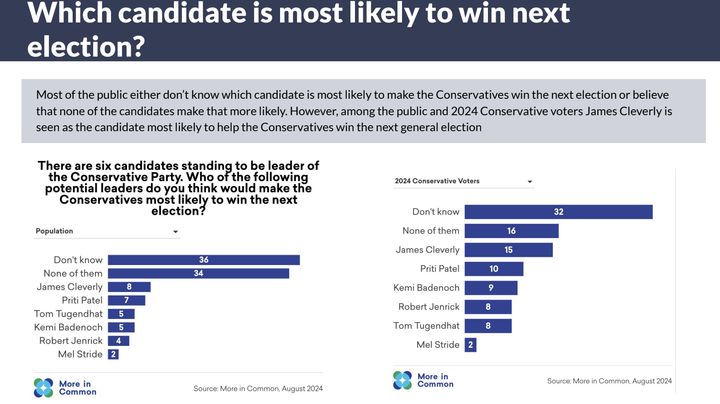
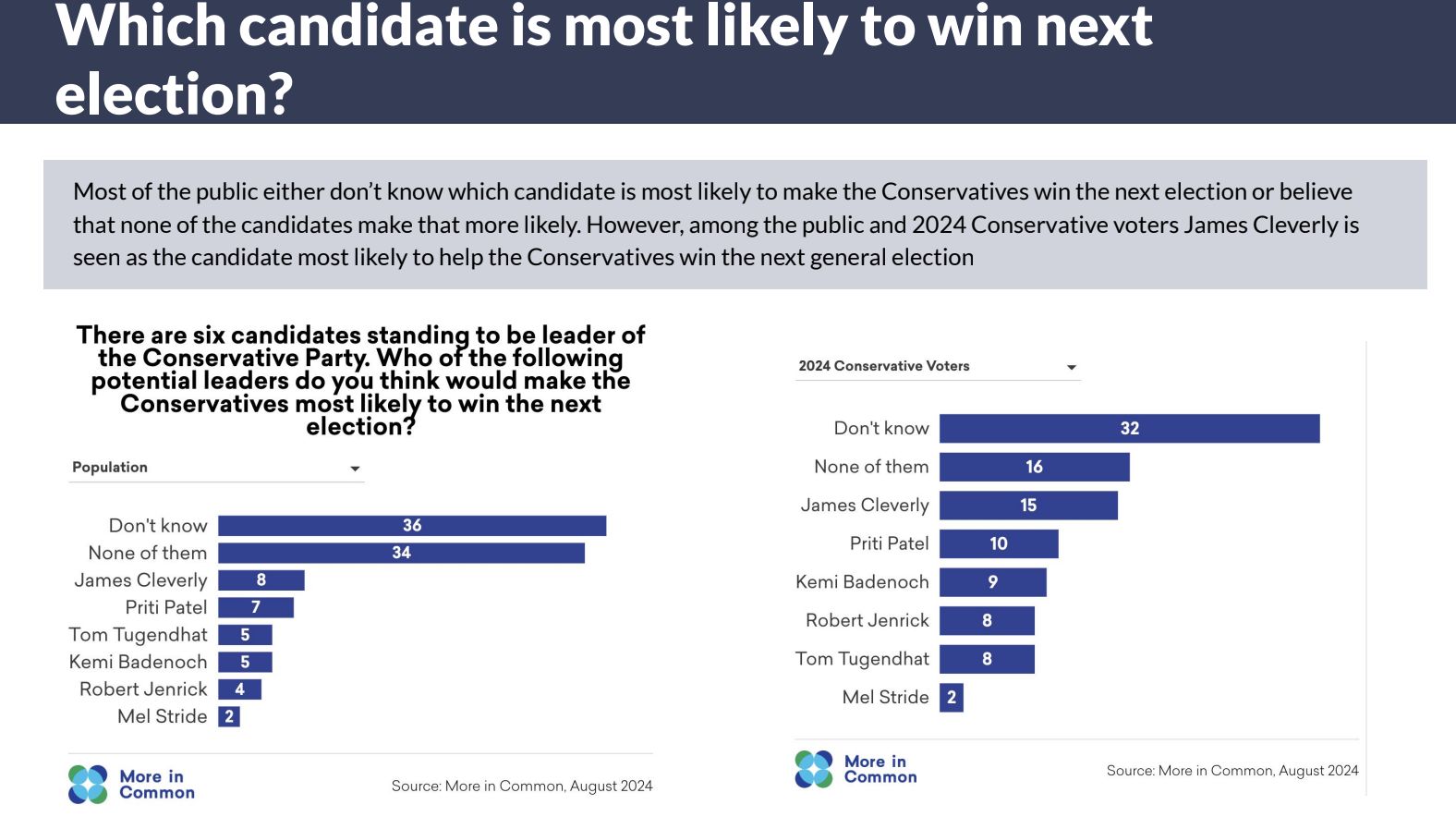
Fewer than 10% of the public think any of the Tory leadership candidates would make them favourites to win the next election, a damning poll has found.

The survey, by the More in Common think-tank, found that 34% of voters replied “none of them” when asked which of the six hopefuls would the Tories most likely to form the next government. Some 36% said they “don’t know”.

James Cleverly came top on just 8%, followed by Priti Patel on 7%, Tom Tugendhat and Kemi Badenoch on 5% each, Robert Jenrick on 4% and Mel Stride on just 2%.

Even those who voted Tory in the last election are less-than-convinced by the choice on offer, the poll found.

Nearly one-third of them (32) said they “don’t know” which candidate will give the party the best chance of winning next time around, while 16% said “none of them”.

Cleverly again came top on 15%, with Patel second once more on 10%, with Badenoch on 9%, Jenrick and Tugendhat on 8% and Stride once again on 2%.

The poll findings
The poll findings

More in Common

The poll also found that Patel is the only candidate recognised by more than half of the electorate.

Some 52% correctly identified the former home secretary when shown a picture of her, with 44% recognising Cleverly.

Badenoch came third with 37%, Jenrick was next on 21%, then Tugendhat on 19% and Stride with 12%.

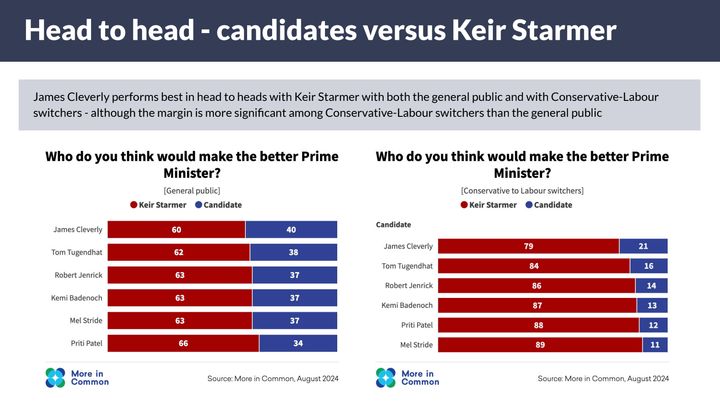
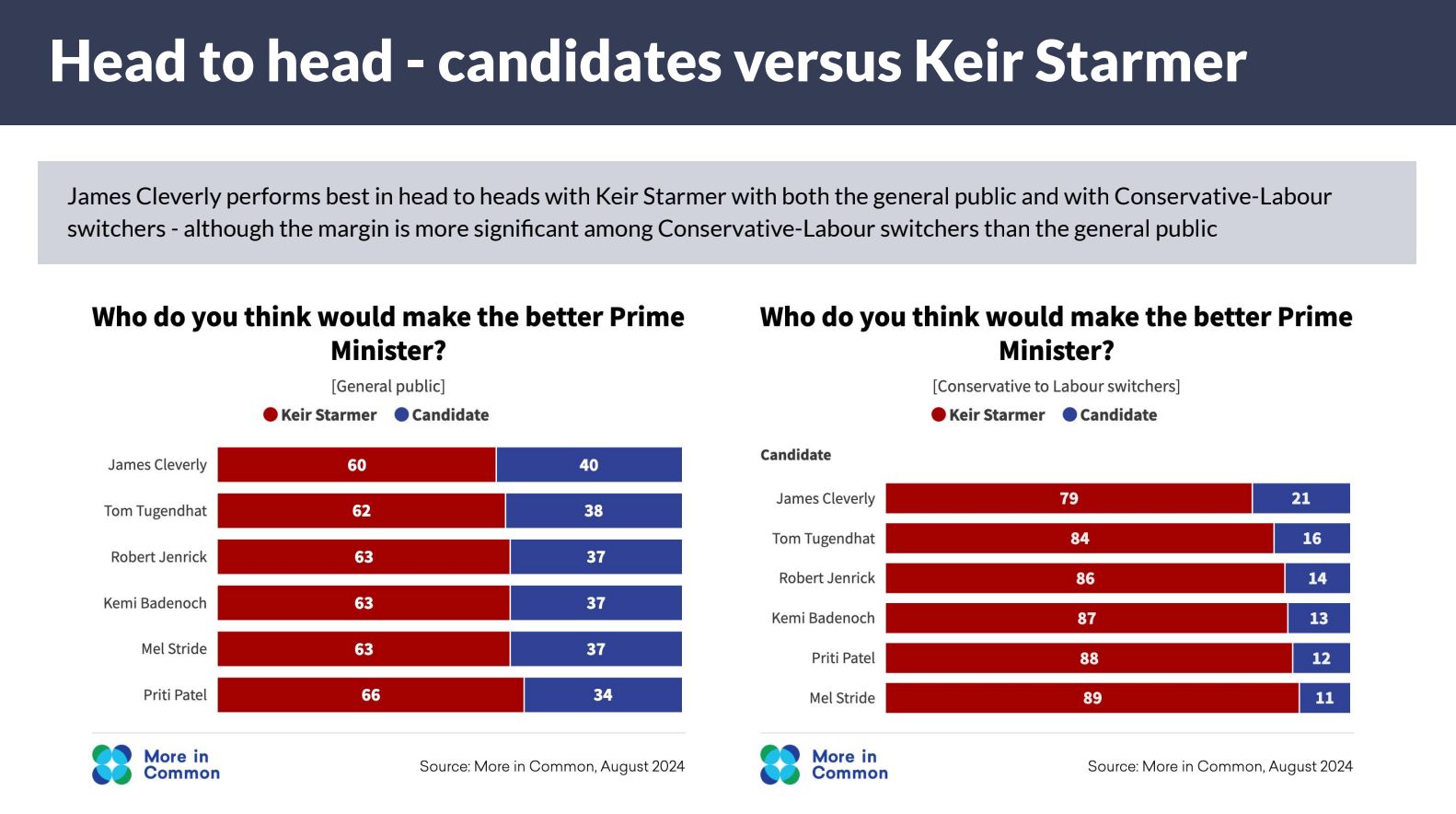
Whoever wins also faces an uphill battle when they take on Keir Starmer, the poll found.

According to the public, none of them would make a better prime minister than the Labour leader, who enjoys a comfortable lead over each of his potential rivals.

Starmer is ahead of each of the candidates on who would make the better PM.

More in Common

The findings were published as Tory MPs prepare for the first ballot of the contest, when the number of candidates will be reduced from six to five.

A second ballot will take place next week, after which the final four candidates will try to woo the party faithful at the Tory conference in Birmingham.

MPs will then choose the final two, who will be voted on my Tory members before the winner is announced on November 2.

Share Button

NHS trust apology after baby given wrong breast milk

The parents of baby Milo say he was given stored breast milk from another mother on three occasions.

Share Button

Winter virus vaccine rolled out for pregnant women and elderly

For the first time women who are at least 28 weeks’ pregnant will be offered the vaccine, which can protect newborns.

Share Button

Wearable heart monitor increases diagnosis of irregular heart rhythm

Wearable, long-term continuous heart monitors helped identify 52% more cases of atrial fibrillation compared to usual care, but that did not lead to a reduction in hospitalizations due to stroke, according to a study led by the Duke Clinical Research Institute.

The findings, reported Sept. 1 at the European Society of Cardiology meeting and published in the Journal of the American College of Cardiology, provide inconclusive data about whether atrial fibrillation screening lowers stroke rates. The COVID pandemic led to an early halt of the study before fully enrolling, so it did not have enough participants to establish definitive results about stroke.

“Atrial fibrillation is often undiagnosed and can increase the risk of ischemic stroke, which is largely reversible by oral anticoagulation,” said lead author Renato Lopes, M.D., Ph.D., a professor of medicine and member of the Duke Clinical Research institute.

“We still need definitive evidence that diagnosis of atrial fibrillation through systematic screening can lead to subsequent treatment with oral anticoagulation and therefore, lower stroke risk,” Lopes said.

The study enrolled approximately 12,000 patients in the U.S. who were at least 70 years old with no history of atrial fibrillation. Roughly half the patients were randomly assigned to receive a long-term (14 days) continuous monitoring device, and the other half usual care.

Over a median of 15 months of follow-up, the study reported a 52% increase in the number of cases of atrial fibrillation diagnosed among the device-wearers compared to those in usual care. There was no increase in rates of hospitalization for bleeding, and no significant reduction in the rate of hospitalizations for all stroke compared with usual care.

The study was originally designed to enroll 52,000 patients, which would have given it the power to determine whether screening reduces the numbers of strokes. A large study population is needed because strokes occur in a subset of patients with atrial fibrillation.

“Despite the inconclusive results, we have a lot of lessons learned that might inform future studies” Lopes said. He said the study’s design, which enabled patients to be enrolled and screened online in a virtual format with self-applied patch devices in their homes with only remote support, could be duplicated in future studies.

In addition to Lopes, study authors include Steven J. Atlas, Alan S. Go, teven A. Lubitz, David D. McManus, Rowena J. Dolor, Ranee Chatterjee, Michael B. Rothberg, David R. Rushlow, Lori A. Crosson, Ronald S. Aronson, Michael Patlakh, Dianne Gallup, Donna J. Mills, Emily C. O’Brien, and Daniel E. Singer.

The study received funding support from the Bristol-Myers Squibb/Pfizer Alliance.

Share Button