A majority of UK adults say they’ve dealt with stress so intense that it’s left them feeling completely overwhelmed.
And chronic stress – worries and/or pressures that keep you in a state of high alert for long, continuous periods of time – has been linked to worse health outcomes, like sleep issues and higher blood pressure.
Advertisement
Sometimes, though, chronic stress lasts so long that it can be hard to tell it apart from “regular life”.
Thankfully, Dr Bijal Chheda, a consultant psychologist and founder of Nos Curare, has shared seven signs your body might give to suggest you’re dealing with the ongoing issue.
1) Persistent headaches
“Stress is a well-recognised trigger for tension-type headaches because it can cause the muscles around the scalp and neck to remain tense,” the psychologist said.
Advertisement
“Over time, the nervous system may become more sensitive to these pain signals, meaning headaches that were once occasional begin occurring more regularly.”
If you’re experiencing this symptom, keep a diary detailing when the headaches happen, how long they last, and what, if anything, helps. If the problem keeps coming back or don’t improve, speak to your GP.
Advertisement
2) Stomach cramps
Yep – stress really can mess up your stomach. For instance, the NHS said, it can slow digestion down.
“During periods of prolonged stress, communication between the brain and gut can become disrupted, affecting how the gut functions,” Dr Chheda added.
“The bowel muscles may contract irregularly, triggering cramps and leaving the stomach feeling unsettled.”
Advertisement
If this happens, she advised that diaphragmatic breathing may help – though again, see your doctor if the symptom doesn’t let up.
3) Tense muscles
When we’re chronically stressed, “the body may remain slightly prepared for action, maintaining a low level of muscle contraction,” the expert explained.
“Over time, this can make it difficult for certain muscles to fully relax, leaving areas such as the shoulders or neck feeling tight.”
I know, I know: supposedly, everyone’s tired. But that doesn’t mean you have to accept constant low-level exhaustion, or that it’s normal.
“Under stress, the body shifts its energy towards responding to whatever feels threatening, and away from the processes that help it recover. This is why so many people under pressure find it difficult to fully relax, even when there is nothing immediate left to respond to,” the psychologist stated.
“Over time, chronic stress can become exhausting, causing even routine tasks to feel more physically demanding. Rather than trying to push through the fatigue, build short periods of genuine recovery into the day.”
Advertisement
5) Disrupted sleep
Though settling down for a good night’s sleep sounds relaxing, Dr Chheda said these quiet periods can make stressful thoughts louder. “This may also keep cortisol levels elevated later than usual, making it harder for the body to shift naturally into rest,” she said.
“As a result, falling asleep may take longer, while small disturbances may be more likely to wake you during the night.”
Following a consistent sleep routine, avoiding screens before bed, and a relaxing hobby like reading can all help, she ended.
Advertisement
But if the issue persists – you guessed it – it might be time to speak to a medical professional.
Did you know that our eyes make three types of tears – basal tears, which lubricate our peepers, reflex tears, which respond to stressors like onion fumes, and emotional tears?
Well, it turns out our sweat might take different forms depending on whether it comes from stress or a workout.
Advertisement
“When you’re exercising or sitting in a hot environment, your body mainly produces sweat to cool itself down. This comes from eccrine sweat glands, which produce a watery sweat that’s mostly made up of water and salt,” Dr Asiya Maula, a private GP at The Health Suite, told HuffPost UK.
“Stress is different. When you’re anxious, nervous or frightened, your body’s ‘fight or flight’ response kicks in.
Advertisement
“This activates a different type of sweat gland called the apocrine gland, which is found mainly in the armpits and groin.”
How can I tell eccrine vs apocrine sweat apart?
It can be hard to tell them apart, Dr Maula said. But stress, or apocrine, sweat has a different texture: this “contains more proteins and fatty compounds, making it thicker than the sweat produced during exercise”.
Additionally, “stress sweat” might have a more intense odour.
“Stress sweat itself is actually almost odourless when it’s first produced. The stronger smell develops when bacteria naturally living on the skin break down those proteins and fats,” the GP explained.
Advertisement
“That’s why many people notice stress sweat has a much more noticeable odour than the sweat they produce after a run or a gym session”.
Of course, context helps – “If you suddenly notice damp palms before a presentation, sweaty underarms during an important meeting or increased sweating while you’re feeling anxious despite not being physically active, stress is likely to be playing a role.”
But the speed of onset might matter too, Dr Maula said.
“People often describe stress sweat as appearing very suddenly and affecting areas like the palms, soles of the feet and underarms, even when the room isn’t particularly warm.”
Advertisement
What does stress sweat mean?
Well, aside from meaning that you’re – you guessed it – stressed, the doctor said occasional apocrine sweat is nothing to worry about.
But “if you’re finding yourself sweating excessively during everyday situations, or you notice it’s becoming more frequent alongside symptoms such as poor sleep, constant worrying, palpitations or feeling on edge most of the time, it may be a sign that your stress levels are becoming difficult to manage”.
That’s worth speaking to your GP about, she said.
How can I stop stress sweat?
Unfortunately, it’s not possible to stop stress sweat in the moment.
But if you want to try reducing your stress levels overall, Dr Maula said you can try “Regular physical activity, good quality sleep, limiting excessive caffeine, mindfulness techniques and breathing exercises can all help reduce activation of the body’s stress response”.
Advertisement
And, she ended, “For people whose sweating is particularly severe or affecting their quality of life, there are also medical treatments available, so it’s important not to suffer in silence”.
Whether it happens on your postprandial fart walk, right in the middle of yoga class or while you’re sleeping, everyone — even the poshest among us — farts.
According to Dr. Satish Rao,professor of Medicine at Augusta University’s Medical College of Georgia, the average person farts seven to 24 times a day.
Advertisement
“It’s a normal physiological phenomenon,” he said, explaining flatulence as the byproduct of fermentation in the colon.
That fermentation creates gas, which is a mixture of nitrogen, oxygen, carbon dioxide, methane, hydrogen and more. One surprisingly smelly fact is that more than 99% of farts are odourless, but a foul smell comes from trace sulphur compounds. Unfortunately, our noses are extremely good at detecting sulphur, even in microscopic amounts.
Once that gas is formed, Rao said there are only two options for it to escape. “Some gas will move from the lining of the colon to the bloodstream, then get exhaled by the breath,” he said. “But the other pathway out is the fart. The gas will find its way out eventually, and if you produce a lot of gas too quickly, it won’t be absorbed, but will automatically push its way out through the anus.”
Advertisement
In general, a few farts a day are nothing to worry about, said Dr. Cait Welsh, postdoctoral researcher from Monash University and the Hudson Institute of Medical Research. “Most of the time, the release of gas is a healthy sign that digestion and gut microbiota are happy and functioning well.”
While you produce gas all day long, you’re more likely to let ’em rip during sleep, when your anal sphincter relaxes and gas escapes more easily.
Which People Are The Gassiest?
It might be hard to think of King Charles or the Pope as real toot machines, but Rao is positive that anyone who eats food, especially carbohydrates, is going to fart at least some time during each day. And some of us are certainly more, um, productive than others, said Dr. Folasade P. May, associate professor of Medicine at University of California Los Angeles.
Advertisement
“People who chew a lot of gum, drink carbonated drinks or eat too quickly may swallow more air, for example, which can cause flatulence,” she said. “Other people have gut bacteria that produce more gas. Diet, how fast you digest, and medications can also change how much gas you make and pass.”
If you’re thinking that President Donald Trump is making you fart more, you might be right. (Fun fact: An old Australian slang word for a fart is a “trump.”) Stress or anxiety, about the current political climate or matters closer to home, can have an impact on how much someone farts, May said.
“Especially in people with irritable bowel syndrome or other functional gut disorders, stress can change how fast we eat and digest, making flatulence seem worse,” May explained.
Advertisement
krisanapong detraphiphat via Getty Images
Stress can increase your flatulence, according to gastro doctors.
Foods That Can Up Your Fart Count
Dr. Ed Giles, a pediatric gastroenterologist and associate professor of pediatrics at Monash University, noted that the most well-known foods to cause gas are the so-called FODMAP foods, an acronym for Fermentable Oligosaccharides, Disaccharides, Monosaccharides and Polyols.
The key term for these carbohydrates, Giles said, is “fermentable.” That means the foods have an ability to produce gas. “They feed the bacteria in the gut and the bacteria produce the gas, including methane, which smells,” he said.
Advertisement
May outlined some of the worst FODMAP culprits: beans, lentils, onions, garlic, crucifers like broccoli and cabbage, and some whole grains and fruits. “If you’re lactose intolerant, consuming dairy can also increase gas production,” she said.
When To Be Concerned
Gas is concerning when it’s painful, disruptive or different from your normal pattern. If you’re regularly releasing gas more than 23 or 24 times a day and it’s causing problems, it’s worth investigating. However, some people may experience more flatulence than that and it’s still considered normal; it all depends on your diet and your personal health factors.
“The most important thing is that if excessive flatulence is persistent or accompanied by pain, weight loss, diarrhea or blood in the stool, it’s worth consulting a clinician for evaluation,” May said. “If gas is persistent or accompanied by these other warning signs, a clinician can help sort out causes.”
Advertisement
Some of the conditions a health care professional will want to rule out include celiac disease, inflammatory bowel disease, irritable bowel syndrome, lactose or other food intolerances, pancreatic enzyme insufficiency and small intestinal bacterial overgrowth. Connective tissue disorders like Ehlers-Danlos syndrome and other diseases like multiple sclerosis also come with increased flatulence.
You might be asked to keep a food journal and, yes, even count the number of farts you produce each day. Luckily, there are now several apps to help you do this, including Gaslog, FlareCare, Gutly and Vitalis. These apps aren’t medical diagnostic tools, but might help you spot patterns in how your diet and lifestyle contribute to gas symptoms.
And just keep in mind that everyone — every single one of us — has experienced an ill-timed fart, and lived to tell the tale. So unless your gas comes with pain or surprises, you’re probably just doing what everyone else is doing, too.
Most of us know about the “fight or flight” response, the body’s built-in survival instinct. But that framework leaves out two other common ways the nervous system reacts to stress.
Indeed, psychologists say there are four instinctive reactions that help us understand how people cope with feeling unsafe, overwhelmed or emotionally flooded.
Advertisement
“The ‘four F’s’ – fight, flight, freeze and fawn – refer to automatic nervous system responses to a perceived threat,” Caitlyn Oscarson, a licensed marriage and family therapist, told HuffPost. “These are ingrained responses that can show up in traumatic situations, as well as everyday stress and overwhelm.”
The four stress responses occur when our bodies are in survival mode, so we aren’t using the reasoning centre of our brains. Thus, we may act in ways that don’t seem logical or reflective of our typical values.
“They’re not personality traits, and they’re not conscious choices,” said board-certified psychiatrist and Practical Optimism author Dr. Sue Varma. “They’re automatic survival strategies wired into the brain and body. When someone feels unsafe, overwhelmed or emotionally flooded, the nervous system steps in and tries to protect them the best way it knows how.”
Advertisement
In this sense, your stress response can offer insight into your past experiences and what your nervous system learned over time to keep you emotionally or even physically safe. Most people don’t have just one response, and their automatic reaction might vary based on context. You might fawn at work but freeze at home, for instance.
“All four responses are adaptive,” Varma said. “They develop for a reason, often early in life, and they’re attempts at self-preservation, not signs of weakness. It is interesting, however, to note if a person has a particular go-to response, that is very telling.”
Although you might have one or two default stress responses in different situations, you ultimately want to work on flexibility to gain access to all four because each can serve a purpose at various times. No one stress response is inherently better or worse. The goal is to help your nervous system understand it has options.
Advertisement
“An individual’s stress response is not their personality but rather their nervous system’s autobiography, and like with any life narrative, it can be changed to have more options to address stressful situations,” said Lora Dudley, a licensed clinical social worker with Thriveworks.
Fight, flight, freeze and fawn are not character flaws, and with mindfulness and therapy, you can learn to choose and be more flexible with your responses. Ultimately, awareness is the first step.
“Once you understand your patterns and how they are tied to your nervous system response, it becomes easier to slow down, be compassionate toward yourself and act with intention rather than reflexively,” Oscarson said.
Advertisement
With that in mind, HuffPost asked the experts to break down each of the four stress responses, how they manifest and what someone’s defaults might say about them.
Fight
“In my patients, the fight response often shows up as anger, irritability, defensiveness or a strong need to control a situation,” Varma said. “Someone might argue more, push back quickly or feel constantly on edge when they’re under stress.”
There can be physical aggression and tension but also yelling and argumentativeness in moments of disagreement or stress.
Advertisement
“This is the ‘come at me’ response,” said Erin Pash, a licensed marriage and family therapist and founder of Pash Co., a company focused on social health.
“You might notice yourself getting argumentative, defensive or aggressive. Your jaw clenches, your voice gets louder, you feel heat in your chest. In everyday life, this might look like snapping at your partner over something minor, getting road rage or having a disproportionate reaction to feedback at work.”
Igor Suka via Getty Images
The body’s natural stress responses go beyond fight or flight.
Advertisement
So what might it say about you if you lean toward confrontation and feel the urge to argue and defend yourself when you feel misunderstood?
“For fight responses, it doesn’t necessarily mean that a person is aggressive or violent,” Oscarson said. “It means that their nervous system activates under threat, and they have learned that taking action is necessary for self-protection. Pushing back, arguing and taking control are ways of creating order in chaos and stress.”
She added that fight-inclined individuals might have a strong sense of justice and fairness and even leadership skills. Past experiences may have taught them that the way to feel safe is to stay alert, push back and stand your ground.
Advertisement
“Maybe you grew up in an environment where you had to defend yourself or your boundaries aggressively, or where conflict was how things got resolved,” Pash said. “The challenge is when this response fires in situations that don’t actually require battle mode.”
Flight
“Flight is characterised by attempts to escape from a threatening situation,” Oscarson said. “It may show up as passiveness, distractedness or avoidance.”
She gave the example of putting off or deflecting emotional conversations.
“You might cancel plans, ghost people, stay ‘too busy’ to deal with difficult conversations or develop sudden urgent tasks when conflict arises,” Pash said. “Physically, you might feel restless, unable to sit still or like you need to run.”
Advertisement
Therapist Natalie Moore compared the way this response manifests in modern human civilisation to how it plays out in the animal world.
“In the wild this looks like actual running, whereas in modern times this manifests as emotional running away – such as ghosting a friend who hurt your feelings, turning away from intimacy in a relationship or running away from your problems through avoidance behaviours like addiction or emotional numbing,” she said.
Those who lean into flight mode might also need constant distractions like screens or video games.
“With a flight response, an individual will try to escape the situation both internally and externally,” said psychologist Doreen Dodgen-Magee. “They may appear to deny what is happening, avoid conflict and the direct expression or working through of big feelings and may be anxious and fearful.”
Advertisement
They might also become hyperproductive.
“I see this in people who stay busy, overwork, overplan or distract themselves constantly,” Varma said. “Sometimes it’s literal leaving, and sometimes it’s mental checking out.”
Social isolation and withdrawing from everyday life can also be signs of a flight response.
“People who tend toward flight have learned that anticipating and avoiding conflict is the best way to stay safe,” Oscarson noted. “They may use productivity and business to keep others at a distance. They appear hardworking and responsible, which is often admired and praised. They also tend to be independent and self-sufficient.”
If this is your instinct, it might be because your nervous system learned that escape or avoidance was an effective survival strategy.
Advertisement
“This can develop when leaving or avoiding actually did make you safer, or when engagement led to worse outcomes,” Pash said. “It’s often paired with anxiety and hyper-vigilance – always scanning for exits and threats.”
Freeze
“To freeze would be to shut down such as by going numb, dissociating or being indecisive,” said Hallie Kritsas, a licensed mental health counsellor with Thriveworks.
Essentially, your nervous system hits pause or shuts down in stressful or trauma-fuelling moments.
“You can’t think clearly, can’t speak up, feel paralysed in decision-making,” Pash said. “People often describe feeling like a deer in headlights – their mind goes blank, they dissociate or they become physically immobile. This might manifest as procrastination, shutting down during arguments or going numb when overwhelmed.”
Advertisement
They might feel low motivation or a sense of being “stuck,” which makes it hard to start a task. It might even seem like they don’t care what’s happening.
″‘Freeze’ can be presented in feeling stuck, numb, inability to act or speak with the purpose being to pause or be unnoticed when there is not a manner to escape the threat,” Dudley said.
The freeze response is very common and often misunderstood, Varma noted, adding that it tends to be a sign of nervous system overload.
Advertisement
“I often see people who experienced overwhelm without enough support,” she explained. “Shutting down became the body’s way of coping when there were no good options available. These individuals are often deeply sensitive and strongly affected by their environments.”
When fighting back or escaping a stressful situation isn’t safe or possible, people often freeze as a way to conserve energy in their state of powerlessness and overwhelm.
“Freeze often develops when we faced threats we couldn’t fight or flee from – particularly in childhood when we were smaller and dependent on adults who were also the source of threat,” Pash said. “It’s also common in people who were punished for showing emotion or who learned that their reactions ‘made things worse.’”
Advertisement
Fawn
“Fawn is the one many people don’t recognise in themselves right away,” Varma said. “It shows up as people-pleasing, over-accommodating, minimising your own needs or trying to keep the peace at all costs. I see this a lot in people who are highly empathetic and tuned in to others’ emotions.”
With fawning, people tend to over-apologise, agree on things they don’t actually agree with and abandon their boundaries. There’s a sense of passiveness as they prioritise others’ needs and emotions and sacrifice their own.
“An example of fawning is feeling responsible for managing other people’s emotions,” Oscarson said.
Those who fawn may have learned that safety depends on keeping others happy or calm.
“Maybe you grew up walking on eggshells around someone’s mood, or you learned that your needs didn’t matter as much as maintaining peace,” Pash said. “Fawning is incredibly common in people who experienced childhood emotional neglect or had caregivers with big emotions they had to manage.”
Advertisement
With fawners, being “low maintenance” or minimising yourself feels like the way to keep the peace, which is the key to emotional and/or physical safety.
“Many of these patients learned early on that maintaining harmony or avoiding conflict protected them from rejection or emotional fallout,” Varma said.
The idea is to be helpful, agreeable or “easy” to others.
“If one fawns, they have learned that safety comes from seeking approval,” Kritsas echoed.
Consequently, they might have learned to be highly intuitive and sensitive to social cues.
As Oscarson put it, “they probably have a hard time when someone is upset with them or disagrees with them, as they view any misalignment as threatening to the relationship and therefore their safety”.
Whether you love or loathe Christmas, it’s hard to deny just how stressful the season can be. Gathering gifts, decorating, reconnecting with family members and if you’re hosting Christmas Dinner… SO much prepping.
Even with all the best intentions, this stress can really take a toll and prevent you from enjoying the holidays which feels like it defeats the entire point.
Advertisement
Thankfully, one psychologist, Nathan D Iverson PhD has found a way to apply the leadership value of 70-20-10 to holiday stress and you know what? It just might be the solution we’ve been looking for.
The 70-20-10 rule for Christmas stress
70% – ‘hard moments we didn’t choose’
We are ALL familiar with them. An established couple being asked when they’re planning to have a child, a flustered family member trying to please everybody or even just falling back into family dynamics you thought you left behind in childhood.
Petty sibling arguments, anyone?
Iverson says: “For most of my life, and still right now, I’ve experienced these moments as obstacles to a peaceful season. But lately, I’m trying—imperfectly—to see them as part of my growth instead of proof of my shortcomings.
Advertisement
“Psychologists call this a learning orientation—seeing challenges as opportunities to grow rather than threats to avoid. It doesn’t make the moment easier. But it does change how we make meaning of it.”
It sounds like it makes perfect sense but I reckon it’ll take some practice to get used to.
20% – ‘The people who help us make sense of things’
A sneaky heart-to-heart with your favourite auntie or words of wisdom from your mum, these quiet corners of conversation can help us to make sense of our own feelings, according to Iverson.
Iverson says: “Often, they help us laugh a little at ourselves—which is a form of grace we don’t give enough credit.
Advertisement
“I rely on these conversations far more than I admit. They turn holiday tension into insight. Without them, the moment just stays a moment. With them, the moment becomes meaningful.”
10% – ‘The tools we bring with us’
Finally, this is a little work you must do yourself. Learn how to control your stress, your big feelings and how to empathise with even your most frustrating family members.
Iverson assures: “These tools rarely show up perfectly in the moment. But afterward, they help us reflect with less shame and more clarity.
Advertisement
“Knowledge alone doesn’t change us—but it supports the slow work that does.”
There’s no such thing as the perfect workplace – but if yours is far from perfect, then it may well be keeping you up at night.
It’s not always obvious, but there are plenty of signs that workplace stress is seeping into your life – with it even affecting your sleep.
Advertisement
Speaking exclusively to HuffPost UK, sleep expert Martin Seeley, from MattressNextDay, walks us through five “red flag” signs that could indicate your work stress is impacting you more than you might think.
Waking at the same time in the early hours every morning suggests that cortisol levels are peaking sooner than they should be.
“When you are in a heightened state of stress throughout the day, your body will remain in that state even when it’s time to rest. If you find yourself waking at odd hours, it may be worth evaluating if the workplace is to blame,” says Seeley.
Advertisement
Sleepless Sundays
We all know about the Sunday scaries – that feeling where dread sinks in on the last day of the weekend ahead of your Monday return to work.
Advertisement
But if you always struggle to fall asleep on a Sunday, even when sticking to your usual sleep routine, it’s very likely to be because of work.
The Sleep Foundation polled people who said Sunday is the hardest night to fall asleep and, of these, 63.9% cited next-day worries as a key factor in their Sunday scaries and 55% of these linked their worries to their jobs.
It’s no surprise that it can impact sleep, really – the thought of returning to work after the weekend triggers a stress response in the body as the brain visualises the upcoming pressures of the working week.
Advertisement
Seeley suggests that analysing whether feelings of stress gradually rise throughout the weekend is a great way to assess whether the thought of approaching a new week is impacting your wellbeing.
Workplace nightmares
Plenty of us spend most of our time at work, so it’s no surprise that, on occasion, we’ll dream about it. However, if you are dreaming of work several times a week and the dreams are more nightmarish than pleasant, it could be a warning sign that it’s impacting your overall health.
Seeley explains: “If the content of your workplace dreams are always surrounded by negativity such as missing deadlines, oversleeping, or even being fired, it suggests that workplace stress is engrained in the subconscious mind as the brain is not able to successfully disconnect from the workplace.”
Having consistent late nights: Even though you know you should go to bed earlier, you find yourself staying up late almost every night.
Feeling tired but resisting sleep: You might be exhausted, but you’re unwilling to go to bed because you want to enjoy some “me time.”
Engaging in low-value activities: You might find yourself scrolling through social media, watching mindless TV, or playing video games for hours on end.
Feeling guilty or regretful in the morning: You might wake up feeling tired and regretting your late-night choices.
“If you are staying up late and engaging in non-work-related activities, even though you know you need to wake up early, it can signal that you feel you have no or little control over your work/life balance and choose to delay sleep to recoup a sense of autonomy,” warns Seeley.
Advertisement
You have a weekday sleep schedule and a weekend schedule
If you sleep for several hours throughout the weekend to counteract work week sleep deprivation, this is a “clear sign” that your job is impacting your sleep cycle, adds the sleep expert.
“This scenario is often referred to as ‘social jet lag’ and can be incredibly disruptive to your overall health,” says Seeley.
“The body favours structure, and when your weekday sleep schedule is dramatically different from your weekend sleep routine, it leads to exhaustion and decreased cognitive function.”
Advertisement
What can you do about it?
It’s not always possible to just quit a job and start fresh (because time, money, job availability, etc.), so what can you do if your workplace is impacting your sleep? Seeley recommends the following:
Establish boundaries. Refrain from checking emails or working late into the evening to prevent stress from transitioning into bedtime.
Structure a nighttime routine. Take part in calming activities before bed, such as reading, meditating, or taking a warm bath, to signal to your body that it’s time to wind down.
Advertisement
Maintain a consistent sleep schedule. Try to go to bed and wake up at the same time every day, even on weekends, to regulate your internal body clock.
Seek professional support. If workplace stress is leading to chronic insomnia or anxiety, consult a sleep specialist or mental health professional for guidance.
You’ve heard of fight or flight but do you know the third stress response? It’s called a freeze response and it’s more common than you’d think. Put simply: the freeze response renders sufferers immobile. This is an acute stress response, much like the fight or flight response.
What Happens During A Freeze Response?
A freeze response is actually a different physiological process than fight or flight. Researchers describe the response as ‘attentive immobility’ as when the person is in a ‘freeze response’, they are unable to move or take action against real or perceived danger. During a freeze response, sufferers experience:
Advertisement
Physical immobility
A drop in heart rate as opposed to the increase found in fight or flight
Muscle tension
What Causes People to Freeze?
While it may seem like a counterintuitive reaction, the freeze response, it does serve a purpose and is rooted in some of our most primal instincts
Research in 2017 suggests that the freeze response is similar and potentially related to disassociation. This is something that can occur when somebody goes through a particularly traumatic event. It makes the event feel less reason, causing the person to feel detached. This makes sense given that the freeze response is more common in people that have had traumatic experiences.
Are You Stuck In Freeze Mode?
While this sounds like a response to external triggers that won’t impact your day-to-day life, anxiety sufferers can be triggered into a stress response due to their nervous systems being overwhelmed. So, for what would usually be a small, inconsequential thing can set off the symptoms of a freeze response.
Advertisement
This can be especially stressful if you’re trying to get on with your daily life and work. According to psychologists, people stuck in Freeze Mode will find themselves feeling heavier, struggling to ‘get going’ with work or household tasks and will often stay in the same place feeling frozen for long periods of time. Of course, not being able to do the things that are usually second nature comes with its own issues such as guilt, frustration and low mood – all of which can compound the freeze response even further.
How To Snap Out Of Freeze Mode
While this can understandably feel inescapable for sufferers, freeze mode is something that you can bring yourself out of. The first thing you can do to help yourself, which may help to gain some clarity, is recognise that what you’re experiencing is freeze mode.
Be mindful of the symptoms that you’re experiencing and then acknowledge them for what they are. This creates a barrier between you and the response. Next, start at your toes and slowly move parts of your body all the way to your head to reconnect with your body and break free from the disconnect that freeze mode creates.
Finally, do something completely different in a different room. This could be pouring yourself a glass of water, washing your face or simply opening a window.
Be gentle with yourself in the days following a freeze response In the hours and days following a freeze response, you may feel tired, aching and even have some residual anxiety.
With both Christmas and New Year’s Day falling on a Sunday this year, the following Monday and Tuesday become bank holidays – which means the day you get paid will be moving.
The majority of companies opt to move their December pay date forward in this situation, which can feel like a real festive treat for employees at the time.
Advertisement
But come January, when you’ve potentially had 40 days or more between pay cheques, the disruption to your usual budget can really hit hard.
6 days until Christmas pay day, 100 days until January pay day 😂😭
Now they have rushed to pay you December Salary very early it’s sweeting you…remember that money is what you will use to work till pay day on the 66th day of January next year…Don’t spend like a theif then start disturbing others in January…Let’s all respect ourselves.
All this means that preparing for the inevitable Christmas pay gap is even more essential than usual.
If you’ve already been paid this month, try to avoid using those early funds to pay for last-minute Christmas gifts and extras that aren’t essential.
To help with budgeting, Mat Megens, CEO of money-saving app HyperJar, recommends dividing your December salary into five as soon as it hits your account.
“If you’re used to a monthly salary lasting four weeks you can come unstuck when you’re paid earlier than usual in December,” he tells HuffPost UK.
Advertisement
“So make sure you divide what you have by five (depending when you’re paid) – not four – to get you through to that next pay cheque at the end of January.”
Don’t forget to spend your December pay wisely, January payday isn’t for another 56 nights so be smart
If you receive Universal Credit alongside your salary, a shift in pay date can also change the benefits you receive – something to factor into any budgeting.
Advertisement
Anna Stevenson, senior benefits specialist at the charity Turn2us, explains: “Unfortunately, if you’re on Universal Credit, this can cause problems, because it might look to Universal Credit that you got twice as much pay in the month as you actually did.
“Your employer is supposed to report pay on the usual pay date, even when they pay early but it might be a good idea to remind them of this and point them to the HMRC guidance.”
If you think your Universal Credit payment has been cut in January, Stevenson advises contacting the Department for Work and Pensions (DWP) to explain what has happened.
“If it has been cut, be sure to ask for an RTI (real time information) dispute,” she says.
“This means that the DWP can investigate and re-assign your missing payment to your next month’s payment. It is worth noting this can take over a month to rectify, so it is best to talk to your employer before you are paid to prevent this happening.”
Others have shared their own tips on social media, such as setting some money aside and ‘paying yourself’ on your usual pay date.
Advertisement
I stick mine in my easy access saver and then transfer it back to my current account at the end of December in line with normal pay day. Stops the temptation to use some of it to “help” with Christmas costs! https://t.co/VkZrhoVMH7
Megens provides us with these further tips for staying on top of your budget when your pay date has moved:
Swap brands for supermarket own-label Food is one of our biggest monthly expenses. You can save around £40 in January by swapping big brands for supermarket own-label equivalents.
Forget regifting… resell instead If you don’t have gift receipts, head to auction sites like eBay, or try Depop and Vinted for clothes and accessories, to get some cash back in your pocket in January.
Have a strategy for the sales Set yourself a limit if you’re spending in the Boxing Day and New Year sales and don’t get carried away. Only buy what you’ve planned for, and double check the price now so you’re sure you’re getting a genuine bargain.
Take control: plan for pressure points Use any downtime between Christmas and New Year to take your first budgeting steps into 2023. Plan for the year’s financial pinch points – those big expenses that come up every year, like house insurance, holidays and Christmas. Note when they’re due and how much you need to start putting aside to pay for them and avoid getting into debt.
And if you’re doing all that and you’re still worried about money, Stevenson says it’s worth checking whether you’re eligible for state support.
Advertisement
“Millions of people miss out on thousands of pounds each year because they’re not sure what they’re entitled to,” she says – urging people use the free Turn2us Benefits Calculator to find out what extra help may be available to you and your family at this time.
If you have ever felt like a full day of back-to-back meetings was draining your life force, you’re not alone.
Many of us dread a packed work calendar. Wasting too much time in meetings is a distraction preventing 67% of professionals from making more of an impact, according to a 2019 survey of nearly 2,000 people by organisational consultancy Korn Ferry.
Advertisement
But it’s not just that a high number of meetings can give us feelings of anxiety. There’s actually research that shows how attending too many — and seldom taking breaks — can cause our brains to work differently.
Study Finds Stress Levels Spiked Amid Back-To-Back Meetings
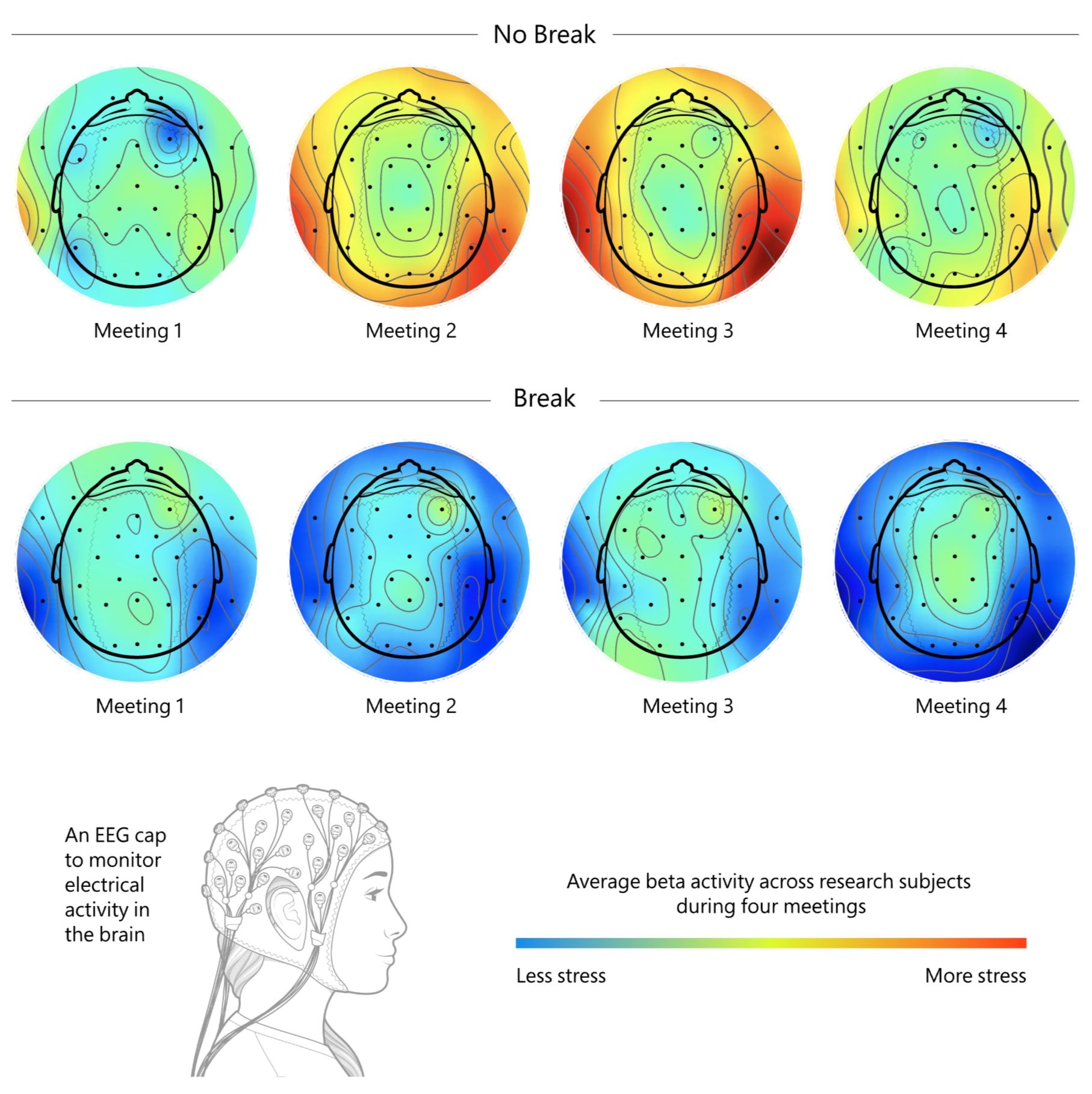
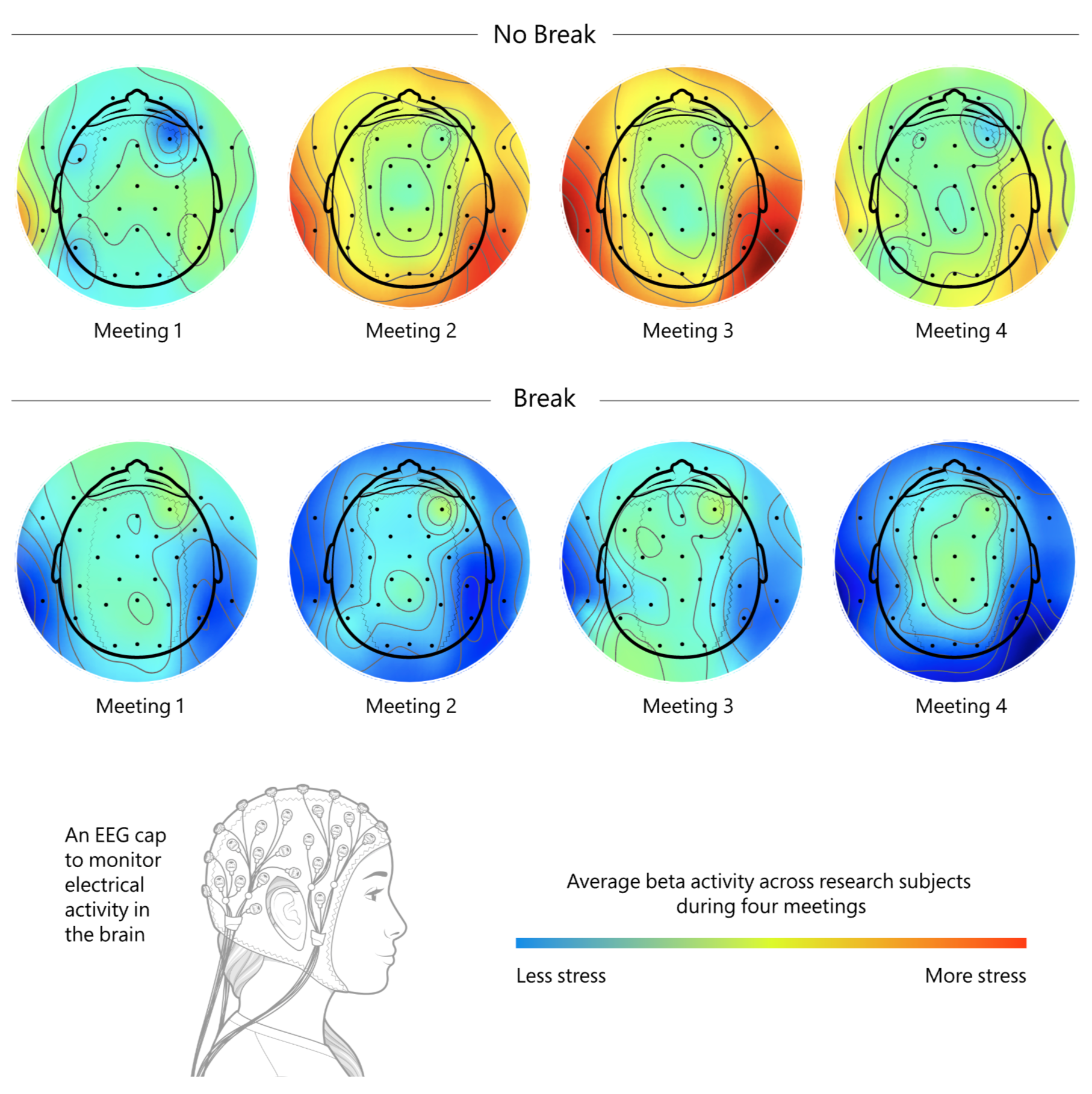
In 2021, researchers at Microsoft’s Human Factors Lab asked 14 people to take part in video calls while wearing electroencephalogram equipment that monitored electrical activity in their brains. On one Monday, some participants were given four half-hour meetings without breaks, while others had four half-hour meetings with a 10-minute break between each for meditation; then, on the following Monday, the two groups switched.
Among those who got no breaks, beta wave activity increased in the brain with each successive meeting, indicating heightened stress levels. In fact, just the anticipation of the next call caused a spike in beta activity during the transition period between meetings, researchers found.
Brown Bird Design
In a Microsoft study last year, beta wave activity increased in the brains of people who had successive meetings with no breaks, indicating a rise in stress. Beta activity remained stable in those who took 10-minute breaks.
Advertisement
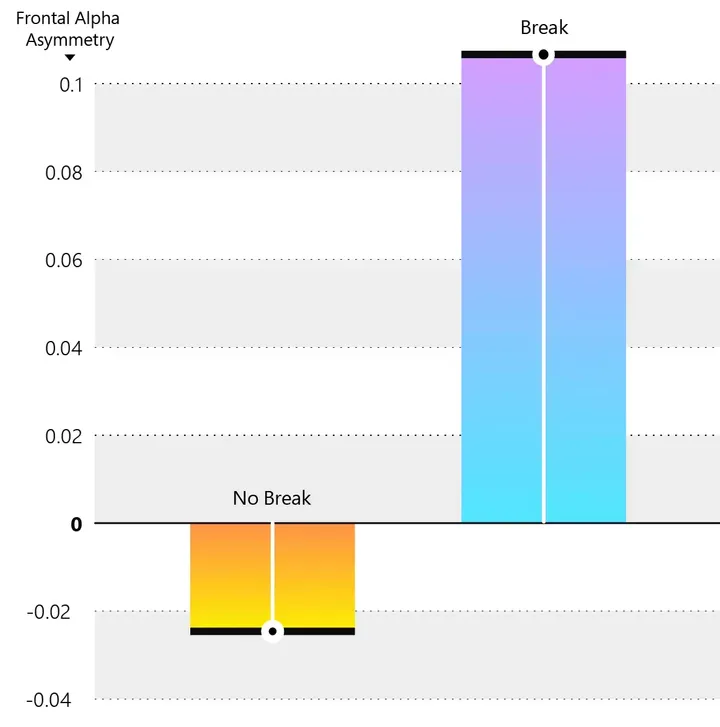
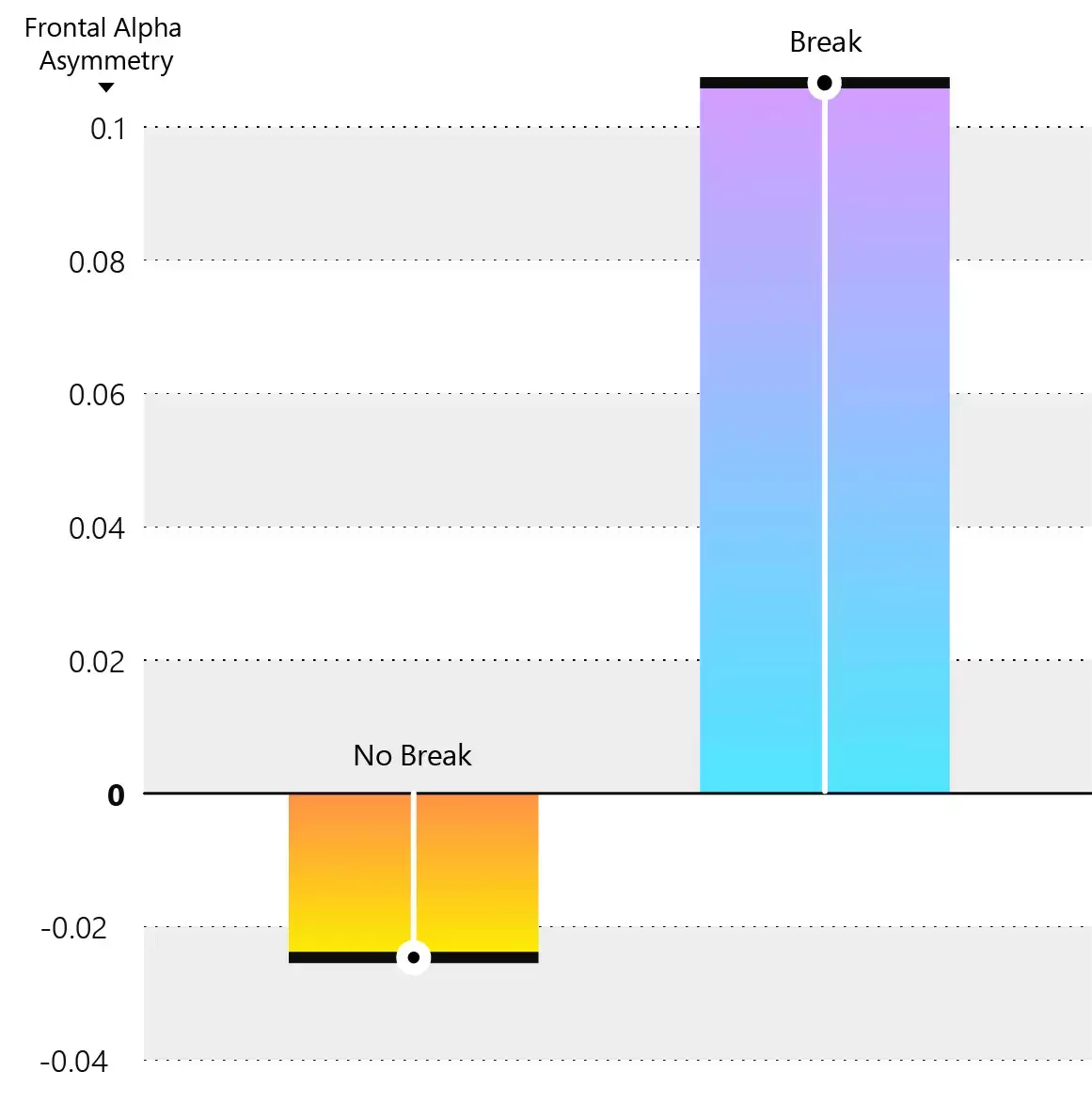
Meanwhile, the researchers also measured the difference in right and left alpha wave activity over frontal regions of the brain — known as frontal alpha asymmetry — which can indicate levels of mental engagement.
Participants who took breaks showed positive frontal alpha asymmetry, suggesting higher engagement during the meetings, while those without breaks had negative asymmetry, indicating that they were more mentally withdrawn.
Valerio Pellegrini
When study participants had breaks between meetings, their brains showed signs of higher engagement.
“I’m not surprised that people who took breaks between meetings felt better. People who take breaks in general feel better,” said Laura Vanderkam, a time management expert and the author of “Tranquility by Tuesday: 9 Ways To Calm the Chaos and Make Time for What Matters.”
“We all take breaks one way or another; it’s just [that] many times they’re unconscious. By choosing when and how to take a break, you notice the break happening and reap the rejuvenation,” Vanderkam said.
Advertisement
One big caveat to Microsoft’s findings, of course, is that the sample size of participants was small. But the study aligns with a large body of other research suggesting that meeting overload causes unproductive, unhappy employees who feel like their schedule is ruling their life.
In a recent survey of 76 companies, for example, management researchers found that employee productivity more than doubled when meetings were reduced by 40%.
“This is largely because employees felt more empowered and autonomous,” the researchers wrote in March for Harvard Business Review. “Rather than a schedule being the boss, they owned their to-do lists and held themselves accountable, which consequently increased their satisfaction by 52%.”
Making The Most Of Breaks In Meeting Marathons
If you’re looking for ways to make your own breaks more impactful, try to resist scrolling on social media or reading your email, experts said.
“Many people check email between meetings as a form of a break, and I get that,” Vanderkam said. “But [it is] even better to batch email at some point in the day, or only do it between every other meeting, and use those little bits of time for something else that will add joy and meaning to your life, like a 10-minute walk outside.”
Advertisement
Holistic health coach and mindfulness teacher Rosie Acosta recommended a relaxation technique in which you breathe in for three seconds and out for six, repeating as necessary.
“You only need to do three to five cycles before your body starts to respond and release tension,” she said. “Most of us sit at computers a lot. So if you do sit, perhaps use this time to stand and stretch. The biggest way to reset is to shut down the distractions.”
And if you’re a manager, try setting your teams up for success by avoiding marathon meeting days and building in more breaks.
“To make 10-minute breaks work, it’s helpful for organisations to set a culture that meetings start at, say, the hour and end 10-15 minutes early,” Vanderkam said. “That allows for a break or a ‘passing period’ like in a high school for people who need to travel.”
The big takeaway? It’s better to take a short breather than to power through a slew of meetings, as even a few minutes can make a big difference in our stress levels and ability to focus.
Advertisement
“When we are laser-focused on a task, we tend to create tension in our body, we stop breathing, and we stay in that tension throughout the day,” Acosta said. “If we are able to take short breaks to either do some breathing or even just relaxing of your shoulders, it gives your body the space it needs to feel relaxed.”
HuffPost is part of Verizon Media. We and our partners will store and/or access information on your device through the use of cookies and similar technologies, to display personalised ads and content, for ad and content measurement, audience insights and product development.
Your personal data that may be used
Information about your device and internet connection, including your IP address
Browsing and search activity while using Verizon Media websites and apps
To enable Verizon Media and our partners to process your personal data select ‘I agree‘, or select ‘Manage settings‘ for more information and to manage your choices. You can change your choices at any time by visiting Your Privacy Controls.