For some people, the joy of a holiday is slightly dampened by the inevitable impacts holidaying can have on sleep. In fact, according to new research commissioned by sleep technology firm Simba has found that over three quarters of Brits 76% find that holiday travel affects their sleep, with over 2 in 5 UK adults finding that tiredness affects the first day of their holiday and more.
Very relatable. The first day of every holiday for me seems to be experienced in a tired and wired daze.
Advertisement
It doesn’t stop there, though. In fact, this tiredness can reoccur once you’re back home in what sleep experts have dubbed a “Holiday Sleep Hangover”.
The ‘Holiday Sleep Hangover’
According to Lisa Artis, Deputy CEO of Simba’s charity partner, The Sleep Charity, the “holiday sleep hangover” describes the lingering effects of travel-related sleep disruption caused by early airport starts and poor in-flight sleep to unfamiliar hotel rooms, changing time zones and disrupted routines
But unlike a traditional hangover, it can strike twice: “once when you arrive on holiday and again when you return home.”
Advertisement
“The holiday sleep hangover has become the hidden physical and mental cost of modern travel,” says Artis.
“Sleep disruption usually starts much earlier and can continue long after you’ve unpacked your suitcase. It’s the combination of lost sleep, changes to routine and, for some travellers, jet lag that can leave people feeling out of sync for days.”
Additionally, if you’re a sucker for an early flight so you can “make the most of the day” once you arrive at your destination, you may be doing yourself a disservice, Artis warns, saying: “If you’re up at 3am for an airport transfer after a restless night’s sleep, you’re already asking your body to function on less recovery than it normally would. That sleep debt can follow you into the first few days of your trip.”
Advertisement
“It can be tempting to over-optimise the night before you travel. But trying to force a really early night can make it harder to switch off,” she explains.
“You end up clock-watching and feeling more alert.”
Instead, she recommends keeping your usual evening routine calm and consistent.
How to recover from a Holiday Sleep Hangover
According to Lisa, the most effective approach is getting back to a consistent routine as quickly as possible. That means returning to regular bedtimes, exposing yourself to daylight during the day and avoiding the temptation to stay up late to prolong the holiday feeling.
“Your sleep environment can help speed up recovery. When you’re trying to get your routine back on track, comfort and temperature become important,” adds Arts.
Advertisement
“If you’re waking because you’re too hot, too cold or uncomfortable, it can make recovery feel slower.”
Most adult Brits struggle to get a good night’s sleep; as many as 14% of us get by on “dangerously low” levels of shut-eye, regularly catching less than five hours of kip a night.
Meanwhile, about two-thirds of us will experience neck pain at one point or another, while almost 80% of us will get back aches.
Advertisement
Worse, back and neck pain can make your sleep worse, and insomnia may increase your perception of discomfort. Talk about a vicious cycle.
So, it’s a good thing a systematic review of studies has found four pillow qualities that might help with all three.
What should I look for in a pillow?
This research analysed 11 studies, with 309 participants in total. The study authors wanted to evaluate the quality of evidence for the benefits of different pillow materials, heights, shapes, and thermal (heat) properties.
Advertisement
They found “moderate evidence that some of the following pillow parameters could improve sleep quality/spinal alignment, and decrease sleep-related neck pain”.
These include:
Latex material,
A contoured design (a dip in the middle of the pillow with higher sides, especially useful for side sleepers),
A height of 7-11cm for the lower, middle part of the pillow,
A cooling surface.
Latex pillows seemed best at reducing neck pain, while a contoured pillow with a 7-11cm high centre helped to keep sleepers’ spines in alignment.
Advertisement
Meanwhile, cooling pillows have been associated with more deep sleep than their non-cooling counterparts.
The researchers added that people should try to “consider as many of the above-mentioned parameters as possible when choosing a new pillow that fits their individual needs of promoting sleep comfort”.
Advertisement
Which pillows seemed to perform the worst?
Another review of studies found that, generally, feather pillows tend to perform worse than rubber or spring pillows.
And a separate 2011 paper also suggested “feather pillow users provided consistently low reports of pillow comfort and sleep quality”.
But your sleeping position matters here.
For instance, those who sleep on their side might have to put their neck at an uncomfortable angle if they’re using a softer pillow, while front or back sleepers could push their head further out of alignment if using a very stiff one.
Advertisement
That’s why, researchers note, it’s important to factor in your individual comfort level.
Hot weather is expected to “rise quickly” and stay high throughout the week.
That can ruin your sleep. One paper found that heatwaves are especially ruinous, causing us to lose crucial minutes of shut-eye.
Advertisement
But if you’ve been sleeping in the nip for a cooler night, Natalie Pennicotte-Collier, a resident sleep expert at MattressNextDay, says you might want to reconsider.
You might think that water wicks away faster when we’re naked. But the sleep expert said that’s not always true,
Advertisement
The move “feels logical, but without breathable natural fibre bedding to wick sweat away, moisture simply sits on the skin and creates a clammy humid ‘microclimate’ that is more likely to wake you up in the middle of the night.” Pennicotte-Collier explained.
The same logic applies to your bedsheets – we “should replace [our duvet] with a lightweight breathable layer instead of sleeping completely uncovered,” she said.
Research has her (pyjamaed) back. One paper from the University of Birmingham found that linen bedding was linked to fewer wake-ups among younger participants in hot weather.
Advertisement
How can I get to sleep in a heatwave?
Sleeping on a lower level in your home might help, the Red Cross said, as heat rises.
And paradoxical as it might sound, taking a warm shower might help, too.
Speaking to HuffPost UK previously, Dr Seeta Shah from PANDA London said: “Many take a cold shower before bed in hot weather, but a shockingly cold shower can actually raise core body temperature as your body works to counteract the sudden cold.
“A lukewarm to slightly cool shower is better. It gently reduces body temperature and triggers the parasympathetic nervous system, helping your body wind down and enter a sleep-conducive state.”
Having the occasional bad night’s sleep isn’t anything to worry about in and of itself, the NHS says.
But if the issue lasts a long time or starts to affect your day-to-day life, it could be worth speaking to a doctor, as this might be down to conditions like insomnia.
Advertisement
Still, those terms can be a little tough to navigate. How long is “a long time”? It feels like everyone complains about feeling tired – how can we tell “normal” fatigue from sleep-disorder-level exhaustion?
Here, doctor and Fellow at the Royal College of Anaesthetists, Dr Sunny Nayee, shared the “3-3-3 rule” he uses to tell bad sleep from a more lasting issue.
What is the “3-3-3 rule”?
“If you experience disrupted sleep at least three nights a week for at least three months, medical practitioners no longer regard it as lifestyle related but in the realm of insomnia,” Dr Nayee said.
Advertisement
He encourages those concerned to ask themselves three questions:
Do you experience poor sleep for a minimum of three nights?
Have you experienced poor sleep hygiene for at least three months?
Does poor sleep impact at least three aspects of your day (fatigue, brain fog, changes in mood, lack of concentration).
After all, he stated, insomnia is usually measured by how you feel in the daytime, not what you struggle with at night.
“A common misconception is that people think insomnia is staring at the ceiling and not sleeping at all,” he wrote.
Advertisement
“However, it’s defined by the impact it has throughout the day. If you find that poor sleep hygiene is having an instrumental impact on your mood, concentration and ability to function, then it may be considered a clinical condition.”
What if I think I have insomnia?
Per the NHS, insomnia is not a life sentence: it is often linked to stress, booze, a poor sleeping setup, or rooms that are too hot or cold, and “usually gets better by changing your sleeping habits”.
Advertisement
The health service recommends going to bed at the same time every day, exercising regularly, ensuring your room is dark and quiet, using comfortable bedding, and unwinding for at least an hour before bed, ie by reading a book.
If changing your sleep habits doesn’t work, if your sleep issues have been going on for months, and/or if your insomnia is “affecting your daily life in a way that makes it hard for you to cope,” speak to your GP.
But a new review published in Science suggested that one thing might link multiple dementia risk factors: how well our brain is able to clear waste while we’re sleeping.
What part of sleep may affect dementia risk factors?
Researcher and neuroscientist Professor Maiken Nedergaard from the University of Rochester Medicine (URM) tried to look at sleep in terms of brain chemicals such as norepinephrine, serotonin, and dopamine.
These “neuromodulators” affect our mood, attention, how awake we feel, and even how well we learn.
Her research noted that “neuromodulators” behave differently during sleep. They run in slow cycles that turn roughly every minute in a manner believed to affect everything from breathing to brain activity.
Advertisement
These sleep changes are also linked to changes in blood vessels called vasomotion, which works independently of our hearts’ pumping motion. One effect of this process is pushing fluid through the brain, helping to clear waste products such as amyloid-beta and tau proteins.
Amyloid plaques come from the buildup of abnormal protein fragments, while tau can turn into stringy proteins that lead to tau tangles. Amyloid plaques and tau tangles have been compared to the “trigger and bullet” of dementia progression.
This paper argued that changes to vasomotion, which happen when we age, face stress, experience some heart conditions, experience poor sleep, or take certain medications, might connect various dementia risk factors.
Advertisement
“Many disorders that increase dementia risk also disrupt the brain’s sleep rhythms”, Prof Nedergaard told URM.
“Our work suggests these may not be separate phenomena. They may be connected through the brain’s ability to clear waste during sleep”.
Advertisement
The researchers hope this will lead to earlier dementia detection
The study authors hope that tracking this might serve as a non-invasive way to monitor the brain’s waste-clearing systems, potentially helping to spot dementia risk earlier.
“Sleep is not a quiet or inactive state,” Prof Nedergaard said.
“During sleep, the brain shifts into a coordinated rhythm that appears to support one of its most important housekeeping functions.”
The UK just saw its hottest May day on record, and we’ve had some unusually hot “tropical nights” (over 20C) too.
That can ruin your sleep. One paper found that heatwaves are especially ruinous, causing us to lose crucial minutes of shut-eye.
Advertisement
But if you’ve been sleeping in the nip for a cooler night, Natalie Pennicotte-Collier, a resident sleep expert at MattressNextDay, says you might want to reconsider.
You might think that water wicks away faster when we’re naked. But the sleep expert said that’s not always true,
Advertisement
The move “feels logical, but without breathable natural fibre bedding to wick sweat away, moisture simply sits on the skin and creates a clammy humid ‘microclimate’ that is more likely to wake you up in the middle of the night.” Pennicotte-Collier explained.
The same logic applies to your bedsheets – we “should replace [our duvet] with a lightweight breathable layer instead of sleeping completely uncovered,” she said.
Research has her (pyjamaed) back. One paper from the University of Birmingham found that linen bedding was linked to fewer wake-ups among younger participants in hot weather.
Advertisement
How can I get to sleep in a heatwave?
Sleeping on a lower level in your home might help, the Red Cross said, as heat rises.
And paradoxical as it might sound, taking a warm shower might help, too.
Speaking to HuffPost UK previously, Dr Seeta Shah from PANDA London said: “Many take a cold shower before bed in hot weather, but a shockingly cold shower can actually raise core body temperature as your body works to counteract the sudden cold.
“A lukewarm to slightly cool shower is better. It gently reduces body temperature and triggers the parasympathetic nervous system, helping your body wind down and enter a sleep-conducive state.”
This year, I’ll be trying sleeping tricks to see whether they actually improve my insomnia. Check back in on this series, Rest Assured, to see how I get on.
For the past few weeks, I’ve been on a science-baked crusade against bad sleep.
Advertisement
So, when I heard about “analogue sleep,” I thought I’d give it a go to see whether it stopped my 3am wake-ups.
What is “analogue sleep”?
Nick Hawkins, Managing Director at Grove Bedding, explained that it’s a low-tech, screen-free approach to bedtime.
“We may live in a digital world, but sleep remains physical, rhythmic, and deeply human. By making our nights tech-free, we give ourselves the chance to rest properly – and to wake feeling genuinely restored,” he said.
While I have already got into the habit of enjoying a novel before bed, I confess I usually watch some videos or check my alarm afterwards.
So, I gave it a go.
Advertisement
How did it go?
I’m going to be completely honest here: I struggled a lot.
I’ve been reading more than ever, but I couldn’t help but feel a familiar urge when I flopped my book down on my bedside table – I usually check my messages, ensure my alarm’s been set, and yes, enjoy a bit of social media before bed.
In this case, being too fastidious about avoiding screen time did not work for me, despite strong evidence that it should.
Advertisement
Still, sticking to a routine is undeniably great for your sleep health, and reading before bed, which really has helped my sleep, has cut my screen time down significantly.
As Dr Grasidar said, “individuals can still use interactive technologies like video games or their phone, but then transition to more passive activities such as watching TV, listening to music, or tuning into a podcast as they wind down.”
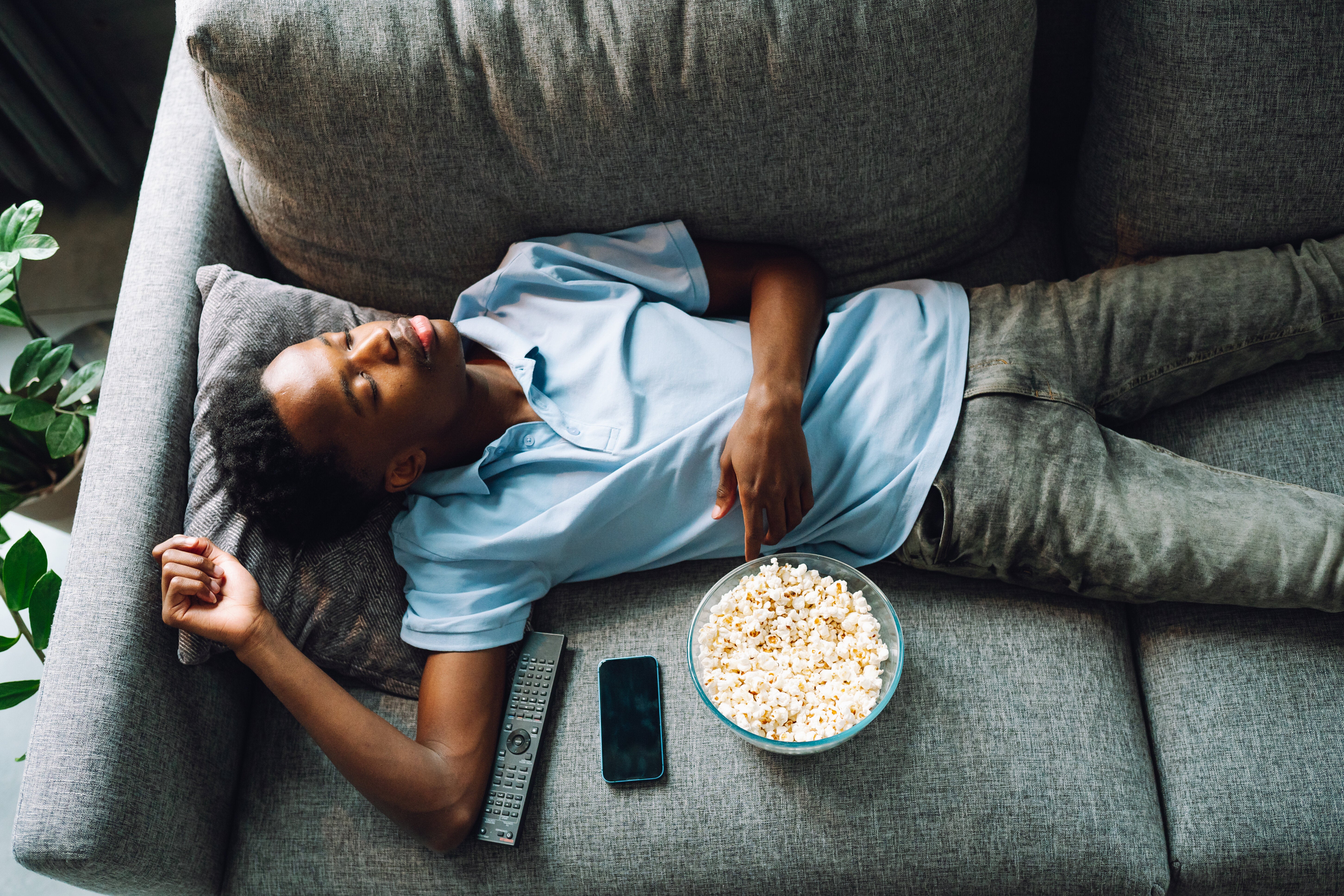
If you’re like most people, you’ve probably drifted off to sleep as soon as you put on a movie or show at night.
It’s a common occurrence – you sit down with your partner to finally watch the season finale of the show everyone is talking about, only to fall asleep, jolt awake, pretend you didn’t fall asleep and keep on watching until you fall asleep again.
Advertisement
Sleep experts told HuffPost there are many reasons this happens, and some are more concerning than others. Here’s what to know:
When you’re watching TV or movies at night, you’re often in a good sleep environment.
“There’s a couple of environmental factors to the fact of watching TV, watching a movie that promotes sleepiness,” said Dr. Neal Walia, a sleep specialist at UCLA Health in California. “When you wake up in the morning, you develop something called a sleep drive, which is how much your body wants to sleep.”
As you go about your day, your sleep drive goes up before peaking at bedtime, he explained. “And that drive is what gets you into sleep and carries you to sleep,” Walia noted.
Advertisement
“Usually, people are watching movies and TV in the evening after a long workday. This is when their sleep drive is at the highest,” he said. So your body naturally wants to sleep at this time.
“And then sometimes it’s just a lack of stimulation,” said Dr. Molly Atwood, the director of clinical training in the behavioural sleep medicine program at Johns Hopkins Medicine in Baltimore.
If you find yourself feeling tired throughout the day, you may notice that your fatigue disappears when you interact with something, whether that’s scrolling on your phone or getting up to make dinner.
Advertisement
Why? “Your body has a system of overcoming whatever sleepiness you have with stimuli,” according to Walia. And watching TV and or a movie is, generally, a low-stimuli activity, he noted. TikTok or even a task like folding laundry are more high-stimuli.
“If you’re lying down, it is dark – so your body’s kind of getting that signal that it’s nighttime and if the movie is not very stimulating or boring, it might be a lot easier, too, for any sleepiness that is there to take over,” Atwood added.
“Another big thing is that, especially patients with insomnia, a lot of times what they’ll say to me is ‘I just can’t turn my brain off.’ And most of our day, our attention is preoccupied by something – probably a screen, most likely – but something is taking our attention away,” Walia said.
Advertisement
We don’t often just sit with our thoughts. That is, until we drift off to sleep at the end of the day. And if you’re stressed about work or anxious about money, sitting with your thoughts can make it difficult to fall asleep.
“But if you’re watching something like a show, you’re not really in your own head for the most part,” Walia said. Your attention is drawn to the show or movie you’re watching, not the taxes you still need to do. This encourages your body to drift off to sleep.
Morning people are more likely to fall asleep while watching TV at night.
Your body’s natural circadian rhythm can play a role in whether you’re prone to falling asleep on the couch or not.
Advertisement
“In some circumstances, if you’re more of a morning person, your body naturally makes you alert early in the morning and it shuts down alertness early at night,” Atwood said.
Folks in this group are just naturally more tired at night. For morning people, their body is giving them signals that it’s time for bed, which makes it more likely that they’ll drift off while watching TV.
It’s also more common if you re-watch shows.
Many people turn on their comfort shows after a long day. And according to Atwood, it’s more likely that you’ll fall asleep during a show you’ve seen several times.
Advertisement
“Our nervous systems are super calm and comforted, versus like an action movie or a horror movie,” Atwood said.
You also don’t have to pay much attention to the show to know what’s going on, which allows your body to drift off easily, too.
Olga Rolenko via Getty Images
If you regularly fall asleep during a movie or TV show and are getting enough sleep at night, it’s worth talking to a doctor.
Advertisement
Most people are also sleep-deprived, which makes it easy to fall asleep while watching TV.
“A lot of our population is sleep deprived,” said Walia, who explained that most people aren’t getting the seven to nine hours of sleep they need each night.
Everyone has different individual sleep needs. But no matter how much sleep your body requires, most folks aren’t getting it.
Because of busy days, family demands and high-stress jobs, you may not even notice you’re sleepy until you’re interacting with something that’s low-stimuli, like a movie. This is when your sleep deprivation can catch up with you and cause you to fall asleep.
Advertisement
Even people who sleep the recommended seven to nine hours a night may not be getting good quality sleep, which can also result in sleepiness on the couch.
“There’s many people out there with untreated or under-treated sleep disorders that disrupt the quality of sleep,” Walia said, adding that sleep apnea is one example of this.
If you fall asleep during a movie once in a while, there isn’t much cause for concern ― but if this is a regular habit, it’s worth evaluating your sleep.
It’s understandable if you fall asleep on the couch after a busy day of travel or after a late night out, but if you’re falling asleep in front of the TV frequently, you should take notice.
“If you’re sitting upright, the lights are on, it’s an engaging movie … and you still can’t keep yourself awake, that might be more of like, ‘OK, I should reevaluate how much sleep I’m getting overall,’” Atwood said.
If you think you’re getting enough sleep but still falling asleep during engaging shows and movies, it’s worth talking to a sleep specialist, she added. A professional can help test you for underlying conditions that could disrupt your sleep.
Advertisement
Being able to stay awake during movies and TV shows at night could be a sign of good sleep health.
If you can usually stay awake while watching TV or movies at night, it’s “probably a good indication that [you’re] not sleep deprived or they’re not having disruptions in their sleep,” Walia said.
This nighttime energy reflects relatively good sleep health, he added.
Some sleep disorders can keep people from napping or falling asleep during shows and movies, but, overall, if you are getting enough high-quality sleep, you likely have good sleep health, he said.
When you wake up in the middle of the night, do you find that you’re sleeping on your stomach or your side? Or do you consistently wind up on your back with the sole of one foot tucked against the calf of your other leg?
If so, you sleep like a flamingo. And if you’re on TikTok or Instagram, you might come across an influencer claiming this sleep position signals you’re stressed out or carry pain in your hips.
Advertisement
While this sleep position isn’t inherently dangerous – and, in fact, may be most comfortable for your body –it may suggest you need some extra support in certain cases, said Laura Nolan, a psychotherapist who specialises in somatic therapy. Here’s what to know.
Why do people end up in the “flamingo position”?
Nolan said she most commonly sees people sleeping this way when they have hypermobility, a condition in which joints stretch beyond their typical range of motion. Many people with joint hypermobility syndrome experience loose joints, joint instability and chronic pain.
“Hypermobility is linked to neurodivergence and many of the neurodivergent adults I work with report sleeping in more unconventional ways, including in the flamingo posture as well as with clenched fists or T. rex hands,” she said.
Advertisement
Sleeping in the flamingo position may be a habit acquired through experience and repetition. Or perhaps you wind up in this position because of chronic pain or a physical injury, Nolan added.
It’s also possible that consistently sleeping in this position – which could be unstable for some – could further strain your joints or even result in muscle stiffness, she explained. “Our bodies are complex,” she noted.
The flamingo position doesn’t immediately mean you are hurting your joints
The flamingo position isn’t an automatic red flag. Nolan said it’s entirely possible that this position is simply a cosy way for you to sleep. “It can be normal and healthy to sleep in the flamingo position,” she explained.
Advertisement
Jade Wu, a board-certified sleep psychologist, similarly said we naturally sleep in positions that are most comfortable to us. “Often being in this position simply shows that someone feels most comfortable doing it,” she added.
In fact, if you’re on your side with a leg up – a variation of side sleeping – the flamingo position may lower your risk of sleep apnoea and other breathing problems, Wu noted.
As a somatic psychotherapist, Nolan is more curious about what feels good about sleeping in this position rather than assuming you have “stuck stress” in the body or that something is wrong.
Advertisement
How to find a comfortable (and safe) sleeping position
Nolan encourages people to have a relaxed, easeful approach to sleeping. “Having too much scrutiny over how you sleep, including by thinking you are sleeping wrong or engaging in sleep perfectionism, will likely worsen sleep quality for those with existing issues,” she said.
Unless an orthopaedic health care provider or another physician has advised you to stop sleeping like a flamingo to avoid putting pressure on certain joints, there’s no need to stop, according to Wu.
Rather than forcing or training yourself to sleep in certain positions, get creative about how you can support your body while you snooze, Nolan advised.
Advertisement
For example, if you tend to sleep like a flamingo, consider adding a pillow underneath your knees. If you’re more of a T. rex sleeper, consider holding something in your hands, like a stuffed animal or pillow. “Be creative,” Nolan said.
If you feel stressed at bedtime, carve out some time to unwind – by practicing yoga, mindfulness or deep breathing – after dinner. Another technique Nolan recommends is progressive muscle relaxation, which involves tensing then relaxing various muscle groups. As you move between body parts, notice how each one feels.
“Remind yourself that stress is not all bad and we have many easy and quick ways of completing the stress response,” Nolan said.
One in eight people in the UK say they feel tired “all the time,” YouGov reported in 2022.
In fact, the feeling is so common that the NHS says it has its own acronym, TATT (tired all the time).
But while the health service said most causes of TATT are “obvious,” like overwork or having a young child, Amir Bhogal, director and superintendent pharmacist at Pyramid Pharmacy Group, told us that “there are several hidden causes that may be easy to overlook”.
Advertisement
Here, he shared seven potential causes:
1) Iron deficiency
“Iron helps transport oxygen throughout the body via red blood cells. When iron levels are low, your body struggles to carry enough oxygen to your muscles and organs, leading to constant tiredness and weakness,” Bhogal said.
These are common signs of iron deficiency anaemia. Others include shortness of breath, headaches, paler than usual skin, and palpitations.
It “is surprisingly common, especially among women, due to regular menstrual blood loss, as well as those who follow a strictly vegetarian or vegan diet. While symptoms can be subtle at first, fatigue can interfere with daily activities and overall quality of life,” Bhogal added.
Advertisement
A blood test can confirm whether you have iron deficiency anaemia.
2) Thyroid issues
The thyroid is a gland in your neck that produces hormones. These affect things like your heart rate and body temperature.
“An underactive thyroid (hypothyroidism) can slow down metabolic processes and reduce the body’s ability to produce energy efficiently, leading to sluggishness or temperature sensitivity,” Bhogal said.
And an overactive thyroid can do the opposite, causing bursts of energy sometimes followed by crashes. It can create difficulty sleeping, too.
Advertisement
“Thyroid issues can develop slowly, with subtle symptoms ranging from unexplained changes in weight and mood, as well as dry skin or thinning hair. However, blood tests can confirm a thyroid imbalance,” the pharmacist said.
3) Low blood pressure
Though high blood pressure can make you tired, that usually happens indirectly through organ changes or associated lifestyle choices. But “low blood pressure (hypotension) can also sap energy,” the pharmacist told us.
Advertisement
“When blood pressure is too low, your organs and muscles may not receive enough oxygen-rich blood, leading to dizziness and constant tiredness.”
Sometimes, he added, low blood pressure can be created by dehydration, nutritional deficiencies, and some medications, and even some heart conditions.
“If fatigue is accompanied by lightheadedness or fainting, please consult with a medical professional immediately,” Bhogal stated.
Advertisement
“Getting your blood pressure tested regularly, even without symptoms, can help detect underlying issues early and support long-term health.”
“Water is essential for just about every function in the body, including energy production. Even just mild dehydration can reduce blood volume, making the heart work harder and leaving you feeling lethargic,” he told us.
Advertisement
“The reality is that many people underestimate their daily fluid needs, especially when the weather is warm, or they are physically active. Instead, they compensate with sugary drinks, alcohol, or caffeine, all of which are diuretics that can worsen dehydration.”
Drinking more water and eating more water-rich foods, like fruits and vegetables, can help a lot.
5) Chronic infections
Sometimes, conditions like the flu or glandular fever can stay in your system for longer than you realise. This, Bhogal explained, can keep you feeling run-down after sneezes, sniffles, and sore throats have abated.
“Often, these infections present with subtle symptoms like low-grade fever or mild muscle aches that are easy to dismiss. Identifying the underlying infection usually requires medical testing, and treatment may involve antibiotics or antiviral therapy to restore energy levels,” he said.
And, Bhogal said, “Frequently waking up can be caused by environmental disturbances, and sometimes from conditions like sleep apnoea or restless leg syndrome, which can prevent the body from entering deep, restorative rest.
“Fatigue caused by poor sleep often presents as brain fog and irritability that manifests as low motivation throughout the day. Overuse of electronic devices before bedtime can also interfere with the natural sleep cycle, so I advise putting away gadgets at least two hours before bedtime.”
Advertisement
If you’re concerned about your sleep, speak to your GP.