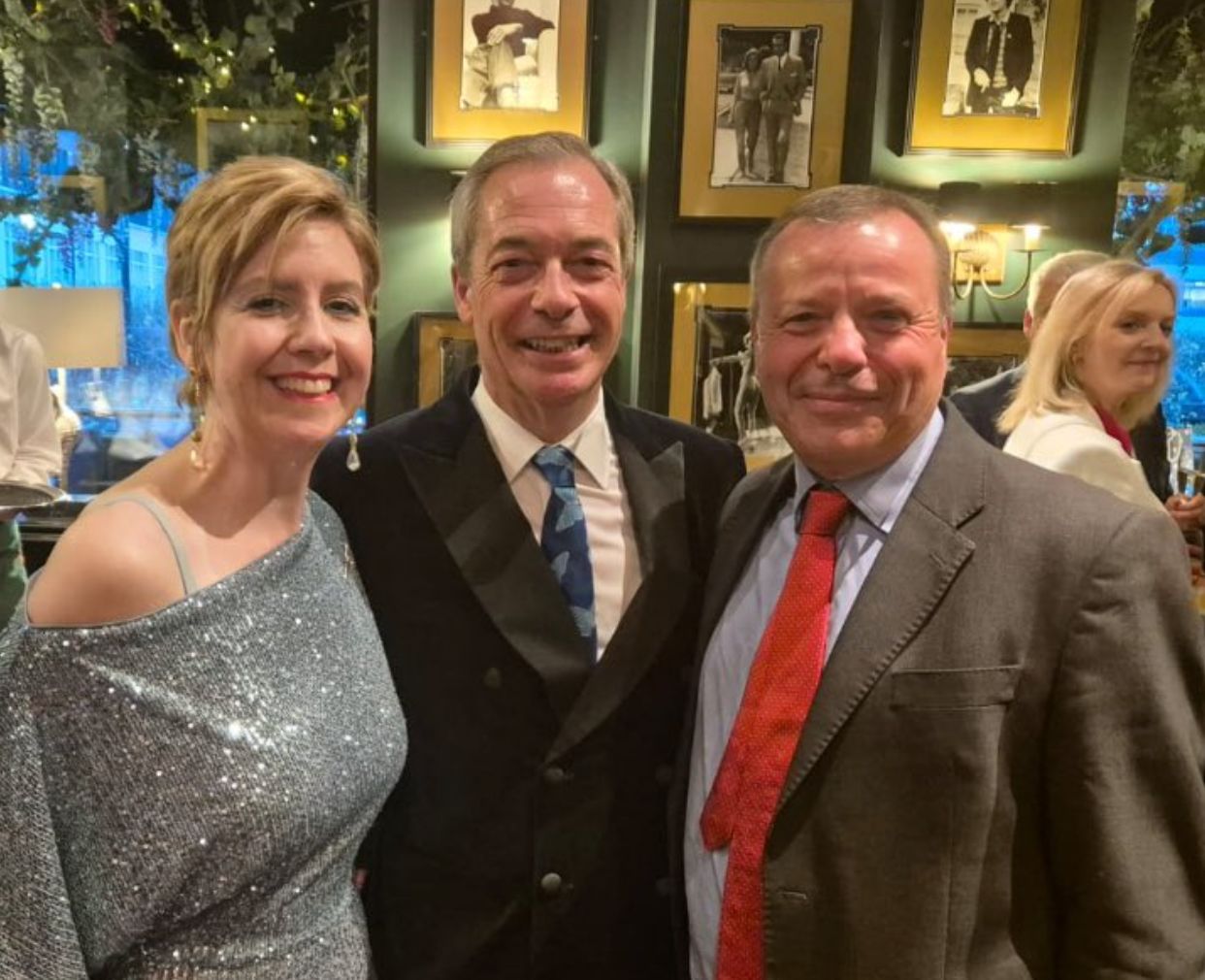
The former prime minister was spotted in the background of a picture taken at the bash, which was held in a posh London restaurant.
Right-wing Tory MP Andrea Jenkyns posted the snap on X (formerly Twitter last night).
In it, she is standing alongside Farage and his Leave.EU ally Aaron Banks.
Truss, who was prime minister for 49 days before being forced to quit after her mini-Budget sparked economic chaos, can clearly be seen in the background turning towards the camera.
Speaking in February, Truss said she would like to see Farage join the Conservative Party to “help turn our country around”.
Nevertheless, it is surprising to see a former Tory PM attend a celebration being thrown for a man who has stood against the party on numerous occasions and is set to throw his weight behind Reform UK at the upcoming general election.
Her presence at the event did not go on-noticed on social media – with some users unable to resist the temptation to refer to the fact that Truss was outlasted by a lettuce during her brief stint in No.10.
The supercut also shows him urging supporters to “fight like hell” on Jan. 6, 2021, just before some of those in the crowd near the White House marched to the U.S. Capitol to attack Congress at it met to certify the electoral vote that gave the presidency to Joe Biden:
One of the four criminal cases against Trump is centered on his role in the events of the Jan. 6 insurrection.
In his personal account, Biden also accused Trump of hypocrisy for holding events for law enforcement and claiming to “back the blue” while also embracing those who attacked police in the U.S. Capitol riot.
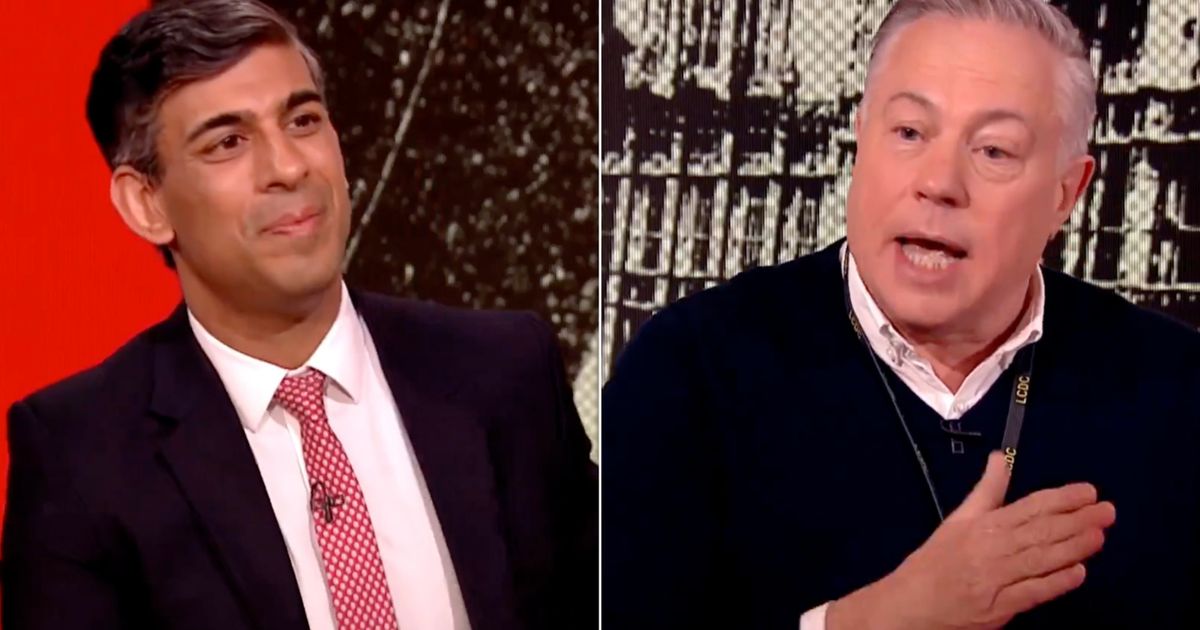
Rishi Sunak said it was “not practical” to deploy the navy to the English Channel to deter migrant crossings as he was confronted by an angry voter.
The prime minister was faced with a question about tackling illegal migration from cab driver Grant Davis as he appeared on The Sun’s Never Mind The Ballots programme.
Advertisement
The Rwanda deportation plan, which is set to cost tens of millions of pounds, is key to Sunak’s pledge to “stop the boats” bringing unauthorised migrants to the UK.
Davis, who is part of The Sun’s “cabinet” as “transport secretary”, told Sunak to be more direct: “Why can’t you put the navy in the Channel so when the dinghies come over, you pull up, tow them back to Calais and say no thank you.
“If you want to send a message to the organised gangs bringing people over, that’s how you do it.”
Another member of The Sun’s “cabinet”, ex-Army captain Hugh Andree, said sending in the military would breach of France’s sovereignty.
🚨 NEW: A voter asks Rishi Sunak why he isn’t getting the Navy to “tow” small boat migrants back to France
Britain and Rwanda signed a deal almost two years ago that would see migrants who cross the English Channel in small boats sent to the East African country, where they would remain permanently. So far, no migrant has been sent to Rwanda under the agreement.
The PM told The Sun that controlling immigration is more important than “membership of a foreign court”.
Critics have said the UK would be an international outlier along with Russia and Belarus if it left the convention, which is overseen by a court sitting in Strasbourg. The court’s president suggested in January the plan would breach international law.
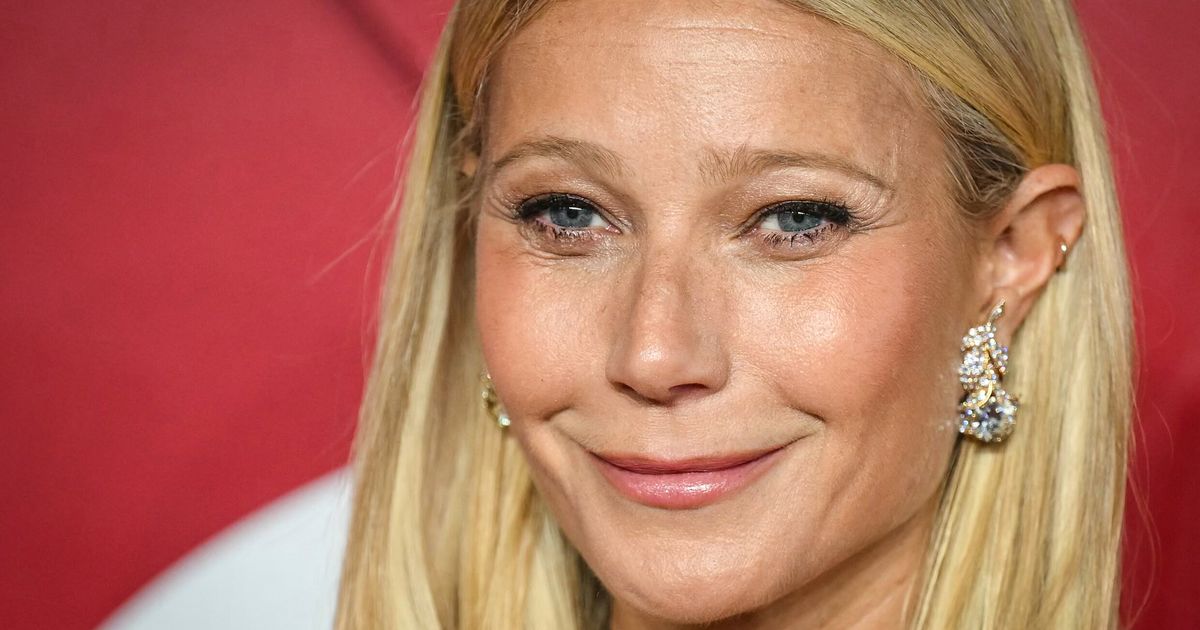
However, there’s one thing the Oscar-winning actor isn’t willing to delve into.
While hosting a Q&A session on her Instagram story last Friday, Gwyneth was asked by a fan if she would ever consider being in a polyamorous relationship, according to People.
Advertisement
“No thanks!” she wrote in response.
The Avengers star clarified that although she’s not a fan of the practice of having romantic relationships with more than one partner at the same time, she’s not side-eyeing anyone who wants to double up on spouses.
“Not for me but [I] have no judgment. I’m a one man kinda gal,” she said.
Gwyneth is married to TV writer Brad Falchuk. They tied the knot in 2018.
She is the stepmother to her husband’s two children, Isabella and Brody Falchuk, whom he shares with his ex-wife, Suzanne Bukinik.
Prior to Brad, Gwyneth was married to Coldplay singer Chris Martin, with whom she shares two children: Apple and Moses Martin.
UK prime minister Rishi Sunak has told Israeli leader Benjamin Netanyahu that he is “appalled” by the killing of aid workers in an Israeli strike in a sign of a growing split between the two allies.
The leaders spoke after it was confirmed three UK citizens were among seven workers for the World Central Kitchen food charity killed in Gaza.
Advertisement
Downing Street said Sunak “demanded a thorough and transparent independent investigation into what happened” and described the situation in Gaza as “increasingly intolerable”.
Britain is a staunch ally of Israeli, but Sunak has become increasingly critical of the conduct of the war. He is under pressure to suspend UK arms exports to Israel.
He told Netanyahu that “Israel’s rightful aim of defeating Hamas would not be achieved by allowing a humanitarian catastrophe in Gaza”.
The UN says at least 180 humanitarian workers have been killed in the war so far.
James Henderson, 33, and John Chapman, 57, were named as two of the Brits who had died in the bombing. On Tuesday night, a third was named as James Kirby by the BBC.
Advertisement
People inspect the site where World Central Kitchen workers were killed in Deir al-Balah, Gaza Strip.
via Associated Press
A Downing Street spokesperson said: “The prime minister spoke to Israel’s prime minister Benjamin Netanyahu this evening.
“He said he was appalled by the killing of aid workers, including three British nationals, in an airstrike in Gaza yesterday and demanded a thorough and transparent independent investigation into what happened.
“The prime minister said far too many aid workers and ordinary civilians have lost their lives in Gaza and the situation is increasingly intolerable.”
Netanyahu has acknowledged that the country’s forces had carried out the “unintended strike” on “innocent people in the Gaza Strip”. He says officials are “checking this thoroughly” and “will do everything for this not to happen again”.
Advertisement
Footage showed the bodies, several wearing protective gear with the charity’s logo, at a hospital in the central Gaza town of Deir al-Balah. Those killed also included an Australian, a Polish national, an American-Canadian dual citizen and a Palestinian, according to hospital records.
Rebel Wilson has reflected on her past work with Sacha Baron Cohen, which she has described as the “worst professional experience of my career”.
Last month, the Pitch Perfect star made headlines when she posted a video on Instagram, in which she referred to an undisclosed former co-star who she’d written about in her upcoming memoir Rebel Rising.
Advertisement
“I worked with a massive asshole, and yeah, now I definitely have a ‘no assholes’ policy,” she explained. “The chapter on said asshole is chapter 23. That guy was a massive asshole.”
In a follow-up Instagram story post shared a few days later, Rebel told her followers: “I will not be bullied or silenced by high priced lawyers or PR crisis managers. The ‘asshole’ that I am talking about in ONE CHAPTER of my book is: Sacha Baron Cohen.”
At the time, a spokesperson for Sacha – who worked with Rebel in the 2016 film Grimsby – told HuffPost UK: “While we appreciate the importance of speaking out, these demonstrably false claims are directly contradicted by extensive detailed evidence, including contemporaneous documents, film footage, and eyewitness accounts from those present before, during and after the production…”
Advertisement
Rebel reflected further on her work with Sacha in an interview with the Sunday Times published over the weekend.
“It’s one thing for someone who is fat to exploit their size for comedy, but it’s another for somebody else to humiliate you,” the Australian star claimed, saying she felt “disrespected” on set, particularly due to her character’s revealing outfits, but didn’t want to speak out in case she were to be labelled a “troublemaker”.
Rebel said she felt “like I was something to be laughed at and degraded because of my size”, noting her character was “demeaned” in certain scenes.
Rebel Wilson and Sacha Baron Cohen in Grimsby
Moviestore/Shutterstock
According to the Times, Rebel later returned to sets for reshoots, to which she recalled: “The fact that I then went back… I felt ashamed of myself. Why do I have such low self-worth?”
Advertisement
In her book, the Times quotes her as saying: “I’m sharing my story now because the more women talk about things like this, hopefully the less it happens. And hopefully fewer women have to work harder just to respect themselves.”
The newspaper also writes that the Borat creator “refutes [Rebel’s] claims about her experiences on the set of Grimsby”.
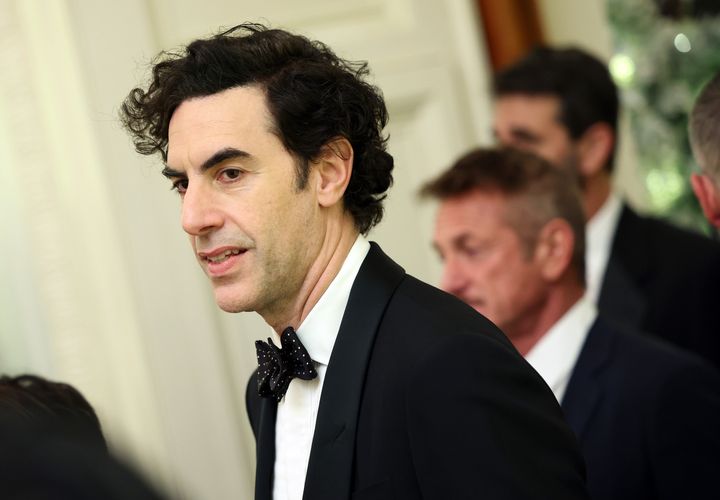
Sacha Baron Cohen
Kevin Dietsch via Getty Images
Sacha Baron Cohen’s team reiterated his original statement when contacted for comment by HuffPost UK.
Rebel previously opened up about her working relationship with the Borat creator during a 2014 radio interview with KIIS FM.
Advertisement
“Sacha is so outrageous,” she said a decade ago, as reported by Australia’s Courier Mail outlet.
“Every single day he’s like, ‘Rebel, can you just go naked in this scene?’ And I’m like, ‘No!’.
“Sacha and I have the same agent in America and I’m like, ‘Sacha, I’m going to call our agent Sharon and tell her how much you are harassing me’.
“Every day he’s like, ’Just go naked, it will be funny. Remember in Borat when I did that naked scene? It was hilarious’.”
She continued: “On the last day I thought I’d obviously won the argument and he got a body double to do the naked scene.
“Then in the last scene … he was like, ‘Rebel can you just stick your finger up my butt?’ And I went, ‘What do you mean Sacha? That’s not in the script.’ “And he’s like, ‘Look, I’ll just pull down my pants, you just stick your finger up my butt, it’ll be a really funny bit’.”
Rebel concluded: “You don’t wanna be a diva so I [said] I’ll slap you once on the butt and that’s it.”
Advertisement
This article has been updated to include a response from Sacha Baron Cohen via his spokesperson.
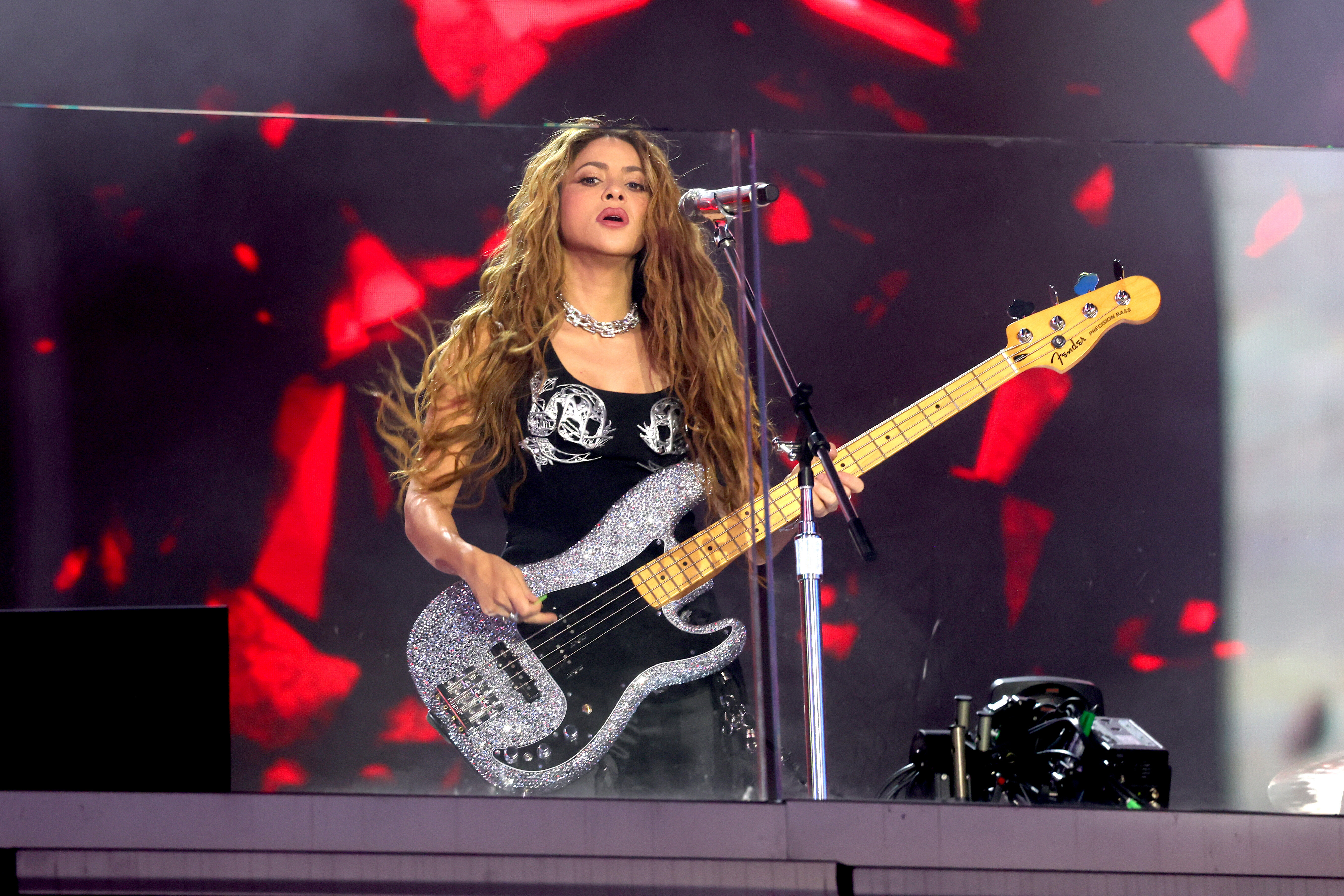
Shakira would’ve liked to have seen a bit more “Kenergy” in the 2023 blockbuster Barbie.
In an interview with Allure published on Monday, the Colombian pop singer shared her less-than-glowing take on Greta Gerwig’s acclaimed movie, which starred Margot Robbie in the title role.
“My sons absolutely hated it. They felt that it was emasculating,” she said, referring to her sons, 11-year-old Milan and nine-year-old Sasha, whom she shares with her ex-boyfriend, Gerard Piqué. “And I agree, to a certain extent.”
Advertisement
The three-time Grammy winner said she wanted her sons “to feel powerful too” while “respecting women,” something she felt Barbie didn’t adequately portray.
“I like pop culture when it attempts to empower women without robbing men of their possibility to be men, to also protect and provide,” Shakira said.
“I believe in giving women all the tools and the trust that we can do it all without losing our essence, without losing our femininity.
“I think that men have a purpose in society and women have another purpose as well. We complement each other, and that complement should not be lost.”
Advertisement
Margot Robbie in character as Barbie
Warner Bros
“Just because a woman can do it all doesn’t mean she should?” journalist Patricia Alfonso Tortolani asked on social media in response, with Shakira replying: “Why not share the load with people who deserve to carry it, who have a duty to carry it as well?”
Released in July last year, Barbie debuted to praise from critics and was a tremendous hit, raking in over $1 billion at the box office worldwide.
The movie also garnered a total of eight Academy Award nominations, including acting nods for Ryan Gosling and America Ferrera.
Despite the accolades Barbie received, a number of dissenting voices did emerge. Among those was director Oliver Stone, who criticised Ryan Gosling for not focusing on “more serious films”.
Advertisement
“Ryan Gosling is wasting his time if he’s doing that shit for money,” he told City A.M. in June last year. “He shouldn’t be a part of this infantilisation of Hollywood.
“Now it’s all fantasy, fantasy, fantasy, including all the war pictures: fantasy, fantasy.”
When Deadline reprinted some of his City A.M. interview in January, the Natural Born Killers director clarified that his remarks on Barbie were made before he’d had a chance to view the movie in its entirety.
“I was able to see Barbie in July and appreciated the film for its originality and its themes,” he wrote on X, formerly Twitter. “I found the filmmakers’ approach certainly different than what I expected. I apologise for speaking ignorantly.”
A Manhattan judge expanded the limited gag order imposed on former President Donald Trump over his upcoming hush money trial after a series of attacks on the judge and his family.
Judge Juan Merchan barred the former president from going after his family members or those of Manhattan District Attorney Alvin Bragg, saying Trump’s efforts served “no legitimate purpose.”
Advertisement
“It merely injects fear in those assigned or called to participate in the proceedings, that not only they, but their family members as well, are ‘fair game’ for Defendant’s vitriol,” Merchan wrote on Monday. “It is no longer just a mere possibility or a reasonable likelihood that there exists a threat to the integrity of the judicial proceedings. The threat is very real.”
His previous order blocked Trump from disparaging or making public comments about witnesses, prosecutors, court staff or jurors. But the judge pointed to Trump’s comments in recent days and said the court could not rely on the former president to modulate his behavior during the proceedings without explicit instructions.
“Admonitions are not enough, nor is the reliance on self-restraint,” Merchan added. “The average observer, must now, after hearing defendant’s recent attacks, draw the conclusion that if they become involved in these proceedings, even tangentially, they should worry not only for themselves, but for their loved ones as well.”
The judge declared that those concerns would “undoubtedly” interfere with the fair administration of justice in the Manhattan criminal case.
Advertisement
Former President Donald Trump faces an expanded gag order in the Manhattan hush money case that’s set to go to trial on April 15.
Lev Radin/Pacific Press/LightRocket via Getty Images
Bragg’s office on Monday asked Merchan to expand the order after Trump took aim at the judge’s daughter, spreading false claims about her on social media.
“Defendant’s dangerous, violent, and reprehensible rhetoric fundamentally threatens the integrity of these proceedings and is intended to intimidate witnesses and trial participants alike — including this Court,” the district attorney wrote in a court filing.
“[Trump] knows what he is doing, and everyone else does too.”
The former president assailed Merchan after the judge imposed the order last week, claiming Merchan was attempting to deny the former president his “First Amendment Right to speak out against he Weaponization of Law Enforcement.” Trump claimed that Merchan’s daughter, Loren, had used an image of him behind bars as her profile picture on the social media platform X.
But that wasn’t true. The account once belonged to the judge’s daughter, but she deleted the handle about a year ago. It has since been taken over by someone else. A spokesperson for New York’s state court was forced to clarify that she was not linked to the account in any way.
Advertisement
“So, let me get this straight, the Judge’s daughter is allowed to post pictures of her ‘dream’ of putting me in jail, the Manhattan D.A. is able to say whatever lies about me he wants, the Judge can violate our Laws and Constitution at every turn, but I am not allowed to talk about the attacks against me,” Trump wrote on his Truth Social platform.
Loren Merchan is a Democratic political consultant.
Trump had been subject to a gag order during his civil fraud trial in New York. He was fined twice for violating the restrictions, and the judge overseeing the case warned the former president to refrain from doing so again or face even “worse” penalties.
Trump’s hush money trial is set to begin on April 15. It centers on payments made before the 2016 presidential election to quash accusations of extramarital affairs. The payments included a reported $130,000 to adult film star Stormy Daniels less than a month before Election Day.
Truth Social, the conservative social media network that former President Donald Trump launched in 2022 after being banned from other platforms, lost more than $58 million and generated a mere $4.1 million in revenue last year.
The revelations about Truth Social’s current situation came in a Securities and Exchange Commission regulatory filing from Trump’s company, Trump Media & Technology Group, on Monday. The financial situation is so dire, an auditor warned in the filing, that it raises “a substantial doubt” about whether TMTG can “continue as a going concern”.
Advertisement
In other words, Truth Social may have to shut down, going the way of Parler ― another conservative social network that had to shutter after just a few years in business.
The news comes a week after TMTG completed a merger with a shell company, Digital World Acquisition, to go public, infusing Truth Social with $300 million. But shares in the company dropped more than 15% following Monday’s news.
To put Truth Social’s precarious finances into context, Twitter, now known as X, generated more than $660 million in revenue in the year leading up to its going public, and it generated $5 billion in the year before Elon Musk bought it and took the company private.
Truth Social had fewer than 500,000 monthly active users in February.
NurPhoto via Getty Images
Advertisement
Per the SEC filing, all of Truth Social’s money comes from advertisers buying space on the platform, and most of its expenses involve paying interest on debt.
The biggest problem Truth Social faces is that its user base is microscopic compared to that of other social platforms. In February, it had just 494,000 monthly active users, according to statistics obtained by CNN. That’s about 150 times smaller than Twitter’s roster of active users, and 290 times smaller than Facebook’s.
Despite its small community, and despite other social platforms lifting their bans on Trump, Truth Social remains the former president’s go-to forum for attacking his opponents and issuing reactions to news events. His posts there have repeatedly landed him in hot water, forcing various judges to impose gagorders on Trump while presiding over cases against him.
Last week, Trump came under fire for posting a video on Truth Social showing an image of a hogtied President Joe Biden painted on a truck. The Biden campaign accused the post of suggesting physical harm toward the president.
“Trump is regularly inciting political violence and it’s time people take him seriously,” Michael Tyler, the campaign’s communications director, said in a statement.
Everyone has opinions about how to get a good job and keep one, and it’s hard to figure out which pointers are actually helpful to follow.
What your well-meaning uncle, professor or manager says you need to do for your next job move may actually be disastrous to follow. To be savvy, you need to learn how to weed out the kernels of good career tips from the bad.
Advertisement
To help professionals avoid these mistakes, we asked career experts to share the worst, most common pieces of job advice you’re going to hear a lot in your life. Read on to learn why these boilerplate outlooks can hold you back and what alternative advice you should follow instead.
1. Only apply for jobs that you meet all the qualifications for.
Graphicscoco via Getty Images
Too often, women and people of color stop themselves from applying to jobs where they don’t meet every qualification.
This is bad advice because job descriptions are not necessarily realistic and are often written as a “wish list” from the employer’s point of view, said Cynthia Pong, founder of Embrace Change, a career coaching and consulting firm.
“Many people, especially women of colour, people of colour, women in general and others from underrepresented backgrounds or with non-traditional career paths, may self-select out of applying because they don’t meet all the criteria listed,” she said.
Advertisement
Just because a job listing states a desired education requirement does not mean you actually need it. For example, in 2017, Accenture, Grads of Life and Harvard Business School conducted an analysis of 26 million job postings and 600 business and HR executive surveys. They found that 67% of the job postings required at least a bachelor’s degree, yet only 16% of employees who were already in those jobs held that degree. The findings are a reminder that many jobs do not require a college degree to succeed, despite what companies advertise.
Instead of taking yourself out of the running before you apply, Pong advised that it is better to “apply if you meet most key qualifications.”
If you have every skill and experience listed in the description, the job opportunity is likely a lateral career move. But if the role is going to push you beyond what you already know, that’s a sign of a good stretch opportunity, and that’s what actually helps you grow in your career.
One important caveat, though, is that a hiring manager is not going to automatically understand why your unique skill set makes you the best hire — you need to explain that to them.
Pong said job seekers should use the cover letter or other application materials “to connect the dots for the hiring manager as to how your past experience is transferable and will enable you to excel in the particular role, even though you may not check all the boxes for them.”
Advertisement
“As someone on the hiring side, I look at the overall qualities and growth potential that a person brings to the table more than their specific skill set, especially if the person demonstrates a strong ability to learn and teach themselves how to do new things,” she continued.
Even if you do not get the job, applying for the role puts you on an employer’s radar.
“If someone’s not a fit for a particular role, it’s a great opportunity to keep them in mind for another role or future work,” Pong said.
2. Find a job you love and you’ll never work a day in your life.
The message behind this common feel-good platitude is that passion alone will make the drudgery of work go away. But there’s no one correct way to feel about your job. It’s perfectly normal for a job to just be a paycheque that funds your life outside of it. Even dream jobs that are fulfilling and meaningful come with hard days, difficult deadlines and the potential for burnout.
Sometimes, the activity you love to do most is an unrealistic career. Don’t be guilted into monetising your passion hobby into your next side hustle just because you enjoy it. In some cases, it’s better to keep your ceramics hobby as a relaxing extracurricular than your next career.
As Gorick Ng, a career adviser at Harvard University and author of “The Unspoken Rules: Secrets to Starting Your Career Off Right,” previously told HuffPost, “Do you love the business of doing something as much as you love doing the thing itself? Not everyone will say yes to this question and that’s OK.”
Advertisement
It’s normal to want meaning and purpose in what you do for a living, but don’t put more pressure on your work to be more than work. Ng suggested rewriting the advice of “find a job you love” to say, “Find something that brings you joy and purpose every day, and you’ll always have something to look forward to.”
3. You should stay in a job at least a year for your resume.
Xavier Lorenzo via Getty Images
Instead of sticking it out, it’s better to prioritize your well-being and leave a job that is no longer serving you.
There is an outdated assumption that the longer you stay at a job, the more reliable and responsible you seem to other employers.
Although some employers do judge “job-hoppers” as disloyal, there are many more who understand that a career at one company is unrealistic for people to achieve now in an unstable job market.
Harleny Vasquez, a career coach and university speaker, said she tried following the “stick it out” advice when she was starting her social work career.
Advertisement
“I remember feeling burnt out and unsatisfied, and the idea of sticking it out at one job only added to that frustration,” she said. “What’s more, I already had a history of job-hopping, so pivoting felt like I was breaking some unspoken rule and made me feel guilty.”
From that experience, Vasquez learned that “it’s OK to prioritise your happiness and growth. If a job isn’t fulfilling you, it’s perfectly fine to explore other options.”
“Don’t let guilt hold you back from finding a career path that truly fits you,” she added.
Having multiple jobs can actually make you a more desirable candidate.
“Employers now often look for candidates who have a range of experiences, have tackled various challenge and have a demonstrated ability to adapt to new environments and learn quickly,” said career coach and diversity consultant Ebony Joyce.
Instead of the outdated advice to stick it out, a more relevant and empowering approach is to actively manage your own career paths, Joyce said. To do that, she recommended embracing continuous learning and being open to training in new skills that are relevant to what you want to do.
“Regularly assess whether your current role aligns with your personal values and long-term career goals,” she said.
Advertisement
4. Make yourself indispensable.
The message behind this clichéd advice is that if you work hard to make an impact at your job, your company will reward your efforts and help you succeed. It can be comforting to believe, but arbitrary layoffs of talented individuals show the glaring problems with this viewpoint.
“I think that this advice makes us feel like we have some control over what companies decide to do when we absolutely do not [have control] if a company decides to eliminate a product or shut down a division or scale down a department,” career and leadership coach Phoebe Gavinpreviously told HuffPost. “They’re just going to do that.“
Instead of following the advice to “make yourself indispensable,” Gavin said employees should focus on building up their layoff resiliency. They can do this by building up their financial cushion and investing in their network, so that it’s easier to walk away from a role that’s not working for them.
“Humans are social creatures, we tend to share information and give the benefit of the doubt to folks that we know,” Gavin said. “And so if you have great skills, but you don’t have a great network, it is still going to be much more challenging for you to step into another role.”
5. Take on the extra work for the exposure.
Too often, professionals are asked to take on unpaid assignments or additional responsibilities outside of their role because it will supposedly be good for their career.
Advertisement
“These requests come with the promise of increasing experience or enhancing visibility, but what is often not considered is that the employee is often not given the institutional support to thrive,” said Cicely Horsham-Brathwaite, a career coach and licensed psychologist.
Horsham-Brathwaite said she’s been given this advice and has taken on extra work or roles without a title, but it did not help her career.
“I felt devalued and a bit resentful, and it impacted my ability to be as effective in the role,” she said.
Before accepting any task for exposure, you should have a “formal and financial acknowledgment of the role you are being asked to take on,” Horsham-Brathwaite said. “If the company is unwilling to do so, use this as an opportunity to find a role or organisation that sees your value.”
But take this advice on a case-by-case basis. Sometimes, doing something for exposure can actually help your career. If it can give you a new ally or a marketable skill that you want, it may be worth it.
Advertisement
Pong gave the example of someone being asked to lead a committee at work. The extra role would be additional, uncompensated work, but it would give this person access to meet certain influential people in the company and also build relationships with them. Working closely with these leaders could convert them into mentors who can later advocate on behalf of this employee.
“So if there were a significant likelihood of this kind of win in taking on the additional work, then it could well be worth it,” Pong said.
6. Wait for things to get better.
AsiaVision via Getty Images
Don’t just wait for work issues to sort themselves out.
Nell Wulfhart, a decision coach who helps professionals get “unstuck,” said the bad advice she often sees clients take is to stay at a job when a work issue does not change because someone keeps promising it will.
Wulfhart shared the classic example of when a colleague quits and you’re asked to pick up their duties.
Advertisement
“‘It’s temporary,’ you’re told. ‘We’re going to hire a replacement ASAP,’ and then they don’t. And you just keep doing two jobs,” she said. “Whenever you ask when things are going to change, you’re told, ‘Change is coming, management is working on it.’”
Wulfhart said clients will often come to her to ask if they should quit their job because a promised reward, promotion or raise hasn’t arrived.
“They know that rationally it makes sense to quit, but there’s always a sense of hope that the people in charge will make good on their word, despite the lack of evidence to the contrary,” she said.
Instead of waiting around, Wulfhart said that it’s better “to look at what the company does, not listen to what they say.”
“Are they making a visible effort to hire that replacement, get you an assistant or give you a raise? Or are they just talking? Have you seen them make promises in the past and fulfil those promises or not?” she said. “Try ignoring the words for a while and observe actions instead ― you’ll have a lot more data with which to make your decision.”
Advertisement
Actions speak louder than words. One of the hardest yet most rewarding career lessons is knowing when enough is enough and when it’s time to move on.