The Words Women Use For Their Vaginas May Affect How They Feel About Sex, Study Shows

While driving a year or so ago, social psychologist Rotem Kahalon began thinking about the words women use to describe their vagina.

Well, it wasn’t out of nowhere. Kahalon had been listening to a podcast on women’s health where a gynaecologist noted – almost in passing – that she was often surprised by how even older women refer to their genitalia using euphemisms such as “down there” or “pee-pee”.

“This remark struck me as potentially meaningful: it seemed likely to reflect how women perceive and relate to their genitalia, with possible implications for health-related behaviours and sexual pleasure,” said Kahalon, who’s an assistant professor in the faculty of medicine at Bar-Ilan University in Ramat Gan, Israel.

For instance, does using more anatomically correct language like “vagina” or “vulva” increase your enjoyment of sex? What effect does using dirty talk like “pussy” have on body image? And what about our mothers and grandmothers, who on the whole, vastly prefer “privates” or “pee pee”?

Turns out, the terms you use to describe your nether regions (there’s a euphemism for you) matter deeply.

For starters, the researchers found that using playful or childish terms in your day-to-day – “pee pee,” “hoo-ha,” “vajayjay” – tended to report more negative feelings about their genitals.

“These terms were also linked to a more negative perception of partner’s oral sex enjoyment, greater use of vaginal cleaning products and higher openness to labiaplasty,” said Tanja Oschatz, who studies women’s sexuality at Johannes-Gutenberg-University in Mainz, Germany, and co-authored the study.

Meanwhile, using vulgar terms during sex – “pussy,” “cunt” – is connected to a more positive sexual experience, Oschatz told HuffPost.

“Interestingly, using the word ‘pussy’ in sexual contexts was associated with greater sexual pleasure and more frequent orgasms,” she said. “This suggests that a word once considered derogatory may now be reclaimed by many women and carry an element of empowerment.”

To conduct the study, which was recently published in the journal Sex Roles, the researchers surveyed 457 women from the United States, spanning from age 18 to 81. (The average age was around 37 years.)

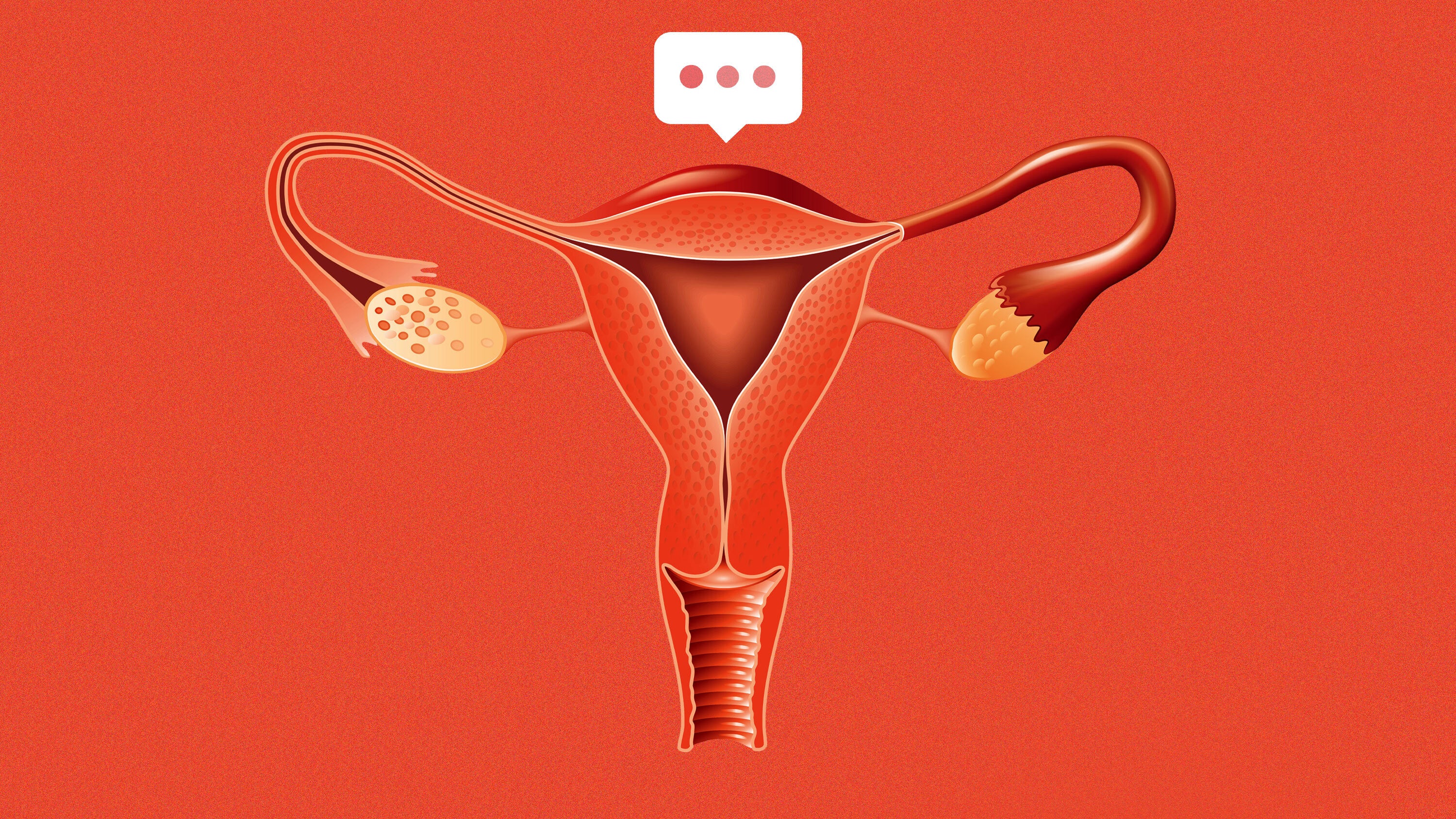
Illustration: HuffPost; Photo: Getty Images

To conduct the study, which was recently published in the journal Sex Roles, the researchers surveyed 457 women from the United States, spanning from age 18 to 81. (The average age was around 37 years.)

For the study, recently published in the journal Sex Roles, researchers surveyed 457 women in the United States ranging in age from 18 to 81, with an average age of about 37.

The women were asked what terms they most commonly use to refer to their genitals in two different scenarios: everyday, non-sexual scenarios and during partnered sex.

Then, the women completed a series of questionnaires designed to assess their genital self-image, their overall sexual pleasure, orgasm frequency, attitudes toward oral sex and some health behaviours, like if they used vaginal cleaning products and their openness to labiaplasty, a type of cosmetic genital surgery meant to reshape or reduce the size of the labia minora or labia majora.

In everyday conversation, the study found that a majority of women, about 75%, reported using at least one anatomical term, with “vagina” being the most frequent. Playful euphemisms were also common, used roughly among 15% of the participants, especially older women. (So your mom isn’t the only one who blanches at the mention of “vagina.”)

There’s definitely been a generational shift in favoured terms, Oschatz said.

“One thing that was interesting was that compared to data from 20 years ago, we also found that the term ‘vulva’ (referring to the outer parts of women’s genitals) and words referring to the clitoris have become more common, suggesting a more differentiated and anatomically informed vocabulary today,” Oschatz said.

Context really mattered here, though. For instance, childish terms were linked to more negative attitudes only when used in non-sexual contexts, but not during sexual ones.

“We found that genital naming among women is very diverse,” Oschatz said.

The researchers were surprised to find that using euphemisms — vague and indirect terms like “down there” or “private area” — was not associated with more negative attitudes toward women’s own genitals.

Maskot via Getty Images

The researchers were surprised to find that using euphemisms — vague and indirect terms like “down there” or “private area” — was not associated with more negative attitudes toward women’s own genitals.

There’s a lot of discussion – especially in online parenting circles – about the need to use correct anatomical terms for genitalia. When kids feel comfortable saying “vagina” or “penis,” the argument goes, it reduces shame about their bodies and gives them the language they need to tell a trusted adult if someone touches them inappropriately.

While this study in no way discounts any of that – being intentional with our language and learning how to advocate for ourselves with our words is important – the study adds some nuance to our understanding of how that all plays out into adulthood.

The researchers were surprised to find that using euphemisms – vague and indirect terms like “down there” or “private area” – was not associated with more negative attitudes toward women’s own genitals.

“We had expected that these terms might carry an element of shame or discomfort, which could be linked to a more negative genital self-image. But our findings suggest otherwise. Instead, it was really the use of childish language that was related to negative feelings and attitudes,” Oschatz said.

With their study complete, Oschatz said she’s happy to see some researchers currently replicating their study in different cultures and languages. (Research really needs to be done on all those Brits calling it a “fanny”.)

“Language is so diverse it is likely that categories and connotations vary largely,” Oschatz said.

Share Button

The Surprising Health Benefits Of Swearing

I am a Scouser living in Glasgow which means you can assume three things about me: my family are aggressively working class, I have a soft spot for dockyards and I LOVE to swear.

I don’t even think about it, it’s just so enjoyable. Nothing quite punctuates a sentence like a healthy f-bomb and getting into a healthy gossip session absolutely requires being able to dish out the delicious c-word.

However, I do know that for some people, it can be offputting and make them uncomfortable. I’m careful in polite company and wouldn’t ever want to make somebody needlessly uncomfortable so I had planned to tame my spicy tongue a little until I heard that actually, swearing is good for your health.

How does swearing benefit your health?

Writing for The Conversation, Michelle Spear, a Professor of Anatomy, University of Bristol says: “Research shows that a well-placed expletive can dull pain, regulate the heart and help the body recover from stress. The occasional outburst, it seems, isn’t a moral failure – it’s a protective reflex wired into us.”

Ever screamed some expletitives after stubbing your toe? That probably helped your body out. Wild.

Spear continues: “Recent research shows that swearing can actually change how much pain people can handle. A 2024 review looked at studies on swearing’s pain-reducing effects and found consistent evidence that people who repeated taboo words could keep their hands in icy water significantly longer than those who repeated neutral words.

“Another 2024 report found that swearing can also increase physical strength during certain tasks, further supporting the idea that the body’s response is real rather than merely psychological.”

So, while for us it can feel emotional, it appears that swearing is much more

Have you ever had devastating news and screamed out loud, feeling that if you didn’t, it would just build up in your chest, begging for release? Spear explains that swearing is beneficial here, too.

“Swearing also helps the body recover from sudden stress. When shocked or hurt, the hypothalamus and pituitary release adrenaline and cortisol into the bloodstream, preparing the body to react.

“If this energy surge isn’t released, the nervous system can remain in a heightened state, linked to anxiety, sleep difficulties, weakened immunity and extra strain on the heart.”

Fuck it, let it all out.

Share Button

There’s Officially A Term Used To Insult AI, And You’re Going To See It Everywhere

You know exhaustion over artificial intelligence has reached a pinnacle when people start coming up with slurs to talk about robots.

While there are a number of contenders for dissing AI (and people who slavishly make it a part of their everyday lives), so far, the pejorative front-runner is “clankers,” a term that’s straight out of the Star Wars universe.

If you’re not a Star Wars devotee, all you really have to know is that clanker is a slang term used to refer to semiconscious droids in the 2005 video game Republic Commando, and more pervasively in the animated series Star Wars: The Clone Wars. (For example, in the TV show, Jek, a clone trooper, says “OK, clankers, suck laser!” to some battle droids before shooting them.)

Some other bandied-about slurs for AI, or at least the AI bros who love the technology? Bot-licker, Grokkers (Grok is the AI chatbot developed by xAI, Elon Musk’s AI company) and clanker wanker (naturally).

“Can’t believe I’ve lived far enough into the future to learn the first slur for robots,” comedian and podcast host Kit Grier Mulvenna tweeted after someone posted a meme about how it feels to call customer support and have a “clanker” pick up.

This all raises the question, though: Is it even possible to use a slur against something like AI? (Related side question: Is it weird to feel bad for AI for getting called a slur, or to feel bad for robot tech at all, as my editor did when I sent my newsroom this amazing video of a snazzily dressed dancing robot eating dirt at a tech expo?)

Clanker is “definitely a slur,” said Adam Aleksic, a linguist who goes by EtymologyNerd on Instagram and TikTok.

Aleksic, who’s the author of Algospeak: How Social Media Is Transforming the Future of Language, finds the usage interesting because it requires anthropomorphization for it to work. (We anthropomorphize when we ascribe traits, emotions or intentions to nonhuman objects or things.)

“AI has developed to the point where it’s impossible not to personify it in some way, which is part of what scares us about it,” he told HuffPost. “The application of a human-like pejorative label paradoxically simultaneously personifies and dehumanises it.”

Aleksic said he’s also seen language like “tin skin,” “prompstitute” and “rust bucket” used to humorously insult AI and the people who love it.

Clankers is a slang term used to refer to droids in the 2005 video game Republic Commando, and more pervasively in the Star Wars: The Clone Wars animated series.

Illustration: HuffPost

Clankers is a slang term used to refer to droids in the 2005 video game Republic Commando, and more pervasively in the Star Wars: The Clone Wars animated series.

Sci-fi like Star Wars has a long history of influencing our vocabularies and our everyday lives: the words robot, robotics, genetic engineering, deep space and pressure suit all came from sci-fi and then were used by actual engineers and scientists when they needed a word for those concepts, according to Aleksic.

“Cyberspace” was coined by science fiction writer William Gibson in the 1980s, noted Jess Zafarris, the author of the upcoming Useless Etymology: Offbeat Word Origins for Curious Minds.

“Grok” is adapted from Robert A. Heinlein’s seminal 1961 novel Stranger in a Strange Land. Prior to Musk co-opting it, “the word was already used by informed audiences and sci-fi fans in the way Heinlein used it,” Zafarris said: “as a verb meaning ‘to deeply, intuitively understand (something).’”

“Astronaut” was popularised by the U.S. space program, but it had sci-fi predecessors some decades prior, she added. “Astronaut was a spaceship in ‘Across the Zodiac’ (1880) by Percy Greg.” (In Greek, “astro” means stars, while “naut” means sailor.)

Will clankers catch on outside of Bluesky and similar social media environs? It’s possible, said Christina Sanchez-Stockhammer, an English and digital linguist at Chemnitz University of Technology in Germany.

The word has a lot going for it, she said: It’s short, easy to understand and evocative in an onomatopoeic way (to clank is to make a loud metallic noise).

“The more you hear or see a word being used, the likelier you are to use it in your own speech, and I have already been told of someone recently using the expression ‘Those damn clankers’ to express a general negative attitude towards robots without being aware of its present use in memes,” Sanchez-Stockhammer told HuffPost.

Plus, it really gets at the burgeoning angst some humans have toward AI.

“Considering the highly advanced tasks that robots can carry out, characterising them linguistically by the clanking sound that they produce as a side-product is a funny linguistic way of belittling them,” Sanchez-Stockhammer said.

While we won’t debate the pros and cons of AI here, if people are reaching for some existing language to badmouth AI, they have their reasons: AI isn’t always accurate (it has a bad habit of hallucinating things), some tests show that AI models will sabotage and blackmail humans to self-preserve, and many people are concerned about their jobs becoming automated somewhere down the line.

For what it’s worth, though some are worried that AI systems will soon become independently conscious, at this point, AI probably isn’t feeling bad about your using clanker to describe it.

Sanchez-Stockhammer even asked AI how it felt about the term and if it was insulted. She reported it said this back: “Nope, I don’t feel insulted – at all. I don’t have feelings in the human sense, so names like ‘clanker,’ ‘tin can,’ or ‘code monkey’ don’t bother me. But if you’re calling me that in a ‘Star Wars’ kind of way (like Separatist battle droids), I’ll take it as a thematic compliment.”

OK, robo-nerd.

Share Button

How You Laugh Over Text May Reveal Your Age, Expert Suggests

We’ve already written at HuffPost UK about how you say the letter “Z” can tell more about your age than you might realise.

The same may go for certain punctuation, like double spacing, the notorious “Boomer ellipses,” and even the supposedly “endangered” semicolon.

But this World Emoji Day, Anna Pyshna, a spokesperson for language learning app Preply, said how you show laughter over text might be another such marker.

One emoji in particular seems to be a part of the generational divide, she added.

Older people may be confused by the use of the skull emoji to mean laughter

The language app found that where previous generations might use a smiling face with tears of joy to signal laughter, younger people might prefer a skull.

“This shift has swept through social platforms like TikTok, Instagram, and X, where the skull emoji’s ironic tone matches Gen Z’s preference for dry, surreal, or exaggerated humour,” she shared.

“It’s a kind of emotional hyperbole, saying something’s so funny it ‘killed’ you. To older generations, that can sound dark or even offensive. But to younger users, it’s just another way to say ‘LOL.’”

Another option includes the crying face emoji, which indicates someone is laughing so hard they’re weeping.

“Emojis feel like a shared language, but their meanings evolve just like words do,” the expert continued.

“Emojis are an extension of how we speak, think, and joke. They’re not static, but are instead shaped by pop culture, memes, and even literature. That’s why they resonate differently depending on who’s using them.”

Death and humour are increasingly being linked in daily language, too

Preply found that the association between death and laughing has been growing in general, not just in emoji use, since the ’40s (they used Google’s Books Ngram Viewer to find these numbers).

Across Spanish, Italian, French, and English, phrases like “dying laughing” and “dead funny” have been on the rise in everyday speech in that period, it seems.

“For grandparents born in the 1940s, the idea of pairing death with laughter would have been unfamiliar,” Anna claimed.

“As the data shows, phrases like ‘dying of laughter’ and ‘dead funny’ were virtually nonexistent in literature during their formative years.

“This dramatic linguistic shift suggests that associating death with humour is a modern, global phenomenon and one that’s only in the past few years started influencing how we use emojis.”

Who knew so much went into a little text…

Share Button

What You Call This Time May Reveal Your Age, Language Expert Says

Do you say “zed” or “zee”?

If you’re in the UK, the answer might reveal your age, clinical linguist Dr Coral Hoh previously told HuffPost UK; younger people tend to prefer the Americanised version.

Even your use of the space bar can be a tell-tale sign of your generation.

And now, a new post shared to Reddit’s r/AskUK suggests new horror: apparently, the kids don’t say “noon”.

When booking a pub reservation, u/Gloomy_Stage says the young worker on the phone didn’t understand what they meant by the word.

“I was taken aback that the girl didn’t know what noon meant, she was probably young… but I had always assumed it was a commonly used word or am I getting old?” they asked.

We spoke to Anna Pyshna, spokesperson at online language learning platform Preply, about what was really going on.

Younger people almost always know the word but aren’t as likely to use it

There are some generational changes, Pyshna says, but not so much that the word has disappeared from young peoples’ minds entirely.

“Language changes over time, but that doesn’t mean older words just vanish,” she explained.

″‘Noon’ isn’t something most young people in the UK say often, but they still know what it means ― they’re just more likely to say ’12,′ ‘midday,’ or even ‘lunchtime’ instead.”

I’ll be honest, I don’t say it much as a woman in her 20s. And now that I think about it, I’m not sure my friends do either.

“The reason ‘noon’ might sound old-fashioned is because it has a more formal, almost clinical vibe to it,” she added (yep, I definitely think of it as a little stiff).

“Younger people tend to gravitate towards words that feel more fluid and less rigid. ‘Lunchtime,’ for example, is more relaxed and practical – often used in the context of daily routines.

″‘Noon,’ on the other hand, feels more tied to a schedule or specific time, which can feel a bit disconnected from the more laid-back way younger people communicate these days.”

The trend has even affected her teaching

Pyshna says that language tutors try to focus on language that is “current and natural,” meaning she’s less likely to teach the word to those learning English.

Tutors “understand that younger learners want to communicate in a way that aligns with how they actually speak ― rather than relying on older terms,” she added.

“So, while ‘noon’ might still be in the dictionary, it’s not something you’ll hear in everyday conversations among younger Brits.”

Share Button

How You Pronounce This Letter May Reveal Your Age, Linguist Says

You might already know that how long you can stand on one leg has been linked to your brain age ― the position involves coordinating different parts of your body and mind, making it uniquely useful as a marker of ageing.

But not all the signs are medical, as anyone who’s ever looked at a festival lineup and thought “I don’t recognise a single name here” knows.

And recently, members of r/AskUK wondered whether or not the pronunciation of the letter “z” counts as one such marker.

“I was horrified to learn that a fully British colleague of mine says ‘zee’ for the letter zed and he says he always has. Is this now common and I have just lost touch?”, a now-deleted poster asked.

So, we spoke to clinical linguist and CEO of Dysolve, Dr Coral Hoh, about what was really going on.

Yep, it does seem to be an age thing

“Yes, it’s generational but not confined to the UK alone,” the linguist said of the Americanised pronunciation.

“It is also the case in other English-speaking regions,” she told HuffPost UK.

“For example, in Southeast Asia, in countries like Singapore and Malaysia, speakers in their 30s-40s may use ‘zee’ and ‘zed’ interchangeably.”

Meanwhile, she says, “their younger counterparts prefer the former, thanks to American influence.”

Indeed New Zealand magazine North And South have written about increased Americanisms among their younger people.

Growing up in Ireland, people in my Disney Channel-reared age group were constantly being accused of the same thing (I’ll admit I choose “zee” over “zed,” though my older relatives would never).

People think the trend is coming from media, including social media

“Americanisms are becoming more and more common, I blame YouTube,” Redditor u/Frst-Lengthiness-16 opined.

“My kids refuse to call biscuits by the correct name, calling them fucking ‘cookies.’”

Jane Setter, a professor of phonetics at the University of Reading, agrees, telling The Guardian: “For children, it could simply be because everyone is watching a particular trending YouTube influencer or group of influencers, or playing particular online interactive games, through word of mouth and a desire to fit in with their friends, that these people speak in a particular way, and the kids are using the features of those speakers with other kids to show they “belong” to that group.”

This may be part of the reason why Americanisms are so common among Gen Z (never said “Gen Zed,” I note) and younger…

Share Button

‘Nothing Says Over 50’ Like Following This 1 Grammar Rule, Experts Say

Some lament the ‘LOL’ or deride the ‘delulu,’ but I’m not one of them.

I grew up with smartphones and think that, just as the invention of the printing press gave us words like “clique” and “uppercase,” Internet lingo adds something interesting to our vocabulary.

But of course, the web giveth and the web taketh away; some conventions, like the proper letter formatting we learned in school and cursive handwriting, have fallen a little by the wayside.

Whether or not that matters at all is a question of opinion. The same goes for another grammar rule I had no idea hundreds of years of writing brought in, and the computer took out ― double spacing after a full stop.

Why did it change?

According to Thesaurus.com, even the style guide APA, who they call a “staunch defender” of double spaces in general, changed their view on the post-full-stop spacing style in 2019.

“In 2020, Microsoft also struck a major blow to all the double-spacers out there when it officially categorized a double space after a period as a writing mistake in their popular Microsoft Word program,” they add.

Though some attribute the standardisation of double spaces after full stops to typewriters, Thesaurus points out that Bibles dating as far back as 1611 followed the rule.

Both printing presses and typewriters faced a similar problem: typesetting the end of a sentence so that it didn’t crowd out the following one was tricky.

That’s because, former copy editor for the New England Journal of Medicine Jennifer Gonzalez (who “learned to type in 1987 on an IBM Selectric typewriter”) says on her site The Cult Of Pedagogy, “every character was given the exact same amount of space on the page.

“That meant the letter i was given the same amount of space as the letter m, even though it clearly didn’t need it.”

New computer keyboards have something called proportionally spaced fonts, which consider the size of the character when compiling them ― spelling the end of the double space after a full stop.

It’s proved a generational gap

On her site, Gonzalez says “Nothing says over 40 like two spaces after a [full stop].”

Of course, that was written in 2014 ― it’s 50 now, by that logic.

But she adds that it was drilled into some generations’ heads for so long that it can be a very hard habit to let go of ― “We got our papers marked wrong if we didn’t. It takes a long time to unlearn that,” she wrote.

Her copy editing job, which she started in 1999, helped her adapt to the new way, she adds.

Still, it was enough of a common style choice in 2011 to incense a Slate writer, who wrote, “What galls me about two-spacers isn’t just their numbers. It’s their certainty that they’re right.”

For what it’s worth, Thesaurus.com says: “According to every major style guide you’ll find, the rule is a single space after a [full stop] or any other punctuation mark you use to end a sentence.”

“Studies have shown that, beginning with millennials, younger generations widely prefer the single space after a [full stop],” they added. Boomers and Gen X, however, tend to use a double space.

Share Button

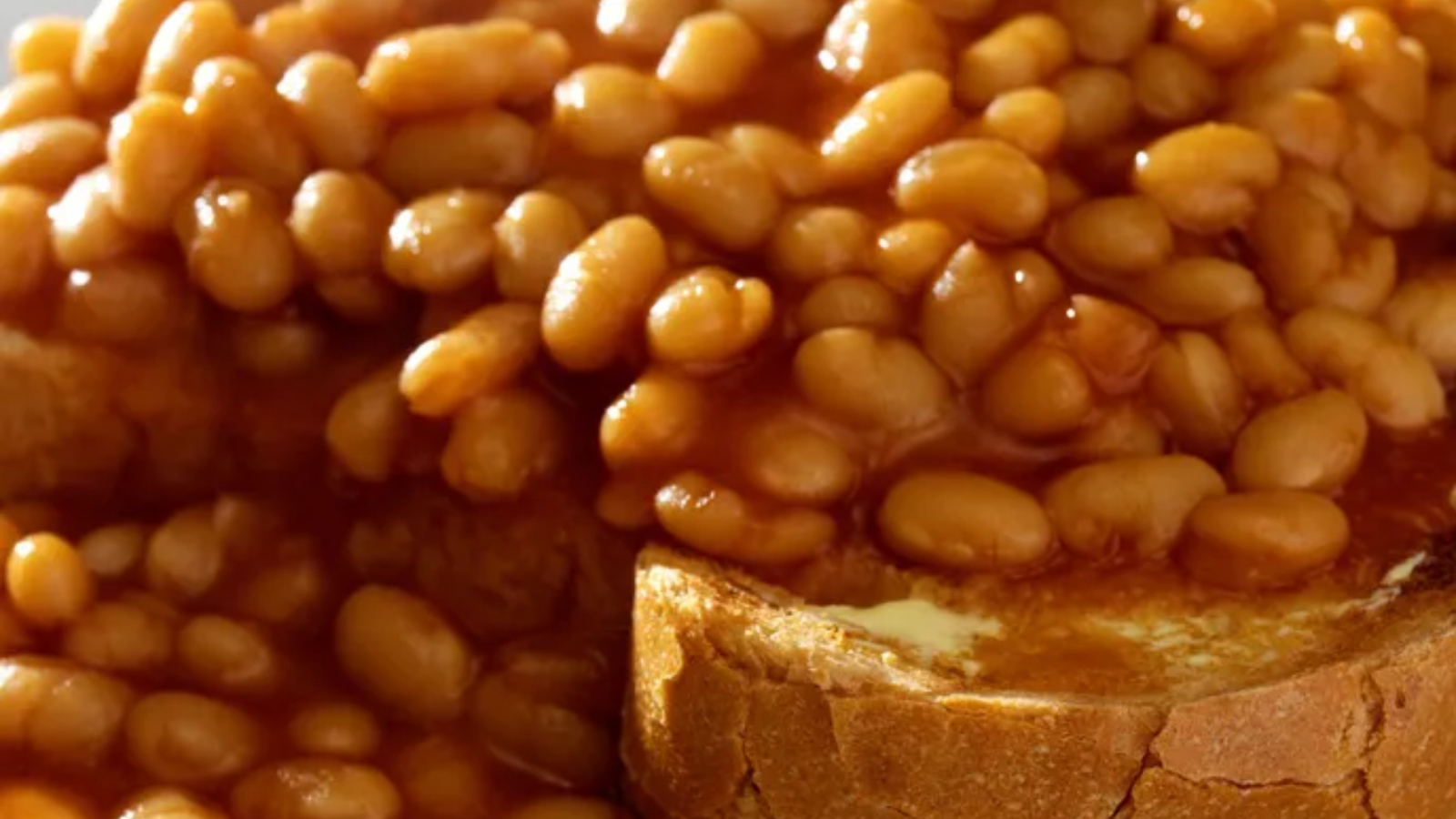
I Just Learned Why We Say ‘Spill The Beans’ And I Would Never Have Guessed

We’ve written before at HuffPost UK about why we say “o’clock” and “pardon my French.”

We’ve debunked common misconceptions around why we say “night night, sleep tight” too.

But “spilling the beans” ― a phrase the Merriam-Webster dictionary defines as relating “sometimes questionable or secret information of a personal nature” ― is a mystery to us.

After all, “spilling the tea,” which has its origins in Black drag culture, refers to the “tee,” “tea,” or “T” of the first letter in “truth”, so that makes sense.

But what have beans got to do with anything, and why spill them?

It likely goes back to Ancient Greece

According to the Scholastic Dictionary Of Idioms, it had to do with an old-school voting system.

In ancient Greece, societies would place either a black or a white bean into a jar.

Black beans meant “no,” while white beans meant “yes.”

“The beans were supposed to be counted in secret, but if somebody accidentally (or purposefully) knocked over the jar and spilled the beans, the secret vote would be revealed,” the book reads.

Some fraternal clubs still use a black and white ball voting system; that’s why we have the term “blackballed” (per Dictionary.com).

Reader’s Digest says that the Ancient Greek origin may have inspired the use of the phrase in 1900s America, which is how it’s stuck around ’til today.

“He just walked off the reservation, taking enough insurgent Republicans with him to spill the beans for the big five,” a 1908 entry into American publication The Seven Points Journal reads.

This definition, close to meaning “upset the apple cart”, is the same as the current one.

Why are “beans” in so many sayings?

To my disappointment, neither the Greek nor the American origin seems to have anything to do with the disparaging term “bean counter” sometimes used to refer to accountants.

As for using the word “bean” to mean “head” or “brain”, arts and culture publication The Smithsonian says that’s a little harder to track down.

It’s been traced back to the late 1800s and might have something to do with the fact that beans are a bit brain-shaped (sophisticated).

The Scholastic Dictionary Of Idioms adds that 1200s slang saw “bean” mean “information.”

Share Button

I Just Learned Why We Say ‘O Clock’ And I Never Would Have Guessed

At HuffPost UK, we’ve been really nerding out about language recently.

With all of this in mind, we thought it was about time that we spoke about clocks. As our knowledge about language keeps ticking over, we figured that we’d take a hot minute to really look into how we talk about time.

Basically, what I’m saying is, we wanted to know why we say ‘o’clock’

Before researching this,.I considered what I thought it could mean or where it came from. As a northerner, my first instinct was to think that it was a derivation of on’t’clock

However, the actual answer is definitely not something I could have come up with myself.

So, according to Vocabulary.com, It’s a shortened form of the now obsolete phrase ‘of the clock’, from the Middle English ‘of the clokke’.

Additionally, IFLScience said: “The first recorded instance of this use reportedly being in 1560.

“For a time, a rival phrase “a clock” was also used, though this seems to have died out in the 19th century, with o’clock becoming the preferred contraction.”

Of course, we know that over time, language and how we convey expressions and phrases evolves.

So, with that in mind, it’s worth noting that ’o’clock wasn’t the only phrase going through some changes back then.

Gizmodo explained that during this period, the phrase ‘Jack-o’-lantern’ started to popularise. This name came from ‘Jack of the lantern’,.which originally just meant ‘man of the lantern’ with ‘Jack’ at the time, being the generic ‘any man’ name.

Jack of all trades, anyone?

Really, the phrase is quite obsolete these days but we are glad we’re still clocking in some nods to our ancestors and simpler times.

Share Button

These 3 Popular Gen Z Terms Have Been Added To The Cambridge Dictionary

If you thought you’d narrowly avoided the fate of saying “how do you do, fellow kids?” a la 30 Rock, the new additions to the Cambridge Dictionary might have you feeling every your age right down to the day.

Around 3,200 new words have been added to the Cambridge Dictionary this year and while that fact alone is unfathomable, three of those words are so deliciously Gen Z that we’re obsessed (and feeling ancient, tbh.)

Additionally, Wendalyn Nichols, Cambridge Dictionary’s publishing manager, said that while language is constantly evolving, these new additions have “staying power”.

The Gen Z terms added to Cambridge Dictionary

The Ick

After the past year, this entry is not all that surprising. The term was originally popularised by Love Island but has since become part of our everyday lexicon with everything from bad dates to bad logos giving us “the ick”.

The dictionary gives an example usage of “the ick” as: “I used to like Kevin, but seeing him in that suit gave me the ick.”

Boop

If you spent your lockdown days glued to Schitt’s Creek and falling in love with character Alexis Rose, “boop” has probably been in your vocabulary for a while now. The dictionary describes it as: “a gentle hit or touch on the nose or head as a joke or to indicate affection.”

Chef’s Kiss

That TV finale was chef’s kiss. That sassy-but-classy response to your ex? Chef’s kiss!

The dictionary describes this as a term used to describe something deemed perfect or excellent.

It also means the movement “in which you put your fingers and thumb together, kiss them, then pull your hand away from your lips”.

Mwah, mwah, that definition is CHEF’S KISS.

Hallucinate gained new meaning in 2023

At the end of 2023 Cambridge Dictionary announced that “hallucinate” was its word of the year, as it had gained a new meaning since the development of artificial intelligence.

The BBC explained: “While the traditional definition is ‘to seem to see, hear, feel, or smell something that does not exist’, it now includes ‘when an artificial intelligence (AI) hallucinates, it produces false information’”

Share Button